Cable Glands Market Size and Share
Market Overview
| Study Period | 2020 - 2031 |
|---|---|
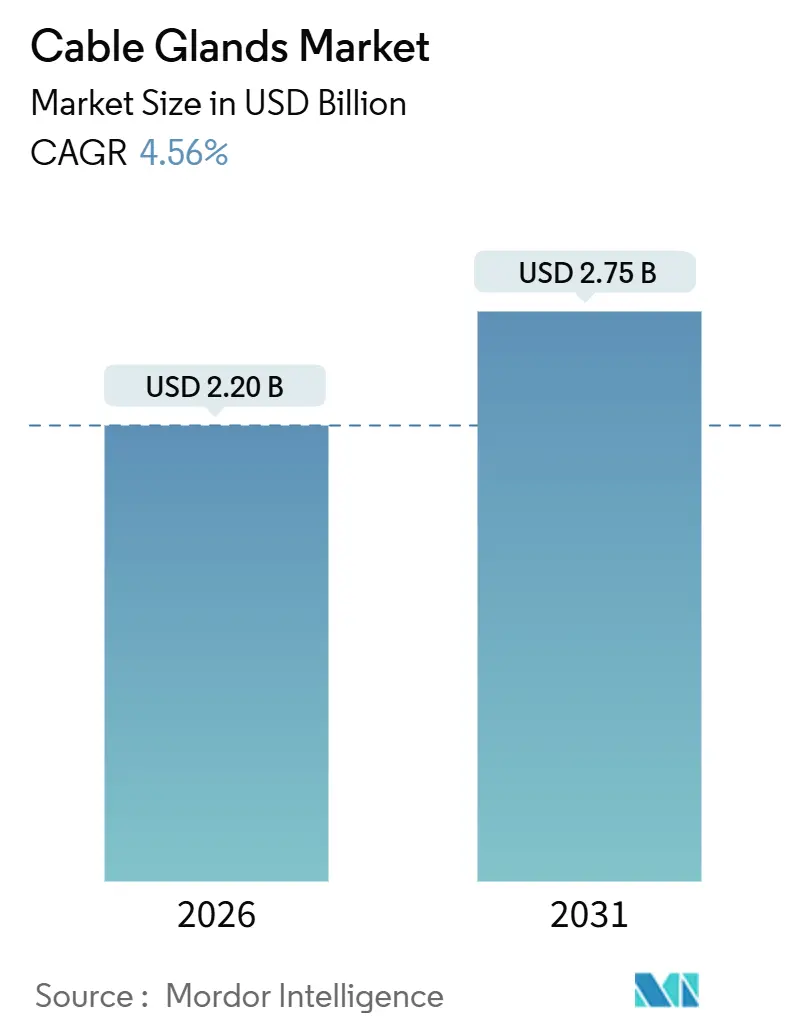
| Market Size (2026) | USD 2.20 Billion |
| Market Size (2031) | USD 2.75 Billion |
| Growth Rate (2026 - 2031) | 4.56% CAGR |
| Fastest Growing Market | Asia Pacific |
| Largest Market | Asia Pacific |
| Market Concentration | Medium |
Major Players *Disclaimer: Major Players sorted in no particular order Image © Mordor Intelligence. Reuse requires attribution under CC BY 4.0. | |
Cable Glands Market Analysis by Mordor Intelligence
The cable glands market size reached USD 2.20 billion in 2026 and is forecast to climb to USD 2.75 billion by 2031, registering a 4.56% CAGR during the period. Grid modernization budgets in North America and Europe, fast-moving manufacturing investments in the Asia-Pacific region, and the rollout of offshore renewable projects are expanding the demand base for certified termination hardware. Utilities are specifying flameproof and increased-safety variants for new transmission lines, while data-center builders are turning to compact multi-cable designs that save rack space and simplify electromagnetic-compatibility compliance. Petrochemical chains in the Middle East and China are adopting dual ATEX and IECEx approvals to align with corporate risk policies, which boosts the revenue mix toward high-margin stainless-steel assemblies. At the same time, tightening ingress-protection rules in food and pharmaceutical plants are accelerating the shift from IP68 to IP69K, opening room for premium-priced, wash-down-ready glands. Competitive intensity remains moderate, yet localized supply, breadth of certification, and rapid prototyping are decisive differentiators in large framework contracts.
Key Report Takeaways
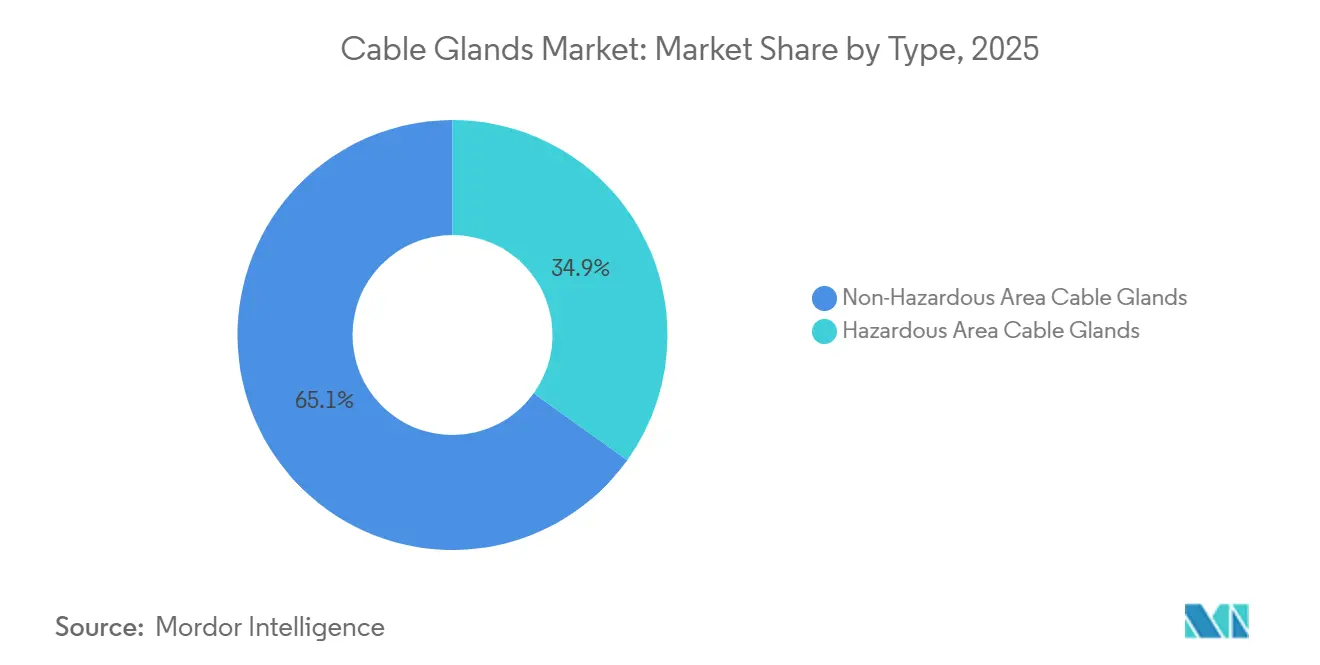
- By type, non-hazardous-area products dominated with 65.10% of 2025 revenue, whereas hazardous-area variants are set to post a 6.30% CAGR to 2031.
- By cable type, armored designs secured 54.20% of 2025 value, while unarmored variants will deliver the fastest 6.10% CAGR thanks to data-center retrofits.
- By material, brass retained 48.30% of 2025 sales, yet stainless steel leads growth at a 4.90% CAGR on offshore wind and marine demand.
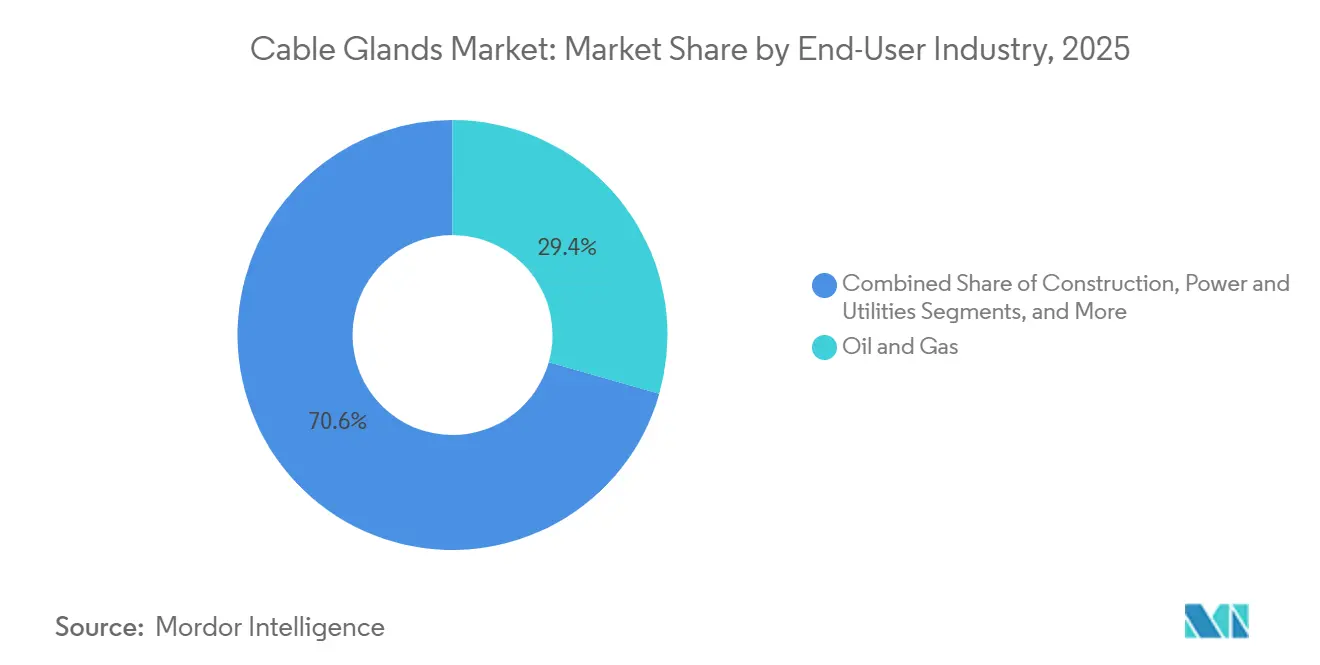
- By end-user industry, oil and gas commanded 29.40% share in 2025, whereas chemicals is projected to expand at a 4.70% CAGR on new petrochemical complexes.
- By ingress-protection rating, IP68 held 36.00% of 2025 turnover, but IP69/IP69K products are poised for a 5.80% CAGR on stringent hygiene codes.
- By thread type, metric threads captured 42.70% of 2025 revenue, while PG threads are on track for a 5.60% CAGR amid Central European machinery exports.
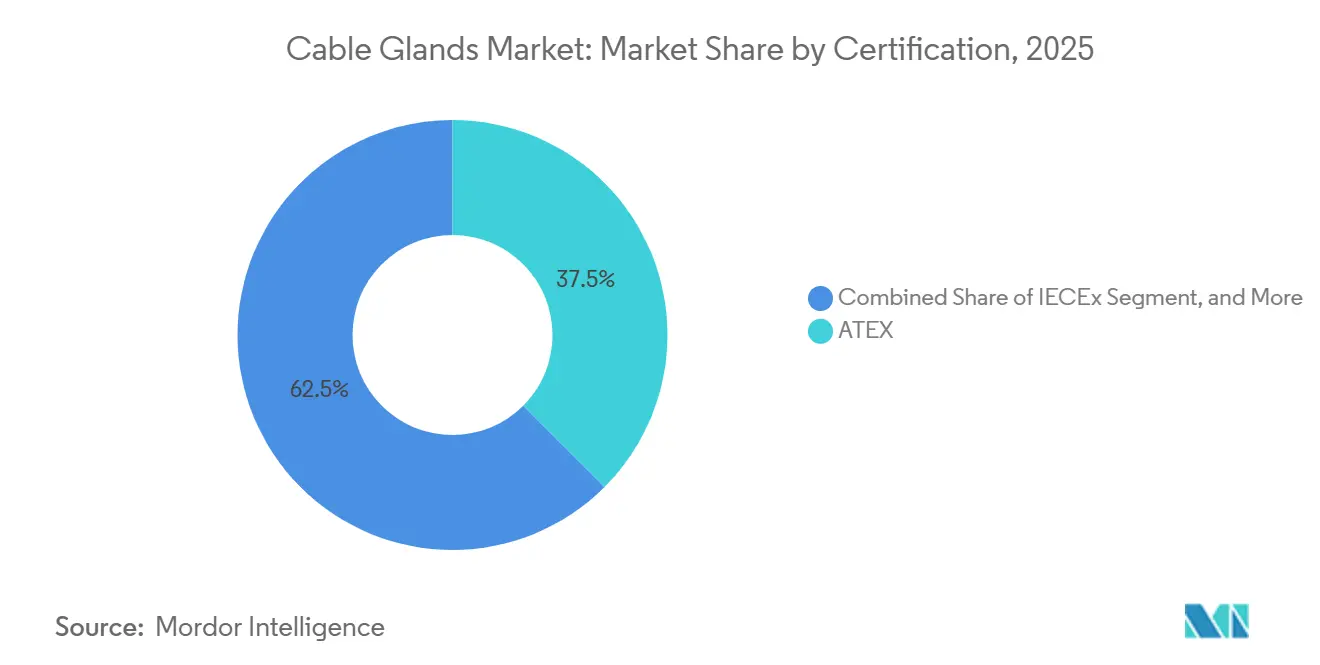
- By certification, ATEX accounted for 37.50% of 2025 revenue, yet IECEx certificates will progress at a 5.20% CAGR as multinationals favor mutual recognition.
- By installation technique, industrial panel mounting delivered 58.00% of 2025 sales, whereas bulkhead and barrier systems will advance at a 6.00% CAGR in modular data centers and offshore platforms.
- By geography, Asia-Pacific led with 38.90% of 2025 revenue and is forecast to grow at a 5.00% CAGR on strong manufacturing FDI inflows.
Note: Market size and forecast figures in this report are generated using Mordor Intelligence’s proprietary estimation framework, updated with the latest available data and insights as of January 2026.
Global Cable Glands Market Trends and Insights
Drivers Impact Analysis*
| Driver | (~) % Impact on CAGR Forecast | Geographic Relevance | Impact Timeline |
|---|---|---|---|
| Upgrading and Renewal of Legacy Power Networks | +1.2% | North America, Europe, Asia-Pacific urban grids | Long term (≥ 4 years) |
| Surge in Global Construction Activity | +0.9% | Asia-Pacific, Middle East, South America | Medium term (2-4 years) |
| Expansion of Offshore Renewable Energy Installations | +0.8% | Europe, Asia-Pacific, North America | Long term (≥ 4 years) |
| Growth in Manufacturing Investments in Emerging Economies | +0.7% | India, Vietnam, Indonesia, Mexico, Egypt | Medium term (2-4 years) |
| Miniaturization Driven High-Density Data-Center Cabling | +0.6% | Early adoption in North America and Europe | Short term (≤ 2 years) |
| Hydrogen Economy Demands Explosion-Proof Glands | +0.4% | Germany, Netherlands, Saudi Arabia, UAE, Japan, South Korea | Long term (≥ 4 years) |
| Source: Mordor Intelligence | |||
Upgrading and Renewal of Legacy Power Networks
Transmission and distribution operators are now channeling record budgets into underground cable replacement, substation digitization, and wildfire-mitigation programs. The International Energy Agency values the global grid-renewal requirement at USD 600 billion per year through 2030, and every project specification includes hundreds of glands for circuit entry.[1]International Energy Agency, “World Energy Investment 2024,” iea.org The European Union’s grid action plan earmarks EUR 584 billion for cross-border interconnectors, which mandates ATEX Zone 1 approvals in many switching stations. In the United States, the Department of Energy’s Transmission Facilitation Program provides USD 2.5 billion in loans that call for UL-listed flameproof terminations. Urban utilities are also burying feeders to cut outage risk, a choice that multiplies the number of cable entries per vault and elevates demand for IP69K ingress protection. Prefabricated, skid-mounted substations further streamline supply chains, favoring vendors that can deliver factory-installed glands with full traceability to ISO 9001 standards.
Surge in Global Construction Activity
Rebounding infrastructure spending in emerging economies is driving orders for termination hardware in HVAC panels, elevator drives, and building automation racks. World Bank data show project starts returning to pre-pandemic levels in South and East Asia. India’s National Infrastructure Pipeline schedules massive metro and airport additions, each embedding hundreds of cable entries that must adhere to IEC 60331 fire-survival standards. In Mexico, nearshoring is driving the expansion of industrial real estate, prompting contractors to specify IP66 and IP67 brass glands for use in dusty production halls. Revised European and Gulf building codes now require outdoor-grade ingress protection in indoor wash-down zones, which drives the adoption of stainless-steel IP69K variants. Higher fire-safety expectations also favor glands with integral sealing elements that hold integrity during high-temperature events, nudging buyers toward premium designs despite cost sensitivity.
Expansion of Offshore Renewable Energy Installations
Global offshore wind capacity reached 83 GW in 2024 and is projected to quintuple by 2034, resulting in significant demand for stainless-steel glands that can withstand salt spray, vibration, and UV aging. Germany awarded 7 GW of new leases in the North and Baltic Seas in 2024, specifying IEC 61892 compliance for all electrical penetrations. The United Kingdom’s seabed round in 2025 added 8 GW, stipulating ATEX Zone 1 protections in turbine nacelles. In the Asia-Pacific region, Taiwan’s 20-GW program requires vendors to localize stainless-steel machining in order to meet the lead-time targets set by the Bureau of Energy. Floating platforms destined for water depths beyond 60 m introduce cyclic bending stresses at the entry point, prompting innovation in dynamic-seal technologies that legacy compression fittings cannot match.
Growth in Manufacturing Investments in Emerging Economies
Foreign direct investment of USD 71 billion in India and USD 36.6 billion in Vietnam in 2024 is translating into fresh demand for motor-control centers, programmable logic controller panels, and clean-energy converters. India’s Production-Linked Incentive scheme triggered 32 electronics plants that require both IP68 and ATEX Zone 2 terminations in solvent-handling sections. Multinational battery-cell manufacturers are requesting IECEx-certified IIC glands in cathode-mixing rooms to meet global insurance requirements. As modern factories pursue zero-downtime targets, operators are increasingly specifying modular glands that facilitate rapid field replacement without disrupting neighboring circuits. These orders favor suppliers capable of shipping mixed material lots, brass for dry zones and stainless steel for corrosive work cells, from a single regional warehouse.
Restraints Impact Analysis*
| Restraint | (~) % Impact on CAGR Forecast | Geographic Relevance | Impact Timeline |
|---|---|---|---|
| Fragmentation of Regional Supplier Base | -0.5% | Asia-Pacific and Africa | Medium term (2-4 years) |
| Volatility in Non-Ferrous Metal Prices | -0.8% | Global | Short term (≤ 2 years) |
| Environmental Rules on Leaded Brass Alloys | -0.3% | North America, Europe | Long term (≥ 4 years) |
| Shift Toward Wireless Sensor Networks | -0.2% | Mining, oil and gas, process industries | Medium term (2-4 years) |
| Source: Mordor Intelligence | |||
Fragmentation of Regional Supplier Base
End users often juggle divergent certification labels, screw threads, and material codes when sourcing glands across multi-country projects. The Asia-Pacific and African markets are especially fragmented, with hundreds of small machine shops supplying unbranded hardware that often lacks cross-border documentation. Engineering, procurement, and construction contractors lose schedule certainty when identical part numbers carry different seismic or flameproof ratings, forcing costly requalification. The absence of universal interchangeability compounds the complexity of maintenance in global asset portfolios.
Volatility in Non-Ferrous Metal Prices
Metal price swings compress margins in product lines where brass, copper, and aluminum account for more than half of the manufacturing cost. International Monetary Fund data showed copper jumping 8.1% between February and August 2024 before moderating. Low-lead brass alloys that meet drinking-water rules trade at a 15-20% premium over C36000, and the premium widens when smelters curtail output during energy spikes. Suppliers are adopting surcharge clauses and bigger hedge books, yet sharp quarterly moves still derail fixed-price framework agreements and slow project award cycles.
*Our forecasts treat driver/restraint impacts as directional, not additive. The impact forecasts reflect baseline growth, mix effects, and variable interactions.
Segment Analysis
By Type: Hazardous-Area Variants Capture High-Value Hydrogen Projects
Hazardous-area glands are poised to erode the 65.10% share held by non-hazardous designs in 2025, as the cable glands market shifts toward hydrogen electrolyzers, floating LNG units, and advanced refineries that require wide footprints to be classified as Zone 1 or Zone 2.
Demand for non-hazardous glands will continue to grow in absolute volume; however, average selling prices will erode under pressure from plastic substitutes and simplified compression fittings. Original-equipment manufacturers lean on large-volume brass catalogs to shave bill-of-materials costs in low-risk environments. Nevertheless, the emergence of new fire-survival and hygiene codes prompts some specifiers to jump directly from basic IP66 brass to IP69K stainless steel, bypassing mid-tier options and challenging legacy pricing ladders in the cable glands market.


By Cable Type: Unarmored Demand Surges in Space-Constrained Racks
Armored glands preserved 54.20% of 2025 sales, driven by oil, gas, and mining circuits that need armor termination for earth continuity. Yet unarmored devices will log a 6.10% CAGR, fueled by hyperscale data halls where every millimeter of rack space counts. Miniaturized cast-metal bodies with integral EMI gaskets slot neatly into overhead tray layouts, and installers appreciate the quicker torque cycle compared with armor clamping. Data-center builders also value the lower weight of unarmored cable bundles, which reduces the need for ladder-rack reinforcement. These factors collectively swing procurement policies toward compact unarmored SKUs without compromising shielding effectiveness against high-frequency switching noise.
Heavy-industry operators remain loyal to armored glands, notably in the Middle East, where 30-year design lives and sand-storm exposure justify steel-wire or aluminum-tape armor. In these sites, utility crews prefer double-seal designs that maintain ingress protection even after repeated torque checks. The bifurcation thus pits high-volume, low-margin unarmored orders in commercial technology sectors against high-spec, high-margin armored projects in greenfield hydrocarbon complexes, keeping the overall cable glands market balanced but competitive.
By Material: Stainless Steel Climbs on Offshore and Desalination Growth
Brass led materials revenue in 2025, yet stainless steel is outpacing at a 4.90% CAGR as developers pursue corrosion-proof solutions in offshore wind substations, subsea umbilical terminations, and Middle Eastern desalination lines. Grade 316L and duplex alloys withstand chloride attack and stress corrosion cracking, delivering a lower life-cycle cost than brass, despite a higher upfront investment. Additionally, new European recyclability directives favor stainless steel due to its high scrap recovery rate, which provides a sustainability credit in project bids.
Brass persists in indoor switchgear and machine tools due to its unparalleled machinability, which keeps part pricing low in high-volume runs. Nickel-plated aluminum remains a niche option in weight-sensitive rail and aerospace cabins, while plastic glands serve low-voltage sensor loops that have no grounding requirements. Growing environmental pressure to eliminate lead pigments in C36000 brass may further increase machining costs, nudging even conservative buyers toward stainless steel sooner than previously forecast, and reinforcing the premium tier within the cable glands market.
By End-User Industry: Chemicals Segment Accelerates on New Complexes
Oil and gas dominated demand with 29.40% share in 2025, but chemicals plants stand out with a projected 4.70% CAGR. Integrated ethylene-to-polyethylene complexes in Saudi Arabia, the UAE, and coastal China require thousands of stainless-steel glands approved for hydrogen sulfide and high-temperature solvents. The weight of capital is shifting toward value-added intermediates and specialty derivatives, each of which demands Zone 1 flameproof equipment. Insurers often insist on dual ATEX and IECEx marks, a requirement that filters out low-tier suppliers and supports higher margins.
Utility, mining, marine, and aerospace orders remain steady, though each follows unique specification dialects that limit part commonality. Power utilities are retrofitting flood-prone substations with IP69K stainless-steel entries, whereas aircraft builders favor anodized-aluminum bodies meeting AS85049. As the chemicals boom plays out, it reconfigures the regional sales mix, anchoring an enlarged premium segment within the cable glands market.

By Ingress Protection Rating: IP69K Becomes the Hygiene Benchmark
IP68 dominated 36.00% of 2025 turnover, yet IP69/IP69K will post a 5.80% CAGR as regulators and brand owners tighten sanitation protocols in food and pharma packaging halls. DIN 40050-9 water-jet tests at 80 °C validate glands for caustic-foam clean-downs, cutting microbial risk. Equipment exporters to the European Union and the United States embed IP69K glands to streamline market access, and Asian producers emulate the requirement to win co-packing contracts from multinational brands. Modular seal inserts now enable field upgrades from IP66 to IP69K, reducing installer inventory but increasing unit price.
Traditional IP66 and IP67 brass bodies will maintain a foothold in indoor industrial cabinets, although some specifiers skip directly to IP69K once they factor in the total cost of cleaning downtime. That leap further enlarges the premium layer of the cable glands market and encourages suppliers to refine machining tolerances that deliver repeatable jet-spray resistance.
By Thread Type: PG Retains Foothold in Central Europe
Metric threads anchored 42.70% of 2025 revenue through ISO standardization across Asia, Southern Europe, and much of South America. PG threads nevertheless secure a 5.60% CAGR, driven by Germany’s vast installed base. Machine builders in Baden-Württemberg and Bavaria ship equipment with DIN 40430 knockouts, obliging maintenance crews worldwide to stock matching glands. Export momentum in plastic extrusion, packaging, and automotive assembly lines keeps PG specifications alive.
Meanwhile, ANSI NPT threads dominate U.S. and Canadian oilfield hardware, and BSP threads persist in the United Kingdom and Australia. Multinational vendors answer this diversity by machining multi-thread inventory from shared billet stock, encouraging economies of scale even amid SKU proliferation in the cable glands market.
By Certification: IECEx Emerges as the Preferred Global Passport
ATEX accounted for 37.50% of 2025 turnover within the European Economic Area, but IECEx certificates are expected to grow at 5.20% as project owners seek a single test suite that unlocks multiple regions. The publicly searchable IECEx database of equipment and manufacturing sites streamlines due diligence checks for engineering firms. Suppliers achieve cost savings by running a single destructive test program and then layering on regional label printing for UL or CSA, where required by law.
North American buyers still demand UL 1203 or CSA C22.2 approvals; however, they often accept an IECEx test report as evidence of baseline conformity. As more regulators reference IEC standards directly, the gravitational pull toward IECEx gathers pace, positioning it as the default baseline for new product development within the cable glands market.
By Installation Technique: Bulkhead Systems Win in Modular Builds
Industrial panel mounting captured 58.00% of the 2025 value, but bulkhead and barrier systems are expected to rise at a 6.00% CAGR, as modular data-center containers and offshore platforms increasingly favor pre-certified multi-cable transits. These frames seal multiple conductors through a single opening while maintaining fire, smoke, and water integrity in accordance with UL 2225 or IEC 60092-101. Factory integration slashes on-site labor and eliminates the risk of field mis-torque.
Direct equipment entry remains popular for pumps, motors, and instruments where a junction box would add cost and volume. Even so, the push for compartmentalized fire zones in lithium-ion battery plants and floating LNG hulls steers engineers toward bulkhead modules, reinforcing the premium diversification inside the cable glands market.
Geography Analysis
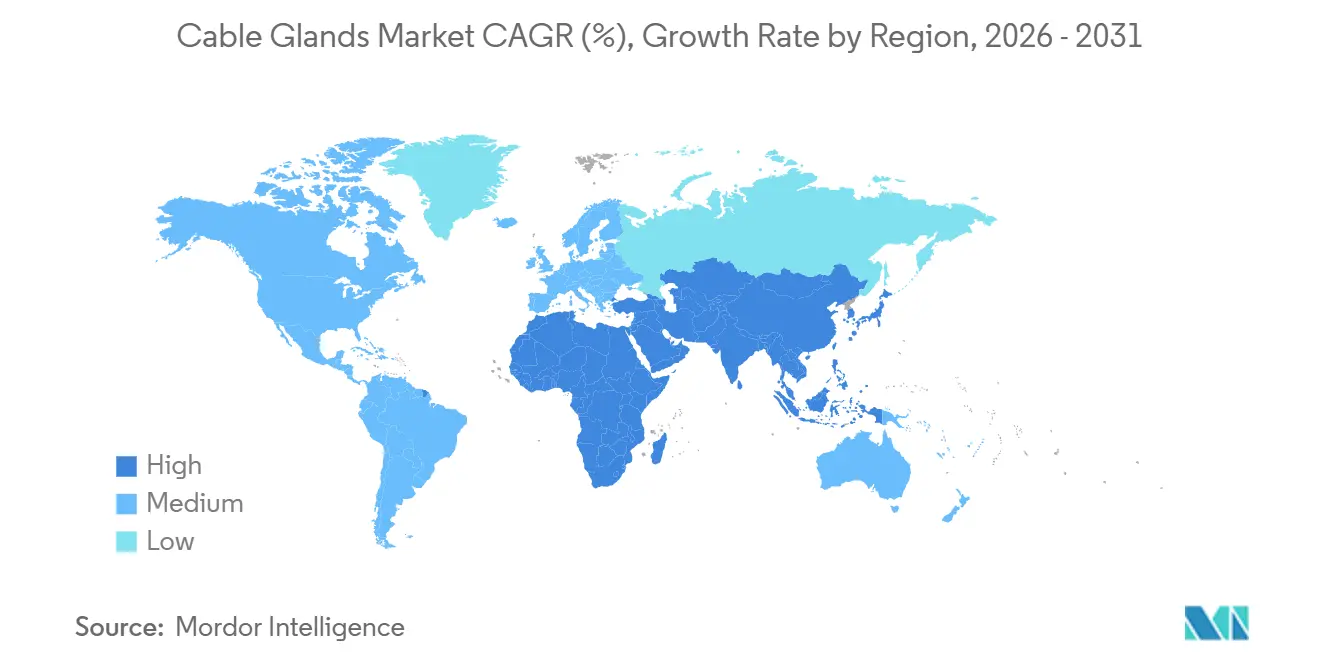
The Asia-Pacific region generated 38.90% of 2025 revenue and is tracking a 5.00% CAGR, as India, Vietnam, and Indonesia welcome record electronics and automotive investments. India’s Production-Linked Incentive scheme alone triggered 32 new factories that rely on metric-thread stainless-steel IP68 glands in solvent areas. China is adding over 10 million t per year of ethylene equivalent on the coast, requiring dual-certified flameproof terminations compliant with GB 3836 guidelines. Japan and South Korea are rolling out hydrogen refueling corridors that specify IECEx-listed equipment, further raising Asia-Pacific’s premium mix in the cable glands market.
Europe benefits from a strong offshore wind pipeline and stringent ATEX enforcement. The European Commission’s EUR 584 billion grid plan funnels stainless-steel orders into Baltic interconnectors, while Germany’s 7-GW auction in 2024 codified IEC 61892 ingress rules for all turbine decks.[2]European Commission, “EU Grid Action Plan,” europa.eu The United Kingdom’s Crown Estate adds to momentum with 8 GW of new seabed leases slated for completion after 2028. These developments secure long visibility for explosion-proof gland suppliers and boost average selling prices across the region.
North America rides a dual narrative: data-center megaprojects in Virginia, Texas, and Quebec order compact multi-cable glands with EMI shielding, while grid resilience funds support UL-listed flameproof entries in high-voltage rebuilds. Mexico’s nearshoring wave spurs PG and metric demand in assembly corridors along the Bajío region. The Middle East commands outsized project values in petrochemicals, notably the Jafurah gas complex and Ghasha sour-gas field, each specifying stainless-steel, dual-certified glands for Zone 1 areas. Africa and South America exhibit smaller bases but demonstrate healthy growth tied to mining and renewable energy concessions, underscoring a diversified geographic runway for the cable glands market.

Regulatory Landscape
Cable gland selection and approvals are shaped by hazardous-area safety regimes, electrical installation standards, and performance testing that differs by end market. In Europe, ATEX requirements under Directive 2014/34/EU remain a core gatekeeper for Zone 1 and Zone 2 applications, while IECEx is also used as a cross-border conformity route by many multinational EPCs to streamline technical qualification across member economies.
Recent updates have also tightened expectations around installation practice and documentation. The IEC 60079 series continues to set the baseline for hazardous-area equipment and installation requirements, and the 2024 update to IEC 60079-14 has renewed scrutiny on correct gland selection and installation for explosive atmospheres. In the Middle East, import and project compliance often adds local conformity layers, such as SASO in Saudi Arabia and ESMA in the UAE, which raises the value of traceable certification packages. For telecom and building infrastructure, standards bodies including ITU-T have continued to advance component standardization, including the November 2025 approval of ITU-T Recommendation L.405 for preconnectorised cabling components in FTTx, which influences how sealed cable entry and strain-relief hardware is specified in rapid-deployment fiber builds.
Competitive Landscape
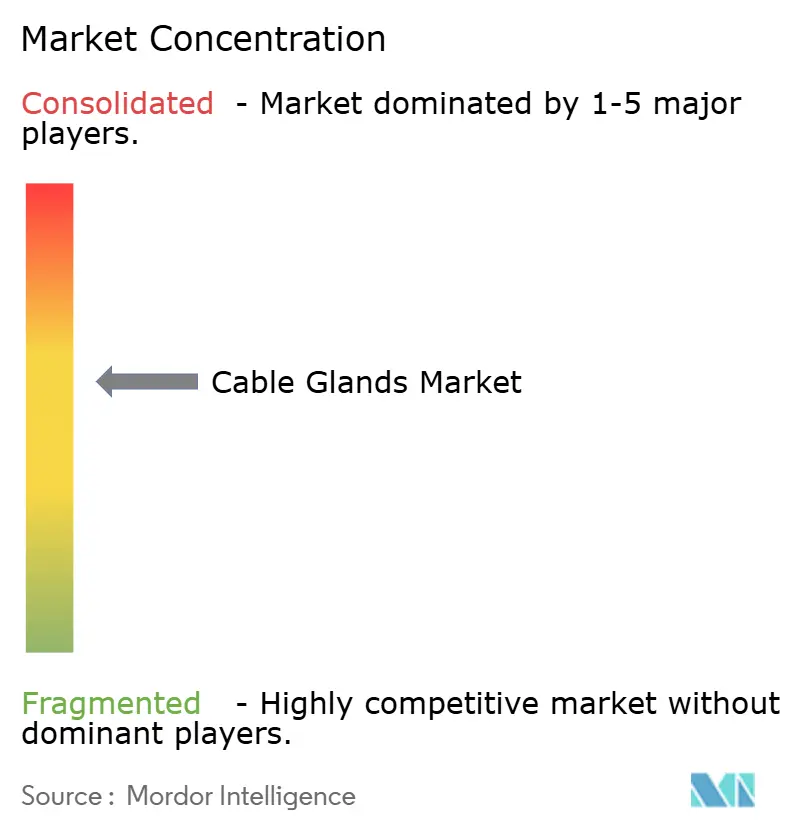
The top 10 suppliers account for roughly 45-50% of global revenue, positioning the cable glands market in a moderately concentrated tier. Multinationals such as ABB, Eaton, and Amphenol leverage broad certification portfolios, regional machining hubs, and digital configurators to win multi-country tenders. Eaton’s 2024 acquisition of Cobham Mission Systems enhances its aerospace cable-management expertise, which may cross-pollinate industrial gland innovation.[3]Eaton Corporation, “Cobham Mission Systems Acquisition,” eaton.com Amphenol reported a 16% year-over-year sales increase in Q3 2024, capturing high-density data center projects that favor miniaturized, EMI-screened glands.
Regional specialists, CMP Products, Hummel, Warom Technology, and Roxtec, differentiate through rapid certification cycles and customization. Roxtec’s additive-manufactured prototypes cut lead time for bespoke bulkhead seals to days, a decisive advantage in offshore retrofits. Meanwhile, Chinese producers offer cost-competitive metric brass glands but face acceptance barriers in ATEX projects due to limited audit trails. Sustainability credentials are emerging as a tender differentiator, pushing suppliers to report recycled-metal content and to substitute low-lead alloys in drinking-water zones. Integrated condition-monitoring sensors and one-turn installation mechanisms represent white-space opportunities as end-users seek predictive maintenance and lower field labor costs.
Supply chain resilience remains under scrutiny following 2024 freight disruptions; vendors with dual-continent machining backups captured a share when transit times from East Asia spiked. Given the mix of premium offshore orders and commoditized commercial demand, strategic partnerships between stainless-steel foundries and global distributors are expected to intensify over the forecast window.
Cable Glands Industry Leaders
CMP Products Limited
ABB Ltd
Eaton Corporation plc (Cooper Crouse-Hinds)
Hubbell Incorporated
Amphenol Corporation
- *Disclaimer: Major Players sorted in no particular order

Market Opportunities and Future Outlook
White-space opportunities are concentrated in engineered, application-specific designs where compliance, uptime, and installation speed carry more weight than unit price. That demand pull already shows up in the report's premium mix, including hygienic IP69/IP69K solutions for wash-down environments (supported by DIN 40050-9 testing cited in the market dynamics), stainless-steel variants for offshore wind and marine duty, and hazardous-area glands with dual ATEX and IECEx markings that align with corporate risk and insurance requirements. Grid renewal and new substations also support sales of pre-installed, traceable cable-entry hardware in prefabricated and skid-mounted electrical modules, where buyers prioritize standardized documentation sets and repeatable installation quality.
Data-center densification and faster deployment cycles create further room for compact, multi-cable and modular bulkhead solutions that reduce panel cutouts and accelerate cable routing, while still meeting electromagnetic-compatibility requirements. On the supply side, capacity and footprint additions by manufacturers such as Yueqing Roppex Electric, which completed construction of a 50,000 sq m factory in July 2024 with operations transition planned during 2025, reinforce competition in cost-competitive SKUs while premium segments demand broader certification portfolios. Across regions, adherence to core performance and safety standards, including IEC 62444 for cable gland performance testing and ANSI/UL 514B for North American safety requirements for fittings, supports opportunities for suppliers that can bundle certified components with clearer installation guidance and faster qualification for project-specific specifications.
Recent Industry Developments
- April 2026: CMP Products hosted the second North East Data Centre Hub gathering in Newcastle on 23 April 2026, building on the consortium launch to connect regional suppliers with data center delivery needs. The event supports local sourcing and coordination for high-density cable management components used in modular and fast-build data halls.
- August 2025: ABB launched T&B Liquidtight Systems cable entry plates for high-density data center infrastructure. The release expands ABBs portfolio beyond traditional single-cable glands into space-saving cable entry systems designed to reduce labor and panel space in crowded electrical enclosures.
- December 2024: ABB completed the acquisition of Solutions Industry & Building (SIB), a French manufacturer of cable glands and electrical products. The deal strengthens ABBs cable protection offering and adds manufacturing and product depth relevant to industrial and infrastructure projects that require certified cable termination hardware.


Research Methodology Framework and Report Scope
Market Definition and Coverage
For this study, the market covers revenue earned from cable glands used to terminate, seal, and provide mechanical protection where cables enter equipment, junction boxes, and enclosures, across industrial and building electrical installations.
Scope exclusions: It excludes cables and wires, cable cleats, connectors, and full enclosure systems where a gland is not sold as a distinct product line item.
Segmentation Overview
- By Type
- Non-Hazardous Area Cable Glands
- Hazardous Area Cable Glands
- By Cable Type
- Armored Cable Glands
- Unarmored Cable Glands
- By Material
- Brass
- Aluminium
- Stainless Steel
- Plastic
- Rest of Materials
- By End-User Industry
- Oil and Gas
- Power and Utilities
- Manufacturing and Processing
- Construction
- Aerospace
- Marine
- Mining
- Chemicals
- By Ingress Protection Rating
- IP66
- IP67
- IP68
- IP69/IP69K
- By Thread Type
- Metric
- PG
- NPT
- BSP
- By Certification
- ATEX
- IECEx
- UL
- CSA
- Other Certifications
- By Installation Technique
- Industrial Panel Mounting
- Direct Equipment Entry
- Bulkhead and Barrier Systems
- By Geography
- North America
- United States
- Canada
- Mexico
- South America
- Brazil
- Argentina
- Rest of South America
- Europe
- Germany
- United Kingdom
- France
- Italy
- Spain
- Russia
- Rest of Europe
- Asia-Pacific
- China
- India
- Japan
- South Korea
- Australia
- Rest of Asia-Pacific
- Middle East
- Saudi Arabia
- United Arab Emirates
- Turkey
- Rest of Middle East
- Africa
- South Africa
- Nigeria
- Egypt
- Rest of Africa
- North America
Data Sources, Market Sizing, and Validation
Desk Research
Desk research was used to build the starting structure of the model and to ground assumptions on end use activity and standards that shape demand. We referred to public sources such as industrial production and manufacturing output series from agencies like the World Bank, UN data portals, and national statistics offices, plus trade and customs releases where available.
To keep the market boundaries practical, we reviewed electrical safety and hazardous area guidance from bodies such as IEC and ISO, and OSHA where relevant, alongside building and electrical code commentary on association websites and in reputed press. For supplier context, we used company filings and investor presentations, supported by paid subscriptions for company financials, news and financials, and patent databases to track product families and certification related innovation. These examples are not exhaustive, and other public sources were also used for data collection, cross checks, and clarification.
Primary Interviews and Surveys
Primary work focused on validating where demand is created, and how pricing changes by material selection, certification, and protection ratings. We spoke with a mix of manufacturers, distributors, EPC firms, and panel builders, plus end users across APAC, EMEA, and the Americas. The input was used to confirm adoption rates, typical order patterns, and realistic ASP ranges for cable gland SKUs.
Distribution of primary research fieldwork respondents
| Company type | Respondent position | Region |
|---|---|---|
| Top tier: 39% | CXOs: 13% | APAC: 48% |
| Mid tier: 45% | Functional/Unit leaders: 38% | EMEA: 33% |
| Smaller Players: 16% | Managers: 49% | Americas: 19% |
Market-Sizing & Forecasting
Sizing was built using a top-down approach, where industrial electrical build activity and installed base signals were reconstructed into a demand pool for cable terminations, then filtered by where glands are required by environment and code. The resulting total was cross checked with selective bottom-up approximations, using sampled channel checks and supplier revenue splits to sanity check volumes and implied pricing before final totals were finalized.
Key model inputs included industrial production and capex cycles, expansion pace in energy and utilities and process industries, the mix shift between hazardous and non-hazardous use, the share of armored versus unarmored cable terminations, and the penetration of higher ingress protection requirements for wet or dusty environments. ASP logic was treated as a range rather than a single point, with price bands shaped by material and certification needs, and then adjusted for region level currency translation timing.
For forecasting, we used scenario analysis supported by regression style checks on industrial output and infrastructure spending indicators. We reconciled the direction of growth with what interviewees expected for project pipelines and replacement demand. Where a clean bottom-up roll up was not feasible, gaps were handled through conservative penetration assumptions that were re-tested using at least two independent interview inputs.
Data Validation & Update Cycle
Outputs were triangulated against independent signals such as manufacturing activity, major project starts, and trade flows for relevant cable gland materials. Any sharp jumps were reviewed line by line before sign-off. When variances fell outside expected ranges, assumptions were revisited, and respondents were re-contacted when needed to confirm whether the shift reflected a real change or a modeling artifact.
Reports are refreshed annually, with interim updates when material events occur that can move demand or pricing, for example regulation changes, supply disruptions, or sudden currency shifts in key buying regions. Before delivery, a final freshness check is performed so clients receive the latest updated view for the stated base year and forecast window.
Mordor Intelligence's Cable Glands Market Size Measured Against Other Published Estimates
Published market values for cable glands often differ because of currency conversion timing, the way ASP is stepped up over the forecast, and the refresh cadence behind project pipeline assumptions. In this report, we kept the sizing anchored to repeatable demand signals and then checked the totals against multiple on-the-ground viewpoints, so the number does not shift based on one-off assumptions.
Main gap drivers in this market are usually whether adjacent items are bundled in (for example, broader cable accessories), whether hazardous area demand is modeled with certification led premiums, and whether channel margins are treated consistently across regions. A fresher refresh cycle also matters because industrial project delays can shift the year of revenue recognition, and currency timing used for translation can change the reported USD value even when local demand is stable. These checks were applied before publishing Mordor Intelligence results.
Benchmark comparison
| Source | Market Size | Gaps in Research Methodology |
|---|---|---|
| Mordor Intelligence | USD 2.20 B (2026) | |
| Global Research Publisher A | USD 2.18 B (2023) | Uses a 2023 base and mixes value with shipment reporting, which can inflate implied growth when ASP escalation is applied uniformly across regions and certifications. |
| Industry Research Group B | USD 1.66 B (2025) | Takes 2025 as base year with a longer horizon, and the USD value can be pulled down when currency timing is fixed to a single period and pricing premiums are not fully differentiated by certification and IP requirements. |
Across the three figures, the spread is explained more by timing and pricing treatment than by a disagreement that glands are a growing, installation-linked product. By keeping scope tight to cable glands, translating currencies with a clear timing rule, and re-checking price bands through interviews, our estimate remains traceable to inputs that can be repeated and updated each year.


Key Questions Answered in the Report
What value will cable gland sales reach by 2031?
Global revenue is projected to rise to USD 2.75 billion by 2031, up from USD 2.20 billion in 2026.
Which geographic region currently buys the largest share of cable glands?
Asia-Pacific generated 38.90% of global 2025 revenue and is forecast to advance at a 5.00% CAGR through 2031.
Why are IP69K-rated products becoming popular in food and pharma facilities?
High-pressure wash-down rules under DIN 40050-9 require equipment to survive 80 °C jets at 80–100 bar, so engineers favor stainless-steel IP69K glands that resist water ingress and chemicals.
How do hazardous-area products compare in price to standard non-hazardous units?
Explosion-proof or increased-safety designs typically command 50–100% premiums because of dual ATEX and IECEx testing, flame-path machining, and stainless-steel construction.
Which material segment is expanding fastest?
Stainless steel is growing at a 4.90% CAGR thanks to offshore wind, marine, and desalination projects that demand superior corrosion resistance.
What makes IECEx certification attractive to multinational EPC contractors?
A single IECEx test report unlocks access to 37 member economies, reducing duplicate testing costs while still allowing local labeling for UL or CSA where required.
Page last updated on: