
Business-Process-as-a-Service Market Size and Share
Market Overview
| Study Period | 2020 - 2031 |
|---|---|
| Market Size (2026) | USD 88.04 Billion |
| Market Size (2031) | USD 154.29 Billion |
| Growth Rate (2026 - 2031) | 11.88 % |
| Fastest Growing Market | Asia-Pacific |
| Largest Market | North America |
| Market Concentration | Medium |
Major Players *Disclaimer: Major Players sorted in no particular order Image © Mordor Intelligence. Reuse requires attribution under CC BY 4.0. | |
Business-Process-as-a-Service Market Analysis by Mordor Intelligence
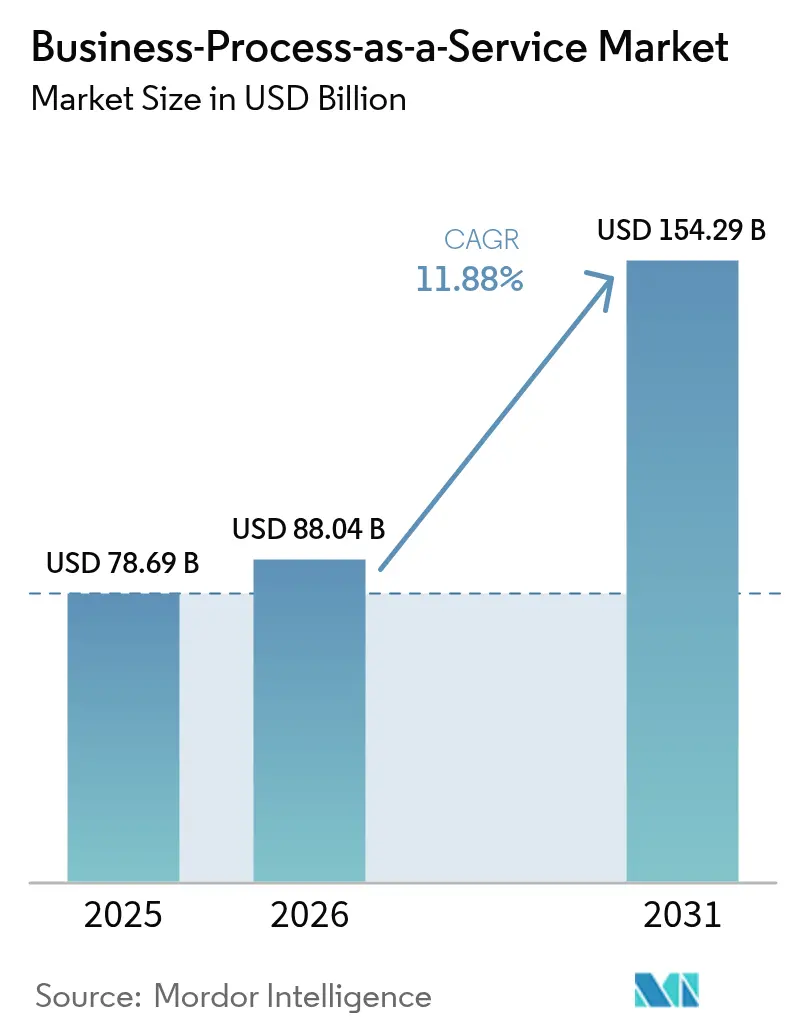
The Business-Process-as-a-Service market size is expected to grow from USD 78.69 billion in 2025 to USD 88.04 billion in 2026 and is forecast to reach USD 154.29 billion by 2031 at 11.88% CAGR over 2026-2031.
Accelerating adoption of cloud-native delivery models, rapid progress in artificial intelligence, and stronger regulatory pressure for resilient operations are reshaping organizational strategies. Enterprises are converting fixed costs into variable outlays while gaining immediate access to advanced automation, analytics, and industry-specific best practices—capabilities that once required years of capital investment. Intensifying focus on operational resilience after recent supply-chain disruptions has further positioned BPaaS as a preferred route for standardized processes that scale globally yet remain locally compliant. Vendors are responding through outcome-based commercial models, sovereign-cloud options, and ESG-linked process bundles, all of which deepen the strategic role of the Business-Process-as-a-Service market in digital transformation programs.
Key Report Takeaways
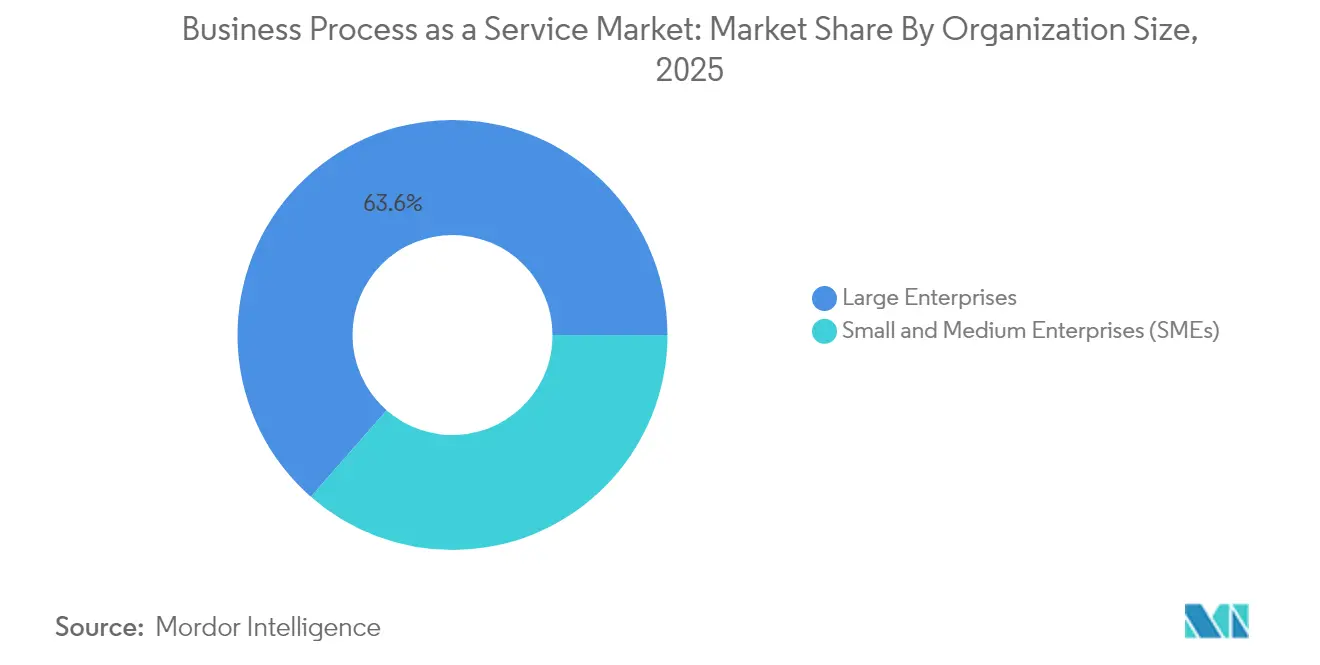
- By organization size, Large Enterprises accounted for 63.55% of the Business-Process-as-a-Service market share in 2025, while SMEs are projected to expand at a 12.97% CAGR through 2031.
- By process, Human Resource Management led with 23.85% revenue share in 2025; Customer Service and Support is expected to post the fastest 14.34% CAGR to 2031.
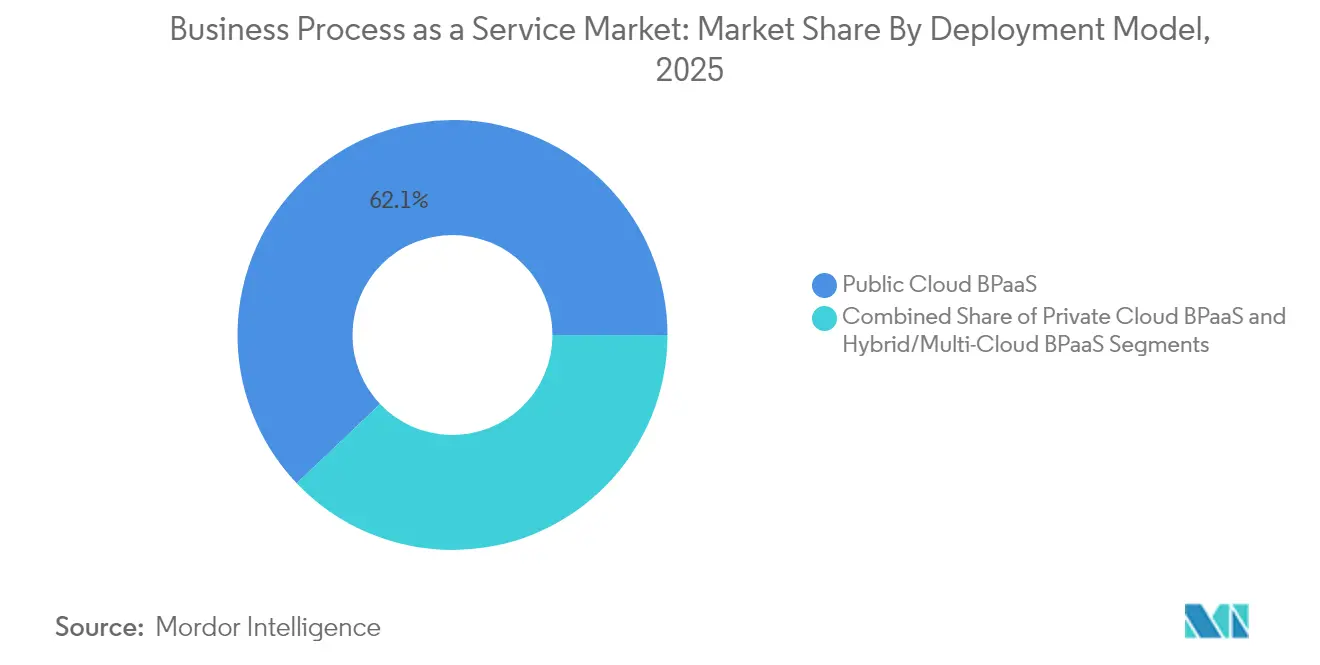
- By deployment model, Public Cloud captured 62.10% of the Business-Process-as-a-Service market size in 2025, whereas Hybrid/Multi-Cloud is set to grow at a 14.53% CAGR.
- By end-user industry, BFSI commanded 23.45% share of the Business-Process-as-a-Service market size in 2025; Healthcare and Life Sciences is anticipated to rise at a 13.95% CAGR.
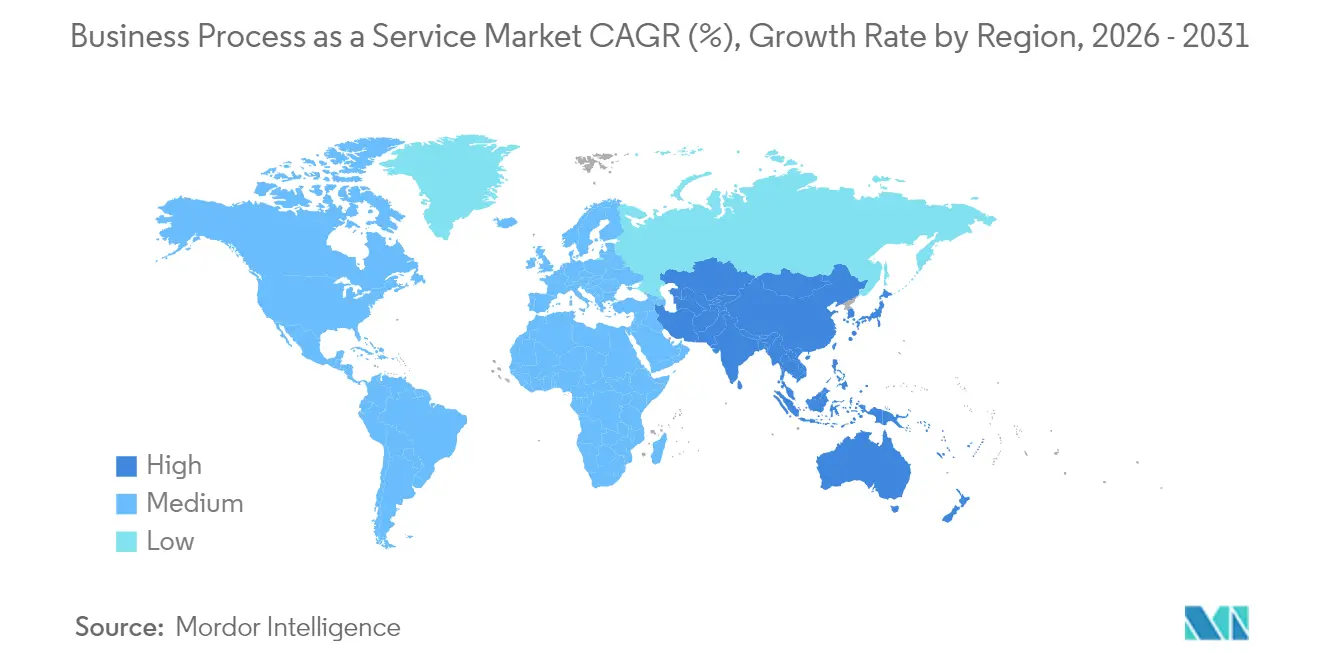
- By geography, North America led with 40.85% revenue share in 2025, and Asia-Pacific is forecast to record the highest 12.62% CAGR between 2026 and 2031.
Note: Market size and forecast figures in this report are generated using Mordor Intelligence’s proprietary estimation framework, updated with the latest available data and insights as of 2026.
Market Trends and Insights
Drivers Impact Analysis of Business-Process-as-a-Service Market*
| Driver | (~)% Impact on CAGR Forecast | Geographic Relevance | Impact Timeline |
|---|---|---|---|
| Growing demand for cloud services and standardized processes | +3.5% | Global, higher impact in North America and Europe | Medium term (2-4 years) |
| Need to reduce operational cost and boost productivity | +2.2% | Global, significant impact in Asia-Pacific | Short term (≤ 2 years) |
| Rapid adoption of AI / hyper-automation in BPaaS | +2.1% | North America, Europe, developed APAC | Medium term (2-4 years) |
| Expansion of outcome-based (gain-share) BPaaS pricing models | +1.8% | North America, Europe | Medium term (2-4 years) |
| ESG-linked reporting mandates driving sustainability BPaaS | +1.2% | Europe, North America, gradual APAC uptake | Long term (≥ 4 years) |
| Demand for industry-specific BPaaS solutions | +1.0% | Global, strongest in regulated verticals | Medium term (2-4 years) |
| Source: Mordor Intelligence | |||
Growing Demand for Cloud Services and Standardized Processes
Universal migration toward cloud platforms underpins large-scale process standardization. Ninety-four percent of enterprises now leverage cloud solutions to streamline workflows, shorten deployment cycles, and ensure consistent governance. Elastic resource allocation supports rapid pivots in demand without forcing new capital decisions. IBM notes that 77% of firms already run hybrid architectures, enabling them to unify core processes over multiple clouds while keeping strategic workloads in preferred jurisdictions. [1] Standardized, cloud-native modules accelerate compliance tasks in banking and insurance, where uniform audit trails are essential. As a result, the Business-Process-as-a-Service market experiences sustained multi-year momentum across sectors that demand speed, resilience, and global reach.
Need to Reduce Operational Cost and Boost Productivity
Economic headwinds intensify pressure to replace fixed costs with consumption-based models. BPaaS converts multi-year license contracts, data-center depreciation, and labor overhead into variable fees that align with actual usage. DXC Technology reports savings of 20-30% when organizations shift from traditional outsourcing to BPaaS frameworks. [2] Process automation embedded in these services delivers additional productivity gains, with some enterprises citing 40% efficiency improvements in finance back-office tasks. These combined financial and operational benefits reinforce the Business-Process-as-a-Service market as a pragmatic lever for near-term profitability and long-term competitiveness.
Rapid Adoption of AI / Hyper-automation in BPaaS
Providers now integrate predictive analytics, natural language tools, and machine learning into core process flows. Cognizant’s USD 1 billion generative-AI program exemplifies the scale of investment aimed at raising automation to near-straight-through levels while generating high-quality insights. [3] In live deployments, straight-through processing surpasses 98% for selected insurance tasks, sharply lowering rework and compliance exceptions. Intelligent orchestration further improves service-level adherence, ensuring that the Business-Process-as-a-Service market evolves from transactional outsourcing to an engine of continuous optimization.
Expansion of Outcome-based (Gain-share) BPaaS Pricing Models
Outcome-based contracts tie provider revenue directly to cost savings, revenue gains, or compliance milestones. Infosys BPM highlights the suitability of these models for high-volume finance processes where key performance indicators can be audited in real time. [4] Shared-value structures intensify collaboration, spark quicker innovation cycles, and embed continuous-improvement mindsets. As a result, more enterprises prefer gain-share agreements, propelling sustained growth for the Business-Process-as-a-Service market during medium-term planning horizons.
Restraints Impact Analysis of Business-Process-as-a-Service Market*
| Restraint | (~)% Impact on CAGR Forecast | Geographic Relevance | Impact Timeline |
|---|---|---|---|
| Heightened data-security and privacy concerns | -2.2% | Global, higher impact in Europe and North America | Short term (≤ 2 years) |
| Integration complexity with legacy core systems | -1.8% | Global, significant in mature markets | Medium term (2-4 years) |
| Vendor lock-in and interoperability limitations | -1.3% | Global | Medium term (2-4 years) |
| Sovereign-cloud requirements restricting cross-border BPaaS | -1.2% | Europe, Asia-Pacific, rising in North America | Long term (≥ 4 years) |
| Source: Mordor Intelligence | |||
Heightened Data-Security and Privacy Concerns
BPaaS deployments involve a distributed infrastructure that can enlarge the threat surface. The South African Reserve Bank cautions that cloud computing amplifies operational and systemic risks when controls are weak. European GDPR and California CCPA regulations impose severe penalties for non-compliance, compelling providers to implement sophisticated encryption, identity management, and regional data-residency architectures. Heightened scrutiny temporarily slows decision cycles, limiting short-term adoption in sensitive verticals even as security-enhanced platforms emerge to rebuild trust in the Business-Process-as-a-Service market.
Integration Complexity with Legacy Core Systems
Many enterprises operate bespoke mainframes and fragmented application estates accumulated over decades. FasterCapital observes that integrating BPaaS with such environments can extend timelines and raise costs, occasionally eroding anticipated value. Data synchronization across hybrid platforms requires robust middleware and governance. Project teams often face unplanned interface redesigns, deep regression testing, and parallel-run overheads. These hurdles moderate uptake among risk-averse organizations, tempering near-term expansion of the Business-Process-as-a-Service market until integration toolkits mature.
*Our forecasts treat driver/restraint impacts as directional, not additive. The impact forecasts reflect baseline growth, mix effects, and variable interactions.
Business-Process-as-a-Service Market Segment Analysis
By Organization Size:
SMEs Accelerate Digital TransformationLarge Enterprises dominated 2025 with 63.55% of the Business-Process-as-a-Service market share, leveraging standardized global workflows to simplify audits and cut duplicative platforms. They often start by outsourcing non-core finance and HR tasks, then extend coverage to customer experience and supply-chain analytics once governance structures prove resilient. Integration remains a priority; many deploy middleware layers that blend on-premise ERPs with public-cloud microservices, preserving strategic data control while maximizing vendor innovation. In parallel, fresh enterprise-wide governance councils monitor vendor performance under outcome-based contracts, ensuring continuous alignment with strategic objectives.
SMEs, though historically under-represented, now display the strongest momentum with a forecast 12.97% CAGR. Cloud-first solutions remove traditional barriers such as capital outlay, specialist talent shortages, and infrastructure maintenance. Japan’s Kubell Co. reports that its Chatwork platform served 605,000 SME clients by September 2024, underscoring the segment’s pent-up demand. SMEs typically begin with single-process modules—payroll, invoicing, or help-desk automation—before scaling to end-to-end suites as reliability is proven. The elastic fee model offers crucial cash-flow flexibility during growth spurts or economic contractions. Consequently, the Business-Process-as-a-Service market size attributable to SMEs is projected to widen substantially through 2031 as providers release pre-configured bundles tailored for industry-specific compliance.

By Process:
Customer Service Innovations Drive GrowthHuman Resource Management retained 23.85% of 2025 revenue, reflecting global recognition that standardized recruitment, payroll, and talent-engagement workflows lower compliance risk and enhance employee experience. Many providers now pair HR modules with predictive analytics that forecast attrition, identify skill gaps, and recommend learning content. Accounting and Finance processes also gain traction as robotic invoice matching, automated reconciliations, and AI-driven fraud checks boost accuracy while shrinking cycle times. Supply Chain and Procurement solutions improve vendor collaboration and inventory visibility, critical in volatile logistics environments.
Customer Service and Support, forecast to rise 14.34% annually, leads growth as brands pivot to omnichannel engagement. AI-driven chatbots and voice analytics deliver instant, personalized responses at far lower cost than traditional call centers. Sutherland Global’s deployments cut average response time while raising first-contact resolution, enhancing NPS scores, and reducing escalations. Sales and Marketing BPaaS complements these advances, synchronizing campaign data with front-office analytics to sharpen lead quality. Operations modules apply workflow engines to field-service dispatch, plant-maintenance scheduling, and quality assurance. Together, these innovations anchor sustained expansion of the Business-Process-as-a-Service market.
By Deployment Model:
Hybrid Approaches Balance Flexibility and ControlPublic Cloud commanded 62.10% of the Business-Process-as-a-Service market size in 2025, thanks to ready availability, frequent feature releases, and transparent cost models. Enterprises benefit from instant scalability during peak periods such as holiday retail surges or fiscal close cycles. Providers supplement offerings with enterprise-grade encryption and multi-factor authentication that satisfy baseline compliance in most industries. However, exclusive public-cloud reliance can conflict with data-sovereignty laws and internal risk appetites.
Hybrid/Multi-Cloud solutions, projected to grow 14.53% per year, address these concerns by enabling sensitive data to remain within private or sovereign facilities while offloading less regulated workloads to public infrastructure. TAdviser reports that 85% of Russian firms plan to adopt hybrid technology by 2025. Logical segmentation of workloads allows firms to optimize for latency, regulation, and economics simultaneously. Private Cloud BPaaS retains relevance in healthcare and banking environments where regulators stipulate explicit residency controls. The overall mix confirms that strategic balance rather than one-size-fits-all adoption will fuel the Business-Process-as-a-Service market through the decade.
By End-user Industry:
Healthcare Digitalization Accelerates AdoptionBFSI led with 23.45% of 2025 revenue, motivated by intense regulatory scrutiny that rewards auditable, standardized processes. Banks deploy BPaaS for anti-money-laundering checks, loan-origination analytics, and real-time ledger reconciliation. Insurance carriers employ digital claims adjudication and policy-administration platforms to compress cycle times and elevate customer satisfaction. Providers embed rule engines to reflect multi-jurisdictional compliance, making the Business-Process-as-a-Service market indispensable to financial risk management.
Healthcare and Life Sciences, forecast at a 13.95% CAGR, exemplify next-wave demand. Cognizant’s payer solution slashed total cost of ownership by 25% while raising claims-pricing accuracy to 99%+. Automated pre-authorization, member-eligibility verification, and provider credentialing alleviate administrative bottlenecks and redirect resources to patient care. IT and Telecommunications firms deploy BPaaS to unify OSS/BSS processes and customer-support journeys. Retail and eCommerce leverage automated supply-chain orchestration to mitigate stock-out risk. Manufacturing integrates quality analytics and predictive maintenance into unified dashboards. Government entities modernize HR and citizen-service channels as 60% of public-sector staff edge toward retirement eligibility, demonstrating the Business-Process-as-a-Service industry’s cross-sector value.
Geography Analysis
North America Business-Process-as-a-Service Market
North America generated 40.85% of 2025 revenue for the Business-Process-as-a-Service market, buoyed by early cloud uptake and deep provider ecosystems. Financial institutions use BPaaS to consolidate compliance documentation across jurisdictions, while retail groups pursue AI-led customer-service automation. Cloud infrastructure concentration is notable; the UK Competition and Markets Authority estimates AWS and Microsoft hold 40-50% and 30-40% of North American infrastructure, respectively. This dominance encourages BPaaS vendors to forge strategic alliances with hyperscalers for latency optimization and joint go-to-market programs.
APAC Business-Process-as-a-Service Market
Asia-Pacific is projected to record the fastest 12.62% CAGR between 2026 and 2031. Governments in India, the Philippines, and Indonesia promote “cloud first” mandates to reduce operating costs and improve citizen services. The Data Security Council of India notes that the national cloud market reached USD 7.70 billion by 2022, underscoring the readiness of foundational infrastructure. Indigenous providers partner with global players to address regional data-localization requirements. Japanese enterprises, challenged by labor shortages, lean on BPaaS to automate routine functions, stimulating demand across manufacturing and retail sectors.
Europe Business-Process-as-a-Service Market
Europe exhibits measured growth as stringent privacy rules guide deployment choices. GDPR compliance shapes contract terms, data-residency clauses, and shared-responsibility frameworks. Germany’s BPO market, forecast to hit USD 21.32 billion by 2029, already registers 81% cloud adoption among firms. Financial institutions prefer hybrid models, pairing local sovereign clouds with scalable public resources to satisfy supervisory guidance outlined by Eurofi. The region’s strong ESG agenda fuels demand for sustainability-centric BPaaS solutions that automate carbon accounting and social-impact reporting.
Regulatory Landscape
The regulatory environment for BPaaS is shaped by cross-border data protection, operational resilience, and ICT third-party risk requirements, which affect how providers design multitenant delivery and contracting. In Europe, the Digital Operational Resilience Act (DORA) raises expectations for governance of ICT third-party providers used by financial entities, tightening requirements around auditability, subcontracting controls, and resilience testing. DORA-related delegated measures, including Commission Delegated Regulation (EU) 2024/1773 (13 March 2024) on the content of policies for contractual arrangements and Commission Delegated Regulation (EU) 2025/532 (24 March 2025) on subcontracting elements for critical or important functions, reinforce process-level oversight that extends from cloud infrastructure into BPaaS process operations.
Security and governance standards also shape procurement and assurance. ISO/IEC TS 38508:2024 provides governance guidance for shared digital service platforms, aligning board-level oversight with acquisition, compliance, and risk management needs that commonly arise in BPaaS programs. In the United States, NIST Special Publication 800-70 Revision 5 supports the use of security checklists mapped to control frameworks (for example, those used in regulated environments such as healthcare and financial services), strengthening how BPaaS providers and buyers document control selection, implementation, and ongoing conformance across hybrid and multi-cloud deployments.
Value Chain Analysis
The BPaaS value chain starts with cloud and software foundations (hyperscaler infrastructure, identity and security tooling, workflow automation, analytics, and AI services), then moves into platformized process design, configuration, and governance delivered by technology-enabled service providers such as Accenture, TCS, Infosys, Tech Mahindra, Sutherland, and Genpact. Providers combine domain playbooks (for HR, finance, procurement, and customer service) with APIs and microservices to connect client ERP/CRM estates, then operationalize delivery through multitenant run-time services, monitoring, and continuous-improvement loops. Commercialization is primarily digital and marketplace-led, supported by solution engineering, partner ecosystems, and industry templates that shorten deployment cycles.
Downstream, delivery operations depend on data quality, integration middleware, and security controls as key inputs. Process performance is managed through KPIs and outcome-oriented service levels, with bottlenecks concentrated in legacy integration complexity, fragmented data silos, and the need for high-fidelity data to support AI-led automation and emerging agentic operating models. Industry trend tracking in CQ1 2026 pointed to provider emphasis on workforce optimization and AI upskilling over headcount expansion, reflecting a shift in how value is created and captured in BPaaS from labor intensity to asset-based delivery and process intelligence.
Competitive Landscape
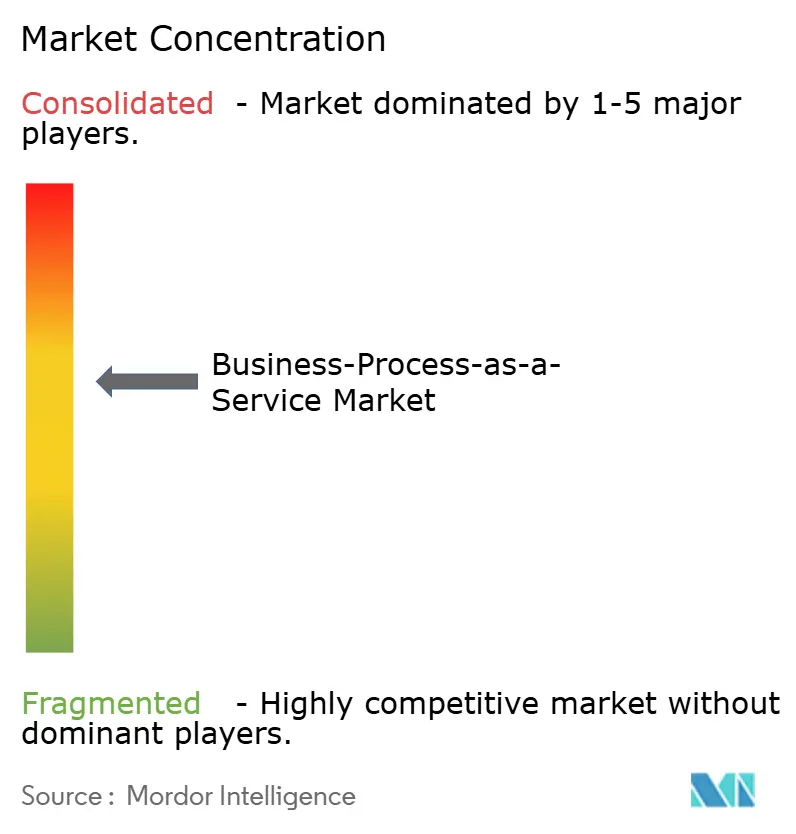
The Business-Process-as-a-Service market displays moderate concentration anchored by Accenture, IBM, TCS, and Cognizant, each leveraging global delivery centers, verticalized solution portfolios, and heavy AI investment. Accenture’s USD 420 million acquisition of a sustainability analytics firm in April 2025 expanded its ESG credentials and strengthened cross-industry traction. IBM’s March 2025 launch of an AI-powered financial-services BPaaS suite fused compliance workflows with cognitive risk analytics, giving banks a turnkey option for multi-jurisdiction operations.
Mid-tier challengers include Wipro, HCLTech, and NTT DATA, which differentiate through regional expertise and niche platforms. NTT DATA’s SimpliZCloud, introduced in January 2025, caters to sovereign-cloud requirements, highlighting growing segmentation along regulatory lines. Specialist vendors such as Sutherland Global dominate customer-experience processes, while Genpact deepens finance-automation capabilities after its February 2025 acquisition of a robotic-process specialist.
Strategic alliances shape competition: Infosys BPM partnered in May 2025 with a leading workflow-automation platform to release pre-configured templates, accelerating deployment speed and extending reach to SMEs. Provider success increasingly depends on ecosystem positioning within hyperscaler marketplaces, industry consortiums, and analytics ISVs. Heightened antitrust scrutiny of dominant cloud-infrastructure suppliers may open new corridors for independent BPaaS providers eager to bundle services across multi-cloud environments.
Business-Process-as-a-Service Industry Leaders
-
Accenture plc
-
IBM Corporation
-
Tata Consultancy Services (TCS)
-
Cognizant Technology Solutions
-
Wipro Limited
- *Disclaimer: Major Players sorted in no particular order
Business-Process-as-a-Service Market Companies Covered in this Report
- Accenture plc
- IBM Corporation
- Tata Consultancy Services (TCS)
- Cognizant Technology Solutions
- Wipro Limited
- HCL Technologies
- Capgemini SE
- Infosys Limited
- Genpact Ltd.
- Fujitsu Ltd.
- Oracle Corporation
- SAP SE
- Deloitte Touche Tohmatsu Limited
- NTT DATA
- CGI Inc.
- DXC Technology
- Tech Mahindra
- EXL Service Holdings
- ADP Inc.
- Alight Solutions
- Paychex Inc.
- UKG (Ultimate Kronos Group)
- TriNet Group
- Ceridian HCM
- WNS Global Services
- Sutherland Global Services
Market Opportunities and Future Outlook
Opportunities cluster around regulated and data-sensitive operations where buyers want audit-ready, resilient process delivery alongside localization controls. EU DORA and its delegated measures (including Commission Delegated Regulation (EU) 2024/1773 and Commission Delegated Regulation (EU) 2025/532) elevate contractual and subcontracting governance for ICT service providers in financial services, creating whitespace for BPaaS offerings that productize third-party risk controls, registers of providers, and process-level KPIs within standard contract and reporting bundles. This also supports demand for hybrid, multi-cloud, and sovereign-aligned delivery patterns that can keep sensitive datasets within preferred jurisdictions while still enabling global standardization.
A second opportunity is the shift from cost-centric outsourcing to AI-led, asset-based process services where agentic AI and process intelligence are embedded in delivery operations. Provider activity provides direction for investment: IBM introduced IBM Enterprise Advantage in January 2026 and expanded related capabilities in May 2026 to help convert legacy processes into agent-ready workflows, while Cognizant announced a five-year engagement in December 2025 to deliver an AI-driven BPaaS solution for health insurance claims modernization. Scaling complex, analytics-heavy BPaaS also depends on expansion of capability centers and delivery footprints, as reflected in Genpact and Nestle Business Solutions partnering to establish a Global Capability Center in Hyderabad in July 2026 focused on agentic AI and process intelligence.
Recent Industry Developments in Business-Process-as-a-Service Market
- May 2026: IBM Consulting expanded IBM Enterprise Advantage with additional capabilities such as Context Studio and Process Studio to help convert legacy process knowledge into agent-ready workflows. The update supports more repeatable BPaaS-style delivery by standardizing how process documentation and operating procedures translate into automated, governed execution across client environments.
- December 2025: Bupa Hong Kong selected Cognizant for a five-year engagement to deliver an AI-driven BPaaS solution to modernize health insurance claims. The deal highlights continued appetite in regulated industries for process outcomes packaged with automation and analytics rather than standalone software tools.
- November 2024: Accenture, Microsoft, and Avanade announced initiatives to help enterprises reinvent business functions using generative AI and Copilot across workflows. The collaboration strengthens the partner ecosystem path for BPaaS providers to embed hyperscaler AI capabilities into standardized finance, HR, and customer operations services.
Business-Process-as-a-Service Market Report Scope and Research Methodology
Market Definition and Coverage
For this methodology, the BPaaS market covers outsourced business processes that are delivered through cloud-based platforms and run as an ongoing service, where the provider is accountable for day-to-day process performance and outcomes.
Scope exclusions: We exclude pure software subscriptions that do not include process delivery, as well as generic cloud infrastructure or platform services that are not tied to a defined business process.
Segments Covered in This Report
- By Organization Size
- Large Enterprises
- Small and Medium Enterprises (SMEs)
- By Process
- Human Resource Management (HRM)
- Accounting and Finance
- Customer Service and Support
- Sales and Marketing
- Supply Chain and Procurement
- Operations and Other Horizontal Processes
- By Deployment Model
- Public Cloud BPaaS
- Private Cloud BPaaS
- Hybrid/Multi-Cloud BPaaS
- By End-user Industry
- BFSI
- IT and Telecommunications
- Healthcare and Life Sciences
- Retail and E-Commerce
- Manufacturing
- Government and Public Sector
- Other End-user Industries
- By Geography
- North America
- United States
- Canada
- Mexico
- South America
- Brazil
- Argentina
- Chile
- Rest of South America
- Europe
- Germany
- United Kingdom
- France
- Italy
- Spain
- Russia
- Rest of Europe
- Asia-Pacific
- China
- Japan
- India
- South Korea
- Australia
- Singapore
- Malaysia
- Rest of Asia-Pacific
- Middle East and Africa
- Middle East
- Saudi Arabia
- United Arab Emirates
- Turkey
- Rest of Middle East
- Africa
- South Africa
- Nigeria
- Egypt
- Rest of Africa
- Middle East
- North America
Data Sources, Market Sizing, and Validation
Desk Research
Desk research was used to set the outer boundaries for BPaaS and to anchor adoption and spend signals to something measurable. We referred to public sources such as the US Bureau of Labor Statistics, the US SEC company filings database, OECD digital economy indicators, World Bank macro series, and official guidance from standards bodies such as ISO where process governance language matters.
Along with these, we reviewed annual reports, earnings call transcripts, investor decks, and press releases to understand how providers describe BPaaS scope, contract structures, and typical process bundles. We also used paid subscriptions for company financials and intelligence, plus news and financials, to cross-check revenue mix cues and major contract announcements without relying on a single disclosure. These sources are illustrative only, and we used additional public materials to collect, validate, and clarify data points during the study.
Primary Interviews and Surveys
Primary work focused on validating what is truly counted as BPaaS in live deals, and how pricing and bundling change by process type and buyer size. We spoke with a mix of service providers, channel and advisory participants, and enterprise users across major regions, then used follow-up questions to close gaps we identified from desk research assumptions.
Distribution of primary research fieldwork respondents
| Company type | Respondent position | Region |
|---|---|---|
| Top tier: 32% | CXOs: 19% | APAC: 52% |
| Mid tier: 48% | Functional/Unit leaders: 37% | EMEA: 30% |
| Smaller Players: 20% | Managers: 44% | Americas: 18% |
Market-Sizing & Forecasting
Sizing starts with a top-down demand pool build that connects addressable business functions to serviceable cloud delivery. In practice, we reconstructed spending by tying it to measurable indicators such as enterprise cloud penetration, outsourcing intensity by industry, employee base trends in process-heavy functions, and the share of processes that are standardized enough to be delivered as multi-tenant services.
Those totals were then corroborated with selective bottom-up approximations, where provider revenue cues, sampled price-per-transaction or price-per-employee ranges, and channel checks were used to test whether the implied volumes looked realistic. When a bottom-up datapoint was missing for a niche process, we filled the gap using proxy adoption rates from adjacent processes and then adjusted the assumption after primary feedback.
For forecasting, scenario analysis was used so adoption speed, pricing normalization, and automation-driven productivity impacts could be varied without breaking the model. The forward view was guided by expert expectations on renewal cycles, new logo momentum, and how quickly buyers shift from stand-alone SaaS tools to outcome-based process services.
Data Validation & Update Cycle
Validation is done through cross-checks against independent signals, such as provider commentary on bookings, contract durations, and regional demand tone, followed by comparisons against macro IT spend direction where it is relevant. Variances are investigated, and if a large swing is seen in a region or process area, we re-check assumptions and re-contact sources to confirm what changed.
Before sign-off, the model and write-up go through multi-step analyst reviews so the math logic, scope boundaries, and unit consistency are aligned. The report is refreshed annually, and interim updates are triggered when material events occur, after which a final pre-delivery pass is completed so clients receive the latest view.
Mordor Intelligence's Business Process As A Service Bpaas Market Size Versus Other Published Estimates
It is common to see different BPaaS market sizes published for the same year because the service boundary is not handled the same way across studies. Differences usually come from what is counted as a full process service versus software only, how global revenue is allocated by delivery location, and whether pricing is assumed to fall as automation rises.
By tracking process-level inclusions, refreshing currency timing and base-year mapping, and then checking deal pricing logic against interview feedback, Mordor Intelligence keeps the BPaaS total tied to end-to-end process delivery rather than stand-alone cloud software bundled loosely with services.
Benchmark comparison
| Source | Market Size | Gaps in Research Methodology |
|---|---|---|
| Mordor Intelligence | USD 78.69 B (2025) | |
| Global Consultancy A | USD 95.90 B (2025) | This estimate appears to use a wider scope that can pull in adjacent cloud software and platform components when they are packaged with services, which lifts the 2025 total versus a strict process-outcome boundary. |
| Industry Publisher B | USD 67.87 B (2024) | The lower value is partly explained by the earlier base year and a tighter counting approach that may exclude private-cloud delivered contracts or limit the definition to a smaller set of standardized processes. |
The spread in the table is mainly explained by scope control and base-year alignment, not by a single math trick. When inclusions are pinned to process delivery and the pricing and adoption assumptions are checked in a repeatable way, the resulting market size is easier to trace back to clear inputs and update year over year.
Key Questions Answered in the Report
What is the projected value of the Business-Process-as-a-Service market by 2031?
The Business-Process-as-a-Service market is forecast to reach USD 154.29 billion in 2031.
Which process segment will grow the fastest through 2031?
Customer Service & Support is expected to register the highest 14.34% CAGR due to AI-driven omnichannel engagement tools.
Why are SMEs adopting BPaaS more rapidly than large enterprises?
SMEs favor BPaaS because it removes large upfront investments, offers pay-as-you-go flexibility, and grants access to enterprise-grade automation without complex infrastructure.
How does hybrid BPaaS help meet data-sovereignty rules?
Hybrid architectures keep sensitive data in controlled private or sovereign clouds while routing less regulated processes to public infrastructure, balancing compliance and scalability.
Which region will see the highest BPaaS growth rate?
Asia-Pacific is projected to expand at a 12.62% CAGR, driven by government cloud mandates, expanding infrastructure, and increasing digitalization in emerging economies.
What are the main risks hindering BPaaS adoption?
Primary risks include data-security concerns under strict privacy regulations and the complexity of integrating cloud services with longstanding legacy systems.