
Burn Care Market Size and Share
Market Overview
| Study Period | 2020 - 2031 |
|---|---|
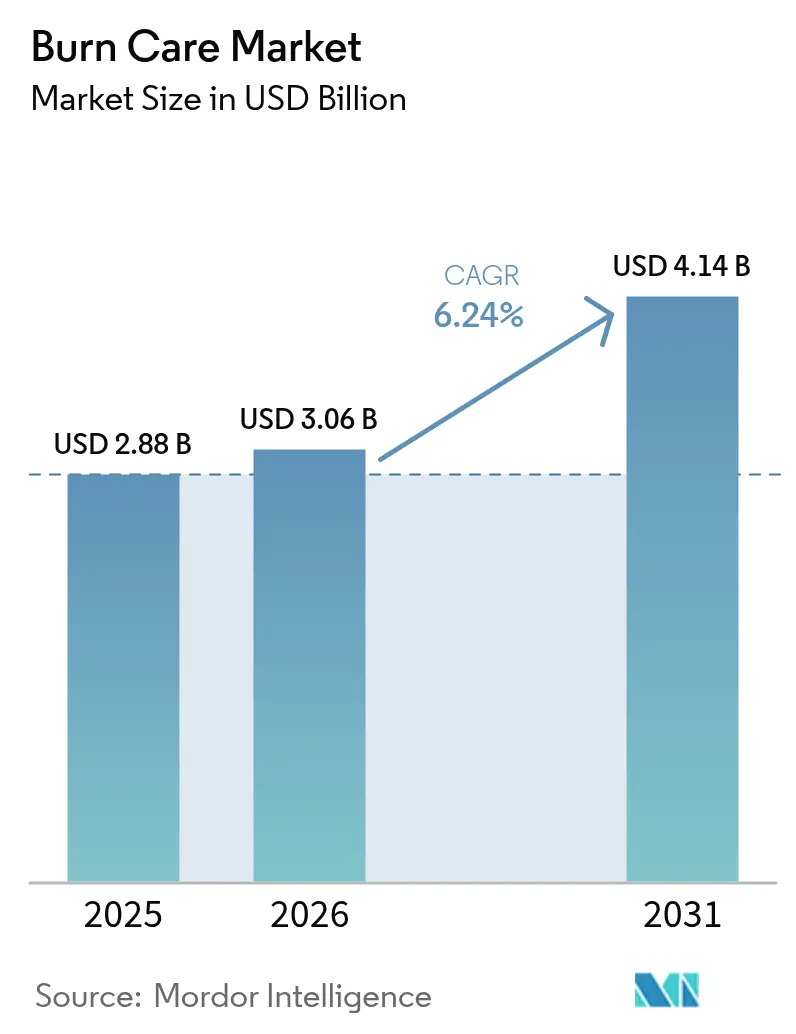
| Market Size (2026) | USD 3.06 Billion |
| Market Size (2031) | USD 4.14 Billion |
| Growth Rate (2026 - 2031) | 6.24 % |
| Fastest Growing Market | Asia Pacific |
| Largest Market | North America |
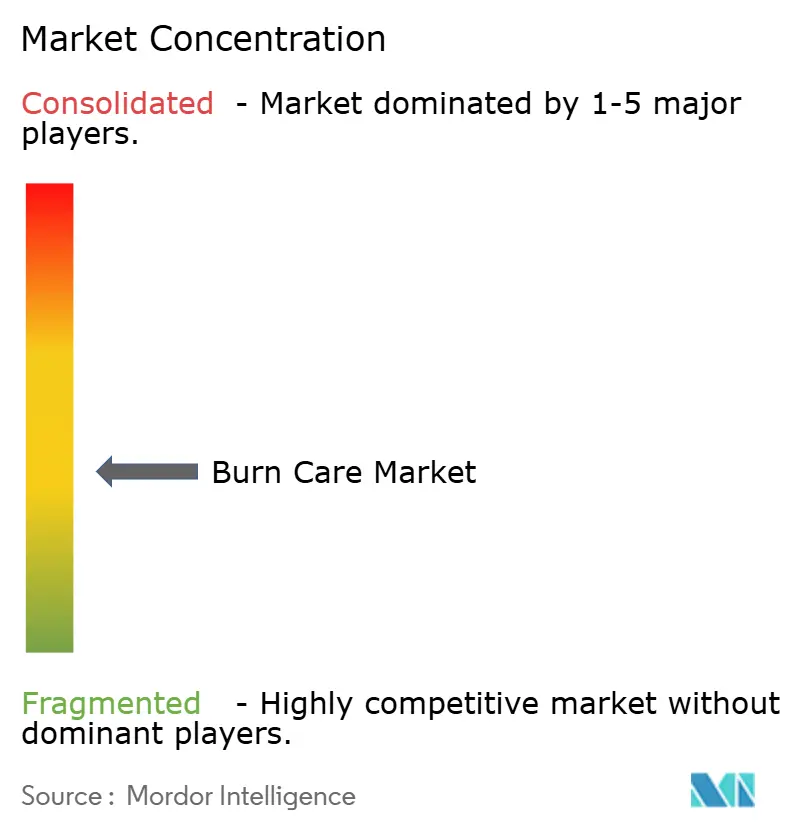
| Market Concentration | Medium |
Major Players *Disclaimer: Major Players sorted in no particular order Image © Mordor Intelligence. Reuse requires attribution under CC BY 4.0. | |
Burn Care Market Analysis by Mordor Intelligence
Burn Care Market size in 2026 is estimated at USD 3.06 billion, growing from 2025 value of USD 2.88 billion with 2031 projections showing USD 4.14 billion, growing at 6.24% CAGR over 2026-2031.
Severe weather events, electric-vehicle battery fires, and industrial accidents continue to elevate the global incidence of burn injuries, sustaining demand for advanced dressings, biologics, and portable negative-pressure therapy systems. Reimbursement reforms in the United States, Europe, and selected Asia-Pacific economies support wider adoption of sophisticated wound technologies. Meanwhile, ambient-intelligence tools such as smart bandages and bioelectronic monitors shorten healing times and reduce readmissions, driving hospital cost-containment strategies. Strategic investments from public research programs and military agencies accelerate translation of laboratory breakthroughs into commercial products.
Key Report Takeaways
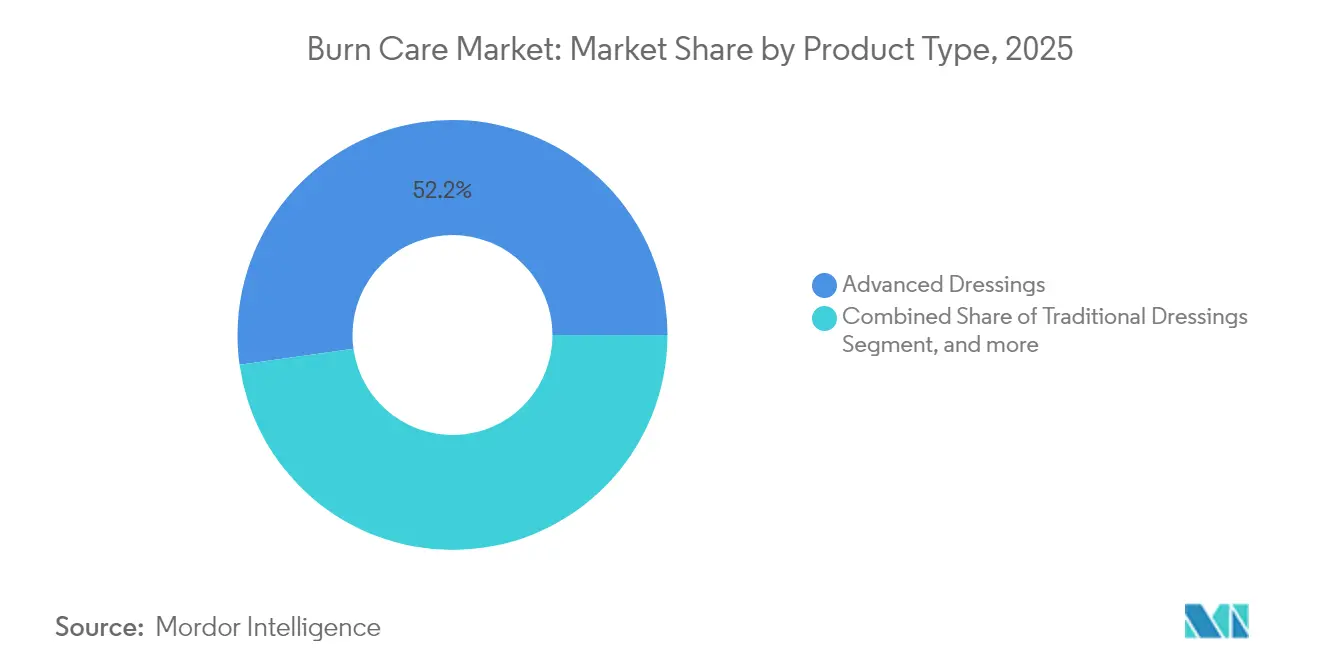
- By product type, advanced dressings led with 52.21% burn care market share in 2025, while biologics recorded the fastest 9.41% CAGR through 2031.
- By depth of burn, partial-thickness cases accounted for 43.61% of the burn care market size in 2025, whereas full-thickness burns are projected to expand at an 8.29% CAGR.
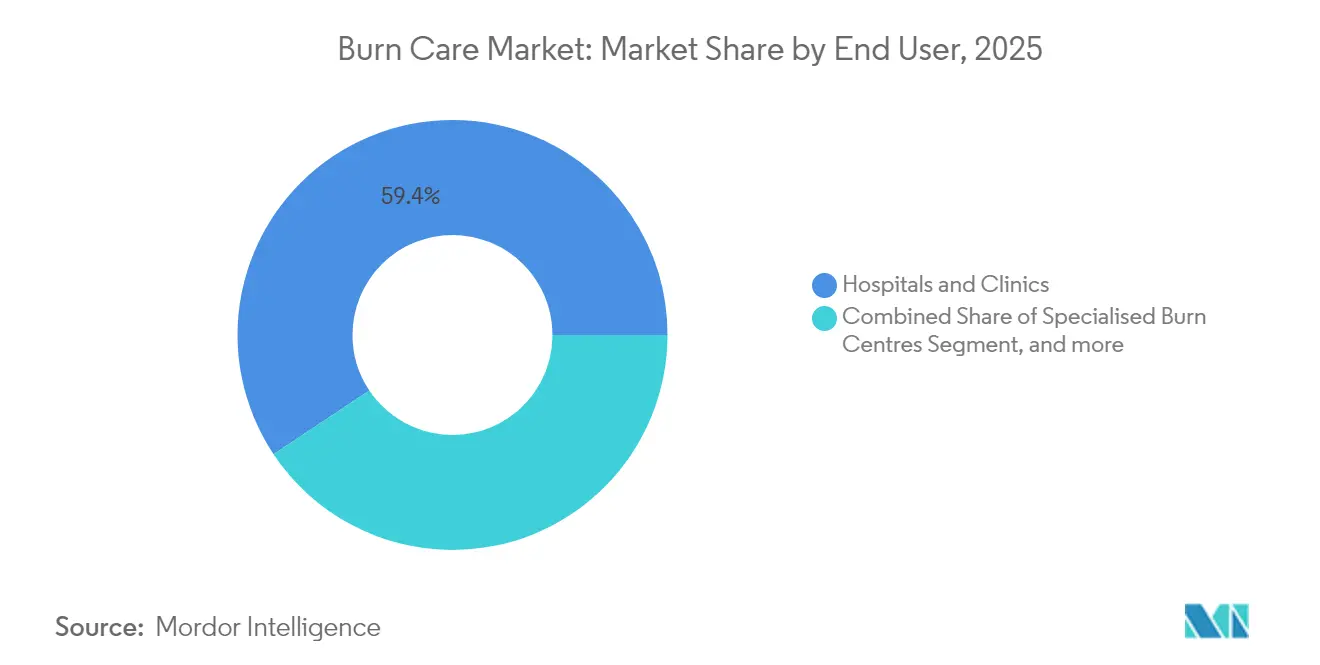
- By end user, hospitals and clinics held 59.35% revenue in 2025; ambulatory surgery centers are forecast to grow 9.72% annually to 2031.
- By geography, North America dominated with 39.28% of 2025 sales, and Asia-Pacific is expected to grow at an 7.78% CAGR through 2031.
Note: Market size and forecast figures in this report are generated using Mordor Intelligence’s proprietary estimation framework, updated with the latest available data and insights as of 2026.
Market Trends and Insights
Drivers Impact Analysis of Burn Care Market*
| Driver | ( ~ ) % Impact on CAGR Forecast | Geographic Relevance | Impact Timeline |
|---|---|---|---|
| High incidence of burn injuries worldwide | +1.2% | Global wildfire-prone zones | Long term (≥ 4 years) |
| Adoption of advanced wound dressings and skin grafts | +1.8% | North America & Europe spreading to Asia-Pacific | Medium term (2-4 years) |
| Rapid technological advances in NPWT, antimicrobial hydrogels, 3-D bioprinting | +2.1% | Worldwide led by North America & Europe | Short term (≤ 2 years) |
| Favourable reimbursement and government safety initiatives | +0.9% | North America, Europe, selected Asia-Pacific | Medium term (2-4 years) |
| Rising electric-vehicle and lithium-battery fire incidents | +0.3% | North America, Europe, China | Short term (≤ 2 years) |
| Climate-linked wildfire frequency | +0.7% | US West Coast, Australia, Mediterranean Europe | Long term (≥ 4 years) |
| Source: Mordor Intelligence | |||
High Incidence of Burn Injuries Worldwide
Wildfires in Central Canada burned 2.7 million hectares in 2025 and forced 33,000 evacuations, pushing emergency departments to an eightfold surge in burn-related visits. The January 2025 Los Angeles fires destroyed 16,250 structures and exposed 41,000 residents, illustrating the escalating clinical burden.[1] Chronic wound management, including burns, carries an annual economic load surpassing USD 20 billion in the United States. Pediatric trials with non-thermal plasma cut skin-graft needs from 40% to 10%.[2] These data point toward sustained allocation of resources across global health systems.
Increasing Adoption of Advanced Wound Dressings & Skin Grafts
Smith+Nephew posted 3.8% underlying growth in its Advanced Wound Management unit during Q1 2025, reflecting robust demand for foams and NPWT devices. The Red Dot-awarded RENASYS EDGE system addresses the needs of 8.2 million American chronic-wound patients at a USD 33 billion financial burden. Silver-nanoparticle and collagen matrices achieve 50-95% healing rates across diverse cohorts. Solventum’s V.A.C. Peel & Place cut application time by 61% and costs by 41% while supporting seven-day wear. Healthcare purchasers therefore continue to favour clinically proven dressings that also reduce total cost of care.
Rapid Technological Advances (NPWT, Antimicrobial Hydrogels, 3-D Bioprinting)
Caltech’s iCares smart bandage delivers real-time diagnostics and machine-learning-based healing predictions with expert accuracy.[3] Three-dimensional bioprinted nanofiber scaffolds show improved adhesion and controlled degradation for full-thickness wounds. Conductive hydrogels containing deep-eutectic solvents stimulate tissue repair through low-intensity electrical fields. MedStar Health paired dynamic thermography with laser Doppler imaging to anticipate wound conversion, enabling earlier intervention. Such tools shorten healing times and limit infection-related readmissions.
Favourable Reimbursement & Government Safety Initiatives
CMS reclassified skin substitutes as wound-care management products in April 2025, expanding application limits and introducing new documentation standards. The 2025 Physician Fee Schedule added caregiver training codes G0541-G0543, supporting telehealth engagement. The Military Burn Research Program committed USD 650 million to triage and treatment technologies designed for austere settings. Compliant suppliers gain advantage under the updated rules.
Restraints Impact Analysis of Burn Care Market*
| Restraint | ( ~ ) % Impact on CAGR Forecast | Geographic Relevance | Impact Timeline |
|---|---|---|---|
| High cost of advanced products and biologics | -1.4% | Global emerging markets | Medium term (2-4 years) |
| Limited reimbursement and skilled staff | -0.8% | Asia-Pacific, Latin America, Africa | Long term (≥ 4 years) |
| Stringent biologic regulatory pathway | -0.6% | North America, Europe, selected Asia-Pacific | Medium term (2-4 years) |
| Raw-material supply volatility | -0.4% | Global manufacture hubs | Short term (≤ 2 years) |
| Source: Mordor Intelligence | |||
High Cost of Advanced Burn-Care Products & Biologics
Medicare investigations into inflated skin-substitute pricing spotlight financial barriers in the burn care market. Integra LifeSciences saw Tissue Technologies revenue fall 15.3% in Q1 2024 due to production outages, underscoring supply risk. DOJ action against Vohra Wound Physicians accentuates compliance pressure. Accountable Care Organizations advocate stricter controls to safeguard budgets. High sticker prices thus temper biologic uptake, especially outside high-income economies.
Limited Reimbursement & Skilled Staff in Emerging Economies
Asia-Pacific still shows the fastest trajectory yet faces gaps in certified wound nurses, hindering the burn care market. Home-health teams struggle with complex dressing protocols, and limited insurance hampers broad technology deployment. A regional consensus on standardized burn assessment called for investment in professional development and telehealth infrastructure. Solutions such as WoundConnect reduced in-person visits while keeping clinical outcomes stable. Nevertheless, progress remains uneven across developing regions.
*Our forecasts treat driver/restraint impacts as directional, not additive. The impact forecasts reflect baseline growth, mix effects, and variable interactions.
Burn Care Market Segment Analysis
By Product Type:
Advanced Dressings Retain Leadership Amid Biologic SurgeAdvanced dressings held 52.21% market share, of the burn care market in 2025. Iterative upgrades in hydrofiber foams, antimicrobial silver layers, and moisture-handling backings maintain clinician confidence and secure reimbursement. Smith+Nephew expanded its foam line in 2024, reinforcing stickiness within hospital formularies. Traditional dressings persist in budget-sensitive outpatient settings, sustaining baseline demand. Therapy devices, notably portable NPWT units, speed patient discharge and bolster outpatient revenue models. Topical antimicrobial gels remain standard prophylaxis for minor wounds.
Biologics, while smaller in absolute value, recorded 9.41% CAGR from 2026 to 2031, the highest across product categories. FDA clearance of AVITA Medical’s Cohealyx dermal matrix in December 2024 widens indications and triples the firm’s total addressable population. Bioengineered skin delivers outcomes similar to autografting without donor-site morbidity. However, the burn care market size for biologics stays curtailed by high manufacturing cost and complex cold-chain logistics. As payers refine coverage criteria, vendors that generate robust comparative-effectiveness data will gain share.

By Depth of Burn:
Prevalence of Partial-Thickness Dominates as Full-Thickness Gains MomentumPartial-thickness injuries comprised 43.61% of the burn care market in 2025, benefiting from established moist-healing protocols and outpatient care pathways. Patients typically receive hydrogel or silicone dressings that minimize trauma on changes, reducing infection risk and scarring. Minor wounds, often treated at home or in urgent-care settings, drive demand for accessible dressings and analgesic sprays. Clinician familiarity, predictable healing times, and lower material cost sustain steady revenue.
Full-thickness burns, although fewer in case volume, will rise at an 8.29% CAGR to 2031. The January 2025 Los Angeles fires exposed tens of thousands of residents, highlighting the need for highly specialized reconstruction. Advanced dermal matrices from Integra anchor staged reconstruction algorithms that now achieve higher survival rates. Growth accelerates as critical-care capabilities improve outside traditional burn centers, expanding geographical availability of complex surgeries. The burn care market size for these severe presentations therefore shows disproportionate revenue contribution compared with case count.
By End User:
Hospitals Dominate While Ambulatory Centers ExpandHospitals and clinics accounted for 59.35% of 2025 revenue in the burn care market. Level I burn centers integrate intensive care, surgical suites, and rehabilitation teams to manage complex trauma. The USD 650 million Military Burn Research Program funds innovations such as deployable resuscitation units, reinforcing hospital capabilities. Emergency departments also function as gatekeepers, initiating NPWT or graft placement before step-down to outpatient settings.
Ambulatory surgery centers are expected to register a 9.72% CAGR through 2031 as portable NPWT and advanced dressings enable same-day procedures. Smart bandages like iCares permit real-time monitoring outside hospital walls, giving clinicians confidence to shorten inpatient stays. Reimbursement incentives for site-of-service shifts, together with patient preference for home recovery, support ambulatory adoption. Vendors tailoring packaging and staff training for outpatient workflows will capture incremental opportunities in the burn care market.
Geography Analysis
North America Burn Care Market
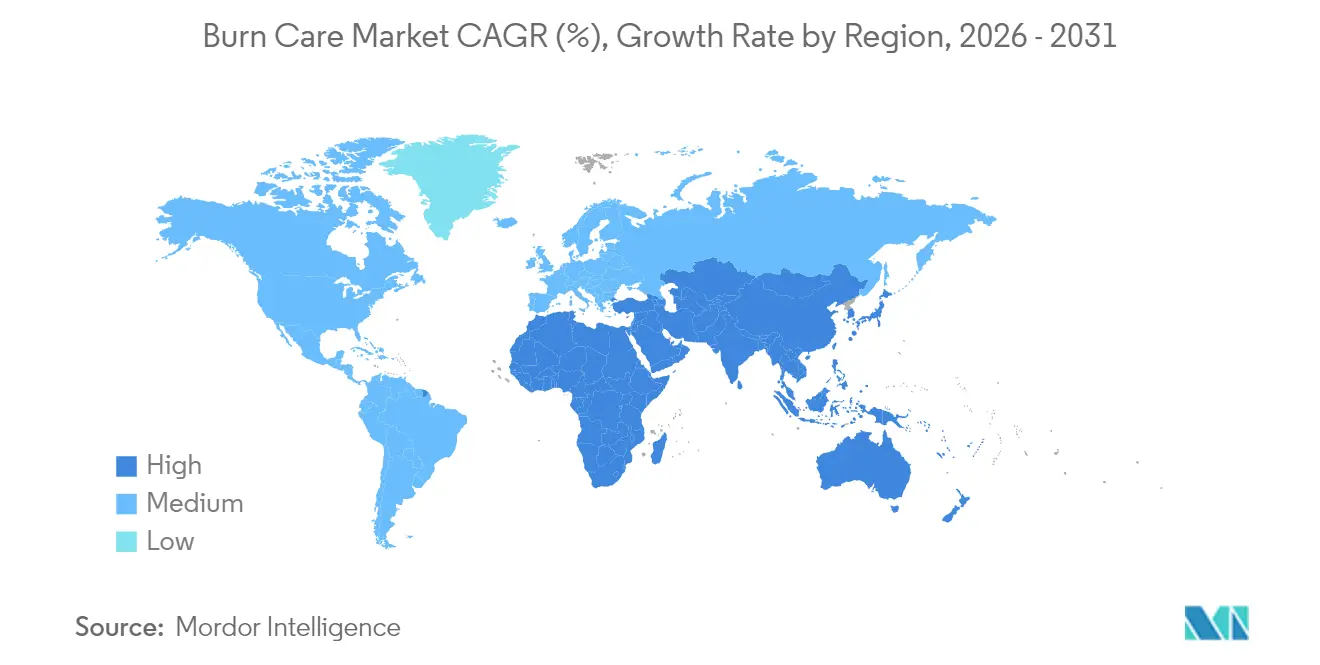
North America held 39.28% of global revenue in 2025. Federal investments, including the USD 650 million Military Burn Research allocation, promote basic and translational science. CMS updates on skin-substitute coverage effective April 2025 further incentivize technology uptake. The Los Angeles wildfires exposed 41,000 people and demonstrated the region’s vulnerability. Canadian wildfires affected 2.7 million hectares and sent smoke toward 117 million Americans, indicating cross-border healthcare contingencies.
Europe Burn Care Market
Europe combines strict regulatory oversight with rising wildfire activity around the Mediterranean. Healthcare systems focus on cost-effectiveness, prompting hospitals to adopt dressings that reduce total hospitalization days. Joint EU research programs foster collaboration between academic groups and device makers, accelerating approvals of smart hydrogel dressings.
APAC Burn Care Market
Asia-Pacific is projected to achieve an 7.78% CAGR to 2031. Policymakers prioritize universal health coverage and invest in trauma infrastructure, creating strong tailwinds in the burn care market. A region-wide consensus issued new burn-assessment guidelines and emphasized workforce training. Private-equity interest grows as healthcare providers consolidate and seek digital-health partnerships.
MEA and South America Burn Care Market
Middle East & Africa and South America remain nascent yet show steady uptake of portable NPWT and silver dressings. Governments modernize emergency services to meet climate-related disaster demands. Multilateral aid and public-private collaborations introduce telehealth solutions for remote burn triage, gradually expanding the burn care market footprint in underserved regions.
Regulatory Landscape
Burn care products span medical devices (advanced dressings, NPWT systems, and emerging non-thermal plasma equipment) and biologics/skin substitutes, so market access depends on both quality-system controls for devices and therapy-specific expectations for clinical evidence. In the United States, FDA positioning for burn-related products continues to rely on its framework for developing products for chronic cutaneous ulcers and burn wounds, while device categorization remains active in the FDA classification system (including product code OJJ for burn kits without drugs, updated in April 2026). The compliance burden is rising for novel modalities: IEC issued IEC 60601-2-91:2026 in June 2026, adding particular safety and essential performance requirements for non-thermal plasma wound treatment equipment, and ISO published ISO 10993-6:2026 in April 2026, tightening expectations for local-effects biocompatibility testing relevant to implantable or longer-wear materials used in advanced wound therapies.
In Europe, Regulation (EU) 2017/745 (MDR) remains the central framework for device approvals and post-market oversight through the 2026 consolidated text, shaping evidence packages for class III and implantable wound-care devices and certain skin-substitute delivery systems. EMA also updated its procedural documentation for parallel joint scientific advice for high-risk medical devices on May 29, 2026, reinforcing the route for developers to align clinical and regulatory strategy earlier in the product cycle. Clinical-development standardization is also being refreshed through professional and scientific channels, including a June 2026 proposed addendum from the Wound Care Collaborative Community to modernize the 2006 FDA guidance with updated reporting standards such as WRAHPS, which can raise the bar for preclinical and translational documentation for advanced burn-care technologies.
Competitive Landscape
The competitive arena features diversified multinationals and agile biotech entrants. Smith+Nephew generated USD 5.5 billion sales in 2023 and leverages scale to bundle foams, infection-control products, and surgical tools. 3M separated its healthcare assets into Solventum, inheriting USD 340 million in federal contracts for NPWT systems. Integra LifeSciences anchors its USD 1.6 billion regenerative portfolio with AI-enabled wound analytics that guide graft decisions.
Disruptors target niche opportunities. Caltech’s iCares smart bandage integrates sensors and predictive algorithms, offering hospitals a data-rich alternative to conventional dressings. Start-ups in 3-D bioprinting supply custom scaffolds for full-thickness reconstructions. Patent filings on conductive hydrogels and polymer nanofibers accelerate as firms seek defensible IP. Heightened DOJ action over false claims raises compliance costs, favouring players with robust governance.
Strategic moves include partnerships with telehealth providers to track outpatients, licensing of antimicrobial coatings, and regional acquisitions that add distribution scale. Vendors also explore value-based contracts where reimbursement ties to documented healing outcomes, aligning incentives with payers and accountable-care organizations in the burn care industry.
Burn Care Industry Leaders
-
Johnson & Johnson
-
Mölnlycke Health Care AB
-
3M Company
-
Smith & Nephew plc
-
Cardinal Health Inc.
- *Disclaimer: Major Players sorted in no particular order
Burn Care Market Companies Covered in this Report
- 3M
- Smiths Group
- Molnlycke Health Care
- ConvaTec Group plc
- Johnson & Johnson
- B. Braun
- Integra LifeSciences Corp.
- Medline Industries
- Cardinal Health
- Hollister
- DeRoyal Industries
- Avita Medical
- PolyNovo Ltd.
- Vericel
- Organogenesis
- Stratatech (Mallinckrodt)
- Stryker
- Coloplast
- Medtronic
Market Opportunities and Future Outlook
Retail and outpatient channels are a clear whitespace for standardized, easy-to-use burn-care regimens that link first aid and cleansing with advanced dressings. A concrete signal came in March 2026, when Sonoma Pharmaceuticals launched an HOCl-based burn relief hydrogel through major US retailers (CVS and Walmart), indicating growing interest in scalable, consumer-accessible products that can also complement clinic pathways. At the same time, site-of-care shifts toward ambulatory and home settings support vendors that package advanced dressings, portable NPWT, and training-enabled protocols to reduce dressing-change complexity and enable telehealth follow-up.
Technology-led opportunities are concentrated in biologics and active platforms that address infection, inflammation, and tissue remodeling rather than passive coverage alone, but adoption is gated by evidence generation and reimbursement scrutiny. Multi-center studies and late-stage development activity provide near-term commercialization pathways, including MediWound's VALUE global study launch in June 2026 (216 patients across the US, Europe, and Israel) using burn-derived enzymatic technology (EscharEx) in chronic wounds, and B&K Corporation's Phase IIIa clinical trial initiation in May 2026 for a rhPDGF-BB gel in deep second-degree burns. With CMS updating skin-substitute policy in April 2025 and the American Burn Association publishing the 2025 Burn Nursing Scope and Standards to standardize specialty practice, suppliers that pair clinically differentiated products with documentation-ready workflows and workforce support tools can better address adoption barriers across both high-income and emerging markets.
Recent Industry Developments in Burn Care Market
- July 2026: Molnlycke Health Care introduced three wound-care innovations in the United States, including Granudacyn Wound Wash Solution, the Tortoise Lite Turning and Positioning System, and the Mepi Press 2 and Mepi Press 2 Lite compression systems. The launches broaden Molnlycke's acute-to-post-acute wound management portfolio in a key geography and support bundled protocols that link cleansing, pressure management, and adjunctive therapy in complex wounds, including burns.
- May 2026: Smith+Nephew launched ALLEVYN COMPLETE CARE Dressing and RENASYS EDGE tNPWT at the EWMA 2026 meeting. Pairing advanced foam dressings with portable negative pressure capabilities supports a pathway for earlier discharge and outpatient management, aligning with hospital cost-containment and ambulatory workflow needs.
- December 2024: AVITA Medical received FDA clearance for Cohealyx dermal matrix, expanding indications and increasing the company's addressable population for skin-substitute use. The clearance strengthens competitive intensity in biologics and raises the importance of payer-facing clinical and economic evidence as more advanced matrices compete for adoption in severe burn reconstruction.
Burn Care Market Report Scope and Research Methodology
Market Definition and Coverage
For this study, the burn care market covers products used to clean, protect, and support healing of burn wounds across care settings, including dressings, biologics, and therapy devices that are purchased for clinical use.
Scope exclusions: We exclude routine cosmetic skin care, general antiseptics not used specifically for burn protocols, and non-medical services that are not billed as burn care.
Segments Covered in This Report
- By Product Type
- Advanced Dressings
- Foam Dressings
- Hydrocolloid Dressings
- Hydrogel Dressings
- Alginate Dressings
- Antimicrobial Silver Dressings
- Collagen & Silicone Dressings
- Traditional Dressings
- Biologics
- Therapy Devices
- Topical Agents
- Other Product Types
- Advanced Dressings
- By Depth of Burn
- Minor Burns
- Partial-Thickness Burns
- Full-Thickness Burns
- By End User
- Hospitals & Clinics
- Specialised Burn Centres
- Ambulatory Surgery Centres
- Home-Care Settings
- Military & Emergency Services
- By Geography
- North America
- United States
- Canada
- Mexico
- Europe
- Germany
- United Kingdom
- France
- Italy
- Spain
- Rest of Europe
- Asia-Pacific
- China
- Japan
- India
- Australia
- South Korea
- Rest of Asia-Pacific
- Middle East & Africa
- GCC
- South Africa
- Rest of Middle East & Africa
- South America
- Brazil
- Argentina
- Rest of South America
- North America
Data Sources, Market Sizing, and Validation
Desk Research
Desk work starts by mapping the treated burn population and care pathways, and then connecting that with how products are purchased and reimbursed in major countries. We lean on public health and utilization references such as World Health Organization injury and burn statistics, CDC injury data, and OECD health expenditure indicators to set the demand context by region.
To make the inputs more practical, we also review sources such as National Institutes of Health and peer reviewed burn and wound care journals, along with government tariff schedules and customs statistics where burn dressings and related devices can be tracked. Company filings, annual reports, investor presentations, and reputable press coverage are used to confirm product mix shifts and pricing direction. Where needed, we also use paid subscriptions for company financials and news intelligence, plus patent databases to sanity check innovation intensity. These desk research sources are illustrative, and many other public and paid references were used for data collection, validation, and clarification.
Primary Interviews and Surveys
Primary conversations are used to confirm what gets counted as burn care in real procurement, and how usage differs by burn depth, setting of care, and country reimbursement practices. We speak with a mix of manufacturers, distributors, clinicians in burn units, and procurement and wound care managers across APAC, EMEA, and the Americas so that the desk assumptions get corrected where local practice varies.
Distribution of primary research fieldwork respondents
| Company type | Respondent position | Region |
|---|---|---|
| Top tier: 35% | CXOs: 13% | APAC: 46% |
| Mid tier: 50% | Functional/Unit leaders: 42% | EMEA: 29% |
| Smaller Players: 15% | Managers: 45% | Americas: 25% |
Market-Sizing & Forecasting
Sizing is built using a top-down approach where epidemiology and treated-case volumes are translated into product demand by applying setting-specific treatment rates, dressing change frequency, and adoption of advanced options. The totals are then checked against selective bottom-up approximations, such as sampled supplier revenue splits, channel checks with distributors, and an ASP times volume test for key product groups, and adjustments are made when the two views drift.
Inputs that matter in burn care include incidence and hospitalization rates for burns, share of partial and full-thickness cases, surgical grafting propensity, average length of stay for severe burns, and the mix shift from traditional dressings to advanced dressings and biologics. Pricing is handled through regional ASP ladders that reflect reimbursement pressure, inflation, and product innovation, and then converted consistently into USD for comparability. For forecasting, scenario analysis is used because practice patterns and funding can swing by country, and the scenarios are anchored by expert views on adoption speed of biologics and therapy devices, plus expected changes in burn center capacity and prevention programs. Where product-level volume data is thin, gaps are handled by using proxy utilization ratios from comparable health systems and rechecking them with interview feedback before finalizing.
Data Validation & Update Cycle
Before sign-off, outputs are triangulated against independent signals, including public injury and hospital activity indicators, regional health spend direction, and visible pricing movements for wound dressings and related devices. Large variances are flagged, worked back to the driver level, and then reviewed in a multi-step analyst check so that arithmetic, assumptions, and scope logic stay consistent.
If interviews or news flow indicates a material shift, such as a reimbursement change or a major practice update in burn centers, we re-contact sources and re-run the affected parts of the model. The report is refreshed annually, and interim updates are completed when major events could alter demand, pricing, or product mix. Right before delivery, a final review pass is done so clients receive the most current view available.
Mordor Intelligence's Burn Care Market Size Compared With Other Published Estimates
Published market sizes for burn care often differ because firms do not line up on what products are included, which year is treated as the current base, and how they handle usage rates for minor burns versus inpatient severe burns. Differences also come from how pricing is normalized across countries and how frequently the assumptions are refreshed.
The main gap comes from whether minor-burn retail and general wound products get blended into the total, where Mordor Intelligence counts value only when items are used within defined burn care protocols across dressings, biologics, and therapy devices, and then ties volumes back to treated-case and setting-of-care indicators.
Benchmark comparison
| Source | Market Size | Gaps in Research Methodology |
|---|---|---|
| Mordor Intelligence | USD 3.06 B (2026) | |
| Industry Publisher A | USD 2.88 B (2024) | Uses an earlier base year and may apply a broader inclusion of traditional burn care and physician office use, which can shift the treated setting mix and smooth pricing differences across regions. |
| Industry Publisher B | USD 2.43 B (2024) | Anchors the total on 2024 and emphasizes product shares without clearly showing how treated-case volumes and dressing change rates scale by burn depth, which can pull down the implied consumption in higher acuity care. |
The spread in the table is largely explained by base-year selection and by how strictly burn-specific utilization is separated from general wound care purchasing. By keeping the model traceable to treated cases, care setting, and product-category pricing, the final total becomes easier to reproduce and to stress-test when assumptions change.
Key Questions Answered in the Report
What is the current size of the burn care market?
The burn care market stood at USD 3.06 billion in 2026 and is projected to reach USD 4.14 billion by 2031.
Which product category dominates revenue?
Advanced dressings accounted for 52.21% of 2025 revenue, making them the leading product segment.
Which region is growing fastest?
Asia-Pacific is forecast to expand at an 7.78% CAGR between 2026 and 2031 because of rising healthcare investment and standardized treatment protocols.
Why are ambulatory surgery centers important for future growth?
Portable NPWT devices and smart bandages enable complex wound management outside hospitals, driving a 9.72% CAGR for ambulatory centers through 2031.
How are technology advances shaping burn care?
Real-time sensors, conductive hydrogels, and 3-D bioprinting accelerate healing, reduce infections, and shorten inpatient stays, shifting budgets toward data-enabled solutions.
What challenges limit adoption of biologics?
High manufacturing costs, stringent regulatory pathways, and reimbursement scrutiny in emerging markets constrain widespread biologic uptake despite strong clinical performance.