
Market Overview
| Study Period | 2020 - 2031 |
|---|---|
| Forecast Data Period | 2026 - 2031 |
| Base Year Market Size (2025) | USD 8.75 Billion |
| Market Size (2026) | USD 9.32 Billion |
| Market Size (2031) | USD 12.76 Billion |
| Growth Rate (2026 - 2031) | 6.49 % |
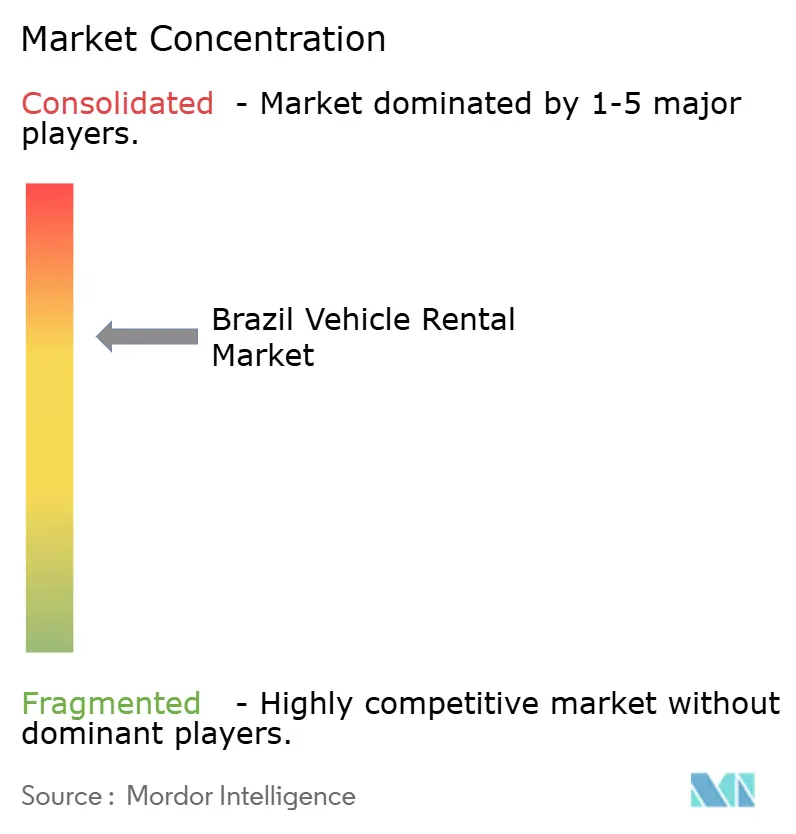
| Market Concentration | Medium |
Major Players *Disclaimer: Major Players sorted in no particular order Image © Mordor Intelligence. Reuse requires attribution under CC BY 4.0. | |
Brazil Vehicle Rental Market Analysis by Mordor Intelligence
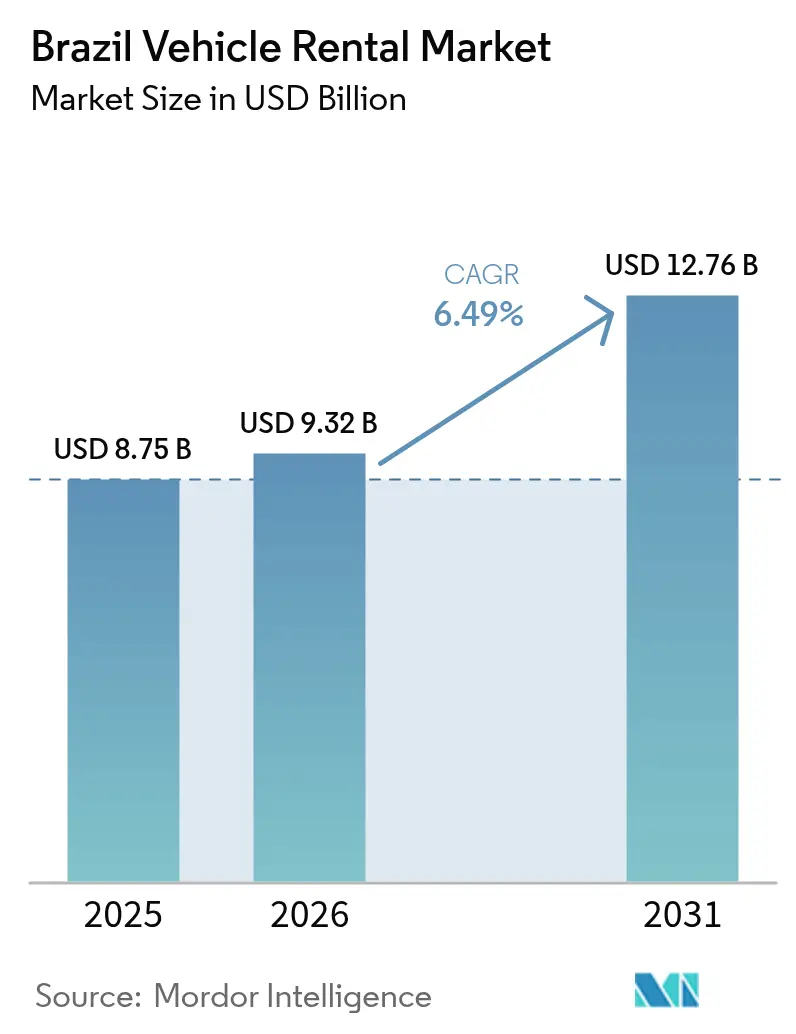
The Brazil vehicle rental market size is expected to grow from USD 8.75 billion in 2025 to USD 9.32 billion in 2026 and is forecast to reach USD 12.76 billion by 2031 at 6.49% CAGR over 2026-2031. This outlook is underpinned by the rebound of domestic leisure trips, the rapid digitalization of booking channels, and corporate preference for outsourced fleets. Passenger-car rentals lead demand because they match both tourist and business travel requirements, while electric-vehicle uptake is growing on the back of favorable Chinese OEM financing. Fleet operators are also scaling quickly as companies convert capital expenditure into operating leases to navigate Brazil’s high-interest-rate environment. The Southeast region keeps the largest revenue base, yet the Northeast is catching up thanks to new low-cost airline routes that push fly-drive itineraries and lift overall utilization rates across the Brazil vehicle rental market.
Key Report Takeaways
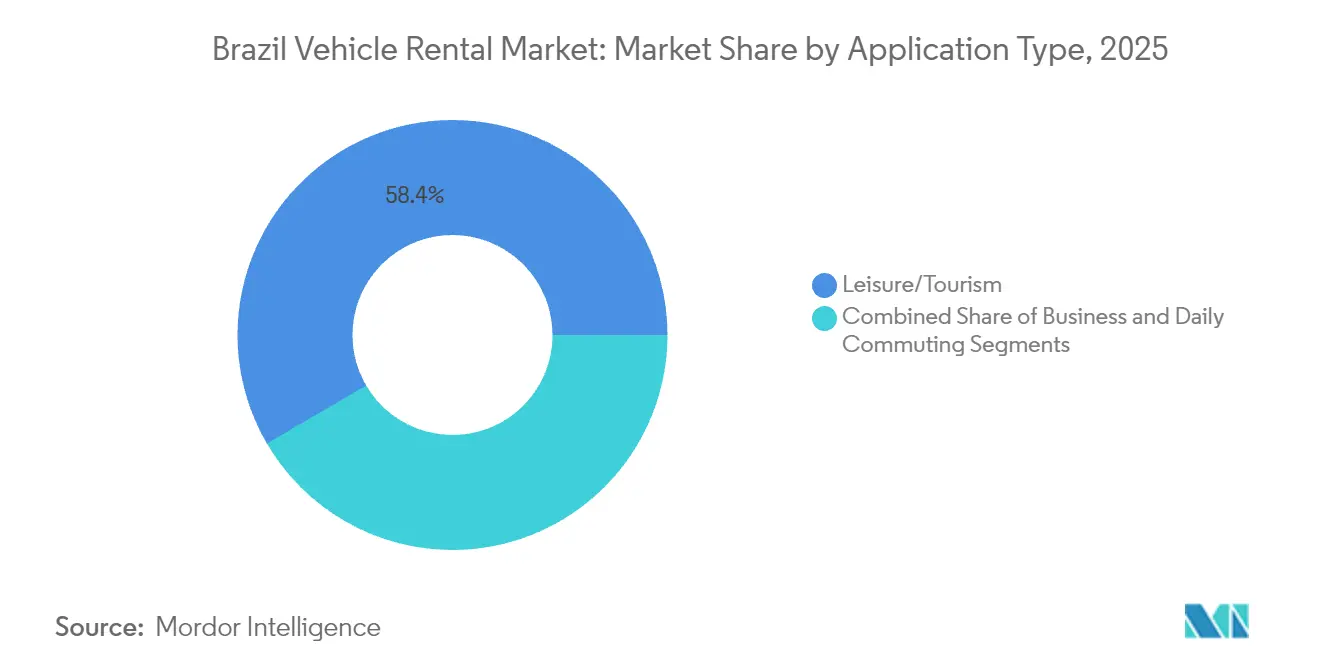
- By application type, leisure/tourism led with 58.42% of the Brazil vehicle rental market share in 2025; daily commuting is projected to advance at a 6.98% CAGR to 2031.
- By booking type, online channels captured 66.05% of the Brazil vehicle rental market share in 2025, and are forecast to grow at a pace of 7.09% through 2031.
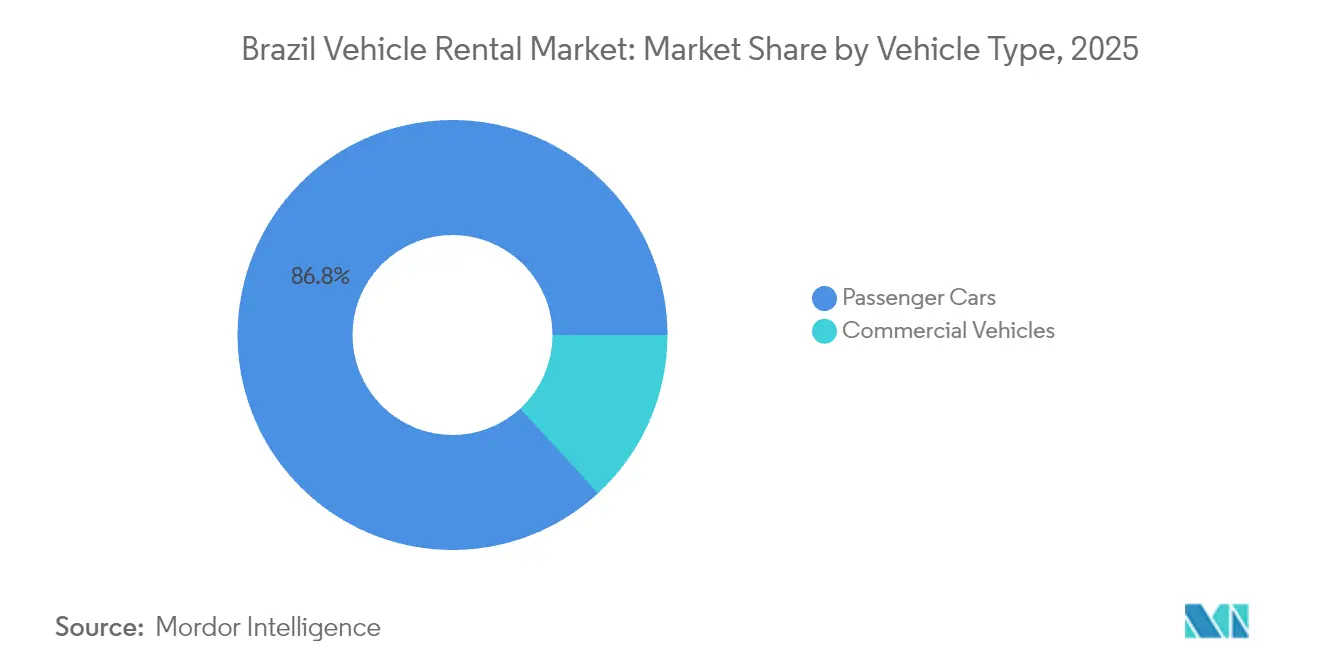
- By vehicle type, passenger cars accounted for 86.84% of the Brazil vehicle rental market size in 2025 and are forecast to grow at a 6.63% CAGR through 2031.
- By end user, tour operators held 62.25% of the Brazil vehicle rental market share in 2025, fleet operators commanded the fastest 9.12% CAGR between 2026-2031.
- By region, Southeast Brazil retained 53.10% of the Brazil vehicle rental market share in 2025, whereas the Northeast is set to grow at an 8.28% CAGR to 2031.
Note: Market size and forecast figures in this report are generated using Mordor Intelligence’s proprietary estimation framework, updated with the latest available data and insights as of 2026.
Market Trends and Insights
Drivers Impact Analysis of Brazil Vehicle Rental Market*
| Driver | ( ~ ) % Impact on CAGR Forecast | Geographic Relevance | Impact Timeline |
|---|---|---|---|
| Boom in Domestic Leisure Tourism Post-COVID | +1.8% | National; strong in Southeast and Northeast | Medium term (2-4 years) |
| Rapid Uptake of Online and Mobile Booking Channels | +1.2% | Nationwide urban centers | Short term (≤ 2 years) |
| Corporate Shift Toward Fleet-Outsourcing Models | +1.0% | Southeast and South metros | Long term (≥ 4 years) |
| Low-Cost Airline Expansion Spurring Fly-Drive Demand | +0.9% | Northeast and Central-West | Medium term (2-4 years) |
| Subscription/Fractional Ownership Models | +0.6% | Major Southeast cities | Long term (≥ 4 years) |
| Chinese OEM Financing Catalyzing EV Fleet Electrification | +0.4% | Nationwide; early in Southeast | Long term (≥ 4 years) |
| Source: Mordor Intelligence | |||
Boom in Domestic Leisure Tourism Post-COVID
Brazilian travel and tourism contributed USD 167.6 billion to GDP in 2025, equal to 7.7% of national output [1]. Leisure trips represent 89.9% of total travel spend, lengthening average stays to 13.1 nights and pushing longer vehicle-rental periods. Government promotion programs such as the 2025-2027 “Plano Brasis” reinforce this trajectory by aiming to attract 8 million foreign visitors. Extended itineraries across coastal, rainforest, and cultural attractions translate into higher revenue per customer for rental operators.
Rapid Uptake of Online and Mobile Booking Channels
Localiza’s Fast Digital Pickup system lets customers collect cars in under five minutes, showing how users' experience and queue elimination foster conversion [2]. Mobile commerce adoption among younger travelers creates data feedback loops, enabling dynamic pricing and fleet-allocation efficiency. As a result, companies that invest in seamless apps and contactless pick-up solutions are capturing disproportionate growth within the Brazil vehicle rental market.
Corporate Shift Toward Fleet-Outsourcing Models
The fleet operator end-user category is expanding because enterprises offload vehicle ownership complexity. Firms like JSL Logistica manage more than 16,400 cars, underscoring scale advantages in telematics, maintenance, and residual-value optimization. Outsourcing converts large capital commitments into predictable operating expenses, an attractive proposition in a 13.25% SELIC-rate environment [3].
Low-Cost Airline Expansion Spurring Fly-Drive Demand
National jet-fuel consumption surpassed pre-pandemic volumes as of April 2024, evidencing a strong domestic aviation recovery. Low-fare carriers have opened routes to secondary coastal airports, particularly in the Northeast, prompting fly-drive packages. New airlift into Fortaleza, Salvador, and Recife lifts vehicle-rental pickup volumes at these gateways and contributes to the Northeast’s forecast-leading growth.
Restraints Impact Analysis of Brazil Vehicle Rental Market*
| Restraint | ( ~ ) % Impact on CAGR Forecast | Geographic Relevance | Impact Timeline |
|---|---|---|---|
| High Interest-Rate Environment Inflating Fleet CAPEX | -1.2% | National | Medium term (2-4 years) |
| Stricter Vehicle-Emission Standards Raising Costs | -0.8% | National | Short term (≤ 2 years) |
| Airport Kerb-Side Restrictions Limiting Pick-Ups | -0.4% | Sao Paulo, Rio de Janeiro, Brasilia | Short term (≤ 2 years) |
| Cyber-Risk on Connected Rental Fleets Inflating Insurance | -0.3% | Urban centers | Long term (≥ 4 years) |
| Source: Mordor Intelligence | |||
High Interest-Rate Environment Inflating Fleet CAPEX
With the SELIC benchmark at 13.25% in 2025, vehicle-loan rates range between 11.58% and 29.22%, driving higher monthly lease costs. Many operators are deferring fleet renewals, risking older average vehicle age and higher maintenance outlays. Elevated borrowing costs also raise the hurdle rate for geographic expansion, slowing penetration in low-density markets.
Stricter Vehicle-Emission Standards Raising Costs
The PROCONVE L8 rules, effective January 2025, require lower fleet-average tailpipe emissions, increasing acquisition prices for compliant models. Rental firms must accelerate replacement cycles or diversify into hybrids and EVs, elevating depreciation charges. Operators that embed vehicle-level emission tracking gain an edge in corporate tenders but may face near-term margin pressure.
*Our forecasts treat driver/restraint impacts as directional, not additive. The impact forecasts reflect baseline growth, mix effects, and variable interactions.
Brazil Vehicle Rental Market Segment Analysis
By Application Type:
Leisure Rentals Drive Volume While Commuting AcceleratesLeisure and tourism applications delivered 58.42% of revenue in 2025, equal to the largest slice of the Brazil vehicle rental market share. Extended stays averaging 13.1 nights translate into longer contracts and higher revenue per booking. Business travel delivers consistent weekday utilization, especially around São Paulo’s financial hubs, while the daily-commuting subsegment is forecast to grow at a 6.98% CAGR on the back of flexible-use subscriptions.
Longer leisure itineraries reinforce weekend demand peaks, helping operators lift overall fleet utilization across seasons. The commuting category benefits from urban congestion policies that deter private-car ownership, positioning subscription platforms as cost-effective alternatives. Corporate-travel demand remains stable but is increasingly met through outsourced fleet contracts rather than individual rentals, a shift that reshapes pricing and service packages within the Brazil vehicle rental market.

By Booking Type:
Digital Dominance Redefines Customer JourneyOnline reservations held 66.05% of transactions in 2025 and are scaling at 7.09% CAGR, confirming that intuitive apps and instant confirmation are now table stakes. Offline channels maintain traction in niche scenarios such as high-touch corporate accounts and first-time foreign visitors.
Dynamic pricing algorithms enabled by real-time demand data help minimize idle inventory and safeguard yields. Conversely, offline counters at airports face staffing-cost pressures yet remain vital for ancillary-service upselling. The shift compels every operator in the Brazil vehicle rental market to invest in cybersecurity, omnichannel loyalty programs, and API connectivity with airlines and OTAs.
By Vehicle Type:
Passenger Cars Retain Leadership as EV Share ClimbsPassenger cars contributed 86.84% to the Brazil vehicle rental market size in 2025, growing at 6.63% CAGR through 2031 as they fit both leisure and corporate use cases. Compact sedans drive volume, but premium SUVs capture outsized profitability. Commercial-vehicle rentals serve parcel-delivery and tour-group niches, delivering steady if smaller revenue streams.
Electrification is starting to reshape the passenger-car mix; BYD’s financing packages reduce upfront costs while lower operating expenses appeal to ESG-minded customers. Commercial-van electrification remains nascent due to payload concerns, but pilot programs are underway for urban last-mile fleets. Connectivity and ADAS features are emerging as must-have specifications in new procurement tenders across the Brazil vehicle rental market.
By End User:
Fleet Operators Gain Momentum Amid Outsourcing WaveTour operators captured 62.25% of revenue in 2025 by aligning with hotel and airline packages, yet their share is eroding slowly as direct digital bookings rise. Fleet-management specialists are expanding at 9.12% CAGR, converting fixed-asset ownership into service contracts for corporations seeking balance-sheet lightness.
Higher service complexity around telematics analytics, fuel controls, and sustainability reporting boosts switching costs and cements long-term client relationships. Smaller independent renters face scale disadvantages in financing and technology integration, prompting industry consolidation corridors. The evolving client base necessitates customized service-level agreements and flexible mileage bands across the Brazil vehicle rental market.
Geography Analysis
Southeast Brazil produced 53.10% of industry turnover in 2025 thanks to the economic heft of Sao Paulo and Rio de Janeiro, mature airport infrastructure, and the headquarters clusters of major rental brands. Dense corporate travel keeps weekday utilization high, while affluent domestic tourism supports premium vehicle categories and drives early electric-vehicle adoption.
The Northeast is on track for an 8.28% CAGR, catalyzed by budget-airline connectivity that now links Salvador, Fortaleza, and Recife to secondary domestic origins. Public-private tourism investment programs have upgraded roads and hospitality capacity, unlocking coastal and cultural circuits where rental cars remain the most practical mobility solution. Improved airport facilitation and pre-booked digital channels reduce wait times and improve customer satisfaction, aiding repeat business growth within the Brazil vehicle rental market.
South and Central-West regions post steady mid-single-digit growth anchored in agribusiness, eco-tourism, and cross-border itineraries into Argentina and Paraguay. Lower population density implies longer average trip distances, which boosts mileage revenue per contract but requires larger station footprints. Operators deploy flexible re-allocation of idle capacity between grain-harvest logistics peaks and holiday-season tourist surges, balancing fleet productivity year-round.
Regulatory Landscape
Brazil vehicle rental operators are governed by national traffic and vehicle-registration rules administered through SENATRAN and CONATRAN frameworks. CONTRAN Resolution 461/2013 established the RENAPTV (National Registry of Temporary Possession and Use of Vehicles), requiring corporate owners to register vehicles primarily intended for leasing or renting. This improves traceability and helps identify the responsible driver for infractions (real infrator) tied to rented fleets. SENATRAN also provides official digital services to consult vehicle restrictions and indicators (administrative, judicial, and financial constraints), which rental firms use to support onboarding, risk controls, and de-fleeting decisions.
In 2026, federal policy added a new layer of influence on fleet acquisition and competitive dynamics in passenger mobility. Medida Provisoria 1.359/2026 authorized BRL 30 billion in repayable financing lines for professional individual passenger transport drivers (including taxi cooperatives) to acquire new vehicles meeting sustainability criteria, and Portaria Interministerial 174/2026 set eligibility rules and a vehicle price cap of BRL 150,000 for financed purchases. While the program is not specific to RAC fleets, it can shift demand and procurement priorities in segments where rental companies serve app-driver and taxi use cases, and it increases the relevance of compliant, lower-emission vehicle availability across the market.
Value Chain Analysis
The Brazil vehicle rental value chain starts with vehicle sourcing (OEMs and dealer networks) and fleet financing, then moves to fleet specification, registration compliance, and deployment across airport counters, city branches, and digital-first pickup points. Scale carries the most weight in procurement and funding: ABLA reported the sector reached 1,717,848 vehicles in 2025 (up 6.2% YoY) and invested BRL 79.3 billion in vehicle acquisition in 2025, with 628,970 automobiles and light commercial vehicles registered by rental companies. Operators then monetize fleets through short-term rentals (RAC), long-term leasing and fleet management (GTF), and subscription models, while telematics, maintenance networks, insurance, and toll or parking payments act as enabling inputs that affect uptime and cost per day.
Downstream, residual value realization is a core profit lever. Large players run dedicated used-vehicle (seminovos) channels and reconditioning capabilities to accelerate de-fleeting and recycle capital. Electrification and hybrids are reshaping upstream sourcing relationships as rental companies seek direct access to supply and financing packages, illustrated by Localiza&Co signing an agreement with BYD to acquire up to 10,000 hybrid and electric vehicles over two years. The chain remains sensitive to macro and policy shocks, including high interest rates that raise fleet CAPEX and government-backed credit lines aimed at individual drivers, which can divert some demand away from rental usage in app-driver-oriented subsegments.
Competitive Landscape
Localiza’s merger with Unidas formed a fleet of roughly 631,639 vehicles, granting multi-segment leadership in car rental, long-term leasing, and used-car de-fleeting channels. A vertically integrated model encompassing proprietary sales yards and reconditioning centers helps control residual-value risk and supports aggressive fleet‐renewal cycles. Movida remains the second largest incumbent, though Q4 2023 losses of R$588 million prompted strategic cost reviews and accelerated used-car liquidations.
Multinational brands such as Hertz, Avis Budget, Enterprise, and Sixt concentrate on premium travelers at major gateways, leveraging global loyalty schemes. Domestic challengers like FOCO Rent a Car offer value-oriented propositions in regional airports, while subscription-focused newcomers such as Turbi attract urban millennials through app-driven monthly packages. Competitive tension is intensifying around fleet electrification, where early access to subsidized EV supply is a differentiator in corporate tenders within the Brazil vehicle rental market.
Technology investment forms the new battleground. Localiza deploys AI-based demand forecasting to trim idle inventory, whereas Movida is rolling out end-to-end digital onboarding for corporate clients. Smaller firms collaborate with fintech to bundle insurance, telemetry, and flexible credit scoring, thereby addressing an underserved SME segment. The interplay between scale economies in procurement and agility in niche service design will shape market share over the next cycle.
Brazil Vehicle Rental Industry Leaders
-
Localiza Rent a Car S.A.
-
Movida Participacoes
-
Avis Budget Group
-
FOCO Rent a Car
-
Enterprise Holdings
- *Disclaimer: Major Players sorted in no particular order
Brazil Vehicle Rental Market Companies Covered in this Report
- Localiza Rent a Car S.A.
- Movida Participacoes
- Sixt SE
- Avis Budget Group
- Enterprise Holdings
- Europcar Mobility Group
- FOCO Rent a Car
- Turbi
- Fox Rent A Car
- Vamos Locacao
- VIP Cars
- Rentcars
- Unidas Frotas
Market Opportunities and Future Outlook
Electrified and hybrid fleets represent a concrete whitespace for differentiation in corporate tenders and premium leisure itineraries, particularly where clients require sustainability reporting and predictable operating costs. The opportunity is visible in active procurement moves, including Localiza&Co's agreement with BYD to acquire up to 10,000 hybrid and electric vehicles over two years, spanning rental, fleet management, and subscription services. With PROCONVE L8 effective from January 2025, operators that industrialize emission-compliant procurement and vehicle-level tracking can use compliance in long-term fleet-outsourcing contracts.
Digital-first distribution and automated service flows also create monetizable gaps, given that online booking already dominates the market. Movida's June 2026 launch of a WhatsApp-based AI agent with Meta to manage the rental journey from reservation to payment signals an operational approach to reduce friction, shift volume toward direct channels, and lower handling costs at peak airport demand. At the same time, federal financing authorized in 2026 for app drivers and taxi drivers (BRL 30 billion under MP 1.359/2026 with eligibility rules under Portaria 174/2026) increases the need for rental companies to redesign products for professional drivers, including shorter-cycle subscriptions, bundled maintenance and insurance, and differentiated hybrid offerings, to defend utilization and maintain healthy fleet turns in driver-oriented segments.
Recent Industry Developments in Brazil Vehicle Rental Market
- June 2026: Movida launched a specialized AI agent on WhatsApp in partnership with Meta to manage the rental process from reservation through payment. The move strengthens direct digital distribution and reduces reliance on staffed counters, supporting faster conversion during peak travel periods.
- March 2026: Movida approved a private capital increase in the range of BRL 500 million to BRL 750 million to reinforce its capital structure. The additional funding supports fleet-intensive mobility and logistics initiatives and increases financial flexibility in a high-rate environment.
- February 2026: Localiza&Co signed a strategic agreement with BYD to acquire up to 10,000 hybrid and electric vehicles over two years for rental, fleet management, and subscription services. This secures electrified supply at scale and raises competitive pressure on peers to accelerate procurement and charging-ready operations.
Brazil Vehicle Rental Market Report Scope and Research Methodology
Market Definition and Coverage
This market covers the revenue generated in Brazil from renting vehicles to end users for short and longer durations through online and offline booking, including passenger and commercial vehicle rental services.
Scope exclusions: We exclude vehicle sales revenue, pure taxi and ride-hailing trip revenue, and interest or insurance revenue that is not bundled within the rental price.
Segments Covered in This Report
- By Application Type
- Leisure/Tourism
- Business
- Daily Commuting
- By Booking Type
- Online
- Offline
- By Vehicle Type
- Passenger Cars
- Commercial Vehicles
- By End User
- Tour Operators
- Fleet Operators
- By Region
- Southeast
- South
- Northeast
- North
- Central-West
Data Sources, Market Sizing, and Validation
Desk Research
Desk research was used to set the frame for how large the addressable rental demand pool is in Brazil and how pricing typically shifts across the cycle. We relied on public sources such as the Brazilian Institute of Geography and Statistics (IBGE) for travel and household indicators, the Central Bank of Brazil for inflation and interest-rate context, and federal road and transport statistics for fleet and mobility signals.
To connect demand with supply-side capacity, we reviewed sources such as ANFAVEA vehicle production and registration releases, ANTT materials on road transport, airport and tourism dashboards from official bodies, and customs and trade statistics where relevant for fleet additions. Company filings, investor presentations, and credible press coverage were used to cross-check rental rate movements, utilization commentary, and expansion announcements. In a few places, paid subscriptions were used for company financials, news, and shipment-level trade checks, mainly to confirm directionally what was found in public data. The desk sources mentioned here are illustrative, and we also reviewed other sources for data collection, validation, and clarification.
Primary Interviews and Surveys
Primary work focused on talking with people close to daily rental operations, fleet procurement, and distribution, so assumptions from desk research could be tested against what is happening in-market. We covered perspectives from national and regional rental operators, corporate mobility buyers, fleet managers, and channel partners, then used those inputs to refine utilization, fleet turn, and pricing logic.
Because this is a Brazil-specific market, interviews were balanced across key demand hubs (airport corridors, large cities, and industrial regions) to reduce the risk that one locality over-influenced the final model.
Distribution of primary research fieldwork respondents
| Company type | Respondent position |
|---|---|
| Top tier: 36% | CXOs: 16% |
| Mid tier: 44% | Functional/Unit leaders: 36% |
| Smaller Players: 20% | Managers: 48% |
Market-Sizing & Forecasting
Sizing started with a top-down build where the demand pool was reconstructed using travel activity, corporate mobility needs, and the active rental fleet base, then translated into revenue using utilization and average daily rate patterns. To keep the model practical, a few key inputs were treated as the main levers, including active fleet size, average rental length, utilization rate by channel, average daily rate progression, mix of passenger versus commercial rentals, and the share of corporate fleet outsourcing.
Once the top-down result was formed, we checked it using selective bottom-up approximations, such as rolling up sampled operator revenues, using publicly visible fleet expansion signals, and applying sampled price points across estimated rental days. Where direct numbers were not available for smaller cities or informal supply pockets, gaps were handled through proxy assumptions tied to airport throughput, population income bands, and regional vehicle registrations, then re-tested with interview feedback.
For forecasting, scenario analysis was used so the forward view reflects different paths for interest rates, tourism recovery pace, corporate outsourcing intensity, and vehicle acquisition costs that affect fleet refresh. Forecast inputs were aligned to what interviewees considered realistic for rate increases and utilization normalization, and the model was extended year by year with consistent logic so the steps remain repeatable.
Data Validation & Update Cycle
Outputs were validated through multiple checks that look for unexpected jumps in fleet, utilization, or pricing, and these checks were compared against independent signals like travel volumes and macro indicators. When a variance was found, assumptions were revisited, and follow-up calls were triggered if the gap could not be explained by seasonality or a known event.
Before sign-off, the full file is reviewed by another analyst to ensure inputs, units, and currency handling are consistent across years. Reports are refreshed annually, and interim updates are made when material events occur, such as major regulatory changes, sharp rate shifts, or demand shocks. Right before delivery, we do a final pass so the latest public releases and verified market signals are reflected.
Mordor Intelligence's Brazil Vehicle Rental Market Sizing Compared With Other Published Estimates
Published market sizes for Brazil vehicle rental do not always line up because the scope can shift between car-only and broader vehicle rental, and because some studies treat fleet outsourcing and commercial rentals differently. Differences also come from which year is used as the base, how local currency is converted to USD, and whether pricing is modeled with normalized utilization or with peak-season rates.
In this study, the biggest gap driver is service coverage and what gets counted as rental revenue, since some estimates narrow the market to self-drive car hire, while others also include business and fleet outsourcing activity plus light commercial rentals. Another common spread driver is the pricing build, where daily rates and utilization are either projected with a smooth inflation-linked path or lifted with aggressive post-recovery assumptions, and those choices can compound quickly over a multi-year forecast.
Benchmark comparison
| Source | Market Size | Gaps in Research Methodology |
|---|---|---|
| Mordor Intelligence | USD 8.75 B (2025) | |
| Global Consultancy A | USD 4.88 B (2024) | Uses a car-rental-only scope and a different base year, which can exclude commercial rentals and parts of corporate fleet outsourcing that raise the total addressable revenue. |
| Industry Publisher B | USD 2.23 B (2024) | Leans toward a narrower car-hire definition and a longer-range forecast set, with assumptions that can undercount rental-day volumes when airport and corporate channels are treated conservatively. |
The table shows that the spread is mostly explained by scope and base-year choices, rather than a single disagreement on growth direction. When commercial rentals and fleet outsourcing are included, and utilization and rate paths are checked against travel and fleet signals, the market total moves up, which is the specific treatment applied here and then validated through annual refresh work by Mordor Intelligence.
Key Questions Answered in the Report
What is the current size of the Brazil vehicle rental market?
The market generated USD 9.32 billion in 2026 and is projected to reach USD 12.76 billion by 2031.
Which segment holds the largest Brazil vehicle rental market share?
Leisure and tourism rentals account for 58.42% of revenue, making them the dominant application type.
How fast is the online booking channel growing?
Online reservations are expanding at a 7.09% CAGR through 2031, already controlling 66.05% of all bookings.
Which region is the fastest growing for vehicle rentals in Brazil?
The Northeast is forecast to grow at an 8.28% CAGR thanks to new low-cost airline routes and tourism investments.