
Market Overview
| Study Period | 2020 - 2031 |
|---|---|
| Forecast Data Period | 2026 - 2031 |
| Historical Data Period | 2020 - 2024 |
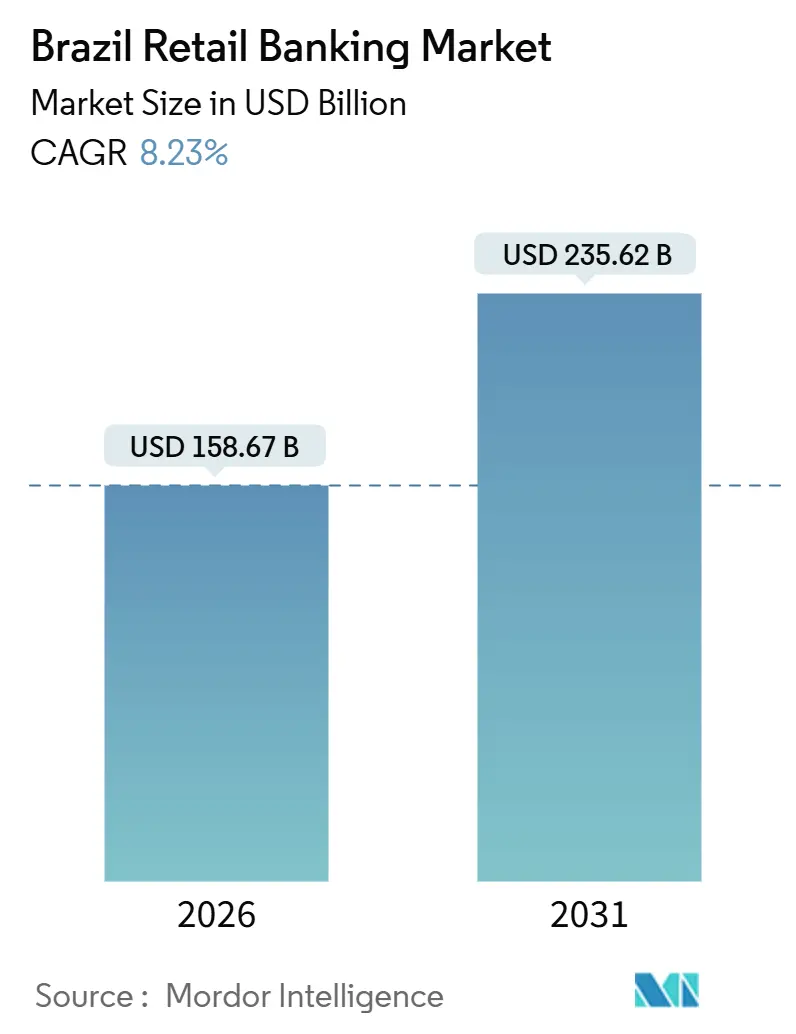
| Market Size (2026) | USD 158.67 Billion |
| Market Size (2031) | USD 235.62 Billion |
| Growth Rate (2026 - 2031) | 8.23 % |
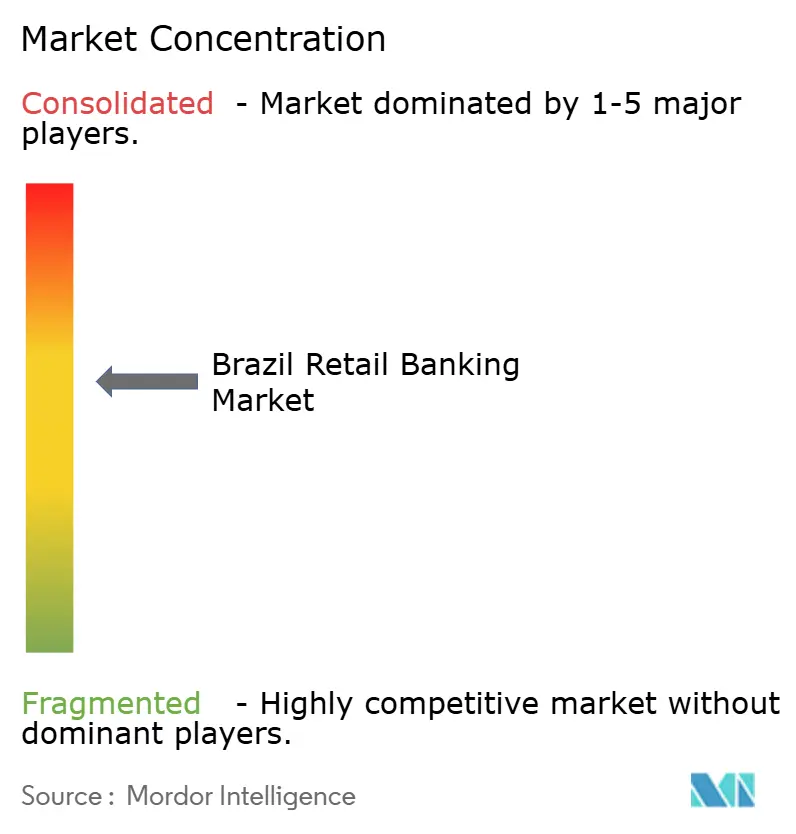
| Market Concentration | Medium |
Major Players *Disclaimer: Major Players sorted in no particular order Image © Mordor Intelligence. Reuse requires attribution under CC BY 4.0. | |
Brazil Retail Banking Market Analysis by Mordor Intelligence
The Brazil retail banking market size is USD 158.67 billion in 2026 and is forecast to reach USD 235.62 billion by 2031 at an 8.23% CAGR. Adoption of instant payments at a national scale, mandatory open-finance data sharing, and digital-only entrants reshape origination, cross-sell, and funding economics in the Brazil retail banking market. Open Finance logged tens of millions of authorized consents and billions of weekly data requests, enabling lenders to refine underwriting and lower friction in onboarding and refinance journeys across the Brazil retail banking market. National banks still anchor scale in the Brazil retail banking market, while neobanks leverage lower cost-to-serve and data-driven risk models that supported a 19.1% ROE for digital banks by mid-2024, signalling a durable shift in competitive dynamics.
Key Report Takeaways
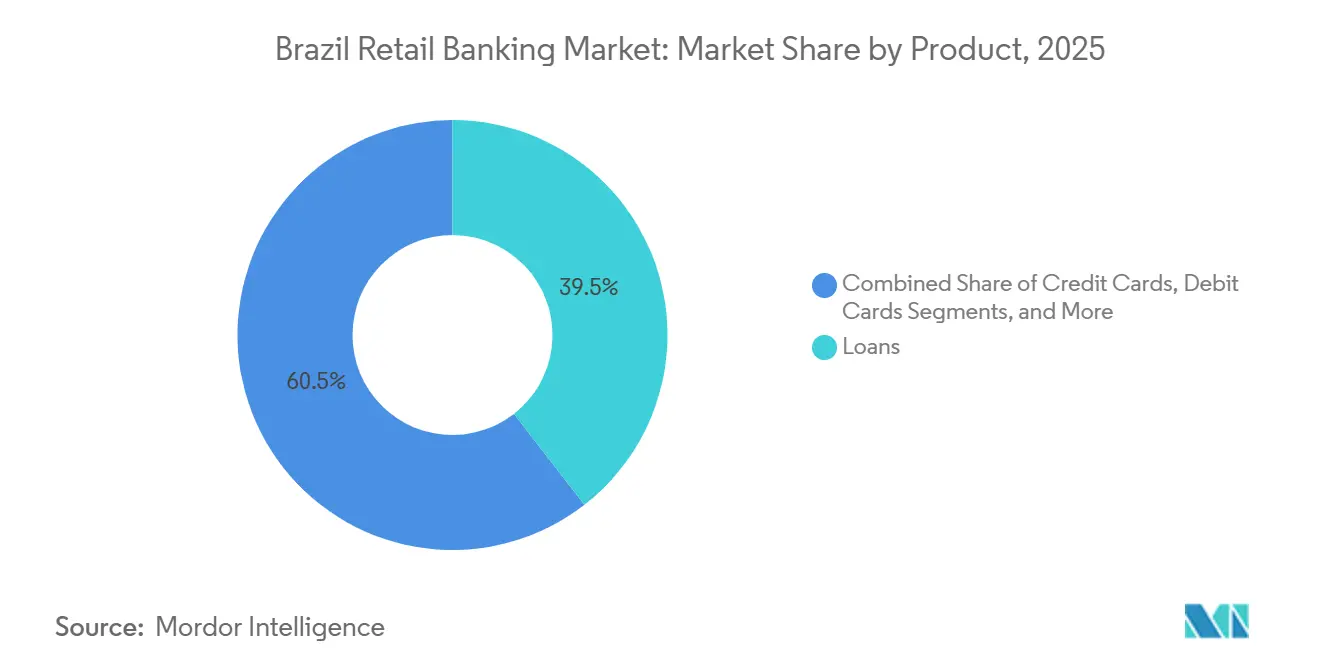
- By product, loans held 39.48% of the Brazil retail banking market share in 2025; credit cards are forecasted to grow at a 12.21% CAGR through 2031.
- By channel, offline banking accounted for 56.52% of the transaction value of the Brazil retail banking market share in 2025, while online banking is projected to record a 14.19% CAGR through 2031.
- By customer age group, the 29–44 cohort held 42.61% of customer accounts of the Brazil retail banking market share in 2025, while the 18–28 segment is set to expand at a 13.43% CAGR through 2031.
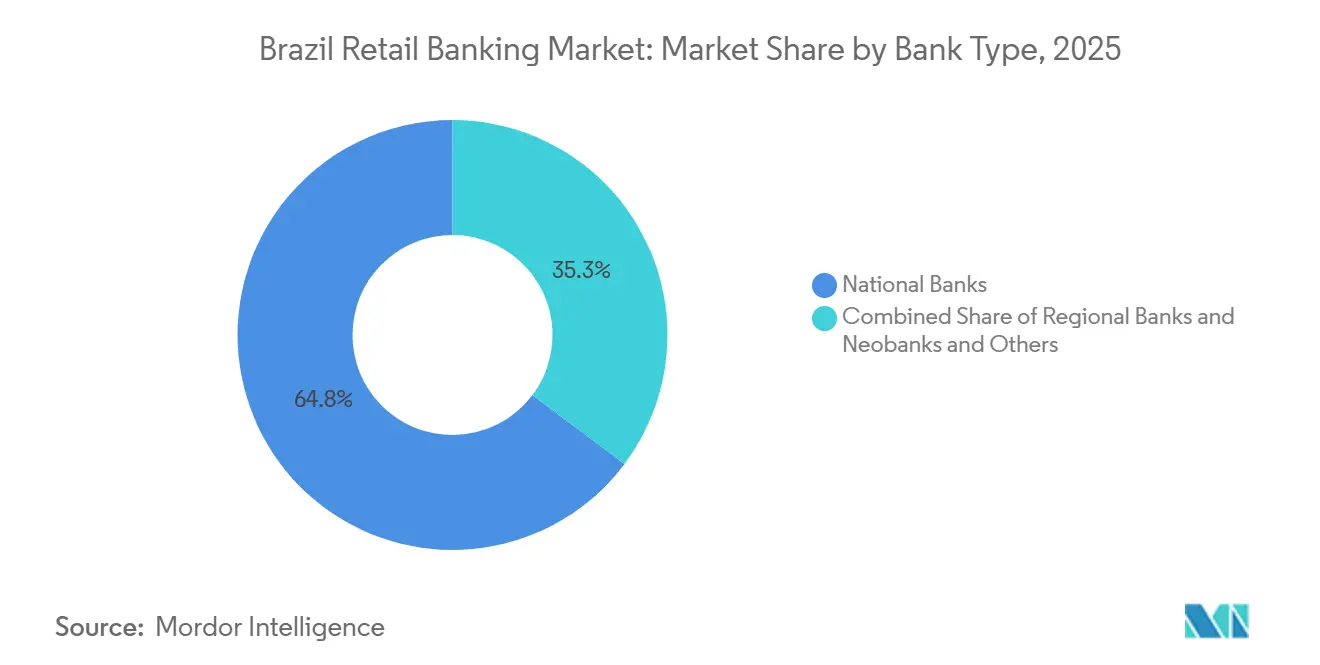
- By bank type, national banks commanded 64.75% of the Brazil retail banking market share in 2025, while neobanks and others are projected to post a 15.87% CAGR through 2031.
Note: Market size and forecast figures in this report are generated using Mordor Intelligence’s proprietary estimation framework, updated with the latest available data and insights as of January 2026.
Brazil Retail Banking Market Trends and Insights
Drivers Impact Analysis*
| Driver | (~) % Impact on CAGR Forecast | Geographic Relevance | Impact Timeline |
|---|---|---|---|
| Pix Instant-Payment Adoption Accelerating Account Growth | +2.8% | National, strongest in Southeast, Northeast, South | Medium term (2-4 years) |
| Open Finance Regulations Fuelling Product Innovation and Competition | +1.9% | National, with the strongest uptake in major urban centres | Medium term (2-4 years) |
| Rise of Digital-Only Challenger Banks Driving Financial Inclusion | +2.1% | National, strong in underbanked regions and among the 18–28 cohort | Long term (≥ 4 years) |
| Government Social-Transfer Programs Boosting Deposit Volumes | +0.9% | National, concentrated in lower-income brackets | Short term (≤ 2 years) |
| Smartphone Penetration Enabling Mobile-First Banking Onboarding | +1.3% | National, strongest in metropolitan areas | Medium term (2-4 years) |
| Interest-Rate Volatility Preserving High Retail Lending Spreads | -0.7% | National | Short term (≤ 2 years) |
| Source: Mordor Intelligence | |||


Pix Instant-Payment Adoption Accelerating Account Growth
PIX, Brazil's instant payment system, covers 90% of the population, positively impacting financial inclusion, the informal economy, and small and medium-sized enterprises (SMEs). Person-to-business flows overtook person-to-person transfers in late 2025, indicating deeper merchant adoption that aligns with lower acceptance costs than card interchange, which improves working capital for small sellers across the Brazil retail banking market. Real-time settlement reduced cash-cycle frictions for large buyers and their supplier networks, with documented case studies showing that payment windows shrank from minutes to seconds for agricultural producers, which supports liquidity and reinvestment decisions. The central bank’s governance of Pix added dispute-resolution tooling and ongoing fraud-prevention enhancements, which underpin trust and support expansion into recurring-billing and point-of-sale use cases in the Brazil retail banking market. As Pix penetrates subscription and invoice use cases, the merchant and consumer activity pools increase the addressable base for cross-sell into checking, cards, and small-ticket credit across the Brazil retail banking market.
Open Finance Regulations Fueling Product Innovation and Competition
Open finance scaled under reciprocity rules that require data sharing by all regulated institutions, with tens of millions of customer consents and billions of weekly API calls recorded as the framework matured through 2025. The architecture supports payment initiation over consented rails and credit-decisioning that integrates payroll, transaction, and portfolio histories from multiple institutions, which reduces information asymmetry and speeds time to decision in the Brazil retail banking market. The central bank’s 2025–2026 roadmap includes credit-portability services with public availability staged for early 2026, which enables frictionless lender switching and intensifies price competition across unsecured and payroll-deducted credit. Investment-data aggregation continues to expand, allowing clients to consolidate views of accounts across brokers and banks, which strengthens cross-sell moves by wealth platforms and universal banks.
Rise of Digital-Only Challenger Banks Driving Financial Inclusion
Digital banks’ ROE rose to 19.1% by mid-2024 as operational leverage improved and provisioning expenses trended lower than those of traditional institutions, validating scalable unit economics for mobile-first players in the Brazil retail banking market. Nubank reported 123 million customers across Brazil, Mexico, and Colombia, and record quarterly revenue of USD 3.7 billion in Q2 2025, while activity rates remained above 83%, which points to durable engagement in core products and add-ons [1]Banco Central do Brasil, “Monetary Policy Report – June 2025,” Banco Central do Brasil, bcb.gov.br. Inter closed Q3 2025 with 41 million total customers and 24 million active accounts, growing its credit portfolio at triple the market pace through private payroll offerings and CX improvements that contained NPL ratios despite macro headwinds [2]OECD, “Brazil: OECD Economic Outlook, Volume 2025 Issue 1,” OECD, oecd.org. Instant-payment access also expanded participation, with multilateral research noting that Pix enabled tens of millions of first-time account-to-account transfers, which broadened the funnel for digital onboarding and basic financial services across the Brazil retail banking market. Regulatory parity on KYC, AML, and authentication, enforced by the central bank, aligns challenger compliance standards with incumbents and sustains confidence in continued scale-up.
Interest-Rate Volatility Preserving High Retail Lending Spreads
Central bank communications in 2025 emphasized a significantly contractionary stance for a prolonged period to ensure convergence of inflation toward the target, which sustained higher retail lending spreads and cautious credit supply in the Brazil retail banking market. Non-earmarked household credit costs rose faster than policy rates over the year as banks incorporated rising delinquency risks into pricing across credit cards and overdrafts [3]BrazilCham, “Inter&Co Reports Record 3Q25 Results, Driven by 30% Credit Expansion and 39% Net Income Growth,” Brazilian-American Chamber of Commerce, brazilcham.com. External funding conditions tightened as frontier-market bond yields climbed toward double digits on average since April 2025, which raised wholesale costs for institutions accessing international markets. The central bank’s forecasts pointed to slower real credit growth in 2025 and 2026 compared with 2024, aligning with tighter financial conditions and higher risk premia in the Brazil retail banking market. Capital and leverage rules under Basel III continued to constrain balance-sheet growth, which encouraged a tilt toward higher-spread retail products relative to lower-margin corporate facilities.
Restraints Impact Analysis*
| Restraint | (~) % Impact on CAGR Forecast | Geographic Relevance | Impact Timeline |
|---|---|---|---|
| Elevated Credit-Delinquency Among Low-Income Borrowers | -1.2% | National, concentrated in lower-income brackets and rural portfolios | Short term (≤ 2 years) |
| Net-Interest-Margin Compression From Selic Rate Cuts | -0.8% | National | Medium term (2-4 years) |
| High Market Concentration Hindering New-Entrant Scale-Up | -0.5% | National | Long term (≥ 4 years) |
| Rising Cyber-Fraud and Compliance Costs | -0.6% | National, with an elevated impact on payment institutions and BaaS providers | Medium term (2-4 years) |
| Source: Mordor Intelligence | |||
Net-Interest-Margin Compression From Selic Rate Cuts
A leading digital bank’s reported NIM moved lower in Q1 2025 as funding costs rose faster than asset repricing, and its risk-adjusted NIM also declined due to higher credit-loss allowances in a changing mix. Central bank projections pointed to slower nominal and real credit growth in 2025 and 2026 than in 2024, which set a backdrop of tighter spreads and cautious originations in the Brazil retail banking market. Non-earmarked household credit granting moderated in late 2024 and shifted toward emergency modalities like revolving cards and overdrafts, which shortened average tenors and concentrated refinancing risk. Real estate lending slowed as the cost of operations rose with policy tightening, which weighed on mortgage affordability and volumes. Macro forecasts indicated decelerating GDP growth into 2026 with inflation above target, reinforcing a restrictive policy stance that will keep liability costs elevated against asset yields in the Brazil retail banking market [4]Nu Holdings, “Nubank Applies for U.S. National Bank Charter,” Nu Holdings, international.nubank.com.br.
Rising Cyber-Fraud and Compliance Costs
Technology and risk-control investments lifted non-interest expenses at leading banks in 2025 as institutions hardened systems and modernized infrastructure for digital channels in the Brazil retail banking market. Supervisors expanded the Risk and Control Assessment model to capture aggressive practices, high indebtedness, and incentive-related conduct risks, with the next cycle broadening the scope to additional entrants from January 2026. Climate-risk management requirements advanced through 2025, with system exposure to drought and water stress cited frequently, and more institutions reporting tangible impacts than a year earlier, which adds to disclosure and risk-modelling workloads. The central bank’s 2025–2026 agenda prioritized continued enhancements of open finance, payments security, and supervisory tooling, reinforcing a tighter compliance perimeter for both incumbents and fintechs in the Brazil retail banking market. The accumulation of cybersecurity spend and regulatory reporting tasks raises fixed costs of participation, which is more challenging for mid-sized players that lack diversified revenue bases.
*Our forecasts treat driver/restraint impacts as directional, not additive. The impact forecasts reflect baseline growth, mix effects, and variable interactions.
Segment Analysis
By Product: Secured Lending Anchors Portfolios While Unsecured Cards Race Ahead
Loans captured 39.48% of the Brazil retail banking market share in 2025, as secured facilities and payroll assignment supported lower loss severity and predictable repayment flows. Credit cards, while smaller in base, are forecast to expand at a 12.21% CAGR through 2031 as instalment plans and revolving balances scale within digital channels in the Brazil retail banking market. Rising consumer use of real-time transfers funded checking balances that serve as liquidity pools for everyday payments and bill pay, broadening cross-sell into short-duration credit. Debit remains widely held and supports a pathway to contactless and mobile wallets, which reduces cash dependence as merchant acceptance densifies. Product bundling that ties payments, deposits, and savings into app-based experiences further improves engagement and monetization paths while maintaining lean distribution costs in the Brazil retail banking market.
Policy shifts reshaped the mix in 2025. Legislation expanded payroll-deducted eligibility and added collateral paths, which unlocked millions of originations at lower average rates than non-payroll personal loans and widened access in underserved segments in the Brazil retail banking industry. Vehicle financing grew, but standards loosened, including higher LTVs and older vehicles, which increases residual-value sensitivity in a cyclical downturn. Real estate lending slowed as financing costs rose, which weighed on affordability and new originations even as housing programs continued to support lower-income households. Rural credit delinquency rose to a time-series high in mid-2025 due to climate events and commodity volatility, highlighting exposure concentration risks in specific sub-portfolios. Across unsecured lines, credit-card debt service remained elevated and reflected persistent use of higher-cost revolving modalities that are sensitive to macro conditions in the Brazil retail banking market.


By Channel: Digital Rails Gain Share as Branches Shrink
Offline banking retained 56.52% of market value in 2025, while online banking is set to grow at a 14.19% CAGR through 2031 as smartphones and instant payments reduce the need for in-person interactions across the Brazil retail banking market. Real-time transactions scaled to billions monthly and accounted for over a quarter of retail payments by late 2025, a trend reinforced by lower merchant acceptance costs and seamless point-of-sale experiences. Weekly login rates and mobile engagement sustained the case for branch-light models as consumers adopted wallet features, bill pay, and QR or contactless payments at checkout. API traffic rose sharply and now supports account aggregation, payment initiation, and automated refinance journeys, which blur the lines between bank and non-bank channels in the Brazil retail banking market. Digital wallets and contactless methods advanced in 2025, further accelerating tap-to-pay adoption and reducing cash withdrawals through Pix Saque functionality.
Incumbents and challengers both optimized distributions. The central bank highlighted continued branch rationalization as a lever to lower cost to serve, which was reflected in improved efficiency at scale for leading banks in 2025. A major incumbent reported a second-quarter efficiency ratio in Brazil of 36.9% alongside rising technology investments, indicating cost discipline even as digital spending continues. Open finance will add credit portability in 2026, which will intensify competition as borrowers compare offers in-app and authorize bank switching with standardized data sharing. As alternative payments reduce fee pools linked to card acquiring and legacy services, institutions continue to reprice bundles and shift toward modular offerings that can be embedded into partner platforms in the Brazil retail banking market. The Brazil retail banking market size benefits from greater channel optionality, yet cost curves continue to favour digital-first distribution at scale.
By Customer Age Group: Millennials Dominate Balances, Gen Z Drives Growth
The 29–44 cohort held 42.61% of customer accounts in 2025, reflecting peak earning years and greater uptake of mortgages and credit cards in the Brazil retail banking market. The 18–28 segment is projected to grow faster at a 13.43% CAGR through 2031 as digital onboarding, open finance, and social-benefit deposits create early relationships that expand over time. Activity data show that consumers aged 20 to 39 drive a majority of transactions on instant-payment rails, which supports mobile-first acquisition strategies and cross-sell penetration across deposit, card, and instalment lines. A leading neobank’s youth-focused products gained industry recognition in 2025 for financial empowerment and literacy, indicating the importance of tailored experiences for younger users in the Brazil retail banking market. For older cohorts, payroll-deducted loans and pension-linked income dynamics anchor stable repayment profiles and deposit balances, which remain a core pillar even as digital channel usage rises.
Credit expansion patterns vary by income and age. Credit is accelerated for lower-income households that frequently use emergency modalities like overdrafts and revolving cards, which carry higher risk and are more sensitive to rate cycles. The central bank noted that emergency credit remained high into late 2025, which signals budget stress risks that can impact younger and lower-income borrowers in the Brazil retail banking market. A digital incumbent added more than a million active clients in Q3 2025, expanding its active base while maintaining stable NPLs through product and risk controls aligned with private payroll offerings. Privacy-by-design and consent-management standards under open finance, monitored by supervisors, support age-appropriate offers and responsible marketing across the Brazil retail banking market. Overall, demographic momentum remains a constructive tailwind as mobile engagement rises, and life-stage events trigger multi-product adoption.
By Bank Type: Incumbents Hold Assets, Neobanks Seize Growth
National banks held 64.75% of the Brazil retail banking market in 2025 and continued to post strong profitability at scale, with a top-5 cohort delivering aggregate quarterly profits above BRL 29 billion. Neobanks and other digital-first entrants are projected to grow at a 15.87% CAGR through 2031, supported by low-cost distribution, data-driven underwriting, and lighter physical infrastructure in the Brazil retail banking market. Digital banks’ ROE reached 19.1% by mid-2024, above the system average, reflecting maturing monetization models and improved cost control. A leading universal bank reported BRL 11.5 billion in recurring net income in Q2 2025 with improved efficiency, while a top digital player posted USD 3.7 billion in Q2 2025 revenue with sustained user activity. Regional lenders and cooperatives maintain niche strength in agricultural and SME credit, though climate and commodity cycles tested risk outcomes in 2025.
Strategic vectors continue to diverge. Incumbents rationalize branches, invest in technology, and refine product mixes toward secured and fee-based offerings under tighter capital and liquidity management in the Brazil retail banking industry. Challengers prioritize customer growth, AI-enhanced underwriting, and embedded finance through partnerships, while scaling international footprints where local regulatory approvals are advancing. Supervisory focus on conduct, climate risk, and operational resilience expands compliance workloads across the board, which raises fixed costs and favours players with robust governance. The balance of market power remains with large incumbents, yet the growth vector continues to favour digital-first models in the Brazil retail banking market. The Brazil retail banking market size is expected to benefit from both the scale of incumbents and the innovation pace of challengers as open finance deepens.
Geography Analysis
Regional usage of instant payments highlights asymmetries that inform distribution choices. The Southeast accounted for 42.8% of Pix transactions in 2025, reflecting the region’s concentration of financial headquarters, merchant density, and high-income urban clusters in the Brazil retail banking market. São Paulo alone generated 23.8% of Pix transactions, while Rio de Janeiro posted 8.8% and Minas Gerais 8.3%, mirroring their roles in commerce, energy, services, and mining. The Northeast contributed 26.6% of Pix activity, driven by mobile adoption among younger demographics and broad acceptance by small merchants, which reduced reliance on cash. The South captured 12.3% of Pix usage, with Paraná at 5.0% supported by manufacturing and export flows, a profile that informs banks’ treasury and SME propositions in the Brazil retail banking market. The North and Central-West posted smaller shares but showed steady growth linked to logistics corridors, agribusiness, and federal payroll concentrations that feed deposits and payment volumes.
Risk and growth conditions diverged by state in 2025. The central bank documented climate events that escalated rural delinquencies to a series high, with southern states facing acute stress that spilled over to banks with concentrated agribusiness exposures in the Brazil retail banking market. Biometric authentication for specific payroll-deducted loans initially reduced daily origination volumes but recovered as mobile processes were tuned, with faster normalization in metropolitan areas with stronger network infrastructure. Open finance infrastructure is on track to expand credit portability in 2026 nationwide, which will intensify competition in peri-urban and rural geographies that previously favoured lenders with proprietary customer data. Government export and ecommerce reports indicated rising adoption of digital and contactless methods by merchants of all sizes, which helps level the playing field for distribution beyond the major capitals. These patterns indicate that regional opportunity sets are widening even as risk drivers remain uneven across the Brazil retail banking market.
Capital-market access and policy support remain uneven across regions. External wholesale funding for EMDEs stayed costly into late 2025, which requires regional and mid-tier banks to build local deposit franchises or alternative funding channels when scaling outside the Southeast and South. Supervisory priorities on open finance, consumer protection, and operational resilience apply uniformly nationwide and support interoperability of products and experiences across geographies in the Brazil retail banking market. As Pix penetration deepens in the Northeast and North, and as open finance portability normalizes switching, banks will intensify localized offers for SMEs and households in growth corridors. Over the forecast period, the Brazil retail banking market size benefits from the broader geographic diffusion of real-time payments and data-driven credit, even as climate and commodity exposures continue to shape regional credit outcomes. These dynamics reinforce the need for region-specific risk models and omnichannel strategies calibrated to local infrastructure and customer behaviour.
Regulatory Landscape
Banco Central do Brasil (BCB) and the Conselho Monetario Nacional (CMN) continue to anchor the retail-banking rulebook for banks, payment institutions, and adjacent fintechs, with open finance and payments security as recurring supervisory priorities. In May 2026, CMN Resolution No. 5.299/2026 set guidelines on the rights of natural persons using financial services, aligned with Law No. 15.252/2025, reinforcing consumer-centric conduct expectations alongside product and data rules.
Open finance rules have shifted from participation scale-up to deeper portability and journey optimization. In December 2025, Resolution BCB No. 526/2025 expanded open finance scope to include portability of credit operations, and in April 2026 Open Finance specifications were updated with production tests started for an optimized payment initiation journey integrating consented data sharing, with general availability beginning June 22, 2026. At the same time, BCB tightened the perimeter for new and emerging players, including November 2025 authorization rules (Resolution BCB No. 519/2025) covering entities such as virtual asset service providers, while supervisors flagged AI risk assessment as a 2025-2026 priority within financial institutions.
Value Chain Analysis
Brazil retail banking value creation begins with customer acquisition and onboarding (KYC, authentication, consent management), then deepens through primary account relationships that concentrate inflows (salary, transfers, social benefits) and daily payments. Pix has become a foundational rail that supports low-friction transfers and merchant payments at national scale, while Open Finance adds standardized data access and, increasingly, payment initiation that can be embedded into bank and third-party journeys. Core intermediation then runs through deposit gathering and liquidity management, credit origination (secured and unsecured), servicing and collections, and cross-sell into cards, savings, and allied fee-based services.
Value chain participants include large incumbents (such as Itaú Unibanco and Banco do Brasil), digital banks (such as Nubank), and specialized non-bank institutions and processors that provide card issuing, risk tooling, fraud controls, and API connectivity. Regulation also shapes operating models and partnerships, with CMN Resolution No. 5,237/2025 expanding the scope for SCFIs to run hybrid models that combine credit with payment services and card issuance, and joint open finance rules simplifying participation for payment institutions and payment initiation service providers through 2025. Bottlenecks and cost drivers cluster around cybersecurity and compliance, high-frequency API and payments uptime requirements, and credit-risk management amid delinquency volatility, which increases fixed costs and pushes smaller players toward partnerships, shared infrastructure, or narrower product focus.
Competitive Landscape
The Brazil retail banking market shows moderate concentration with sustained profitability among the largest incumbents and fast growth among digital-first challengers. The top five banks reported aggregate quarterly profits above BRL 29 billion in Q3 2025, underscoring durable earnings that fund technology and risk investments at scale. Itaú Unibanco posted BRL 11.5 billion in recurring net income in Q2 2025, supported by stronger service revenue, lower delinquency, and improved efficiency in Brazil operations, while the loan book reached BRL 1.4 trillion. On the challenger side, Nubank delivered record Q2 2025 revenue of USD 3.7 billion with high activity rates, while advancing regulatory applications that support expansion of deposit and lending capabilities beyond Brazil. These profiles frame the Brazil retail banking market where scale and speed can coexist under uniform supervisory standards.
Strategic moves in 2025 emphasized productivity and selective expansion. Incumbents continued branch rationalization and deepened technology spend to support digital channels, which improved efficiency ratios even as infrastructure investment remained high. Digital players focused on AI-driven underwriting, customer experience improvements, and payroll-linked credit features to expand portfolios while managing NPLs in a risk-aware manner. Supervisors expanded conduct and climate-risk reporting frameworks, which raised compliance workloads and favoured players with strong governance in the Brazil retail banking market. The result is a competitive field that rewards cost leadership, disciplined risk, and rapid product iteration.
The outlook balances earnings resilience with continued disruption. Open finance credit portability will intensify competition for balances and compress switching frictions, which challenges legacy pricing power but unlocks share gains for teams with superior onboarding and servicing journeys in the Brazil retail banking market. External wholesale conditions will likely remain a constraint for mid-tiers, steering strategies toward deposit-led growth and partnership-driven embedded finance. Macro policy remains restrictive to secure inflation convergence, which supports retail spreads but weighs on origination volumes and keeps credit discipline at the forefront. Over time, the combination of instant-payments scale and data-sharing under open finance sustains a wide innovation surface while elevating operational and compliance standards across the Brazil retail banking market.
Brazil Retail Banking Industry Leaders
Caixa Economica Federal
Banco do Brasil
Itau Unibanco Holding
Banco Bradesco
Santander Brasil
- *Disclaimer: Major Players sorted in no particular order

Market Opportunities and Future Outlook
Open finance implementation is creating a commercialization surface across onboarding, refinancing, and in-app switching, especially as the framework moves toward integrated journeys that combine consent and payment initiation. In April 2026, testing began for an optimized open finance customer journey that integrates data sharing consent and payment initiation into one screen, with public release scheduled for June 2026, and new API standards were communicated with a July 2026 implementation window. This widens whitespace for banks, neobanks, and BaaS providers to redesign origination and servicing around fewer screens, faster pre-fill, and standardized consent controls, while also raising demand for API management, identity, and fraud tooling that can operate at Pix-scale transaction volumes.
Regulatory tightening around data usage and prudential requirements is also reshaping where value pools sit. In March 2026, BCB proposed restrictions on the sale of raw transactional data by open finance partners, shifting monetization away from secondary data markets and toward product-led outcomes such as better underwriting, lower-cost servicing, and responsible cross-sell. At the infrastructure layer, the Drex program remains in pilot work, and BCB clarified that Phase 3 focuses on using assets as collateral for credit operations, pointing to opportunities in collateral workflows and programmable credit controls that can be integrated into retail lending processes. In parallel, BCB Financial Stability communications highlighting compliance pressure under updated capital requirements raise the bar for risk governance and capital efficiency, increasing the premium on scalable operating models and partnerships that can spread compliance and technology costs.
Recent Industry Developments
- May 2026: Banco do Brasil, Caixa Economica Federal, Itaú Unibanco, Banco Bradesco, Santander Brasil, and BTG Pactual agreed to form a syndicate to provide a financial guarantee tied to a credit operation supporting Banco de Brasilia (BRB), referenced as homologated by the Supremo Tribunal Federal (STF). The move highlighted the role of large national institutions as system backstops and underscored how balance-sheet scale and coordination capacity can translate into influence over credit stability and competitive positioning.
- April 2026: Banco Bradesco and Itaú Unibanco executed a joint purchase of credit portfolios from Banco de Brasilia (BRB). The transaction reflected portfolio rebalancing among major incumbents and added another lever for scaling or de-risking targeted retail exposures without relying solely on new origination.
- April 2025: Fiserv announced the acquisition of Money Money Servicos Financeiros S.A., a Brazilian fintech focused on solutions that help SMBs access capital. The acquisition strengthened a payments-to-credit enablement stack in Brazil by combining processing reach with risk analytics and receivables-backed funding workflows that connect merchant payments data to lending decisions.


Research Methodology Framework and Report Scope
Market Definition and Coverage
This market is defined as the value of retail banking activities delivered to individuals in Brazil, covering everyday deposits and accounts, payments, consumer credit, and related fee-based services offered through regulated banking entities and digital-first providers.
Scope exclusions: Corporate banking, investment banking, private wealth mandates, and insurance underwriting are excluded from this market sizing.
Segmentation Overview
- By Product
- Transactional Accounts
- Savings Accounts
- Debit Cards
- Credit Cards
- Loans
- Other Products
- By Channel
- Online Banking
- Offline Banking
- By Customer Age Group
- 18-28 Years
- 29-44 Years
- 45-59 Years
- 60 Years and Above
- By Bank Type
- National Banks
- Regional Banks
- Neobanks & Others
Data Sources, Market Sizing, and Validation
Desk Research
Desk research starts with public datasets that help us frame demand, funding conditions, and product usage in Brazil retail banking. We referred to sources such as the Central Bank of Brazil for credit, deposit, and payments system statistics, and IBGE for household income and consumption context that influences borrowing and saving.
To keep the model grounded in observable activity, we also checked Banco Central do Brasil releases on Pix and payment instruments, CMVM and B3 style public filings and results decks from listed banks, and IMF and World Bank macro series for inflation, GDP, and household indicators used in normalization. In parallel, a paid subscription for company financials and intelligence and a paid news and financials service were used to align reporting periods and capture material regulatory or rate events that can shift retail banking revenue. These examples are not exhaustive, and many other public sources were also consulted for data collection, validation, and research clarification.
Primary Interviews and Surveys
Primary work was used to test the elements desk data cannot fully explain, such as product repricing pace, channel mix shifts, and which retail fees are consistently charged versus waived. We spoke with retail banking practitioners, product and risk leaders, payments specialists, and distribution managers in Brazil, so the assumptions used in translating system-level payment and credit data into retail revenue could be tightened before results were finalized.
Distribution of primary research fieldwork respondents
| Company type | Respondent position |
|---|---|
| Top tier: 33% | CXOs: 12% |
| Mid tier: 45% | Functional/Unit leaders: 38% |
| Smaller Players: 22% | Managers: 50% |
Market-Sizing & Forecasting
The sizing model begins with a top-down build where national banking and payments data is used to reconstruct the retail activity pool, which is then filtered to the services in scope. Because banking revenues move with the rate cycle, the model tracks indicators such as policy rate direction, household credit outstanding by product, deposit base growth, card and instant payment usage, and reported net interest and fee income trends.
After this, selective bottom-up approximations are used as a check, based on sampled bank revenue disclosures, product-level yield and spread ranges, and sanity checks on account and customer penetration where available. When a product line has limited public splits, we fill the gap using interview-guided allocation keys, and then re-check totals against aggregate signals so the math stays realistic. For forecasting, scenario analysis is applied around the rate path, credit growth, and digital adoption, and the outputs are reviewed with expert expectations before the curve is finalized.
Data Validation & Update Cycle
Validation is handled through several passes that compare model outputs with independent signals, such as credit and deposit system totals, payment volume trends, and bank reporting cycles. When a variance looks too large, the drivers are re-opened, inputs are traced back to the data series used, and follow-up conversations are triggered with relevant respondents.
Before sign-off, the work is reviewed by another analyst to confirm scope alignment, unit consistency, and currency treatment. The report is refreshed annually, and interim updates are made when major regulatory shifts, rate moves, or structural events materially change the outlook. Right before delivery, we run a final pass so clients receive the latest updated view.
Mordor Intelligence's Brazil Retail Banking Market Sizing Compared With Other Published Estimates
Published market sizes for Brazil retail banking can look different even when the topic name sounds identical, since each publisher draws the line differently on what counts as retail banking value. Gaps also come from base year selection, the way interest rate effects are treated through time, and whether fee-based services are included as part of retail banking or grouped elsewhere.
By tracking regulated retail deposit, payments, and consumer credit revenue signals and refreshing rate and credit growth assumptions each cycle, Mordor Intelligence keeps corporate lending and private wealth mandates outside the market, which is one practical reason totals diverge across publications.
Benchmark comparison
| Source | Market Size | Gaps in Research Methodology |
|---|---|---|
| Mordor Intelligence | USD 158.67 B (2026) | |
| Global Consultancy A | USD 134.08 B (2024) | Uses an earlier base year and presents a broad segment coverage that can blend extra banking activities without clear exclusions, which changes what is counted as retail revenue. |
| Industry Bulletin B | USD 128.02 B (2023) | Anchors the size to an older study window and does not clearly separate retail consumer banking from adjacent financial services, which can shift totals and growth rates. |
The table indicates that the year used and the clarity of what is in scope explain much of the spread, not just a difference in forecasting style. When retail banking value is tied back to observable credit, deposit, and payments signals and then reconciled with bank reporting patterns, the output stays easier to replicate in later updates.


Key Questions Answered in the Report
What is the size and growth outlook for the Brazil retail banking market to 2031?
The Brazil retail banking market size is USD 158.67 billion in 2026 and is projected to reach USD 235.62 billion by 2031 at an 8.23% CAGR.
How is Pix changing customer behavior in Brazil retail banking?
Pix accounted for 26% of retail transactions by late 2025, reduced merchant costs, and enabled near-instant settlement, which increased account engagement and expanded cross-sell opportunities.
Which product lines are leading, and which are growing fastest within Brazil retail banking?
Loans led with 39.48% share in 2025, while credit cards are the fastest growing with a projected 12.21% CAGR through 2031.
What role is open finance playing in Brazil retail banking?
Open finance supports consent-based data sharing and payment initiation across tens of millions of accounts, which improves underwriting and lowers switching frictions as credit portability comes online in 2026.
How are incumbents and neobanks competing in Brazil's retail banking?
Incumbents are optimizing cost and investing in technology, while neobanks scale low-cost distribution and AI-enhanced underwriting, with digital banks achieving a 19.1% ROE by mid-2024.
Which regions show the highest activity in Brazil's retail banking payments?
The Southeast leads with 42.8% of Pix transactions, followed by the Northeast at 26.6%, with the South at 12.3%, reflecting differences in merchant density and income profiles.
Page last updated on:


 Your data is secure and never sold or shared.


