
Market Overview
| Study Period | 2020 - 2031 |
|---|---|
| Forecast Data Period | 2026 - 2031 |
| Base Year Market Size (2025) | USD 3.68 Billion |
| Market Size (2026) | USD 4.05 Billion |
| Market Size (2031) | USD 6.57 Billion |
| Growth Rate (2026 - 2031) | 10.13 % |
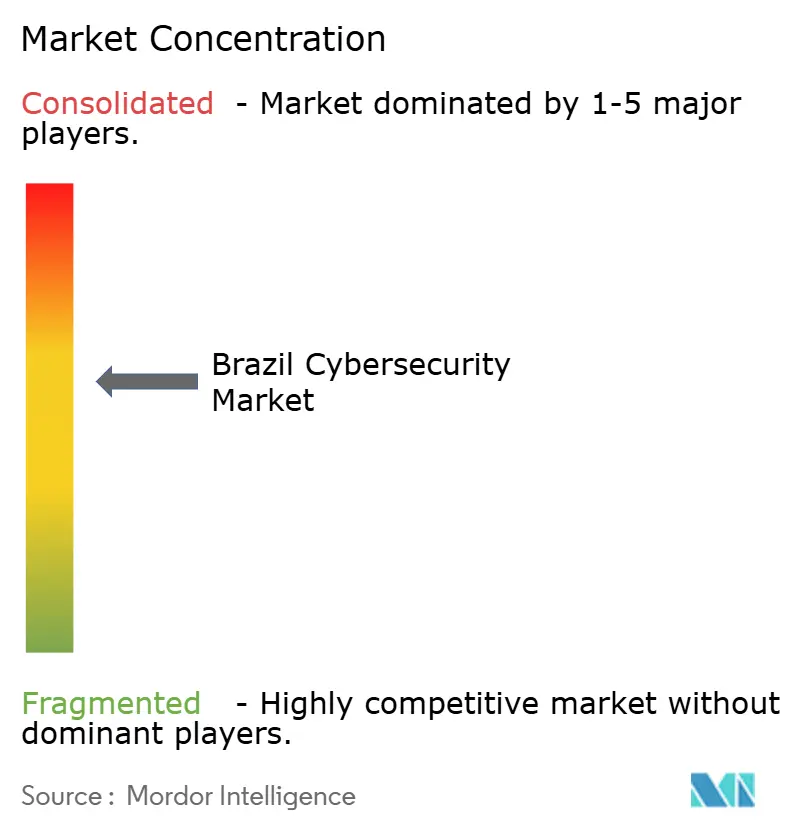
| Market Concentration | Medium |
Major Players *Disclaimer: Major Players sorted in no particular order Image © Mordor Intelligence. Reuse requires attribution under CC BY 4.0. | |
Brazil Cybersecurity Market Analysis by Mordor Intelligence
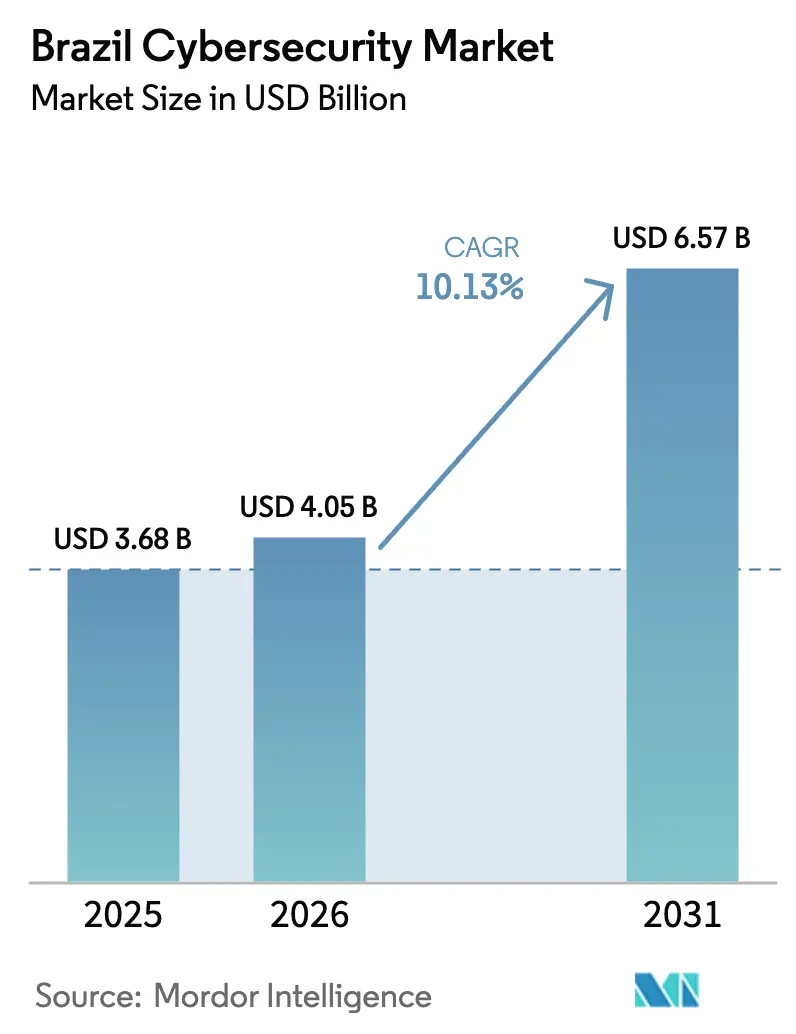
The Brazil cybersecurity market size is expected to grow from USD 3.68 billion in 2025 to USD 4.05 billion in 2026 and is forecast to reach USD 6.57 billion by 2031 at 10.13% CAGR over 2026-2031. Growth is underpinned by the mass adoption of Pix, rapid public-sector migration to GovCloud, steady 5G roll-outs and heightened LGPD enforcement. As digital payments exceed 3 billion monthly transfers, banks, retailers and utilities allocate larger budgets to threat detection platforms while shifting capital-intensive appliance refreshes to later years. Currency volatility pressures import-oriented hardware purchases, yet spending remains resilient because incident-response costs now dwarf preventive outlays. The acute talent gap is another structural driver: with SOC analysts scarce outside São Paulo, many firms outsource monitoring to managed service providers. A parallel trend sees compliance investment morphing into broader resilience programmes as organisations unify privacy, fraud-prevention and disaster-recovery initiatives under one governance umbrella.
Key Report Takeaways
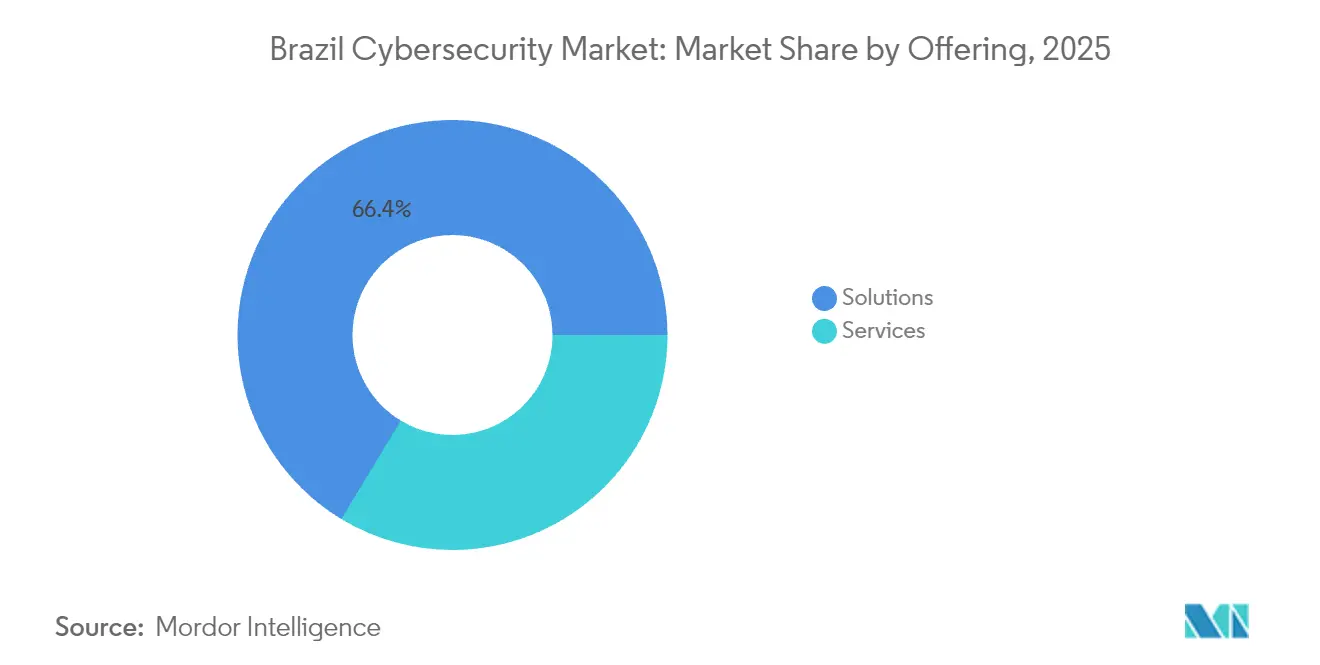
- By offering, Solutions captured 66.35% of 2025 revenue, whereas Services are forecast to expand at a 14.78% CAGR to 2031.
- By deployment mode, On-premises deployments held 60.80% of the 2025 Brazil cybersecurity market share, while Cloud-based models are set to grow at a 17.25% CAGR.
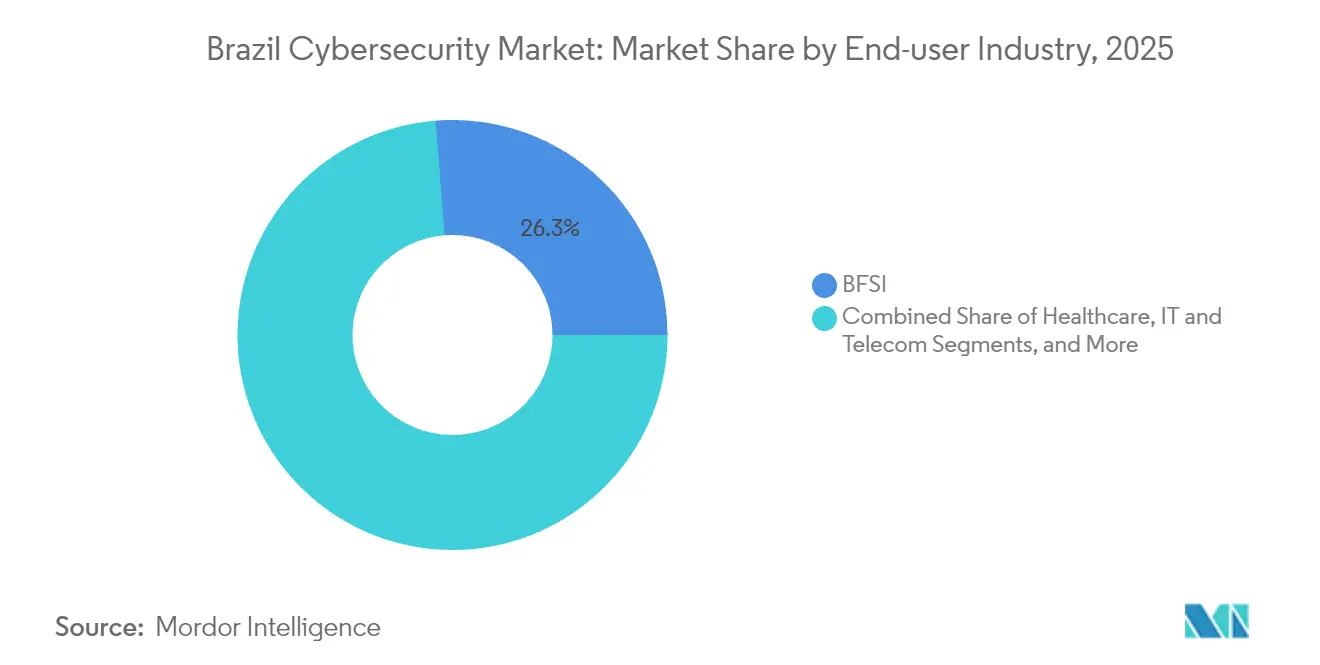
- By end-user industry, BFSI led with 26.25% revenue share in 2025; Healthcare is poised to record the fastest 17.45% CAGR through 2031.
- By end-user enterprise size, Large enterprises commanded 71.60% of 2025 spending, whereas SMEs are projected to increase outlays at a 13.74% CAGR.
Note: Market size and forecast figures in this report are generated using Mordor Intelligence’s proprietary estimation framework, updated with the latest available data and insights as of 2026.
Brazil Cybersecurity Market Trends and Insights
Drivers Impact Analysis*
| Driver | (~) % Impact on CAGR Forecast | Geographic Relevance | Impact Timeline |
|---|---|---|---|
| Nationwide roll-out of Open Finance and Pix driving new threat vectors | +2.5% | Major urban centres | Short term (≤ 2 years) |
| Government “Cloud First” and GovCloud mandates boosting security spend | +2.0% | Brasília first, expanding nationwide | Medium term (2–4 years) |
| Surging ransomware on critical infrastructure post-2022 election | +1.5% | Energy, water, transport networks nationwide | Short term (≤ 2 years) |
| LGPD and Central Bank Res. 4658 compliance deadlines | +2.3% | BFSI and healthcare hubs | Medium term (2–4 years) |
| Rapid 5G rollout expanding IoT attack surface | +1.8% | Urban nodes, widening to interior regions | Medium term (2–4 years) |
| Venture-capital inflow into fintech scale-ups demanding resilient security | +1.2% | São Paulo–Rio corridor and emerging tech hubs | Short term (≤ 2 years) |
| Source: Mordor Intelligence | |||
Nationwide Roll-out of Open Finance and Pix Driving New Threat Vectors
Pix processed about 3 billion transactions a month in early 2024, drawing sophisticated malware such as “PixPirate” that hijacks mobile transfers [1]. Seventy percent of all Pix traffic now originates on smartphones, escalating endpoint exposure. Because Open Finance lets users link multiple accounts, breaches at one institution propagate laterally across the ecosystem. Banks respond by hard-coding quarterly refreshes of fraud-detection models and subscribing to shared threat-intelligence exchanges. As a result, demand for API-security gateways and mobile-security SDKs increases faster than any other protection layer inside the Brazil cybersecurity market.
Government Cloud First and GovCloud Mandates Boosting Security Spend
A presidential decree in 2024 obliges federal agencies to default to cloud resources and align with new national cybersecurity policy frameworks [2]. Procurement teams therefore bundle workload-protection and configuration-audit tools into every new SaaS contract. Uniform baseline controls shorten the sales cycle for vendors with early certifications, enabling them to capture disproportionate Brazil cybersecurity market share inside public-sector accounts. Spill-over effects reach state and municipal bodies as federal grants require adherence to GovCloud specifications.
Surging Ransomware on Critical Infrastructure Post-2022 Election
Confirmed ransomware incidents on utilities jumped from zero a decade ago to 16 in 2024; experts assert the real figure is higher due to voluntary disclosure rules. Organised crime groups exploit legacy industrial-control protocols, shrinking the defender’s dwell-time window. Utilities now redirect operational-expenditure budgets toward network segmentation, OT-SOC outsourcing and immutable backup tiers. Consequently, service-heavy contracts outpace appliance deals, reinforcing the growth of managed services inside the Brazil cybersecurity market.
LGPD and Central Bank Resolution 4658 Compliance Deadlines
Resolution CD/ANPD 15 requires organisations to disclose material incidents to the National Data Protection Authority within three business days, raising the bar for automated detection and response. Financial institutions must also observe Central Bank Resolution 4658, which mandates five-year audit-log retention. Companies now integrate user-behaviour analytics, file-integrity monitoring and immutable storage in a single compliance stack. This convergence accelerates platform adoption and enlarges the Brazil cybersecurity market because one investment simultaneously satisfies privacy, resilience and fraud-prevention objectives.
Restraints Impact Analysis*
| Restraint | (~) % Impact on CAGR Forecast | Geographic Relevance | Impact Timeline |
|---|---|---|---|
| Acute shortage of SOC analysts inflating MSSP pricing | −1.8% | Most severe outside São Paulo–Rio | Medium term (2–4 years) |
| Double-digit BRL depreciation versus USD squeezing appliance-import capex | −1.5% | Import-dependent sectors nationwide | Short term (≤ 2 years) |
| Legacy systems resisting integration with modern OT-security platforms | −1.3% | Manufacturing and utilities | Long term (≥ 4 years) |
| Highly fragmented VAR/MSSP ecosystem outside the São Paulo–Rio corridor | −0.8% | Regional cities and rural areas | Medium term (2–4 years) |
| Source: Mordor Intelligence | |||
Acute Shortage of SOC Analysts Inflating MSSP Pricing
Brazil graduates fewer than 8,000 cybersecurity specialists per year against an open-position count exceeding 37,000, creating wage inflation and vacancy backlogs [3]. Talent scarcity drives hourly MSSP rates up to 35% higher outside the São Paulo-Rio corridor, straining provincial budgets. Many mid-tier enterprises therefore adopt cloud-delivered detection platforms that embed orchestration and automated playbooks. While this shift supports spending growth, the skills gap narrows only gradually and remains a structural brake on the Brazil cybersecurity market.
Double-Digit BRL Depreciation Squeezing Appliance-import Capex
The BRL lost more than 10% against the USD between 2023 and 2024, inflating imported firewall and router prices. Hardware refresh cycles now stretch from four to six years, delaying appliance revenue. Enterprises prioritise software licences billed in local currency, and vendors respond by offering flexible subscription plans. Although depreciation tempers near-term hardware sales, the broader shift toward operational-expense models ultimately favours services and cloud offerings within the Brazil cybersecurity market.
*Our forecasts treat driver/restraint impacts as directional, not additive. The impact forecasts reflect baseline growth, mix effects, and variable interactions.
Segment Analysis
By Offering: Services Gain Momentum as Skills Gap Widens
Solutions held 66.35% of 2025 spending, cementing the Brazil cybersecurity market share for appliance and software vendors. Network-security boxes and next-generation firewalls dominate, especially in BFSI and telecom environments that require deterministic latency. Yet, services grow at a 14.78% CAGR because CIOs concede that internal teams cannot keep pace with detection complexity. Managed detection and response contracts often bundle compliance reporting, enabling buyers to rationalise overlapping tools. Vendors embedding machine-learning analytics into service dashboards differentiate themselves and capture premium pricing.
The services surge also reflects regulatory pressure: LGPD audits increasingly request evidence of continuous monitoring, a requirement more easily satisfied by external SOCs. National-scale integrators therefore purchase regional MSSPs to secure talent and footprint, driving consolidation. Over the forecast horizon, integrated solution-service bundles gain popularity, blurring traditional demarcations and raising the average deal size in the Brazil cybersecurity market.

By Deployment Mode: Cloud Security Approaches Parity
On-premises deployments owned 60.80% of 2025 revenue because data-sovereignty mandates historically favoured local processing. Core banking systems, telecom signalling and defence networks still depend on dedicated hardware and air-gapped segments. Cloud-based security, however, is set to expand at a 17.25% CAGR, narrowing the gap and transforming procurement patterns. The government’s Cloud First edict obliges every new agency project to show why cloud is not viable, flipping the burden of proof.
Service providers respond by building sovereign-cloud zones in São Paulo and Rio that comply with LGPD localisation rules. Hyperscalers partner with domestic telcos to shorten last-mile latency and embed threat-intelligence feeds natively. Hybrid architectures dominate transition roadmaps, allowing organisations to protect sensitive workloads on-premise while harnessing cloud analytics for internet-facing applications. As confidence in remote key-management matures, cloud security will likely eclipse a third of total Brazil cybersecurity market size before the forecast period ends.
By End-user Industry: Healthcare Rises on Data-Protection Mandates
BFSI held 26.25% of 2025 spend, reinforcing its status as largest buyer because fraud pressure and strict Central Bank audits compel continuous control upgrades. Institutions integrate behavioural biometrics with Pix transaction monitoring, elevating analytics licences as a share of wallet. Healthcare, meanwhile, posts the highest 17.45% CAGR, propelled by digital records expansion and LGPD clauses on sensitive data. Hospitals deploy zero-trust network micro-segmentation to stop lateral malware movement, and health insurers insist on encryption-at-rest before settling breach-related claims.
Industrial OT environments also accelerate spending as 5G connectivity links sensors once isolated behind serial lines. Utilities migrated SCADA traffic into modern protocols, exposing legacy assets to internet-routed threats. Because regulatory mandates for OT security are still emergent, early movers voluntarily adopt ISA/IEC 62443 frameworks, setting de facto standards that suppliers must meet to remain on vendor lists. This multi-sector investment portfolio sustains double-digit growth across the Brazil cybersecurity market.
By End-user Enterprise Size: SMEs Turn Security into Sales Enabler
Large enterprises contributed 71.60% of 2025 revenue because of complex, multi-site environments and 24/7 monitoring requirements. Their budgets underpin early adoption of extended detection and response and breach-attack simulation. SMEs, conversely, lead growth at a 13.74% CAGR because digital supply-chain contracts now demand proof of information-security controls. Merchants exporting through global marketplaces must present security questionnaires aligned with ISO 27001 or NIST frameworks; failure blocks sales channels.
Cloud-native security platforms priced per user or per asset lower adoption barriers. Municipal economic-development agencies offer subsidised cyber-readiness training, creating shared buying syndicates that negotiate volume discounts. These mechanisms extend security coverage faster than direct subsidies could, enlarging the Brazil cybersecurity market without distorting competition. As cyber-insurance carriers incorporate security attestation into premium models, SMEs further prioritise investment.
Geography Analysis
Most cybersecurity revenue concentrates in the Southeast, where São Paulo hosts 80% of national data-centre capacity and the majority of tier-one incident-response teams. Corporates headquartered here enjoy sub-one-hour response times and faster threat-intelligence cross-pollination. Local universities collaborate with banks to run capture-the-flag competitions, enlarging the skilled-graduate pipeline. These factors reinforce São Paulo’s dominance within the Brazil cybersecurity market and attract foreign investment that amplifies ecosystem maturity.
Rio de Janeiro forms the second pole, driven by energy majors and critical-infrastructure operators. The city’s offshore oil platforms rely on low-latency satellite links secured by purpose-built encryption overlays. Regional development agencies offer tax incentives for SOC build-outs, drawing managed-service providers to the port zone. Cross-pollination between maritime and utilities segments accelerates adoption of OT-aware detection tools. As 5G covers metro districts, telcos bundle endpoint-security add-ons with consumer broadband, broadening market reach.
Interior and northern regions historically lagged but are closing the gap as federal grants require compliance with GovCloud blueprints. States such as Pernambuco and Ceará deploy regional data hubs anchored by renewable-energy micro-grids. Agritech innovators in Goiás secure drone telemetry via light-weight certificate-based authentication, demonstrating that cyber-enabled productivity now extends beyond urban corridors. The expansion of regional IXPs lowers latency for cloud-security traffic, improving user experience and encouraging more rural enterprises to adopt advanced controls. Collectively these trends extend the geographic footprint of the Brazil cybersecurity market.
Regulatory Landscape
Brazil's cybersecurity governance is shaped by the Institutional Security Cabinet (GSI) through the National Cybersecurity Policy (PNCiber) and the E-Ciber strategy, alongside privacy enforcement under the LGPD (Law 13.709/2018) by the National Data Protection Authority (ANPD). On the federal administration side, Decreto 12.572 (August 2025) established the National Information Security Policy (PNSI), tightening governance expectations for information security programs across federal entities.
Enforcement and reporting requirements continue to harden operational controls. ANPD Resolution 15/2024 requires reporting of material security incidents within three business days, pushing organizations toward continuous monitoring and documented incident response. In 2026, GSI's Instrucao Normativa 09/2026 strengthened the formal role of the Information Security Manager within federal entities. PL 4752/2025 (in the Senate) proposes a Marco Legal da Ciberseguranca with minimum technical standards and a national authority concept, indicating a move toward more standardized cybersecurity obligations across sectors.
Value Chain Analysis
Brazil's cybersecurity value chain spans global and local technology providers (endpoint, network, identity, cloud and data security), distribution through VARs and telecom-led integrators, and delivery via professional services and managed security service providers (MSSPs) operating SOCs concentrated around Sao Paulo and other major hubs. On the demand side, regulated verticals (notably BFSI and public sector workloads tied to cloud migration) influence product requirements, procurement packaging, and audit readiness, while critical infrastructure buyers increasingly combine OT visibility, segmentation, and immutable backup with 24/7 monitoring.
Regulatory and policy frameworks affect how participants interact and what artifacts move across the chain. Under Decreto 12.572/2025, federal agencies have to operationalize information security management structures, increasing formal requirements for supplier onboarding, security governance documentation, and audit evidence. ANPD Resolution 15/2024 standardizes incident reporting expectations, which then feeds into third-party risk management and contractual SLAs for monitoring, logging, and breach notification. E-Ciber's push toward a national cybersecurity maturity model also raises the bar for solution providers and service partners aiming to qualify for public sector and critical infrastructure programs.
Competitive Landscape
Global vendors such as Cisco, Fortinet and Microsoft dominate network-security, identity management and cloud-workload protection. Their pre-certified GovCloud integrations and worldwide telemetry confer trust advantages for regulated buyers. To localise offerings, they partner with telecom operators and managed service providers that supply Portuguese-first interfaces and LGPD compliance modules. This symbiosis deepens penetration into federal agencies and tier-one banks, underpinning high-margin maintenance renewals.
Local specialists, including Tempest Security Intelligence and Modulo, leverage cultural fluency and bespoke consulting to win projects where regulatory nuance matters more than technology breadth. They excel in readiness assessments, LGPD gap analysis and incident-response retainers. Many white-label global XDR engines but wrap them with region-specific playbooks that address Pix-centric fraud vectors. Such layering delivers quicker mean-time-to-detect than generic templates, yielding measurable risk reduction that clients value.
Fragmentation persists in managed security services, yet consolidation accelerates. International entrants have begun acquiring regional VARs to gain client relationships and fulfil service-level obligations outside metropolitan hubs. Hyperscalers embed select MSSPs into marketplace contracts, rewarding partners that meet sovereign-cloud attestation. As talent scarcity persists, merger rationales hinge on SOC workforce pooling and playbook standardisation rather than purely geographical access. This consolidation trend will gradually raise the combined top-five Brazil cybersecurity market share, though niche providers will survive by specialising in OT or privacy audit services.
Brazil Cybersecurity Industry Leaders
-
IBM Corporation
-
Microsoft Corporation
-
Check Point Software Technologies Ltd.
-
Palo Alto Networks, Inc.
-
Cisco Systems, Inc.
- *Disclaimer: Major Players sorted in no particular order
Market Opportunities and Future Outlook
A clear opportunity sits in compliance-led security operations that can produce audit-ready evidence across hybrid environments. ANPD's enforcement posture under LGPD, including its incident-notification requirements (Resolution 15/2024, three business days), supports demand for integrated detection and response, log retention, and incident-response retainers that can be shown to regulators and insurers. At the same time, the federal government's PNSI framework (Decreto 12.572/2025) and GSI-led cybersecurity governance create room for vendors and integrators that can map controls to standardized baselines and accelerate procurement for GovCloud-aligned projects.
Talent and capability development is another investable area tied to measurable constraints in Brazil. The country graduates fewer than 8,000 cybersecurity specialists per year against more than 37,000 open positions, creating room for managed detection and response, automation-driven SOC tooling, and formal training and certification programs. This aligns with policy actions such as GSI's Instrucao Normativa 09/2026, which elevates the requirements and strategic role of Information Security Managers in federal entities, and with workforce initiatives that expand the pipeline, including Microsoft and SENAI-SP's agreement to train 50,000 people in cybersecurity by end-2026.
Recent Industry Developments
- June 2026: Microsoft TIM Brasil implemented Microsoft Defender XDR to manage security for 12,000 endpoints. The initiative accelerates endpoint security modernization across Brazil and signals rapid adoption of AI driven threat detection at scale.
- February 2026: Check Point Software Technologies announced the acquisition of Cyata, Cyclops, and Rotate to strengthen its cybersecurity strategy. It broadens local capabilities and playbooks for threat detection and incident response.
- December 2025: Microsoft/SENAI-SP signed an agreement to train 50,000 people in cybersecurity by end 2026. The talent development supports enterprise resilience investments and helps close Brazil's skilled labor gap.
Research Methodology Framework and Report Scope
Market Definition and Coverage
For this methodology, the Brazil cybersecurity market covers spending on products and services that prevent, detect, and respond to digital threats across networks, endpoints, cloud, applications, and data. The value is measured as revenue generated from customers located in Brazil, stated in USD.
Scope exclusions: Consumer-only antivirus purchases and purely physical security systems are excluded from this market sizing.
Segmentation Overview
- By Offering
- Solutions
- Application Security
- Cloud Security
- Data Security
- Identity and Access Management
- Infrastructure Protection
- Integrated Risk Management
- Network Security
- End-point Security
- Services
- Professional Services
- Managed Services
- Solutions
- By Deployment Mode
- Cloud
- On-Premise
- By End-user Industry
- BFSI
- Healthcare
- IT and Telecom
- Industrial and Defense
- Retail and E-commerce
- Energy and Utilities
- Manufacturing
- Others
- By End-user Enterprise Size
- Large Enterprises
- Small and Medium Enterprises (SMEs)
Data Sources, Market Sizing, and Validation
Desk Research
Desk research is used to build the first structure for demand signals and to keep assumptions realistic for Brazil. We start from public digital and cyber indicators that reflect the attack surface, such as data breach reports and national cyber posture updates published by bodies such as the ITU, and also public enforcement updates linked to LGPD.
We use public and official datasets to understand where budgets usually concentrate, such as Central Bank of Brazil releases on payment volumes (useful for linking fraud pressure to security spend), IBGE macro series, and telecom and spectrum updates from Anatel that reflect connectivity rollouts. This is paired with company filings, investor presentations, audited statements, and credible press coverage, then supplemented using paid subscriptions for company financials, news and financials, patent search, and tender tracking when it helps validate large deals. The desk sources listed here are not exhaustive, and other public documents and databases were referenced for cross-checking and clarification.
Primary Interviews and Surveys
Primary work is used to test the realism of desk assumptions and fill gaps where public data is limited, especially around price ranges, renewal cycles, and the split between in-house delivery and outsourced security operations. We speak with buyers and implementers across regulated and non-regulated sectors in Brazil, then recheck items like managed security penetration, cloud security adoption, and incident response retainer usage before the totals are finalized.
Distribution of primary research fieldwork respondents
| Company type | Respondent position |
|---|---|
| Top tier: 27% | CXOs: 17% |
| Mid tier: 56% | Functional/Unit leaders: 41% |
| Smaller Players: 17% | Managers: 42% |
Market-Sizing & Forecasting
The core model is built using a top-down approach where Brazil IT and digital spend signals are reconstructed into a security spending pool, then filtered through adoption rates by major buyer groups and workload types. To keep it grounded, we corroborate results with selective bottom-up approximations, such as sampling typical contract values for managed services, checking renewal and expansion patterns, and validating a few supplier revenue splits tied to Brazil.
Inputs used in the model include indicators like reported breach frequency and severity, cloud migration intensity, digital payment growth (including Pix-related transaction expansion), and shifts in regulatory compliance activity linked to LGPD. We also track security talent availability and outsourcing intensity because these factors shift budgets from tools toward services. For forecasting, scenario analysis is used around macro conditions and incident intensity, and the scenarios are then aligned with expert expectations on ASP movement and buying-cycle length. Where bottom-up signals are missing for smaller buyers, gap handling uses sector-level spend ranges and conservative penetration assumptions, which are rechecked through interviews.
Data Validation & Update Cycle
Validation is done through triangulation across demand indicators, supplier-side signals, and expert feedback, then through variance checks against macro and digital adoption series. If an output looks inconsistent, we reopen the assumptions, recheck the arithmetic, and re-contact respondents when a key variable, such as service mix or renewal timing, drives the mismatch.
Before sign-off, the model and narrative go through multi-step internal reviews so extreme jumps, currency effects, and timing issues are caught early. Reports are refreshed annually, and interim updates are triggered when there are material changes, such as major regulation enforcement shifts, large public incidents, or step changes in cloud and telecom rollout pace. Right before delivery, a final pass is completed so clients receive the latest updated view.
Mordor Intelligence's Brazil Cybersecurity Market Size Compared With Other Published Estimates
Published market sizes for cybersecurity in Brazil can differ even when the topic sounds the same, because the underlying market basket and timing assumptions are not always aligned. Differences usually come from what is counted as cybersecurity versus adjacent IT services, how currency conversion is timed, and whether the estimate is built from spend signals or from supplier revenues.
Consumer antivirus subscriptions sit outside Mordor Intelligence's scope, which tends to reduce the total versus sources that include household security purchases in the same headline number. Gaps also come from how managed security is treated, since some estimates count broader IT operations outsourcing under security, and from ASP logic, where aggressive price growth assumptions can raise a forecast. Refresh cadence matters too, since exchange-rate swings and incident-driven budget releases can change a single year quickly in Brazil.
Benchmark comparison
| Source | Market Size | Gaps in Research Methodology |
|---|---|---|
| Mordor Intelligence | USD 3.68 B (2025) | |
| Industry Advisory A | USD 3.00 B (2024) | Uses an earlier base year and often reports a spend snapshot influenced by short-term budgeting, and it can apply different currency timing, which shifts the USD total when converted from local values. |
| Consulting Note B | USD 4.50 B (2029) | Presents a forward point estimate that may embed faster growth in service-led bundles, and it may include adjacent IT risk management work alongside cybersecurity, which inflates the longer-term number. |
Taken together, the spread is mainly explained by year alignment and what gets bundled into the cybersecurity basket, rather than a simple math issue. Our process stays traceable because each step ties back to clear Brazil demand signals, and then it is stress-tested through interviews so the final number remains practical to use in planning.
Key Questions Answered in the Report
What is the forecast Brazil cybersecurity market size in 2031?
The Brazil cybersecurity market size is projected to reach USD 6.57 billion by 2031, up from USD 3.68 billion in 2025 and USD 4.05 billion in 2026.
Which deployment model is growing fastest?
Cloud-based security is expanding at a 17.25% CAGR, outpacing on-premises deployments as agencies comply with Cloud First mandates.
What drives healthcare’s rapid growth?
Digitisation of patient records and LGPD requirements boost healthcare cybersecurity spending at a 17.45% CAGR.
How does Brazilian currency volatility affect spending?
BRL depreciation raises the cost of imported appliances, prompting a shift toward locally priced software and cloud subscriptions.