
Global Blood Warmer Devices Market Size and Share
Market Overview
| Study Period | 2020 - 2031 |
|---|---|
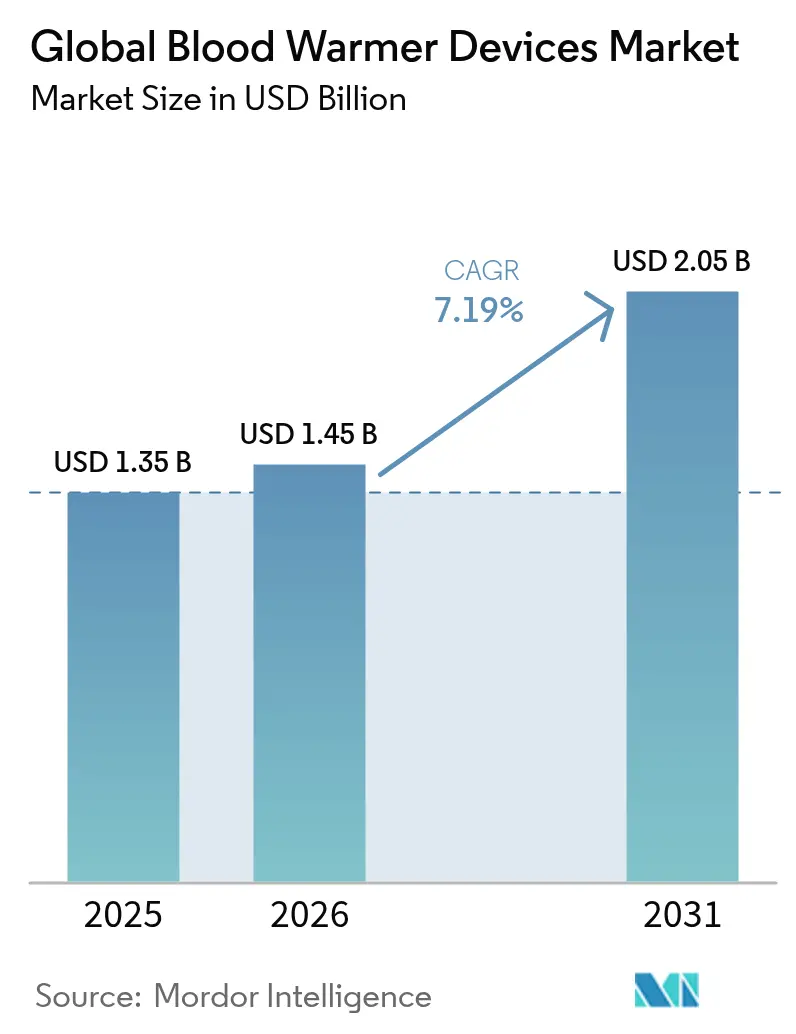
| Market Size (2026) | USD 1.45 Billion |
| Market Size (2031) | USD 2.05 Billion |
| Growth Rate (2026 - 2031) | 7.19 % |
| Fastest Growing Market | Asia Pacific |
| Largest Market | North America |
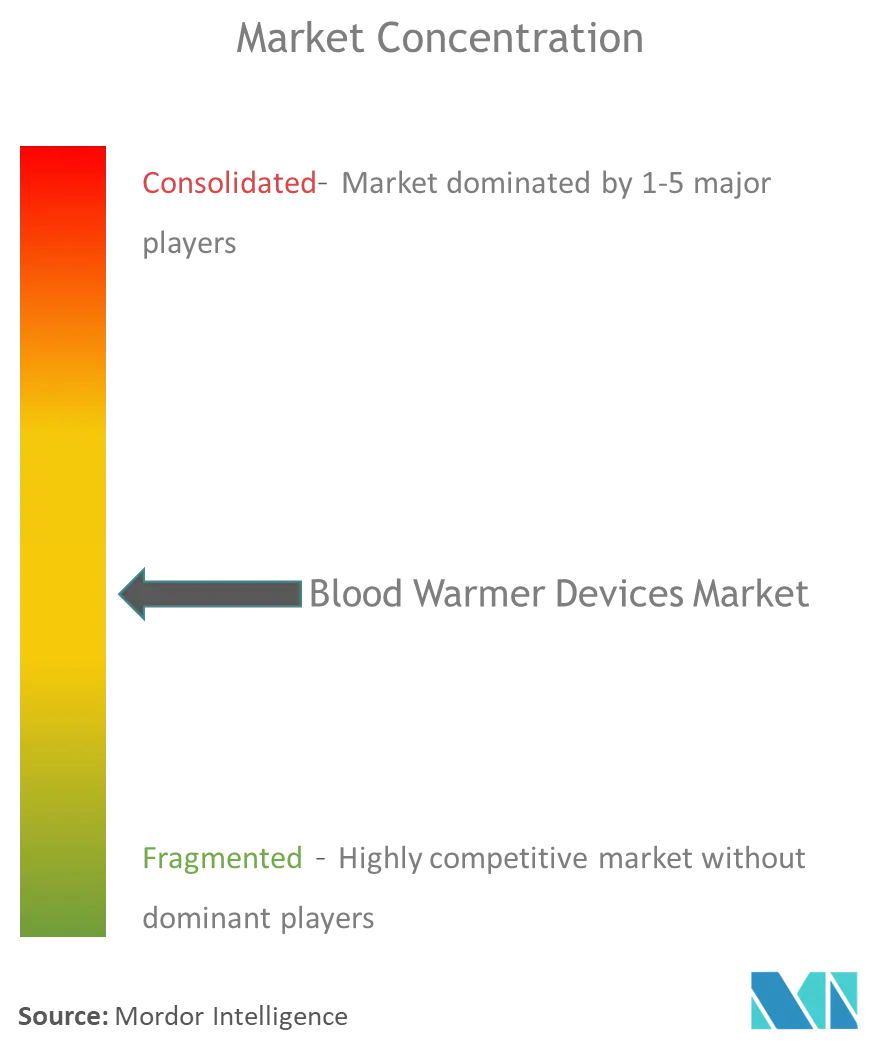
| Market Concentration | Medium |
Major Players *Disclaimer: Major Players sorted in no particular order Image © Mordor Intelligence. Reuse requires attribution under CC BY 4.0. | |
Global Blood Warmer Devices Market Analysis by Mordor Intelligence
The blood warmer devices market size is expected to grow from USD 1.35 billion in 2025 to USD 1.45 billion in 2026 and is forecast to reach USD 2.05 billion by 2031 at 7.19% CAGR over 2026-2031. Strong momentum comes from the push to keep surgical and trauma patients normothermic, escalating trauma procedure volumes, and rapid military uptake of portable systems. Continuous-warming mandates issued by the Association of periOperative Registered Nurses in March 2025 have heightened hospital compliance efforts, while recent FDA guidance on medical-device supply-chain resilience has sharpened focus on uninterrupted product availability. Manufacturers respond with integrated IoT logging, battery life extensions, and battlefield-grade ruggedisation—features that win new contracts from defense and emergency-medical service (EMS) buyers.
Key Report Takeaways
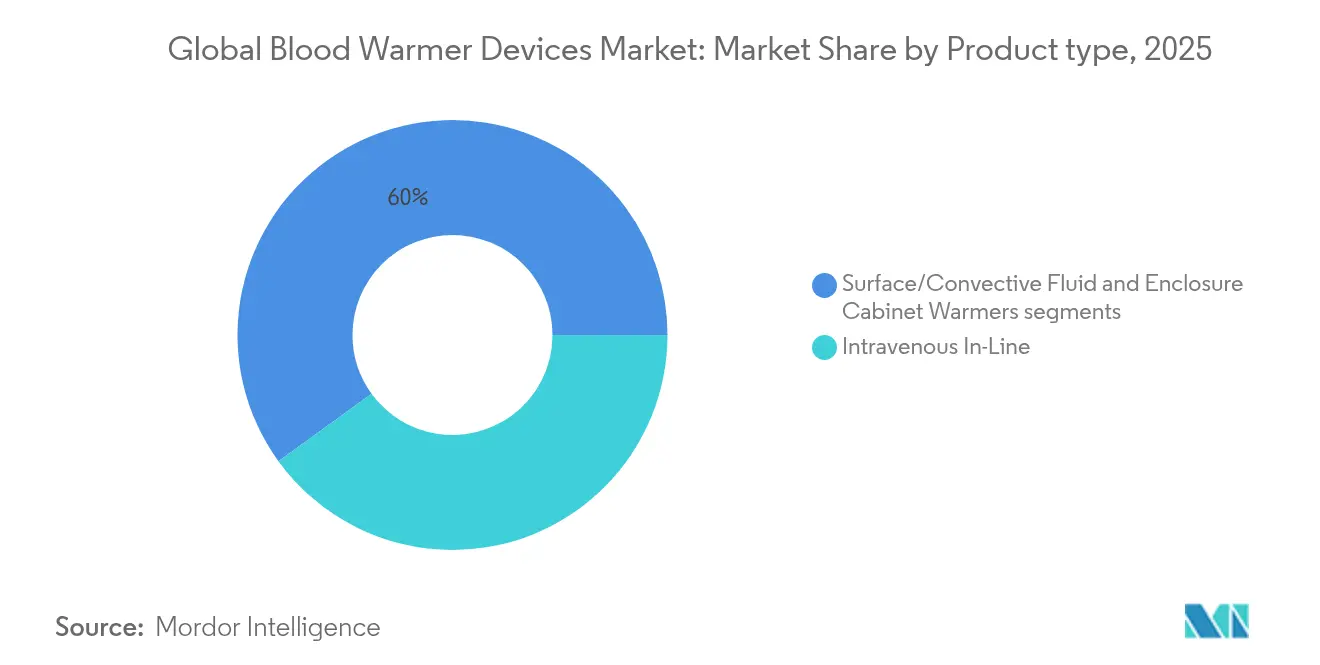
- By product type, intravenous in-line systems led with 40.02% revenue share in 2025, whereas surface warmers are projected to expand at an 8.05% CAGR to 2031.
- By modality, portable units commanded 60.05% of the blood warmer devices market share in 2025, and this modality is forecast to post an 8.62% CAGR through 2031.
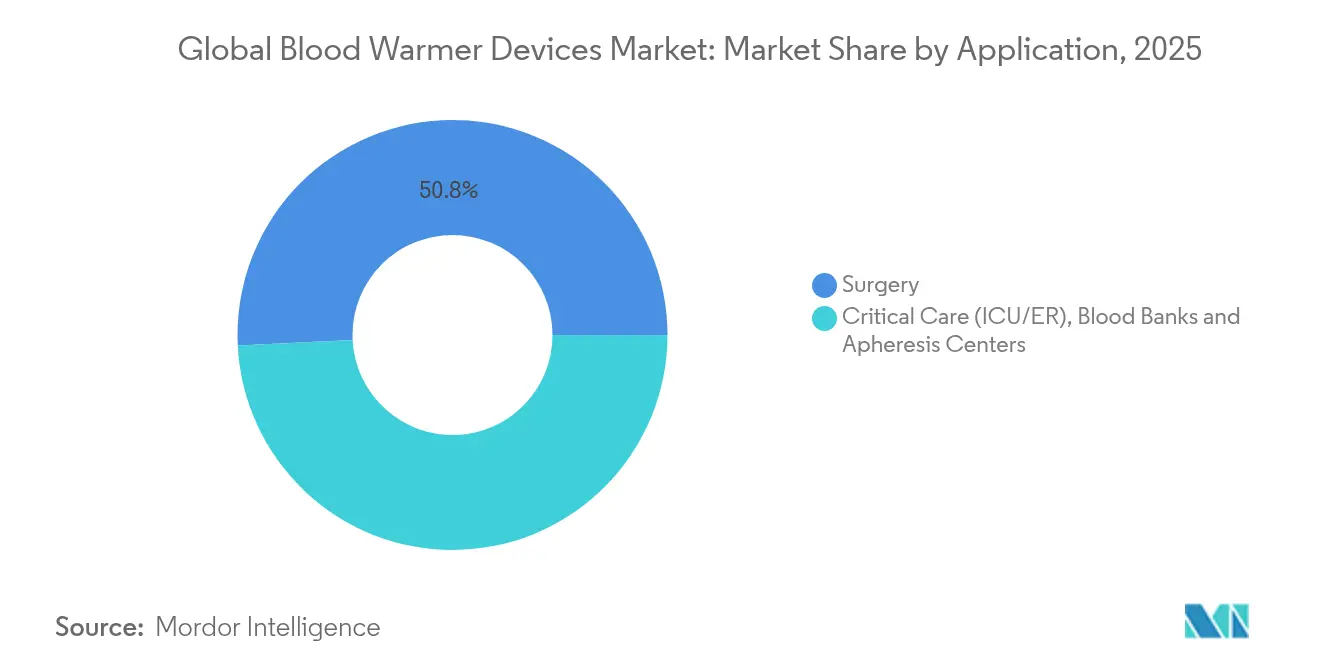
- By application, surgery accounted for a 50.78% share of the blood warmer devices market size in 2025, while military & EMS adoption is advancing at a 9.18% CAGR to 2031.
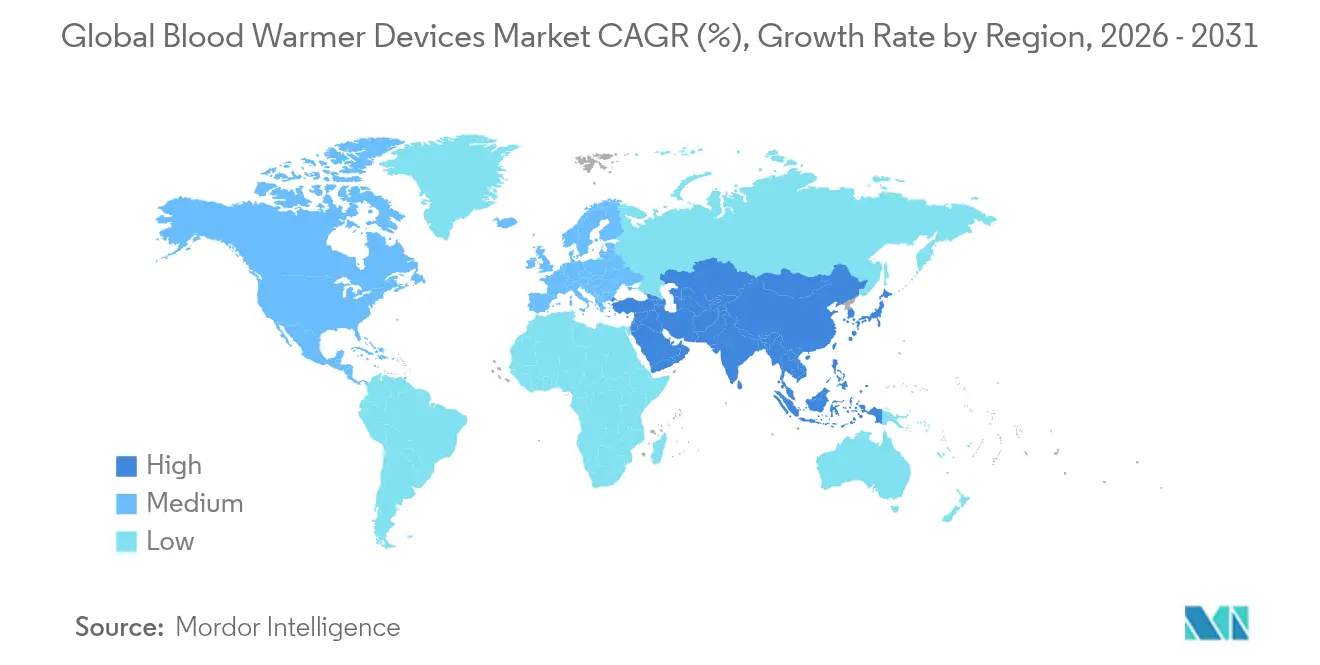
- By geography, North America held 44.68% of the blood warmer devices market in 2025; the Asia-Pacific region is expected to grow the fastest at a 9.98% CAGR over the period.
Note: Market size and forecast figures in this report are generated using Mordor Intelligence’s proprietary estimation framework, updated with the latest available data and insights as of 2026.
Market Trends and Insights
Drivers Impact Analysis of Global Blood Warmer Devices Market*
| Driver | (~) % Impact on CAGR Forecast | Geographic Relevance | Impact Timeline |
|---|---|---|---|
| Rising trauma & emergency surgery volumes | +1.8% | Global, with concentration in North America & Europe | Short term (≤ 2 years) |
| Stringent peri-operative normothermia guidelines | +1.2% | Global, led by North America & EU regulatory frameworks | Medium term (2-4 years) |
| Adoption of portable, battery-operated warmers in military & EMS | +0.9% | North America, Europe, with expansion to APAC | Medium term (2-4 years) |
| Integration of IoT temperature logging for compliance | +0.6% | North America & EU primarily, gradual APAC adoption | Long term (≥ 4 years) |
| AI-assisted real-time perfusion monitoring | +0.4% | North America & Europe advanced healthcare systems | Long term (≥ 4 years) |
| Stem-cell & apheresis therapy growth needing large-volume warming | +0.3% | Global, concentrated in developed markets | Long term (≥ 4 years) |
| Source: Mordor Intelligence | |||
Rising Trauma & Emergency Surgery Volumes
Global trauma caseloads keep climbing, driven by road accidents, ageing populations and prolonged conflict zones. The U.S. Joint Trauma System recorded a 44% drop in battlefield deaths once automated blood-warming logistics became standard practice health.mil. Emergency-department studies show prehospital transfusion programs could benefit as many as 900,000 U.S. patients annually, underscoring the need for reliable warmers that avert hypothermia-related mortality. Mass-transfusion protocols now embed warming requirements, making the blood warmer devices market central to hospital trauma-care budgets.
Stringent Peri-operative Normothermia Guidelines
Updated AORN guidelines mandate continuous warming from pre-induction through recovery, threatening legal exposure for facilities that fail to comply[1]. Complementary FDA test-protocols released in March 2024 standardise thermal-effect evaluation, accelerating procurement of systems with automatic shut-off and ±0.1 °C accuracy. Clinical evidence ties uncorrected peri-operative hypothermia to 9% higher complication rates and a 14% lift in acute kidney injury, further motivating hospitals to deploy state-of-the-art devices.
Adoption of Portable Warmers in Military & EMS
The MEQU portable system secured FDA clearance and a UK Ministry of Defence order in 2024, catalysing demand for battery-powered units that operate for up to 19 hours in austere settings. U.S. EMS agencies in 23 states now run blood-on-board programs, though they represent <1% of national services, signaling ample headroom for growth. Portable devices satisfy Committee on Tactical Combat Casualty Care protocols requiring 38-42 °C output regardless of ambient conditions.
Integration of IoT Temperature Logging for Compliance
January 2025 FDA interoperability rules oblige medical devices to export time-stamped temperature data, spurring embedded-sensor adoption. The ISO/IEEE 11073-10206 framework finalised in 2024 lets warmers feed hospital information systems directly, cutting paperwork and easing audits. Early field data show connected units can predict divergence events six minutes ahead of loss of normothermia, helping clinicians adjust flow rates proactively.
Restraints Impact Analysis of Global Blood Warmer Devices Market*
| Restraint | (~) % Impact on CAGR Forecast | Geographic Relevance | Impact Timeline |
|---|---|---|---|
| Risk of hemolysis & protein denaturation at supra-physiologic temps | -0.8% | Global, particularly in quality-sensitive markets | Short term (≤ 2 years) |
| Capital cost sensitivity in LMIC hospitals | -1.2% | LMIC regions, concentrated in Sub-Saharan Africa & South Asia | Medium term (2-4 years) |
| Disposable set incompatibility across brands | -0.6% | Global, with higher impact in multi-vendor healthcare systems | Medium term (2-4 years) |
| Supply-chain fragility for heating elements rare-earths | -0.7% | Global, with acute impact in Asia-Pacific manufacturing hubs | Long term (≥ 4 years |
| Source: Mordor Intelligence | |||
Risk of Hemolysis & Protein Denaturation
Temperatures exceeding 46 °C cause measurable red-cell rupture, while proteins begin denaturing at 43 °C after two-hour exposure. Trials on irradiated leukoreduced units warmed to 60 °C recorded sharp potassium release, elevating cardiac-arrest risk in neonates. Device makers now integrate triple sensors, automatic bypass and instant shut-off, which add cost and raise validation hurdles but are essential for patient safety.
Capital-Cost Sensitivity in LMIC Hospitals
Resource-constrained hospitals often face device downtime when blood stocks appear only 26-50% of the time, as documented in Ethiopia. A cost study at a leading Indian neurosurgery centre found machinery and equipment drive 43.6% of operating expenses, a burden not offset by user fees. Faced with budget trade-offs, many facilities prioritise ventilators over blood warmers, restraining adoption despite clinical need.
*Our forecasts treat driver/restraint impacts as directional, not additive. The impact forecasts reflect baseline growth, mix effects, and variable interactions.
Global Blood Warmer Devices Market Segment Analysis
By Product Type:
In-line Precision Sets the StandardIntravenous in-line systems controlled 40.02% of 2025 revenue, demonstrating the blood warmer devices market preference for seamless integration and tight temperature control. Units such as 3M’s Ranger 245 reach set-point in 45 seconds and manage concurrent infusions between 37 °C and 41 °C, making them the workhorse for operating-theatre and trauma-bay protocols. Surface warmers, although niche in absolute sales, register an 8.05% CAGR, propelled by EMS crews that value flexible wrapping pads deployable inside ambulances or aircraft.
Clinical evidence underlines why in-line models dominate. Comparative trials show fresh blood warmed at 47 °C for one hour displayed no cell damage, whereas immersion baths showed higher variability. Cabinet units such as Sarstedt’s SAHARA-III still serve blood banks needing large-volume processing without water immersion, yet growth pivots to smaller, agile devices for point-of-care use.

By Modality:
Portables Power Field MedicineThe portable format accounted for 60.05% of global turnover in 2025, underscoring how battlefield and ambulance environments shape the blood warmer devices market. Systems like MEQU’s compact cartridge design can warm 4 units at flow rates up to 150 mL/min while running on a single rechargeable pack. Stationary models stay relevant in ICUs and OR suites where grid power is constant and higher throughput is required.
Portable systems post an 8.62% CAGR through 2031 as defense spending and civilian EMS programs converge around rapid transfusion protocols. Committee on Tactical Combat Casualty Care specifications demand devices withstand -20 °C to +50 °C and a 1.2 m drop, criteria driving ruggedised build quality wms.org. Stationary installations, conversely, evolve through software integrations that auto-populate electronic medical records, simplifying audits and maintenance scheduling.
By Application:
Surgery Still Largest, Military & EMS Surge FastestSurgical use retained 50.78% share of the blood warmer devices market size in 2025, backed by escalating procedure counts and zero-tolerance norms for peri-operative hypothermia. Military and EMS segments climb at a 9.18% CAGR as 152 U.S. agencies now carry whole blood, validating prehospital transfusion economics.
Continuous-warming forced-air blankets remain the gold standard in theatre, yet ICU guidelines for traumatic brain injury patients now prioritise steady 37 °C perfusion, boosting ward-based demand. Blood-bank and apheresis settings rely on specialised cabinets that gently thaw stem-cell grafts while maintaining cryoprotectant integrity, a niche albeit steadier revenue stream.
Geography Analysis
North America Blood Warmer Devices Market
North America led with 44.68% of 2025 revenue, reflecting mature reimbursement, stringent FDA oversight and a well-funded EMS network that already fields blood on board in 23 states. Medicare payment updates for 2025-2026 increase quality incentives tied to normothermia compliance, driving new hospital upgrades federalregister.gov. Pentagon innovations such as the Automated Battlefield Trauma System, which delivered a 44% mortality reduction, spill over into civilian care and sustain upstream demand.
Europe Blood Warmer Devices Market
Europe shows balanced expansion as harmonised Medical Device Regulation and intensive-care society guidelines reinforce thermal-management standards. Consensus on targeted temperature control for traumatic brain injury, adopted by leading centres in Germany, France and the United Kingdom, secures a steady cadence of procurement despite supply-chain frictions triggered by regional geopolitical tensions
APAC Blood Warmer Devices Market
Asia-Pacific delivers the fastest compound growth at 9.98%, propelled by massive trauma caseloads and government infrastructure programmes in China, India and Southeast Asia. While venture funding dips curtailed some local start-ups, state procurement of battlefield-grade equipment after natural-disaster responses keeps the adoption curve steep. Price-sensitive public hospitals increasingly trial lower-cost portable units, opening new avenues for manufacturers that can tier offerings without diluting accuracy.
Regulatory Landscape
Blood and plasma warming devices fall under established medical-device controls in major markets, with the United States regulating these products under 21 CFR 864.9205. Classification pathways vary by technology, with nonelectromagnetic blood and plasma warmers generally treated as Class II devices (510(k) route, Product Code BSB). Electromagnetic blood and plasma warmers can face a higher bar as Class III devices requiring PMA, which raises evidence and validation demands for manufacturers.
Across markets, compliance is anchored in safety and performance standards that guide design verification and submissions. In the US, FDA-recognized consensus standards include ASTM F2172-02 (Reapproved 2011) for blood, intravenous fluid, and irrigation fluid warmers, and FDA reviewer guidance for 510(k) submissions (CBER, July 2001) continues to inform expectations around labeling, temperature accuracy, and safety controls intended to reduce hemolysis and overheating risk.
Value Chain Analysis
The value chain starts with upstream sourcing of medical-grade plastics for disposable sets, heating elements, high-precision thermal sensors, and electronics, followed by device and consumable design under a regulated QMS environment. Midstream manufacturing centers on assembly, calibration, and functional testing for temperature control, automatic shut-off, and alarm performance, typically structured to meet ISO 13485:2016 quality management requirements for medical devices, which is widely used as a baseline for global market access.
Downstream, blood warmer vendors distribute through hospital procurement channels, EMS and military supply programs, and specialized distributors that support installation, training, and preventive maintenance. Service, calibration, and accessory replenishment (single-use cartridges, tubing sets, filters, and connectors) are recurring touchpoints. At the same time, supply resilience for specialized components and cross-brand disposable-set incompatibility influence lead times, SKU strategy, and total delivered cost to multi-vendor health systems.
Competitive Landscape
Market concentration is moderate. 3M, Stryker and ICU Medical together hold good portion of revenue, leveraging established distribution and regulatory depth. Competitive thrust focuses on differentiated accuracy, IoT connectivity and military-grade portability. The Defense Health Agency secured five FDA clearances in 2024, including the MEQU Portable Blood and IV Fluid Warmer System, validating a fast-track defence origin pipeline.
Pricing pressure remains secondary to performance, but capital-expenditure shy hospitals in lower-income markets incentivise stripped-down, single-use cartridge innovations. Larger vendors respond with financing packages and swap-out programmes that offset up-front costs. Strategic M&A shapes product breadth: Stryker’s June 2025 agreement to buy Inari Medical for USD 4.9 billion extends its vascular reach, reinforcing adjacent use-cases that rely on warmed blood during complex interventions[2].
Global Blood Warmer Devices Industry Leaders
-
3M
-
Geratherm Medical
-
Stryker Corporation
-
Smiths Group
-
The 37Company
- *Disclaimer: Major Players sorted in no particular order
Global Blood Warmer Devices Market Companies Covered in this Report
- 3M
- Stryker Corporation (Belmont)
- ICU Medical
- Barkey
- Belmont Medical Technologies
- Fresenius
- GE HealthCare Technologies Inc.
- Gentherm Medical
- Vyaire Medical
- Princeton Medical Scientific Inc.
- Emit Corporation
- The 37Company B.V.
- SOMATEX Medical Technologies GmbH
- Keewell Medical Technology Co. Ltd.
- Qingdao Flux Medical
- ThermoGenesis Holdings Inc.
- Sarstedt
- Smiths Group
- Inspiration Healthcare Group plc
- Enthermics Medical Systems
Market Opportunities and Future Outlook
Pediatric-focused warming and broader therapy-specific configurations are gaining attention, where clinical practice demands tighter control of flow and temperature and clear labeling around safe warming limits. February 2026 FDA clearance for pediatric use of TSC Life's Fluido Compact Fluid Warming System in the United States and Canada highlights active commercialization of indication- and population-specific variants. That can support wider adoption beyond adult OR and trauma workflows and drive standardization across mixed-acuity sites.
Another opportunity sits in compliance-ready connectivity and documentation that aligns with peri-operative warming protocols and transfusion practice requirements that prohibit unmonitored heating sources. Hospitals and EMS programs expanding blood-on-board capabilities also place more emphasis on audit readiness, and differentiation increasingly centers on verified temperature performance, time-stamped records, and interoperability with clinical documentation processes. This creates room for vendors that pair validated warming performance with simplified setup and rugged portable designs.
Recent Industry Developments in Global Blood Warmer Devices Market
- February 2026: TSC Life received FDA clearance for pediatric use of its Fluido Compact Fluid Warming System in the United States and Canada. The clearance broadens the addressable use base into pediatric care pathways where temperature control and labeling constraints are especially strict, supporting hospitals that aim to standardize warming workflows across age groups.
- March 2025: The FDA cleared Giotto Monza automated blood component separator and the AHC Platelet Concentrate Separator, expanding temperature-controlled blood processing capabilities. Greater automation at blood component preparation points can increase throughput and consistency, which tightens demand for compatible warming, handling, and monitored temperature management across the transfusion chain.
- April 2024: Babson Diagnostics unveiled a hand-warming tool aimed at improving capillary blood collection. While not a transfusion blood-warmer platform, the launch reflects continued product activity around temperature management in blood workflows and reinforces the broader emphasis on warming as a lever to improve sample and collection quality.
Global Blood Warmer Devices Market Report Scope and Research Methodology
Market Definition and Coverage
This market covers devices and related disposables used to warm blood and infusion fluids to a controlled temperature before or during administration in clinical and emergency care settings, aiming to reduce the risk of unintended hypothermia.
Scope exclusions: We exclude general patient warming blankets and room warming systems that do not warm blood or infusion lines as their primary function.
Segments Covered in This Report
- by Product Type (Value)
- Intravenous In-Line
- Surface/Convective Fluid
- Enclosure Cabinet Warmers
- by Modality (Value)
- Portable
- Stationary
- by Application (Value)
- Surgery & Peri-operative Care
- Critical Care (ICU/ER)
- Blood Banks & Apheresis Centers
- Military & EMS Use
- Geography (Value)
- North America
- United States
- Canada
- Mexico
- Europe
- Germany
- United Kingdom
- France
- Italy
- Spain
- Rest of Europe
- Asia-Pacific
- China
- India
- Japan
- South Korea
- Australia
- Rest of Asia-Pacific
- South America
- Brazil
- Argentina
- Rest of South America
- Middle East and Africa
- GCC
- South Africa
- Rest of Middle East and Africa
- North America
Data Sources, Market Sizing, and Validation
Desk Research
Desk research starts with public, non-paywalled sources that help set the clinical and procedure context and define a clean demand pool. Common references include sources such as the US FDA device databases and safety communications, CDC procedure and hospital statistics, WHO health system indicators, and clinical guidance published in peer-reviewed anesthesiology and transfusion medicine journals.
To translate that context into market inputs, we also review sources such as USITC and UN Comtrade trade flows for relevant categories, payer and hospital association publications, and investor materials like annual reports and presentations for device makers and distributors. Where needed, we use paid subscriptions for company financials and intelligence, plus patent databases, to cross-check product positioning and revenue exposure. These examples are illustrative only, and many other sources were also used for data collection, validation, and clarification during the study.
Primary Interviews and Surveys
Primary work tests the real adoption pattern of blood and fluid warming across surgery, trauma, ICU, and emergency workflows, and then checks what portion of spending sits in the device versus recurring disposables. We spoke with a mix of clinical users, procurement teams, and industry participants across the Americas, EMEA, and APAC. Their input was used to refine assumptions on utilization, replacement cycles, and average selling prices.
Distribution of primary research fieldwork respondents
| Company type | Respondent position | Region |
|---|---|---|
| Top tier: 27% | CXOs: 18% | APAC: 45% |
| Mid tier: 52% | Functional/Unit leaders: 32% | EMEA: 33% |
| Smaller Players: 21% | Managers: 50% | Americas: 22% |
Market-Sizing & Forecasting
The core sizing is built using top-down and bottom-up logic. In the top-down build, procedure volumes and care settings are used to reconstruct the addressable warming demand, then adjusted using penetration rates for blood and high-volume fluid warming in OR, trauma, ICU, and emergency settings. Bottom-up checks are added through selective rollups of supplier revenue exposure, sampled device ASP times estimated unit shipments, and channel discussions to keep totals realistic.
Key inputs used in the model include surgical and trauma procedure counts, transfusion intensity by setting, installed base and typical replacement period for warmers, disposable set attachment rates, and regional pricing differences tied to procurement practices and currency timing. For forecasting, we apply scenario analysis supported by expert views on procedure growth, guideline adherence, and technology shifts such as more portable systems and improved temperature control. Where country data is thin, we bridge gaps using proxy indicators like hospital bed capacity and surgical rate benchmarks, then validate that the implied per-facility spending looks reasonable.
Data Validation & Update Cycle
Validation is done through multiple checks that look for inconsistencies before final sign-off. Model outputs are compared against independent signals such as procedure growth, import and export directionality, and the implied split between capital equipment and consumables. Any sharp variance is reviewed and corrected.
A second analyst review is completed for assumptions, math logic, and year-to-year movement. We re-contact participants when inputs shift materially, or when a new claim cannot be supported cleanly. Reports are refreshed annually, with interim updates when major events change demand or pricing, and a final pre-delivery pass is done so clients receive the most current view.
Mordor Intelligence's Blood Warmer Devices Market Sizing Compared With Other Published Estimates
It is common to see different market sizes for blood warmer devices because each publisher draws the scope line differently, then applies different pricing, currency timing, and adoption assumptions. Differences also come from whether the estimate leans on procedure-based demand pools or on narrow product shipment tracking.
Some published figures focus on blood warmers as a small subset of IV warming products, or count only a limited set of hospital uses, which can pull the number down. Other figures may include adjacent patient temperature management categories, or use aggressive ASP growth without checking disposable attachment rates, which can push the number up. Some estimates fold general patient warming devices into the same bucket, but for Mordor Intelligence, revenue is counted only when a device or disposable directly warms blood or infusion fluids used in transfusion and high-volume infusion workflows.
Benchmark comparison
| Source | Market Size | Gaps in Research Methodology |
|---|---|---|
| Mordor Intelligence | USD 1.35 B (2025) | |
| Global Consultancy A | USD 1.46 B (2025) | Uses a broader device definition with limited visibility on what is counted as accessories and disposables, and the pricing uplift assumptions are not clearly reconciled to procedure and utilization checks across care settings. |
| Industry Research Desk B | USD 0.25 B (2025) | Appears to track a narrower product basket focused on blood or IV warmers only, which likely excludes parts of the fluid warming workflow and undercounts recurring disposable revenue tied to installed base use. |
The spread in the table is mainly explained by how each estimate treats adjacent warming categories and whether recurring disposable revenue is included consistently. By keeping the demand pool tied to procedure settings and then checking pricing and utilization with interviews, the final number stays traceable to clear steps that can be repeated and audited.
Key Questions Answered in the Report
What temperature window do blood warmers typically maintain?
Most devices target 37-42 °C, keeping well below the 43 °C threshold at which protein denaturation becomes significant.
How long can modern portable warmers operate without mains power?
Current battery designs deliver up to 19 hours of continuous function while holding temperature within ±6.47%.
Which market segment is expanding the quickest?
Military and EMS applications grow at a 9.18% CAGR, propelled by broader prehospital transfusion programmes and defence spending.
Are special regulatory clearances required for portable battlefield warmers?
Yes. Devices need FDA 510(k) clearance and must meet Committee on Tactical Combat Casualty Care specifications for ruggedisation and output temperature.