
Blood Gas And Electrolyte Analyzer Market Size and Share
Market Overview
| Study Period | 2020 - 2031 |
|---|---|
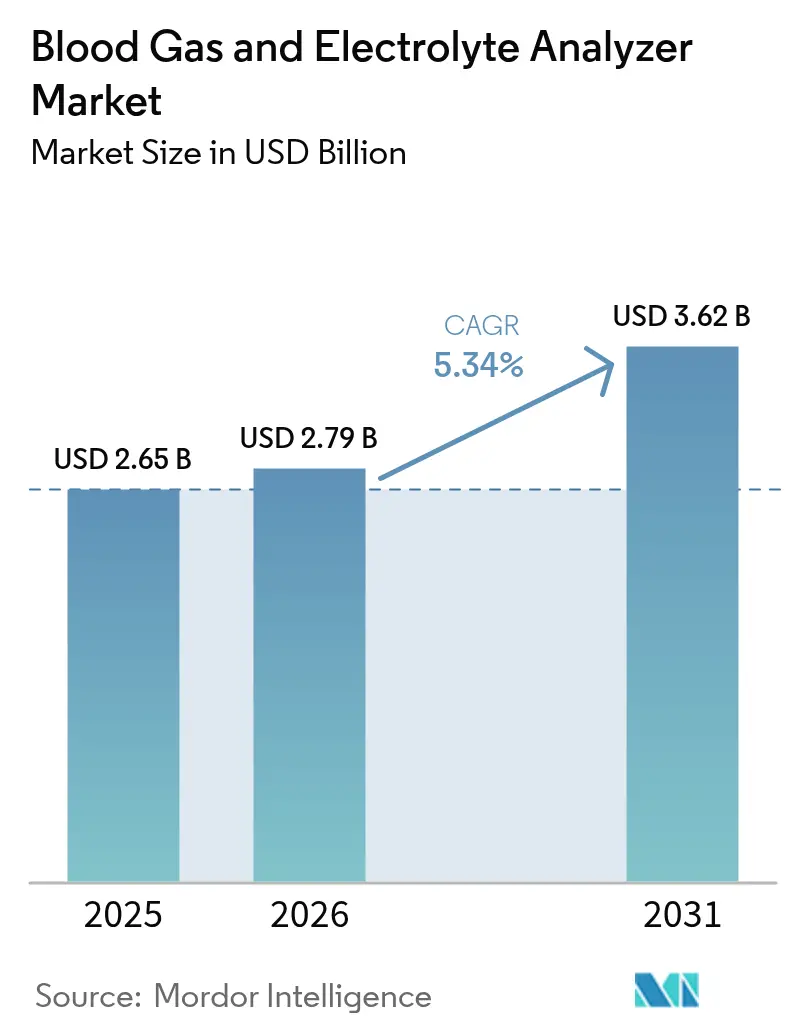
| Market Size (2026) | USD 2.79 Billion |
| Market Size (2031) | USD 3.62 Billion |
| Growth Rate (2026 - 2031) | 5.34 % |
| Fastest Growing Market | Asia Pacific |
| Largest Market | North America |
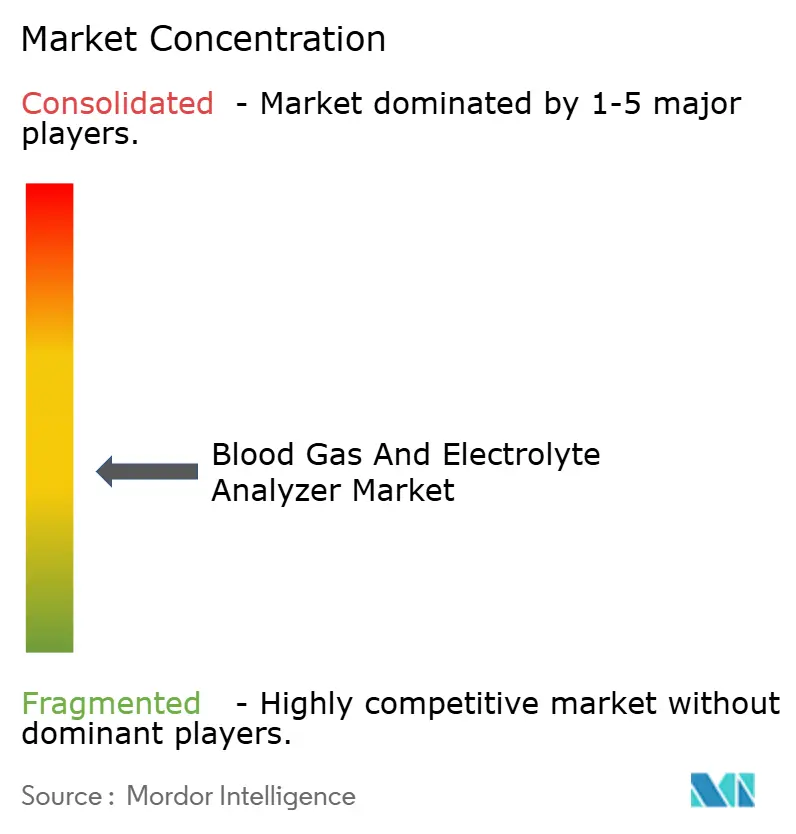
| Market Concentration | Medium |
Major Players *Disclaimer: Major Players sorted in no particular order Image © Mordor Intelligence. Reuse requires attribution under CC BY 4.0. | |
Blood Gas And Electrolyte Analyzer Market Analysis by Mordor Intelligence
The Global Blood Gas And Electrolyte Analyzer Market size was valued at USD 2.65 billion in 2025 and estimated to grow from USD 2.79 billion in 2026 to reach USD 3.62 billion by 2031, at a CAGR of 5.34% during the forecast period (2026-2031).
Growth rests on the indispensable role of rapid arterial blood-gas and electrolyte testing in critical-care, emergency, and peri-operative settings, especially as respiratory disease, neonatal intensive-care admissions, and complex metabolic emergencies rise. Demand is reinforced by health-system moves toward point-of-care workflows that compress result turnaround from hours to minutes, plus hospital automation initiatives that link analyzers to laboratory information systems for continuous quality oversight. Portable devices with wireless connectivity are scaling fastest because ambulance crews, operating theatres, and bedside teams value immediate decision support. Asia-Pacific is closing the gap on North America’s volume dominance as public and private investment channels modernize acute-care infrastructure and widen access to acute diagnostics.
Key Report Takeaways
- By product type, consumables contributed 58.12% of the blood gas and electrolyte analyzer market share in 2025, while electrolyte analyzers are projected to post the fastest 5.82% CAGR through 2031.
- By modality, benchtop systems retained 50.35% revenue share in 2025, yet portable/handheld units are set to grow at a 7.12% CAGR to 2031.
- By technology, cartridge-based platforms held 52.86% of the blood gas and electrolyte analyzer market size in 2025; optical/optode sensing is on track for a 6.78% CAGR between 2026-2031.
- By end-user, hospital central laboratories commanded 45.05% of 2025 sales, whereas ambulance and emergency services will record the highest 6.12% CAGR over the forecast horizon.
- By geography, North America generated 38.12% of global revenue in 2025; Asia-Pacific will register the fastest 7.14% CAGR to 2031.
Note: Market size and forecast figures in this report are generated using Mordor Intelligence’s proprietary estimation framework, updated with the latest available data and insights as of 2026.
Market Trends and Insights
Drivers Impact Analysis of Blood Gas And Electrolyte Analyzer Market*
| Driver | (~) % Impact on CAGR Forecast | Geographic Relevance | Impact Timeline |
|---|---|---|---|
| Critical-care point-of-care testing uptake | +1.20% | Global, strong in North America & Europe | Short term (≤ 2 years) |
| COPD & asthma admissions in megacities | +1.00% | Asia-Pacific, Middle East, global urban hubs | Medium term (2-4 years) |
| Neonatal ICU micro-sampling demand | +0.70% | Global, higher in advanced health systems | Medium term (2-4 years) |
| IoT-enabled lab automation | +1.10% | North America, Europe, Japan, South Korea | Medium term (2-4 years) |
| Technology advances in analyzers | +0.80% | Early adoption in developed markets | Short term (≤ 2 years) |
| Source: Mordor Intelligence | |||
Growing Adoption of Critical-Care Point-of-Care Testing
Bedside analyzers now deliver arterial pH, PaO₂, PaCO₂, electrolytes, and lactate results in under a minute, compressing decision cycles for sepsis bundles, ventilator adjustments, and trauma resuscitation. Systems such as the epoc Blood Analysis System integrate Wi-Fi modules so data flows directly into electronic medical records, eliminating manual transcription errors and cutting laboratory workload.Lower turnaround times translate into documented cost avoidance: a pediatric ICU reduced daily test frequency by 53% and saved USD 19,068 annually after deploying stewardship protocols around point-of-care blood-gas devices journals. Emergency departments also benefit, where 60-second results support prompt stroke differentiation before radiology confirmation.
Rapid Rise in COPD & Asthma Admissions in Megacities
Ambient air pollution, aging populations, and high smoking prevalence are driving COPD burdens toward low- and middle-income economies; 90% of COPD deaths now arise in those settings [1]. Metropolitan hospitals facing surges of acute exacerbations require on-site blood-gas capacity to titrate oxygen therapy and non-invasive ventilation. Manufacturers are releasing ruggedized analyzers with battery backup and climate-tolerant sensors for secondary-level facilities lacking stable power. Expanded access improves triage accuracy, shortens emergency room dwell time, and can curb readmission penalties tied to respiratory care pathways.
Integration of IoT-Enabled Benchtop Analyzers Accelerating Lab Automation
Next-generation benchtop systems act as networked nodes inside fully automated “Dark Labs,” exchanging QC flags, maintenance alerts, and patient results with laboratory middleware in real time mlo-online.com. Automated substrate loading, on-board calibration, and machine-vision robotics slash manual touches by 75%, allowing overstretched technologists to manage more tests per shift siemens-healthineers.com. Remote dashboards let vendors push firmware updates and provide predictive maintenance, reducing downtime and aligning with hospitals’ smart-connected-care blueprints.
Technological Advancements in Blood Gas and Electrolyte Analyzers
Optical optode sensors that use luminescence quenching for dissolved gases deliver stable baselines with fewer recalibrations, supporting a 7.20% CAGR leadership within the technology segment diagnostics. Simultaneously, cartridge-based analyzers continue to evolve through embedded intelligence modules that spot hemolysis or air bubbles before results release, as seen in GEM Premier 7000 with iQM3. AI algorithms trained on patient-based real-time QC data sets outperform rule-based systems in detecting systematic drift, mitigating error propagation and lowering repeat test costs.
Restraints Impact Analysis of Blood Gas And Electrolyte Analyzer Market*
| Restraint | (~) % Impact on CAGR Forecast | Geographic Relevance | Impact Timeline |
|---|---|---|---|
| Capital-budget constraints | -0.90% | Global, amplified in emerging markets | Short term (≤ 2 years) |
| Regulation & reimbursement hurdles | -0.60% | North America & Europe | Medium term (2-4 years) |
| Skilled-operator shortage | -0.80% | Worldwide, variable intensity | Long term (≥ 4 years) |
| Source: Mordor Intelligence | |||
Capital-Budget Constraints
Capital scarcity after pandemic procurement spikes forces hospitals to defer analyzer refresh cycles. The U.S. Department of Health and Human Services documented sharp price surges for critical devices, squeezing budgets and shifting preference to reagent-rental or pay-per-test contracts that lift upfront cost barriers. Vendors respond by bundling service, QC cartridges, and analytics dashboards under operating-expense models, aligning with finance teams that favor predictable monthly cash flows.
Issues Regarding Regulation and Reimbursement of ABG Tests
Regulatory hurdles and reimbursement issues tied to arterial blood gas (ABG) tests are stifling the market's growth. Manufacturers face delays in launching new devices due to stringent regulatory approvals, which also inflate compliance costs and pose challenges for those looking to innovate or broaden their product offerings. Furthermore, varying or sparse reimbursement policies in diverse healthcare systems diminish the financial allure for providers to embrace cutting-edge blood gas analyzers, further curbing the market's growth.
*Our forecasts treat driver/restraint impacts as directional, not additive. The impact forecasts reflect baseline growth, mix effects, and variable interactions.
Blood Gas And Electrolyte Analyzer Market Segment Analysis
By Product Type:
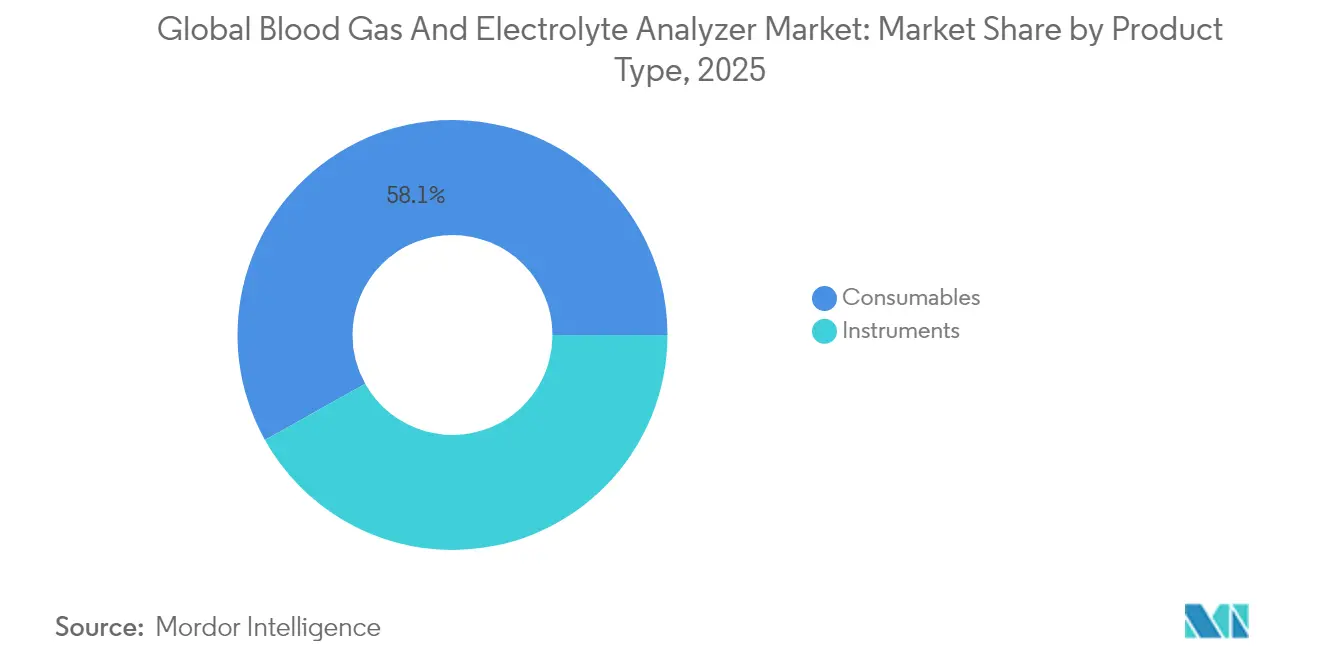
Consumable Dominance and Electrolyte Analyzer MomentumConsumables contributed 58.12% to the blood gas and electrolyte analyzer market in 2025, underlining the razor-razorblade model that anchors vendor revenue stability. Each arterial or venous sample draws a single-use cartridge, electrode pack, or reagent ampoule, turning high test frequency in critical-care beds into recurring cash flow. Masimo demonstrates the model: 89% of its healthcare revenue comes from consumables and services, financing R&D cycles that feed next-generation platforms. Integrated reagent-QC pouches also reduce inventory complexity and environmental exposure, lifting shelf life—an attractive feature for resource-limited facilities.
Electrolyte analyzers display a 5.82% CAGR through 2031 as outpatient chronic-disease clinics, dialysis centers, and sports-medicine programs seek compact devices that report sodium, potassium, chloride, ionized calcium, and glucose within two minutes. The segment overlays growth of combined analyzers that merge gases, metabolites, CO-oximetry, and electrolytes in one platform, shrinking blood draw volumes—a decisive point for neonatal wards. Nova Biomedical’s micro-sample mode demonstrates how microfluidics and intelligent fluidics engineering can fit an 11-test panel into 90 µL, linking clinical benefit to lower total cost of ownership news-medical.net. As a result, the blood gas and electrolyte analyzer market size for electrolyte-focused devices is forecast to command material share gains over the decade.

By Modality:
Portable Systems Outpace Benchtop InstallationsBenchtop analyzers retained 50.35% of global revenue in 2025 thanks to throughput, extended menus, and middleware hooks that central labs require. Dark-lab architecture integrates these analyzers with track systems and robotic arms, pushing unattended overnight operation to new levels mlo-online.com. Hospitals value long-term reagent contracts and consolidated QC regimes that stabilize per-test economics.
Portable and handheld platforms, however, are increasing at a 7.12% CAGR. Ambulance crews deploy battery-powered analyzers alongside defibrillators, capturing pH and lactate en-route to trauma centers, enabling physicians to pre-activate massive transfusion protocols. In operating rooms, anesthesiologists place palm-sized devices on the instrument table to fine-tune ventilation during thoracic surgery. Because these handhelds upload results via Bluetooth or hospital Wi-Fi, they integrate into lab reports without extra clerical work, making them pivotal to the decentralization wave sweeping the blood gas and electrolyte analyzer market.
By Technology:
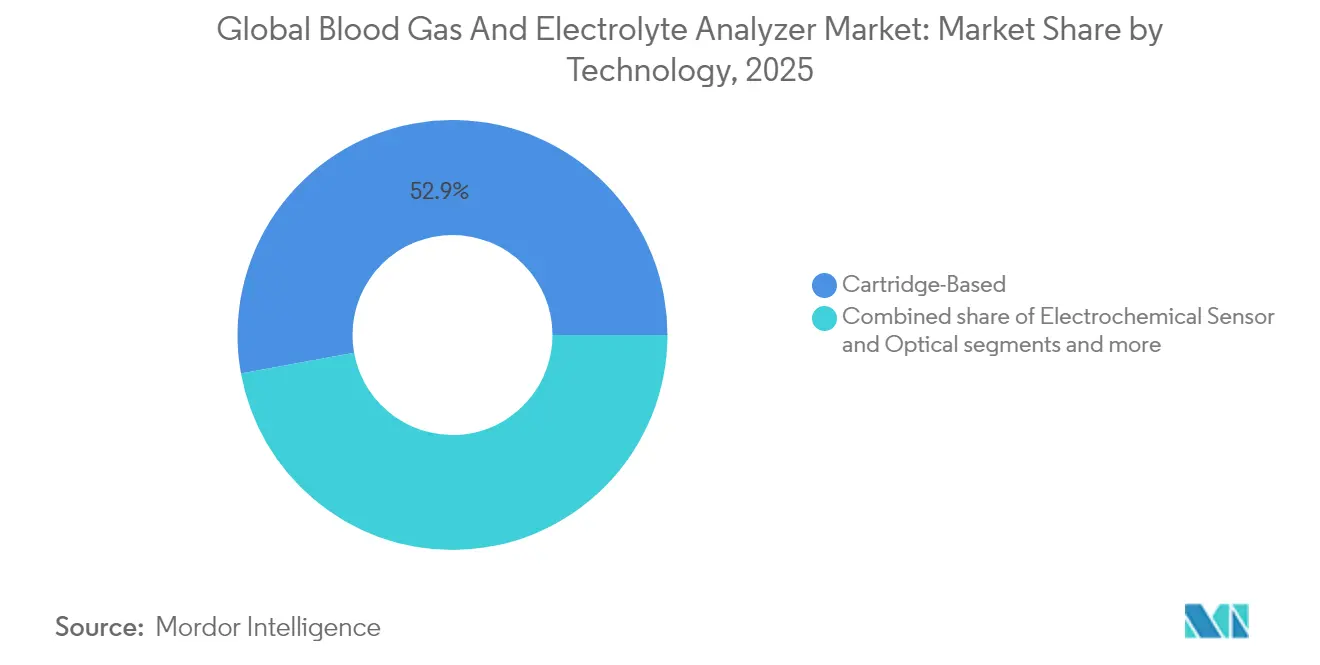
Cartridge Systems Hold Lead, Optode Sensors AccelerateDisposable-cartridge systems held 52.86% market share in 2025 by packaging sensors, calibrants, and QC fluids into sealed units that technicians swap in seconds. Automated detection of hemolysis and micro-clots in the pathway, as embedded in GEM Premier 7000, mitigates the 70% error contribution attributed to pre-analytical factors, protecting clinical confidence.
Optode technology is rising fastest on a 6.78% CAGR as photoluminescence quenching and NDIR modules bring drift-free sensing across wider temperature ranges, cutting recalibration downtime. Hospitals in tropical climates appreciate the resilience when air-conditioning falters. Electrochemical sensors are trending toward miniaturization with nanostructured electrodes that maintain linearity at low currents, extending usable life. Collectively these advances preserve the blood gas and electrolyte analyzer market size advantage of established modalities while opening incremental niches.
By End-User:
Hospital Labs in Front, Emergency Services Scaling FastHospital central laboratories contributed 45.05% of 2025 revenue by virtue of volume concentration and broad test menus. However, automation means a single technologist can monitor multiple instruments through dashboards, mitigating labor shortages. Atellica integrated lines illustrate this shift, trimming manual tasks by up to 75%.
Ambulance and emergency services, expanding at 6.12% CAGR, create new front-line demand. Point-of-care devices placed in helicopters offer altitude-adjusted calibration curves, delivering uncompromised accuracy for aeromedical teams. Diagnostic clinics treating COPD outpatients and veterinary ICUs monitoring equine colic cases also broaden reach. These divergent settings ensure the blood gas and electrolyte analyzer market retains a balanced mix of centralized and distributed testing channels, cushioning vendors against single-site demand shocks.
Geography Analysis
North America Blood Gas and Electrolyte Analyzer Market
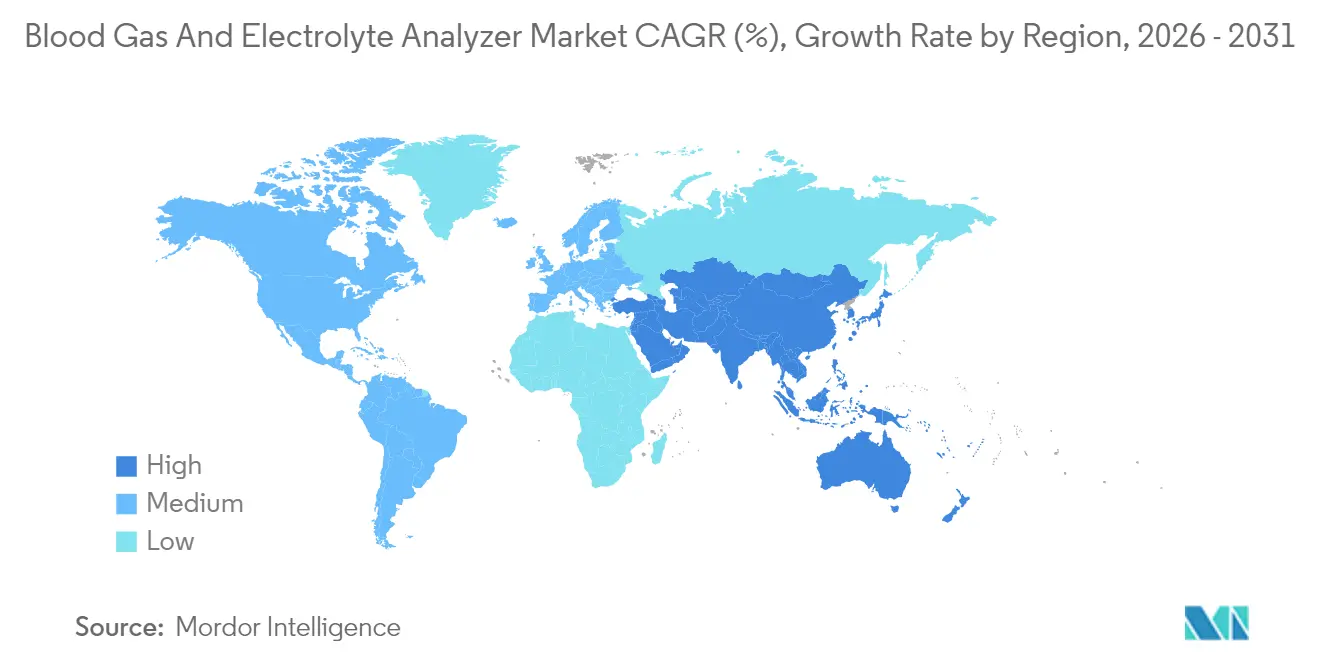
North America generated 38.12% of global revenue in 2025, anchored by dense ICU bed stock, reimbursement for respiratory diagnostics, and extensive provider networks. The blood gas and electrolyte analyzer market size for the region stays buoyant as consolidation, exemplified by BD’s USD 4.2 billion purchase of Edwards Lifesciences’ Critical Care Unit, adds connected-care capabilities to corporate portfolios. Nevertheless, laboratory retirement waves threaten capacity; 18.9% vacancy in blood-bank brethren spills over to critical-care labs, prompting health systems to favor analyzers with walk-away operation.
APAC Blood Gas and Electrolyte Analyzer Market
Asia-Pacific is forecast to post a 7.14% CAGR to 2031, narrowing the gap through public hospital expansion, private sector build-out, and government programs that subsidize diagnostic equipment for lower-tier cities. Urban smog adds to COPD caseloads, swelling arterial blood-gas demand. Domestic manufacturing initiatives encourage localization of cartridges and sensors, trimming import duties and strengthening supply resilience. As a result, the blood gas and electrolyte analyzer market in Asia-Pacific is transitioning from import-dependent to hybrid supply chains, accelerating price-point convergence with Western markets.
Europe Blood Gas and Electrolyte Analyzer Market
Europe retains a solid revenue base thanks to early technology uptake, stringent QC standards, and centralized procurement that negotiates large reagent volumes. Growth is steadier than in emerging regions but benefits from rising adoption of handheld analyzers in ambulance fleets aligned with pan-European emergency-medical-services guidelines.
LATAM and MEA Blood Gas and Electrolyte Analyzer Market
Latin America and the Middle East & Africa together represent modest but accelerating slices of the blood gas and electrolyte analyzer market. Gulf countries channel oil surpluses into tertiary-care complexes that specify analyzers with Arabic user interfaces, while Brazilian private chains upgrade labs to manage a growing cardiovascular burden. Vendor differentiation increasingly depends on training hubs, local-language software, and heat-tolerant cartridges that sustain performance above 35 °C.
Regulatory Landscape
In the United States, blood gas, electrolyte, and metabolite analyzers generally fall under FDA Class II clinical chemistry test systems (21 CFR Part 862), which typically require 510(k) clearance alongside compliance with FDA device regulation and quality system requirements. FDA clearances continue to shape competitive timing for platform refreshes, for example Radiometer received a 510(k) clearance for the ABL90 FLEX PLUS System (K252475, May 2026), reinforcing the importance of documented performance and quality controls for new iterations.
In Europe, the In Vitro Diagnostic Regulation (IVDR, Regulation (EU) 2017/746) governs conformity assessment and risk-based classification for IVDs, with blood gas analyzers often treated as Class B depending on intended use and diagnostic impact. A concrete compliance milestone is the EUDAMED rollout, with four modules (including actor registration and UDI/device registration) becoming mandatory effective 28 May 2026, increasing the operational need for complete device and certificate data readiness to avoid commercialization disruptions. In China, manufacturers must align with NMPA registration requirements for imported devices and local technical standards such as T/GDMDMA 0043-2025 for blood gas, electrolyte, and metabolite analyzers implemented on 28 May 2025, which elevates the role of type testing and localized documentation in market access planning.
Competitive Landscape
The blood gas and electrolyte analyzer market exhibits moderate concentration around Radiometer Medical (Danaher), Siemens Healthineers, Abbott, Werfen, Nova Biomedical, Masimo, and bioMérieux. Abbott maintains a robust footprint through i-STAT handhelds, leveraging its global rapid-diagnostics channel globalpointofcare.abbott. Siemens continues to marry hardware to the Atellica informatics stack, fostering lock-in around consumables and middleware.
Acquisitions fuel portfolio enhancement. bioMérieux spent EUR 138 million on SpinChip Diagnostics in January 2025 to obtain 10-minute immunoassay capability from whole blood, complementing its respiratory panel offering. Werfen’s earlier buyout of Accriva Diagnostics added coagulation and ACT cartridges to its GEM line, bundling broader peri-operative coverage. Competitive axes now center on workflow simplification, cartridge shelf life, integrated QC, and cybersecurity credentials for IoT connectivity.
Technology differentiation remains key. Werfen’s iQM3 self-monitoring detects hemolysis in seconds, lowering repeat-draw incidence. Siemens offers dual-channel connectivity to hospital Wi-Fi and LTE fallback, ensuring uptime in disaster scenarios. Nova Biomedical emphasizes microsampling strength, while Masimo leverages signal-processing expertise to add continuous SpO₂ trend lines to intermittent blood-gas results. White-space opportunities persist in microsample neonatal suites, field-deployable rugged analyzers, and platforms that embed AI-driven interpretive commentary for non-specialist users. Smaller innovators such as Sphere Medical and Brolis target those niches with near-real-time spectroscopic sensing and swept-wavelength infrared lasers, respectively.
Blood Gas And Electrolyte Analyzer Industry Leaders
-
Abbott Laboratories
-
Medica Corporation
-
Danaher Corporation (Radiometer)
-
Siemens Healthcare GmbH
-
F. Hoffmann-La Roche Ltd
- *Disclaimer: Major Players sorted in no particular order
Blood Gas And Electrolyte Analyzer Market Companies Covered in this Report
- Radiometer Medical ApS (Danaher)
- Siemens Healthineers
- Abbott Laboratories
- F. Hoffmann-La Roche AG (Roche Diagnostics)
- Nova Biomedical
- Medica Corporation
- Sensa Core
- Nihon Kohden
- Eschweiler GmbH
- Grifols
- Arkray
- OPTI Medical (IDEXX)
- Convergent Technologies
- EKF Diagnostics
- PHC Holdings (Ascensia)
- WerfenLife Diagnostics China
- Terumo Cardiovascular
- Edan Instruments
- Sphere Medical
- Brolis Sensor Technology
- Balio Diagnostics
- Trinity Biotech plc
Read Analysis of Blood Gas And Electrolyte Analyzer Companies
Market Opportunities and Future Outlook
A near-term opportunity sits in automating quality management and connectivity for point-of-care testing (POCT) deployments, as laboratories and hospital networks align POCT governance with ISO 15189:2022 and ISO 22870:2016 expectations for internal quality control. Cartridge-based systems that embed QC logic and reduce operator touches address the same bottlenecks highlighted in clinical settings (training burden, result transcription risk, and oversight across many decentralized testing sites). Published clinical validation evidence for cartridge-based bedside blood gas analyzers showing comparable performance to established benchtop systems supports broader use cases where portability and rapid turnaround matter, particularly in emergency and acute-care workflows.
Regulatory and reimbursement-linked changes also open whitespace in select countries where rules and allowable testing locations are being clarified. In Europe, the May 28, 2026 EUDAMED module mandate under IVDR pushes manufacturers to strengthen UDI, registration, and post-market readiness, favoring suppliers with mature documentation and lifecycle support for multi-site hospital groups. In India, CDSCO updating its list of authorized laboratories for IVD performance evaluation (January 19, 2026) provides a more explicit route for performance testing and registration preparation. France amending its 2014 framework for POCT in February 2026 to allow defined biological analyses outside traditional laboratories creates a pathway for hospitals and approved settings to formalize bedside and near-patient blood gas and electrolyte testing, with adoption hinging on aligning devices, procedures, and billing pathways rather than only instrument capability.
Recent Industry Developments in Blood Gas And Electrolyte Analyzer Market
- March 2026: Abbott completed its acquisition of Exact Sciences, expanding its diagnostics footprint in areas such as cancer screening and precision oncology. While not specific to blood gas testing, the deal strengthens Abbott's broader diagnostics scale, which can support investment capacity and channel leverage across its point-of-care diagnostics portfolio.
- July 2025: Werfen expanded commercial availability of the GEM Premier 7000 with iQM3 to Europe, strengthening its footprint in regulated markets.
- July 2024: Werfen introduced the GEM Premier 7000 with iQM3 blood gas testing system at the ADLM Annual Meeting, highlighting hemolysis detection at the point of care. This product direction underscores vendor focus on reducing pre-analytical and analytical errors within decentralized testing environments, supporting broader adoption in emergency and critical-care workflows.
Blood Gas And Electrolyte Analyzer Market Report Scope and Research Methodology
Market Definition and Coverage
This market covers instruments and related consumables used to measure blood gases and electrolytes from patient samples, for use in lab and point-of-care settings. Revenue is counted at the manufacturer level in current US dollars across the covered countries and regions.
Scope exclusions: We exclude broader critical care diagnostics tests that are not blood gas or electrolyte related, along with general clinical chemistry analyzers that do not perform these parameters.
Segments Covered in This Report
- By Product Type (Value)
- Instruments
- Blood Gas Analyzer
- Electrolyte Analyzer
- Combined Blood Gas & Electrolyte Analyzer
- Consumables (Cartridges, Reagents & Sensor Strips)
- Instruments
- By Modality (Value)
- Benchtop Systems
- Portable / Hand-Held Systems
- By Technology (Value)
- Cartridge-Based
- Electrochemical Sensor
- Optical / Optode
- Others (Ion-Selective Electrode, Fluorescent)
- By End-User (Value)
- Hospital Central Laboratories
- Point-of-Care Testing within Hospitals
- Ambulance & Emergency Medical Services
- Diagnostic Laboratories & Clinics
- Home Healthcare Settings
- By Geography (Value)
- North America
- United States
- Canada
- Mexico
- Europe
- Germany
- United Kingdom
- France
- Italy
- Spain
- Rest of Europe
- Asia-Pacific
- China
- Japan
- India
- South Korea
- Australia
- Rest of Asia- Pacific
- Middle East and Africa
- GCC
- South Africa
- Rest of Middle East and Africa
- South America
- Brazil
- Argentina
- Rest of South America
- North America
Data Sources, Market Sizing, and Validation
Desk Research
Desk research was used to build the starting structure of the model and to pin down the real-world demand signals that drive analyzer purchases. We relied on non-paywalled sources such as the US CDC and WHO for disease burden context, OECD and World Bank indicators for health spending and hospital capacity, and OECD health statistics style series for lab utilization proxies. Where available, public health agency guidance and peer-reviewed clinical journals were used to understand testing cadence, turnaround time needs, and where point-of-care fits versus centralized labs.
We also reviewed company annual reports, investor decks, product brochures, and major tender or procurement disclosures to understand portfolio mix and typical pricing bands by modality. Select paid database subscriptions were used mainly for company financials and news monitoring, and for patent searches to sanity-check technology shifts like cartridge-based workflows. The desk sources listed here are illustrative only, and many other public documents were reviewed to collect, cross-check, and clarify inputs.
Primary Interviews and Surveys
Primary work focused on interviews and short surveys with hospital lab heads, critical care clinicians, point-of-care coordinators, and distributor or service partners who see installation and replacement cycles up close. We covered major regions to check modality splits, consumables attachment rates, and whether pricing movement aligns with what is being purchased in day-to-day practice. The respondent input was then used to tighten assumptions where desk research was thin, especially around point-of-care adoption timing and consumables linkage to analyzer placements.
Distribution of primary research fieldwork respondents
| Company type | Respondent position | Region |
|---|---|---|
| Top tier: 25% | CXOs: 13% | APAC: 52% |
| Mid tier: 60% | Functional/Unit leaders: 29% | EMEA: 30% |
| Smaller Players: 15% | Managers: 58% | Americas: 18% |
Market-Sizing & Forecasting
Sizing starts with a top-down build where the addressable testing pool is reconstructed from hospital and critical care activity, and then translated into equipment and consumables demand through penetration and utilization rates. For blood gas and electrolyte analyzers, the model is anchored on variables such as ICU and emergency department throughput, point-of-care testing adoption inside hospitals, analyzer installed base replacement timing, consumables tests per day per device, and average selling prices that differ between benchtop and handheld systems. Those inputs are set at the country level first and then rolled up to regions, so the mix shift toward portable systems is captured rather than averaged away.
To keep totals realistic, we corroborate results with selective bottom-up checks like supplier revenue share indications, distributor channel feedback, and sampled ASP times estimated unit shipments for a few representative countries, followed by adjustments where gaps appear. When bottom-up signals are incomplete, missing pieces are handled using regional analogs and then corrected through interview feedback, which keeps assumptions explainable and repeatable. For forecasting, scenario analysis is used around utilization and replacement cycles, and it is aligned to the directional view heard from clinical and procurement respondents on budget pressures and point-of-care expansion.
Data Validation & Update Cycle
Validation is done through multiple checks so that one noisy input does not move the final number too much. We compare modeled revenue against independent signals such as installed base consistency, implied tests per device per year, and whether the pricing curve matches procurement reality across regions. If a country or segment shows an unusual jump, the driver is traced back to the exact assumption, and the relevant expert is re-contacted when the variance cannot be explained through public indicators.
Before sign-off, the work is reviewed in steps, starting with basic math and unit checks and then moving to cross-region logic and trend consistency. Reports are refreshed annually, and interim updates are made when material events affect pricing, supply continuity, or hospital purchasing behavior. Right before delivery, the model and key assumptions get a final pass so clients receive the most current view available.
Mordor Intelligence's Blood Gas and Electrolyte Analyzer Market Size Compared Against Other Published Estimates
Published market values for blood gas and electrolyte analyzers can look far apart because the scope and counting rules are not always the same, even when the product names sound identical. Differences also show up when one source uses an older base year, applies a single global price trend, or blends adjacent critical care diagnostics categories into the total.
The key gap drivers in this market usually come down to whether consumables are fully included, how combination analyzers are treated, and how fast point-of-care placements are assumed to expand inside hospitals. Some estimates also use aggressive replacement assumptions or smooth pricing across benchtop and handheld systems, which can lift totals in the early years. In our model, the 2026 value is kept closer to procurement reality by separating instruments from ongoing consumables demand and by updating regional modality mix before totals are finalized, which is a modeling choice applied by Mordor Intelligence.
Benchmark comparison
| Source | Market Size | Gaps in Research Methodology |
|---|---|---|
| Mordor Intelligence | USD 2.79 B (2026) | |
| Industry Research Publisher A | USD 3.06 B (2025) | Uses a different base year and a longer forecast window, and the scope presentation suggests broader inclusion of product breakouts, which can shift the counted mix between combination analyzers and consumables. |
| Global Research Publisher B | USD 3.05 B (2025) | Positions the market through product and application labels and may apply smoother pricing and adoption curves across regions, which can overstate near-term value when modality mix and replacement timing are not validated country by country. |
The spread in the table is mostly explained by year alignment and how strictly instruments, consumables, and combination systems are separated when building the total. When assumptions are tied back to usage intensity, installed base behavior, and realistic price movement, the final number becomes easier to audit and reuse for planning.
Key Questions Answered in the Report
How big is the Global Blood Gas And Electrolyte Analyzer Market?
The Global Blood Gas And Electrolyte Analyzer Market size is expected to reach USD 2.79 billion in 2026 and grow at a CAGR of 5.34% to reach USD 3.62 billion by 2031.
What is the current Global Blood Gas And Electrolyte Analyzer Market size?
In 2026, the Global Blood Gas And Electrolyte Analyzer Market size is expected to reach USD 2.79 billion.
Who are the key players in Global Blood Gas And Electrolyte Analyzer Market?
Abbott Laboratories, Medica Corporation, Danaher Corporation (Radiometer), Siemens Healthcare GmbH and F. Hoffmann-La Roche Ltd are the major companies operating in the Global Blood Gas And Electrolyte Analyzer Market.
Which is the fastest growing region in Global Blood Gas And Electrolyte Analyzer Market?
Asia Pacific is estimated to grow at the highest CAGR over the forecast period (2026-2031).
Which region has the biggest share in Global Blood Gas And Electrolyte Analyzer Market?
In 2025, the North America accounts for the largest market share in Global Blood Gas And Electrolyte Analyzer Market.