
Market Overview
| Study Period | 2020 - 2031 |
|---|---|
| Market Size (2026) | USD 27.38 Billion |
| Market Size (2031) | USD 33.59 Billion |
| Growth Rate (2026 - 2031) | 4.18 % |
| Fastest Growing Market | Asia Pacific |
| Largest Market | Asia Pacific |
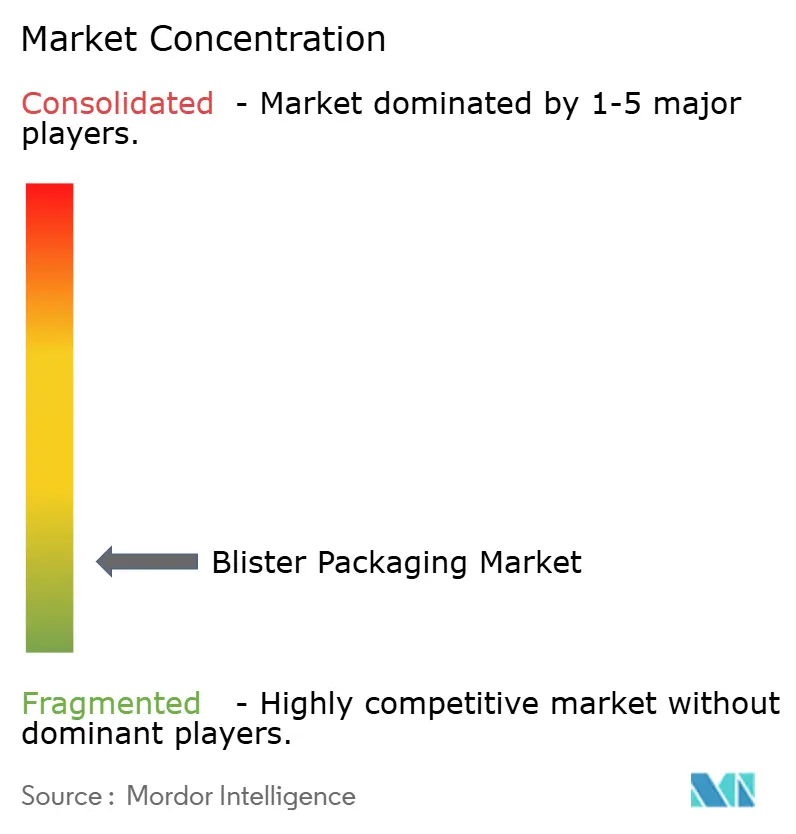
| Market Concentration | Low |
Major Players *Disclaimer: Major Players sorted in no particular order Image © Mordor Intelligence. Reuse requires attribution under CC BY 4.0. | |
Blister Packaging Market Analysis by Mordor Intelligence
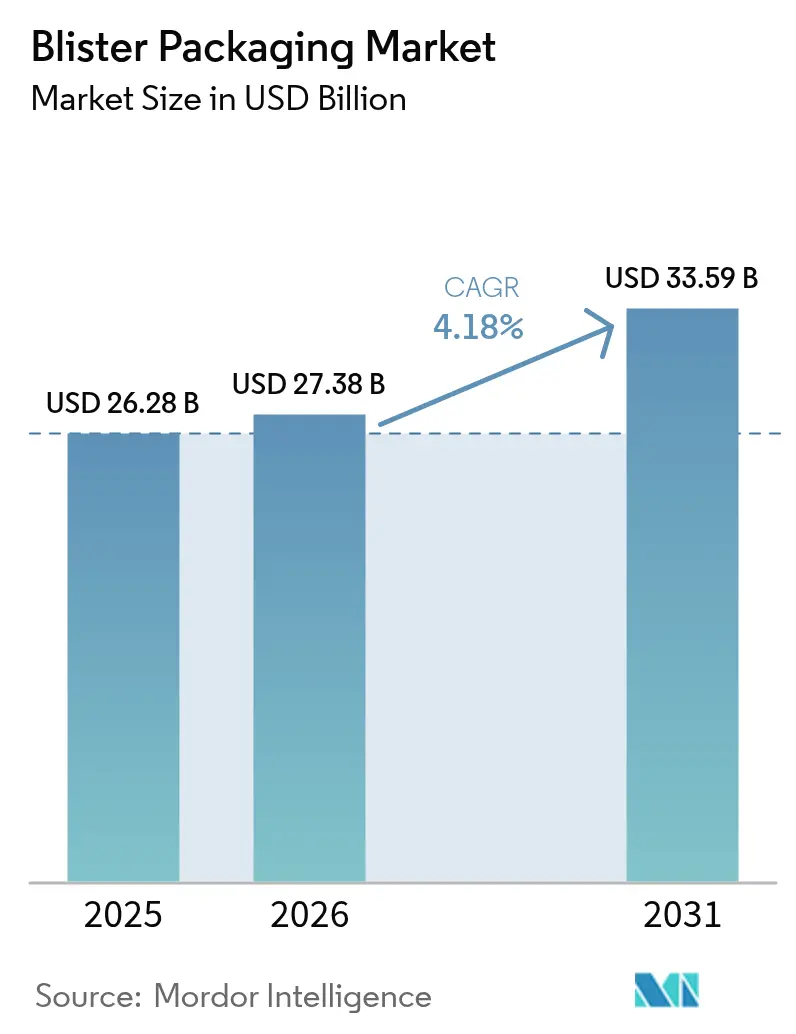
The blister packaging market size was valued at USD 26.28 billion in 2025 and estimated to grow from USD 27.38 billion in 2026 to reach USD 33.59 billion by 2031, at a CAGR of 4.18% during the forecast period (2026-2031). Robust demand from prescription drugs, over-the-counter medications, and increasingly complex biologics underpins this growth, while unit-dose formats continue to displace bulk bottles across hospital, long-term-care, and retail channels. Regulatory pressure—most notably the European Union’s Regulation 2025/40 mandating full recyclability by 2030 and the U.S. FDA’s strengthened tamper-evident rules—has sparked a wave of compliance-driven innovation that commands premium pricing and protects margins even as raw-material costs fluctuate.[1]European Commission, “Regulation (EU) 2025/40 on Packaging and Packaging Waste,” eur-lex.europa.eu Asia-Pacific leads global demand thanks to China and India’s manufacturing scale, while North America and Europe shape high-value niches through serialization, smart packs, and sustainability upgrades. Meanwhile, industry consolidation—typified by Amcor’s USD 8.43 billion purchase of Berry Global—signals a pivot toward integrated flexible, rigid, and intelligent solutions that can serve multinational pharmaceutical clients.
Key Report Takeaways
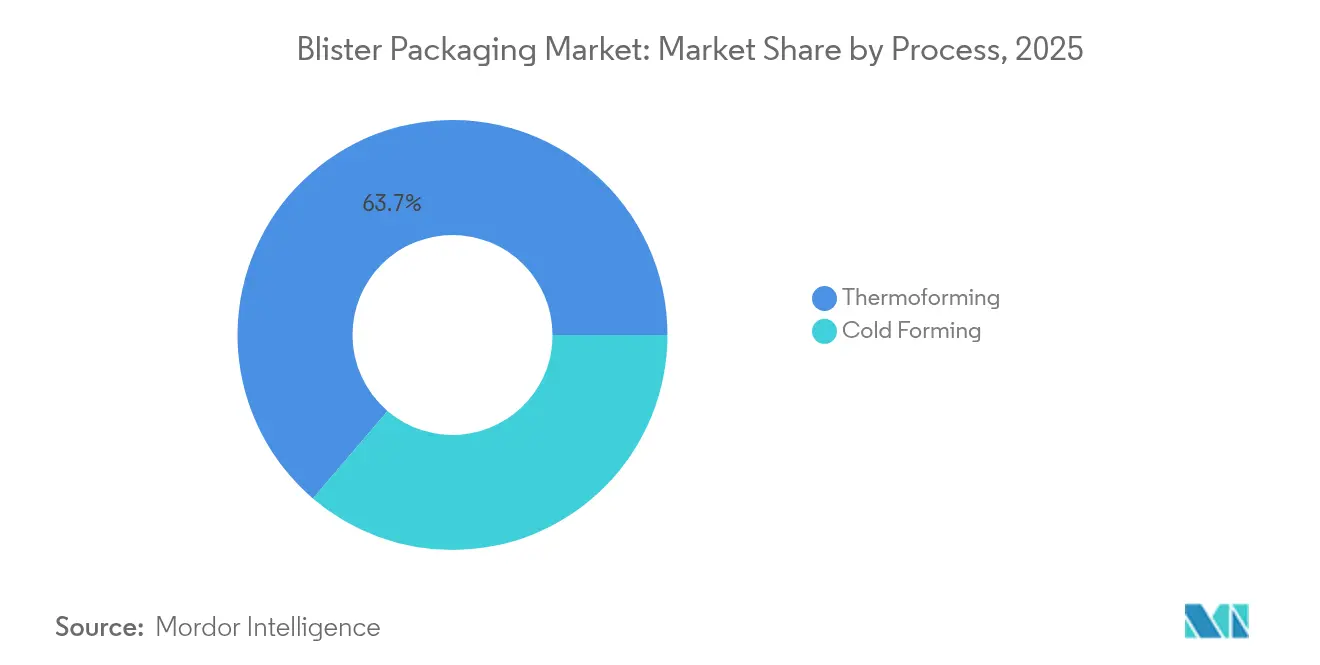
- By process, thermoforming led with 63.75% of the blister packaging market share in 2025 and is progressing at a 5.54% CAGR through 2031.
- By material, plastic films held 67.52% revenue share in 2025, while paper and paperboard are expanding fastest at 7.02% CAGR to 2031.
- By product type, carded/face-seal blisters captured 51.78% revenue in 2025; clamshell formats post the strongest outlook at 7.68% CAGR through 2031.
- By end-user industry, pharmaceuticals commanded 57.62% share of the blister packaging market size in 2025, whereas nutraceuticals are forecast to grow at 7.55% CAGR to 2031.
- By geography, Asia-Pacific dominated with 40.95% share in 2025; the region is advancing at 7.29% CAGR, the fastest globally.
Note: Market size and forecast figures in this report are generated using Mordor Intelligence’s proprietary estimation framework, updated with the latest available data and insights as of 2026.
Market Trends and Insights
Drivers Impact Analysis of Blister Packaging Market*
| Driver | (~) % Impact on CAGR Forecast | Geographic Relevance | Impact Timeline |
|---|---|---|---|
| Growing geriatric population & chronic diseases | +1.2% | Global; North America & Europe concentrated | Long term (≥ 4 years) |
| Rising demand for unit-dose adherence packs | +0.8% | Global; strongest in developed markets | Medium term (2-4 years) |
| Regulatory push for tamper-evident formats | +0.6% | North America & EU; APAC catching up | Short term (≤ 2 years) |
| Smart packs with NFC/QR for track-and-trace | +0.4% | EU & North America first; global roll-out | Medium term (2-4 years) |
| Personalized-medicine small-batch blister lines | +0.3% | North America & EU core | Long term (≥ 4 years) |
| PVC-to-PE retrofits driven by sustainability targets | +0.2% | EU leading; global adoption follows | Medium term (2-4 years) |
| Source: Mordor Intelligence | |||
Growing Geriatric Population and Chronic-Disease Prevalence
The global cohort aged 60 and above will surge 56% by 2030, intensifying demand for user-friendly blister packs that improve medication adherence while offering tamper evidence. Senior-centric designs—larger print, color coding, and low opening force—are being commercialized by converters such as Drug Plastics Group, whose Pop & Click closure reduces required hand pressure by roughly a quarter. Chronic conditions like diabetes and cardiovascular disease further amplify multi-dose pack adoption, enabling clear visual cues for complex regimes and reinforcing premium price realization for blister specialists.
Demand for Unit-Dose and Patient-Adherence Packs
Hospitals, pharmacies, and home-health providers increasingly link reimbursement to adherence metrics, elevating the role of blister-based unit-dose packs. Automated equipment from Parata now integrates directly with electronic health-record platforms, cutting dispensing errors while simplifying repack operations. The FDA’s proposal to require single-unit containers for orally disintegrating OTC forms underscores regulatory endorsement of unit-dose safety benefits.[2]U.S. Federal Register, “Proposed Rule on Single-Unit Containers for OTC Drugs,” federalregister.gov Pharmaceutical brands also leverage unit-dose blisters for differentiation, combining brand visibility with tamper-evidence that bottles cannot replicate.
Regulatory Push for Tamper-Evident Formats
U.S. 21 CFR 211.132 obliges OTC drugs to integrate overt tamper-evident features, while Europe’s Falsified Medicines Directive mandates unique identifiers and anti-tamper devices on prescription packs. These overlapping frameworks favor blister formats that pair mechanical indicators with serialization, enabling cross-border compliance and reducing counterfeit risk for high-value therapies.
Smart Blister Packs with NFC/QR for Track-and-Trace
Embedding NFC chips or QR codes turns everyday blisters into data-rich assets. Schreiner Group’s NFC labels allow patients to confirm authenticity and log usage with a tap of a smartphone. Aardex Group’s electronics record time-stamped dose events, permitting healthcare teams to intervene promptly when adherence deviations surface. The approach dovetails with the U.S. Drug Supply Chain Security Act and EU mandates for serialized medicines, giving early adopters a compliance-plus-engagement edge.
Restraints Impact Analysis of Blister Packaging Market*
| Restraint | (~) % Impact on CAGR Forecast | Geographic Relevance | Impact Timeline |
|---|---|---|---|
| Volatile PVC & aluminium prices | -0.9% | Global; especially import-dependent markets | Short term (≤ 2 years) |
| Tightening PVC disposal/recycling rules | -0.7% | EU leads; North America follows | Medium term (2-4 years) |
| PVDC resin supply bottlenecks | -0.4% | Global; specialty niches | Short term (≤ 2 years) |
| OTC stick-pack & sachet substitution | -0.3% | Global; fastest in emerging markets | Long term (≥ 4 years) |
| Source: Mordor Intelligence | |||
Volatile PVC and Aluminium Prices
China’s jump in PVC import tariffs from 1% to 5.5% in 2025 lifted resin costs for downstream converters, spotlighting vulnerability to policy shifts. Indian converters remain exposed since 60% of their PVC feedstock is sourced abroad, making hedging and backward integration central to risk management. Aluminium foil prices also swing with energy markets, straining smaller blister firms that lack the scale to lock in multi-year contracts.
Tightening PVC Disposal/Recycling Legislation
The EU’s Packaging and Packaging Waste Regulation defines recyclability requirements for all formats by 2030, and discussions on classifying PVC as hazardous waste in the U.S. could raise disposal costs dramatically. In response, leaders such as TekniPlex are commercializing blister films with 30% post-consumer recyclate, balancing barrier performance with circular-economy targets.
*Our forecasts treat driver/restraint impacts as directional, not additive. The impact forecasts reflect baseline growth, mix effects, and variable interactions.
Blister Packaging Market Segment Analysis
By Process:
Thermoforming Dominance Faces Cold-Form InnovationThermoforming commanded 63.75% of global revenues in 2025 and will grow 5.54% a year as drug makers favor its low tooling cost, fast line speeds, and compatibility with diverse film substrates. Brown Machine’s Quad-Series thermoformers now deliver up to 250,000 lids per hour while trimming energy use by roughly one-quarter, giving contract packers productivity gains that sustain the blister packaging market’s momentum. Smaller laboratories gain access through modular machines introduced by GEA, broadening supplier bases beyond large multinationals.
Cold-form foil, though a minority share, is indispensable for moisture- or light-sensitive molecules. Drug makers often specify aluminium-aluminium structures when stability studies demand near-zero water vapor transmission. As biologics and high-potency actives proliferate, cold form’s installed base expands, intensifying R&D into thinner foils and hybrid lamination that cut weight without compromising barrier. Together, these advances widen the technology palette, reinforcing the blister packaging market as a versatile platform for both mass-production generics and niche specialty drugs.


By Material:
Plastic Films Lead While Paper Gains Sustainability MomentumPlastic films, led by PVC, PET, and PP, accounted for 67.52% of blister revenues in 2025 thanks to mature supply chains and easy thermoformability. Yet heightened scrutiny of fossil-based materials is spurring rapid incremental gains for paper-based solutions, which log a 7.02% CAGR through 2031. TekniPlex now offers transparent recyclable mid-barrier PET blisters containing 30% recycled content, illustrating how converters preserve pharmacopoeial compliance while advancing circularity.
Paperboard entrants such as Rohrer’s EcoVolve-30 use fiber plus functional coatings to withstand line forming temperatures and protect moisture-tolerant tablets. Although moisture sensitivity limits broad substitution, brand owners deploy paper variants in vitamins, nutraceuticals, and short shelf-life SKUs, bolstering eco-credentials. Over time, material science breakthroughs are expected to let hybrid fiber-polymer laminates secure higher-barrier categories, reinforcing the blister packaging market size trajectory and aligning with regulatory recycled-content mandates.
By Product Type:
Carded Blisters Dominate as Clamshells SurgeCarded or face-seal formats held 51.78% of 2025 revenue owing to cost-efficient inline carding and broad acceptance across prescription and OTC drugs. Their design simplicity keeps tooling budgets modest, benefiting generic manufacturers competing on unit economics. The blister packaging market continues to rely on carded solutions for high-volume SKUs where shelf visibility and tamper evidence suffice.
Clamshell packs, the fastest-expanding product type at an 7.68% CAGR, blend premium feel with robust mechanical protection, gaining traction for nutraceuticals, medical devices, and combination kits. Converters integrate child-resistance and senior-friendliness using next-generation mechanisms such as Fresh-Lock’s push-and-turn Child-Guard closure, which satisfies U.S. Consumer Product Safety Commission protocols while reducing opening torque for elderly users. Continuous refinement of full-card and trapped-blister designs offers brand teams heightened security against pilferage and counterfeiting, reinforcing the blister packaging market’s versatility.

By End-User Industry:
Pharmaceuticals Lead While Nutraceuticals AcceleratePharmaceutical companies consumed 57.62% of global blister output in 2025, a testament to regulatory preference for tamper-evident, unit-dose formats that fit electronic pedigree and patient-adherence programs. Personalized-medicine pathways now drive capital investment in small-batch blister lines capable of frequent changeovers without yield loss, extending the blister packaging industry into oncology and orphan-drug niches where run sizes are measured in thousands rather than millions.
Nutraceuticals, posting a 7.55% CAGR to 2031, benefit from consumer interest in preventive health and premium delivery. Moisture-sensitive probiotics and omega-3 capsules move from bulk bottles into aluminium-aluminium blisters, commanding higher retail price points while reassuring consumers about product integrity. Beyond healthcare, electronics, personal-care, and hardware retain steady demand for barrier properties and hang-tab retail merchandising. Such diversity cushions the blister packaging market against cyclical swings in any single sector and supports long-term revenue visibility.
Geography Analysis
APAC Blister Packaging Market
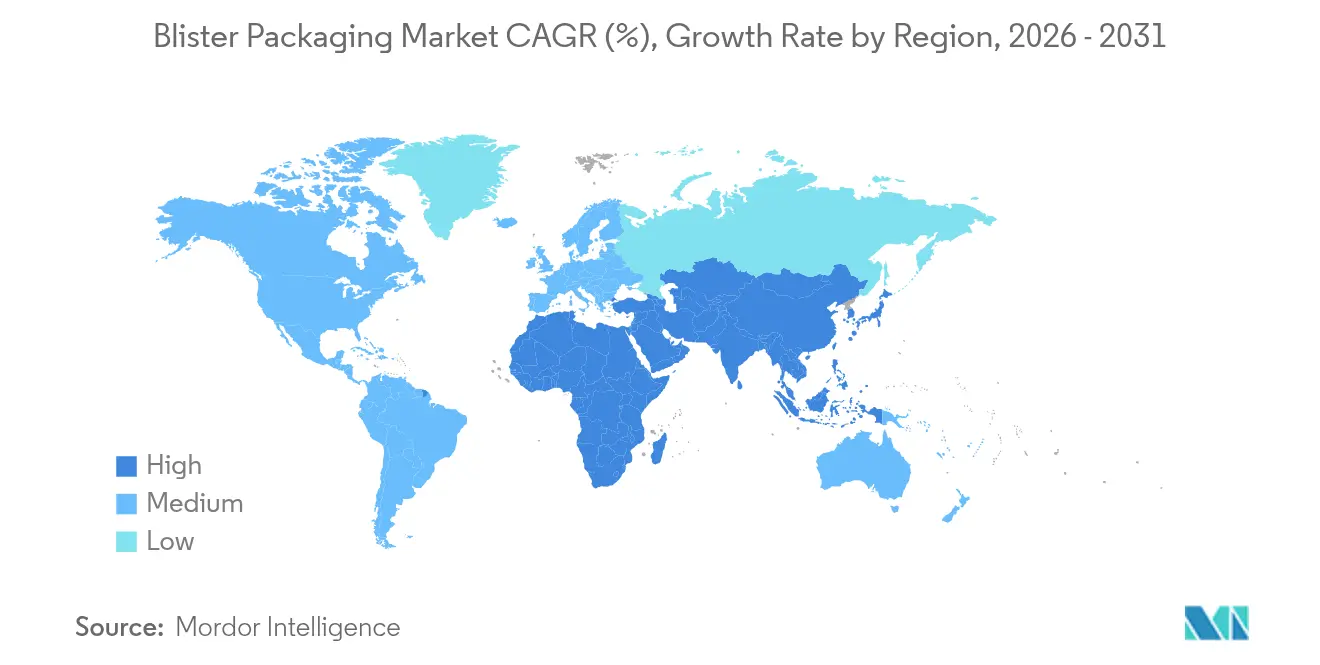
Asia-Pacific led with 40.95% of 2025 revenue and will outpace all regions at 7.29% CAGR as China and India scale active-pharmaceutical-ingredient output and align with Western quality standards. WuXi STA’s new Taixing API site and proposed Singapore expansion exemplify regional manufacturing build-out, directly lifting local demand for compliant blister lines. China’s tariff hike on imported PVC to 5.5% further encourages domestic film extrusion, reinforcing supply-chain localization that underpins the blister packaging market in East Asia.
North America Blister Packaging Market
North America remains a technological bellwether. Stringent FDA serialization plus tamper-evidence rules sustain premium margins for intelligent formats, while machinery capex expands in anticipation of biologic fill-finish demand. PMMI projects packaging-machinery sales will hit record highs by 2027, with pharmaceutical applications outperforming food and beverage. Amcor’s Berry Global acquisition consolidates flexible and rigid capabilities inside a single platform, ensuring scale and vertical reach that smaller North American converters will find hard to match.
Europe and APAC Blister Packaging Market
Europe confronts the most aggressive sustainability legislation. Regulation 2025/40 enforces recyclability and 30% recycled content in PET packs by 2030, directing investment into circular-ready designs. TekniPlex’s showcase of transparent recyclable mid-barrier blisters demonstrates compliance pathways that still satisfy stringent EMA barrier specifications. Clinical-trial packs also adapt to EU 536/2014, prompting Catalent to equip its Shiga, Japan, site with high-speed blister lines that serve pan-regional studies and underscore the global nature of compliance-driven demand. Consequently, the blister packaging market share in Europe remains resilient even as material choices evolve.

Regulatory Landscape
Blister packaging for pharmaceuticals operates under overlapping product-safety and packaging-waste rules that shape material choices, validation, and labeling. In the United States, FDA cGMP requirements (including 21 CFR 211.132 for tamper-evident packaging for OTC drugs) and track-and-trace obligations under the Drug Supply Chain Security Act (DSCSA) reinforce demand for unit-dose packs that can carry identifiers and support anti-tamper features. In Europe, the Falsified Medicines Directive requires unique identifiers and anti-tamper devices on prescription packs, while the European Medicines Agency provides guidance on plastic immediate packaging materials used in medicinal products, tightening expectations around compatibility and performance documentation.
Sustainability regulation adds a parallel compliance layer. The EU Packaging and Packaging Waste Regulation (Regulation (EU) 2025/40) entered into force in 2025 and applies from 12 August 2026, introducing design-for-recyclability and labeling requirements that are pushing blister structures toward recycle-ready solutions where feasible. Globally, WHO GMP guidance (WHO TRS) and integrity-oriented standards used in sterile and device-related applications (for example, ISO 11607 in relevant sterile-packaging contexts) influence supplier qualification, traceability, and process control for converters supporting multi-country pharmaceutical programs.
Value Chain Analysis
The blister packaging value chain begins with upstream raw materials, primarily polymer resins and specialty films (PVC, PET, PP, PE and related blends) and aluminium-based structures for high-barrier applications, along with lidding materials that commonly use aluminium foils with heat-seal coatings. These inputs flow to film and foil producers and converters that compound, calender/extrude, coat, print, and laminate forming webs and lidding stocks, which then feed into packaging-line operations at pharmaceutical manufacturers and contract packaging organizations. The dominant manufacturing route is thermoforming, where plastic webs are heated and formed before filling, lidding, sealing, and die cutting, while cold forming uses aluminium laminates pressed into cavities for moisture- and light-sensitive products.
Downstream, finished blisters move through pharmaceutical distribution channels (wholesalers, hospitals, retail pharmacies, and e-commerce fulfillment, depending on the product) with additional requirements for serialization/traceability and tamper evidence in many markets. Enabling layers include machinery OEMs that supply integrated blister lines and inspection, plus providers of smart-pack components (for example, NFC/QR labeling) and quality systems that support validation and audit trails. Risk points highlighted in the market context include volatility in PVC and aluminium pricing, PVDC-related supply constraints in barrier niches, and the operational complexity of converting to recycle-ready structures without compromising barrier performance and regulatory documentation.
Competitive Landscape
The blister packaging market sits in the mid-range of concentration. Top players—Amcor, Constantia Flexibles, WestRock, and select regional specialists—collectively control an estimated two-thirds of global pharmaceutical blister capacity. Consolidation is accelerating: Amcor’s USD 8.43 billion purchase of Berry Global cements a healthcare-focused powerhouse that targets USD 650 million in cost synergies within three years. Meanwhile, Nutra-Med’s acquisition of Legacy Pharma Solutions equips the nutraceutical co-packer with high-speed blistering to address dietary-supplement growth.
Technology differentiation drives competitive edge. Pharmaworks’ TF1e blister machine caters to mid-volume drug makers seeking GMP compliance without the footprint of legacy lines. Ecobliss Pharma’s cold-seal technology lowers energy consumption, aligning with decarbonization targets while preserving high-barrier protection. Patent filings on single-piece re-closable unit packs reveal sustained R&D investment into user-friendly, adherence-boosting formats. As sustainability and digital traceability become table stakes, innovators capable of integrating post-consumer recycled content with embedded electronics are positioned to outpace conventional rivals.
Smaller converters focus on niche strengths—specialty films, rapid-changeover lines, or country-specific compliance expertise—to capture high-margin contracts that global majors overlook. Strategic partnerships between machinery OEMs and material suppliers further erode barriers for mid-tier entrants, keeping the blister packaging industry dynamic despite headline consolidation.
Blister Packaging Industry Leaders
Klockner Pentaplast Group
Amcor PLC
Constantia Flexibles GmbH
Honeywell International Inc.
Huhtamaki Oyj
- *Disclaimer: Major Players sorted in no particular order
Blister Packaging Market Companies Covered in this Report
- Amcor plc
- WestRock Company
- Constantia Flexibles GmbH
- Klöckner Pentaplast Group
- Sonoco Products Company
- DuPont de Nemours, Inc.
- Honeywell International Inc.
- Tekni-Plex, Inc.
- Dow Inc.
- Uflex Ltd.
- Huhtamaki Oyj
- Winpak Ltd.
- Bilcare Ltd.
- Bemis Company LLC (Amcor)
- Lotte Aluminium Co., Ltd.
- Toyo Aluminium K.K.
- Pharma Packaging Solutions
- R-Pharm Germany GmbH
- FormPaks Ltd.
- Zhejiang Hualian Pharmaceutical Co.

Market Opportunities and Future Outlook
A major whitespace is scaling recycle-ready blister structures that still meet pharmaceutical barrier and machinability requirements under tightening packaging-waste frameworks. The EU Packaging and Packaging Waste Regulation (Regulation (EU) 2025/40) applying from 12 August 2026 creates a concrete timeline for converters and brand owners to qualify materials, seals, inks, and labels against recyclability and labeling rules. Commercial activity is already visible in mono-material and recycle-ready concepts, including Amcor securing a commercial order for its AmSky Blister System that uses HDPE as a recyclable blister alternative, alongside supplier roadmaps that increasingly shift away from complex multi-layer laminates where product protection allows.
Operational and compliance-driven opportunities are also developing around higher automation and inspection capability on blister lines. As line speeds rise, batch sizes shrink, and product complexity increases, defect detection and fill control become harder to manage at the same margins, which supports investment in inspection-focused upgrades. Industry showcase activity at Interpack 2026 highlighted high-speed lines compatible with mono-materials and AI-enabled inspection systems for blister packaging, reinforcing adoption pathways for converters and pharma sites upgrading throughput while keeping quality risk low. Separately, end-of-life solutions for mixed-material blister waste remain underdeveloped, and published research on automated recycling and separation of pharmaceutical blister waste points to technology directions that can support take-back, de-blistering, and material recovery initiatives where collection systems exist.
Recent Industry Developments in Blister Packaging Market
- June 2026: Amcor announced a multi-million-dollar investment to expand its healthcare packaging manufacturing facility in Sira, Karnataka, India. The move increases regional output and shortens lead times for pharmaceutical packaging and drug-delivery related components, supporting localization strategies for regulated healthcare supply chains.
- January 2026: Klöckner Pentaplast completed its financial restructuring and emerged from the US Chapter 11 process. The deleveraging and new capital strengthened its ability to fund material innovation and capacity programs that influence specialty film availability for blister packaging applications.
- April 2025: Amcor secured a commercial order for its AmSky Blister System for TheraBreath chewing gum, using high-density polyethylene (HDPE) as a recyclable blister packaging alternative. This order converted a recycle-ready blister concept into a shipped program, signaling buyer acceptance for mono-material formats beyond traditional PVC-based structures.


Blister Packaging Market Report Scope and Research Methodology
Market Definition and Coverage
For this study, the blister packaging market covers the revenue generated from blister packs used to protect, display, and unit-dose products. Revenue is counted at the packaging supply level and reported in USD for the covered geographies.
Scope exclusions: We exclude secondary packaging formats that are not blister packs, as well as unrelated packaging machinery and services.
Segments Covered in This Report
- By Process
- Thermoforming
- Cold Forming
- By Material
- Plastic Films (PVC, PET, PP, PE, rPET, COP, others)
- Aluminium (ALU-ALU, PTP foil)
- Paper and Paperboard
- By Product Type
- Carded / Face-Seal Blisters
- Clamshell Blisters
- Trapped and Full-Card Blisters
- Child-Resistant / Senior-Friendly Packs
- By End-User Industry
- Pharmaceuticals
- Nutraceuticals and Dietary Supplements
- Consumer Electronics and Hardware
- Personal Care and Cosmetics
- Other End-user Industry
- By Geography
- North America
- United States
- Canada
- Mexico
- Europe
- Germany
- United Kingdom
- France
- Italy
- Spain
- Russia
- Rest of Europe
- Asia-Pacific
- China
- India
- Japan
- South Korea
- Australia and New Zealand
- Rest of Asia-Pacific
- Middle East and Africa
- Middle East
- United Arab Emirates
- Saudi Arabia
- Turkey
- Rest of Middle East
- Africa
- South Africa
- Nigeria
- Egypt
- Rest of Africa
- Middle East
- South America
- Brazil
- Argentina
- Rest of South America
- North America
Data Sources, Market Sizing, and Validation
Desk Research
Desk research was used to anchor the model on real-world demand signals and packaging supply dynamics before assumptions were finalized. We reviewed public sources such as the US FDA databases and guidance relevant to drug and pack compliance signals, US Census and Eurostat manufacturing and trade tables, UN Comtrade import and export series, and trade association publications that track packaging materials and recycling trends.
To translate these signals into a value model, broader secondary sources were also used, such as annual reports, investor decks, and reputable press coverage around capacity additions, material substitutions, and regulatory changes for pharma and consumer goods. In a few places, paid subscriptions for company financials and intelligence, patent databases, and shipment-level trade datasets were used to sanity-check company exposure and cross-border flow direction. The sources named here are illustrative, and many other public references were also used for data collection, validation, and clarification during the study.
Primary Interviews and Surveys
Primary work focused on interviews and structured surveys with packaging converters, material suppliers, distributors, and large end users that buy blister packs at scale. These discussions were used to confirm pricing logic, typical pack formats by end use, and how fast demand shifts across thermoformed versus cold-formed packs, and then the inputs were reconciled across APAC, EMEA, and the Americas for consistency.
Distribution of primary research fieldwork respondents
| Company type | Respondent position | Region |
|---|---|---|
| Top tier: 29% | CXOs: 14% | APAC: 43% |
| Mid tier: 56% | Functional/Unit leaders: 38% | EMEA: 32% |
| Smaller Players: 15% | Managers: 48% | Americas: 25% |
Market-Sizing & Forecasting
Sizing used a top-down and bottom-up structure. First, packaging demand was reconstructed from end-use output and consumption signals, then validated through selective supplier and channel checks. We started with demand pools linked to pharma solid-dose volumes, OTC and nutraceutical unit consumption, and consumer goods blister use where relevant, which were converted into packaging value using typical pack counts and price ranges gathered in research.
To keep the model grounded, practical inputs were tracked year by year, including the mix of thermoforming versus cold forming, shifts in PVC versus alternative films, aluminum foil price movement, and average pack size changes driven by compliance and child-resistant requirements. Bottom-up approximations were applied as a cross-check, using sampled converter revenue exposure, capacity and utilization commentary, and ASP times volume logic for representative pack formats. Where a sub-region had limited public disclosure, gaps were handled through conservative interpolation.
For forecasting, we used scenario analysis supported by primary expert views, since demand is shaped by healthcare volume growth and material cost cycles. We built a base case first, then ran sensitivities for resin and aluminum price swings, pharma production changes, and adoption rates of higher-barrier structures.
Data Validation & Update Cycle
Outputs were validated through triangulation across independent signals, and outliers were investigated before results were finalized. We compared implied packaging intensity with end-use unit trends, checked regional splits against trade flow and manufacturing indicators, and re-contacted respondents when pricing or mix shifts created unusual jumps.
A multi-step internal review is completed before sign-off, including consistency checks across historical and forecast years. Reports are refreshed annually, and interim updates are made when material events occur, such as major regulatory changes, capacity announcements, or sharp raw material moves. Before delivery, the analyst performs a fresh pass so the numbers reflect the most current available information.
Mordor Intelligence's Blister Packaging Market Size Compared Against Other Published Estimates
Published market sizes for blister packaging often do not align because the market is defined and counted differently across sources, and the time window used for pricing also varies. Differences in whether the study leans more on end-use consumption signals or packaging supply reporting can shift the final total.
The main gap comes from which pack types and end uses are counted together, and how quickly price and mix are allowed to change in the model. Some estimates fold in a wider set of healthcare packaging formats or use aggressive price escalation. Mordor Intelligence counts only blister packs and keeps pricing tied to observed material moves and validated pack-format mix by region, which limits how much the total can drift.
Benchmark comparison
| Source | Market Size | Gaps in Research Methodology |
|---|---|---|
| Mordor Intelligence | USD 27.38 B (2026) | |
| Industry Research Publisher A | USD 30.45 B (2024) | Uses an earlier base year and a faster growth arc, and the figure is influenced by a broader healthcare-driven demand narrative, which can pull in adjacent packaging consumption assumptions and higher assumed ASP progression. |
| Global Consultancy B | USD 30.60 B (2025) | Reports a later base year with higher implied pricing and mix uplift, and the total can rise if premium barrier structures are assumed to scale faster across regions without the same level of pack-format normalization. |
Across the three figures, the spread is mainly explained by the chosen base year and how strictly the scope stays on blister packs versus adjacent formats. Pricing and mix shifts then drive most of the remaining variation. By keeping the model tied to observable end-use unit signals and cross-checked pack pricing ranges, the estimate remains easier to trace, repeat, and update when market conditions change.


Key Questions Answered in the Report
How large is the blister packaging market in 2026?
The blister packaging market size is USD 27.38 billion in 2026 and is projected to reach USD 33.59 billion by 2031 at a 4.18% CAGR.
Which region is growing fastest in blister packaging?
Asia-Pacific leads growth with a 7.29% CAGR through 2031, driven by pharmaceutical production expansion in China and India.
What process dominates blister production?
Thermoforming holds 63.75% of global revenue and remains preferred for its cost-efficiency and high throughput.
How are sustainability regulations affecting materials?
EU Regulation 2025/40 mandates recyclability and recycled-content thresholds, accelerating the shift from PVC toward recyclable PET and paper-based structures.
Why are smart blister packs gaining traction?
NFC and QR-enabled blisters meet serialization laws and allow real-time adherence monitoring, improving patient outcomes and supply-chain visibility.
What impact do raw-material price swings have on converters?
Volatile PVC and aluminium costs can shave up to 0.9 percentage points off forecast CAGR, pressuring margins and hastening industry consolidation.
Page last updated on:


 Your data is secure and never sold or shared.


