
Biological Safety Cabinet Market Size and Share
Market Overview
| Study Period | 2020 - 2031 |
|---|---|
| Market Size (2026) | USD 282.55 Million |
| Market Size (2031) | USD 410.39 Million |
| Growth Rate (2026 - 2031) | 7.76 % |
| Fastest Growing Market | Asia Pacific |
| Largest Market | North America |
| Market Concentration | Medium |
Major Players *Disclaimer: Major Players sorted in no particular order Image © Mordor Intelligence. Reuse requires attribution under CC BY 4.0. | |
Biological Safety Cabinet Market Analysis by Mordor Intelligence
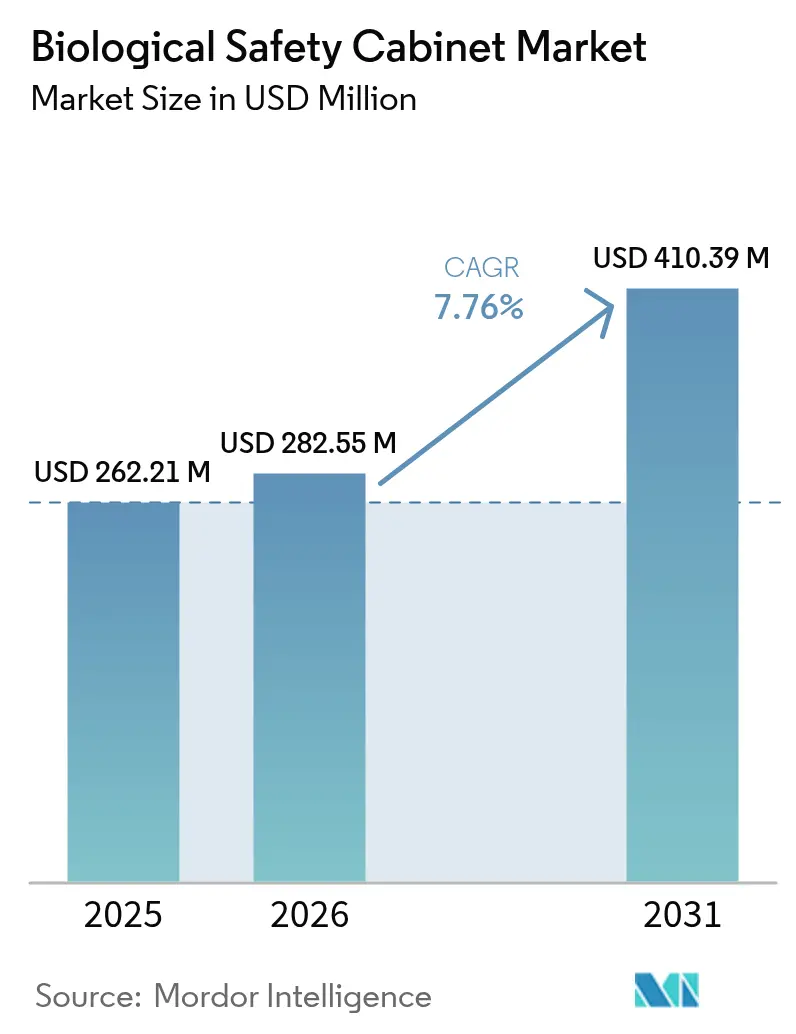
The biological safety cabinets market size was valued at USD 262.21 million in 2025 and estimated to grow from USD 282.55 million in 2026 to reach USD 410.39 million by 2031, at a CAGR of 7.76% during the forecast period (2026-2031). This expansion stems from record capital spending on cell and gene therapy infrastructure, large-scale aseptic manufacturing projects, and steady adoption of higher-containment technologies. Investment announcements such as Novo Nordisk’s USD 4.1 billion fill-finish campus and Thermo Fisher Scientific’s USD 2 billion U.S. capacity upgrade signal sustained equipment demand. Contract development and manufacturing organizations (CDMOs) now capture a growing share of cabinet purchases as outsourcing accelerates, while energy-efficient ductless designs win favor in retrofit laboratories. Regulatory convergence around ISO 14644-4 and the EU Machinery Regulation is eliminating regional specification gaps and rewarding suppliers with global compliance expertise. Asia-Pacific is set to overtake Europe in new installations as pharmaceutical supply chains rebalance away from China toward India and Southeast Asia.
Key Report Takeaways
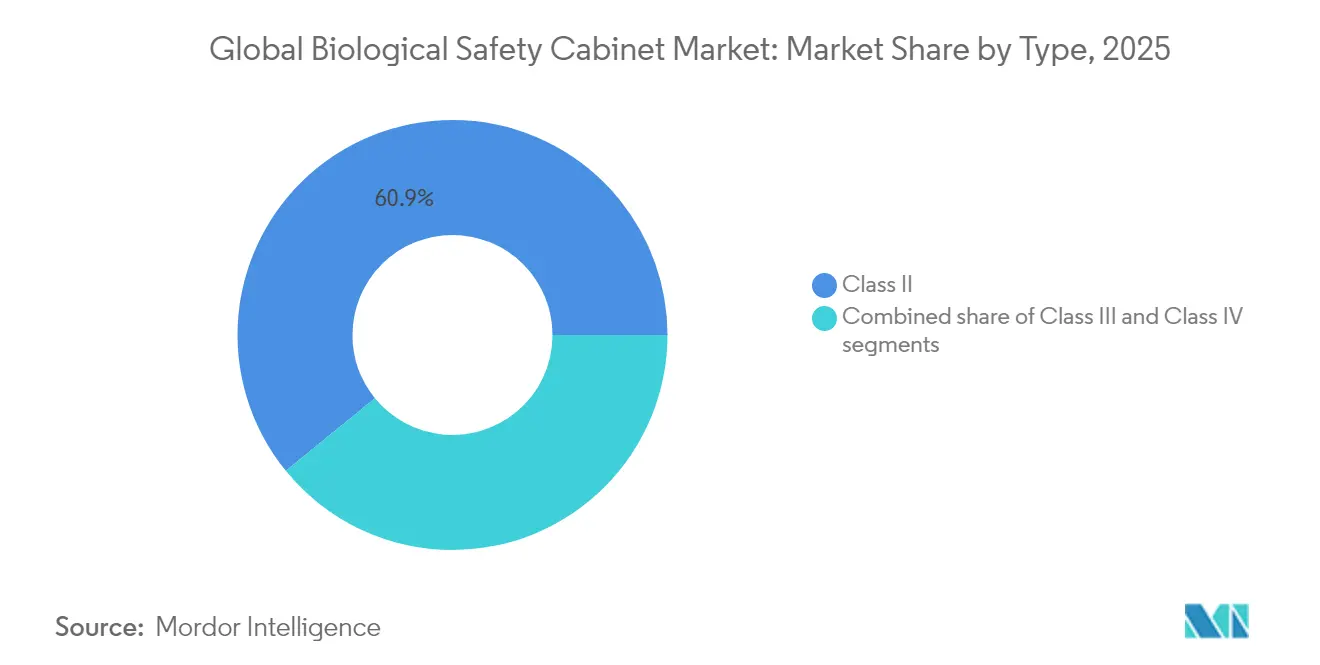
- By type, Class II equipment accounted for 60.88% share of the biological safety cabinets market size in 2025, whereas Class III systems are expanding at a 10.01% CAGR.
- By exhaust system, ducted models commanded 57.92% share of the biological safety cabinets market size in 2025, while ductless solutions are rising at a 10.28% CAGR.
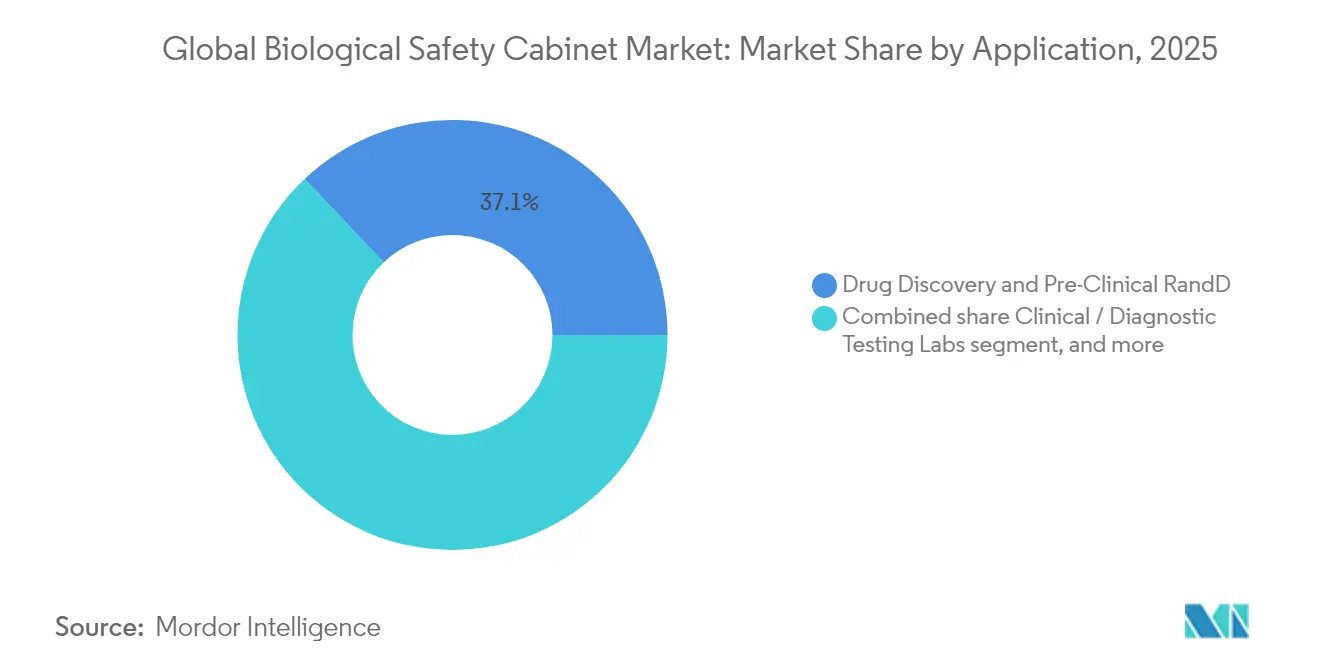
- By application, drug discovery and pre-clinical R&D held 37.08% of the biological safety cabinets market share in 2025; biopharmaceutical manufacturing and fill-finish is growing fastest at an 10.92% CAGR.
- By end-user, pharmaceutical and biotechnology companies held 48.02% of the biological safety cabinets market share in 2025, while CDMOs record the fastest growth at an 11.33% CAGR through 2031.
- By geography, North America led with 41.98% revenue share in 2025; Asia-Pacific is projected to advance at a 9.22% CAGR to 2031.
Note: Market size and forecast figures in this report are generated using Mordor Intelligence’s proprietary estimation framework, updated with the latest available data and insights as of 2026.
Global Biological Safety Cabinet Market Trends and Insights
Drivers Impact Analysis*
| Driver | % Impact on CAGR Forecast | Geographic Relevance | Impact Timeline |
|---|---|---|---|
| Expanding pharmaceutical and biotechnology research expenditure | +2.1% | Global, with concentration in North America & Europe | Medium term (2-4 years) |
| Escalating global preparedness for emerging infectious diseases | +1.8% | Global, priority in Asia-Pacific & North America | Short term (≤2 years) |
| Stringent occupational health and safety regulations | +1.5% | North America & EU core, expanding to Asia-Pacific | Long term (≥4 years) |
| Accelerating cell and gene therapy manufacturing expansion | +2.3% | North America & Europe, emerging in Asia-Pacific | Medium term (2-4 years) |
| Rising adoption of smart energy-efficient cabinet technologies | +0.8% | Global, led by North America & Europe | Long term (≥4 years) |
| Source: Mordor Intelligence | |||
Expanding Pharmaceutical and Biotechnology Research Expenditure
Robust drug-development pipelines are prompting large companies to build redundant research hubs that need new containment suites. Thermo Fisher Scientific is allocating USD 1.5 billion of its four-year U.S. investment program to laboratory infrastructure that includes biological safety cabinets. Mergers that add late-stage assets further boost facility retrofits, and AI-enabled discovery platforms are re-configuring workspaces for automated, high-throughput assays that still require operator protection. As a result, the biological safety cabinets market gains additional pull-through from every newly equipped research laboratory. Universities benefit from expanded grant funding that covers biosafety upgrades, supporting steady public-sector demand. The trend is most visible in North America, but similar capacity builds are underway in Western Europe.
Escalating Global Preparedness for Emerging Infectious Diseases
Governments have prioritized resilient laboratory networks since 2024. The CDC’s sixth edition of the Biosafety in Microbiological and Biomedical Laboratories outlines tighter performance criteria for airflow and filter integrity, prompting cabinet replacement cycles. OSHA’s forthcoming infectious-disease rule will extend similar requirements to clinical laboratories, accelerating domestic orders[1]U.S. Department of Health & Human Services, “OSHA Infectious Disease Rulemaking Update,” hhs.gov. Defense programs that study bioaerosol threats also rely on HEPA-filtered workstations, underlining cross-sector demand. National stockpiles of rapid-response testing infrastructure now routinely include biosafety cabinets, ensuring immediate deployment during outbreaks. This focus on readiness sustains short-term growth, particularly in Asia-Pacific where public-health laboratories are scaling up.
Stringent Occupational Health and Safety Regulations
The FDA’s adoption of ISO 14644-4 for cleanroom construction sets new benchmarks for air-change efficiency and maintenance documentation, affecting cabinet selection after December 2026. The EU Machinery Regulation 2023/1230 adds mandatory conformity assessments that standardize performance claims across member states[2]European Parliament and Council, “Machinery Regulation 2023/1230,” eur-lex.europa.eu. OSHA’s revised Hazard Communication Standard elevates labeling and ventilation expectations for laboratories. Europe’s updated GMP Annex 1 stipulates 0.45 m/s unidirectional airflow, pressuring manufacturers to refine cabinet design[3]International Society for Pharmaceutical Engineering, “Impact of EU GMP Annex 1 on Airflow,” ispe.org. Global harmonization reduces regional model variants and favors suppliers with multi-jurisdiction certifications, thereby shaping procurement decisions within the biological safety cabinets market.
Accelerating Cell and Gene Therapy Manufacturing Expansion
Major biomanufacturing projects are reshaping the production footprint of advanced therapies. Fujifilm is investing USD 1.2 billion to add eight 20,000-liter bioreactors in North Carolina, each requiring multiple Class II and III workstations for seed train and fill-finish steps. Lonza’s agreement to make Vertex’s CRISPR-edited therapy uses dedicated containment suites in Portsmouth and the Netherlands, illustrating specialized cabinet requirements. GenScript’s 128,000-square-foot New Jersey site expands plasmid DNA output and relies on modular cabinets with automated decontamination. Canadian federal support for STEMCELL Technologies’ new plant demonstrates public-sector backing for advanced bioprocessing that includes biosafety investments. Each project translates directly into demand for high-containment, rapid-cycle equipment.
Restraints Impact Analysis*
| Restraints Impact Analysis | (~) % Impact on CAGR Forecast | Geographic Relevance | Impact Timeline |
|---|---|---|---|
| High capital and certification costs | -1.2% | Global, particularly affecting smaller laboratories | Short term (≤2 years) |
| Emergence of alternative closed isolator systems | -0.8% | North America & Europe, expanding globally | Medium term (2-4 years) |
| Supply chain vulnerabilities in HEPA / ULPA filtration components | -0.6% | Global, with acute impact in Asia-Pacific | Short term (≤2 years) |
| Intensifying energy-efficiency compliance pressure | -0.4% | EU core, expanding to North America | Long term (≥4 years) |
| Source: Mordor Intelligence | |||
High Capital and Certification Costs
Total installed cost often doubles list price once validation, construction modifications, and GMP documentation are added. Academic laboratories struggle to fund upgrades because research grants rarely cover infrastructure. Uncertainty over future certification rules tied to ISO 14644-4 has prompted some buyers to postpone orders. Smaller biotech firms mitigate expense by leasing shared lab space, which delays direct equipment sales. Custom validation for potent-compound handling pushes expenses higher, particularly for first-time CDMOs.
Emergence of Alternative Closed Isolator Systems
Isolators deliver higher sterility assurance levels for cytotoxic or HPAPI production. Telstar’s Pura system achieves log-6 microbial reductions while reducing cleanroom classification needs. Restricted Access Barrier Systems lower HVAC loads yet offer limited operator protection for very toxic materials. Pharmaceutical contamination-control guidelines increasingly recommend isolators for cell therapy lines. Curis System’s rapid vaporized-hydrogen-peroxide decontamination unit completes validated cycles in under one hour, illustrating technical advantages. As isolators proliferate, the biological safety cabinets market faces substitution risk, especially in fill-finish suites.
*Our forecasts treat driver/restraint impacts as directional, not additive. The impact forecasts reflect baseline growth, mix effects, and variable interactions.
Segment Analysis
By Type: Class III Systems Lead Innovation
Class II units retained 60.88% of the biological safety cabinets market share in 2025 because they meet the majority of routine research and diagnostic needs. However, Class III glove-box designs are on a 10.01% CAGR trajectory thanks to rising HPAPI and viral-vector handling requirements. Esco’s leak-tight Class III series supports chemotherapy compounding and vaccine formulation while ensuring zero operator exposure. The biological safety cabinets market size for Class III units is projected to grow rapidly as CRISPR and oncolytic-virus pipelines expand. Across all classes, manufacturers embed touch-screen airflow analytics and automatic pressure-decay tests that simplify annual recertification. Energy-optimization remains a cross-class design focus to satisfy ISO-driven lifecycle cost mandates.
Technological parity is narrowing, yet Class I equipment remains niche, serving teaching labs that require personnel and environmental protection without the product shielding offered by higher classes. Software integrations now push usage data to building-management systems, enabling laboratory managers to demonstrate ventilation compliance in real time. Global harmonization of airflow velocity targets is expected to drive retrofits, sustaining demand for all classes within the biological safety cabinets market.


By Exhaust System: Ductless Solutions Gain Momentum
Ducted configurations captured 57.92% of revenue in 2025 due to regulatory preference in GMP suites. They remain indispensable where direct hazardous-air removal is mandated, especially in large biopharmaceutical campuses. Even so, ductless units are advancing at a 10.28% CAGR because they avoid costly HVAC rework in space-constrained buildings. The biological safety cabinets market size for ductless models will accelerate in emerging economies where laboratory retrofits exceed new-build projects. Better Basics Laborbedarf’s SmartIntegrate module boosts workstation efficiency by 30% and allows tool-free filter swaps, illustrating innovation in this segment.
Energy codes pushing toward net-zero buildings give ductless units an advantage by minimizing conditioned-air losses. Suppliers now offer hybrid models that allow future conversion between ducted and recirculating modes, protecting customer capital as regulations evolve. Despite these gains, high-risk HPAPI suites still specify hard-ducted exhaust to guarantee negative pressure, so both systems will coexist in the biological safety cabinets market.
By Application: Manufacturing Applications Accelerate
Drug discovery and pre-clinical R&D accounted for 37.08% of 2025 revenue, yet the manufacturing and fill-finish segment is growing faster at 10.92% CAGR. Capacity expansions for monoclonal antibodies and mRNA vaccines require multiple high-throughput biosafety lines within a single plant, elevating demand. Monmouth Scientific’s Class II units support organoid production in Molecular Devices’ facility, indicating how specialized therapeutic platforms influence cabinet choice. The biological safety cabinets market size for manufacturing applications is projected to outstrip R&D spending as late-stage pipelines mature. Automation and robotics inside fill-finish suites are increasing cabinet footprint per line because each robotic enclosure still demands HEPA filtration and validated airflow integrity.
Clinical and diagnostic labs remain a stable buyer group, benefiting from syndicated testing programs and new molecular-assay launches. Growth in biosafety testing, projected to reach USD 15.07 billion by 2034, supplies a steady replacement cycle for cabinets handling endotoxin, sterility, and mycoplasma assays. Academic institutes continue to upgrade to energy-smart units, partly funded by government infrastructure grants.
By End-User: CDMOs Drive Market Evolution
Pharmaceutical and biotechnology companies held the largest 2025 share at 48.02%, but CDMOs are expanding faster at 11.33% CAGR. Fujifilm’s mammalian-cell expansion and Lonza’s CRISPR deal illustrate the rapid scaling that outsourcers undertake on behalf of sponsors. The biologics CDMO sector is forecast to quadruple its revenue by 2034, translating into sustained cabinet procurement. The biological safety cabinets market benefits as each greenfield CDMO campus installs dozens of units across seed train, media prep, and QC labs.
Academic and research centers occupy a third tier of demand, aided by public funding aimed at pandemic preparedness. Meanwhile, small biotech firms increasingly rely on shared lab incubators that centralize Class II workstations, indirectly boosting utilization rates and service revenues within the biological safety cabinets industry.
Geography Analysis
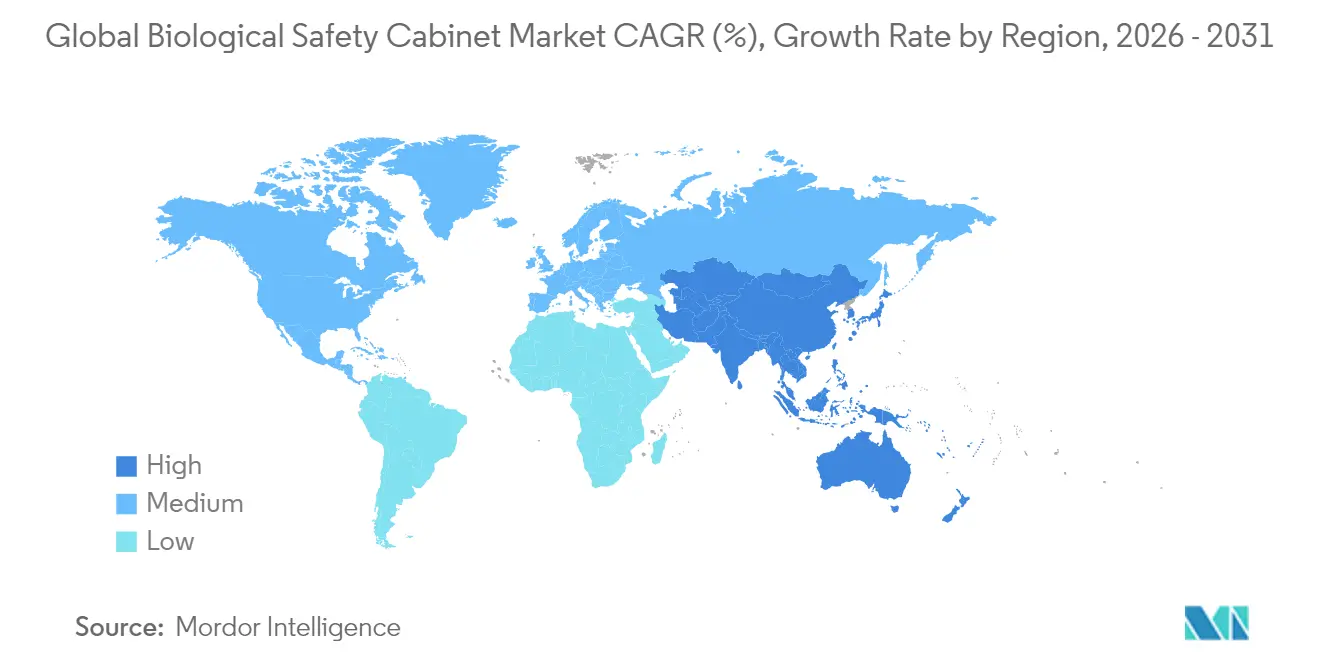
North America led the biological safety cabinets market at 41.98% revenue share in 2025. Large-scale projects such as Novo Nordisk’s 1.4-million-square-foot aseptic facility and Thermo Fisher Scientific’s multiyear capital program underscore sustained equipment pull. FDA adoption of ISO 14644-4 plus OSHA’s forthcoming infectious-disease rule create back-to-back compliance cycles that compel cabinet upgrades. Federal incentives for reshoring pharmaceutical supply chains also channel investment into U.S. CDMO campuses that specify high-containment designs.
Asia-Pacific is the fastest-growing region at a 9.22% CAGR through 2031. The US Biosecure Act is redirecting outsourcing toward India, where the CDMO market will climb from USD 15.63 billion in 2023 to USD 26.73 billion by 2028. Singapore’s USD 150 million Pall Corporation filtration plant demonstrates the region’s evolving ecosystem that integrates upstream consumables with cabinet manufacturing. China’s ongoing pharmaceutical build-out and Japan’s vaccine self-sufficiency plans further elevate demand. Harmonized standards simplify imports, encouraging multinational suppliers to locate final assembly closer to customers.
Europe shows steady expansion anchored by strict regulatory mandates and green-building directives. The Machinery Regulation and Ecodesign rules push laboratories to adopt energy-efficient units with digital passports. Rentschler Biopharma’s buffer-media complex and other biologics investments bolster replacement demand for high-performance cabinets. The region’s active-pharmaceutical-ingredient market growth supports modern GMP suites, lifting the biological safety cabinets market. Sustainability targets that require net-zero emissions by 2050 are tilting procurement toward ductless or low-pressure designs, reinforcing technology differentiation among suppliers.

Regulatory Landscape
Biological safety cabinets (BSCs) are primarily governed as laboratory containment and facility safety equipment rather than uniformly regulated as medical devices, so compliance is anchored in biosafety guidance, workplace safety rules, and consensus standards. In the United States, guidance in Biosafety in Microbiological and Biomedical Laboratories (BMBL) 6th Edition and facility obligations under the Federal Select Agent Program (9 CFR Part 121) reinforce documented biosafety plans and verification practices that commonly translate into required cabinet certification, including HEPA filter integrity and airflow performance checks.
Standards updates are tightening cross-region alignment on design and performance verification. In Europe, EN 12469:2025 Parts 1 and 2 (published November 2025) update design, construction, safety, and hygiene requirements for Class I and II BSCs, creating a clearer reference point for procurement specifications and upgrade decisions. At the state level, requirements such as California Title 8 Section 5154.2 reinforce routine certification practices, making qualified field testing, documentation, and maintenance a recurring compliance driver for installed cabinets.
Value Chain Analysis
The value chain starts with upstream materials and components, notably stainless steel work surfaces and housings, HEPA/ULPA filtration media, blowers and precision motors, control electronics, and sash and lighting assemblies. BSC OEMs integrate these into Class I, II, and III platforms, then route products through direct sales and specialized laboratory distributors that frequently bundle installation, IQ/OQ documentation support, and multi-year service contracts for pharmaceutical sites, CDMOs, hospitals, and academic labs.
Downstream verification and lifecycle services drive value: field certification (for example, to NSF/ANSI 49 requirements for Class II performance in many installations) and periodic re-certification programs generate recurring service revenue and influence brand choice at purchase. Bottlenecks sit in filtration components and the pool of accredited certifiers, because compliance cycles depend on timely HEPA leak testing and airflow measurements. As buyers centralize procurement (including broader use of GPO-style purchasing for mid-size biotech and health systems), suppliers with broad distribution coverage and service networks gain an execution advantage alongside product performance.
Competitive Landscape
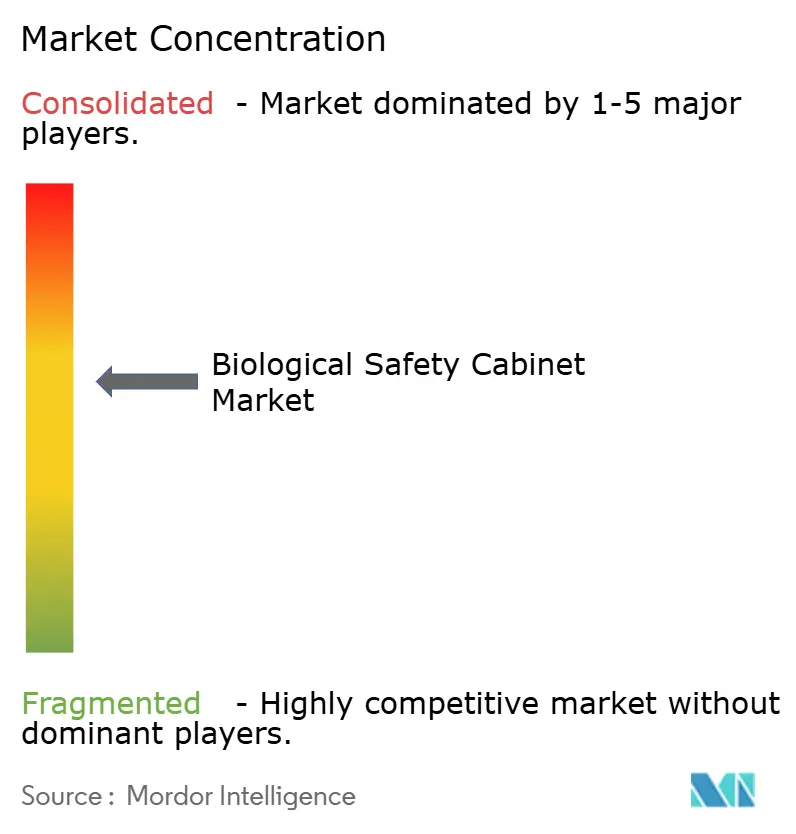
The biological safety cabinets market features a moderately concentrated vendor pool where innovation and compliance scope define leadership. Thermo Fisher Scientific deepened vertical integration by agreeing to acquire Solventum’s filtration unit for USD 4.1 billion, adding critical upstream capability in HEPA media and purification hardware. Kewaunee Scientific’s January 2025 alliance with NuAire merges furniture and containment portfolios, delivering turnkey laboratory packages that simplify procurement. These moves reflect a trend toward bundled offerings that include cabinets, casework, and facility monitoring software.
Suppliers differentiate through IoT analytics, automated decontamination, and ergonomic advances. The new Herasafe 2025 platform offers adaptive airflow control and voice prompts that guide safe work practice. Esco, NuAire, and Baker adopt similar digital dashboards that feed data to quality-management systems. Global certification breadth is another competitive lever as ISO, GMP Annex 1, and Machinery Regulation frameworks converge. Companies capable of rapid multi-jurisdiction validation gain share, especially among CDMOs with cross-border operations.
Smaller regional firms carve out niches in custom isolator retrofits or aftermarket service. They partner with HEPA cartridge specialists to secure supply, insulating customers from the filtration shortages seen in 2024. Overall, price competition remains balanced by high switching costs and the critical-safety function cabinets perform, keeping margins stable for top-tier producers inside the biological safety cabinets industry.
Biological Safety Cabinet Industry Leaders
Esco Micro
Labconco
The Baker Company
Kewaunee Scientific
Thermo Fisher Scientific, Inc.
- *Disclaimer: Major Players sorted in no particular order

Market Opportunities and Future Outlook
Regulatory refresh cycles and performance-verification demands create whitespace in replacement and upgrade activity, particularly in Europe following the November 2025 EN 12469:2025 update. laboratories and manufacturers standardizing on updated test and documentation expectations are prompting demand for globally certifiable platforms and for service ecosystems that can deliver audit-ready records across multi-site networks.
Another opportunity area is cGMP-ready and digitally enabled cabinet configurations for biopharmaceutical manufacturing, fill-finish, and CDMO deployments, where buyers increasingly specify features that simplify validation and ongoing quality oversight. Evidence of market momentum includes Esco Lifesciences LA2 G-Series for Pharma with 21 CFR Part 11 oriented controls and upgraded materials for cGMP environments, Thermo Fisher expanding its Class II portfolio with the 1500 Series featuring SmartFlow Plus and updated cleanability-oriented design. On the supply side, Esco Micro's expanded Singapore manufacturing footprint (15,000 square meter site with a stated 40% annual capacity increase) supports shorter lead times and broader regional availability, reinforcing competition on delivery, standard compliance, and lifecycle support rather than on hardware alone.
Recent Industry Developments
- April 2026: Esco Micro announced expansion of its Singapore manufacturing footprint to 15,000 square meters, with a stated 40% annual capacity increase, accelerating lead times and regional availability for Class II biosafety cabinets.
- October 2025: AES Environmental announced the Ultima Class II Biological Safety Cabinet, positioned for compliance with AS 2252.2:2025. The launch targets customers that need documented alignment to updated regional specifications, strengthening supplier positioning in regulated lab builds and refurbishment projects. It also raises the bar for competitors selling into Australia and export markets that reference the same compliance framework.
- November 2024: Kewaunee Scientific Corporation completed its acquisition of Nu Aire for USD 55 million, expanding into biosafety cabinets alongside its laboratory furniture and infrastructure portfolio. The deal broadens Kewaunee's ability to offer bundled lab build-and-equip packages that combine casework, biocontainment, and related equipment. Greater portfolio breadth shifts competitive dynamics toward turnkey procurement and integrated service coverage for large multi-site buyers.


Research Methodology Framework and Report Scope
Market Definition and Coverage
This market covers revenues generated from new biological safety cabinets used to protect people, products, and the lab environment during work with biological materials through controlled airflow and HEPA filtration.
Scope exclusions: This sizing excludes laminar flow clean benches, powder containment hoods, and refurbished or rental cabinets.
Segmentation Overview
- By Type
- Class I
- Class II
- Class III
- By Exhaust System
- Ducted (Hard-Connected)
- Recirculating / Ductless
- By Application
- Drug Discovery & Pre-Clinical R&D
- Clinical / Diagnostic Testing Labs
- Biopharmaceutical Manufacturing & Fill-Finish
- By End-User
- Pharmaceutical & Biotechnology Companies
- Academic & Research Institutes
- Contract Research / CDMOs
- Other End Users
- Geography
- North America
- United States
- Canada
- Mexico
- Europe
- Germany
- United Kingdom
- France
- Italy
- Spain
- Rest of Europe
- Asia-Pacific
- China
- Japan
- India
- Australia
- South Korea
- Rest of Asia-Pacific
- Middle East & Africa
- GCC
- South Africa
- Rest of Middle East & Africa
- South America
- Brazil
- Argentina
- Rest of South America
- North America
Data Sources, Market Sizing, and Validation
Desk Research
Desk work started by mapping what is counted as a biological safety cabinet and how it is commonly classified and regulated, since these boundaries decide what should be included in revenue. We used public references such as OSHA and CDC biosafety guidance, WHO Laboratory Biosafety Manual references, and standards bodies such as NSF/ANSI (for cabinet performance) to align terminology used by buyers and labs.
To quantify the demand backdrop, we reviewed sources such as US FDA and EMA expectations around inspections and GMP, national statistics and public health dashboards (where relevant), and peer-reviewed studies on lab capacity and biosafety practices. Company annual reports, investor presentations, and reputable press were reviewed to understand product focus and regional exposure. Where disclosures are mixed, a paid subscription for company financials and intelligence was used to normalize reported business lines to the cabinet category. These examples are not exhaustive, and many other public sources were also referenced for data collection, validation, and clarification during the study.
Primary Interviews and Surveys
Primary discussions were completed with a mix of cabinet manufacturers, distributors, certification and service providers, and procurement or lab operations stakeholders across pharma and biotech, diagnostics labs, hospitals, and academic research. For a global view, inputs were balanced across APAC, EMEA, and the Americas so our assumptions on replacement cycles, pricing movement by class, and installation intensity could be checked and corrected where needed.
Distribution of primary research fieldwork respondents
| Company type | Respondent position | Region |
|---|---|---|
| Top tier: 29% | CXOs: 12% | APAC: 49% |
| Mid tier: 57% | Functional/Unit leaders: 28% | EMEA: 32% |
| Smaller Players: 14% | Managers: 60% | Americas: 19% |
Market-Sizing & Forecasting
For sizing, we started with a top-down build where lab expansion and compliance-driven demand are reconstructed through visible indicators, then the demand pool is converted into cabinet requirements by class. With the right filters applied, such as biosafety level usage, installed-base renewal, and lab build-out pace, the market value becomes easier to explain and repeat.
Key inputs used in the model include the split of demand across Class I, II, and III cabinets, the share of ducted versus ductless designs, average selling price ranges by class and configuration, replacement and recertification driven refresh patterns, and regional mix of pharmaceutical manufacturing versus research and diagnostics activity. Since publicly reported volumes are incomplete, selective bottom-up checks were used, including sampled price points from market catalogs and channel checks, and supplier-level revenue cues to sanity check totals and adjust where outliers were found.
Forecasting relied on scenario analysis supported by simple trend fitting, where variables such as life sciences capacity additions, regulatory inspection intensity, funding and lab build cycles, and energy efficiency upgrades were stress tested with primary feedback. We kept assumptions transparent so the model can be updated quickly when pricing, lead times, or lab build activity shifts.
Data Validation & Update Cycle
Validation was done by comparing model output against independent signals, then reviewing variances by class, end-use intensity, and region so the story stays consistent with how cabinets are actually purchased. If a region showed an unusual jump, the assumptions were rechecked, supporting inputs were revisited, and follow-up calls were triggered with relevant respondents before sign-off.
Each report goes through multi-step analyst review where calculations, unit consistency, and currency conversions are checked again. The study is refreshed annually, and interim updates are made when there are material events that can change demand or pricing. Before delivery, a fresh pass is done across key tables and assumptions so clients receive the latest updated view.
Mordor Intelligence's Biological Safety Cabinet Market Size Versus Other Published Estimates
Published market sizes for biological safety cabinets can look far apart because researchers draw the line differently on what counts as a cabinet, and because service revenue and refurbished units may be treated in inconsistent ways. The year used, the currency timing, and the way prices are averaged across cabinet classes also create visible spread.
By tracking class-level demand drivers and refreshing the scope boundary around service and secondary units, Mordor Intelligence keeps the number tied to sales of new Class I to III cabinets rather than adjacent lab airflow products. Some estimates include installation, certification, filter changes, and ongoing maintenance, which pushes totals higher, while others apply a single blended price that can understate Class III value and overstate entry Class II configurations.
Benchmark comparison
| Source | Market Size | Gaps in Research Methodology |
|---|---|---|
| Mordor Intelligence | USD 282.55 M (2026) | |
| Global Research House A | USD 163.89 M (2024) | Uses an earlier base year and appears to apply a narrower device-only capture and segmentation lens, which can miss parts of demand linked to regulated manufacturing upgrades and broader lab build activity. |
| Industry Publisher B | USD 335.00 M (2025) | Includes installation, certification, filter changing, and ongoing maintenance in the market value, which expands the scope beyond new cabinet sales and raises the reported total. |
Looking across the table, most of the difference is explained by what is included in the value, especially whether service and maintenance are counted, and by which year anchors the pricing and demand mix. When the scope is kept consistent to new cabinet revenues and the pricing logic is kept class-aware, the resulting market size is easier to validate and update without hidden add-ons.


Key Questions Answered in the Report
What is the current valuation of the biological safety cabinets market?
The market is valued at USD 282.55 million in 2026 and is projected to reach USD 410.39 million by 2031.
Which region leads the biological safety cabinets market?
North America leads with 41.98% revenue share, supported by major biopharmaceutical investments and rigorous regulatory standards.
Why are CDMOs important to future cabinet demand?
CDMOs are expanding at an 11.33% CAGR as drug sponsors outsource complex manufacturing, driving continuous installation of new containment suites.
How are regulations influencing cabinet design?
Adoption of ISO 14644-4, the EU Machinery Regulation, and revised GMP Annex 1 is pushing suppliers to deliver energy-efficient, globally certified models.
What technological trends are shaping new cabinet models?
IoT-enabled airflow monitoring, predictive maintenance, and low-pressure HEPA systems are reducing energy costs while improving safety and compliance.
Are ductless cabinets replacing ducted systems?
Ductless cabinets are growing faster due to retrofit flexibility, yet ducted units remain indispensable for high-risk GMP operations that require direct exhaust.
Page last updated on:


 Your data is secure and never sold or shared.


