
Biofuel Enzymes Market Size and Share
Market Overview
| Study Period | 2021 - 2031 |
|---|---|
| Market Size (2026) | USD 0.74 Billion |
| Market Size (2031) | USD 1.02 Billion |
| Growth Rate (2026 - 2031) | 6.63 % |
| Fastest Growing Market | Asia Pacific |
| Largest Market | North America |
| Market Concentration | High |
Major Players *Disclaimer: Major Players sorted in no particular order Image © Mordor Intelligence. Reuse requires attribution under CC BY 4.0. | |
Biofuel Enzymes Market Analysis by Mordor Intelligence
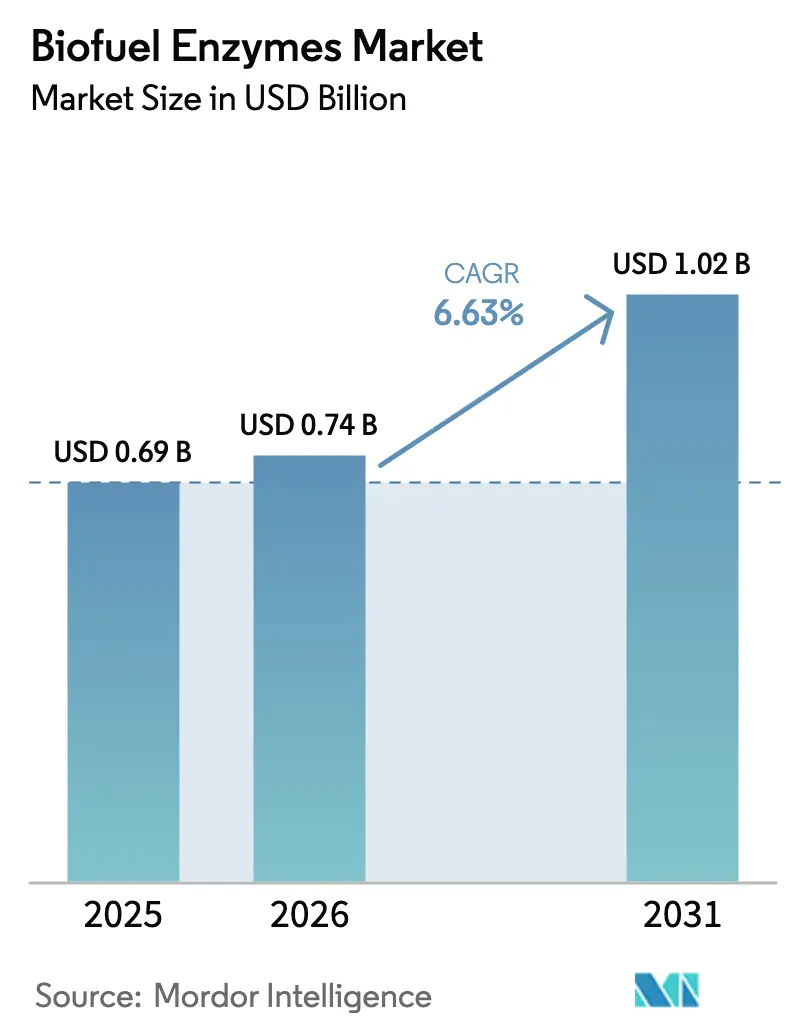
The Biofuel Enzymes Market size is projected to expand from USD 0.69 billion in 2025 and USD 0.74 billion in 2026 to USD 1.02 billion by 2031, registering a CAGR of 6.63% between 2026 to 2031. Mandated renewable fuel volumes in the United States, India and the European Union are expanding the addressable pool of biofuels, while R&D breakthroughs in thermostable cellulases continue to compress cost per gallon for cellulosic ethanol. Mature corn-ethanol infrastructure in North America underpins sizeable baseline demand, but the fastest incremental growth is moving to Asia-Pacific as China and India accelerate ethanol blending targets. On-site enzyme manufacture, consolidated bioprocessing pilots and enzyme cocktails that unlock waste oils and high-ash residues are reshaping competitive strategies for both incumbents and emerging biotechnology firms. Capital spending announcements by leading suppliers signal confidence that policy support and technology gains will sustain mid-single-digit volume expansion through the decade.
Key Report Takeaways
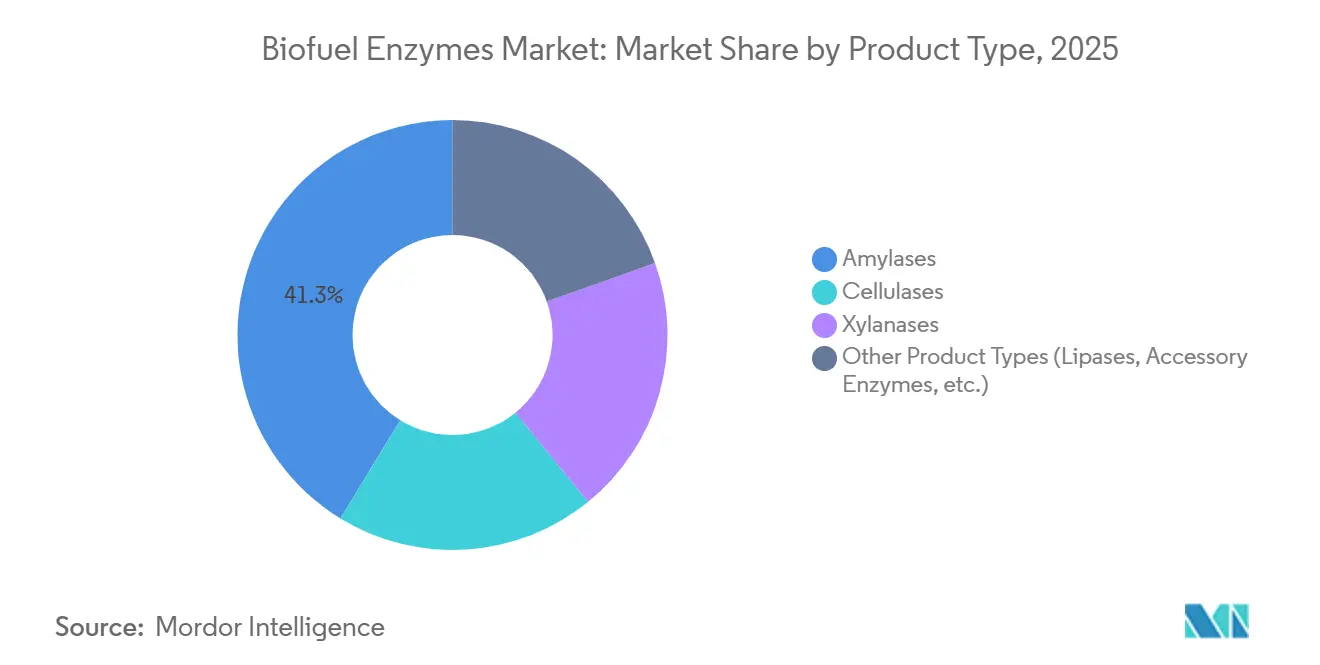
- By product type, amylases led with 41.27% revenue share in 2025; cellulases are forecast to expand at an 8.67% CAGR to 2031.
- By feedstock, starch crops accounted for 40.35% of the biofuel enzymes market share in 2025, while algae is advancing at a 9.68% CAGR through 2031.
- By technology, free enzyme catalysis captured 50.81% of the biofuel enzymes market size in 2025 and consolidated bioprocessing is projected to climb at a 9.79% CAGR between 2026-2031.
- By application, corn/starch-based ethanol represented 45.78% of revenue in 2025; lignocellulosic ethanol is progressing at an 8.49% CAGR to 2031.
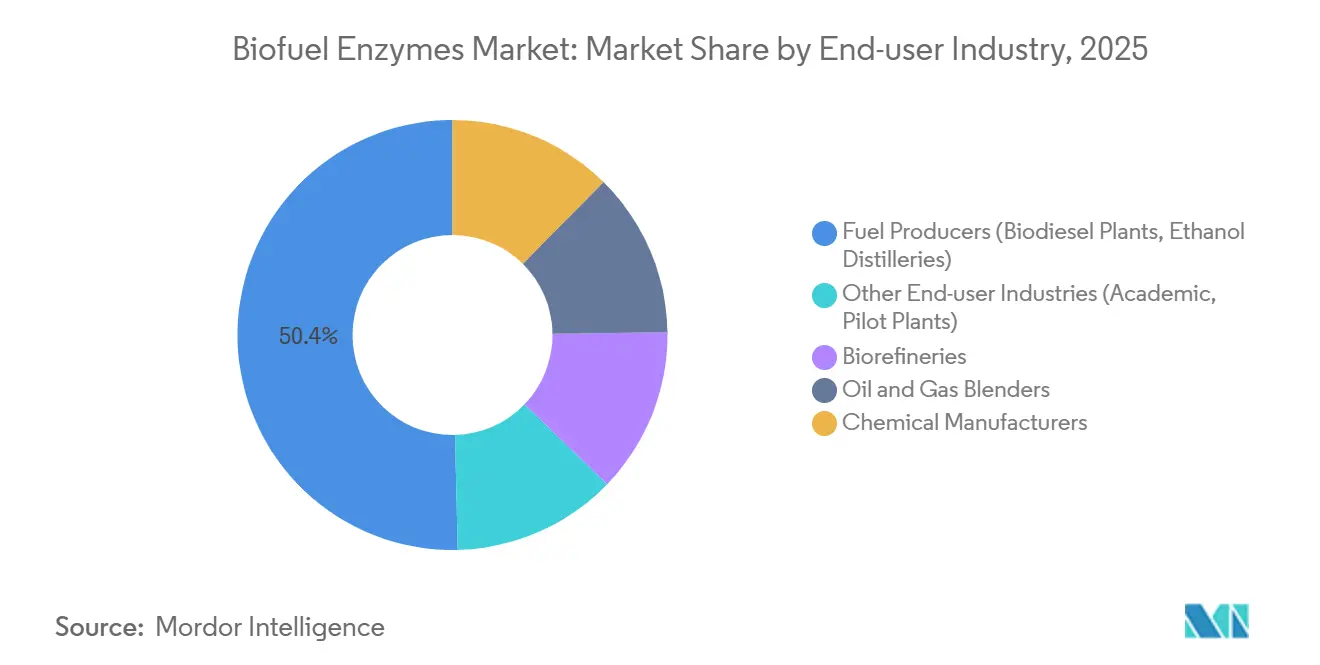
- By end-user, fuel producers held 50.39% revenue in 2025, whereas biorefineries are growing at an 8.45% CAGR to 2031.
- By geography, North America commanded 35.55% revenue in 2025; Asia-Pacific is the fastest region, expanding at a 7.98% CAGR to 2031.
Note: Market size and forecast figures in this report are generated using Mordor Intelligence’s proprietary estimation framework, updated with the latest available data and insights as of January 2026.
Market Trends and Insights
Drivers Impact Analysis of Biofuel Enzymes Market*
| Driver | (~) % Impact on CAGR Forecast | Geographic Relevance | Impact Timeline |
|---|---|---|---|
| Growing Biodiesel Blending Mandates | +1.2% | Global, with concentration in North America, EU, Brazil, Indonesia, Malaysia | Medium term (2-4 years) |
| Expanding Demand for Second-Generation (Cellulosic) Ethanol | +1.5% | North America, EU, China, India | Long term (≥ 4 years) |
| Rapid Advances in Enzyme Engineering and Directed Evolution | +1.3% | Global, led by North America and EU R&D hubs | Medium term (2-4 years) |
| On-Site Enzyme Production Lowering Operating Costs | +0.9% | North America, Brazil, China | Short term (≤ 2 years) |
| Biorefinery Integration with Advanced Pretreatment Platforms | +1.0% | North America, EU, Brazil | Medium term (2-4 years) |
| Source: Mordor Intelligence | |||
Growing Biodiesel Blending Mandates
Regulatory mandates are recalibrating enzyme demand as biodiesel blending ratios rise faster than ethanol obligations in several jurisdictions. The European Union’s Renewable Energy Directive III requires advanced biofuels to supply 5.5% of transport energy by 2030, a threshold that pushes enzymatic transesterification of waste oils and tallow into the mainstream. Indonesia’s B35 program consumes roughly 14 million metric tons of crude palm oil annually, incentivizing lipase enzymes that convert high-free-fat-acid feedstocks without costly pre-esterification. Brazil lifted its biodiesel blend to B15 in 2025, widening substrate diversity and opening opportunities for enzyme formulations that handle soybean oil, tallow and used cooking oil interchangeably. The U.S. Environmental Protection Agency set 2026 biomass-based diesel at 3.35 billion gallons, rewarding enzyme suppliers capable of lowering catalyst cost below USD 0.08 per gallon[1]. California’s Low Carbon Fuel Standard multiplies credit values for fuels derived from waste fats, propelling demand for lipases tolerant of moisture and impurities.
Expanding Demand for Second-Generation (Cellulosic) Ethanol
Commercial deployment of cellulosic ethanol plants is multiplying enzyme consumption per gallon of fuel. The U.S. Department of Energy awarded USD 118 million in 2025 to projects targeting cellulase cost reductions below USD 0.30 per gallon by 2030. POET-DSM’s Project LIBERTY produced 22 million gallons of cellulosic ethanol in 2025 and consumed about 110 metric tons of cellulase and xylanase, proving full-scale economics once plants run near nameplate capacity. India contracted 500 million liters of second-generation ethanol from rice straw and bagasse, demanding cocktails optimized for high-ash feedstocks. China approved 600,000 metric tons per year of cellulosic capacity with on-site enzyme plants to avoid cold-chain costs in northern provinces. The European Commission’s Innovation Fund invested EUR 150 million in sunliquid technology that co-locates enzyme production with pretreatment and fermentation, cutting supply-chain overhead by 40%.
Rapid Advances in Enzyme Engineering and Directed Evolution
Protein-engineering breakthroughs are lifting specific activity, thermostability and inhibitor tolerance. A 2025 study showed CRISPR-edited Trichoderma reesei cellulase genes raised activity 34%, enabling loading cuts from 15 to 10 mg per g of biomass without yield loss. Novonesis cut development cycles in half using machine-learning-guided directed evolution, accelerating time-to-market for region-specific cocktails. DuPont’s new xylanase operates at 70 °C, allowing simultaneous saccharification and fermentation that eliminates cooling costs of USD 0.04 per gallon. Techno-economic modeling from the U.S. National Renewable Energy Laboratory suggests next-generation cellulases can shave USD 0.12 per gallon off minimum ethanol selling price, putting cellulosic fuels on parity with corn ethanol in unsubsidized markets. Patent activity mirrors the trend, with dsm-firmenich filing 12 patents in 2025 for AI-designed lipases targeting biodiesel from waste oils.
On-Site Enzyme Production Lowering Operating Costs
Biorefineries are internalizing enzyme manufacture to avoid cold-chain logistics and tune blends in real time. Project LIBERTY’s on-site fermentation slashed purchased enzyme expense by 25%. Raízen’s Bonfim complex produces 500 metric tons of cellulase per year from molasses and bagasse hydrolysate, driving cost to USD 0.18 per gallon for second-generation ethanol. A DOE-led consortium is piloting modular production skids that retrofit existing distilleries and aim for enzyme cost below USD 0.25 per gallon. Cofco Biochemical’s Zhaodong site in China now makes its own amylase, cutting spend by 18% and stabilizing supply in peak seasons. In-house plants also allow formula tweaks within hours when lignin or moisture levels shift, a responsiveness impossible with centralized supply chains.
Restraints Impact Analysis of Biofuel Enzymes Market*
| Restraint | (~) % Impact on CAGR Forecast | Geographic Relevance | Impact Timeline |
|---|---|---|---|
| High Enzyme Production and Immobilization Costs | -0.8% | Global, particularly impacting emerging markets in Asia-Pacific and South America | Medium term (2-4 years) |
| Feedstock Price Volatility Dampening Enzyme Demand Visibility | -0.6% | North America, South America, Asia-Pacific | Short term (≤ 2 years) |
| Competitive Pressure from Thermo-Chemical Conversion Routes | -0.5% | North America, EU, China | Long term (≥ 4 years) |
| Source: Mordor Intelligence | |||
High Enzyme Production and Immobilization Costs
Fermentation, purification and formulation represent up to half of delivered enzyme cost, challenging adoption in price-sensitive regions. NREL pegged cellulase production at USD 4.50-6.00 per kg in 2025, equal to USD 0.45-0.60 per gallon of cellulosic ethanol, eroding margins whenever oil trades below USD 70 per barrel[2]. Immobilized systems allow catalyst reuse but require USD 2-5 million for carriers and retrofits, a barrier for mid-sized mills. Advanced Enzyme Technologies noted recovery and recycling add 15-20% to enzyme outlay and only 30% of plants have installed the hardware. Indian distilleries operating on USD 0.08-0.12 per liter margins often choose lower-grade enzymes that slow throughput. Tropical supply chains face refrigerated transport surcharges of USD 0.50-0.80 per kg, pricing out small biodiesel producers.
Feedstock Price Volatility Dampening Enzyme Demand Visibility
Corn, sugarcane and palm oil trade in wide bands, disrupting enzyme purchasing plans. U.S. corn futures swung 62% in 2025 as drought and Chinese import demand whipsawed prices, prompting ethanol plants to throttle runs and defer enzyme orders. Brazilian mills shifted to sugar when export prices exceeded USD 0.20 per pound, trimming enzyme use 12% during peak sugar months. Indonesian palm oil prices spiked to USD 1,350 per metric ton during El Niño, forcing biodiesel capacity idling and an 8-10% enzyme demand dip. Corn-stover collection fell 18% in 2025 after wet harvests limited field access, slashing cellulase consumption at cellulosic plants. Suppliers now offer contracts indexed to feedstock costs, but the mechanism shifts margin risk and complicates capacity planning.
*Our forecasts treat driver/restraint impacts as directional, not additive. The impact forecasts reflect baseline growth, mix effects, and variable interactions.
Biofuel Enzymes Market Segment Analysis
By Product Type:
Cellulases Drive Next-Generation ShiftCellulases are projected to grow at 8.67% between 2026-2031, outpacing all other enzyme categories as policy targets drive lignocellulosic ethanol build-out. Amylases retained 41.27% revenue share in 2025, a legacy of corn and wheat starch dominance in North America and Asia-Pacific. Xylanases and accessory enzymes are being bundled with cellulases to maximize hemicellulose conversion, while lipase development focuses on biodiesel from waste oils and animal fats.
Demand dynamics are diverging by region. U.S. corn-ethanol plants remain the cornerstone for amylase volumes, yet suppliers are diverting R&D budgets toward thermostable cellulases that maintain activity above 65 °C to cut cooling energy. Patent filings for cellulases rose 27% in 2025 versus 8% for amylases, underscoring the pivot. Lipases, although smaller in value, underpin emerging palm-oil biodiesel markets in Southeast Asia and waste-oil transesterification in Europe. Suppliers are marketing enzyme packages that integrate laccases or pectinases to loosen lignin and pectin matrices in tough biomass such as softwood or algal cell walls.

By Feedstock:
Algae Emerges as High-Growth FrontierStarch crops generated 40.35% revenue in 2025, yet their share is gradually eroding in favor of residues, energy crops and algae. The biofuel enzymes market share linked to algae carries the highest 9.68% CAGR forecast through 2031 as aviation mandates favor low-carbon lipids. Agricultural residues hold vast potential but are constrained by enzyme cost per gallon; next-generation cocktails demonstrated by NREL that lower dosage to 12 mg g-1 promise to unlock this segment.
Suppliers are tailoring formulations to high-ash rice straw in India and moisture-rich corn stover in the U.S., while Scandinavian firms develop cold-adapted cellulases for forestry residues processed at 15-20 °C. Waste cooking oil conversion is another bright spot, with lipases handling 15% free-fatty-acid streams without caustic pretreatment, saving USD 0.10 per gallon in European biodiesel plants. Algal biofuel pilots are demanding cellulases that break tough cell walls and lipases that free intracellular lipids without energy-intensive drying, a niche where early-stage suppliers are positioning for first-mover advantage.
By Technology:
Consolidated Bioprocessing Redefines EconomicsFree enzyme catalysis accounted for 50.81% of 2025 revenue, yet consolidated bioprocessing (CBP) is forecast to post the fastest 9.79% CAGR through 2031. The biofuel enzymes market size tied to CBP is embryonic but could multiply once engineered microbes reach industrial titers. Immobilized systems, although promising 30-40% cost savings, still face capital hurdles and limited retrofits.
On-site enzyme production is scaling quickly; twelve commercial plants adopted integrated fermentation in 2025, squeezing logistics costs and allowing real-time recipe tuning. Continuous-flow micro-reactors and modular hydrolysis units are in pilot phase, offering throughput gains for distributed biorefineries. CBP projects funded by DOE aim for ethanol selling prices under USD 1.00 per gallon, a target that would upend current procurement models. However, CBP organisms require further metabolic tuning to match industrial yeast ethanol tolerance, keeping free enzyme catalysis dominant for most of the forecast period.
By Application:
Lignocellulosic Ethanol Gains Policy TailwindsCorn/starch-based ethanol retained 45.78% revenue in 2025, yet lignocellulosic ethanol is set to expand faster at an 8.49% CAGR on the back of favorable carbon-intensity credits in the U.S. and Brazil. California awards cellulosic ethanol credits worth USD 0.40-0.60 per gallon, absorbing higher enzyme costs. Biodiesel remains sizeable as Indonesia, Malaysia and the EU raise blending ratios, with enzyme demand pivoting to lipases that can tackle waste oils containing 8-15% free fatty acids.
Emerging applications include biogas upgrading, where enzymes boost anaerobic digestion rates, and biochemical intermediates such as bio-succinic acid produced via enzyme-assisted fermentation. Specialty enzymes for leather and textiles carve out niche revenue streams but remain small relative to fuel applications. Policy equivalence factors (1.5x for cellulosic ethanol in the U.S.) are steering investment toward lignocellulosic pathways that expand the total addressable market for cellulases and accessory enzymes.
By End-user Industry:
Biorefineries Integrate UpstreamFuel producers, chiefly ethanol distilleries and biodiesel plants, controlled 50.39% revenue in 2025, but biorefineries show the strongest 8.45% CAGR outlook. The biofuel enzymes market size captured by biorefineries will rise as facilities co-locate pretreatment, hydrolysis, fermentation and enzyme production. POET secures enzymes via multi-year contracts indexed to corn prices, stabilizing dollar-per-gallon costs even in volatile grain cycles. Raízen spreads enzyme expenditure across electricity and lignin-derivative revenue, diluting cost impact.
Chemical manufacturers and consumer-goods companies are nascent yet strategic customers, adopting enzymatic routes to biochemicals and surfactants. Academic pilot plants, though small, remain essential for validating new cocktails on unconventional feedstocks. Licensing deals for on-site fermentation strains and process know-how represent an emerging revenue stream for suppliers as more end-users pursue vertical integration.
Geography Analysis
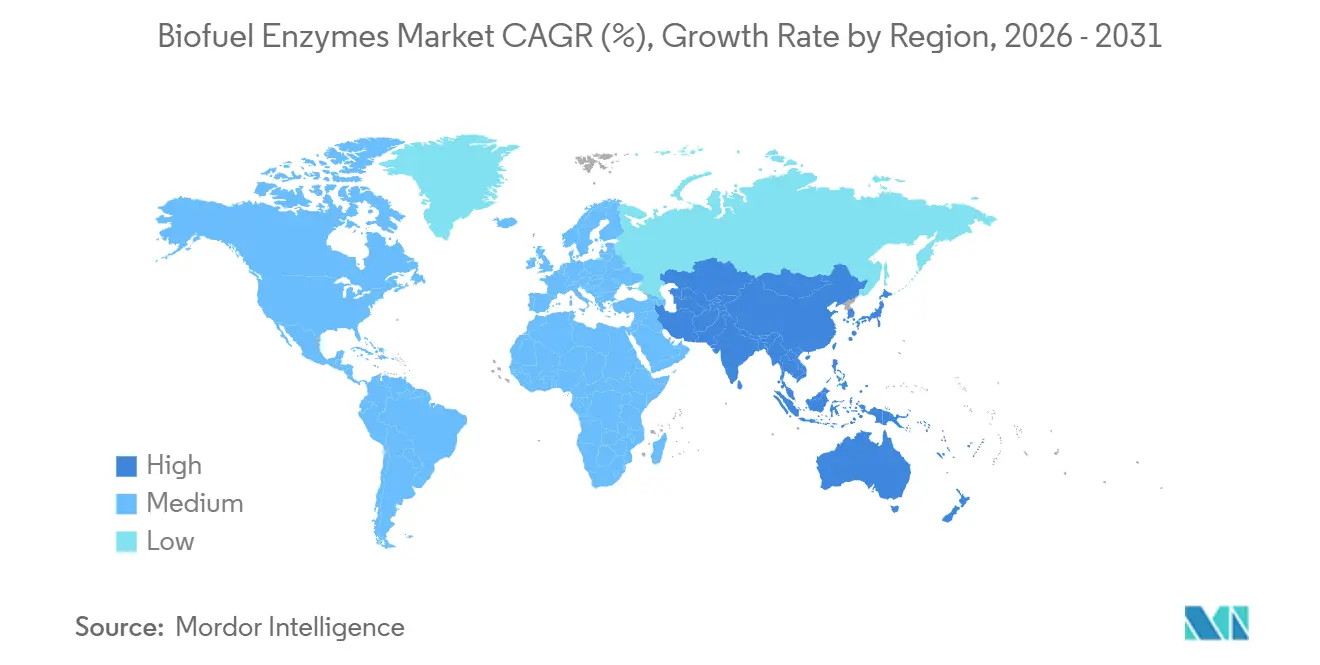
North America Biofuel Enzymes Market
North America captured 35.55% revenue in 2025, underpinned by 15.4 billion gallons of U.S. corn ethanol and the continent’s deepest R&D ecosystem. The 2026 EPA mandate sets 590 million gallons of cellulosic biofuel, sustaining cellulase demand despite political debate over Renewable Fuel Standard targets. Canada’s Clean Fuel Regulations support wheat-straw ethanol, while Mexico’s E10 blend in metro areas fosters sugarcane-derived demand. Research institutions such as NREL and the Great Lakes Bioenergy Research Center published 134 enzyme papers in 2025, feeding a pipeline of licensed variants.
APAC Biofuel Enzymes Market
Asia-Pacific is the fastest-growing region at 7.98% CAGR through 2031 as China and India crank up ethanol blends and Southeast Asia boosts palm-oil biodiesel. China’s E10 rollout across 15 provinces adds 4 billion liters of ethanol demand and needs roughly 20,000 metric tons of amylase annually. India’s E20 target will double ethanol consumption to 10 billion liters by 2030, driving enzymes across 400 distilleries. Japan, South Korea and ASEAN economies layer additional fuel standards that diversify enzyme portfolios toward rice straw and waste cooking oil.
Europe Biofuel Enzymes Market
Europe benefits from mature biodiesel capacity and Renewable Energy Directive III’s 5.5% advanced-fuel sub-target, but growth is moderating as blending plateaus. Germany produced 3.2 million tons of biodiesel in 2025, leveraging lipases for rapeseed and used oil. France reached 95% E10 penetration, while the U.K. incentivizes double-counting of waste-based fuels. NORDIC countries push forestry-residue ethanol, requiring cold-active cellulases. Italy’s 600,000 ton advanced-biofuel capacity at Eni sites underscores ongoing, albeit slower, demand creation.
South America Biofuel Enzymes Market
South America is anchored by Brazil’s 32 billion liters of sugarcane ethanol and RenovaBio credit scheme that values second-generation capacity at 2.5× first-generation. Raízen’s Bonfim plant alone consumes 410 metric tons of cellulase yearly and demonstrates economic viability for bagasse-to-ethanol conversion. Argentina’s soybean-oil biodiesel hits 2.1 million tons and explores lipase routes to cut energy costs. Colombia and Paraguay expand sugarcane distillation but remain smaller enzyme consumers.
MEA Biofuel Enzymes Market
Middle East and Africa remain emergent. Saudi Arabia targets 2 billion liters of waste-oil biofuel by 2030 under Public Investment Fund backing, while South Africa’s E10 and B5 mandates stimulate modest enzyme imports. The UAE pilots high-salinity algae fuels, requiring novel lipase and cellulase blends.
Value Chain Analysis
The biofuel enzymes value chain starts with strain discovery and enzyme design (microbial hosts such as Trichoderma reesei and proprietary expression platforms), followed by industrial fermentation, downstream processing (recovery, concentration, stabilization), and formulation into application-specific cocktails (amylase, cellulase, xylanase, lipase). End-user supply splits between direct B2B contracts with large ethanol and biodiesel producers and sales via regional formulators that blend and adapt packages for smaller plants. Co-development and performance-linked supply agreements are becoming more common as facilities diversify into agricultural residues and waste oils.
Cost and logistics remain the main bottlenecks, since purification, formulation, and cold-chain delivery can represent a large share of delivered cost. This has supported integration moves such as on-site enzyme production at biorefineries and localization initiatives. CNPEM launching the OpEn enzyme cocktail in Brazil (March 2026) is one example affecting chain structure, alongside continued demand build-up in India as biofuel programs translate into higher enzyme needs. This reinforces the role of large suppliers with application support networks and local partnerships.
Competitive Landscape
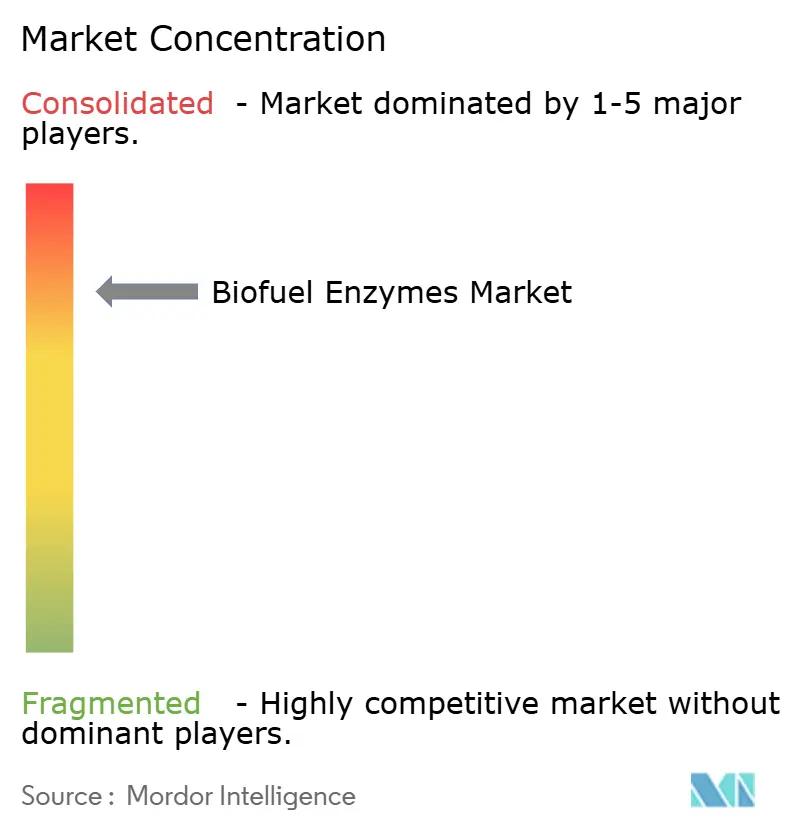
The biofuel enzymes market displays high concentration: Novonesis Group, DuPont, AB Enzymes, Lallemand Inc. and dsm-firmenich command roughly 80% of global revenue. Novonesis filed 47 enzyme patents in 2025, 18 focused on thermostable cellulases operating above 65 °C, and is expanding Nebraska capacity by 40% to secure U.S. cellulosic ethanol supply. DuPont’s Accellerase TRIO delivers 92% glucose yield at 30% lower loading on corn stover, offering premium pricing power. dsm-firmenich’s acquisition of Amano Enzyme’s biofuel portfolio broadens lipase reach in Asia-Pacific.
Niche innovators exploit feedstock niches. MetGen Oy provides lignin-modifying enzymes that raise softwood glucose yield 12%, while Agrivida explores plant-integrated enzymes expressed in transgenic corn. Zymergen engineers cellulases with 40% higher specific activity, licensing to biorefineries for on-site production. On-site fermentation threatens logistics-based advantages of incumbents but opens licensing revenue for strain owners. Consolidated bioprocessing could disrupt the entire procurement model within a decade, yet performance gaps in ethanol tolerance keep it in development.
Strategic moves include Novonesis’ USD 75 million Nebraska expansion, DuPont-Raízen co-development pact and dsm-firmenich’s Amano acquisition. Financing rounds such as Iogen’s USD 250 million debt package and Advanced Enzyme Technologies’ new Indian plant underline capital commitment across the value chain.
Biofuel Enzymes Industry Leaders
-
AB Enzymes
-
DuPont
-
Lallemand Inc.
-
Novozymes A/S (Novonesis Group)
-
dsm-firmenich
- *Disclaimer: Major Players sorted in no particular order
Biofuel Enzymes Market Companies Covered in this Report
- AB Enzymes
- Advanced Enzyme Technologies
- Agrivida Inc.
- Amano Enzyme Inc.
- Aumenzymes
- Biocatalysts
- Creative Enzymes
- dsm-firmenich
- DuPont
- Enzyme Supplies Limited
- International Flavors & Fragrances Inc.
- Iogen Corporation
- Lallemand Inc.
- MetGen Oy
- Novozymes A/S (Novonesis Group)
- TransBiodiesel Ltd
Market Opportunities and Future Outlook
Near-term whitespace is concentrated in enzymes that make low-quality, variable feedstocks economical at scale, especially lipases for waste oils with high free fatty acids, and cellulase and hemicellulase systems engineered for high-ash residues such as rice straw and bagasse. Technical evidence supporting this opportunity includes 2026 published work describing lignocellulosic ethanol titers above 40 g/L at enzyme dosages an order of magnitude lower than earlier benchmarks. Process platforms that improve enzyme recovery (reported at 96.8%) while cutting production costs (reported at 52-58%) also target the delivered-cost barrier that limits broader second-generation adoption.
A second opportunity lies in value-chain localization and on-site supply models, where domestic cocktails and integrated production reduce import dependence and cold-chain exposure. CNPEM introduced the OpEn cocktail in Brazil (March 2026) for local biorefineries, and in India, higher ethanol blending under the Ethanol Blended Petrol Programme has translated into stronger pull for biofuel-focused biosolutions, encouraging suppliers to expand local technical service, formulation, and production footprints. Alongside incumbents, capability expansion by platform players is visible, including Dyadic International adding a proprietary industrial enzyme program targeting advanced cellulose processing (July 2026), broadening the set of suppliers focused on next-generation biomass conversion.
Recent Industry Developments in Biofuel Enzymes Market
- March 2026: CNPEM launched the OpEn enzyme cocktail in Brazil to serve local biorefineries, enabling domestic supply of enzyme solutions and strengthening local technical support. This aligns with near-term localization trends and could shorten supply chains for Brazilian ethanol and biodiesel plants.
- June 2025: Novonesis completed the acquisition of dsm-firmenich's stake in the Feed Enzyme Alliance for EUR 1.5 billion, dissolving the long-running alliance structure and bringing sales and distribution under Novonesis control. This consolidation strengthens Novonesis' manufacturing and go-to-market execution in industrial enzymes, improving its ability to prioritize capacity and application support for fuel and biorefinery customers. It also tightens competitive dynamics for other enzyme suppliers that rely on shared routes to market.
- June 2024: BASF completed the sale of its bioenergy enzymes business, including the Spartec product portfolio, to Lallemand subsidiaries Danstar Ferment AG and Lallemand Specialties Inc. The transaction added bioenergy enzyme assets into Lallemand's Biofuels & Distilled Spirits business unit and broadened its product and customer coverage in bioethanol and adjacent fermentation markets. It also reshaped supplier options for producers by transferring established enzyme brands and technical support capabilities into a specialist fermentation-focused group.
Biofuel Enzymes Market Report Scope and Research Methodology
Market Definition and Coverage
This market covers enzymes sold for biofuel production, where the enzyme helps convert starch, sugars, oils, or lignocellulosic biomass into usable fuel such as ethanol or biodiesel. We count revenues tied to industrial-grade enzyme supply to biofuel producers across major regions.
Scope exclusions: Lab-only enzyme reagents and enzymes used mainly for food, detergents, animal feed, and pharmaceuticals are not counted.
Segments Covered in This Report
- By Product Type
- Amylases
- Cellulases
- Xylanases
- Other Product Types (Lipases, Accessory Enzymes, etc.)
- By Feedstock
- Starch Crops
- Sugar Crops
- Waste Cooking Oil and Grease
- Agricultural Residues
- Energy Crops (Switchgrass, Miscanthus)
- Forestry Residues
- Algae
- By Technology
- Free Enzyme Catalysis
- Immobilized Enzyme Systems
- Consolidated Bioprocessing (CBP)
- On-site Enzyme Production
- Continuous-flow Micro-reactor Systems
- By Application
- Corn/Starch-based Ethanol
- Biodiesel
- Lignocellulosic Ethanol
- Leather and Textile
- Other Applications (Biogas/Renewable Natural Gas, Biochemicals (e.g., biobutanol), etc.)
- By End-user Industry
- Fuel Producers (Biodiesel Plants, Ethanol Distilleries)
- Biorefineries
- Oil and Gas Blenders
- Chemical Manufacturers
- Other End-user Industries (Academic, Pilot Plants)
- By Geography
- Asia-Pacific
- China
- India
- Japan
- South Korea
- ASEAN Countries
- Rest of Asia-Pacific
- North America
- United States
- Canada
- Mexico
- Europe
- Germany
- United Kingdom
- France
- Italy
- NORDIC Countries
- Rest of Europe
- South America
- Brazil
- Argentina
- Rest of South America
- Middle-East and Africa
- Saudi Arabia
- South Africa
- Rest of Middle-East and Africa
- Asia-Pacific
Data Sources, Market Sizing, and Validation
Desk Research
Desk research begins with mapping the demand pool for biofuels and identifying the process steps where enzymes are used, with a focus on starch hydrolysis and biomass breakdown. We then anchored the model using public energy and production signals, and refined key assumptions around how enzyme usage shifts by feedstock and plant type.
We referred to widely available sources including the US Energy Information Administration, International Energy Agency, USDA and related agriculture statistics portals, Eurostat, and FAOSTAT for feedstock and fuel indicators. To connect those indicators to commercial enzyme activity, we also used company annual reports, investor presentations, and credible press coverage to track capacity additions, technology shifts, and pricing commentary. Patent databases were checked to see where enzyme innovation is concentrated and how that could affect adoption timing and dosing rates. The list of desk research sources mentioned here is not exhaustive, and additional sources were used for data collection, validation, and clarification throughout the study.
Primary Interviews and Surveys
Primary work was used to pressure-test the desk assumptions on enzyme dosage ranges, typical purchasing models, and how frequently plants change formulations. We interviewed a mix of enzyme supply-side roles and biofuel producer side roles across APAC, EMEA, and the Americas. The inputs were used to confirm pricing direction and realistic adoption levels by process type, rather than treating the desk model as a standalone estimate.
Distribution of primary research fieldwork respondents
| Company type | Respondent position | Region |
|---|---|---|
| Top tier: 31% | CXOs: 17% | APAC: 44% |
| Mid tier: 49% | Functional/Unit leaders: 38% | EMEA: 29% |
| Smaller Players: 20% | Managers: 45% | Americas: 27% |
Market-Sizing & Forecasting
The sizing logic starts from a top-down demand reconstruction where biofuel output and installed capacity by key fuel routes are translated into enzyme consumption, then converted to value using typical price ranges by enzyme category. To keep totals realistic, we also ran selective bottom-up checks using sampled supplier revenue splits, channel checks with distributors, and simple volume times ASP calculations for a few high-usage routes.
Inputs used in the model include bioethanol and biodiesel production volumes, biorefinery capacity additions and utilization patterns, feedstock availability signals (corn and sugar crop flows and residues), enzyme dosing intensity by process step, and observed price movement for industrial enzymes. Where data is thin, gaps are handled by applying conservative adoption curves and using proxy plants with similar feedstocks, followed by expert review to ensure the proxy does not overstate mature markets.
For the forecast, scenario analysis is used around policy support for blending mandates, plant utilization levels, and the pace of cellulosic ethanol scale-up. Those scenarios are then tightened using expert consensus from interviews, so the final forecast reflects what operators are actually planning and what suppliers can reasonably support.
Data Validation & Update Cycle
Validation is done through step-by-step cross-checks across demand signals, pricing logic, and internal consistency across regions. We compare model output with independent indicators such as biofuel production trends, announced capacity ramps, and reported enzyme business commentary, and then investigate any spikes that do not align with what stakeholders describe.
Before sign-off, results go through analyst reviews that focus on unit checks, currency conversion timing, and year-on-year movement that should align with known industry developments. If a major variance is found, we re-contact respondents to confirm whether it is caused by one-off pricing, a plant shutdown, or a mix shift across feedstocks. Reports are refreshed annually, with interim updates when material events occur, and a final pre-delivery pass is completed so clients receive the latest updated view.
Mordor Intelligence's Biofuel Enzymes Market Size Measured Against Other Published Estimates
Published market sizes for biofuel enzymes often differ because the scope line is drawn differently and the pricing logic is not always tied back to real biofuel output. Variations also come from the base year used, how currency is converted, and whether the estimate is updated after new capacity starts up.
Lab-only enzyme reagents and non-fuel enzyme demand are kept outside Mordor Intelligence's scope, which changes the total versus figures that blend industrial biofuel use with adjacent enzyme applications. Another driver is how cellulosic projects are treated, since some estimates assume full utilization quickly, while others keep longer ramp periods and lower near-term dosing intensity. Refresh cadence also matters, because recent policy changes and plant restarts can move the near-term number even when the long-run trend remains similar.
Benchmark comparison
| Source | Market Size | Gaps in Research Methodology |
|---|---|---|
| Mordor Intelligence | USD 0.74 B (2026) | |
| Trade Journal A | USD 1.73 B (2024) | Often mixes the wider enzyme-in-energy theme with biofuel enzymes, and may not separate laboratory and non-fuel industrial enzyme demand, which lifts the reported value. |
| Regional Consultancy B | USD 0.69 B (2025) | Tends to apply conservative utilization and slower adoption for advanced routes, and may use tighter price assumptions without adjusting for enzyme type mix across ethanol versus biodiesel processes. |
The comparison shows that the spread is mostly explained by what is counted as biofuel-related enzyme revenue and how quickly newer pathways are assumed to scale. When the model is tied back to observable fuel output, plant utilization, and realistic pricing by enzyme category, the resulting market value becomes easier to trace, repeat, and update.
Key Questions Answered in the Report
What is the estimated value of biofuel enzymes in 2026, and how large could the market become by 2031?
The market is valued at USD 0.74 billion in 2026 and is projected to reach USD 1.02 billion by 2031 on a 6.63% CAGR trajectory.
Which enzyme category shows the strongest growth outlook over 2026-2031?
Cellulases lead the expansion, with an expected 8.67% CAGR as lignocellulosic ethanol capacity moves from pilot to commercial scale.
Which geographic region is poised for the quickest demand acceleration?
Asia-Pacific is forecast to grow at about 7.98% a year, driven by China’s E10 and India’s E20 ethanol programs plus expanding palm-oil biodiesel in Southeast Asia.
What operational shift offers the greatest potential to cut enzyme procurement costs?
On-site enzyme production at biorefineries can trim purchased enzyme expense by roughly 20-25% while enabling real-time formulation tweaks.