
BFSI Marketing Services Market Size and Share
Market Overview
| Study Period | 2020 - 2031 |
|---|---|
| Market Size (2026) | USD 53.10 Billion |
| Market Size (2031) | USD 94.20 Billion |
| Growth Rate (2026 - 2031) | 12.15 % |
| Fastest Growing Market | Asia-Pacific |
| Largest Market | North America |
| Market Concentration | Medium |
Major Players *Disclaimer: Major Players sorted in no particular order Image © Mordor Intelligence. Reuse requires attribution under CC BY 4.0. | |
BFSI Marketing Services Market Analysis by Mordor Intelligence
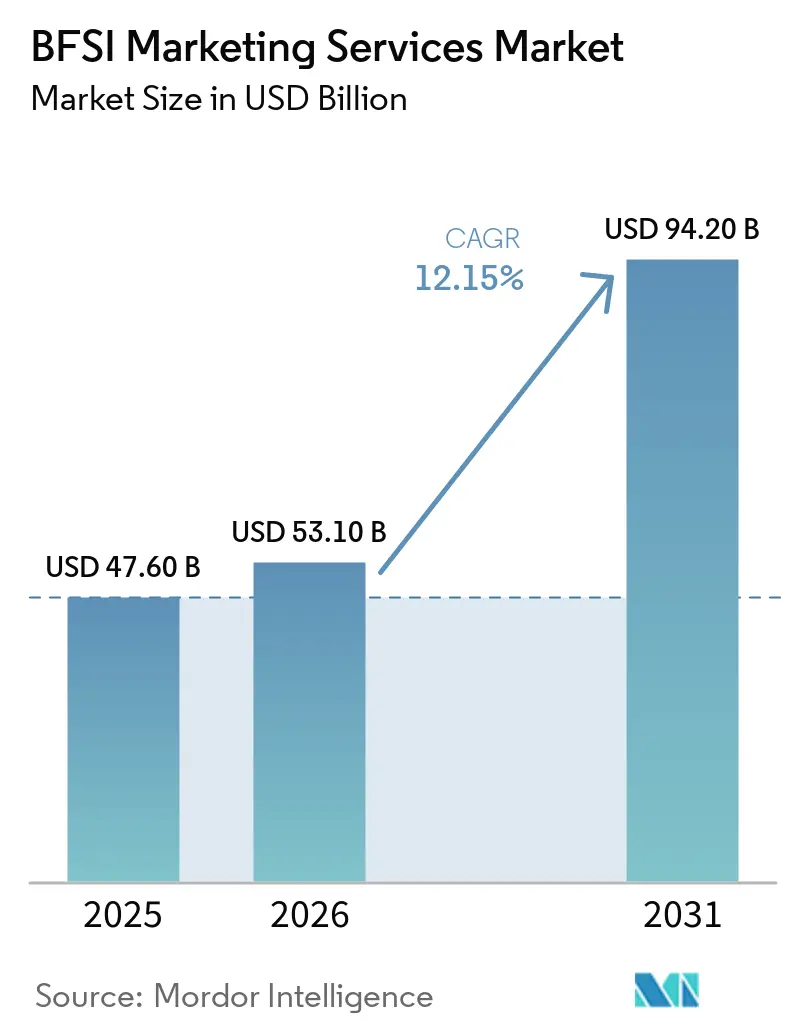
The BFSI Marketing Services Market size is expected to increase from USD 47.6 billion in 2025 to USD 53.1 billion in 2026 and reach USD 94.2 billion by 2031, growing at a CAGR of 12.15% over 2026-2031. The BFSI Marketing Services Market is moving away from broad financial advertising toward programs that tailor messages, timing, and channels to customer needs. Banks, insurers, and wealth managers are placing more value on work that links marketing activity to account openings, retention, and service usage. The BFSI Marketing Services Market also faces tighter expectations for approval records, disclosures, and customer consent across digital channels. Providers that combine campaign delivery with data integration and compliance processes can support longer client engagements. Demand is therefore shifting toward partners that can connect acquisition, customer relationship management, content controls, and measurement without creating new operational burdens.
Key Report Takeaways
- By service type, digital acquisition services held 31.68% of the BFSI Marketing Services Market revenue in 2025, while marketing technology and automation services are forecast to grow at a 12.78% CAGR through 2031.
- By organization size, large enterprises held 58.19% of revenue in 2025, while mid-market institutions are forecast to grow at a 12.98% CAGR through 2031.
- By geography, North America held 35.91% of revenue in the BFSI Marketing Services Market in 2025, while Asia-Pacific is forecast to grow at a 12.91% CAGR through 2031.
Note: Market size and forecast figures in this report are generated using Mordor Intelligence’s proprietary estimation framework, updated with the latest available data and insights as of January 2026.
Global BFSI Marketing Services Market Trends and Insights
Drivers Impact Analysis*
| Driver | (~) % Impact on CAGR Forecast | Geographic Relevance | Impact Timeline |
|---|---|---|---|
| Demand For Hyper-Personalized Customer Journeys | +2.8% | Global | Short term (≤ 2 years) |
| Shift Toward Measurable Digital Advertising | +2.3% | Global, North America and Europe leading | Short term (≤ 2 years) |
| Need For Compliance-Embedded Content Workflows | +1.8% | Global, particularly the United States, Europe, and China | Medium term (2-4 years) |
| Expansion Of Cross-Channel Lifecycle Engagement | +1.5% | Global, Asia-Pacific and North America leading | Medium term (2-4 years) |
| AI Answer-Engine Discoverability For Product Shortlisting | +1.2% | Global, North America dominant | Short term (≤ 2 years) |
| Open Banking And Permissioned Data Activation | +1.0% | Europe, the United Kingdom, and Asia-Pacific, with spillover to the Middle East and Africa | Long term (≥ 4 years |
| Source: Mordor Intelligence | |||
Demand For Hyper-Personalized Customer Journeys
Personalized communication has become a practical requirement for banks and card issuers rather than a branding preference. J.D. Power reported in May 2026 that 20% of bank customers and 16% of credit card customers said their provider always personalized the information they received.[1] The same study found that accurate personalization was associated with satisfaction gains of 238 points among bank customers and 219 points among card customers. This gap between customer expectations and delivery creates demand in the BFSI Marketing Services Market for customer-data design, consent management, and journey orchestration. Many institutions adopted relevant tools between 2022 and 2025, but still need help joining product, channel, and customer data. Service providers can therefore earn durable assignments by improving the operating model around personalization rather than simply deploying software.
Shift Toward Measurable Digital Advertising
Financial advertisers are shifting budgets to channels where activity can be more clearly linked to business outcomes. In 2026, Innovid reported planned increases in investment in AI media, digital display, social, and search among financial services marketers.[2] The American Bankers Association reported in 2025 that search engine marketing and search engine optimization had moved ahead of display advertising as a priority among bank marketers. High-intent search is especially relevant when customers compare lending, insurance, or investment products. This change supports the BFSI Marketing Services Market because institutions need one view across search, paid media, owned channels, and emerging AI search interfaces. Providers that unite these activities with clear controls can help clients avoid fragmented measurement and inconsistent messaging.
Need For Compliance-Embedded Content Workflows
Compliance requirements are shaping the way financial marketing programs are planned and delivered. The U.S. Securities and Exchange Commission identified deficiencies related to testimonials, endorsements, third-party ratings, and recordkeeping in its 2025 Marketing Rule Risk Alert.[3] FINRA stated that its technology-neutral communications rules apply when firms use generative AI and other emerging technologies. China issued measures in April 2026 that set requirements for online marketing of financial products and took effect on September 30, 2026. The BFSI Marketing Services Market benefits when compliance checks are built into content creation, review, and archive processes. This approach can reduce late-stage rework while providing institutions with a record of how campaigns were approved. It also raises the value of providers that understand both local rules and the technical workflow used to execute campaigns.
Expansion of Cross-Channel Lifecycle Engagement
Retention and reactivation are receiving more attention as financial institutions look beyond single-product acquisition campaigns. AppsFlyer reported in 2026 that Southeast Asian BFSI brands had increased remarketing investment by 193%.[4] The report also noted that retaining and reactivating existing customers costs less than acquiring new customers. This supports a broader role for the BFSI Marketing Services Market in loyalty design, behavioral triggers, CRM coordination, and post-conversion communication. Capgemini and Google Cloud described a continuous model for customer engagement that uses real-time data and automated optimization. Such work usually requires ongoing service relationships because data, content, and campaign rules need regular adjustment. It also makes performance measurement more important, as teams must demonstrate how retention activity contributes to customer value.
Restraints Impact Analysis*
| Restraint | (~) % Impact on CAGR Forecast | Geographic Relevance | Impact Timeline |
|---|---|---|---|
| Lengthy Regulatory Review Cycles And Disclosure Requirements | -1.8% | Global, particularly the United States, Europe, and China | Medium term (2-4 years) |
| Legacy Data Silos And Fragmented Martech Stacks | -1.4% | Global | Long term (≥ 4 years) |
| AI Content Oversight Burden Beyond Human Capacity | -0.9% | Global | Short term (≤ 2 years) |
| Off-Site Misinformation Across Comparison, Affiliate, And AI Channels | -0.6% | Global, with focus on the United States, Europe, and Asia-Pacific | Medium term (2-4 years) |
| Source: Mordor Intelligence | |||
Lengthy Regulatory Review Cycles And Disclosure Requirements
Regulatory review can limit the speed at which digital campaigns are attractive to financial institutions. The SEC’s 2025 alert showed that examiners expect firms to demonstrate how they meet Marketing Rule requirements in practice. The Financial Conduct Authority’s guidance requires financial promotions on social media to be fair, clear, and not misleading. These expectations apply to influencer, affiliate, and other third-party communications as well as a firm’s own advertising. In the BFSI Marketing Services Market, outsourced teams must support auditable approval paths and accurate disclosures across channels. This adds time and cost to campaign launches, particularly where several regulators apply. Providers that use standardized review steps and maintain clear records are better positioned to maintain speed without weakening controls.
Legacy Data Silos And Fragmented Martech Stacks
Customer and campaign data often remain fragmented across core banking systems, CRM tools, mobile applications, and analytics platforms. The American Bankers Association reported in July 2026 that 87% of bank marketers used some form of marketing technology. Tool adoption alone does not resolve the data architecture issues that restrict timely activation. The BFSI Marketing Services Market must often work around older batch-based connections between core systems and marketing platforms. Delayed or incomplete data makes it harder to personalize messages and coordinate contact across channels. Duplicate records and inconsistent consent details also raise the risk of poorly timed communication. These conditions extend implementation cycles and can delay proof of value for complex client programs.
*Our forecasts treat driver/restraint impacts as directional, not additive. The impact forecasts reflect baseline growth, mix effects, and variable interactions.
Segment Analysis
By Service Type: Digital Acquisition Maintains The Largest Revenue Position
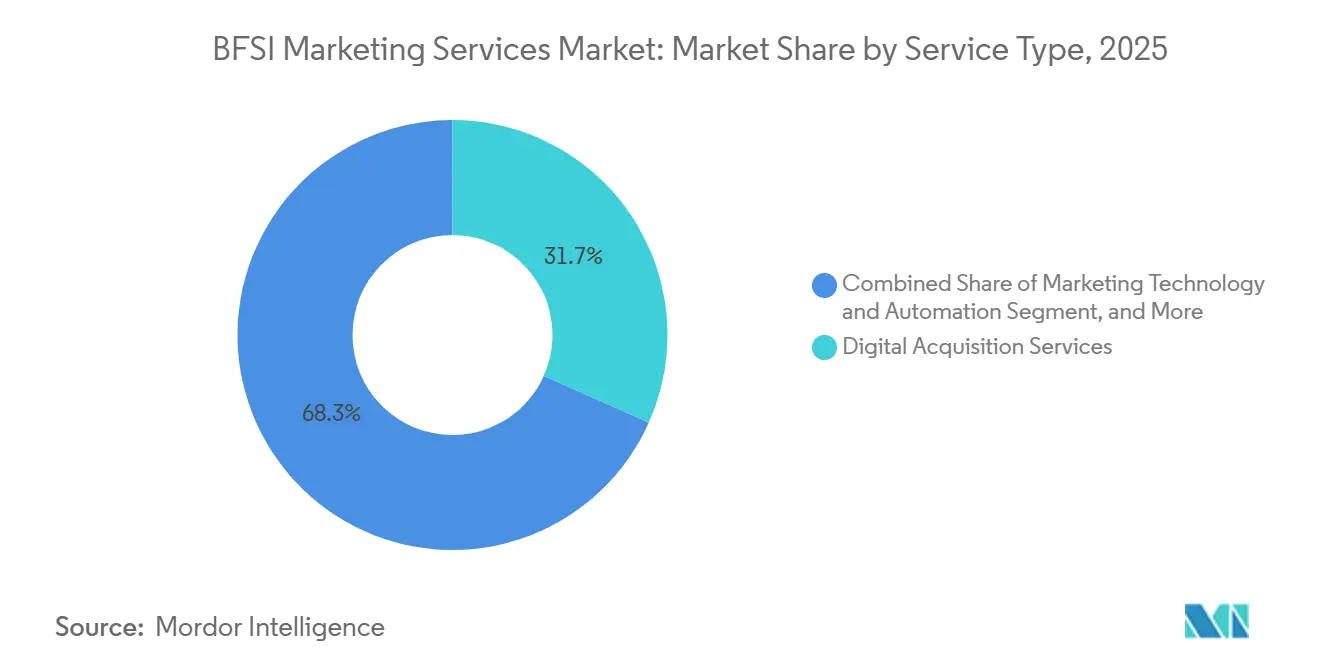
Digital acquisition services held 31.68% of the BFSI Marketing Services Market share in 2025. Banks, insurers, and wealth managers continue to invest in paid search, digital display, social advertising, and related channels because these activities can be measured against product applications and account openings. High customer lifetime values can support considerable acquisition spending in lending, insurance, and investment products. The sector also needs specialized support because financial services keywords can be expensive and closely regulated. The BFSI Marketing Services Market offers providers an opportunity to integrate media planning, landing-page design, customer verification, and campaign measurement into a single service model.
Marketing technology and automation services are forecast to record a 12.78% CAGR through 2031. The American Bankers Association reported that adoption of AI-powered marketing tools among bank marketers reached 50.4% in 2026, up from 16.9% in 2024. CRM and marketing automation remain central parts of bank technology environments. Brand and trust-building, compliance-led content, lifecycle and CRM, and analytics and measurement services also become more relevant as institutions seek connected programs. The BFSI Marketing Services Market is increasingly organized around offerings that link acquisition, automation, compliance, and measurement rather than treating them as separate projects.

By Organization Size: Large Enterprises Lead While Mid-Market Adoption Accelerates
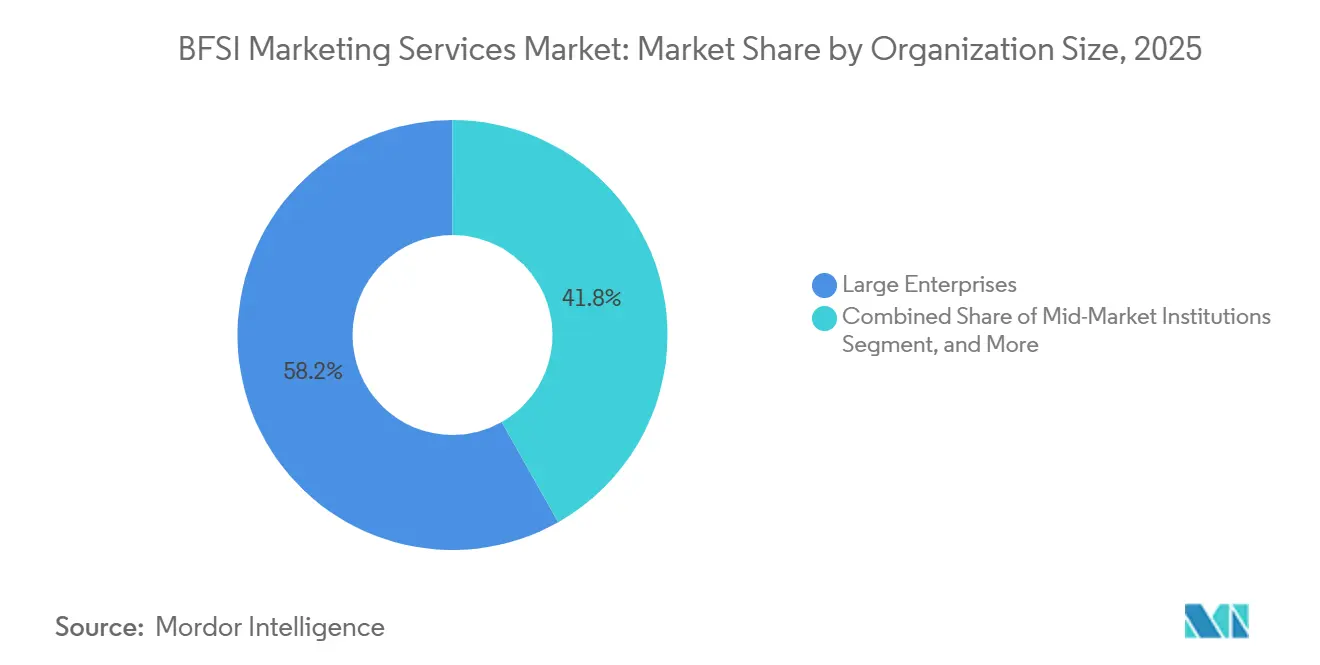
Large enterprises held 58.19% of the BFSI Marketing Services Market share in 2025. Large banks, insurers, and asset managers often manage multiple brands, product categories, and regulatory jurisdictions simultaneously. Their programs require coordinated content, data processes, approvals, and customer engagement across many markets. This complexity favors sustained relationships with providers that can combine creative, technology, and operating support. Infosys and Citizens Financial Group announced an AI-first Innovation Hub in Bengaluru in 2026 to support transformation across banking operations and customer experience. The example shows how enterprise assignments can extend beyond campaign delivery into broader customer experience and technology work.
Mid-market institutions are forecast to expand at a 12.98% CAGR through 2031. Lower technology costs and subscription-based platforms make more formal marketing programs accessible to regional banks and insurers. Kyoto Bank announced in April 2026 that it had introduced the bdash marketing automation tool as part of its medium-term management plan. Smaller institutions and credit unions remain constrained by procurement budgets and limited internal teams. Still, they can use lighter deployment models for customer communications, digital acquisition, and measurement. The BFSI Marketing Services Market can serve this group when its services are scalable, compliant, and aligned with a smaller institution’s internal capacity.
Geography Analysis
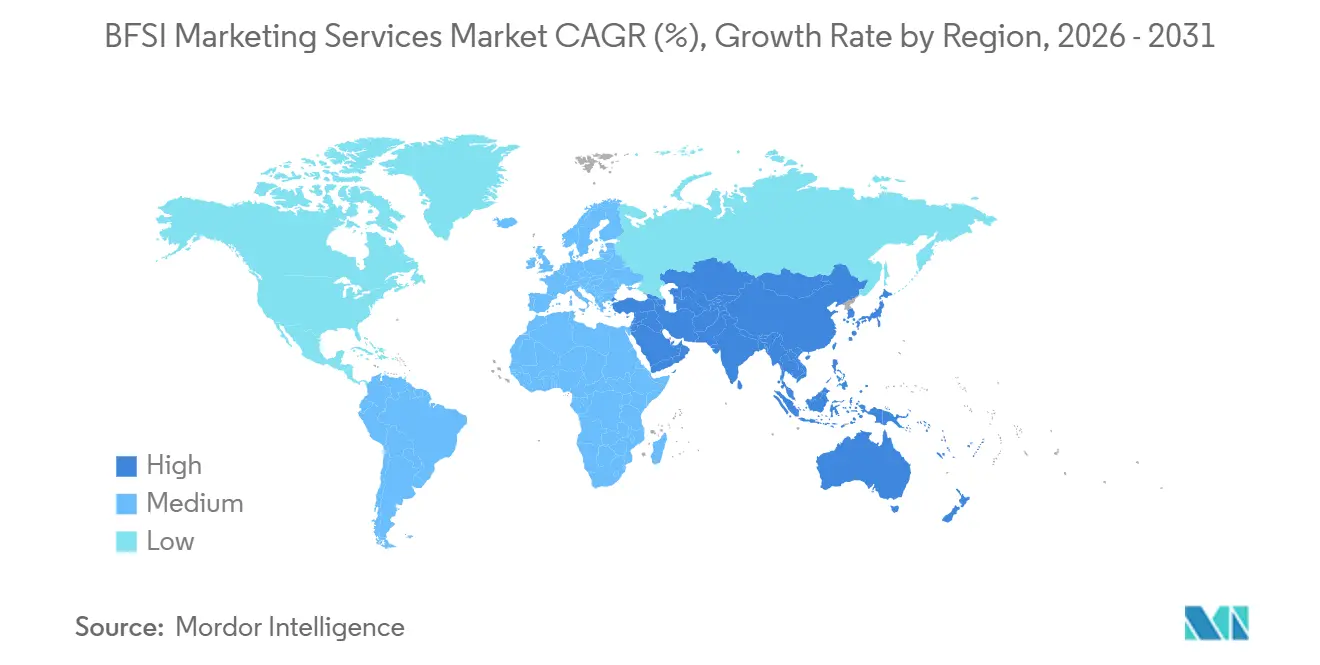
North America held 35.91% of the BFSI Marketing Services Market share in 2025. The region combines large financial advertising budgets with a mature technology supplier base and major transformation programs at banks, insurers, and asset managers. In 2025, the American Bankers Association found that 82.1% of U.S. bank marketers planned to increase digital advertising budgets. U.S. providers must also consider FINRA rules, the SEC Marketing Rule, and consumer protection requirements when planning and approving financial promotions. Canada and Mexico contribute to regional demand by developing digital banking and advancing open banking infrastructure.
Asia-Pacific is forecast to grow at a 12.91% CAGR through 2031. The region is formalizing digital engagement programs across China, India, Japan, and Southeast Asia. DBS reported SGD 1 billion (USD 771 million) in AI-attributable economic value in 2025. In 2026, Gunma Bank reported that it had expanded its AI-driven marketing automation scenarios by 1.5 times. Mizuho has also described a platform that connects online and offline customer experience through hyper-personalized marketing. China’s new rules on online marketing impose tighter requirements on third-party platforms while supporting demand for regulated delivery models.
South America, the Middle East, and Africa remain smaller regional blocks in the BFSI Marketing Services Market. Brazil and Chile are important South American demand centers, with banks using AI-enabled engagement to improve sales conversion. GCC economic development programs and the United Arab Emirates financial sector agenda support demand for bilingual, digital, and compliance-ready services. In Africa, South Africa, Nigeria, Egypt, and Kenya are at earlier stages of financial marketing technology adoption. The geographical mix gives providers room to adapt services for local languages, regulatory frameworks, and different levels of digital maturity.
Competitive Landscape
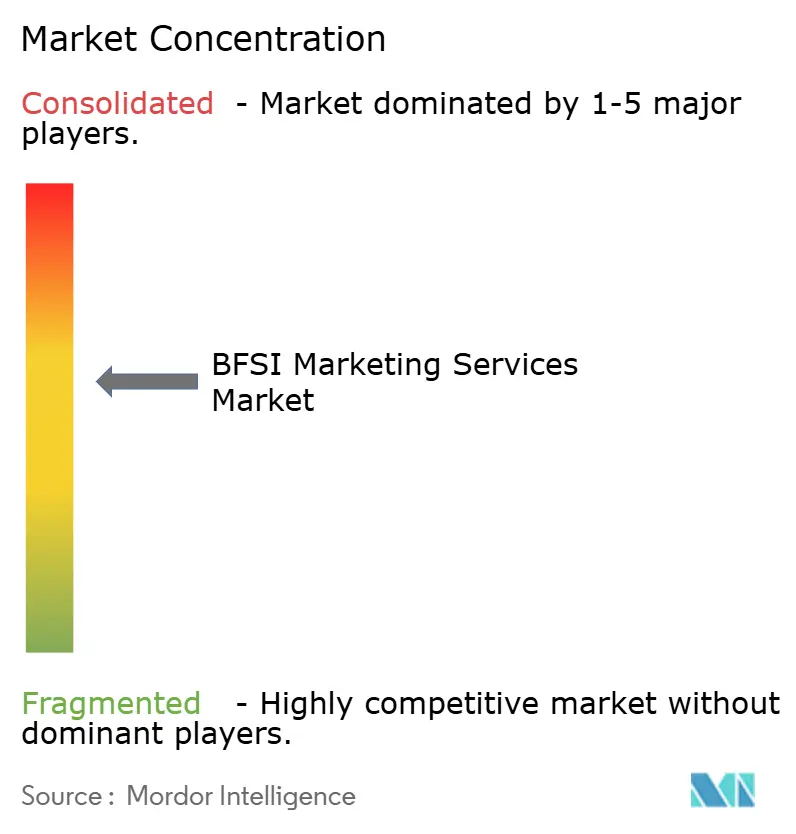
The BFSI Marketing Services Market has a concentrated enterprise tier and a more fragmented group of specialized providers. Large firms compete for complex assignments that combine strategy, creative work, technology implementation, AI-enabled operations, and performance measurement. Accenture Song, Capgemini, Cognizant, Deloitte Digital, IBM, Infosys, Merkle, Omnicom, Publicis Groupe, and TCS have the scale to deliver across several markets. Smaller marketing technology vendors address specific needs in workflow automation, analytics, customer data, and compliance. This division allows clients to choose either broad transformation partners or narrowly focused platforms. The competitive position of each provider depends on its ability to align technology capabilities with the governance needs of financial institutions.
Publicis Groupe entered into an agreement in May 2026 to acquire LiveRamp for USD 2.2 billion, subject to regulatory and shareholder approvals. The proposed transaction emphasizes the strategic value of first-party data collaboration for personalized financial marketing. Accenture acquired MomentumABM in September 2025 to expand its account-based marketing capabilities. It also acquired Superdigital in August 2025 to strengthen social and influencer marketing services. Cognizant partnered with Typeface in January 2026 to modernize enterprise marketing through agentic AI orchestration. These moves show that providers are extending their reach through acquisitions, platform partnerships, and deeper technology integration.
Compliance automation within campaign workflows remains an important gap in the BFSI Marketing Services Market. Financial institutions need AI-enabled production processes that also support review records, disclosures, and audit trails. AI answer engine optimization is another emerging service need, as customers increasingly use AI interfaces during product research. Cognizant’s work with Typeface covers ideation, content creation, channel optimization, and compliance review within a connected workflow. Providers that can demonstrate the safe use of automation may reduce manual workload for marketing teams while maintaining accountability. No combined market share for leading providers is available in the supplied material, so a concentration score cannot be assigned under the stated methodology.
BFSI Marketing Services Industry Leaders
-
Accenture plc
-
Deloitte Touche Tohmatsu Limited
-
Capgemini SE
-
Cognizant Technology Solutions Corporation
-
Merkle Inc.
- *Disclaimer: Major Players sorted in no particular order
Recent Industry Developments
- July 2026: UniCredit, Accenture, and IBM announced a long-term strategic collaboration to build Europe’s next-generation banking technology platform across 13 European markets. As part of the agreement, Accenture will acquire IBM’s majority stake in the joint venture managing a significant portion of UniCredit’s technology infrastructure. IBM will provide IBM Z platforms, software, and consulting services. The multi-year program is designed to scale AI, cloud, and data capabilities across banking operations and customer engagement for UniCredit’s 20 million+ clients.
- May 2026: Publicis Groupe entered an agreement to acquire LiveRamp, a global data-collaboration platform, in an all-cash transaction valued at a total enterprise value of USD 2.2 billion, or USD 38.5 per share. The acquisition is expected to close before year-end 2026, subject to regulatory and shareholder approvals. It positions Publicis Groupe to lead in first-party data co-creation for AI-driven, personalized financial marketing at enterprise scale.
- May 2026: Genpact and Google Cloud expanded their alliance to build and scale agentic AI-led solutions for the Office of the CFO. The partnership introduced Genpact Finance One - Revenue Lens Agents through Google Cloud’s Agent Marketplace. The offering targets revenue forecasting accuracy, cash flow management, and financial planning and analysis use cases across BFSI clients.
- April 2026: Microsoft and Publicis Groupe expanded their strategic partnership to build a full-stack marketing solution that unifies legacy systems, AI agents, and identity-based data. Publicis deployed Microsoft 365 Copilot to all 114,000+ employees and selected Microsoft Azure as its preferred cloud provider. The partnership scales agentic AI capabilities for financial services marketing transformation.
Global BFSI Marketing Services Market Report Scope
The BFSI marketing services market refers to the ecosystem of specialized professional and managed services tailored specifically for the banking, financial services, and insurance sector. This market encompasses a broad range of offerings, including digital customer acquisition, brand and trust-building, compliance-led content creation, lifecycle engagement and CRM management, marketing technology implementation, and advanced performance analytics. Due to the highly regulated nature of the financial industry, these services place a critical emphasis on strict data security, adherence to regional financial regulations, and the building of consumer trust. Catering to organizations of all sizes, from large global banks to mid-market institutions and small credit unions, these services enable financial entities to navigate complex compliance landscapes, optimize customer acquisition costs, foster long-term customer loyalty, and drive sustainable growth in an increasingly digital and competitive financial landscape.
The BFSI Marketing Services Market Report is Segmented by Service Type (Digital Acquisition Services, Brand and Trust-Building Services, Compliance-Led Content Services, Lifecycle Engagement and CRM Services, Marketing Technology and Automation Services, and Analytics and Measurement Services), Organization Size (Large Enterprises, Mid-Market Institutions, and Small Institutions and Credit Unions), and Geography (North America, South America, Europe, Asia-Pacific, Middle East, and Africa). The Market Forecasts are Provided in Terms of Value (USD).
| Digital Acquisition Services |
| Brand and Trust-Building Services |
| Compliance-Led Content Services |
| Lifecycle Engagement and CRM Services |
| Marketing Technology and Automation Services |
| Analytics and Measurement Services |
| Large Enterprises |
| Mid-Market Institutions |
| Small Institutions and Credit Unions |
| North America | United States |
| Canada | |
| Mexico | |
| South America | Brazil |
| Argentina | |
| Chile | |
| Rest of South America | |
| Europe | Germany |
| United Kingdom | |
| France | |
| Italy | |
| Spain | |
| Rest of Europe | |
| Asia-Pacific | China |
| Japan | |
| India | |
| South Korea | |
| Australia | |
| Rest of Asia-Pacific | |
| Middle East | United Arab Emirates |
| Saudi Arabia | |
| Qatar | |
| Rest of Middle East | |
| Africa | South Africa |
| Egypt | |
| Nigeria | |
| Rest of Africa |
| By Service Type | Digital Acquisition Services | |
| Brand and Trust-Building Services | ||
| Compliance-Led Content Services | ||
| Lifecycle Engagement and CRM Services | ||
| Marketing Technology and Automation Services | ||
| Analytics and Measurement Services | ||
| By Organization Size | Large Enterprises | |
| Mid-Market Institutions | ||
| Small Institutions and Credit Unions | ||
| By Geography | North America | United States |
| Canada | ||
| Mexico | ||
| South America | Brazil | |
| Argentina | ||
| Chile | ||
| Rest of South America | ||
| Europe | Germany | |
| United Kingdom | ||
| France | ||
| Italy | ||
| Spain | ||
| Rest of Europe | ||
| Asia-Pacific | China | |
| Japan | ||
| India | ||
| South Korea | ||
| Australia | ||
| Rest of Asia-Pacific | ||
| Middle East | United Arab Emirates | |
| Saudi Arabia | ||
| Qatar | ||
| Rest of Middle East | ||
| Africa | South Africa | |
| Egypt | ||
| Nigeria | ||
| Rest of Africa | ||
Key Questions Answered in the Report
What is current market size of the BFSI Marketing Services Market?
The BFSI Marketing Services Market size is expected to increase from USD 47.6 billion in 2025 to USD 53.1 billion in 2026 and reach USD 94.2 billion by 2031, growing at a CAGR of 12.15% over 2026-2031.
Which service type holds the largest share?
Digital acquisition services held 31.68% of revenue in 2025, reflecting the importance of measurable customer acquisition for banks, insurers, and wealth managers.
Which service type is growing fastest?
Marketing technology and automation services is forecast to grow at a 12.78% CAGR through 2031, supported by broader use of AI, CRM, and automation tools.
Which organization size segment is expanding fastest?
Mid-market institutions is forecast to grow at a 12.98% CAGR through 2031 as lower-cost and subscription-based solutions widen access to advanced marketing capabilities.
Which region leads the BFSI Marketing Services Market?
North America held 35.91% of revenue in 2025, supported by large financial advertising budgets and a mature technology ecosystem.
What limits adoption of advanced marketing services in BFSI?
Lengthy regulatory reviews, disclosure requirements, legacy data silos, and fragmented technology stacks can delay campaign launches and personalization programs.