
Benzodiazepine Drugs Market Size and Share
Market Overview
| Study Period | 2020 - 2031 |
|---|---|
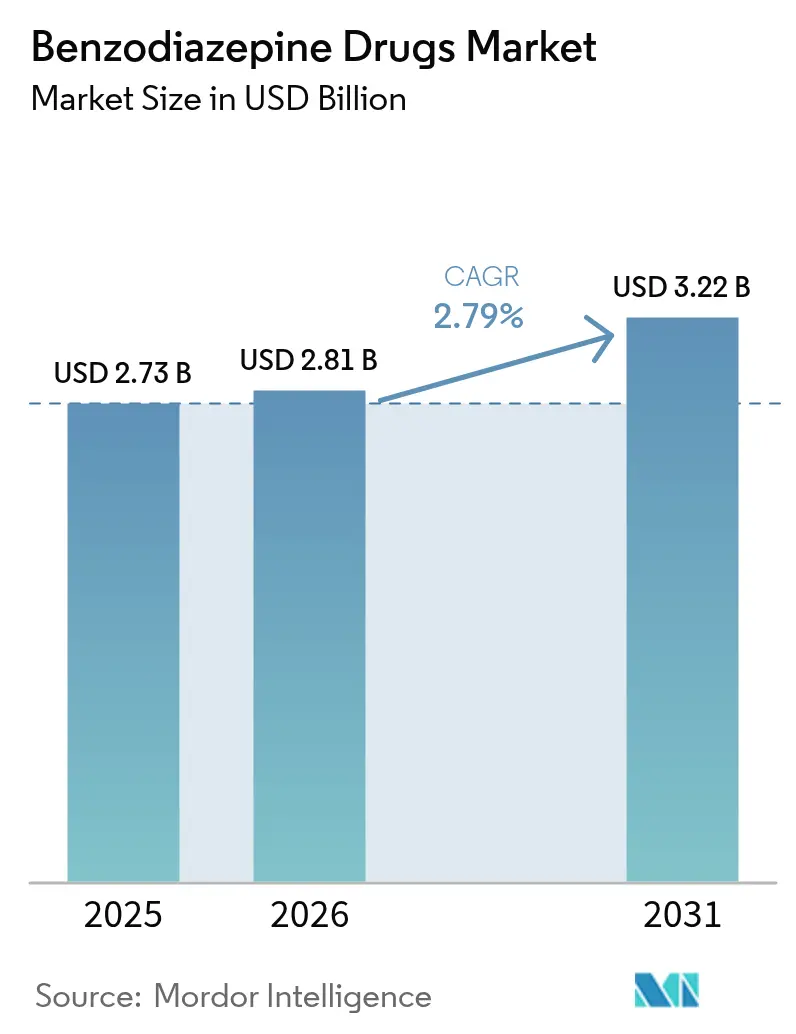
| Market Size (2026) | USD 2.81 Billion |
| Market Size (2031) | USD 3.22 Billion |
| Growth Rate (2026 - 2031) | 2.79 % |
| Fastest Growing Market | Asia Pacific |
| Largest Market | North America |
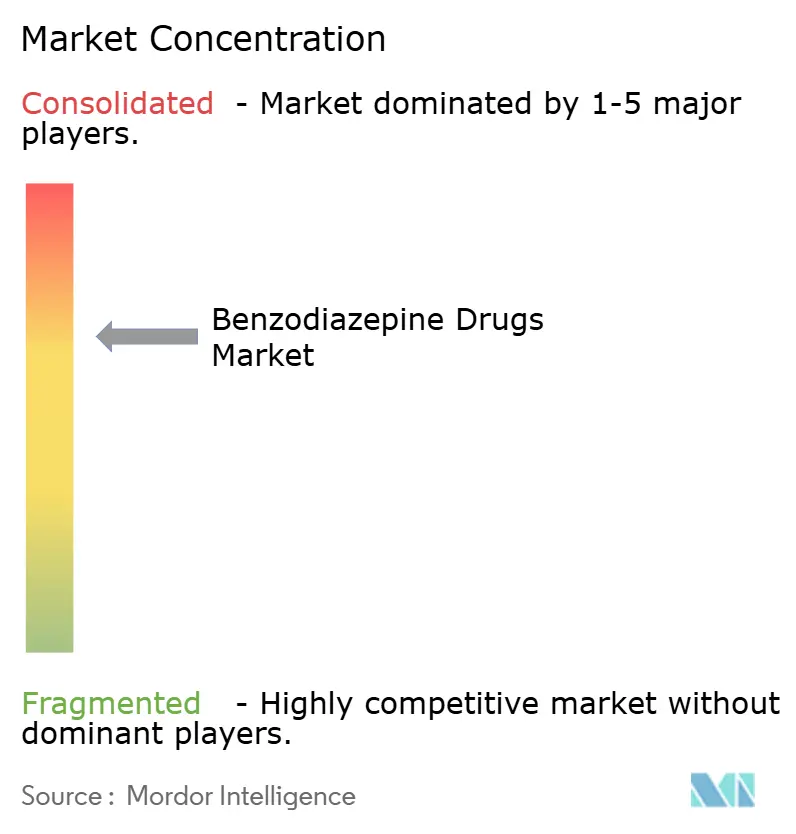
| Market Concentration | Medium |
Major Players *Disclaimer: Major Players sorted in no particular order Image © Mordor Intelligence. Reuse requires attribution under CC BY 4.0. | |
Benzodiazepine Drugs Market Analysis by Mordor Intelligence
benzodiazepine drugs market size in 2026 is estimated at USD 2.81 billion, growing from 2025 value of USD 2.73 billion with 2031 projections showing USD 3.22 billion, growing at 2.79% CAGR over 2026-2031. Demand stays resilient because anxiety prevalence remains high, hospital protocols still favor rapid-acting sedatives, and regulators now allow controlled telemedicine prescribing. Growth also stems from expanding intranasal and pediatric indications, wider generic uptake in emerging economies, and steady uptake in alcohol-withdrawal protocols. Counterbalancing forces include stringent monitoring rules, recurring API shortages, and substitution by non-benzodiazepine anxiolytics, yet the net effect keeps the benzodiazepine drugs market on a measured upward path.
Key Report Takeaways
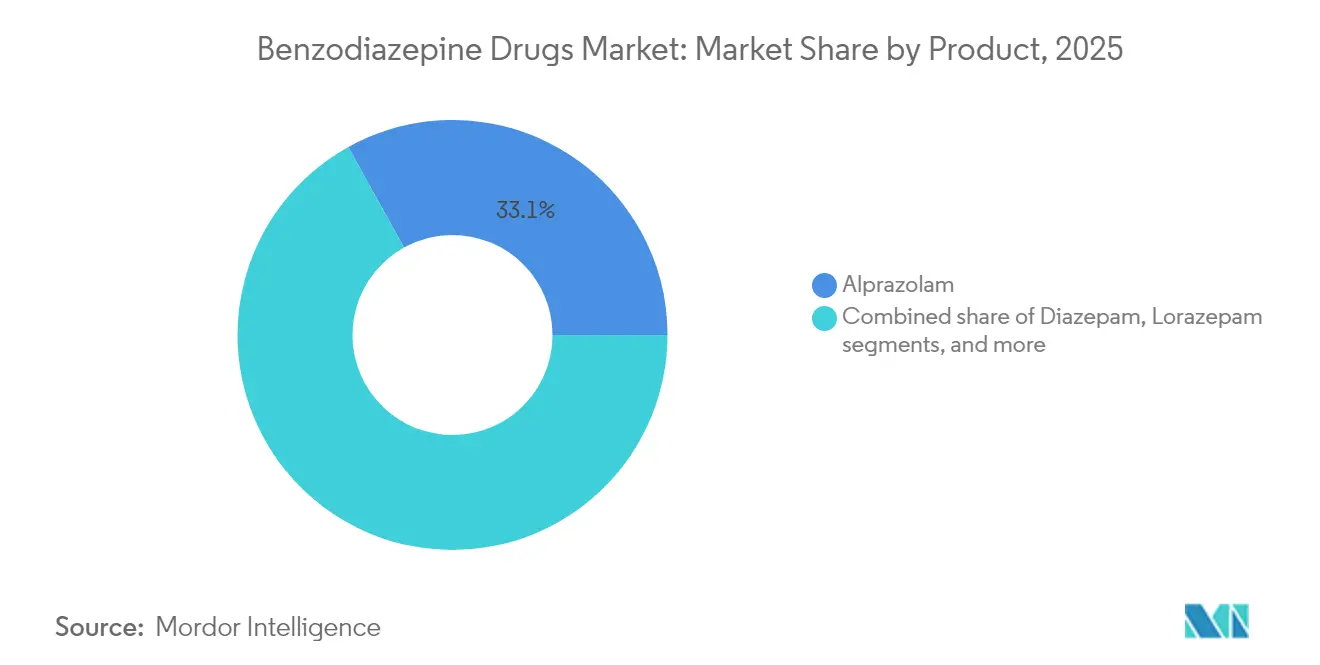
- By product, alprazolam led with a 33.05% revenue share in 2025, while diazepam is projected to post the fastest 4.16% CAGR through 2031.
- By application, anxiety disorders accounted for 54.10% of the benzodiazepine drugs market size in 2025; alcohol-withdrawal therapy is set to grow at a 3.58% CAGR.
- By time of action, short-acting agents captured 47.40% of the benzodiazepine drugs market share in 2025; ultra-short options are poised to register a 4.21% CAGR.
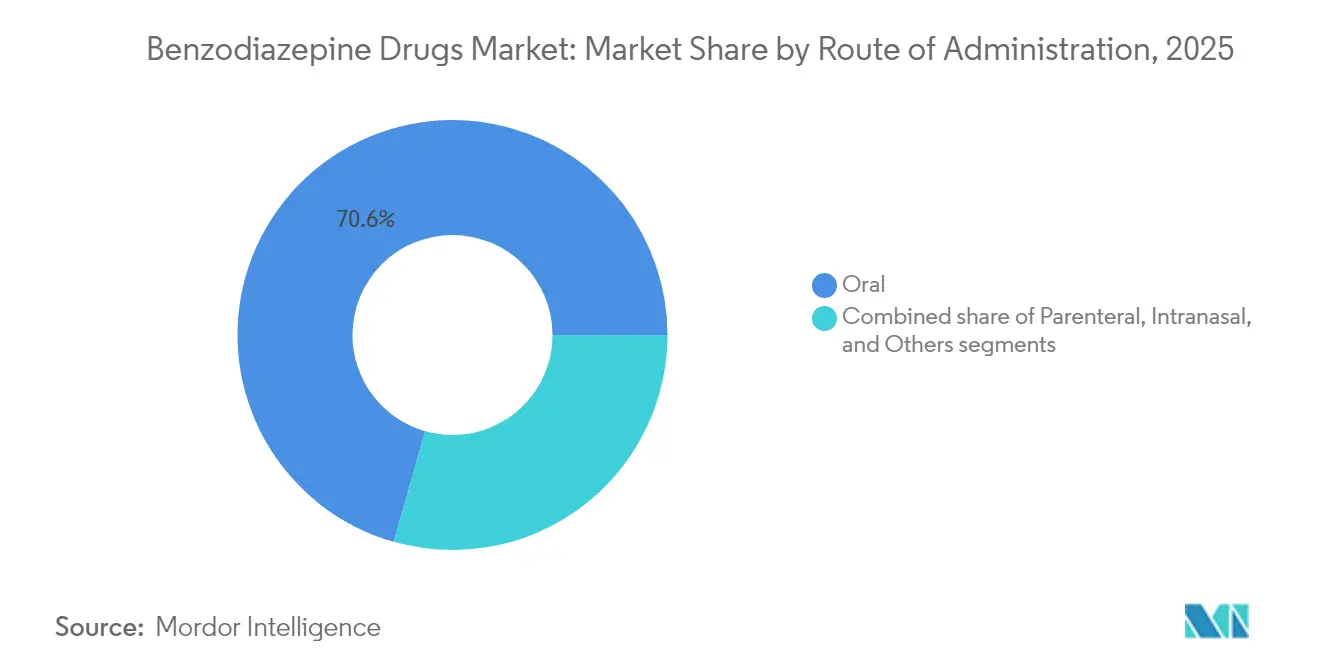
- By route of administration, oral forms held 70.60% share, whereas intranasal products are expanding at a 3.74% CAGR.
- By distribution channel, hospital pharmacies dominated with a 51.30% share in 2025; online pharmacies show the fastest 3.83% CAGR.
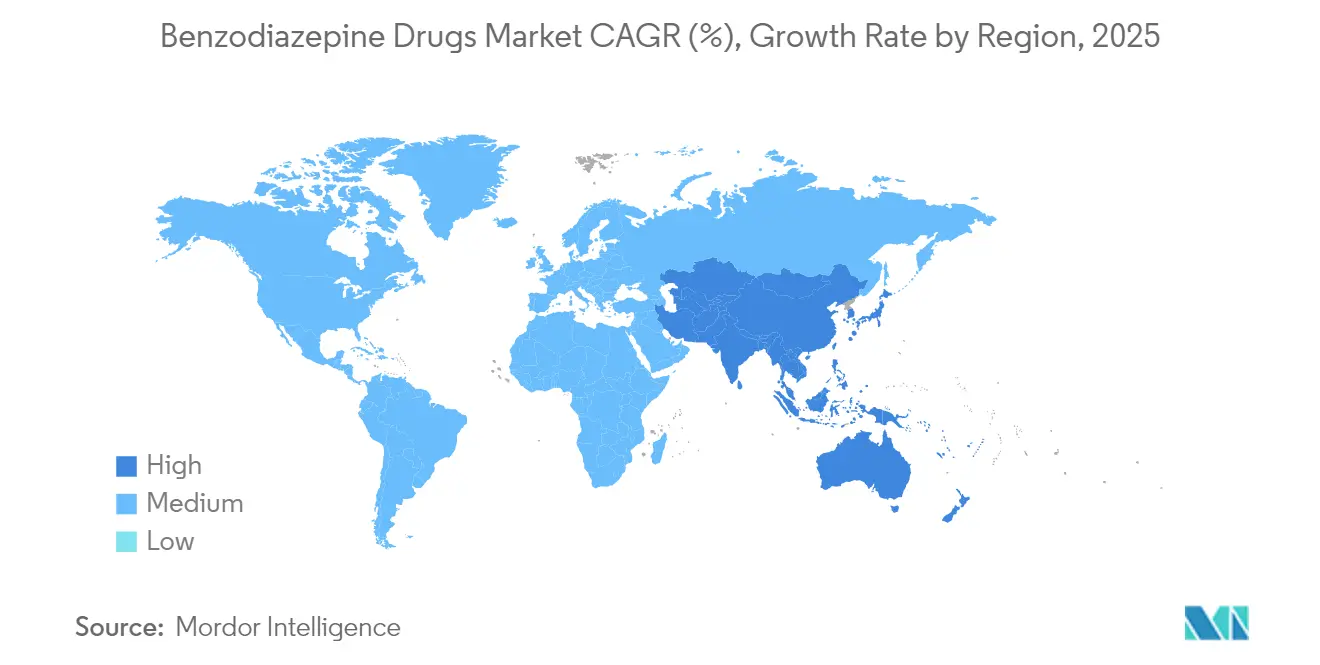
- North America represented 40.10% of revenue in 2025; Asia-Pacific is the quickest-growing region at a 3.25% CAGR.
Note: Market size and forecast figures in this report are generated using Mordor Intelligence’s proprietary estimation framework, updated with the latest available data and insights as of 2026.
Market Trends and Insights
Drivers Impact Analysis of Benzodiazepine Drugs Market*
| Driver | (~) % Impact on CAGR Forecast | Geographic Relevance | Impact Timeline |
|---|---|---|---|
| Rising prevalence of anxiety & panic disorders | +0.8% | Global, with highest impact in North America & Europe | Medium term (2-4 years) |
| Ageing population with multiple comorbidities | +0.6% | Global, concentrated in developed markets | Long term (≥ 4 years) |
| Increasing insomnia linked to digital-lifestyle fatigue | +0.5% | North America & EU, emerging in urban APAC | Medium term (2-4 years) |
| Growing adoption of low-cost generics | +0.4% | APAC core, spill-over to Latin America | Short term (≤ 2 years) |
| Expansion of palliative-care protocols using benzodiazepines | +0.3% | Global, early gains in developed healthcare systems | Long term (≥ 4 years) |
| Shortages of alternative anti-anxiety APIs driving formulary substitution | +0.2% | North America & EU | Short term (≤ 2 years) |
| Source: Mordor Intelligence | |||
Rising Prevalence of Anxiety & Panic Disorders
Global anxiety incidence keeps climbing, especially in BRICS economies. U.S. data showed 18.2% of adults screened positive for anxiety symptoms in 2025, up from pre-pandemic baselines. This epidemiological pressure sustains prescriptions even as guidelines tighten. Reproductive-age women report higher medication adherence, amplifying script volumes. Telehealth now broadens reach, notably after the DEA allowed Schedule III-V benzodiazepine e-prescribing under special registration rules. Professional bodies nevertheless push gradual tapering[1] for long-term users, underscoring the balancing act between need and safety.
Ageing Population with Multiple Comorbidities
Aging societies contribute a steady patient pool with anxiety, insomnia and seizure comorbidity. A 2024 seven-nation survey[2] found 14.9% benzodiazepine use among Europeans aged 65+, peaking at 35.5% in Croatia. Prescribers prefer longer-acting diazepam for simplified dosing yet must monitor fall and cognition risks. Health agencies promote deprescribing campaigns, but the clinical reality of complex multimorbidity keeps benzodiazepines in geriatric toolkits.
Increasing Insomnia Linked to Digital-Lifestyle Fatigue
Remote work and device overuse disrupt circadian rhythms. Novel partial modulators such as dimdazenil promise fewer cognitive effects, signaling industry innovation toward safer sleep aids. Younger adults now drive short-acting demand, but regulators first recommend behavioral therapy, placing a ceiling on volume growth.
Growing Adoption of Low-Cost Generics
Patent expiries and new capacity spur generic substitution. A Brazilian primary-care audit recorded 29.1% prolonged use, often at supra-guideline doses, spotlighting both affordability and misuse risk. Established generic firms with stringent quality systems gain share as intermittent shortages hit smaller rivals.
Restraints Impact Analysis of Benzodiazepine Drugs Market*
| Restraint | % Impact on CAGR Forecast | Geographic Relevance | Impact Timeline |
|---|---|---|---|
| High risk of dependence, abuse & diversion | -0.9% | Global, most severe in North America | Medium term (2-4 years) |
| Intensifying regulatory scrutiny & up-scheduling initiatives | -0.7% | North America & EU, expanding to APAC | Short term (≤ 2 years) |
| Emergence of non-benzo anxiolytics (e.g., Z-drugs, CBD-based) | -0.5% | North America & EU, early adoption in urban centers | Medium term (2-4 years) |
| API supply-chain vulnerabilities (China–India chokepoints) | -0.3% | Global, concentrated impact on generic manufacturers | Short term (≤ 2 years) |
| Source: Mordor Intelligence | |||
High Risk of Dependence, Abuse & Diversion
Designer analogues fuel overdose deaths, with 141 fatalities linked in the last one and a half decades. Scottish prison screens frequently detect etizolam, illustrating illicit penetration. Young adult prescribing has crept upward since 2008, diverging from the overall decline, driving regulators to intensify monitoring. The UK has already proposed Class C controls on fifteen novel agents.
Intensifying Regulatory Scrutiny & Up-Scheduling Initiatives
New DEA telemedicine rules introduce multi-tier registration and mandatory PDMP checks. China shifted midazolam to Category I in July 2024, adding license hurdles and full-chain traceability. In Europe, the EMA lorazepam Macure referral showcased the bloc’s willingness to harmonize labelling when member states disagree. Smaller firms face rising compliance costs, potentially thinning supplier pools.
*Our forecasts treat driver/restraint impacts as directional, not additive. The impact forecasts reflect baseline growth, mix effects, and variable interactions.
Benzodiazepine Drugs Market Segment Analysis
By Product:
Alprazolam Dominance Faces Diazepam RenaissanceIn 2025, alprazolam generated 33.05% of revenue, anchoring the benzodiazepine drugs market size. Demand stems from frontline anxiety protocols and prescriber familiarity. The benzodiazepine drugs market size for diazepam is projected to rise at a 4.16% CAGR, fueled by seizure, alcohol-withdrawal, and pediatric nasal-spray extensions. Diazepam was again the most widely traded psychotropic agent, reported by 158 nations. Supply interruptions hit clonazepam and lorazepam during 2024, exposing how concentrated manufacturing magnifies the risk of shortage.
Innovators now pursue delivery upgrades. In April 2025, the FDA cleared diazepam nasal spray for children down to age 2, stretching exclusivity for Neurelis. Such milestones signal an era where differentiated formats rather than new molecules sustain margins within the benzodiazepine drugs market.

By Application:
Anxiety Disorders Drive Volume While Alcohol Withdrawal Shows PromiseAnxiety disorders accounted for 54.10% of the benzodiazepine drugs market share in 2025, a position underpinned by persistently high symptom prevalence. Alcohol-withdrawal management, though smaller, will exhibit a 3.58% CAGR through 2031, aided by detox program growth and evidence favoring benzodiazepines for seizure prophylaxis.
Intranasal diazepam and midazolam have improved emergency seizure care response times. Insomnia scripts remain controlled as payers push non-drug therapies, yet technology-induced sleep disruption keeps a niche need alive. Muscle spasm relief and pre-operative sedation add incremental volumes.
By Time of Action:
Short-Acting Formulations Lead Despite Ultra-Short InnovationShort-acting agents held 47.40% of 2025 revenue, reflecting clinician desire for quick onset and lower accumulation. The benzodiazepine drugs market size tied to ultra-short molecules is forecast to grow at 4.21% CAGR, enabled by inhalable or vaporised technologies.
Staccato alprazolam reached peak plasma in 2 minutes versus 45 minutes orally, underscoring the clinical appeal of rapid delivery. Intermediate and long-acting options still serve elderly cohorts needing sustained coverage with fewer doses.
By Route of Administration:
Oral Dominance Challenged by Intranasal InnovationOral tablets and capsules retained 70.60% of the benzodiazepine drugs market size in 2025, a function of ease, cost, and entrenched habits. Intranasal formats are expanding at 3.74% CAGR as they offer non-invasive, fast brain availability and bypass the hepatic first pass.
Supply shocks in injectable lorazepam after Akorn’s exit highlighted parenteral fragility. Academic work on nose-to-brain transfer confirms robust seizure mitigation in animal models for intranasal benzodiazepines. Sublingual and rectal forms stay niche for special-needs users.
By Distribution Channel:
Hospital Pharmacies Lead While Online Growth AcceleratesHospital pharmacies dispensed 51.30% of sales in 2025. Institutional controls, EHR linkage and formulary oversight keep this channel central. Retail outlets occupy a steady second position but face tighter audit trails.
Online pharmacies, aided by telepsychiatry, will post a 3.83% CAGR. A recent survey valued the global e-pharmacy space at USD 353.9 billion by 2032. DEA’s new telehealth framework tightens safeguards, yet patients still value discretion and convenience when sourcing controlled drugs
Geography Analysis
North America Benzodiazepine Drugs Market
North America generated 40.10% of 2025 revenue and will grow at 2.32% CAGR. Anxiety prevalence of 18.2% in U.S. adults underscores continuing demand. Supply disruptions in clonazepam and lorazepam during 2024 revealed manufacturing concentration risks, while three-tier DEA rules now govern tele-prescribing.
Europe Benzodiazepine Drugs Market
Europe advances at 2.70% CAGR to 2031. Elderly prescription prevalence reaches 35.5% in Croatia, 33.5% in Spain, highlighting intra-region variance. EMA’s centralised referrals, such as for lorazepam Macure, harmonise safety messaging and ensure cross-border consistency. Surveillance of 36 new designer analogues keeps regulatory vigilance high.
APAC, MEA and South America Benzodiazepine Drugs Market
Asia-Pacific records the fastest 3.25% CAGR. India saw a 113.30% surge in anxiety cases over three decades. China’s Category I reclassification of midazolam raises compliance stakes. Japan could soon launch the first locally approved diazepam nasal spray following Aculys Pharma’s orphan-drug submission. Markets in the Middle East & Africa and South America grow at roughly 2.9% under improved mental-health recognition and broader health-system funding.
Regulatory Landscape
Benzodiazepines remain tightly regulated controlled medicines across major markets, with safety labeling centered on class-wide warnings for abuse, misuse, addiction, dependence, and withdrawal, as well as heightened cautions around concomitant opioid use, reflected in US FDA-required boxed warnings for the class. In the United States, access is also shaped by controlled-substance frameworks and telemedicine oversight, including the DEA special registration approach for Schedule III-V e-prescribing with mandatory PDMP checks referenced in the report context.
Regulatory tightening also shows up in actions targeting synthetic and designer benzodiazepines, which intersect with diversion and counterfeit supply risks. In March 2026, the DEA finalized the permanent Schedule I placement of clonazolam, diclazepam, etizolam, flualprazolam, and flubromazolam (effective March 2, 2026), and issued a separate temporary Schedule I order for bromazolam (effective March 16, 2026). In the EU, binding harmonization steps include the Lorazepam Macure referral, with an EU-wide decision updating product information to support status epilepticus control while mandating excipient toxicity warnings in young children, reinforcing the need for MAHs to keep labeling aligned with EMA and PRAC-driven pharmacovigilance expectations.
Value Chain Analysis
The benzodiazepine value chain begins with regulated chemical precursors and key starting materials, then moves through API synthesis, finished-dose formulation (oral solids, parenterals, and device-based intranasal products), and packaging and serialization where applicable. Distribution is controlled through wholesalers and pharmacies. International control under the 1971 Convention on Psychotropic Substances adds import-export reporting and licensing requirements that shape sourcing and shipment flows. In the US, commercialization further depends on DEA registration, recordkeeping, and quota-linked controls for certain controlled-substance activities, which increases operational complexity for both API producers and dose-form manufacturers.
Supply risk is most pronounced upstream, where APIs and intermediates often rely on manufacturing footprints in India and China and on a narrow set of qualified starting-material suppliers, which raises exposure to quality events, environmental compliance actions, and logistics disruptions. Recent supply-chain commentary from USP (April 2026) flagged vulnerabilities in starting-material sourcing, aligning with the report context on recurring API shortages and chokepoints. Downstream, hospital pharmacies dominate benzodiazepine dispensing in value terms, supported by EHR-linked controls and formulary governance, while telehealth-enabled e-prescribing increases the need for compliant e-pharmacy workflows and documentation across controlled-substance distribution.
Competitive Landscape
The benzodiazepine drugs market remains moderately consolidated. Leading manufacturers integrate API production, formulation and distribution to buffer cost shocks. Repeated shortages in 2024 shifted share toward firms that sustained supply.
Differentiation now pivots to abuse-deterrent designs and alternative delivery. Valtoco’s expanded paediatric nod in April 2025 exemplifies how targeted indications widen the addressable base. Patents on device-drug combinations protect price premia even as molecule patents lapse.
Smaller entrants face sizable regulatory and capital hurdles, especially after new telemedicine and up-scheduling rules. White-space opportunities lie in paediatric, intranasal and ultra-short action niches, yet require strong regulatory expertise to navigate complex, multi-jurisdiction oversight.
Benzodiazepine Drugs Industry Leaders
-
Bausch Health Companies Inc.
-
F. Hoffmann-La Roche AG
-
Pfizer Inc.
-
Teva Pharmaceutical Industries Ltd.
-
Viatris Inc.
- *Disclaimer: Major Players sorted in no particular order
Benzodiazepine Drugs Market Companies Covered in this Report
- Accord Healthcare
- Amneal Pharmaceuticals
- Apotex
- Aurobindo Pharma Ltd.
- Bausch Health
- Cipla
- Dr. Reddy’s Laboratories
- Endo International
- Roche
- Fresenius
- Glenmark Pharmaceuticals
- Hikma Pharmaceuticals
- Lupin
- Neurelis Inc.
- Nichi-Iko Pharmaceutical Co. Ltd.
- Orion
- Pfizer
- Sandoz Group AG
- Sun Pharmaceuticals Industries
- Teva Pharmaceutical Industries
- Torrent Pharmaceuticals
- Viatris
Market Opportunities and Future Outlook
Opportunity in this market increasingly comes from extending established molecules through delivery innovation and safer-use infrastructure, rather than from new chemical entities. Device-based intranasal benzodiazepines and pediatric extensions create a tangible pathway, illustrated by the FDA clearance in April 2025 for diazepam nasal spray use down to age 2, which expands the addressable seizure segment while sustaining differentiation beyond commodity oral generics. Ultra-rapid onset formats also align with emergency seizure care, where time-to-effect has clear operational implications for hospitals and caregiver-administered use cases.
A second opportunity area relates to services and product design that match tightening oversight around dependence and prescribing. In January 2026, the UK MHRA mandated strengthened dependency and addiction warnings on benzodiazepine packaging and patient leaflets, and in 2025 the FDA recognized the Joint Clinical Practice Guideline on Benzodiazepine Tapering, reinforcing structured tapering protocols in clinical practice. These changes create whitespace for manufacturers and channel partners that can combine stable supply with compliant patient information and monitoring integrations, including PDMP-oriented workflows in the US, and with formulations or packaging that reduce misuse while keeping access for acute indications such as seizures, procedural sedation, and alcohol-withdrawal management.
Recent Industry Developments in Benzodiazepine Drugs Market
- April 2026: The US DEA issued final and temporary scheduling actions targeting synthetic benzodiazepines, including permanent Schedule I placement for clonazolam, diclazepam, etizolam, flualprazolam, and flubromazolam (effective March 2, 2026) and a temporary Schedule I order for bromazolam (effective March 16, 2026). These actions tighten enforcement around counterfeit and illicit analog supply, raising compliance and monitoring expectations across controlled-substance handling and distribution.
- April 2025: The US FDA broadened diazepam nasal spray (Valtoco) use to children aged 2-5. The expanded pediatric label strengthens differentiated intranasal seizure-care offerings versus commodity oral generics and supports wider adoption in emergency and caregiver-administered settings.
- June 2024: The EMA completed its lorazepam Macure review and recommended product-information updates for status epilepticus and pediatric excipient warnings. The outcome reinforced EU-wide labeling harmonization and increased the need for marketing authorization holders to maintain aligned risk communication across member states.
Benzodiazepine Drugs Market Report Scope and Research Methodology
Market Definition and Coverage
For this study, the market is defined as revenues generated from prescription-only benzodiazepine medicines approved for human use, across strengths and dosage forms, and counted at the manufacturer level in USD.
Scope exclusions: Illicit designer analogs, veterinary tranquilizers, and hospital compounding of bulk diazepam are excluded from the market totals.
Segments Covered in This Report
- By Product
- Alprazolam
- Diazepam
- Lorazepam
- Clonazepam
- Temazepam
- Others
- By Application
- Anxiety Disorders
- Seizures
- Insomnia
- Alcohol Withdrawal
- Other Applications
- By Time of Action
- Ultra-short Acting
- Short Acting
- Intermediate Acting
- Long Acting
- By Route of Administration
- Oral
- Parenteral
- Intranasal
- Others
- By Distribution Channel
- Hospital Pharmacies
- Retail Pharmacies
- Online Pharmacies
- By Geography
- North America
- United States
- Canada
- Mexico
- Europe
- Germany
- United Kingdom
- France
- Italy
- Spain
- Rest of Europe
- Asia-Pacific
- China
- India
- Japan
- Australia
- South Korea
- Rest of Asia-Pacific
- Middle East and Africa
- GCC
- South Africa
- Rest of Middle East and Africa
- South America
- Brazil
- Argentina
- Rest of South America
- North America
Data Sources, Market Sizing, and Validation
Desk Research
Desk work starts by mapping the demand side, anchored on public health and utilization indicators that are visible and repeatable. We leaned on sources such as the World Health Organization for mental health and epilepsy context, CDC and NCHS for U.S. prescribing and overdose related series, FDA labeling and safety communications for molecule coverage, and the National Institutes of Health and peer reviewed journals for guideline shifts and real world use patterns.
To align the model with how the category is supplied and paid for, secondary inputs were pulled from national prescription statistics portals where available, trade summaries similar to UN Comtrade for selected molecules, and company filings and investor presentations for product mix cues. A paid subscription for company financials and news intelligence was used selectively to confirm corporate events, portfolio changes, and timing of launches or withdrawals that can distort a single year. These desk research sources are illustrative, and many other public and paid references were also reviewed to clarify data points and validate assumptions.
Primary Interviews and Surveys
Primary work focused on interviews and structured surveys with clinicians, hospital and retail pharmacy stakeholders, payor and reimbursement informed professionals, and supply side roles involved in manufacturing and distribution. We used these inputs to test prescribing shifts across anxiety, insomnia, seizures, alcohol withdrawal, and procedural sedation, to refine price and mix changes for branded versus generic supply, and to compare regional patterns across APAC, EMEA, and the Americas.
Distribution of primary research fieldwork respondents
| Company type | Respondent position | Region |
|---|---|---|
| Top tier: 30% | CXOs: 14% | APAC: 46% |
| Mid tier: 53% | Functional/Unit leaders: 31% | EMEA: 30% |
| Smaller Players: 17% | Managers: 55% | Americas: 24% |
Market-Sizing & Forecasting
Sizing begins with a top-down build where the treated patient pool and prescribing intensity are reconstructed from public epidemiology and utilization signals, then translated into revenue using therapy mix and typical pricing bands. In practice, we use indicators such as anxiety and insomnia diagnosis trends, seizure and alcohol withdrawal treatment volumes, controlled substance monitoring tightness, generic penetration by molecule, and average pack level pricing movement, which are then applied to region level demand pools.
Those totals are checked using selective bottom-up approximations, mainly supplier and channel checks, along with sampled volume assumptions multiplied by realistic net prices, so the model stays anchored to supply chain feasibility. When a molecule level or country level volume is not consistently visible, gaps are handled using proxy markets with similar prescribing rules and income levels, followed by an adjustment step validated through primary feedback. For forecasting, we run scenario analysis around policy and access changes, and we align the final trajectory to expert consensus on refill patterns, substitution to non-benzodiazepine options, and hospital sedation use where it remains clinically favored.
Data Validation & Update Cycle
Validation is done through a sequence of checks rather than a single pass. We compare modeled revenues against independent signals such as prescription volume direction, major molecule level demand changes, and known policy events that can change access or monitoring, and then investigate outliers before sign off.
When a variance cannot be explained by a clear driver like pricing, mix, or a one time supply disruption, analysts recheck inputs and may reconnect with respondents to confirm what changed. Reports are refreshed annually, and interim updates are triggered when material events occur, such as regulatory tightening, major shortages, or significant label changes. Before delivery, a final review sweep is completed so clients receive the latest updated view based on the most recent data available.
Mordor Intelligence's Benzodiazepine Drugs Market Estimate Compared With Other Published Estimates
Published market sizes for benzodiazepine drugs can look far apart even when the topic name is the same, mainly because the counting point and the product boundary are not consistent. Differences also show up when one source anchors on prescription revenue, another uses factory gate values, or when adjacent sedative categories and non prescription channels are blended into the total.
By tracking molecule level inclusion rules and refreshing the manufacturer revenue conversion logic each cycle, Mordor Intelligence keeps the estimate focused on prescription only, human use benzodiazepines and avoids spillover from illicit analogs, veterinary use, or hospital compounding, which can inflate totals in some write ups.
Benchmark comparison
| Source | Market Size | Gaps in Research Methodology |
|---|---|---|
| Mordor Intelligence | USD 2.81 B (2026) | |
| Industry Publisher A | USD 2.83 B (2024) | Uses a different base year and may rely more on retail prescription revenue views and longer historical anchoring, which can shift totals when net price erosion and generic mix change quickly. |
| Global Publisher B | USD 3.76 B (2025) | States a factory gate valuation basis and a broader region framework, which can lift the number versus a manufacturer revenue approach that excludes downstream resales and also screens out non human and non prescription edge cases. |
The spread across the three numbers is largely explained by the valuation point, the year selected as the anchor, and how strictly the benzodiazepine boundary is enforced. Our approach stays traceable to clear demand and pricing drivers, and the cross checks help keep the final value in line with observable prescription and clinical use signals.
Key Questions Answered in the Report
How are new telemedicine regulations influencing benzodiazepine access in the United States?
The DEA’s special-registration framework now lets physicians prescribe Schedule III-V benzodiazepines via video visits, expanding patient reach but adding strict PDMP look-ups that limit potential misuse.
Which benzodiazepine delivery formats are gaining the most traction among clinicians?
Intranasal sprays and other rapid-acting, device-based formulations are increasingly favored because they provide faster symptom control and incorporate features that deter diversion.
What supply-chain vulnerabilities should executives monitor for benzodiazepine products?
Dependence on a small group of API plants in China and India makes the market prone to shortages when factories face regulatory, quality or logistics disruptions.
How is regulatory up-scheduling outside the United States affecting global distribution strategies?
Countries such as China have moved certain molecules into stricter psychotropic categories, compelling manufacturers to secure additional licences and implement end-to-end traceability before shipping product.
Why are abuse-deterrent technologies becoming a key competitive differentiator?
Devices and formulations that minimize tampering not only meet tightening safety expectations but also enable premium pricing and longer periods of brand protection despite heavy generic penetration.