Market Overview
| Study Period | 2021 - 2031 |
|---|---|
| Forecast Data Period | 2026 - 2031 |
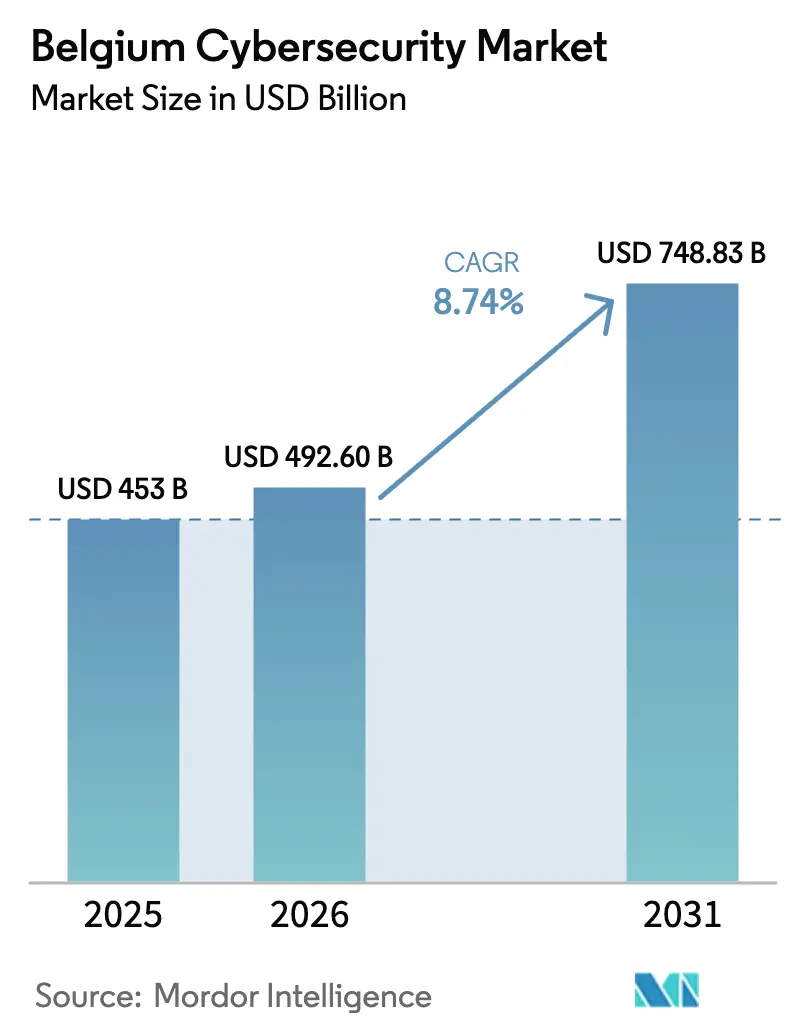
| Base Year Market Size (2025) | USD 453 Billion |
| Market Size (2026) | USD 492.6 Billion |
| Market Size (2031) | USD 748.83 Billion |
| Growth Rate (2026 - 2031) | 8.74% CAGR |
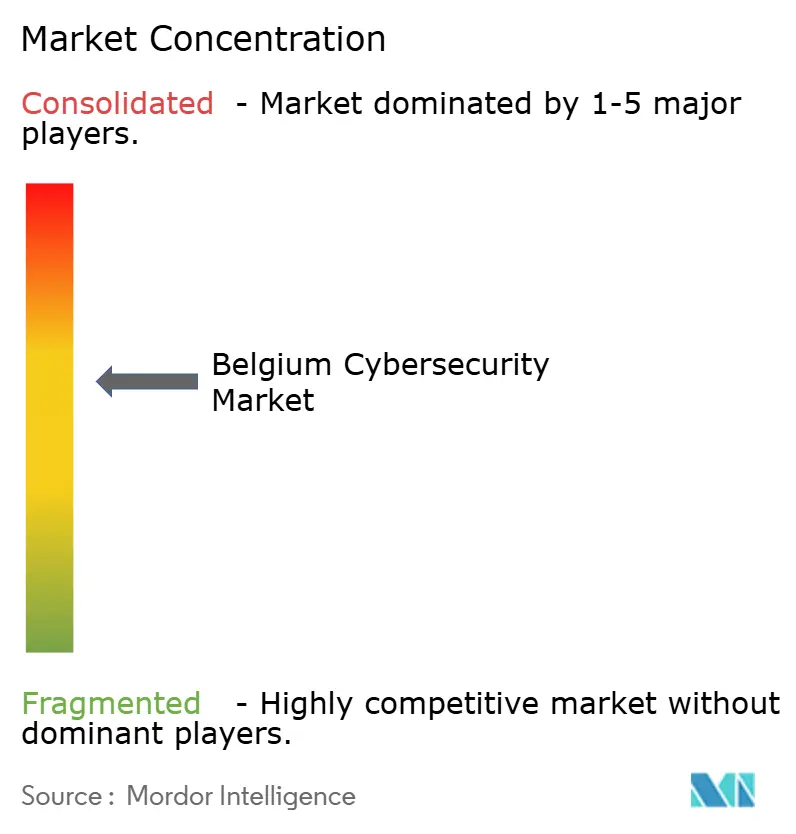
| Market Concentration | Medium |
Major Players *Disclaimer: Major Players sorted in no particular order Image © Mordor Intelligence. Reuse requires attribution under CC BY 4.0. | |
Belgium Cybersecurity Market Analysis by Mordor Intelligence
The Belgium cybersecurity market size is expected to grow from USD 453 million in 2025 to USD 492.6 million in 2026 and is forecast to reach USD 748.83 million by 2031 at 8.74% CAGR over 2026-2031. Robust digital-economy policies, early transposition of the EU NIS2 directive and strong sovereign-cloud programmes are lifting corporate security budgets, while a rising cadence of sophisticated attacks is forcing board-level attention on cyber risk. Vendor competition remains moderate; global suppliers such as Thales and Fortinet are embedding artificial-intelligence analytics into their Belgian portfolios, while home-grown players including NVISO and Aikido Security focus on tailored compliance and managed services. End-user demand is led by financial services, but healthcare, manufacturing and public sector workloads show the steepest outlay increases as regulation tightens. Government financing, notably the EUR 390 million allocation under the Digital Europe Programme, helps smaller organisations upgrade defences and offsets part of the national skills gap.
Key Report Takeaways
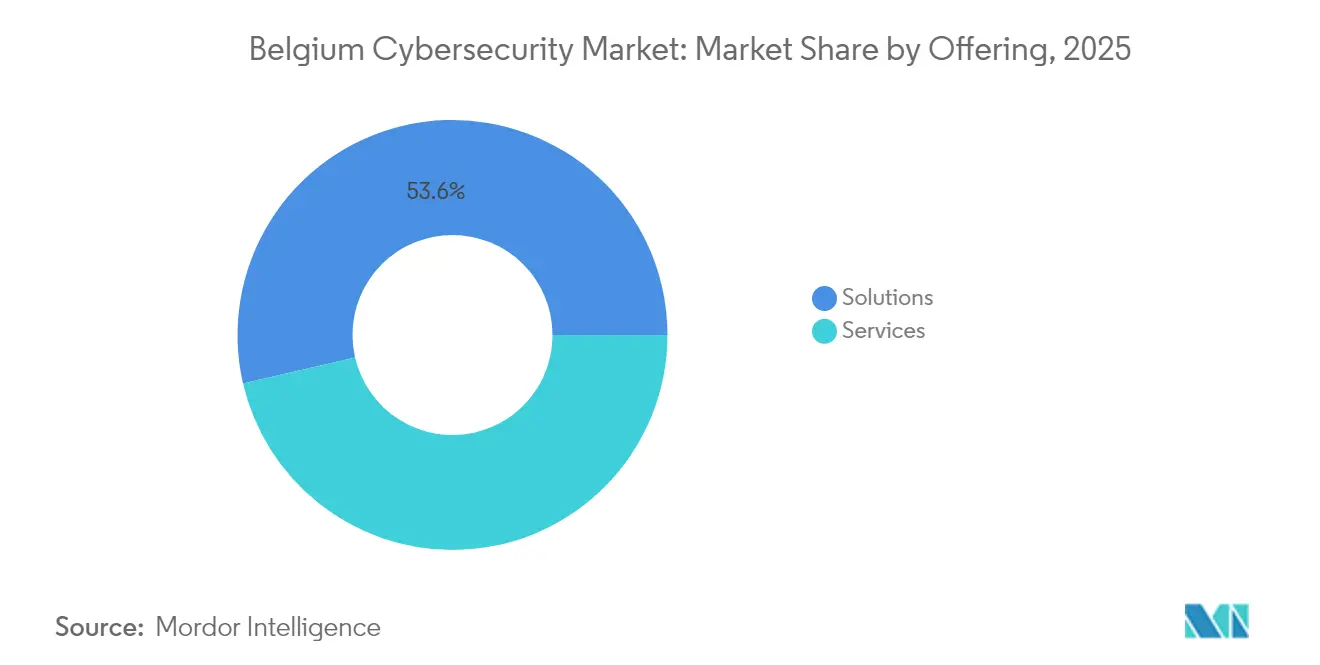
- By offering, solutions retained 53.62% revenue share in 2025, while services are set to accelerate at a 10.08% CAGR through 2031.
- By deployment mode, cloud security captured the highest 56.48% slice of the Belgium cybersecurity market share in 2025 and will advance at a 12.44% CAGR to 2031.
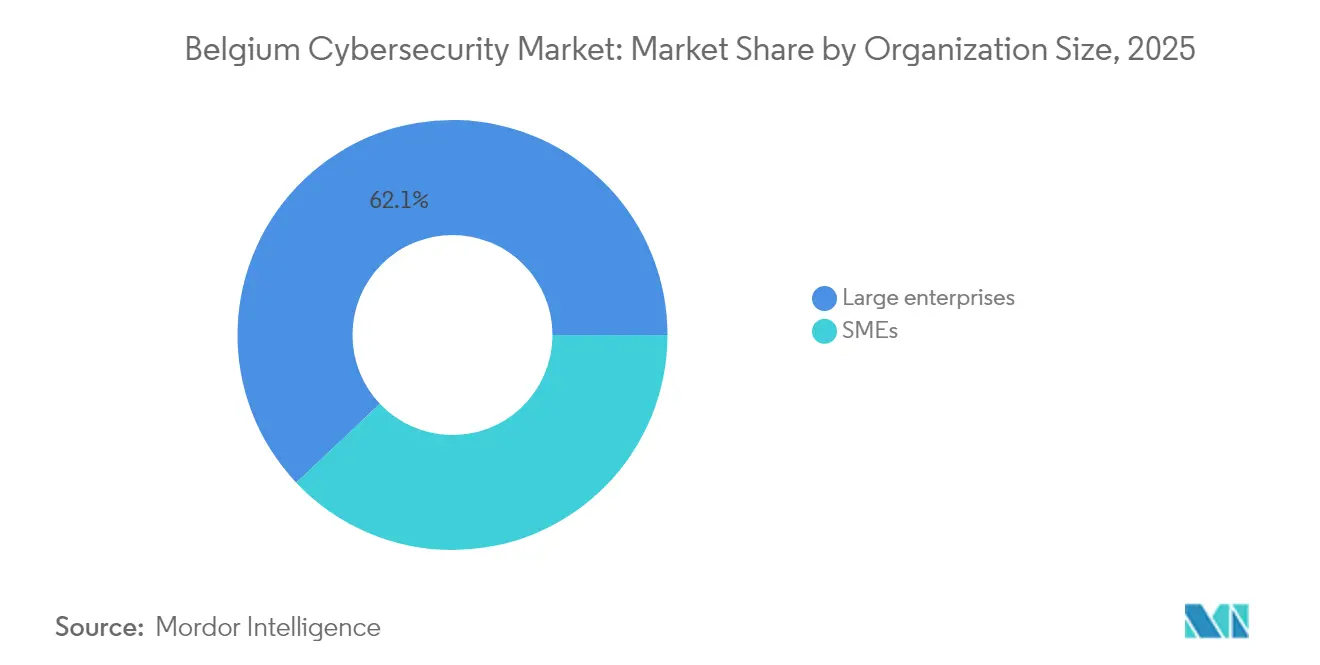
- By organisation size, large enterprises controlled 62.05% of the Belgium cybersecurity market size in 2025; the SME segment is projected to grow at 11.05% CAGR during 2026-2031.
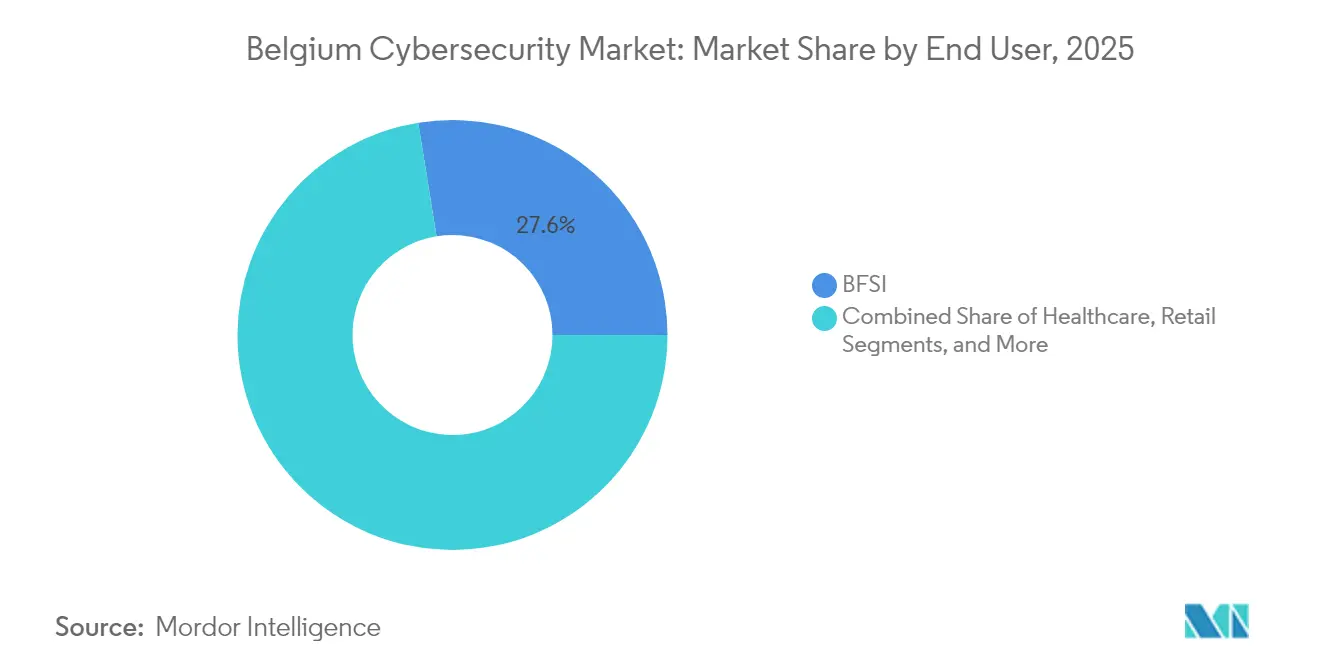
- By end user, BFSI led with 27.55% of 2025 revenue, while healthcare is forecast to post the fastest 11.18% CAGR to 2031.
Note: Market size and forecast figures in this report are generated using Mordor Intelligence’s proprietary estimation framework, updated with the latest available data and insights as of 2026.
Belgium Cybersecurity Market Trends and Insights
Drivers Impact Analysis*
| Driver | (~) % Impact on CAGR Forecast | Geographic Relevance | Impact Timeline |
|---|---|---|---|
| EU NIS2-driven mandatory security upgrades | +2.1% | National, with concentration in Brussels, Antwerp, Ghent | Short term (≤ 2 years) |
| Low cybersecurity awareness among non-digital native SME leadership | +1.8% | National, particularly Wallonia and rural Flanders | Medium term (2-4 years) |
| Accelerating cloud adoption among Belgian SMEs | +1.4% | National, with early gains in Brussels, Antwerp | Medium term (2-4 years) |
| Emergence of regional MSSP ecosystems (e.g., Proximus ICT) | +1.2% | National, with hub concentration in Brussels | Long term (≥ 4 years) |
| AI-powered threat-hunting platforms lowering SOC costs | +0.9% | National, with enterprise focus in Brussels, Antwerp | Medium term (2-4 years) |
| Cyber-insurance premium incentives for zero-trust architectures | +0.8% | National, with BFSI sector concentration | Long term (≥ 4 years) |
| Source: Mordor Intelligence | |||
EU NIS2-driven Mandatory Security Upgrades
Belgium began enforcing the NIS2 directive in October 2024, obliging 2,410 essential and important entities to implement structured risk-management controls and report incidents within 24 hours. Penalties of up to EUR 10 million (USD 11.73 million)or 2% of global turnover have shifted cyber risk to board agendas, spurring multi-year platform refresh projects. The Centre for Cybersecurity Belgium’s CyberFundamentals framework provides a tiered certification path that lowers compliance friction and quickens vendor selection cycles. Hospitals such as UZA Antwerp now run centralised SOCs and have trimmed phishing-email click-rates from 30% to 8% after mandatory staff awareness campaigns. Spending momentum is expected to hold through 2027 as utilities, postal operators and digital-service providers finalise alignment plans.
Accelerating Cloud Adoption Among Belgian SMEs
Seventy-four-and-a-half percent of Belgian SMEs achieved basic digital intensity in 2023, surpassing the EU average and creating steady demand for cloud-native security stacks. Sovereign-cloud agreements, notably the Proximus-Google Cloud initiative, embed locality controls while offering elastic workloads, improving uptake in regulated verticals. Digital-only banks such as NewB operate cloud-first architectures paired with PSD2-compliant strong authentication systems, setting precedents for fintech peers. SMEs now earmark 10-15% of their IT budgets for cybersecurity, channelled mainly toward SaaS-delivered identity, data-protection and micro-segmentation tools. AI-enabled threat analytics bundled into these platforms reduce operational complexity and narrow the capability gap between small firms and large enterprises.
Emergence of Regional MSSP Ecosystems
Proximus Ada and other Brussels-centred service hubs pool scarce security talent and supply 24/7 monitoring, incident-response and compliance-as-a-service packages.[1]Proximus, “Proximus and Google Cloud launch sovereign cloud in Belgium,” proximus.com Partnerships such as Orange Cyberdefense with CrowdStrike extend managed detection and response (MDR) to mid-market manufacturers and logistics operators. MSSPs increasingly embed local regulatory knowledge—especially around NIS2—and offer tiered subscription models aligned to risk appetites. Demand is strongest among organisations with under 250 employees that cannot justify dedicated SOC staffing but must satisfy regulatory baselines.
AI-powered Threat-hunting Platforms Lowering SOC Costs
AI automation is cutting investigation cycles and per-alert handling costs. Proximus’ 365guard blocks SMS spam by continuously learning regional patterns, while FortiSOAR supplies 800+ playbooks for unified case management.[2]Fortinet, “FortiSOAR solution brief,” fortinet.com Belgian hospitals deploy anomaly-detection engines that snapshot clinical systems and flag suspicious behaviours in real time, safeguarding patient records without adding analyst headcount. Adoption is fastest in finance and healthcare where alert volumes are high and compliance timelines short.
Restraints Impact Analysis*
| Restraint | (~) % Impact on CAGR Forecast | Geographic Relevance | Impact Timeline |
|---|---|---|---|
| Acute 10k-person cybersecurity talent gap | -1.9% | National, with concentration in Brussels, Antwerp | Long term (≥ 4 years) |
| High reliance on legacy industrial OT in Flanders manufacturing | -1.3% | Flanders region, manufacturing corridors | Long term (≥ 4 years) |
| Budget saturation in public-sector IT refresh cycles | -0.8% | National, with federal and regional government focus | Medium term (2-4 years) |
| Fragmented local vendor landscape limiting platform consolidation | -0.7% | National, with SME sector concentration | Medium term (2-4 years) |
| Source: Mordor Intelligence | |||
Acute 10k-person Cybersecurity Talent Gap
Forecasts indicate Belgium will lack about 21,000 technology specialists by 2026, with cyber roles the hardest to fill. Average security-analyst salaries exceed EUR 85,000 (USD 91,800), pitting local firms against multinationals and EU agencies headquartered in Brussels. Skills scarcity is most severe in OT security, cloud architecture and AI-based analytics. Enterprises respond by upsizing MSSP contracts and funding university programmes such as KU Leuven’s master in Cybersecurity Engineering. Despite these measures, the labour pipeline will take several years to stabilise, keeping wage inflation and project delays elevated.
High Reliance on Legacy Industrial OT in Flanders Manufacturing
Many process-control networks in petrochemicals, food and metals plants remain unsegmented and run outdated protocols, exposing critical infrastructure to lateral-movement attacks. Internet-facing scans have revealed vulnerable programmable-logic controllers and HMI dashboards across Flanders.[3]Van Impe, “Industrial Control Systems Exposure Report,” vanimpe.eu Operators hesitate to patch or replace equipment that must run near-continuous production cycles, prolonging risk windows. Specialised integrators such as Soteria retrofit passive-monitoring sensors and anomaly-detection nodes, yet full remediation often coincides with 10-15-year capex refresh intervals, tempering near-term security spend.
*Our forecasts treat driver/restraint impacts as directional, not additive. The impact forecasts reflect baseline growth, mix effects, and variable interactions.
Segment Analysis
By Offering: Services Accelerate as Skills Gap Widens
Solutions retained 53.62% of 2025 revenue, anchored by firewall, endpoint and identity suites procured to satisfy NIS2 baselines. In value terms, solutions accounted for USD 242.9 million of the Belgium cybersecurity market size in 2025. Growth, however, tilts toward services at a 10.08% CAGR because outsourcing offsets the labour deficit and offers predictable costs. Managed detection and response, incident readiness assessments and compliance workshops draw the bulk of new contracts. Eye Security’s expansion across the Benelux exemplifies rising interest in tailored MDR packages for mid-sized firms.
Services revenue climbed as clients requested continuous monitoring, threat-intelligence feeds and red-teaming exercises. The Belgium cybersecurity market share of managed services is projected to approach 48.35% by 2031, narrowing the gap with product sales. Vendor success increasingly hinges on integrating automation, analytics and frontline expertise into cohesive service bundles that map directly to regulatory controls.


By Deployment Mode: Cloud Security Dominates Digital Transformation
Cloud-delivered controls captured 56.48% of 2025 spend, equivalent to USD 255.9 million of the Belgium cybersecurity market size, and are forecast to grow at 12.44% CAGR. Sovereign-cloud zones operated by Proximus, paired with Google’s disconnected services, address data-residency mandates and enable regulated workloads. On-premises investments persist in defence, critical infrastructure and certain public entities, yet comprise a shrinking allocation of new budgets.
Cloud uptake is fastest among fintechs and healthcare start-ups that leverage container security, micro-segmentation and DevSecOps pipelines to accelerate product cycles. Multi-cloud and hybrid governance frameworks gain traction in large enterprises seeking unified policy enforcement across Amazon Web Services, Microsoft Azure and private-cloud assets. Automated posture-management tools help resource-constrained teams visualise misconfigurations and policy drift.
By Organization Size: SMEs Drive Growth Despite Enterprise Dominance
Large organisations held 62.05% of 2025 expenditure, underpinned by consolidated SOCs and layered defence platforms. They continue to invest in attack-surface management and zero-trust segmentation, but their incremental budget growth trails that of smaller firms. SMEs generate the highest 11.05% CAGR as the NIS2 scope now encompasses medium-sized businesses in energy, logistics and digital services.
Subscription-based SaaS models and bundled MDR contracts make enterprise-grade controls financially viable for organisations with fewer than 250 employees. Funding rounds for Aikido Security illustrate investor belief that intuitive developer-centric security tooling matches SME requirements. Government voucher schemes in Wallonia further defray adoption costs, stimulating demand across rural municipalities.
By End User: Healthcare Emerges as Fastest-Growing Vertical
BFSI contributed 27.55% of 2025 turnover; its compliance-driven posture keeps spend per employee among the highest in Europe. Banks such as KBC automate behavioural-biometrics and AI-driven fraud analytics to satisfy PSD2 strong-customer-authentication rules. Healthcare, however, is projected to chart an 11.18% CAGR through 2031 on the back of electronic-health-record rollouts and ransomware exposure.
Hospitals deploy phishing-resilience platforms and immutable backup services after a series of 2024 disruptions. Industrial enterprises in Flanders prioritise OT-network segmentation, while telecom operators guard national fibre backbones with high-capacity DDoS scrubbing centres. Retail chains fortify point-of-sale endpoints and e-commerce APIs as transaction volumes climb.
Geography Analysis
Brussels hosts EU institutions, global headquarters and Belgium’s principal cyber-talent pool. The concentration translates into the country’s densest cluster of solution integrators, incident-response firms and research laboratories. Thales alone maintains 1,200 employees across eleven Belgian sites, with flagship CyberIT and CyberOT competence centres in the capital. The city will pilot biometric digital-identity cards from November 2026, injecting fresh investment into encryption, key-management and citizen-data protection frameworks.
Antwerp and Ghent anchor Flanders’ industrial corridor, where manufacturers face legacy-OT risk and port authorities secure maritime logistics chains. InvestAI programme grants, designed to mobilise EUR 200 billion for AI projects, earmark funding for predictive maintenance and cyber-resilience of production lines. Antwerp’s port authority has expanded its cyber-fusion centre to monitor vessel-tracking systems and automate threat-intelligence sharing with freight forwarders.
Wallonia emphasises SME digitalisation under the 2024-2029 Digital Wallonia roadmap, offering “Chèque-Entreprise” subsidies that refund up to 80% of cybersecurity audits. Cross-border ties with France and Luxembourg enable regional MSSPs to service multilingual client bases and standardise compliance tooling across jurisdictions. Emerging projects in renewable-energy storage and smart-grid orchestration are spawning demand for niche OT-security solutions that integrate with real-time SCADA environments.
Regulatory Landscape
Belgium’s cybersecurity obligations are being reshaped by the country’s transposition and operationalization of EU cyber rules, with the Centre for Cybersecurity Belgium (CCB) acting as a central national authority through Safeonweb guidance and NIS2-related regulatory information. The Law of 26 April 2024 (NIS2 Law) formalizes risk management and incident reporting duties for essential and important entities, and as of mid-2026 Safeonweb had registered 7,825 organizations, indicating wider institutional coverage beyond early adopters.
The compliance stack also extends into sector and critical-infrastructure requirements, including the Law on the Resilience of Critical Entities of 19 December 2025 and EU instruments applied in Belgium such as DORA (from 17 January 2025), the Cyber Solidarity Act (4 February 2025), and the Cyber Resilience Act (10 December 2024), alongside phased AI Act implementation (2024-2026). In 2026, Belgium revised and adopted a fully updated National Cyber Emergency Plan by Royal Decree and took part in the Cyber Europe 2026 exercise (June 2026), strengthening crisis coordination and raising incident-readiness expectations across regulated sectors.
Competitive Landscape
The Belgium cybersecurity market contains a balanced mix of global platform vendors, regional service providers and niche specialists. Thales, Fortinet, Palo Alto Networks and Cisco leverage scale and multicloud integration to capture complex enterprise deployments. Local champions such as NVISO focus on penetration testing and incident forensics, while Sweepatic’s external-attack-surface mapping broadens Outpost24’s European reach following its 2023 acquisition.
Artificial-intelligence capability is a primary differentiator. Thales works with Google Cloud to embed Chronicle SecOps analytics into its Belgian SOC, enabling sub-minute alert triage. Proximus Ada bundles proprietary AI data-lakes with partner telemetry to feed behavioural-anomaly engines that auto-contain endpoint threats. Competition in managed services intensifies as Orange Cyberdefense doubles MDR headcount, and Sophos integrates Secureworks’ telemetry to support 28,000 MDR customers worldwide.
White-space opportunities persist in OT security for manufacturing and energy, as well as compliance-as-a-service solutions that translate NIS2 clauses into automated control libraries. Partnerships between niche technology vendors and MSSPs are expected to accelerate to bridge capability gaps and satisfy mid-market demand for integrated, outcome-based offerings.
Belgium Cybersecurity Industry Leaders
IBM Corporation
Cisco Systems, Inc.
Thales
Sweepatic
RHEA Group
- *Disclaimer: Major Players sorted in no particular order

Market Opportunities and Future Outlook
NIS2 alignment, crisis-readiness programs led by the Centre for Cybersecurity Belgium (CCB), and the layering of EU-wide requirements (Cyber Resilience Act, DORA, Cyber Solidarity Act, and the AI Act rollout) support sustained demand for compliance-mapped security controls and evidence-ready services. The scale of registered organizations on Safeonweb (7,825 as of mid-2026) further expands the addressable pool for audit support, incident reporting workflows, and managed detection and response offerings built around regulator-facing documentation.
Product security and SME enablement tied to the Cyber Resilience Act stand out as a concrete opportunity area, supported by the EU-funded SECURE project providing EUR 16.5 million in cascade funding and grants of up to EUR 30,000 per project to help SMEs meet CRA obligations. Additional demand areas are forming around AI-security controls as LLMs are integrated into attacker workflows, increasing focus on credential security, patch management, and automation in incident response, especially in public administrations running legacy environments. Vendor and MSSP packaging channels are also taking shape through Flanders Investment efforts and Wallonia’s ecosystem updates, which support localized compliance, training, and technical hardening services for SMEs and critical operators.
Recent Industry Developments
- June 2026: Cisco Systems Inc. - Cisco Catalyst SD-WAN Manager vulnerability is actively exploited, prompting security updates as advised by the Centre for Cybersecurity Belgium. This patching reinforces enterprise networks and sustains Cisco's role in securing Belgian digital infrastructure.
- April 2026: Cisco Systems Inc. - Partnered with Belgian AI company ML6 to join Cisco’s AI Defense Design Partner Program to secure AI applications. The partnership with ML6 expands Cisco's AI security capabilities in Belgium, accelerating adoption of safeguarded AI workloads.
- April 2026: Cisco Systems Inc. - Cisco Catalyst SD-WAN Manager and Secure Firewall vulnerabilities were identified as actively exploited, requiring immediate patching as advised by the Centre for Cybersecurity Belgium. The rapid remediation preserves continuity of network operations and reinforces Cisco's commitment to Belgian cyber defense.


Research Methodology Framework and Report Scope
Market Definition and Coverage
For this methodology, the Belgium cybersecurity market is defined as the revenues generated within Belgium from cybersecurity solutions and services that help prevent, detect, respond to, and recover from cyber threats across IT environments.
Scope exclusions: This sizing excludes general IT hardware, basic connectivity services, and non-security consulting that is not directly tied to cybersecurity outcomes.
Segmentation Overview
- By Offering
- Solutions
- Application Security
- Cloud Security
- Data Security
- Identity and Access Management
- Infrastructure Protection
- Integrated Risk Management
- Network Security Equipment
- Endpoint Security
- Other Solutions
- Services
- Professional Services
- Managed Services
- Solutions
- By Deployment Mode
- Cloud
- On-premise
- By Organisation Size
- SMEs
- Large Enterprises
- By End User
- BFSI
- Healthcare
- IT and Telecom
- Industrial and Defence
- Retail
- Energy and Utilities
- Manufacturing
- Others
Data Sources, Market Sizing, and Validation
Desk Research
Desk research sets the ground rules for what gets counted and helps anchor the demand context in Belgium. We used public sources such as Eurostat for digital economy indicators, ENISA publications for threat patterns and preparedness topics, and the European Commission and Belgian federal portals for policy and compliance direction linked to cybersecurity.
To keep the model practical, we also reviewed national statistical releases where available, cybersecurity incident advisories from public bodies, and reputable association or standards websites that clarify common security control areas. Company filings, investor presentations, and trusted press coverage were used to understand product focus shifts, service mix, and pricing direction, and then supported with selected paid subscriptions for company financials, patent checks, and news and financials to spot major changes. The sources listed here are illustrative only, and we relied on additional public and subscribed references to collect, validate, and clarify data points.
Primary Interviews and Surveys
Primary work was used to confirm what is actually being purchased in Belgium and how budgets are moving across solutions and services. We spoke with a mix of suppliers, channel partners, and enterprise buyers, then validated assumptions with security leaders across regulated and non-regulated industries to close gaps from desk research.
Because this is a country market, the interviews were kept Belgium-focused, and the checks centered on common buying motions such as managed security adoption, cloud security spend timing, and compliance-led refresh cycles.
Distribution of primary research fieldwork respondents
| Company type | Respondent position | Region |
|---|---|---|
| Top tier: 38% | CXOs: 13% | |
| Mid tier: 40% | Functional/Unit leaders: 39% | |
| Smaller Players: 22% | Managers: 48% |
Market-Sizing & Forecasting
The sizing starts with a top-down approach where national-level IT and digital activity signals are used to reconstruct a realistic cybersecurity spending pool for Belgium, and then it is split into solution and service revenue blocks. To keep the totals practical, we corroborated them with selective bottom-up approximations such as sampled price-per-user or price-per-endpoint checks, channel feedback on deal sizes, and a supplier roll-up for areas where public revenue disclosure is clearer.
A few market fingerprints that were tracked as model inputs include cloud deployment mix in security workloads, managed security service penetration, compliance-driven refresh timing, incident-response and monitoring demand after reported attack waves, and typical contract duration for security services. Where direct volume inputs are not consistently available, we used ranges from primary interviews and narrowed them using desk indicators, so the final numbers do not lean on a single assumption.
For forecasting, scenario analysis was used so that budget growth is linked to practical drivers such as regulatory readiness cycles, cloud migration pace, and staffing constraints that push buyers toward managed services. The scenarios were then reconciled into a base case after expert feedback confirmed which levers were most likely to hold over the next few years.
Data Validation & Update Cycle
Outputs are checked through triangulation across supply signals, buyer feedback, and independent market indicators. We also run variance checks to understand why any segment grows too quickly or too slowly versus the broader IT spend context. If an anomaly cannot be explained with a clear event, for example a compliance deadline shift or a major breach-driven spending wave, the assumption is revisited and targeted callbacks are triggered.
Before sign-off, the model goes through a multi-step analyst review so arithmetic, currency consistency, and timing logic are aligned across the full study period. Reports are refreshed annually, and interim updates are made when material events change demand or pricing. A final pre-delivery pass is completed so clients receive the latest updated view.
Mordor Intelligence's Belgium Cybersecurity Market Size Measured Against Other Published Estimates
Published market sizes for Belgium cybersecurity can look different even when they discuss similar themes, because the counted revenue lines and the timing of the base year are often not the same. Differences also show up when one estimate mixes product revenue with broader IT security adjacent work, or when services are treated as a smaller add-on instead of a core part of spend.
The main gap comes from whether managed security services and professional services are fully counted alongside solution revenue. Mordor Intelligence treats Belgium cybersecurity as the combined vendor revenues from security solutions plus related services sold for active protection and response, rather than a narrower software-only view. Another common driver is the assumed price path for subscriptions and services, since some estimates keep prices flat while others bake in faster cloud security adoption and compliance-led upgrades. Currency conversion timing and refresh cadence also matter, since a fast-moving threat environment can change quarterly purchasing behavior and shift annualized totals.
Benchmark comparison
| Source | Market Size | Gaps in Research Methodology |
|---|---|---|
| Mordor Intelligence | USD 492.6 M (2026) | |
| Regional Consultancy A | USD 430.0 M (2026) | Typically focuses on cybersecurity product and platform revenues, and it often treats managed services as part of broader IT outsourcing, which reduces the counted total in a services-heavy market. |
| Industry Association B | USD 540.0 M (2026) | Often reports a spend-based view that can include adjacent IT risk and compliance activity, and it may apply higher assumed budget uplift rates during regulatory deadlines, which can push the annual figure upward. |
The spread in the table is mainly explained by what gets classified as cybersecurity revenue versus nearby IT services, and by how quickly pricing and adoption are allowed to move in the forecast year. By keeping the steps traceable to a defined solution-plus-services scope and then pressure-testing it with buyer and supplier checks, the final view stays balanced and repeatable for decision-making.


Key Questions Answered in the Report
What is the size of the Belgium cybersecurity market in 2026?
The Belgium cybersecurity market size reached USD 492.6 million in 2026 and is forecast to climb to USD 748.83 million by 2031.
Which segment is growing the fastest?
Cybersecurity services show the highest momentum, expanding at a projected 10.08% CAGR as organisations outsource monitoring and compliance workloads.
Why is cloud security so dominant in Belgium?
Rapid SME digitalisation and sovereign-cloud offerings that ensure data residency have pushed cloud-delivered controls to 56.48% of 2025 spend, with a 12.44% forecast CAGR.
How does the EU NIS2 directive influence spending?
NIS2 imposes mandatory risk controls and strict fines, elevating cybersecurity to a board-level issue and adding an estimated 2.1 percentage points to the market’s CAGR.
What is the main challenge hindering market growth?
Belgium faces a prolonged shortage of about 10,000 cybersecurity professionals, driving labour costs up and extending project timelines.
Page last updated on: