
Beer Stabilizers Market Size and Share
Market Overview
| Study Period | 2021 - 2031 |
|---|---|
| Market Size (2026) | USD 75.81 Million |
| Market Size (2031) | USD 98.95 Million |
| Growth Rate (2026 - 2031) | 5.47 % |
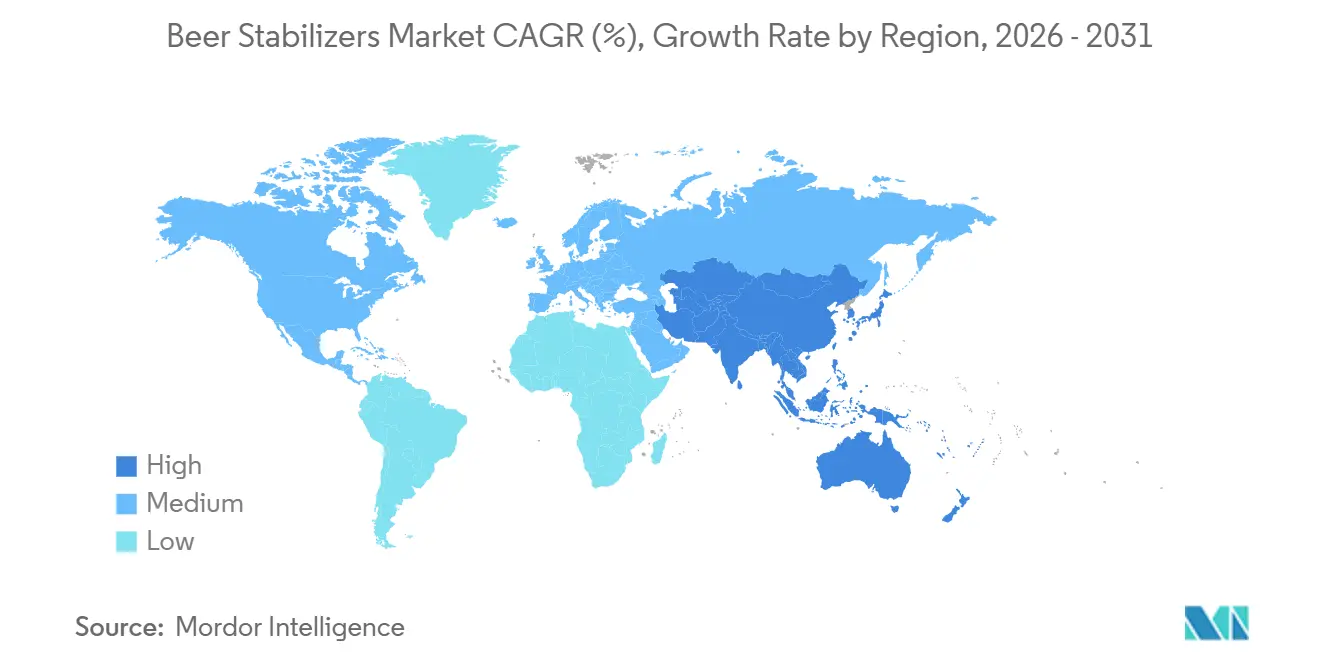
| Fastest Growing Market | Asia-Pacific |
| Largest Market | North America |
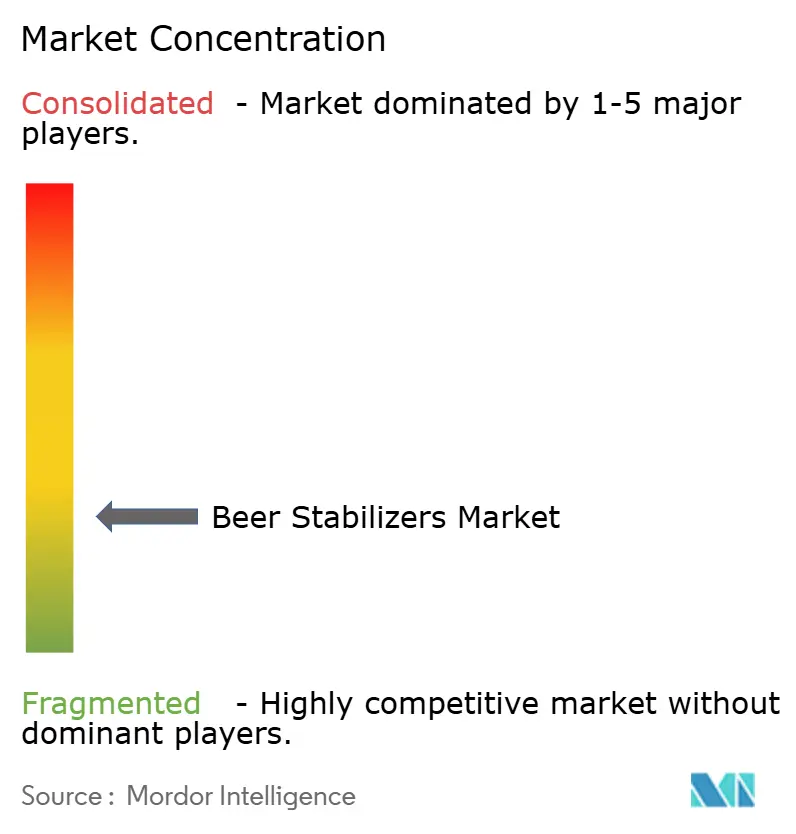
| Market Concentration | Low |
Major Players *Disclaimer: Major Players sorted in no particular order Image © Mordor Intelligence. Reuse requires attribution under CC BY 4.0. | |
Beer Stabilizers Market Analysis by Mordor Intelligence
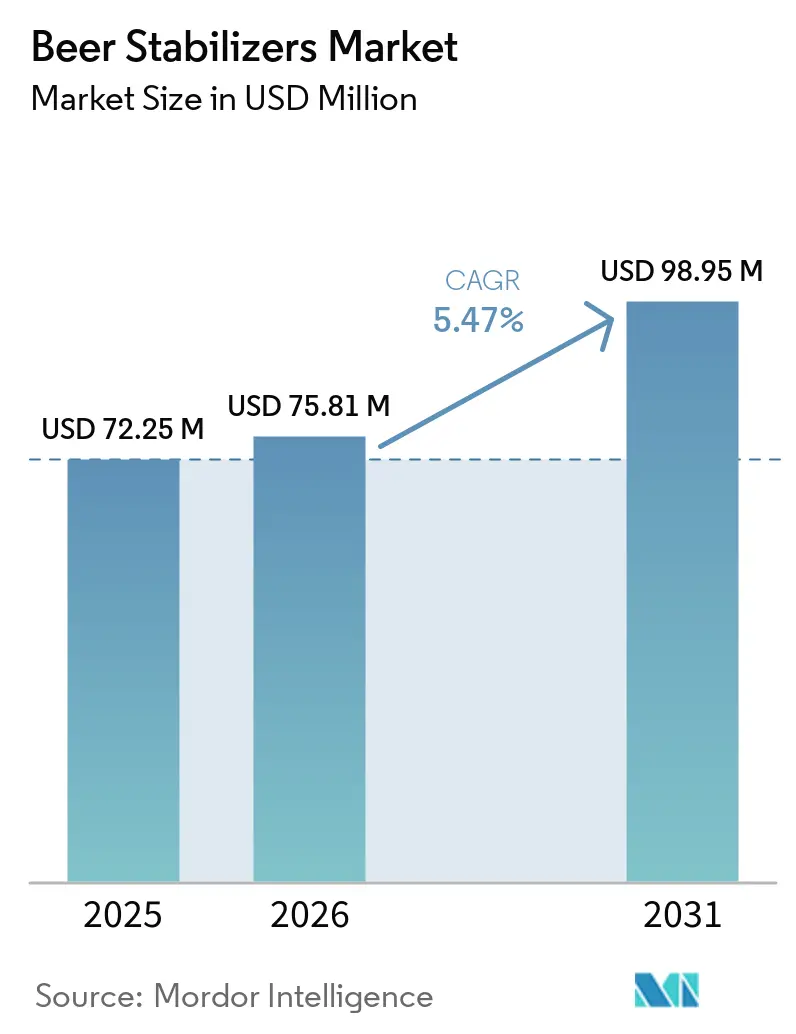
The beer stabilizers market size is expected to grow from USD 72.25 million in 2025 to USD 75.81 million in 2026 and is forecast to reach USD 98.95 million by 2031 at 5.47% CAGR over 2026-2031. The beer stabilizers market is supported by retailer requirements for clear beer and reliable shelf life, which make stabilization a standard brewery operating cost. Growth in non-alcoholic and low-alcohol beer is raising stabilizer use per hectoliter because dealcoholization changes the natural colloidal balance of beer. Non-alcoholic beer volumes in the European Union grew 5.87% in 2025, and 1 in 12 beers consumed in the bloc was non-alcoholic. Suppliers are responding with dosing guidance, combined PVPP and silica gel programs, and products suited to different beer styles. This places technical support and process knowledge at the center of competition in the beer stabilizers market.
Key Report Takeaways
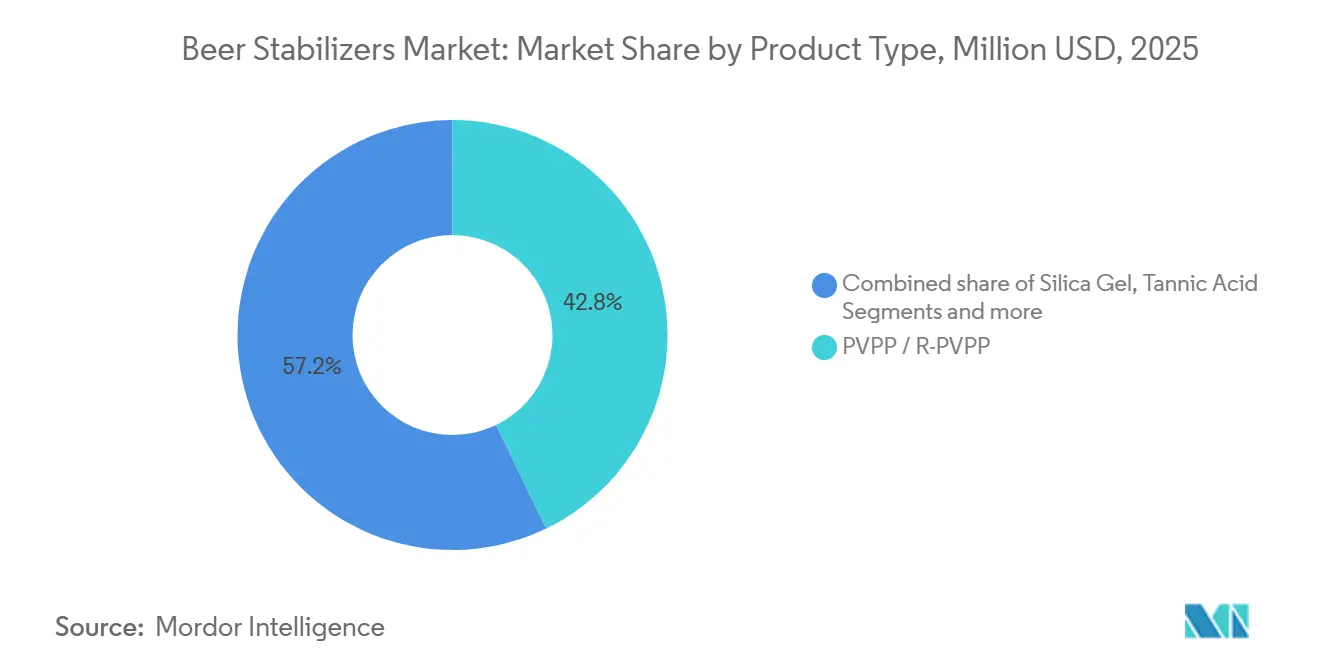
- By product type, PVPP/R-PVPP held 42.81% of the beer stabilizers market share in 2025, while silica gel is forecast to grow at a 6.45% CAGR through 2031.
- By beer type, lager accounted for 67.44% of the beer stabilizers market size in 2025, while ale is forecast to expand at a 6.81% CAGR through 2031.
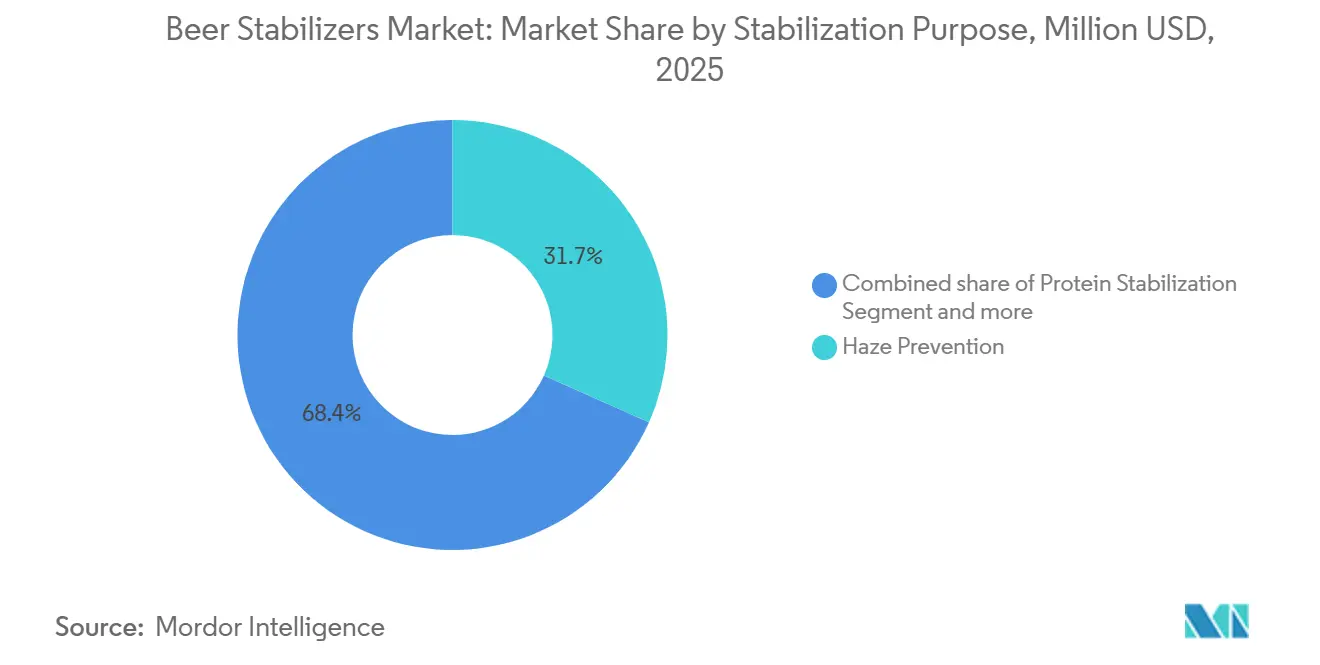
- By stabilization purpose, haze prevention held 31.65% share in 2025, while polyphenol removal is projected to grow at a 6.13% CAGR through 2031.
- By geography, North America commanded 34.55% revenue in 2025, while Asia-Pacific is poised for 6.36% CAGR growth through 2031.
Note: Market size and forecast figures in this report are generated using Mordor Intelligence’s proprietary estimation framework, updated with the latest available data and insights as of January 2026.
Market Trends and Insights
Drivers Impact Analysis of Beer Stabilizers Market*
| Driver | (~) % Impact on CAGR Forecast | Geographic Relevance | Impact Timeline |
|---|---|---|---|
| Growing demand for beer clarity and haze prevention | +1.2% | Global, with concentrated impact in North America and Europe | Medium term (2-4 years) |
| Increasing focus on extended beer shelf life | +0.9% | Global, especially North America, Asia-Pacific export markets | Long term (≥ 4 years) |
| Expansion of craft and specialty beer production | +1.0% | North America, Europe, Asia-Pacific (India, Australia) | Medium term (2-4 years) |
| Rising premium beer consumption and quality expectations | +0.7% | North America & Europe; spill-over to Asia-Pacific core | Long term (≥ 4 years) |
| Growth of non-alcoholic and low-alcohol beer | +0.8% | Global, strongest in Germany, United States, United Kingdom | Short term (≤ 2 years) |
| Increasing adoption of PVPP and silica-gel stabilization | +0.6% | Asia-Pacific core (China, India), emerging adoption in Middle East and Africa | Medium term (2-4 years) |
| Source: Mordor Intelligence | |||
Growing Demand for Beer Clarity and Haze Prevention
Growing consumer and brewery demand for clear, visually appealing, and haze-free beer is supporting the adoption of beer stabilizers. Haze can develop when proteins and polyphenols interact during storage, particularly under cold conditions, negatively affecting beer appearance. Stabilizers such as PVPP and silica gel help remove these haze-forming compounds and improve colloidal stability. Their use enables breweries to maintain consistent clarity throughout storage and distribution. The growing focus on premium and craft beer quality is further increasing the importance of reliable stabilization processes. Consequently, demand for effective haze-prevention solutions is expected to support the growth of the beer stabilizers market.
Increasing Focus on Extended Beer Shelf Life
Long distribution routes increase the time available for protein and polyphenol complexes to develop. Export-oriented breweries consequently treat shelf-life control as a condition for market access rather than an optional quality upgrade. Regenerable PVPP can reduce the cost of repeated stabilization for large breweries because the material is designed for reuse. A 2025 technical validation described a fixed-bed adsorber system using PVP-functionalized agarose resin that maintained performance through more than 1,000 regeneration cycles. Non-alcoholic beers add to this need because their production routes can require more intensive polyphenol control. As breweries expand distribution of these products, the beer stabilizers market gains from higher value per liter even where total beer volume is under pressure.
Expansion of Craft and Specialty Beer Production
Craft producers commonly work with smaller batches, varied recipes, and beer styles that need tailored stabilization. U.S. craft beer volume declined 5% in 2025, compared with a 5.7% decline for the overall beer category, indicating relative resilience for differentiated offerings[1]. Smaller breweries often use single-use PVPP or PVPP and silica gel blends because they may not operate regeneration equipment. This creates higher stabilizer use per hectoliter than a large reusable system. The Brewers Association reported that 85% of craft drinkers consumed craft beer monthly in 2026, the highest level since 2019-2020. These operating conditions preserve a premium demand base within the beer stabilizers market, especially for hop-forward and seasonal beers.
Rising Premium Beer Consumption and Quality Expectations
Premium beer producers need stable appearance, flavor, and foam throughout a longer distribution window. This can require higher stabilizer doses and combined treatment programs than products intended for short local distribution. Budweiser APAC reported strong double-digit volume and revenue growth in India during the first quarter of 2026, led by its premium and super-premium portfolio. The result shows that premiumization is active in a region that is also the fastest-growing geography in the beer stabilizers market. Longer shelf-life goals for premium lagers can increase demand for precise polyphenol and protein control. Quality expectations also strengthen the role of suppliers that can validate a dosing program for a brewery’s recipe and packaging route.
Restraints Impact Analysis of Beer Stabilizers Market*
| Restraint | (~) % Impact on CAGR Forecast | Geographic Relevance | Impact Timeline |
|---|---|---|---|
| Stringent regulations governing food-grade brewing additives | -0.5% | European Union, North America | Long term (≥ 4 years) |
| Consumer preference for additive-free and minimally processed beer | -0.8% | North America and Europe, particularly craft and premium segments | Medium term (2-4 years) |
| High cost of advanced stabilization technologies | -0.6% | Asia-Pacific core (small to mid-size craft breweries) | Short term (≤ 2 years) |
| Technical complexity in optimizing stabilizer dosage | -0.4% | Global, particularly markets with limited technical service support | Medium term (2-4 years) |
| Source: Mordor Intelligence | |||
Stringent Regulations Governing Food-Grade Brewing Additives
Regulation increases the documentation and testing required to supply processing aids to breweries. In the United States, polyvinylpyrrolidone is regulated under 21 CFR 173.50, while European requirements sit within Regulation EC No 1333/2008. The Codex General Standard for Food Additives specifies a maximum level of 10 mg/kg for PVP in beer[2]. Commission Regulation EU 2024/374 adjusted permissions for additives in alcoholic beverage categories, which adds work for suppliers selling across different product classifications. A material cleared in Europe can still require further documentation under Chinese or ASEAN rules. These requirements raise entry barriers, while the cost of advanced systems and the technical challenge of setting the right dosage can be harder for smaller breweries and suppliers to absorb.
Consumer Preference for Additive-free and Minimally Processed Beer
Clean-label positioning can limit the use of synthetic stabilizers in premium and craft beer. Researchers at the 2025 Trends in Brewing symposium presented lignin as a plant-derived material with protein-binding capacity and turbidity reduction results across beer matrices. Such alternatives could appeal to breweries seeking a different labeling profile. German breweries operating under Reinheitsgebot positioning also limit the use of nontraditional additives, with silica gel more readily accepted than many synthetic options. This puts particular pressure on PVPP suppliers serving high-value craft and premium customers. The beer stabilizers market still has room for conventional agents, but suppliers need to show that they deliver clarity and shelf life without weakening a brewery’s product positioning.
*Our forecasts treat driver/restraint impacts as directional, not additive. The impact forecasts reflect baseline growth, mix effects, and variable interactions.
Beer Stabilizers Market Segment Analysis
By Product Type:
Dual-Agent Protocols Redefine Stabilization EconomicsBy product type, PVPP/R-PVPP accounted for 42.81% of the market in 2025, making it the largest product segment. PVPP/R-PVPP is widely used to remove polyphenols and reduce chill-haze formation, helping breweries maintain beer clarity and stability. Its effectiveness without significantly affecting beer flavor or aroma supports its adoption across both large-scale and craft brewing operations. Regenerable PVPP (R-PVPP) also provides an economic advantage through repeated use, reducing stabilizer consumption and waste
Silica gel is projected to be the fastest-growing product segment, registering a CAGR of 6.45% from 2026 to 2031. Its strong protein-adsorption capability makes it effective in reducing haze-forming proteins and improving beer clarity. Silica gel is also compatible with different brewing processes and can be used across a broad range of beer types. Its ability to improve colloidal stability without materially altering the beer's sensory characteristics supports its growing use among brewers.

By Beer Type:
Lager’s Volume Dominance Meets Ale’s Faster Stabilization IntensityLager represented 67.44% of the beer stabilizers market by beer type in 2025. Its large base reflects the central role of lager in major brewing countries, including China, Germany, the United States, and Brazil. Large lager breweries require repeatable processes that maintain clarity through broad distribution. Premium lager lines with 12-month shelf-life targets can need more detailed dosing control than products for shorter routes. This makes lager a steady source of PVPP and silica gel demand.
Ale is forecast to grow at a 6.81% CAGR through 2031, supported by craft production and hop-forward styles. India pale ales and New England IPAs can carry high polyphenol loads from dry hopping, increasing the need for colloidal management. Stout and porter represent lower volume but can require higher stabilizer use because roasted malt contributes additional polyphenols. The others category includes non-alcoholic, low-alcohol, flavored, and fruit beer. European Union non-alcoholic beer volumes rose 5.87% in 2025. This shifts the beer stabilizers market toward beer types that require high stabilization intensity regardless of total volume.
By Stabilization Purpose:
Polyphenol Removal Gains Ground as the Harder ChallengeHaze prevention accounted for 31.65% share in 2025. This reflects the need to keep packaged beer clear across its commercial life. Protein stabilization is also important because proteins can bind polyphenols and begin haze formation. Flavor and sensory stability has a smaller role, but PVPP can help slow oxidative flavor change by reducing some flavonoid polyphenols. Shelf-life extension combines these benefits into a single performance objective for breweries serving distant markets.
Polyphenol removal is forecast to grow at a 6.13% CAGR through 2031. Combined PVPP and silica gel programs address polyphenol and protein precursors at the same time, but breweries increasingly focus on polyphenol removal because incomplete removal can contribute to permanent haze. Permanent haze does not redissolve when beer warms, making it a difficult quality issue. Precision treatment can therefore be more valuable than general fining for premium and export beers. The beer stabilizers industry is also evaluating enzyme-based options where a brewery wants to manage proteins without relying only on adsorbent materials.
Geography Analysis
North America Beer Stabilizers Market
North America held 34.55% of the beer stabilizers market share in 2025. The region combines large breweries with a broad craft base, creating demand for PVPP, silica gel, and enzyme-based solutions across many beer styles. The Brewers Association reported relative resilience in U.S. craft beer during 2025, even as total category volumes declined. Craft breweries often need flexible solutions that work without large regeneration systems. U.S. regulatory conditions for beer processing aids are also well established, which supports suppliers that hold the required technical and compliance documentation.
Europe Beer Stabilizers Market
Europe remains a demanding region for stabilization because consumers expect clear beer across retail storage periods that can last several months. European Union non-alcoholic beer volumes increased 5.87% in 2025, and non-alcoholic beer represented 1 in 12 beers consumed[3]. Germany’s beer sales fell 6% in 2025 to 7.8 billion liters, while non-alcoholic beer became an increasingly important part of the country’s beer revenue mix. This reduces the effect of lower total volume on the beer stabilizers market because non-alcoholic products typically need more intensive treatment per liter. The European Union regulatory framework also lets suppliers use broadly consistent compliance documentation across member states.
APAC, South America and MEA Beer Stabilizers Market
Asia-Pacific is forecast to grow at a 6.36% CAGR through 2031, making it the fastest-growing regional part of the beer stabilizers market size. China is seeing lower beer volumes alongside higher revenue per hectoliter as brewers focus on premium products. Budweiser APAC reported an 8.6% volume decline in China in 2025 but a 4.8% increase in revenue per hectoliter. India’s developing craft scene creates demand for single-use solutions suited to smaller breweries. South America adds demand through industrial lager production, where silica gel is valued for cost efficiency. Middle East and Africa remains the smallest contributor, but developing craft and premium beer offerings in South Africa, Nigeria, and Turkey support gradual demand growth.
Competitive Landscape
The beer stabilizers market is fragmented, with no supplier controlling pricing across all products and geographies. Ashland, BASF, and W. R. Grace compete through technical support, product performance, and established brewing relationships. Their positions are reinforced when a brewery has validated a product in its own filtration and dosing process. Ashland’s Polyclar Brewbrite combines purified food-grade kappa carrageenan with modified PVPP for wort clarification and beer stabilization in one addition. This can reduce the need for separate dosing equipment at smaller breweries.
BASF’s Divergan RS was developed for integration with regeneration plants, using controlled swelling volume and particle characteristics to support filtration operations. W. R. Grace continues to supply its DARACLAR silica range for beer clarification and stabilization. These established suppliers can offer brewing know-how and documentation that are difficult for a new commodity supplier to match. Their strategy is less dependent on price than on solving a brewery-specific clarity and shelf-life issue. In the beer stabilizers market, this makes application engineering an important defense against product substitution.
Chinese manufacturers, including Shandong Sinchem Silica Gel Co., Ltd. and Qingdao Makall Group Co., Ltd., are expanding export activity in silica gel and PVPP. Their approach centers on price competitiveness in commodity grades, while premium breweries often require validated technical service. Enzyme stabilization remains an open area because proline-specific endoproteases can manage haze-active proteins and support different processing claims. Fixed-bed regenerative systems and digital process control can also alter supplier selection for large breweries. Pall’s continuous beer stabilization offering illustrates the focus on process visibility and efficiency
Beer Stabilizers Industry Leaders
-
Ashland Inc.
-
AEB S.p.A.
-
BASF SE
-
Eaton Corporation plc
-
W. R. Grace & Co.
- *Disclaimer: Major Players sorted in no particular order
Beer Stabilizers Market Companies Covered in this Report
- Ashland Inc.
- AEB S.p.A.
- BASF SE
- Eaton Corporation plc
- W. R. Grace & Co.
- PQ Corporation
- Gusmer Enterprises, Inc.
- ERBSLÖH Geisenheim GmbH
- Lehmann&Voss&Co. KG
- AB Vickers Ltd.
- Shandong Sinchem Silica Gel Co., Ltd.
- Qingdao Makall Group Co., Ltd.
- Lallemand Inc.
- Huangshan Bonsun Pharmaceuticals Co., Ltd.
- JH Nanhang Life Sciences Co., Ltd.
- Boai NKY Pharmaceuticals Ltd.
- Synvent Materials Corporation
- Cargill, Incorporated
- Palsgaard A/S
- Kerry Group plc
Recent Industry Developments in Beer Stabilizers Market
- April 2026: Switchback Brewing Co. and Sustainable Beverage Technologies presented Krush N.A. IPA, brewed using BrewVo alcohol-separation technology, at the Craft Brewers Conference. The product demonstrated commercial-scale production of non-alcoholic IPA with hop-forward aroma profiles, which may require tailored stabilization following dealcoholization.
- August 2025: LANXESS presented Velcorin® and Nagardo® at drinktec 2025, the world’s leading beverage technology trade fair, targeting the microbiological stabilization of non-alcoholic beers and wines. This dual-solution approach addresses the limitations of cold stabilization in non-alcoholic production and positions the company to capture incremental demand driven by the non-alcoholic beer segment’s sustained double-digit growth. The offering addresses the need for stable products when conventional cold stabilization is insufficient.
- March 2025: Asahi Group Foods agreed to acquire Leiber GmbH, strengthening its yeast-processing capabilities and ingredient portfolio. The acquisition supports Asahi’s broader brewing-ingredient capabilities, including the development and supply of yeast-derived solutions used in beer stabilization and quality management.
- January 2025: Lallemand Brewing and Danish biotech startup EvodiaBio entered into a strategic partnership to commercialize Yops™, a natural, yeast-derived aroma solution designed to restore hop and malt aromatics lost during low- and no-alcohol beer production. Through its existing sales network, Lallemand will distribute Yops™ across North America, the United Kingdom, and Europe, adding a natural flavor-stability solution to its brewing portfolio. The partnership expands access to a brewing input designed for products that lose aromatic compounds during alcohol reduction.
Global Beer Stabilizers Market Report Scope
Beer stabilizers are food-processing additives or processing aids used during beer production to improve colloidal stability, clarity, and shelf life by removing or controlling haze-forming compounds such as proteins and polyphenols. The beer stabilizers market is segmented into product type, beer type, stabilization purpose and geography. Based on product type, the market is segmented into pvpp/r-pvpp, silica gel, papain, and others. Based on beer type, the market is segmented into lager, ale, stout and porter, and others. Based on stabilization purpose, the market is segmented into haze prevention, protein stabilization, polyphenol removal, and others. By geography, the market is segmented into North America, Europe, Asia-Pacific, South America, and Middle-East and Africa. For each segment, the market sizing and forecasting have been done in value terms (USD million) and volume (Tons).
| PVPP / R-PVPP |
| Silica Gel |
| Papain (Proteolytic Enzyme) |
| Tannic Acid |
| Bentonite |
| Other Stabilizers |
| Lager |
| Ale |
| Stout & Porter |
| Others |
| Haze Prevention |
| Protein Stabilization |
| Polyphenol Removal |
| Flavor/Sensory Stability |
| Shelf-Life Extension |
| North America | United States |
| Canada | |
| Mexico | |
| Rest of North America | |
| Europe | United Kingdom |
| Germany | |
| France | |
| Italy | |
| Spain | |
| Netherlands | |
| Sweden | |
| Belgium | |
| Poland | |
| Rest of Europe | |
| Asia-Pacific | China |
| Japan | |
| India | |
| South Korea | |
| Australia | |
| Indonesia | |
| Rest of Asia-Pacific | |
| South America | Brazil |
| Argentina | |
| Rest of South America | |
| Middle East and Africa | United Arab Emirates |
| South Africa | |
| Saudi Arabia | |
| Nigeria | |
| Turkey | |
| Rest of Middle East and Africa |
| By Product Type | PVPP / R-PVPP | |
| Silica Gel | ||
| Papain (Proteolytic Enzyme) | ||
| Tannic Acid | ||
| Bentonite | ||
| Other Stabilizers | ||
| By Beer Type | Lager | |
| Ale | ||
| Stout & Porter | ||
| Others | ||
| By Stabilization Purpose | Haze Prevention | |
| Protein Stabilization | ||
| Polyphenol Removal | ||
| Flavor/Sensory Stability | ||
| Shelf-Life Extension | ||
| By Geography | North America | United States |
| Canada | ||
| Mexico | ||
| Rest of North America | ||
| Europe | United Kingdom | |
| Germany | ||
| France | ||
| Italy | ||
| Spain | ||
| Netherlands | ||
| Sweden | ||
| Belgium | ||
| Poland | ||
| Rest of Europe | ||
| Asia-Pacific | China | |
| Japan | ||
| India | ||
| South Korea | ||
| Australia | ||
| Indonesia | ||
| Rest of Asia-Pacific | ||
| South America | Brazil | |
| Argentina | ||
| Rest of South America | ||
| Middle East and Africa | United Arab Emirates | |
| South Africa | ||
| Saudi Arabia | ||
| Nigeria | ||
| Turkey | ||
| Rest of Middle East and Africa | ||
Key Questions Answered in the Report
What is driving demand for beer stabilizers?
Clear packaged beer, longer shelf-life requirements, and growth in non-alcoholic beer are increasing demand for stabilization solutions. These conditions make the beer stabilizers market relevant to both large exporters and smaller specialty brewers.
What is the forecast growth rate for beer stabilizers?
The beer stabilizers market is forecast to grow at a 5.47% CAGR from 2026 to 2031, reaching USD 98.95 million by 2031.
Which beer stabilizer product leads sales?
PVPP/R-PVPP led product demand with 42.81% share in 2025, while silica gel is forecast to grow at a 6.45% CAGR. The beer stabilizers market uses both materials because they target different haze precursors.
Why are non-alcoholic beers important to stabilizer suppliers?
Dealcoholization can require intensive colloidal control, and European Union non-alcoholic beer volumes grew 5.87% in 2025. This gives the beer stabilizers market a source of demand that is not tied only to conventional beer volumes.