
Bed And Breakfast Accommodation Market Size and Share
Market Overview
| Study Period | 2020 - 2031 |
|---|---|
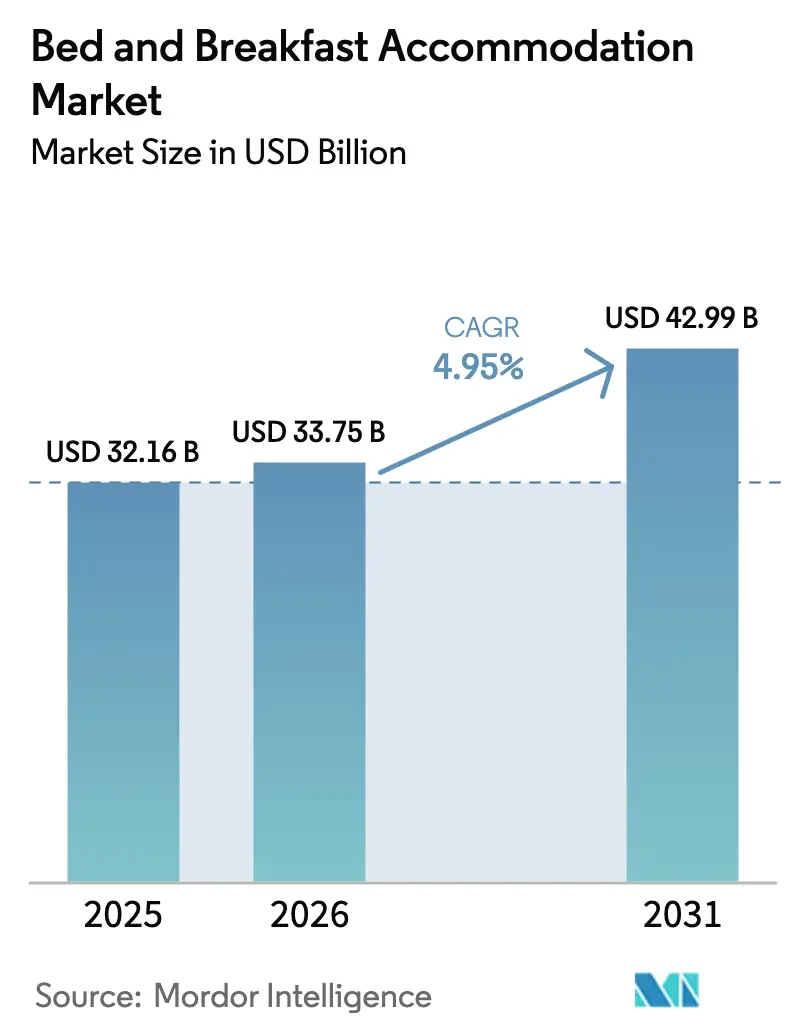
| Market Size (2026) | USD 33.75 Billion |
| Market Size (2031) | USD 42.99 Billion |
| Growth Rate (2026 - 2031) | 4.95 % |
| Fastest Growing Market | Asia Pacific |
| Largest Market | North America |
| Market Concentration | Low |
Major Players *Disclaimer: Major Players sorted in no particular order Image © Mordor Intelligence. Reuse requires attribution under CC BY 4.0. | |
Bed And Breakfast Accommodation Market Analysis by Mordor Intelligence
The bed and breakfast market size was valued at USD 32.16 billion in 2025 and estimated to grow from USD 33.75 billion in 2026 to reach USD 42.99 billion by 2031, at a CAGR of 4.95% during the forecast period (2026-2031). A decisive shift toward authentic, small-scale lodging, coupled with digital booking innovations, shapes this expansion. Rural properties continue to capture growing domestic tourism flows, while boutique and heritage inns outperform generic lodging by leaning into experiential travel. Technology-enabled distribution platforms have reduced entry barriers for independent operators yet tightening short-term rental rules in urban centers underscore the need for agile compliance strategies. Ongoing labor shortages and climate-linked insurance costs remain the principal headwinds.
Key Report Takeaways
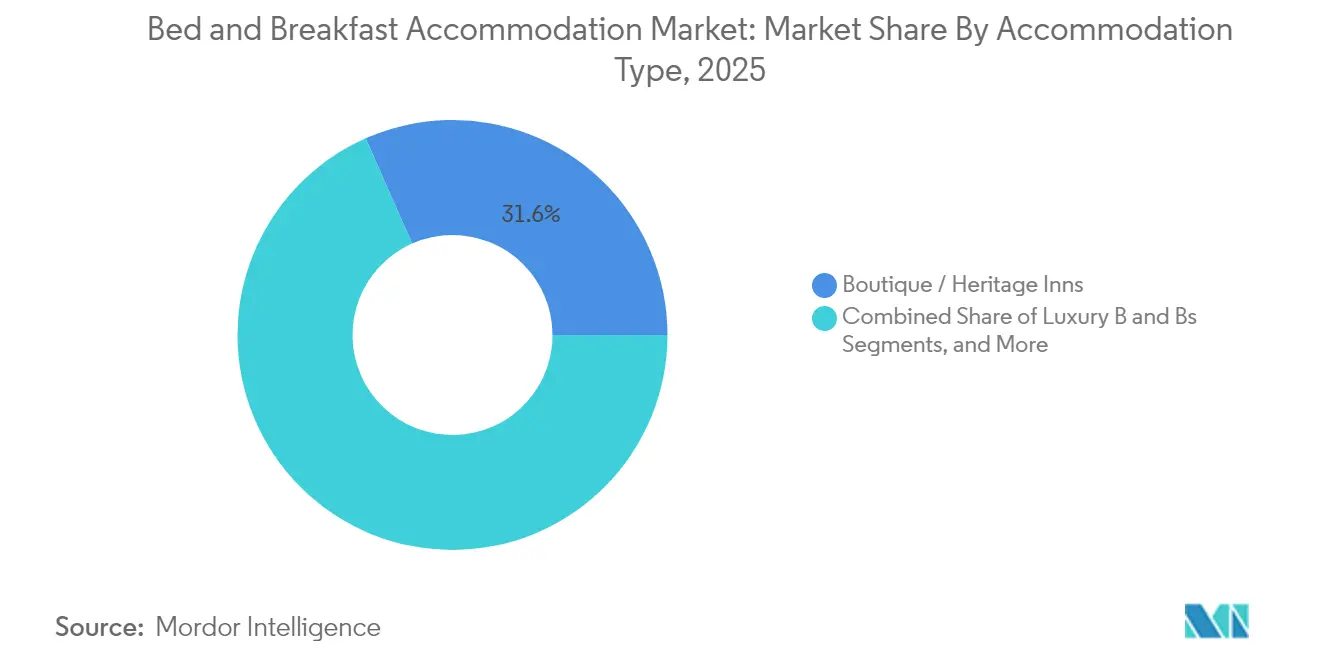
- By accommodation type, boutique and heritage inns led with 31.62% revenue of the bed and breakfast accommodation market share in 2025.
- By location setting, rural properties accounted for 42.98% of the bed and breakfast accommodation market share in 2025.
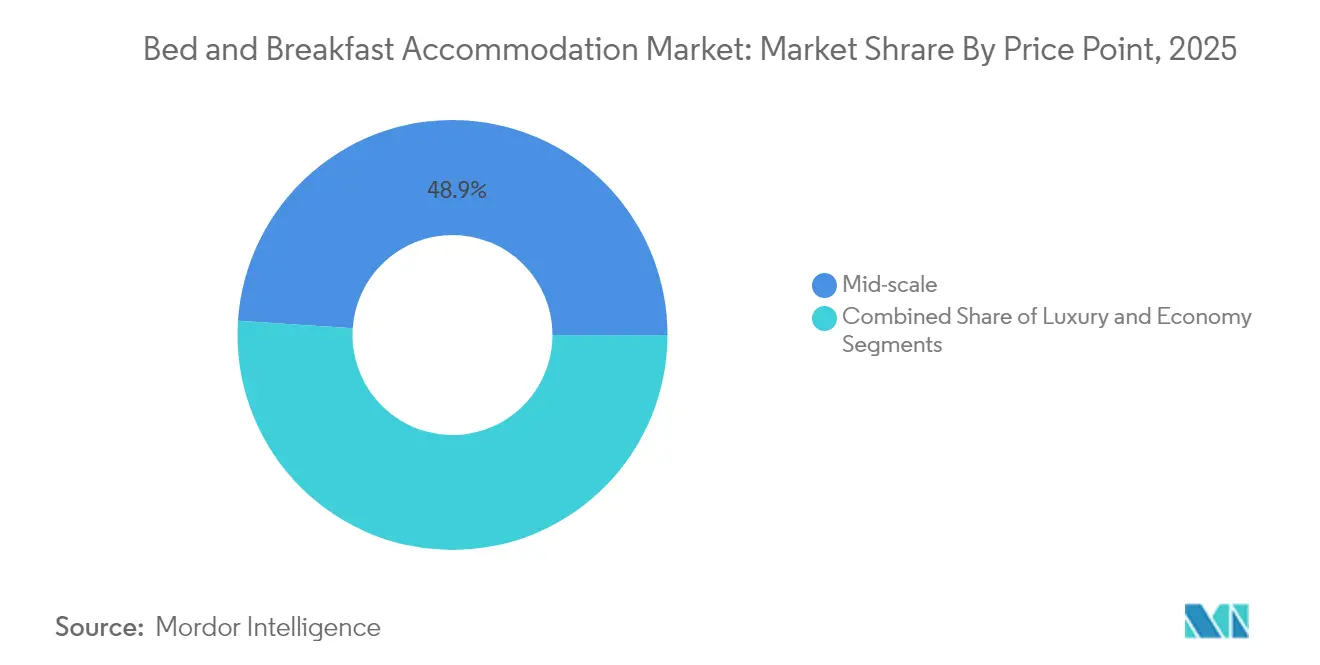
- By price point, the mid-scale segment contributed 48.94% of the bed and breakfast accommodation market size in 2025; luxury is projected to rise at 6.88% CAGR to 2031.
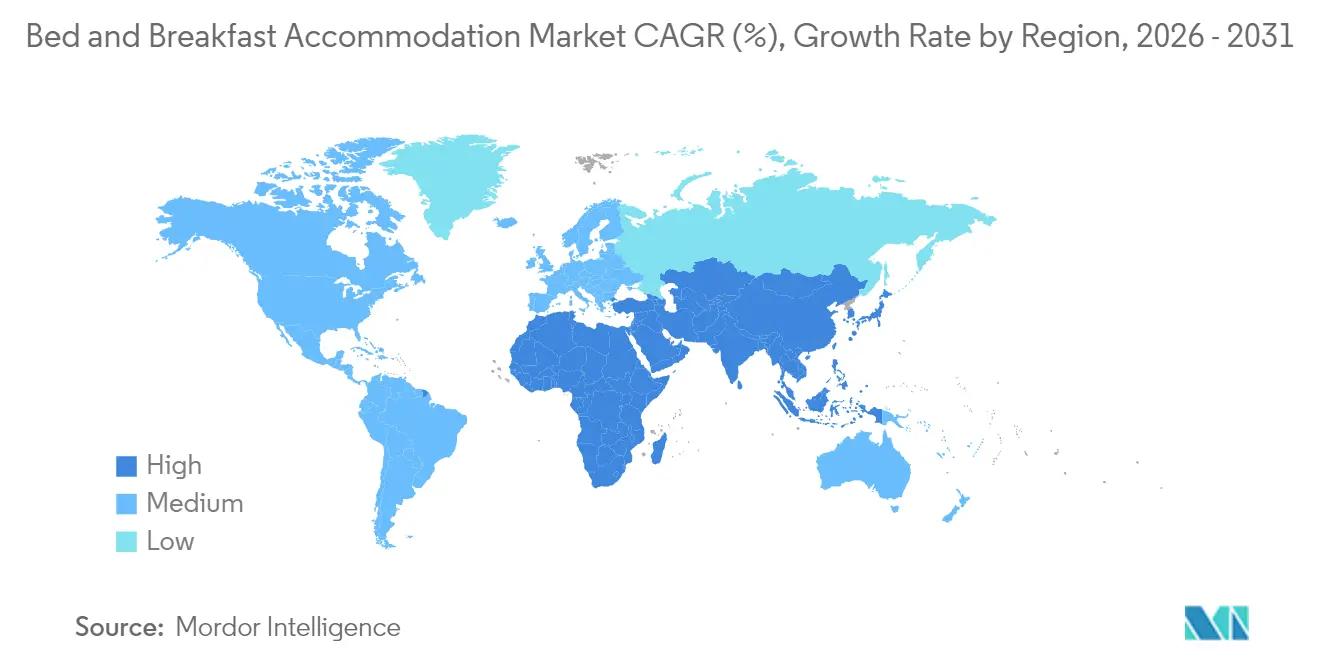
- By geography, North America held 43.15% of the bed and breakfast accommodation market share in 2025, whereas Asia-Pacific posts the fastest regional CAGR at 8.45% through 2031.
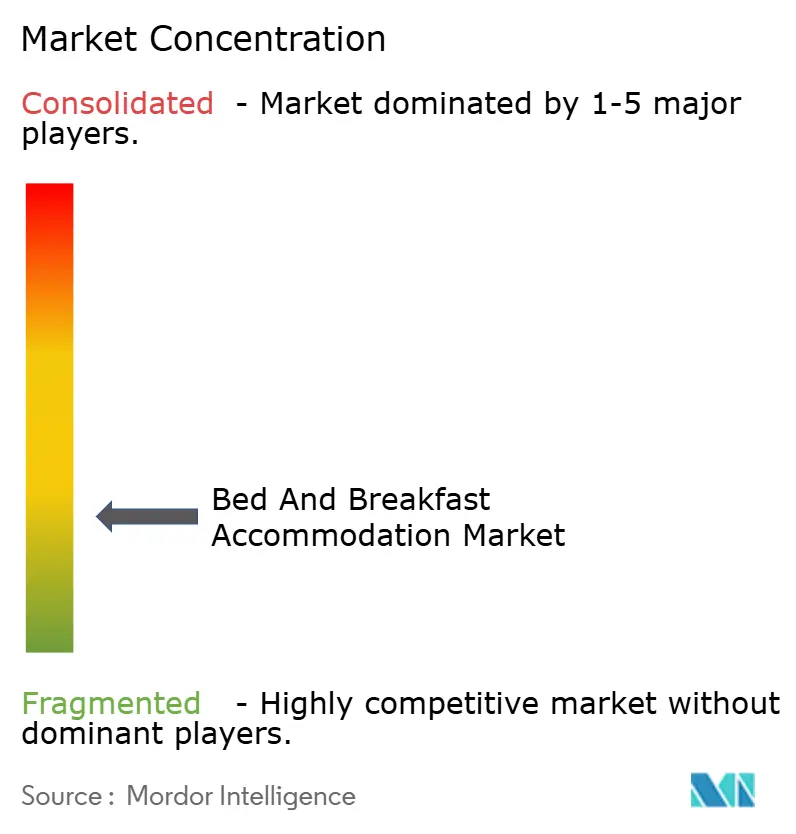
- The bed and breakfast market exhibits high fragmentation with the top 5 players, Airbnb, B&B HOTELS Group, OYO Hotels & Homes, Select Registry Distinguished Inns, and The Inn Collection Group, collectively holding modest market share in 2025.
Note: Market size and forecast figures in this report are generated using Mordor Intelligence’s proprietary estimation framework, updated with the latest available data and insights as of 2026.
Market Trends and Insights
Drivers Impact Analysis of Bed And Breakfast Accommodation Market*
| Driver | (~) % Impact on CAGR Forecast | Geographic Relevance | Impact Timeline |
|---|---|---|---|
| Growing demand for personalized experiential travel | +1.2% | Global, with premium impact in North America & Europe | Medium term (2-4 years) |
| Rapid expansion of online booking and OTA ecosystems | +0.9% | Global, accelerated in Asia-Pacific markets | Short term (≤ 2 years) |
| Surge in domestic short-stay tourism post-pandemic | +0.8% | North America, Europe, India core markets | Short term (≤ 2 years) |
| Rising disposable incomes of Millennials and Boomers | +0.7% | North America, Europe, emerging APAC markets | Long term (≥ 4 years) |
| Hybrid "work-cation" B&B packages for remote workers | +0.4% | North America, Europe, select urban-adjacent rural areas | Medium term (2-4 years) |
| Rural sustainability grants fueling community B&Bs | +0.2% | Europe, North America, Australia regional focus | Long term (≥ 4 years) |
| Source: Mordor Intelligence | |||
Growing Demand for Personalized Experiential Travel
Travelers increasingly seek culturally rooted stays, and 54% of recent guests said local immersion now outweighs a property’s star classification. Bed and breakfasts embed themselves in neighborhood life by partnering with artisans, farmers, and guides to craft one-off activities ranging from foraging walks to pottery workshops. Average U.S. guests booked 4.7 on-site experiences in 2023, up sharply from pre-pandemic norms, signaling higher ancillary-revenue opportunities. Millennials, who represent a large outbound cohort in Europe, commonly choose alternative lodging over chain hotels, fueling premium rates for story-rich heritage inns. Rural operators are layering in wellness sessions such as forest-bathing and yoga, positioning themselves for the fast-growing health-and-nature segment.
Rapid Expansion of Online Booking and OTA Ecosystems
Digital platforms captured a dominant share of reservations in 2024, yet direct website conversions display the strongest momentum at 12.9% CAGR through 2030. Commission-sensitive hosts now combine OTA reach for first-time discovery with sustained guest lifecycle tactics via email, loyalty perks, and mobile apps. The cost to acquire a direct booking fell to 7.1% of room revenue in 2023 as programmatic advertising tools matured, whereas OTA fees linger between 15% and 30%. Embedded AI within search engines automates personalized trip bundling, helping small properties deliver friction-free booking journeys. Voice search and “book-on-Google” flows are expected to elevate direct volumes further in the near term.
Surge in Domestic Short-Stay Tourism Post-Pandemic
Border uncertainty redirected many leisure budgets toward local destinations. Domestic lodging nights rose in the double digits across numerous high-income economies during 2024, providing sustained demand that insulated rural B&Bs from foreign visitor volatility. India’s internal travel rebound has spurred record highway traffic and rail ticketing, translating into elevated mid-week occupancy in hill-station guesthouses. Similar momentum in China’s tier-two cities is lifting weekend-stay business for family-run courtyard inns. This urban-to-rural migration of leisure spend reduces currency risk for operators and aligns neatly with government programs that champion small-community tourism.
Rural Sustainability Grants Fueling Community B&Bs
Public funding in Europe, North America, and Australia channels fresh capital into historic barn conversions and eco-cabins, bringing new supply to sparsely populated areas [1] Source: HM Government, “Tourism Cooperation Grants,” gov.uk. . Qualifying owners secure low-interest loans for solar panels, grey-water systems, and heritage restoration, enabling them to meet rising guest expectations around responsible travel. These grants lower upfront costs and accelerate payback periods, encouraging clusters of community-run B&Bs that collectively market entire villages as single tourism propositions. The model strengthens local employment and diversifies rural economies while feeding the broader bed and breakfast market.
Restraints Impact Analysis of Bed And Breakfast Accommodation Market*
| Restraint | (~) % Impact on CAGR Forecast | Geographic Relevance | Impact Timeline |
|---|---|---|---|
| Tightening zoning and STR regulations | -0.8% | North America, Europe, Australia urban markets | Short term (≤ 2 years) |
| Intensifying competition from whole-home rentals | -0.6% | Global, concentrated in urban and resort areas | Medium term (2-4 years) |
| Escalating climate-linked insurance premiums | -0.3% | Global, severe impact in coastal and wildfire-prone regions | Medium term (2-4 years) |
| Rural labour shortages impacting service quality | -0.2% | North America, Europe, Australia rural tourism areas | Long term (≥ 4 years) |
| Source: Mordor Intelligence | |||
Tightening Zoning and STR Regulations
Provincial law in British Columbia restricts most urban short-term rentals to a principal residence, with significant fines for violators [2]Source: Government of British Columbia, “Short-Term Rental Accommodations Act,” gov.bc.ca. Scotland now mandates licenses for all hosts, and parts of France require annual energy audits for new listings. City caps on permissible rental nights further constrain inventory in Paris, Barcelona, and Amsterdam. Compliance costs—ranging from safety certifications to digital registration—hit independent hosts hardest because they lack dedicated legal staff. In rural districts, the same rules often prove less stringent, producing an unintended shift of supply toward countryside markets.
Intensifying Competition for Whole-Home Rentals
Professional management firms now operate large portfolios with revenue-optimization software, eroding the service gap that once favored host-occupied B&Bs. Cleaning fees and higher nightly rates have risen across the entire alternative-lodging spectrum, yet platforms such as Airbnb are broadening into add-on experiences, amplifying their competitive reach. In response, many B&B owners emphasize hosted interaction, heritage storytelling, and farm-to-table breakfasts to preserve differentiation. Airbnb's expansion into services and experiences through its 2025 platform redesign creates additional competitive pressure by offering comprehensive travel solutions that extend beyond accommodation.
*Our forecasts treat driver/restraint impacts as directional, not additive. The impact forecasts reflect baseline growth, mix effects, and variable interactions.
Bed And Breakfast Accommodation Market Segment Analysis
By Accommodation Type:
Heritage Properties Drive Premium PositioningBoutique and heritage inns captured 31.62% revenue in 2025, giving them the largest share across accommodation styles. Their curated architecture and localized storytelling tap directly into travelers’ quest for memorable stays, a dynamic that keeps occupancy sturdy even during shoulder seasons. Within the bed and breakfast market, farm-stay and Agri-tourism venues register the quickest 9.22% CAGR, boosted by regional grants and consumer interest in food provenance. Luxury B&Bs, though niche, command high ADRs that fortify segment profitability during peak demand weekends. At the opposite end, economy units face margin compression from citywide yield wars against professional whole-home rentals.
Heritage hosts often integrate smart room controls and contactless check-ins while safeguarding historic character. This digital layer hastens guest satisfaction and raises review scores, protecting rate integrity. Agritourism sites in the European countryside leverage the bed and breakfast market size for rural tourism grants, reinforcing economic resilience. The segment’s evolution underscores the broader preference shift toward immersive lodging over standardized hotel chains.


By Booking Channel:
Digital Transformation Accelerates Direct EngagementOnline travel agencies owned 70.82% of reservations in 2025, yet direct website sales mark the fastest expansion path at 12.3% CAGR through 2031. Improved SEO, loyalty discounts, and one-click mobile payments empower independents to recapture costly OTA traffic. Predictive pricing engines adjust room rates against real-time comp-set data, ensuring channel profitability. Legacy offline agents still cater to seniors booking complex itineraries, but their share diminishes annually.
The shift toward direct bookings is supported by artificial intelligence integration in marketing platforms, with Google's Performance Max campaigns enabling small B&B operators to optimize advertising spend across multiple channels effectively. Mobile app adoption accelerates direct booking growth, particularly among younger travelers who prefer seamless, personalized booking experiences that OTAs struggle to deliver for individual properties.
By Traveler Type:
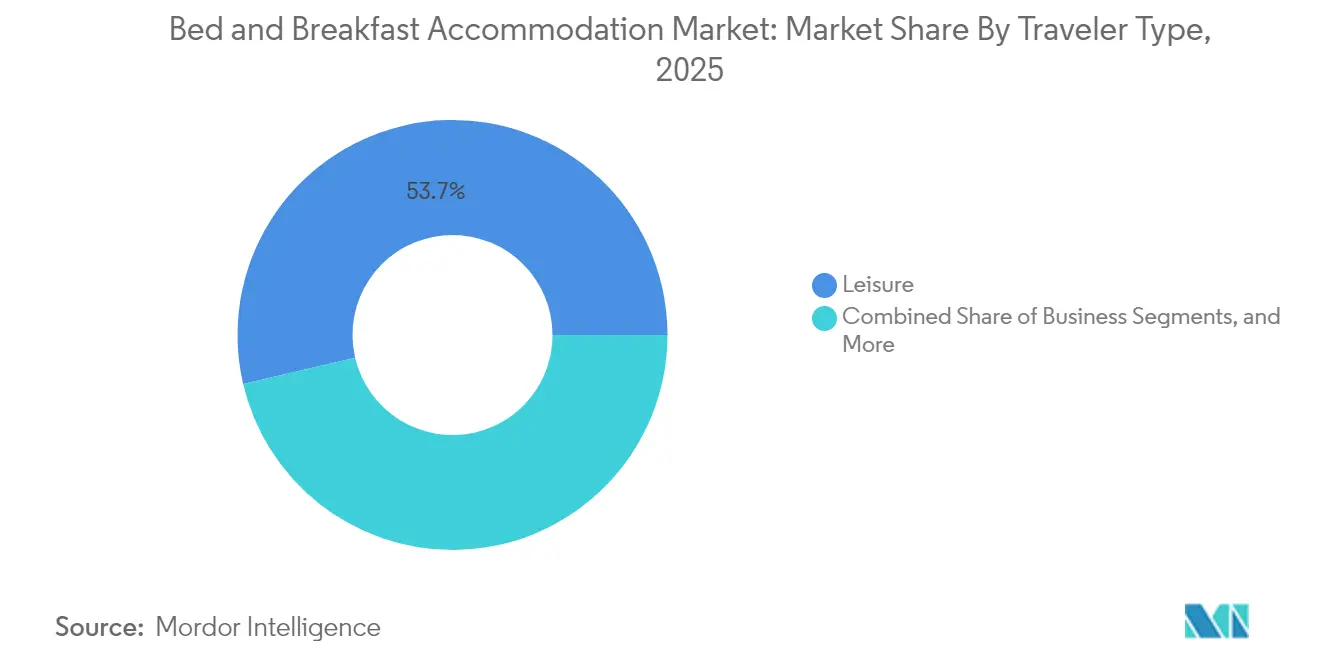
Remote Work Reshapes Accommodation DemandLeisure guests represented 53.65% of stays in 2025, yet the work-cation niche races ahead at 11.15% CAGR. Properties outfitted with fiber internet and sound-isolated corners report weekday occupancy surges that buffer seasonality. Business-only travel lags pre-2020 levels, but hybrid meetings now migrate to rural inns offering conference barns and evening bonfire socials. Solo travel upticks among Gen Z foster demand for communal kitchens and hosted group excursions.
Extended-stay patterns favor B&Bs' cost advantages over hotels, while the integration of work amenities such as high-speed internet, dedicated workspace areas, and flexible check-in/check-out policies creates competitive differentiation opportunities. Operators tailoring package bundles—combining coworking credits, guided hikes, and mindfulness sessions—see higher ancillary spend per booking. Such offerings place B&Bs at the heart of evolving digital-nomad ecosystems.
By Location Setting:
Rural Dominance Reflects Sustainability TrendsRural properties accounted for 42.98% of the bed and breakfast market share in 2025, and their growth trajectory sits at a robust 7.25% CAGR to 2031. Travelers seek open space, lower crowd density, and farm-fresh cuisine, attributes city stock cannot match. Coastal and island B&Bs achieve premium ADRs but remain highly seasonal, whereas heritage-town locations benefit from steady cultural tourism footfall.
Government tax relief for green renovation and digital connectivity upgrades accelerates rural inventory expansion. Carbon-conscious visitors favor countryside lodgings with verified low emissions, nudging urban hoteliers to adopt similar standards or risk share attrition. Broadband rollouts reduce remote-work friction, transforming once-isolated hamlets into viable year-round bases for mobile professionals.
By Price Point:
Mid-Scale Segment Balances Value and ExperienceMid-scale B&Bs delivered 48.94% of global revenue in 2025, blending affordability with bespoke hosting. Their sweet-spot positioning attracts families during peak vacation windows and millennials on experiential road trips. Luxury properties, though smaller in count, anticipate 6.88% CAGR, underpinned by affluent boomers and well-healed digital entrepreneurs chasing exclusive settings.
The mid-scale segment's dominance reflects broader hospitality trends where travelers seek authentic experiences at accessible price points, particularly in domestic markets where value consciousness remains high despite increased travel spending. Luxury segment growth is supported by the wealth accumulation among millennials and baby boomers, who prioritize unique experiences over standardized luxury hotel offerings.
By Ownership Model:
Independent Operators Maintain Market LeadershipIndependents dominate supply, a reality rooted in the hyper-local nature of B&B hospitality. Yet franchise and soft-brand affiliations gain momentum where marketing muscle and cross-selling engines matter. Consortia provide light-touch shared services—central reservations, group promotions—while respecting each inn’s identity.
Technology partners now bridge capability gaps for solo hosts, offering yield management, AI chatbots, and bundled insurance. As these tools mature, the performance divide between branded and standalone properties narrows, preserving independence as the defining feature of the bed and breakfast industry across most regions. The emergence of technology platforms that provide independent operators with sophisticated marketing and management tools reduces traditional advantages of franchise models while preserving the authenticity that drives B&B demand.
Geography Analysis
North America Bed and Breakfast Accommodation Market
North America retained 43.15% revenue share in 2025, buoyed by the United States’ USD 1 trillion domestic travel spend and Canada’s CAD 19.5 billion (USD 14.27 billion) accommodation turnover, up 14.7% year over year. Deep-rooted B&B culture in New England, the Pacific Northwest, and Atlantic Canada secures a stable guest pipeline, although urban zoning caps constrain new listings in cities such as New York and Vancouver. Mexico’s revitalized heritage towns supplement regional momentum by attracting cross-border leisure traffic.
APAC Bed and Breakfast Accommodation Market
Asia-Pacific posts the quickest 8.45% CAGR through 2031 on the back of India’s expanding middle class and China’s progressive reopening. Improved air links streamlined visa processes, and government-funded rural tourism corridors spark fresh supply in hill stations, tea estates, and coastal fishing villages. Australia’s state grants for agri-lodging conversion further draw investment to countryside estates. Varied regulations across jurisdictions require operators to fine-tune compliance strategies, yet the sheer scale of intra-regional travel propels steady occupancy gains.
Europe Bed and Breakfast Accommodation Market
Europe remains mature yet opportunity rich. Scotland’s licensing, France’s energy performance mandates, and Italy’s new national accommodation codes raise compliance expenses, which could trigger consolidation. EU sustainability goals and Common Agricultural Policy funds channel capital into farmhouse restorations and eco-ins. Intraregional weekend breaks and rail travel keep domestic nights high, supporting occupancy even as long-haul segments fluctuate. Rural Brittany, the Italian Alps, and Eastern European wine valleys illustrate pockets where experiential demand sustains healthy rate growth despite broader regulatory friction.

Regulatory Landscape
The regulatory environment for bed-and-breakfast and adjacent short-term rental supply is tightening around registration, data sharing, and platform accountability. In the European Union, Regulation (EU) 2024/1028 took effect on 20 May 2026, requiring member states to implement registration systems and enabling standardized data sharing, which raises the compliance bar for hosts and platforms operating across borders. In Canada, British Columbia's principal-residence restriction for most urban short-term rentals continues to show how local housing-focused rules can redirect incremental supply toward suburban and rural settings rather than city cores.
Platform and consumer-protection requirements are also increasingly shaping distribution and marketing practices. In the United Kingdom, the Online Safety Act brings major booking platforms into a regulated user-to-user framework, elevating obligations around moderation and related controls that can cascade into listing standards and verification processes. In the United States, California Senate Bill 346, effective 1 January 2026, requires short-term rental facilitators to share address and transaction data with local agencies when a qualifying local ordinance is in place, reinforcing a trend toward greater municipal visibility into inventory and bookings.
Value Chain Analysis
The bed-and-breakfast value chain starts with property acquisition or conversion, often heritage buildings or rural homes, and then moves through licensing and safety compliance, fit-out and refurbishment, and day-to-day operations such as housekeeping, breakfast sourcing, maintenance, and guest services. Distribution is increasingly platform-led, with online travel agencies and marketplace intermediaries supporting discovery, payments, and reviews, while many operators build direct website and mobile booking to reduce commission leakage. Guest experience partners, including local guides, wellness providers, and food producers, are gaining weight as experiential travel drives both ancillary revenue and differentiation.
Across the chain, the key constraints are shifting toward data, sustainability, and compliance capabilities. Digital infrastructure, including channel managers, dynamic pricing, and marketing tools, narrows the gap between independents and branded operators. At the same time, data-sharing and registration requirements, including the EU short-term rental framework effective 20 May 2026 and California's SB 346 effective 1 January 2026, add reporting and verification steps that can raise operating overhead for both platforms and hosts. On procurement and financing, larger hospitality groups rely on centralized sourcing, workforce training, and sustainability-linked financing structures, which affects supplier selection for energy, linen, and amenities. This also pushes smaller operators toward cooperatives or shared-service models to meet cost and reporting expectations.
Competitive Landscape
The sector is markedly fragmented; Airbnb, B&B HOTELS Group, OYO Hotels & Homes, Select Registry Distinguished Inns, and The Inn Collection Group jointly control only a small slice of global revenues. Such diffusion allows nimble independents to thrive by highlighting uniqueness rather than brand uniformity. Technology has leveled the playing field, enabling single-property hosts to access channel managers, dynamic pricing, and AI-driven marketing once reserved for large chains.
Strategic thrusts center on portfolio diversification and digital direct-to-consumer funnels. OYO’s USD 525 million purchase of G6 Hospitality widened its economy footprint while Marriott’s USD 355 million CitizenM acquisition diversified its lifestyle offering [3]Source: Marriott International, “Marriott to Acquire CitizenM,” marriott.com. . Airbnb’s 2025 platform revamps now bundles services like catering and personal coaching, extending its customer lifetime value beyond lodging. Meanwhile, regional collectives leverage shared procurements to cut linen, amenity, and insurance costs.
High-growth adjacencies include work-cation-centric clusters, sustainability-certified farm stays, and blockchain-enabled loyalty exchanges. Mergers among third-party management groups, such as Pyramid Global’s tie-up with Axiom Hospitality, illustrate the race to scale operational synergies. Looking forward to data-rich revenue management, embedded fintech for trip financing, and dynamic packaging APIs from suppliers like Expedia will further reshape competitive contours.
Bed And Breakfast Accommodation Industry Leaders
Airbnb, Inc.
B&B HOTELS Group
OYO Hotels & Homes
Select Registry Distinguished Inns
The Inn Collection Group
- *Disclaimer: Major Players sorted in no particular order
Bed And Breakfast Accommodation Market Companies Covered in this Report
- Airbnb, Inc.
- B&B HOTELS Group
- Booking Holdings Inc.
- Expedia Group Inc. (Vrbo)
- OYO Hotels & Homes
- Select Registry Distinguished Inns
- The Inn Collection Group
- RedAwning.com Inc.
- Vacasa
- Sonder Holdings Inc.
- Wyndham Hotels & Resorts
- Accor S.A. (greet, MGallery B&Bs)
- Choice Hotels International (Ascend Collection)
- Plum Guide
- Bedandbreakfast.eu
- MyBoutiqueHotel.com
- The Originals Human Hotels & Resorts
- Rural Retreats & Country Cottages
- Host & Stay
- Farm Stay UK*

Market Opportunities and Future Outlook
Compliance-led productization is creating whitespace for software and services that streamline registration, verification, and reporting across jurisdictions. The EU short-term rental framework effective 20 May 2026, together with state and municipal data-access requirements such as California SB 346 effective 1 January 2026, increases demand for tools that manage listing IDs, address validation, tax handling, and data exchanges between hosts, platforms, and local authorities. Operators and consortia that standardize compliance workflows can reduce friction when expanding across cities and countries.
Platform-led travel ecosystems and sustainability financing also provide concrete routes to commercialization for B&B-style supply. Airbnb's 2025 platform redesign, which bundles services and experiences, points to more monetization points around meals, activities, and trip add-ons that many small inns already offer offline, with formalization improving attach rates and visibility. At the same time, sustainability-linked loans used by hotel groups, tied to emissions and supplier engagement, highlight an opening for B&B operators and soft brands to aggregate upgrades such as energy efficiency and low-carbon procurement and to access better financing terms through cooperative purchasing and standardized reporting, particularly in rural areas already supported by public sustainability grant programs.
Recent Industry Developments in Bed And Breakfast Accommodation Market
- June 2026: OYO Hotels & Homes (Prism) filed an updated Draft Red Herring Prospectus (UDRHP-I) with SEBI for a Rs 6,650 crore initial public offering. The filing indicates a capital raise aimed at accelerating international expansion and supporting institutional funding for growth.
- April 2026: Airbnb, Inc. launched Summer 2026 update, introducing new services including boutique hotel bookings in 20 global cities, airport pickups, and grocery delivery. The update expands services beyond lodging and increases the platform's services coverage.
- March 2026: B&B HOTELS Group partnered with GARBE Commercial Living to develop a portfolio of 30 new hotels across Germany, Austria, the Netherlands, Denmark, Poland, and the Czech Republic. The collaboration supports European growth through development partnerships that mix institutional funding with asset-light and asset-heavy approaches.


Bed And Breakfast Accommodation Market Report Scope and Research Methodology
Market Definition and Coverage
This market covers revenue earned from paid overnight stays at bed-and-breakfast properties where breakfast is included in the room rate and is prepared and served on-site, across the study geographies and time period. We treat this spend as the guest-facing accommodation revenue tied to these stays.
Scope exclusions: Excludes whole-home vacation rentals, hostels, and large boutique hotels even if they offer breakfast.
Segments Covered in This Report
- By Accommodation Type
- Luxury BandBs
- Boutique / Heritage Inns
- Farm-stay and Agri-tourism BandBs
- Budget / Economy BandBs
- By Price Point
- Luxury
- Mid-scale
- Economy
- By Traveller Type
- Leisure
- Business
- Bleisure / Work-cation
- Solo
- By Booking Channel
- Online Travel Agencies (OTAs)
- Direct Website / Mobile
- Offline Travel Agents
- By Location Setting
- Urban
- Suburban
- Rural
- Coastal / Island
- Heritage / Historic Towns
- By Ownership Model
- Independent
- Franchise / Affiliated
- Cooperative / Consortium
- By Geography
- North America
- Canada
- United States
- Mexico
- South America
- Brazil
- Peru
- Chile
- Argentina
- Rest of South America
- Asia-Pacific
- India
- China
- Japan
- Australia
- South Korea
- South East Asia (Singapore, Malaysia, Thailand, Indonesia, Vietnam, and Philippines)
- Rest of Asia-Pacific
- Europe
- United Kingdom
- Germany
- France
- Spain
- Italy
- BENELUX (Belgium, Netherlands, Luxembourg)
- NORDICS (Denmark, Finland, Iceland, Norway, Sweden)
- Rest of Europe
- Middle East and Africa
- United Arab Emirates
- Saudi Arabia
- South Africa
- Nigeria
- Rest of Middle East and Africa
- North America
Data Sources, Market Sizing, and Validation
Desk Research
Desk research started with mapping publicly visible supply and demand signals, then checking whether those signals moved consistently across the study years. We used government and official tourism statistics such as national tourism boards, UN Tourism, and the US Bureau of Economic Analysis travel and tourism satellite accounts, alongside labor and price indicators from sources such as the US Bureau of Labor Statistics.
To keep the model aligned with lodging operating realities, we also reviewed lodging and travel trade bodies such as AHLA and regional innkeeper associations for operating definitions and property characteristics, plus macro series for disposable income and travel spending direction from sources in the style of central bank and IMF datasets. Company filings, investor presentations, and credible press were reviewed to understand booking mix shifts and fee structures, and we selectively used paid databases for company financials and news, along with patent searches around booking technology. Where relevant, we also looked at global contracts and tenders for additional context. The sources listed here are illustrative only, and many other public and paid references were used to compile inputs, validate relationships, and clarify unclear points.
Primary Interviews and Surveys
Primary research was used to sanity-check what desk sources cannot fully explain, especially where property types blur and where breakfast inclusion is marketed differently across countries. We spoke with independent property owners, operators, channel partners, and travel intermediaries across major regions, then aligned the outputs with traveler mix, seasonal occupancy, and pricing behavior observed for B&B formats.
Distribution of primary research fieldwork respondents
| Company type | Respondent position | Region |
|---|---|---|
| Top tier: 39% | CXOs: 12% | APAC: 47% |
| Mid tier: 44% | Functional/Unit leaders: 32% | EMEA: 31% |
| Smaller Players: 17% | Managers: 56% | Americas: 22% |
Market-Sizing & Forecasting
Sizing was built using a top-down and bottom-up approach. We reconstructed tourism nights and paid lodging demand pools by region, then filtered them to the bed-and-breakfast format using observed supply indicators and traveler preference signals. To keep outputs realistic, we corroborated the totals with selective bottom-up checks, including sampled room supply by destination clusters, occupancy ranges shared by operators, and average daily rate patterns when breakfast is bundled.
Key inputs used in the model included (as illustrative drivers) international and domestic overnight trips, seasonality in occupancy for small-format lodging, average daily rates with breakfast included, length of stay, and the share of stays booked through direct channels versus online travel agencies. Where data gaps appeared, we used conservative proxy assumptions and then re-tested them in interviews, especially for mixed-use properties that also list on broader short-stay platforms.
Forecasts were generated using scenario analysis supported by multivariate regression on travel demand indicators such as income trends, airfare and fuel-linked travel costs, and lodging price inflation. Final year-by-year values were adjusted only after demand-side and supply-side checks converged to a stable range that could be explained using the same input series.
Data Validation & Update Cycle
Validation was done through multiple steps so outliers do not silently drive the total. We compared implied revenue per room night against independent signals such as tourism nights, lodging price indices, and operator-reported occupancy direction, then flagged any country-level jumps that did not match known travel timing patterns.
Before sign-off, the model and assumptions go through an internal analyst review where calculations are re-run and spot-checked, followed by re-contact triggers when key variables drift from expected ranges. Reports are refreshed annually, with interim updates when material events occur, and a final pre-delivery pass so clients receive the latest updated view.
Mordor Intelligence's Bed and Breakfast Accommodation Market Sizing Compared With Other Published Estimates
Published numbers for this market can vary widely because the category is used loosely, and some sources blend adjacent lodging formats into one bucket. Differences also show up when a study applies a country-only lens, mixes traveler-paid revenue with platform fees, or uses a single global ADR assumption without checking local seasonality.
Whole-home vacation rentals are kept outside Mordor Intelligence's scope, which is one of the main reasons the table below does not align with estimates that combine B&B stays with broader short-term rental demand.
Benchmark comparison
| Source | Market Size | Gaps in Research Methodology |
|---|---|---|
| Mordor Intelligence | USD 33.75 B (2026) | |
| Industry Dataset A | USD 79.00 B (2025) | Uses a combined bucket that merges B&Bs with hostels and similar budget lodging, and the total is lifted further when hosted stays are defined broadly across regions. |
| Econometric Publisher B | USD 7.50 B (2026) | Counts only a narrow subset of registered bed-and-breakfast inns, which can omit small licensed properties and blended-use operators in several countries. |
The spread mainly comes from how tightly the category is defined and whether neighboring lodging formats are blended in. By anchoring the model to overnight travel demand, breakfast-included pricing, and practical supply checks, we keep the final number traceable to clear inputs that can be re-tested when conditions change.


Key Questions Answered in the Report
What is the current size of the global bed and breakfast market?
The market reached USD 33.75 billion in 2026 and is forecast to grow to USD 42.99 billion by 2031.
Which region is expanding the fastest in the bed and breakfast market?
Asia-Pacific posts the quickest growth, registering an 8.45% CAGR through 2031, driven by rising domestic travel in India and gradual reopening in China.
Which accommodation type holds the largest share?
Boutique and heritage inns lead the segment with 31.62% revenue share, owing to traveler demand for authentic, culturally immersive stays.
How are booking channels changing for B&B operators?
Online travel agencies still dominate but direct website bookings are rising at 12.3% CAGR, helped by mobile apps and lower acquisition costs.
What regulatory challenges face the sector?
Urban zoning limits and principal-residence rules in markets such as British Columbia and Scotland impose compliance costs and restrict new urban inventory.
Page last updated on:


 Your data is secure and never sold or shared.


