
Battery Thermal Runaway Propagation Barrier Materials Market Size and Share
Market Overview
| Study Period | 2021 - 2031 |
|---|---|
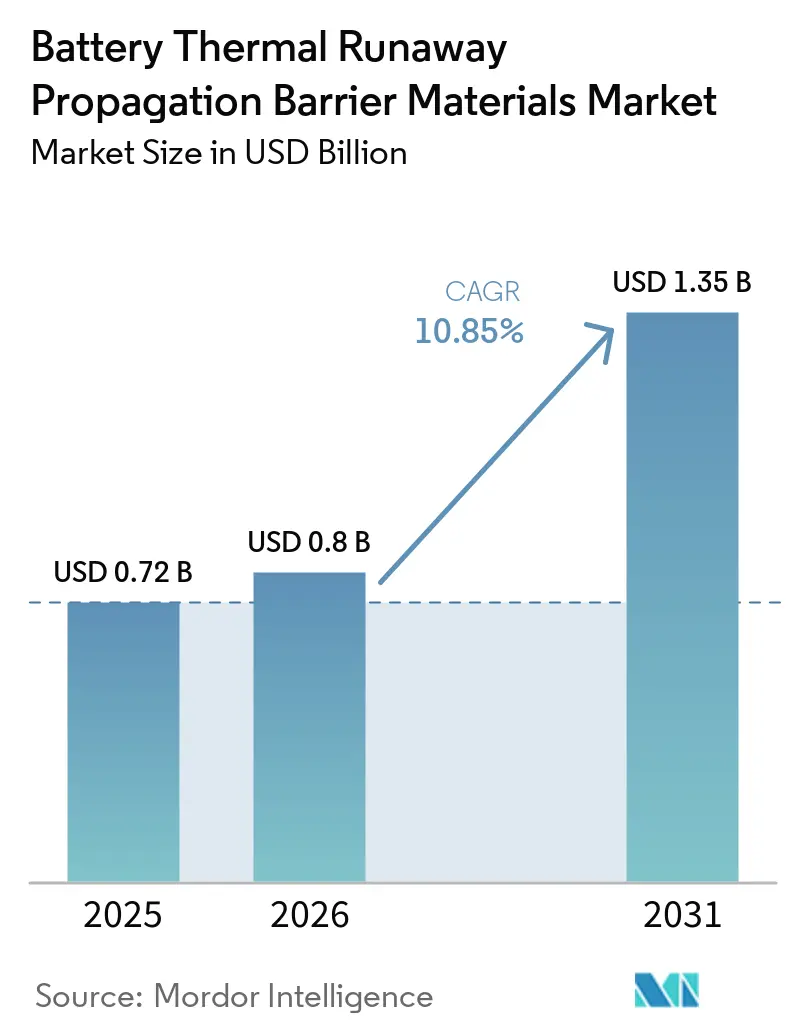
| Market Size (2026) | USD 0.8 Billion |
| Market Size (2031) | USD 1.35 Billion |
| Growth Rate (2026 - 2031) | 10.85 % |
| Fastest Growing Market | Asia-Pacific |
| Largest Market | Asia-Pacific |
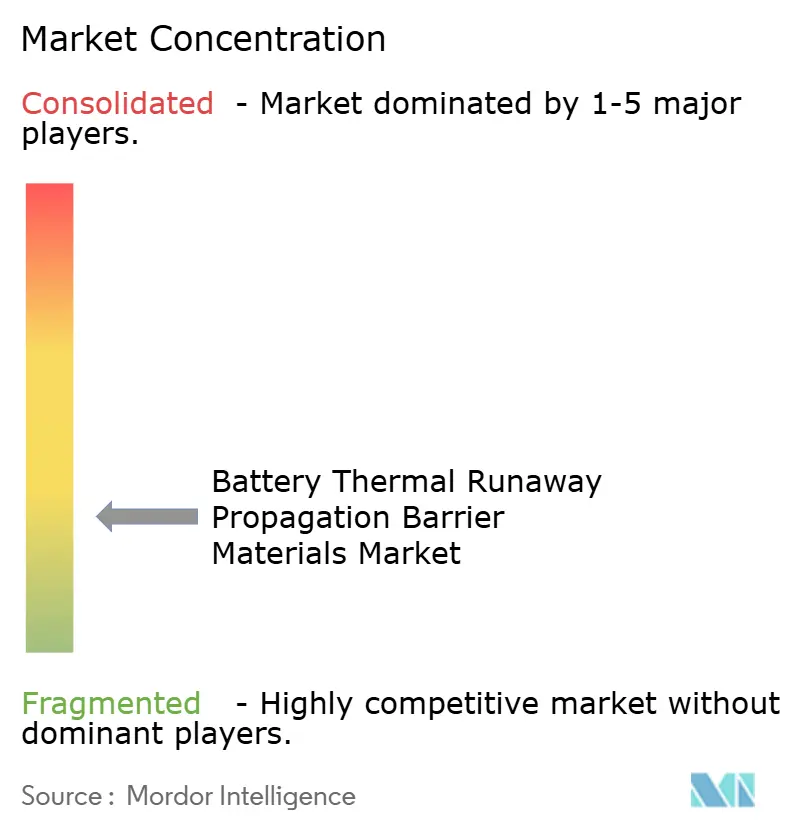
| Market Concentration | Low |
Major Players *Disclaimer: Major Players sorted in no particular order Image © Mordor Intelligence. Reuse requires attribution under CC BY 4.0. | |
Battery Thermal Runaway Propagation Barrier Materials Market Analysis by Mordor Intelligence
The Battery Thermal Runaway Propagation Barrier Materials Market was valued at USD 0.72 billion in 2025 and is estimated to grow from USD 0.80 billion in 2026 to reach USD 1.35 billion by 2031, at a CAGR of 10.85% during the forecast period (2026–2031). The battery thermal runaway propagation barrier materials market is being shaped mainly by tighter safety rules for traction batteries and stationary storage systems. China’s Guóbiāo (GB) 38031-2025 requires a two-hour no-fire, no-explosion result after thermal runaway for newly declared vehicle models from July 2026, raising the required performance level for passive barriers. North American testing and vehicle safety requirements also add demand for materials that manage thermal propagation, electrical isolation, and fire limitation. Battery designs with more closely packed cells are changing barrier selection from a simple insulation choice into a pack-level design decision. The battery thermal runaway propagation barrier materials market, therefore, favors suppliers that can qualify materials for specific cell chemistry, pack geometry, and regulatory tests.
Key Report Takeaways
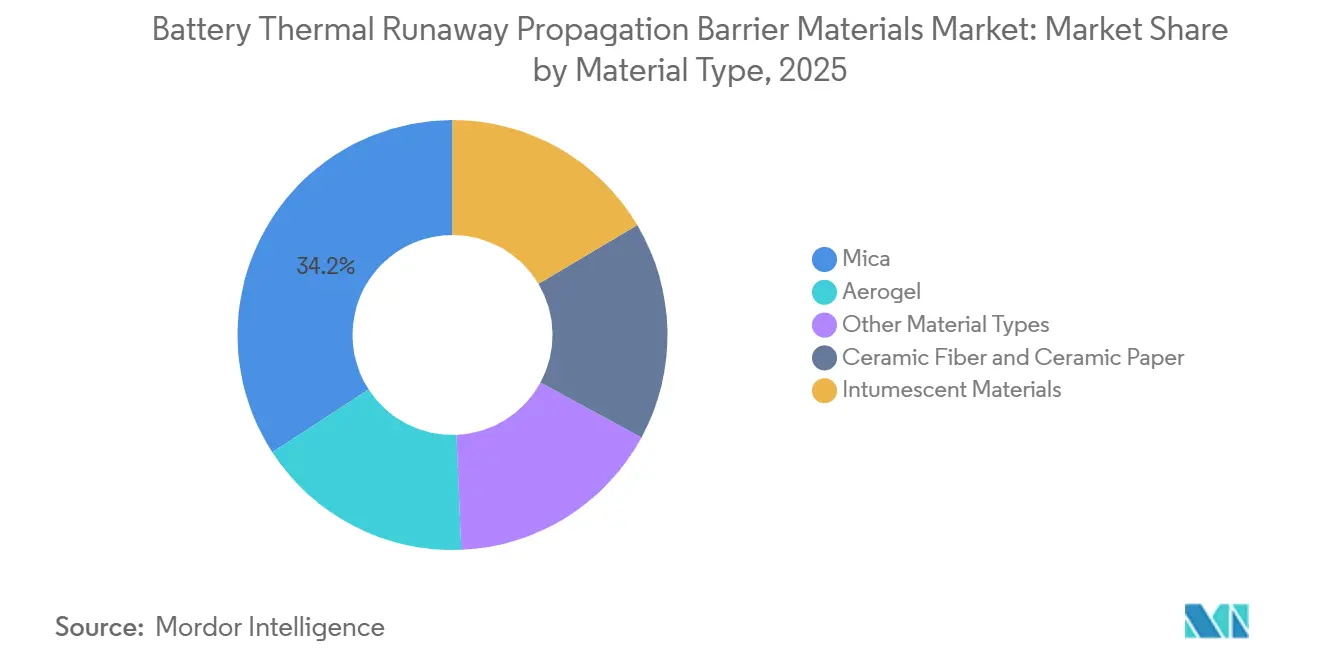
- By material type, mica held 34.18% of the battery thermal runaway propagation barrier materials market share in 2025, while aerogel is forecast to grow at a 12.02% CAGR through 2031.
- By form type, sheets and pads held 34.31% of the battery thermal runaway propagation barrier materials market share in 2025, while coatings are forecast to grow at an 11.71% CAGR through 2031.
- By battery chemistry, Nickel Manganese Cobalt (NMC) and Nickel Cobalt Aluminum (NCA) batteries held 37.06% of the battery thermal runaway propagation barrier materials market share in 2025, while solid-state batteries are forecast to grow at an 11.44% CAGR through 2031.
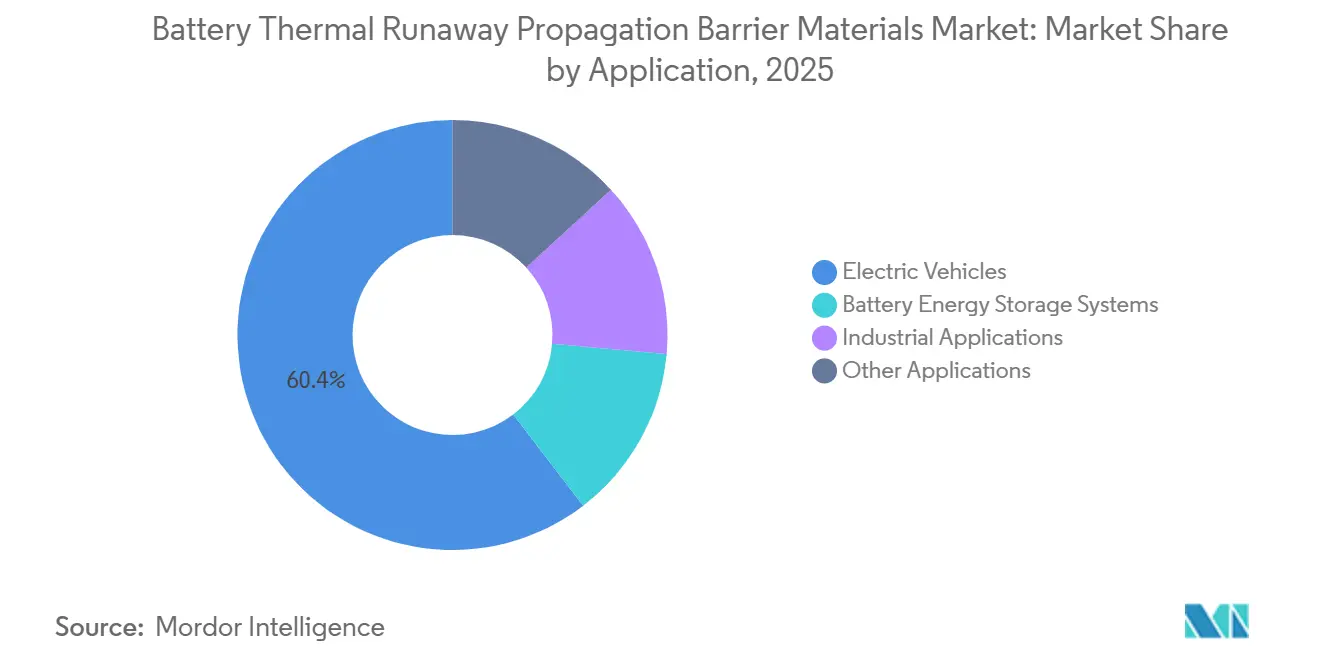
- By application, electric vehicles held 60.40% of the battery thermal runaway propagation barrier materials market share in 2025, while battery energy storage systems are forecast to grow at a 12.13% CAGR through 2031.
- By geography, Asia-Pacific held 44.47% of the battery thermal runaway propagation barrier materials market share in 2025 and is forecast to grow at an 11.86% CAGR through 2031.
Note: Market size and forecast figures in this report are generated using Mordor Intelligence’s proprietary estimation framework, updated with the latest available data and insights as of January 2026.
Market Trends and Insights
Drivers Impact Analysis of Battery Thermal Runaway Propagation Barrier Materials Market*
| Driver | (~) % Impact on CAGR Forecast | Geographic Relevance | Impact Timeline |
|---|---|---|---|
| Mandatory Thermal Propagation Compliance in China and North America | +2.8% | China (primary), North America (co-primary), spill-over to EU | Short term (≤ 2 years) |
| Battery Pack Densification Through Cell-to-Pack and Cell-to-Body Architectures | +1.9% | Global, led by China, South Korea, and EU | Short term (≤ 2 years) |
| Rising Energy Density and Faster Charging Requirements | +1.5% | Global, led by China, Germany, and United States | Medium term (2-4 years) |
| Expansion of Grid-Scale Battery Energy Storage Systems | +1.3% | APAC core, spill-over to North America and EU | Short to Medium term (≤ 4 years) |
| Integration of Thermal, Mechanical and Electrical Protection in Single Components | +0.9% | Global, led by EU and North America | Medium term (2-4 years) |
| Qualification Demand for Low-Weight, Thin and Moldable Barrier Systems | +0.7% | Global, led by China, Germany, and Japan | Medium term (2-4 years) |
| Source: Mordor Intelligence | |||
Mandatory Thermal Propagation Compliance in China and North America
China’s GB 38031-2025 took effect for newly declared vehicle models on July 1, 2026, and requires existing models to comply by July 1, 2027. The standard requires a two-hour no-fire, no-explosion outcome after thermal runaway, while smoke must not enter the passenger compartment. It also includes bottom-impact testing and a post-fast-charging sequence of 300 aging cycles followed by an external short-circuit test. These tests make barrier durability under mechanical and thermal stress a qualification requirement for the battery thermal runaway propagation barrier materials market. In North America, Underwriters Laboratories (UL) 9540A testing for storage systems and draft FMVSS 305a requirements for high-voltage vehicle batteries create separate compliance paths for suppliers. The result is demand for passive barriers that address both vehicle and stationary-storage safety conditions.
Battery Pack Densification Through Cell-to-Pack and Cell-to-Body Architectures
Cell-to-pack designs remove the intermediate module layer and increase cell utilization from 40-50% to 60-70%. This architecture also removes module housing walls that had limited heat transfer between cells. A 2026 study found that heat transfer during thermal runaway in cell-to-pack modules depends directly on barrier conductivity and mechanical behavior at the cell interface. Cell-to-body designs add crash loads and compressive stress because the battery enclosure becomes part of the vehicle structure. The battery thermal runaway propagation barrier materials market is therefore moving toward conformal parts, precision die-cutting, injection molding, and coating methods. Low-weight and thin materials remain important because safety components must fit into increasingly compact pack geometries.
Rising Energy Density and Faster Charging Requirements
High-nickel NMC cells release more heat during thermal runaway than Lithium Iron Phosphate (LFP) cells when compared at the cell level. A 2025 study of 51 Ah NMC811 modules found that a thermo-mechanical-chemical composite layer was needed for effective thermal protection in a high-energy configuration. GB 38031-2025 also places fast-charging packs under an aging and short-circuit safety sequence, which raises the importance of fatigue resistance. Research on thermal storage materials identifies phase-change materials, hydrogels, and thermochemical additives as useful components in barrier designs for high-nickel and fast-charging batteries. Suppliers in the battery thermal runaway propagation barrier materials market are responding with composite materials that combine thermal, mechanical, and electrical functions. This creates a higher-value option for demanding battery programs than standard passive insulation alone.
Expansion of Grid-Scale Battery Energy Storage Systems
Global battery storage additions reached 108 GW in 2025, up 40% from 2024, and utility-scale projects accounted for 87 GW[1]. China added 63 GW of storage capacity during 2025, increasing the role of stationary storage in regional barrier demand. Gas jets from rack-level thermal runaway can reach 800–1,200 °C and exceed 200 m/s, which creates conditions unlike those in many vehicle packs. This increases demand for ceramifiable and gradient-laminated barriers in the battery thermal runaway propagation barrier materials market. International Electrotechnical Commission (IEC) 62933-5-2 and UL 9540A add a longer qualification path for storage-focused materials. Those requirements can delay adoption, but they also distinguish products that meet stationary-storage conditions from standard automotive barriers.
Restraints Impact Analysis of Battery Thermal Runaway Propagation Barrier Materials Market*
| Restraint | (~) % Impact on CAGR Forecast | Geographic Relevance | Impact Timeline |
|---|---|---|---|
| High Cost of Aerogel and Advanced Multilayer Barrier Systems | -1.8% | Global; most acute in cost-sensitive Asia-Pacific OEM segments | Short term (≤ 2 years) |
| Lengthy OEM Qualification and Validation Cycles | -1.2% | Global; most acute in EU and North America | Medium term (2-4 years) |
| Material Performance Trade-Offs Under Compression, Venting and Crash Loads | -0.8% | Global, led by EU (UNECE R100.3 combined crash/thermal requirements) | Medium term (2-4 years) |
| Recycling, End-of-Life Separation and Material Traceability Constraints | -0.5% | EU (Battery Regulation 2023/1542), China, expanding globally | Long term (≥ 4 years) |
| Source: Mordor Intelligence | |||
High Cost of Aerogel and Advanced Multilayer Barrier Systems
Aerogel barriers cost more per unit area than mica or ceramic fiber alternatives, especially in high-volume LFP programs with tight cost limits. Aspen Aerogels stopped its planned USD 325 million facility in Statesboro, Georgia, in 2025 and focused on Rhode Island capacity and external fabrication. The decision showed the capital intensity and utilization risk associated with large-scale automotive aerogel production. Barriers must also preserve their thermal function under compression, venting, and crash loads, which can make a low-cost material unsuitable for a demanding pack design. Alkegen started full-scale production of its AlkeGel fiber-aerogel composite in June 2025, using a low-dust format intended to remove the encapsulation step required by conventional aerogels. This approach addresses cost at the pack assembly stage, although material selection still depends on the safety and price targets of each program.
Recycling, End-of-Life Separation and Material Traceability Constraints
Major Original Equipment Manufacturer (OEM) programs commonly require 18–36 months from material selection to production sign-off, slowing the conversion of new materials into revenue. GB 38031-2025 adds internal heating, bottom-impact, and post-fast-charging sequences that require material requalification against the prior standard. Established suppliers can apply existing test protocols and certified material libraries, while new entrants must bear a larger validation burden. The battery thermal runaway propagation barrier materials market also faces traceability and end-of-life separation requirements for multi-material composites. Europe’s Battery Regulation 2023/1542 makes these issues more important for sourcing and procurement decisions. These constraints can limit the use of mica-based or complex composite systems until suppliers demonstrate responsible sourcing and practical separation routes.
*Our forecasts treat driver/restraint impacts as directional, not additive. The impact forecasts reflect baseline growth, mix effects, and variable interactions.
Battery Thermal Runaway Propagation Barrier Materials Market Segment Analysis
By Material Type:
Mica Leads Revenue While Aerogel Raises Performance RequirementsMica held 34.18% of 2025 revenue, making it the leading material category in the battery thermal runaway propagation barrier materials market. Its dielectric strength exceeds 11 kV, and its temperature resistance is above 1,000 °C, supporting cell-to-cell and module-level applications. Mica remains relevant in high-volume LFP and NMC programs because it combines cost control with established thermal and electrical performance. Cell-to-pack designs increase the need for materials that fit three-dimensional prismatic cell surfaces rather than regular planar gaps. This favors suppliers that can mold, die-cut, and assemble complex mica components for specific pack layouts.
Aerogel is forecast to expand at a 12.02% CAGR through 2031, the fastest rate among material types in the battery thermal runaway propagation barrier materials industry. Aspen Aerogels reported more than USD 300 million in EV thermal barrier revenue during 2024, with most of that revenue linked to a single OEM relationship. Ceramic fiber and ceramic paper remain suited to applications that require sustained flame resistance, including NMC and NCA module barriers. Intumescent materials provide a char-forming response under heat, unlike passive mica and aerogel formats. The battery thermal runaway propagation barrier materials market thus contains both established insulation products and active-response materials for more severe use cases.

By Form Type:
Coatings Fit Densified Battery Pack DesignsSheets and pads held 34.31% of revenue in 2025, the largest form type share within the battery thermal runaway propagation barrier materials market. This format is established across mica, aerogel, and ceramic fiber products because it can be placed between cells, modules, or structural components. Rogers Corporation’s ProCell EV Firewall 300 series combines gap filling, vibration management, and thermal propagation protection in one silicone elastomeric component. Molded parts support complex pack geometries, including cell barriers, module covers, and busbar insulation. ElringKlinger’s ElroForm TP is rated to 1,300 °C and has UL 94 V-0 certification for these applications.
Coatings are forecast to grow at an 11.71% CAGR through 2031. The battery thermal runaway propagation barrier materials market size for coatings is supported by cell-to-pack and cell-to-body designs, where direct application may be the only workable geometry between closely arranged cells. Dip-coating, spray coating, and screen printing allow barriers to follow cell surfaces without adding separate inserts. Sumitomo Riko received US Patent 12,562,415 in February 2026 for a silica-aerogel-containing insulation sheet between battery cells. ISO 12405 and IEC 62619 testing conditions also favor materials that maintain their function under electrical, mechanical, and thermal stress. Coatings, therefore, offer a route to combine safety performance with compact pack integration.
By Battery Chemistry:
NMC and NCA Batteries Lead Revenue While Solid-State Batteries Raise Thermal DemandsNMC and NCA batteries held 37.06% of 2025 revenue. High-nickel cathodes create greater thermal runaway heat release than LFP cells, which increases the need for composite containment solutions. A 2025 study found that a thermo-mechanical-chemical interlayer was necessary to provide timely protection in 51 Ah NMC811 battery modules. LFP and LMFP packs generally require less costly thermal containment and often use mica sheets in module-less Chinese designs. This chemistry split affects average barrier value per vehicle and supports a premium tier for high-nickel platforms.
Solid-state batteries are forecast to grow at an 11.44% CAGR through 2031, the highest rate among battery chemistries. QuantumScape began shipping QSE-5 cells from its Eagle Line pilot facility in San Jose during 2026 to Volkswagen’s PowerCo and Ducati. Solid electrolytes remove the flammable liquid associated with conventional lithium-ion thermal runaway, but NMC-based all-solid-state cells can reach temperatures approaching 1,400 °C. BASF disclosed thermal management solutions for semi-solid and all-solid-state batteries in July 2026. These programs require materials that can operate beyond the limits of many existing mica and standard aerogel products.
By Application:
Electric Vehicles Lead Demand While Battery Energy Storage Systems Require Distinct ProtectionElectric vehicles held 60.40% of 2025 application revenue, providing the primary demand base for the battery thermal runaway propagation barrier materials market. Passenger cars, light commercial vehicles, and two-wheelers all require barriers that limit cell-to-cell propagation while fitting constrained pack designs. China’s active vehicle-installing battery suppliers declined from 52 in 2025 to 37 in the first five months of 2026, concentrating design-in decisions in fewer battery programs. Industrial applications also include forklifts, automated guided vehicles, and advanced air mobility platforms with demanding safety requirements.
Battery energy storage systems are forecast to expand at a 12.13% CAGR through 2031, the fastest application rate in the battery thermal runaway propagation barrier materials market. Utility-scale storage systems face high-temperature and high-velocity gas jets during rack-level events, requiring purpose-designed ceramifiable and laminated composites. Aspen Aerogels is pursuing BESS qualification programs with grid infrastructure and data-center developers in 2026. W. L. Gore & Associates is developing battery insulation with thermal conductivity of 0.05 W/m·K at 500 °C for battery energy storage system conditions. The storage application creates a separate technical and commercial pathway from vehicle battery barriers.
Geography Analysis
APAC Battery Thermal Runaway Propagation Barrier Materials Market
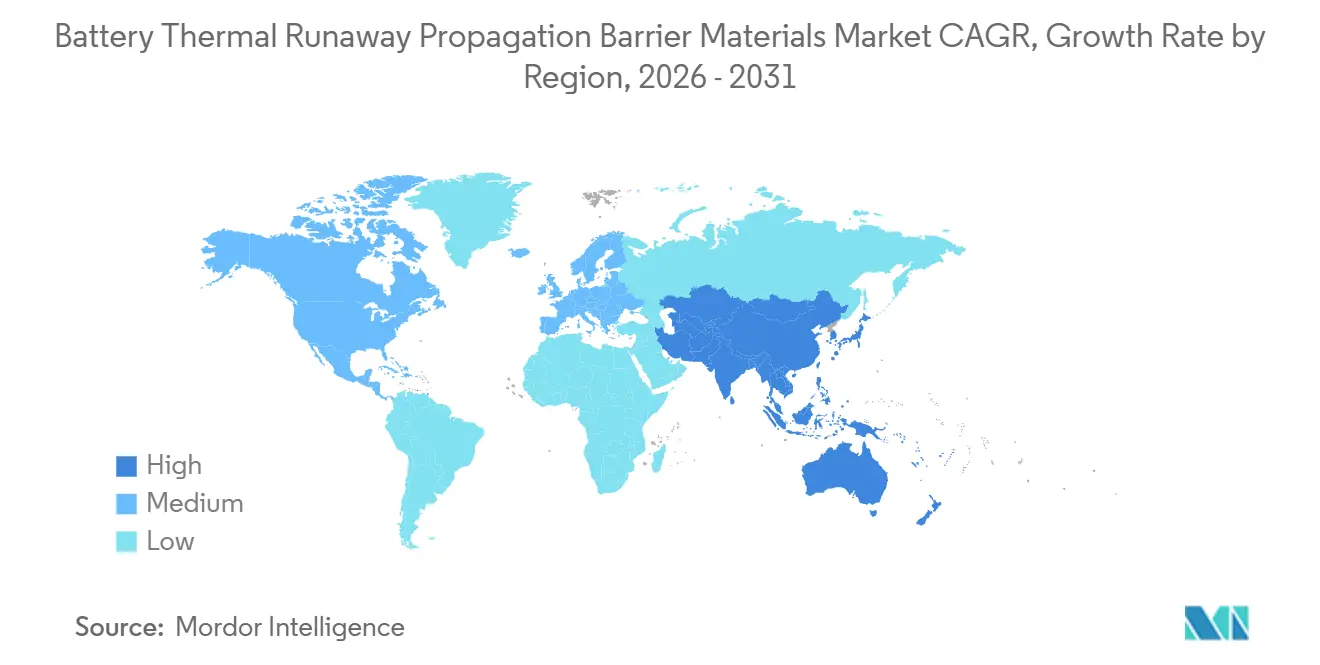
Asia-Pacific held 44.47% of 2025 revenue and is forecast to grow at an 11.86% CAGR through 2031, the highest regional rate in the battery thermal runaway propagation barrier materials market. China combines cell production, battery pack assembly, automotive demand, and storage deployment at a scale unmatched by other regions. China added 63 GW of new BESS capacity in 2025, creating a second demand channel beyond electric vehicles. The enforcement of GB 38031-2025 makes thermal propagation performance a central part of battery qualification in the country. Japan and South Korea also contribute through solid-state cell development and future OEM qualification programs.
The Americas Battery Thermal Runaway Propagation Barrier Materials Market
In North America, domestic battery storage capacity is projected to exceed 60 GW by the end of 2026, with most capacity in utility-scale lithium-ion systems. This creates requirements for cabinet and rack barriers that differ from automotive pack requirements. Aspen Aerogels reached a USD 37.6 million commercial settlement with General Motors in the first quarter of 2026 under a long-term EV thermal barrier supply agreement. The relationship reflects the high-value and concentrated nature of platform-specific supply arrangements. Brazil and Argentina represent earlier-stage opportunities linked to domestic battery plans and renewable energy integration.
EMEA Battery Thermal Runaway Propagation Barrier Materials Market
Europe has a growing revenue contribution in the battery thermal runaway propagation barrier materials market because of vehicle safety, traceability, and storage procurement requirements. UNECE R100.3 and the EU Battery Regulation 2023/1542 increase attention to fire protection, system separation, responsible sourcing, and end-of-life treatment. ElringKlinger received EUR 33.8 million (approximately USD 37 million) in Important Projects of Common European Interest (IPCEI) funding for an innovative battery cell housing design through 2026. Italy’s MACSE auction contracted 10 GWh of utility-scale storage for delivery by 2028, while Great Britain’s long-duration storage plan targets 2.7-7.7 GWh by 2035. The Middle-East and Africa drive demand through renewable storage projects in Saudi Arabia, and grid investment in South Africa supports later demand.
Competitive Landscape
The battery thermal runaway propagation barrier materials market is highly fragmented, with the top five players including Aspen Aerogels, Inc., 3M, Morgan Advanced Materials plc, Saint-Gobain, and Rogers Corporation. Existing qualification data and material libraries help these suppliers manage the cost of tighter testing requirements. Aspen Aerogels reported more than USD 300 million in EV thermal barrier revenue in 2024, with most revenue coming from one OEM relationship. This concentration can make a single design win commercially significant for both supplier revenue and production planning.
Suppliers follow different product strategies within the battery thermal runaway propagation barrier materials market. Alkegen extended its offer into aerogel wraps and full barrier systems with AlkeGel in 2025. Pyrophobic Systems focuses on intumescent thermoplastic barriers designed for cell and module containment. Morgan Advanced Materials supplies ceramic fiber papers for module-to-module and pack-level applications. Rogers Corporation combines gap filling and propagation protection in its ProCell EV Firewall 300 series[2]. These approaches respond to pack integrators’ need to reduce the number of separate components while maintaining thermal, mechanical, and electrical protection.
Product development remains focused on multifunctional barriers, BESS materials that withstand sustained 1,200 °C gas-jet exposure, and solid-state formats capable of operating near 1,400 °C. ElringKlinger’s US Patent 12,597,661 covers battery propagation protection elements positioned between adjacent modules. Rogers Corporation’s US Patent 12,119,467 addresses a reactive-filler composite sheet designed to mitigate inter-cell heat transfer. KULR Technology uses phase-change vapor circulation in its Thermal Runaway Shield, while Zotefoams offers a foam-adhesive-fabric composite tested above 1,000 °C for more than 1 minute. These alternative mechanisms widen the options available for aerospace, commercial vehicle, and stationary-storage specifications. The battery thermal runaway propagation barrier materials market remains difficult for new suppliers because technical performance must be paired with production readiness and program-specific validation.
Battery Thermal Runaway Propagation Barrier Materials Industry Leaders
-
Aspen Aerogels, Inc.
-
3M
-
Morgan Advanced Materials plc
-
Saint-Gobain
-
Rogers Corporation
- *Disclaimer: Major Players sorted in no particular order
Battery Thermal Runaway Propagation Barrier Materials Market Companies Covered in this Report
- 3M
- Alkegen
- Aspen Aerogels, Inc.
- DuPont
- ElringKlinger AG
- KULR Technology Group, Inc.
- L&L Products
- Morgan Advanced Materials plc
- Pyrophobic Systems Ltd.
- Röchling SE & Co. KG
- Rogers Corporation
- Saint-Gobain
- Sumitomo Riko Company Limited
- Von Roll Holding AG
- Zotefoams plc
Recent Industry Developments in Battery Thermal Runaway Propagation Barrier Materials Market
- July 2026: China's GB 38031-2025 introduced stricter thermal runaway safety requirements and more rigorous battery testing standards, increasing demand for thermal runaway propagation barrier materials. This is expected to drive the adoption of these materials as EV batteries are required to meet the updated safety standards.
- July 2026: BASF launched Thermoplastic Polyurethane (TPU)-based thermal management solutions for semi-solid and all-solid-state batteries. This expands the use of barrier materials designed to improve thermal runaway protection in next-generation battery systems.
Global Battery Thermal Runaway Propagation Barrier Materials Market Report Scope
Battery thermal runaway propagation barrier materials are specialized materials designed to prevent or delay the spread of excessive heat and fire from one battery cell to adjacent cells during thermal runaway events. They enhance battery safety, improve thermal management, and help electric vehicles and energy storage systems meet increasingly stringent safety and performance requirements.
The Battery Thermal Runaway Propagation Barrier Materials Market is segmented by material type, form type, battery chemistry, application, and geography. By material type, the market is segmented into mica, aerogel, ceramic fiber and ceramic paper, intumescent materials, and other material types. By form type, the market is segmented into sheets and pads, coatings, molded parts, and other form types. By battery chemistry, the market is segmented into NMC and NCA batteries, LFP and LMFP batteries, solid-state batteries, and other battery chemistries. By application, the market is segmented into electric vehicles, battery energy storage systems, industrial applications, and other applications. The report also covers the market size and forecasts for battery thermal runaway propagation barrier materials in 15 countries across major regions. For each segment, the market sizing and forecasts have been done on the basis of value (USD).
Segmentation Overview
| Mica |
| Aerogel |
| Ceramic Fiber and Ceramic Paper |
| Intumescent Materials |
| Other Material Types |
| Sheets and Pads |
| Coatings |
| Molded Parts |
| Other Form Types |
| NMC and NCA Batteries |
| LFP and LMFP Batteries |
| Solid-State Batteries |
| Other Battery Chemistries |
| Electric Vehicles |
| Battery Energy Storage Systems |
| Industrial Applications |
| Other Applications |
| Asia-Pacific | China |
| India | |
| Japan | |
| South Korea | |
| Rest of Asia-Pacific | |
| North America | United States |
| Canada | |
| Mexico | |
| Europe | Germany |
| United Kingdom | |
| France | |
| Italy | |
| Rest of Europe | |
| South America | Brazil |
| Argentina | |
| Rest of South America | |
| Middle-East and Africa | Saudi Arabia |
| South Africa | |
| Rest of Middle-East and Africa |
| By Material Type | Mica | |
| Aerogel | ||
| Ceramic Fiber and Ceramic Paper | ||
| Intumescent Materials | ||
| Other Material Types | ||
| By Form Type | Sheets and Pads | |
| Coatings | ||
| Molded Parts | ||
| Other Form Types | ||
| By Battery Chemistry | NMC and NCA Batteries | |
| LFP and LMFP Batteries | ||
| Solid-State Batteries | ||
| Other Battery Chemistries | ||
| By Application | Electric Vehicles | |
| Battery Energy Storage Systems | ||
| Industrial Applications | ||
| Other Applications | ||
| By Geography | Asia-Pacific | China |
| India | ||
| Japan | ||
| South Korea | ||
| Rest of Asia-Pacific | ||
| North America | United States | |
| Canada | ||
| Mexico | ||
| Europe | Germany | |
| United Kingdom | ||
| France | ||
| Italy | ||
| Rest of Europe | ||
| South America | Brazil | |
| Argentina | ||
| Rest of South America | ||
| Middle-East and Africa | Saudi Arabia | |
| South Africa | ||
| Rest of Middle-East and Africa | ||
Key Questions Answered in the Report
What is the size of the battery thermal runaway propagation barrier materials market?
The battery thermal runaway propagation barrier materials market stands at USD 0.80 billion in 2026 and is projected to reach USD 1.35 billion by 2031.
Which material type led the market share in 2025?
Mica led the material type with a 34.18% market share in 2025, supported by thermal resistance, dielectric performance, and cost competitiveness.
Which application is expected to grow fastest through 2031?
Battery energy storage systems are forecast to grow at a 12.13% CAGR through 2031 because rack-level safety conditions require specialized barriers.
Why are coatings gaining importance in battery packs?
Coatings are forecast to grow at an 11.71% CAGR through 2031 because they can be applied directly to cell surfaces in cell-to-pack and cell-to-body designs.