
Battery Electrode Binder Materials Market Size and Share
Market Overview
| Study Period | 2021 - 2031 |
|---|---|
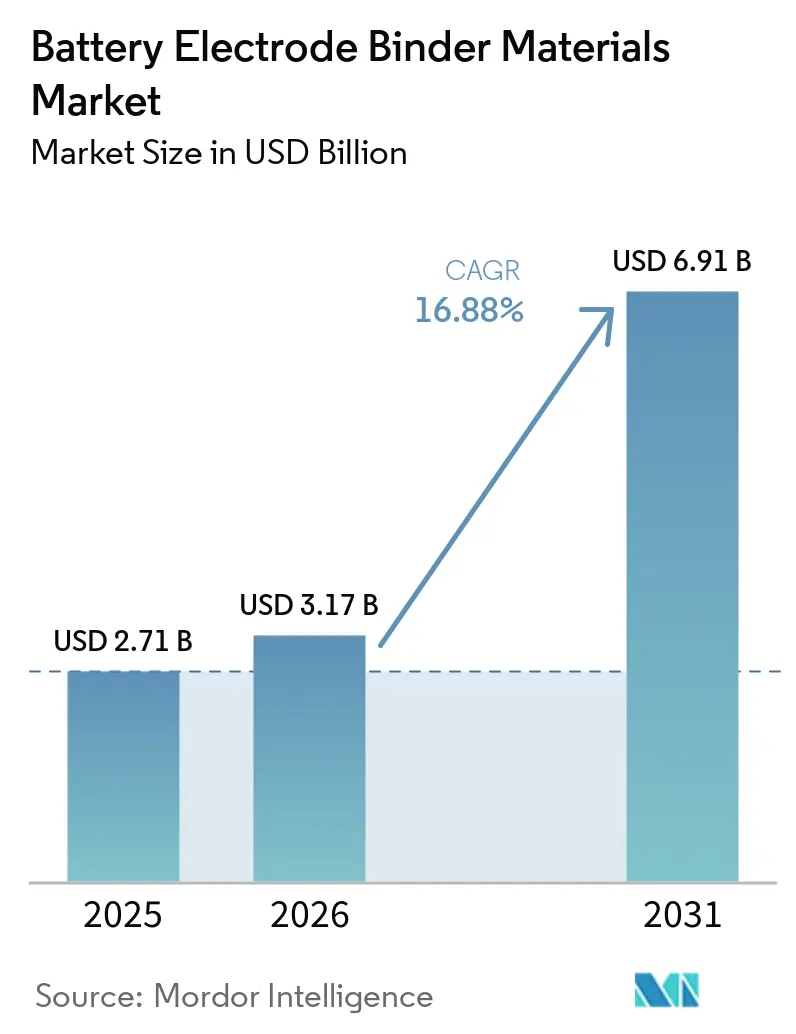
| Market Size (2026) | USD 3.17 Billion |
| Market Size (2031) | USD 6.91 Billion |
| Growth Rate (2026 - 2031) | 16.88 % |
| Fastest Growing Market | Asia-Pacific |
| Largest Market | Asia-Pacific |
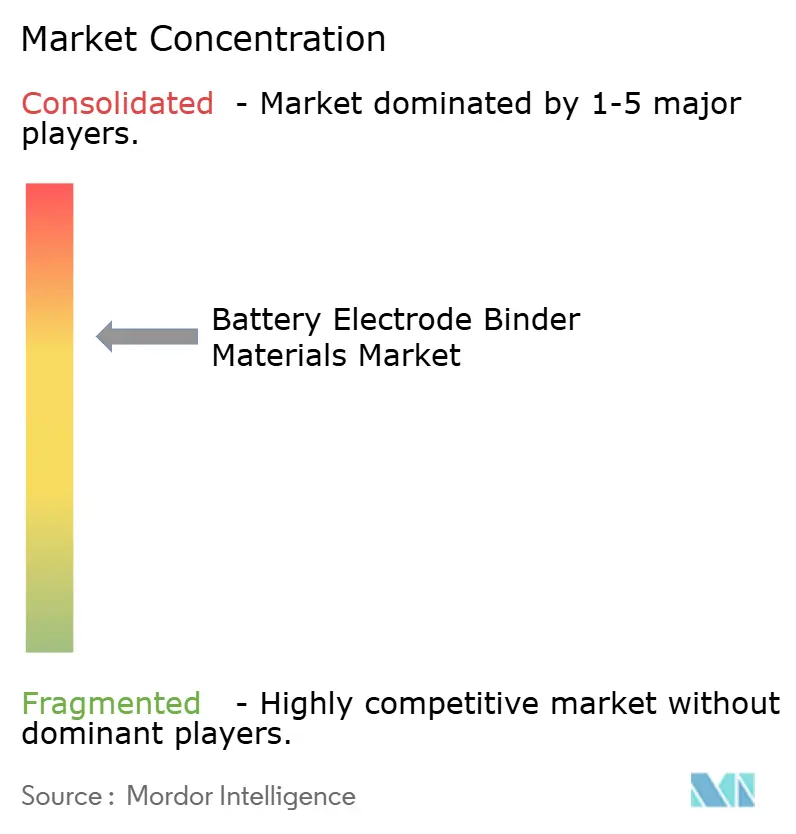
| Market Concentration | Medium |
Major Players *Disclaimer: Major Players sorted in no particular order Image © Mordor Intelligence. Reuse requires attribution under CC BY 4.0. | |
Battery Electrode Binder Materials Market Analysis by Mordor Intelligence
The Battery Electrode Binder Materials Market was valued at USD 2.71 billion in 2025 and is estimated to grow from USD 3.17 billion in 2026 to reach USD 6.91 billion by 2031, at a CAGR of 16.88% during the forecast period (2026–2031). Committed cell-factory additions for electric vehicles and stationary storage are expanding the need for qualified binder materials. The battery electrode binder materials market is also being shaped by the move toward silicon-containing anodes and high-nickel cathodes, which require binders with stronger adhesion and greater electrochemical stability. Electric-vehicle cells favor qualified Polyvinylidene Fluoride (PVDF) grades because manufacturers prioritize proven performance and consistent specifications. Stationary storage is increasing demand for aqueous Styrene-Butadiene Rubber/Carboxymethyl Cellulose (SBR/CMC) systems because these applications place more weight on cost and long cycle life. Supplier strategies, therefore, combine local capacity additions with application-specific product development and longer customer qualification programs.
Key Report Takeaways
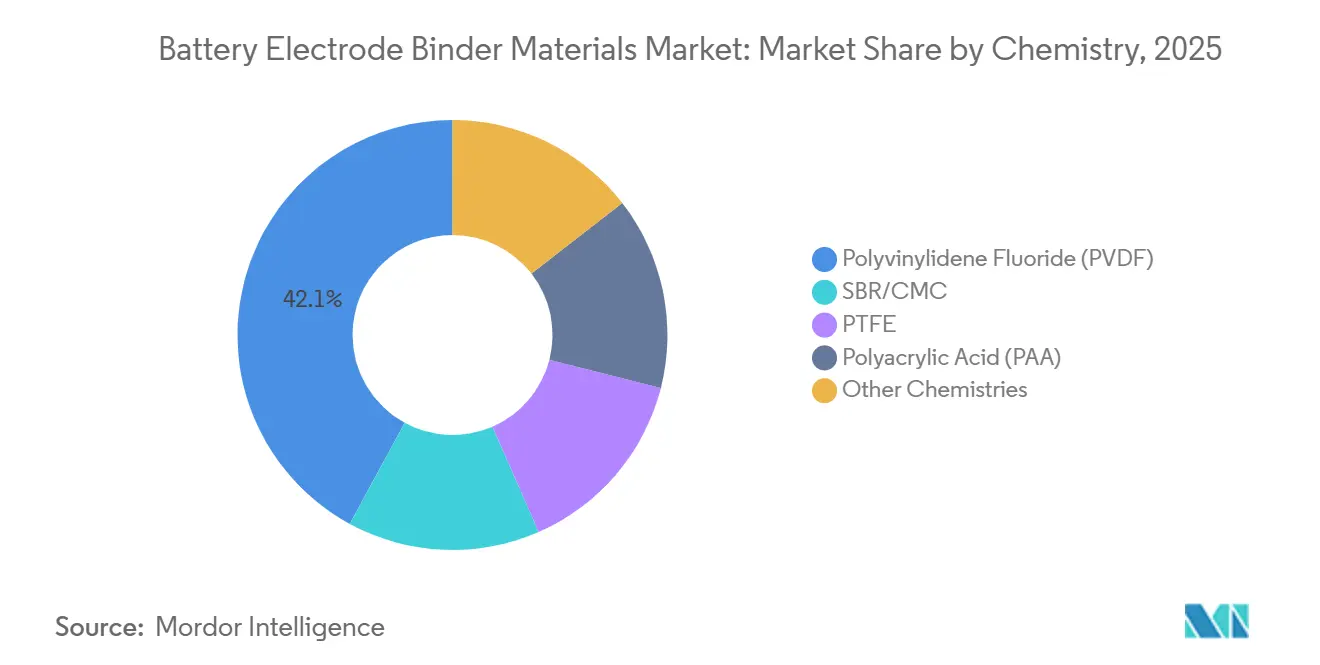
- By chemistry, Polyvinylidene Fluoride (PVDF) held 42.08% of the battery electrode binder materials market share in 2025, while SBR/CMC is forecast to grow at an 18.21% CAGR through 2031.
- By electrode type, cathode binders accounted for 59.67% of the battery electrode binder materials market share in 2025, while anode binders are projected to advance at an 18.33% CAGR through 2031.
- By battery chemistry, nickel manganese cobalt (NMC)/nickel cobalt aluminum (NCA) batteries held 48.73% of the battery electrode binder materials market share in 2025, while sodium-ion batteries are forecast to grow at a 17.89% CAGR through 2031.
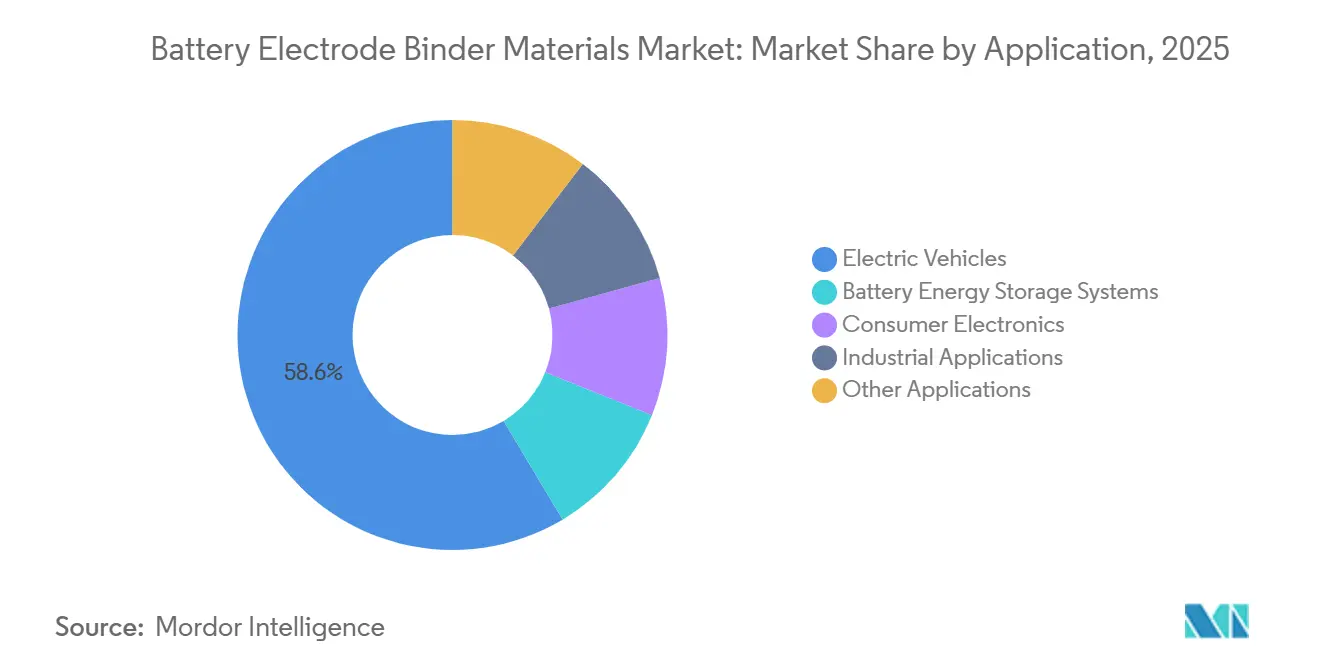
- By application, electric vehicles held 58.56% of the battery electrode binder materials market revenue share in 2025, while battery energy storage systems are projected to grow at a 19.05% CAGR through 2031.
- By geography, Asia-Pacific held 47.25% of the battery electrode binder materials market revenue share in 2025 and is projected to grow at an 18.17% CAGR through 2031.
Note: Market size and forecast figures in this report are generated using Mordor Intelligence’s proprietary estimation framework, updated with the latest available data and insights as of January 2026.
Market Trends and Insights
Drivers Impact Analysis of Battery Electrode Binder Materials Market*
| Driver | (~) % Impact on CAGR Forecast | Geographic Relevance | Impact Timeline |
|---|---|---|---|
| Electric Vehicle and Gigafactory Capacity Expansion | +5.8% | Global, concentrated in Asia-Pacific, North America & EU | Short term (≤ 2 years) |
| Grid-Scale Battery Energy Storage Deployment | +4.2% | Global, largest near-term gains in US, China & EU | Short term (≤ 2 years) |
| Silicon-Rich Anode Qualification Requirements | +2.1% | North America, EU, Asia-Pacific (Korea, Japan) | Medium term (2–4 years) |
| Demand for High-Voltage and High-Nickel Cathode Stability | +1.6% | Asia-Pacific (Korea, Japan), North America, EU | Medium term (2–4 years) |
| Water-Based Electrode Manufacturing Adoption | +1.5% | Global | Medium term (2–4 years) |
| Dry-Electrode Process Commercialization | +1.4% | Asia-Pacific (Korea), North America, EU | Long term (≥ 4 years) |
| Source: Mordor Intelligence | |||
Electric Vehicle and Gigafactory Capacity Expansion
Committed cell-factory capacity additions continue to provide a clear demand base for the battery electrode binder materials market. Each new production line needs qualified binder supply arrangements before commercial cell output begins. U.S. developers plan to add 24 GW of utility-scale battery storage in 2026 after adding 15 GW in 2025, adding stationary demand alongside electric-vehicle cell manufacturing[1]U.S. Energy Information Administration, “U.S. Battery Storage Developers Plan a Record 24 Gigawatts in 2026,” U.S. Energy Information Administration, eia.gov. Arkema completed a 15% PVDF capacity expansion at Calvert City, Kentucky, in June 2026 to support the North American battery ramp. Regional qualified supply still trails announced cell capacity in some locations. This gap supports demand for locally produced and approved binder grades during the current qualification cycle.
Grid-Scale Battery Energy Storage Deployment
Grid-scale storage is creating a separate demand base within the battery electrode binder materials market. These systems require long service life and cost discipline, which favors aqueous CMC/SBR binder configurations for many lithium iron phosphate (LFP) cells. Battery energy storage systems are projected to grow at a 19.05% CAGR through 2031. Operators commonly prioritize cycle life, throughput, and material cost rather than energy density or fast-charge performance. A study in Nature Communications reported that a kosmotropic aqueous process could reduce cathode manufacturing operating costs by 23% and related capital costs by 95% compared with NMP-based processing. This manufacturing path can widen the role of water-based processing as storage deployments expand.
Silicon-Rich Anode Qualification Requirements
Silicon-graphite anodes can expand by up to 300% during lithiation, placing greater stress on binder systems. Standard CMC/SBR and homopolymer PVDF formulations need modification for these anodes. BASF and Group14 Technologies reported in May 2025 that the Licity 2698 X F binder supported cells exceeding 1,000 cycles at room temperature with 80% capacity retention. A review of silicon-anode binders found that water-based materials with carboxyl or hydroxyl groups can form stronger interactions with silicon surfaces than PVDF. These requirements favor co-developed formulations and longer validation periods rather than interchangeable grades.
Dry-Electrode Process Commercialization
Dry-electrode processing removes NMP solvent and energy-intensive drying steps from electrode manufacturing. LG Energy Solution plans mass production by 2029 and expects the process to reduce the cell-factory footprint by more than 30%. The process requires polytetrafluoroethylene (PTFE)-based or fibrillatable binders that can form self-supporting electrode films under shear. This differs from the soluble PVDF grades used in conventional slurry processing. Pilot work by major cell producers is making dry-process binder capability a relevant product-development focus. The battery electrode binder materials market may therefore see new qualification opportunities as dry-electrode lines move beyond pilot scale.
Restraints Impact Analysis of Battery Electrode Binder Materials Market*
| Restraint | (~) % Impact on CAGR Forecast | Geographic Relevance | Impact Timeline |
|---|---|---|---|
| High Binder Qualification and Switching Costs | -3.2% | Global, most acute in North America & EU | Medium term (2–4 years) |
| Fluoropolymer Feedstock and Supply Concentration | -2.5% | Global, concentrated in China & EU | Short term (≤ 2 years) |
| Performance Trade-Offs in Emerging Binder Systems | -1.8% | Global | Medium term (2–4 years) |
| Uncertain Scale-Up Timing for Dry-Electrode Lines | -1.4% | Asia-Pacific, North America, EU | Long term (≥ 4 years) |
| Source: Mordor Intelligence | |||
Fluoropolymer Feedstock and Supply Concentration
Battery-grade PVDF supply remains concentrated among a limited group of qualified manufacturers. Upstream dependence on R142b can lead to periodic procurement pressure for PVDF-based binder systems. The European Chemicals Agency is due to provide final committee opinions on the proposed per- and polyfluoroalkyl substances (PFAS) restriction to the European Commission in 2026[2]European Chemicals Agency, “ECHA Update on PFAS Restriction,” European Chemicals Agency, echa.europa.eu. The current proposal includes a 13.5-year derogation for energy-sector battery-binder uses under Registration, Evaluation, Authorization, and Restriction of Chemicals (REACH). This regulatory review is encouraging European cell producers to consider fluorine-free cathode-binder options. Kureha is expanding Iwaki Factory capacity by 8,000 metric tons per year, with commercial operation scheduled for fiscal 2026.
High Binder Qualification and Switching Costs
New binder qualification can require 18 to 36 months of electrochemical testing, safety validation, and process integration. The length of this process slows the adoption of alternative chemistries even when laboratory performance is strong. A material change can also require new procurement terms and modifications to slurry handling or pH-control practices. A 2025 Nano-Micro Letters study noted that emerging cathode binders must demonstrate reliable performance across multiple operating conditions before validation programs accept them. These favors approved suppliers for existing platforms. New platforms and greenfield factories provide the clearest opening for alternative binder systems.
*Our forecasts treat driver/restraint impacts as directional, not additive. The impact forecasts reflect baseline growth, mix effects, and variable interactions.
Battery Electrode Binder Materials Market Segment Analysis
By Chemistry:
PVDF Incumbency Coexists with SBR/CMC AccelerationPVDF held 42.08% of the battery electrode binder materials market share by chemistry in 2025. Its position reflects a long qualification history in lithium-ion cells and the stability requirements of high-nickel cathodes. PVDF remains particularly relevant where cathode formulations require proven electrochemical performance. Arkema’s Kynar HSV 1200 and HSV 1400 products target LFP cathodes with improved adhesion and lower binder loading. This approach allows suppliers to improve established chemistry for newer cathode designs. The battery electrode binder materials industry continues to rely on PVDF for many qualified cathode platforms.
SBR/CMC is forecast to grow at an 18.21% CAGR through 2031. Its growth reflects the transition toward water-based anode processing and compatibility with graphite and silicon-graphite anodes. BASF’s production footprint supports supply to both Asian and Western cell producers. PTFE is gaining attention in dry-electrode pilot programs because it fibrillates under mechanical shear. PAA-based binders also offer a route to aqueous processing for high-nickel cathodes. The Nature Communications study reported comparable cycle life for several NMC cathodes using a kosmotropic aqueous process, with 96% lower material cost than NMP-based processing.


By Electrode Type:
Cathode Binders Lead, Anode Binders Drive Innovation ActivityCathode binders accounted for 59.67% of the battery electrode binder materials market revenue share in 2025. Higher material loading and the premium economics of PVDF-based systems supported this leading position. Cathode formulations also involve durable qualification relationships between cell producers and approved suppliers. The battery electrode binder materials market size for cathode binders is supported by high-nickel cells that require stable performance at demanding voltages. Research on PVDF-graft-PAA binder networks points to improvements in toughness, elasticity, and lithium-ion transport for NMC811 cathodes. These results can influence the criteria for next-generation cathode qualification.
Anode binders are projected to grow at an 18.33% CAGR through 2031. Silicon adoption and sodium-ion scale-up are increasing the demand for more specialized anode formulations. Primearth EV Energy adopted Resonac’s POLYSOL LB polyamide-imide binder for Toyota hybrid-vehicle batteries in April 2024. The material can tolerate up to 30% silicon active-material content while maintaining electrode integrity. UBE has also presented a water-soluble polyimide binder for silicon-based anodes. These products show a shift away from treating anode binders as standard graphite-only materials.
By Battery Chemistry:
NMC/NCA Batteries Anchor Demand While Sodium-Ion Batteries Open New Chemistry RequirementsNMC/NCA batteries held 48.73% of the battery electrode binder materials market revenue share by battery chemistry in 2025. Their cathode specifications, including high-voltage NMC811 and NMC9-series designs, set demanding requirements for premium binder systems. A 2025 study reported 86.4% capacity retention for a sulfonyl-ether polyimide binder in NMC811 half-cells after 100 cycles at 4.3 V, compared with 70% for PVDF. LFP and lithium manganese iron phosphate (LMFP) cells support demand through stationary storage and cost-sensitive electric vehicles. Kureha has identified major Chinese battery manufacturers as customers consuming 15,000 to 20,000 metric tons of PVDF annually per company.
Sodium-ion batteries are forecast to grow at a 17.89% CAGR through 2031. Their higher alkalinity can cause PVDF defluorination, which can weaken adhesion and electrochemical stability. This creates a clear need for fluorine-free binder development in sodium-ion cathodes. Polyethylene oxide and cellulose triacetate systems are being studied for their adhesion and ion-conductivity potential. Solid-state batteries also represent a future opportunity for specialty binder materials. BASF introduced Oppanol N PLUS in June 2026 for solid-state cathode, anode, and electrolyte applications.
By Application:
Electric Vehicles Command Revenue, Battery Energy Storage Systems Momentum Forces Strategic AttentionElectric vehicles held 58.56% of the application segment in 2025. They remain the primary source for PVDF cathode binders and silicon-anode development work. High-volume cell programs depend on stable material supply and multi-stage approval processes. Consumer electronics are a more mature application, although high-voltage silicon-carbon anodes in premium smartphones create specialized demand. Syensqo reported commercial deployment of Energain SA076 in lithium cobalt oxide (LCO)/Si-C cells operating above 4.53 V. Industrial, medical, aerospace, and marine applications remain smaller but can require high-reliability binder grades.
Battery energy storage systems (BESS) are forecast to grow at a 19.05% CAGR through 2031. The battery electrode binder materials market size for this application is supported by long-cycle LFP configurations that favor cost-effective aqueous binder systems. BESS operators prioritize 5,000 or more charge-discharge cycles, processability, and cost per kilogram. Synthomer has positioned its LITEX LB SBR binder range for long duty cycles and electrode integrity in these systems. The application expands demand beyond electric-vehicle qualification cycles. It also increases the commercial relevance of water-based processing for cathodes and anodes.
Geography Analysis
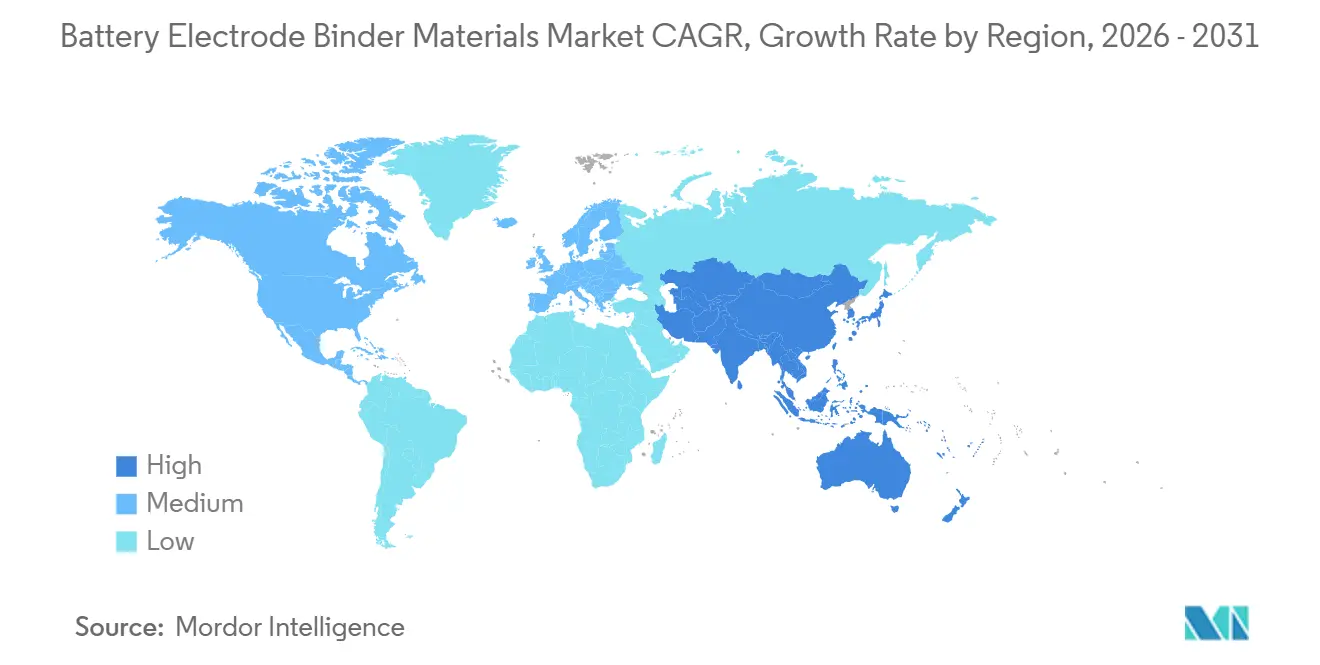
APAC Battery Electrode Binder Materials Market
Asia-Pacific held 47.25% of the battery electrode binder materials market revenue share in 2025 and is forecast to grow at an 18.17% CAGR through 2031. Chinese production clusters in the Yangtze River Delta and Pearl River Delta are important consumption centers for PVDF and SBR/CMC. Kureha has cited annual PVDF consumption of 15,000 to 20,000 metric tons for individual Chinese battery manufacturers. South Korea and Japan play an important role in setting qualification requirements for NMC811 and silicon-graphite binder systems.
APAC, North America and Europe Battery Electrode Binder Materials Market
Arkema announced a 20% PVDF capacity expansion at Changshu, China, in March 2026, with startup planned for 2028. India is scaling battery manufacturing through production-linked incentive programs. ASEAN markets are also attracting early battery-assembly activity linked to electric-vehicle policies. North America and Europe are adding local production capacity to address localization and compliance requirements. Arkema completed its USD 20 million Calvert City PVDF expansion in June 2026. BASF established Licity anode-binder production capability in Monaca, Pennsylvania, and Chattanooga, Tennessee, in March 2025.
EMEA and South America Battery Electrode Binder Materials Market
The EU Batteries Regulation requires battery due-diligence policies from February 2025 and introduces battery passport requirements from 2026. These rules affect qualification and traceability practices in European supply chains. Syensqo is developing an Augusta, South Carolina PVDF site with Orbia to supply Western demand. South America, and Middle-East and Africa currently represent smaller demand centers. Brazil, Argentina, South Africa, and Saudi Arabia have longer-term relevance through battery supply-chain plans, mineral resources, and energy-storage investment. These areas offer early qualification opportunities but are not expected to change the global balance through 2031.

Competitive Landscape
The battery electrode binder materials market is moderately concentrated, with the top five players including Arkema, BASF, KUREHA CORPORATION, Syensqo, and ZEON CORPORATION. Suppliers in the battery electrode binder materials market are investing in capacity and product development to serve gigafactory demand. Arkema completed its Kentucky expansion in June 2026. Kureha’s Iwaki expansion targets an additional 8,000 metric tons per year.
Leading suppliers are also using contract coverage and regional production to strengthen their positions. This battery electrode binder materials market also rewards suppliers that can provide qualified grades near new cell plants. Syensqo signed multi-year Solef PVDF contracts with automotive original equipment manufacturers (OEMs) and battery manufacturers totaling more than EUR 150 million in cumulative net sales during Q1 2025. Its North American facility development with Orbia supports supply closer to Western cell plants. BASF is building a global production base for Licity anode binders, including U.S. manufacturing. These moves are intended to support qualification continuity and local supply requirements. They also show that supplier competition extends beyond capacity to application support and product validation.
Silicon anode binders and aqueous cathode processing remain areas without a single validated commercial leader. Daikin’s POLYFLON BDP supports solvent-free dry-electrode processing for conventional lithium-ion and solid-state batteries. BASF’s Oppanol N PLUS provides an early commercial product for solid-state battery components. Specialty polyimide and bio-based binder developers are also targeting silicon-anode and sodium-ion applications. Co-development with cell manufacturers can create durable supplier positions before wider qualification occurs. The battery electrode binder materials market remains competitive because approved supply relationships can be difficult to replace.
Battery Electrode Binder Materials Industry Leaders
Arkema
BASF
KUREHA CORPORATION
Syensqo
ZEON CORPORATION
- *Disclaimer: Major Players sorted in no particular order
Battery Electrode Binder Materials Market Companies Covered in this Report
- Arkema
- Ashland
- BASF
- DAIKIN INDUSTRIES, Ltd.
- ENEOS Materials Corporation
- KUREHA CORPORATION
- LG Chem
- Resonac Holdings Corporation
- SUMITOMO SEIKA CHEMICALS CO.,LTD.
- Syensqo
- Synthomer plc
- The Chemours Company
- UBE Corporation
- ZEON CORPORATION

Recent Industry Developments in Battery Electrode Binder Materials Market
- June 2026: Arkema completed a 15% PVDF capacity expansion at its Calvert City, Kentucky, facility. The expansion supports growing demand for lithium-ion batteries in electric vehicles (EVs) and energy storage systems, strengthening Arkema's PVDF supply position in North America.
- June 2026: BASF introduced Oppanol N PLUS, a polyisobutene-based binder developed for solid-state battery cathode, anode, and electrolyte applications. The product is designed for solid-state platforms that require a longer driving range and improved safety.


Global Battery Electrode Binder Materials Market Report Scope
Battery electrode binder materials are polymeric materials that bind active materials and conductive additives to the current collector, ensuring mechanical integrity and stable electrochemical performance within battery electrodes. They play a critical role in enhancing battery durability, energy density, cycle life, and manufacturing efficiency across a wide range of rechargeable battery technologies.
The Battery Electrode Binder Materials Market is segmented by chemistry, electrode type, battery chemistry, application, and geography. By chemistry, the market is segmented into polyvinylidene fluoride (PVDF), SBR/CMC, PTFE, polyacrylic acid (PAA), and other chemistries (including alginate, bio-based, and other fluorine-free binders). By electrode type, the market is segmented into cathode binders and anode binders. By battery chemistry, the market is segmented into NMC/NCA batteries, LFP/LMFP batteries, sodium-ion batteries, solid-state batteries, and other battery chemistries (including LCO, LMO, lead-acid, and emerging chemistries). By application, the market is segmented into electric vehicles, battery energy storage systems, consumer electronics, industrial applications, and other applications. The report also covers the market size and forecasts for battery electrode binder materials in 16 countries across major regions. For each segment, the market sizing and forecasts have been done on the basis of value (USD).
| Polyvinylidene Fluoride (PVDF) |
| SBR/CMC |
| PTFE |
| Polyacrylic Acid (PAA) |
| Other Chemistries (Alginate, Bio-based, Other Fluorine-Free Binders) |
| Cathode Binders |
| Anode Binders |
| NMC/NCA Batteries |
| LFP/LMFP Batteries |
| Sodium-Ion Batteries |
| Solid-State Batteries |
| Other Battery Chemistries (LCO, LMO, Lead-Acid and Emerging Chemistries) |
| Electric Vehicles |
| Battery Energy Storage Systems |
| Consumer Electronics |
| Industrial Applications |
| Other Applications |
| Asia-Pacific | China |
| India | |
| Japan | |
| South Korea | |
| ASEAN Countries | |
| Rest of Asia-Pacific | |
| North America | United States |
| Canada | |
| Mexico | |
| Europe | Germany |
| United Kingdom | |
| France | |
| Italy | |
| NORDIC Countries | |
| Russia | |
| Rest of Europe | |
| South America | Brazil |
| Argentina | |
| Rest of South America | |
| Middle-East and Africa | Saudi Arabia |
| South Africa | |
| Rest of Middle-East and Africa |
| By Chemistry | Polyvinylidene Fluoride (PVDF) | |
| SBR/CMC | ||
| PTFE | ||
| Polyacrylic Acid (PAA) | ||
| Other Chemistries (Alginate, Bio-based, Other Fluorine-Free Binders) | ||
| By Electrode Type | Cathode Binders | |
| Anode Binders | ||
| By Battery Chemistry | NMC/NCA Batteries | |
| LFP/LMFP Batteries | ||
| Sodium-Ion Batteries | ||
| Solid-State Batteries | ||
| Other Battery Chemistries (LCO, LMO, Lead-Acid and Emerging Chemistries) | ||
| By Application | Electric Vehicles | |
| Battery Energy Storage Systems | ||
| Consumer Electronics | ||
| Industrial Applications | ||
| Other Applications | ||
| By Geography | Asia-Pacific | China |
| India | ||
| Japan | ||
| South Korea | ||
| ASEAN Countries | ||
| Rest of Asia-Pacific | ||
| North America | United States | |
| Canada | ||
| Mexico | ||
| Europe | Germany | |
| United Kingdom | ||
| France | ||
| Italy | ||
| NORDIC Countries | ||
| Russia | ||
| Rest of Europe | ||
| South America | Brazil | |
| Argentina | ||
| Rest of South America | ||
| Middle-East and Africa | Saudi Arabia | |
| South Africa | ||
| Rest of Middle-East and Africa | ||


Key Questions Answered in the Report
What is the size of the battery electrode binder materials market?
The battery electrode binder materials market size stands at USD 3.17 billion in 2026 and is forecast to reach USD 6.91 billion by 2031.
Which chemistry is expected to grow fastest through 2031?
SBR/CMC is forecast to grow at an 18.21% CAGR through 2031, supported by water-based anode processing.
Why are cathode binders important for lithium-ion cells?
Cathode binders held 59.67% of the battery electrode binder materials market share in 2025 because cathode systems use higher-value materials and demanding, qualified formulations.
Which application is expected to grow fastest through 2031?
Battery energy storage systems are projected to grow at a 19.05% CAGR through 2031, supported by demand for long-cycle LFP cell configurations.
Page last updated on:


 Your data is secure and never sold or shared.


