
Batter And Breader Premixes Market Size and Share
Market Overview
| Study Period | 2021 - 2031 |
|---|---|
| Market Size (2026) | USD 3.16 Billion |
| Market Size (2031) | USD 4.27 Billion |
| Growth Rate (2026 - 2031) | 6.20 % |
| Fastest Growing Market | Asia Pacific |
| Largest Market | North America |
| Market Concentration | Medium |
Major Players.webp)
*Disclaimer: Major Players sorted in no particular order Image © Mordor Intelligence. Reuse requires attribution under CC BY 4.0. |
|
Batter And Breader Premixes Market Analysis by Mordor Intelligence
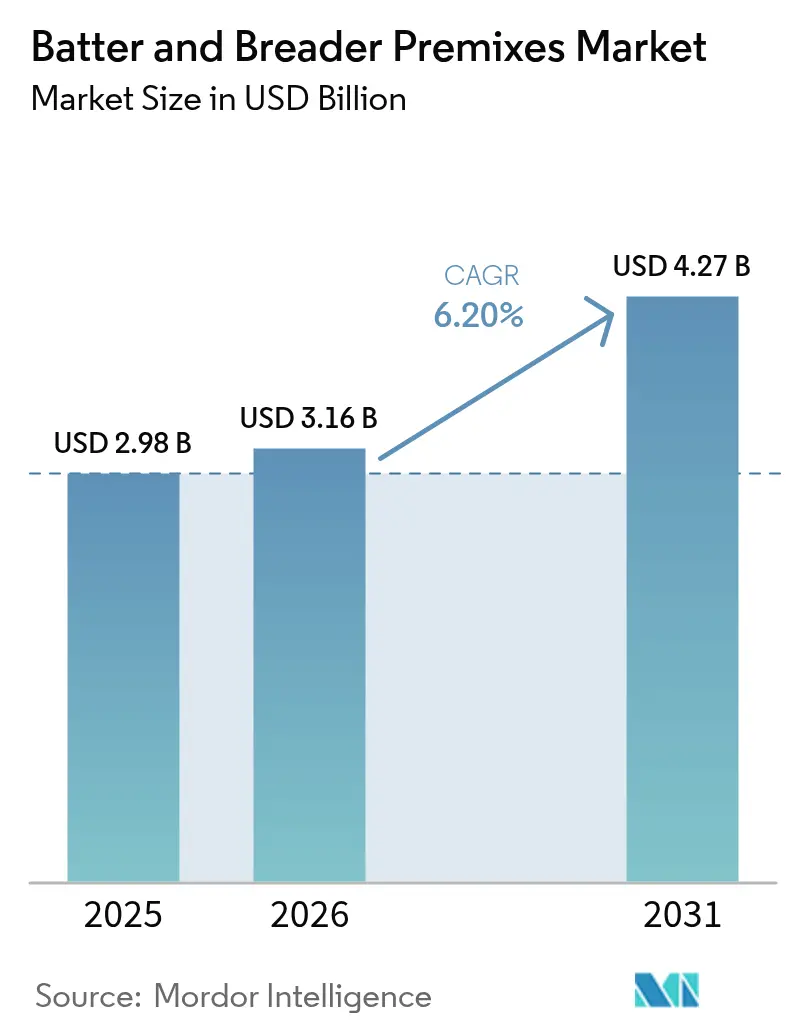
The batter and breader premixes market size is expected to grow from USD 2.98 billion in 2025 to USD 3.16 billion in 2026 and is forecast to reach USD 4.27 billion by 2031 at 6.20% CAGR over 2026-2031. The significant expansion of quick-service restaurant menus globally has intensified the demand for high-performance coating formulations that maintain consistent texture and appearance during large-scale food production operations. The substantial growth in frozen and ready-to-cook meal segments has prompted suppliers to develop advanced starch-based systems that effectively maintain crispness after reheating while demonstrating resilience through multiple freeze-thaw cycles. The increasing disposable income levels in emerging economies have facilitated the introduction of premium coating formulations that deliver superior adhesion properties alongside enhanced taste, texture, and visual appeal. In response to market volatility, manufacturers are implementing comprehensive vertical integration strategies and establishing long-term commodity hedging mechanisms to effectively manage wheat price fluctuations and preserve operating margins across their production cycles.
Key Report Takeaways
- By batter type, adhesion batters held 47.02% revenue share of the batter and breader premixes market in 2025, while coating batters are projected to register the fastest 7.42% CAGR through 2031.
- By breader type, American-style crumbs led with 50.86% revenue share in 2025; Japanese Panko crumbs are expected to expand at a 9.08% CAGR to 2031.
- By application, processed meat and seafood accounted for 48.44% revenue share of the batter and breader premixes market in 2025; savory snacks are forecast to grow at a 6.32% CAGR between 2026 and 2031.
- By geography, North America dominated with a 36.16% share in 2025, whereas Asia-Pacific is set to post the highest 8.18% CAGR through 2031.
Note: Market size and forecast figures in this report are generated using Mordor Intelligence’s proprietary estimation framework, updated with the latest available data and insights as of 2026.
Market Trends and Insights
Drivers Impact Analysis of Batter And Breader Premixes Market*
| Driver | (~) % Impact on CAGR Forecast | Geographic Relevance | Impact Timeline |
|---|---|---|---|
| Growing demand for convenience, frozen, and ready-to-cook meals | +1.8% | Global, with concentration in North America & Europe | Medium term (2-4 years) |
| Expansion of quick-service restaurants (QSRs) and food-service chains | +1.2% | APAC core, spill-over to MEA and Latin America | Long term (≥ 4 years) |
| Rising consumption of processed meat and seafood products | +0.9% | Global, particularly strong in North America & APAC | Medium term (2-4 years) |
| Growth in global snacking culture and popularity of finger foods | +0.7% | Global, led by urban centers in developed markets | Short term (≤ 2 years) |
| Increasing consumer preference for enhanced taste and texture in coated foods | +0.6% | North America & Europe, expanding to APAC | Medium term (2-4 years) |
| Rise in demand for specialty coating systems for plant-based protein products | +0.5% | North America & Europe, early adoption in urban APAC | Long term (≥ 4 years) |
| Source: Mordor Intelligence | |||
Growing Demand for Convenience, Frozen, and Ready-to-Cook Meals
The growth of convenience foods has led manufacturers to adjust coating systems to maintain quality during freeze-thaw cycles and ensure good texture after reheating. Conagra's Future of Frozen Food 2025 report states that the U.S. frozen food market has grown to USD 91.3 billion, with rising demand for air fryer-compatible products requiring specific coating methods. This shift has driven the creation of modified starch-based coating systems that prevent moisture loss and keep food crisp during frozen storage. The FDA's approval of food starch-modified formulations for batter applications provides the regulatory framework for manufacturers to improve texture retention [1]Organisation for Economic Co-operation and Development, "Household disposable income" oecd.org. Current coating technologies use nano-emulsion systems and composite materials to enhance barrier properties, meeting consumer expectations for high-quality frozen food. These advancements help coating manufacturers benefit from consumers' willingness to pay more for premium convenience foods.
Expansion of Quick-Service Restaurants (QSRs) and Food-Service Chains
Quick-service restaurant (QSR) chains are increasingly adopting coating systems that ensure consistent food preparation across different markets and workforce skill levels. This trend has increased the demand for premixed coatings that provide uniform results despite variations in local preparation methods. US Foods' 2024 product line includes Taiwanese-style salt and pepper popcorn chicken with a light coating and par-fried preparation, which reduces preparation time by 40% while maintaining menu flexibility. QSRs are implementing coating systems that combine multiple functions - adhesion, texture, flavor enhancement, and appearance - in a single application step. As QSR chains expand into new markets, they require coating systems that balance local flavor preferences with brand consistency. Recent patents in coating formulations indicate the industry's focus on developing adaptable systems that maintain operational efficiency across markets with varying labor costs and workforce capabilities.
Rising Consumption of Processed Meat and Seafood Products
The processed meat industry has shifted toward premium products, increasing the demand for coating systems that enhance taste and texture while ensuring meat preservation. FDA regulations require frozen breaded shrimp to contain at least 65% shrimp content, which has led manufacturers to develop coating systems that optimize product value within regulatory limits. These regulations have driven innovations in coating efficiency, as manufacturers aim to achieve maximum sensory benefits with minimal coating usage. Manufacturers face the technical challenge of developing coating systems that perform consistently across various protein bases, including conventional meat, fish, and plant-based alternatives. Modern coating formulations incorporate functional proteins, such as zein and modified wheat proteins, to improve binding capabilities and nutritional content while meeting clean-label demands.
Growth in Global Snacking Culture and Popularity of Finger Foods
Changes in snacking preferences have transformed coating system requirements, with emphasis on convenience, cleanliness during consumption, and aesthetic appeal. Mini portions show consistent year-over-year growth, as reported by Conagra, reflecting consumers' shift toward smaller, more frequent meals that include coated finger foods. This consumer behavior has prompted the development of coating systems specifically engineered for handheld foods, featuring enhanced coating adhesion and regulated oil migration during storage. Visual appearance has become essential, driving manufacturers to create coating systems that maintain uniform color and texture under different lighting conditions. Technological developments focus on coating systems that provide stronger flavor profiles and superior mouthfeel in smaller portions to meet consumer expectations.
Restraints Impact Analysis of Batter And Breader Premixes Market*
| Restraint | (~) % Impact on CAGR Forecast | Geographic Relevance | Impact Timeline |
|---|---|---|---|
| Volatility in raw-material prices | -0.8% | Global, particularly acute in regions dependent on wheat imports | Short term (≤ 2 years) |
| Price sensitivity among mass food-service operators | -0.6% | Emerging markets and cost-focused segments globally | Medium term (2-4 years) |
| Stringent regulatory standards on food additives and labeling | -0.4% | North America and Europe, expanding to APAC | Long term (≥ 4 years) |
| Consumer concerns over artificial ingredients and preservatives in premixes | -0.3% | Developed markets, urban centers in emerging economies | Medium term (2-4 years) |
| Source: Mordor Intelligence | |||
Volatility in Raw-Material Prices
Raw material price volatility affects the coating supply chain, as wheat flour price fluctuations impact product margins and customer relationships. Coating manufacturers have responded by developing new formulations that incorporate alternative starches and protein sources to reduce wheat flour dependency. Global commodity market factors, including weather conditions, trade policies, and currency fluctuations, create variable cost structures that affect long-term customer agreements. Ingredion's 2024 financial results demonstrated this impact, with favorable pricing in multi-year contracts driving 74% operating income growth in their Food and Industrial Ingredients segment. Companies manage price risk through procurement strategies that include derivative instruments and diversified supply sources. Research and development efforts focus on creating flexible coating systems that enable ingredient substitutions while maintaining product performance.
Price Sensitivity Among Mass Food-Service Operators
The foodservice industry's margin pressures have created a market segmentation between premium and economy coating systems. Quick-service restaurants require coatings that enhance protein quality perception while maintaining cost efficiency. Manufacturers have responded by developing formulations that deliver consistent results across different protein qualities. The industry has incorporated functional ingredients, including modified starches and protein concentrates, in coating systems to improve yield and reduce waste, lowering per-serving costs. Coating systems must also offer simple application methods and consistent results to reduce training needs and operational complexity. In response to operational cost concerns and consumer health preferences, manufacturers have developed coating systems optimized for air frying applications.
*Our forecasts treat driver/restraint impacts as directional, not additive. The impact forecasts reflect baseline growth, mix effects, and variable interactions.
Batter And Breader Premixes Market Segment Analysis
By Breader Type:
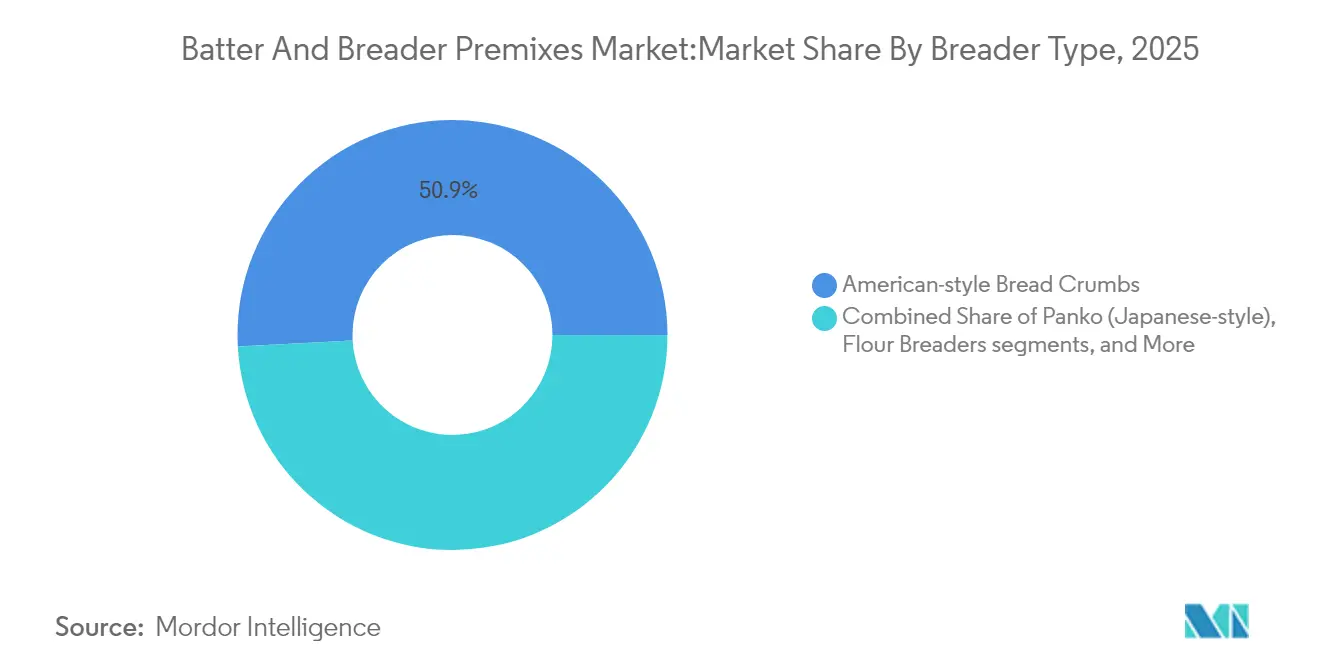
American-Style Dominance Faces Asian Innovation ChallengeAmerican-style bread crumbs held a 50.86% market share in 2025, supported by established supply chains and widespread adoption in major food service markets. Panko Japanese-style breaders are growing at 9.08% CAGR through 2031, driven by consumer demand for their lighter, crispier texture. This growth indicates changing consumer preferences, with texture becoming a significant factor in coated food products. Manufacturing advancements have enabled the mass production of Panko while preserving its characteristic airy structure that provides superior crispness and controlled oil absorption.
Flour breaders serve a specific purpose in applications that require thin coatings, particularly in products where the protein component needs to remain prominent. The premium segment comprises specialty and seasoned breadcrumbs, which incorporate herbs, spices, and functional ingredients to enhance both flavor and appearance. The market is segmented between basic commodity applications and premium products that emphasize sensory attributes.


By Application:
Processed Proteins Drive Volume While Snacks Capture GrowthProcessed meat and seafood products dominate the coating systems market with a 48.44% share in 2025. These systems enhance product value and extend shelf life for protein products. The segment's prominence results from coating systems' effectiveness in improving yield, minimizing cooking losses, and delivering consistent sensory attributes across varying protein qualities. Savory snacks represent the fastest-growing application segment, with a projected CAGR of 6.32% through 2031. This growth reflects the expansion of snacking culture and increased demand for portable, clean-consumption formats enabled by coating systems. The market shows a shift from traditional meal applications toward frequent, smaller consumption occasions favoring coated snack foods.
Coating systems in frozen and ready-to-eat meals maintain structural integrity during freeze-thaw cycles and ensure optimal texture after reheating. Research by Conagra indicates that air fryer compatibility drives growth in frozen foods, leading to the development of specific coating systems for air fryer preparation. In bakery products, coatings function as moisture barriers and enhance texture, while in plant-based proteins, they provide specialized formulations for desired sensory attributes. These applications showcase how coating systems deliver multiple benefits, including product protection, texture enhancement, flavor delivery, and visual appeal across various food categories.
By Batter Type:
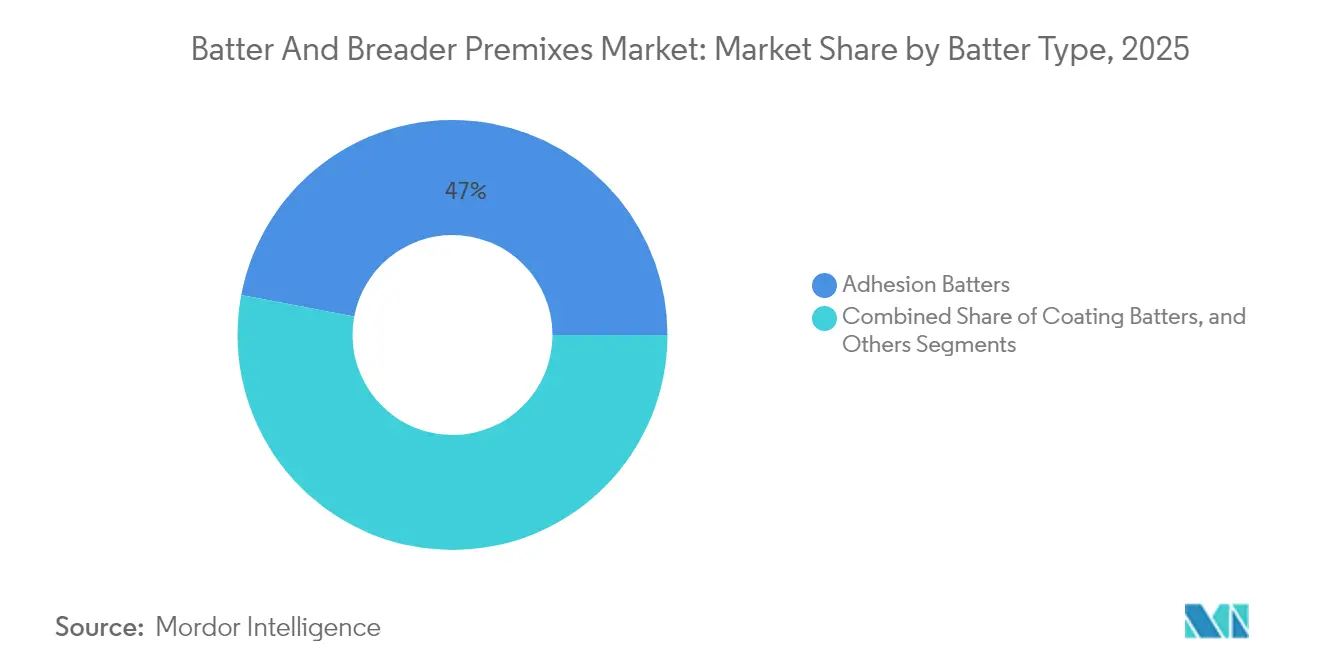
Adhesion Systems Lead Market FoundationAdhesion batters held a 47.02% market share in 2025, demonstrating their essential role in maintaining coating integrity across various protein substrates and cooking methods. These systems prevent coating separation during processing, storage, and consumption, making them essential for large-scale food manufacturing operations. Coating batters, while currently holding a smaller market share, are projected to grow at 7.42% CAGR through 2031. This growth is driven by increasing consumer demand for enhanced texture and visual appeal in coated foods, indicating a shift toward premium product positioning.
Recent developments in adhesion batter formulations focus on maintaining binding effectiveness across varying moisture conditions and protein types, particularly in plant-based protein applications. These formulations include modified starch systems that work effectively with both animal proteins and plant-based alternatives. The remaining batter types present opportunities in specialized applications, including gluten-free and clean-label systems for specific dietary needs. This evolution aligns with food industry trends toward customization, where manufacturers balance functional performance with natural ingredients and improved sensory attributes.
Geography Analysis
North America Batter And Breader Premixes Market
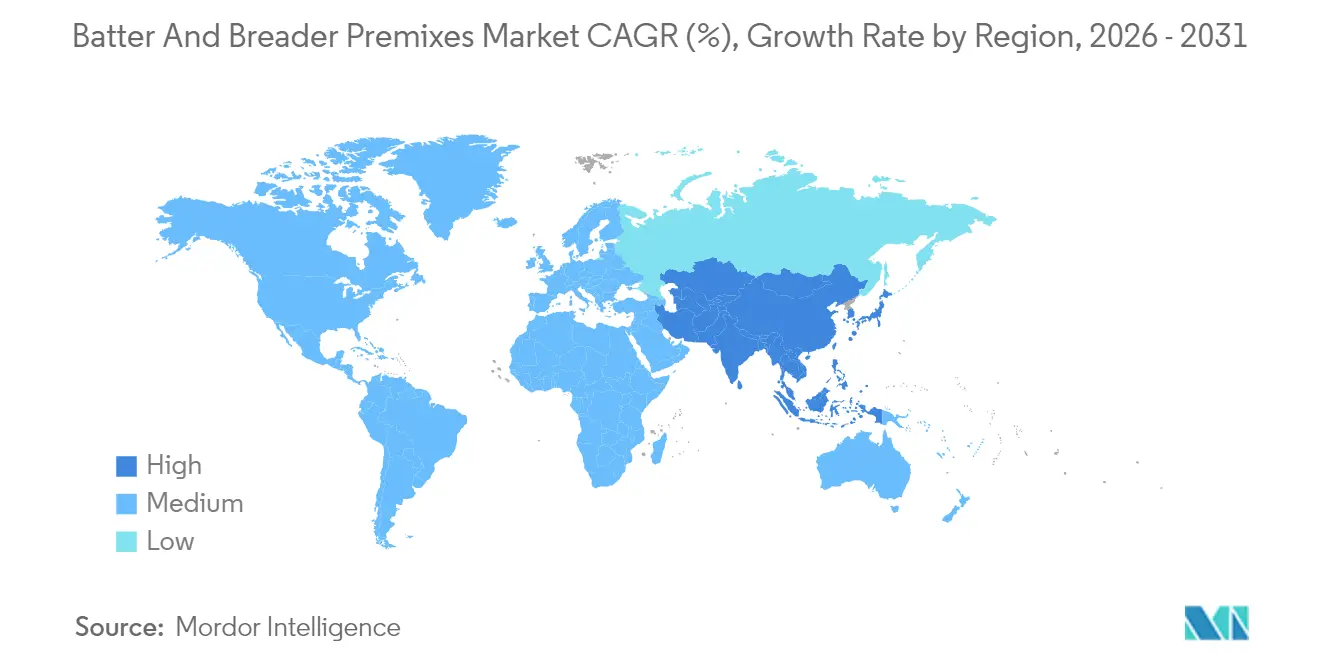
North America dominated the batter and breader premixes market with a 36.16% share in 2025. This leadership position stems from extensive quick-service restaurant networks, efficient cold-chain logistics, and established FDA regulatory frameworks. The market benefits from direct integration between coating suppliers and protein processors through long-term contracts, ensuring predictable demand. The region's focus on standardized premixes enables consistent performance across corporate and franchise operations, maintaining regular replacement cycles.
APAC Batter And Breader Premixes Market
Asia-Pacific is expected to grow at 8.18% CAGR through 2031. The growth is driven by increasing disposable income and expansion of cloud kitchens across China, India, and Southeast Asia, generating high-volume purchases of batters that combine Western textures with regional flavors. Japanese Panko manufacturing expertise is expanding across the region through licensing agreements and joint ventures. The development of cold-chain infrastructure by governments is creating new distribution channels for specialized coatings as frozen food adoption increases.
EMEA and LATAM Batter And Breader Premixes Market
Europe maintains steady growth, influenced by strict clean-label regulations requiring natural ingredients and colors. Manufacturers gain market advantage by emphasizing sustainable grain sourcing and reduced environmental impact in production. Latin America and the Middle East and Africa show growth potential, though price remains a key factor. Suppliers combining technical support with product offerings are establishing relationships with early adopters, preparing for increased adoption as cold-storage infrastructure develops.

Regulatory Landscape
Regulation for batter and breader premixes is primarily shaped by rules on food additives, labeling, and use in meat and poultry applications. In the European Union, Regulation (EC) No 1333/2008 sets additive permissions and conditions of use by food category, with specific constraints on carry-over (Article 18) that do not apply to certain base categories such as flour and starches. This approach tightens formulation discipline for suppliers selling into bakery-adjacent and staple ingredient categories. In May 2026, the European Commission published Implementing Regulation (EU) 2026/1011 to correct technical errors related to labeling of food additive premixtures, underscoring the need for precise disclosure of active substance content when premixes contain regulated additive preparations.
In the United States, premix manufacturers must align ingredient safety and labeling with FDA requirements (including 21 CFR Part 170 for food additives) and, where coatings are used on regulated meat and poultry products, with USDA-FSIS requirements. FSIS Directive 7120.1 is a practical reference list for safe and suitable ingredients, including certain antimicrobial interventions used in meat and poultry processing, while 9 CFR Part 430 governs Listeria monocytogenes controls that can affect allowable processing aids and formulation choices for coated, ready-to-eat products. FDA also highlighted 2026 Human Foods Program priorities around data-driven oversight of imported food safety, which increases the importance of documentation, traceability, and compliant specifications for global premix suppliers shipping into the US.
Value Chain Analysis
The value chain starts with agricultural and specialty ingredient inputs, notably wheat flour and bread crumbs, starches (including modified food starches), hydrocolloids, leavening systems, spices, colors, and functional proteins used for adhesion and texture. These ingredients are then taken up by premix formulators and ingredient companies that carry out precision blending, quality control, and application testing to meet performance targets such as viscosity control, pick-up, adhesion, and crispness retention across fry, oven, and air-fry formats. Large ingredient portfolio players, including Archer Daniels Midland, Cargill, Kerry Group, Ingredion, and Associated British Foods, coexist with coating specialists such as Newly Weds Foods and regional crumb and premix producers, with customization and technical service commonly used to differentiate.
Downstream, premixes are sold to industrial protein processors, frozen and ready-to-cook manufacturers, snack producers, and foodservice/QSR operators that need repeatable outcomes across sites and operators. Distribution is handled through direct contracts for large processors and foodservice accounts, as well as through food-ingredient distributors serving mid-sized manufacturers. In practice, performance validation and technical support are often embedded in customer relationships. Supply risks concentrate on commodity volatility, particularly wheat-linked inputs, regional logistics and storage constraints, and the operational need for consistent coatings across different preparation environments, where moisture migration and hold-time can degrade texture if formulations are not optimized.
Competitive Landscape
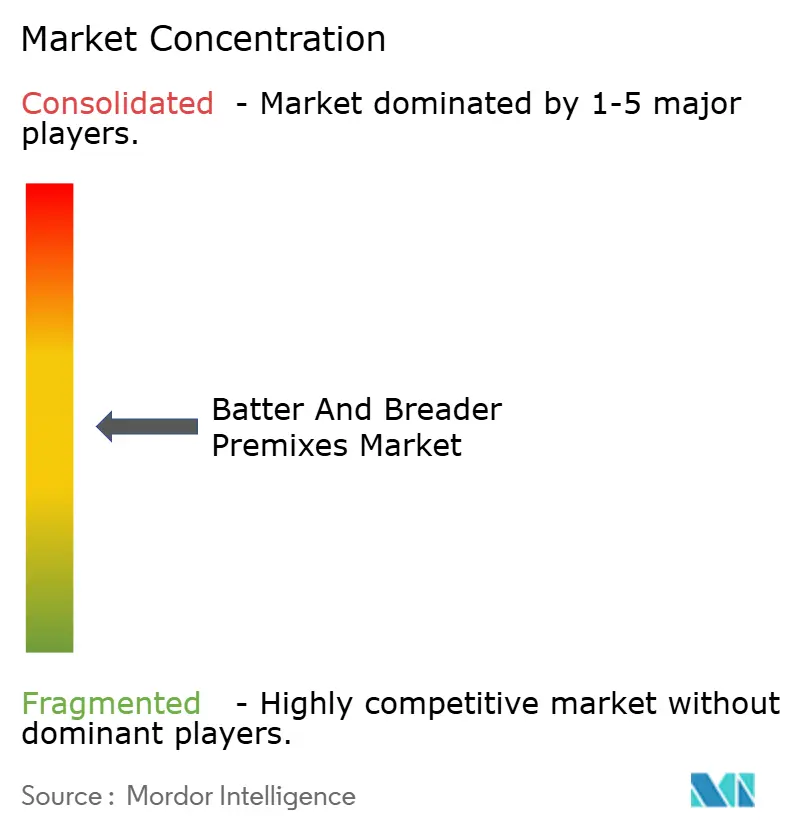
The batter and breader premixes market maintains a moderately fragmented structure, with major companies integrating ingredient expertise and supply chain management. Key manufacturers, such as McCormick and Company Inc., Archer Daniels Midland Co., and Bunge Ltd., are not only broadening their foothold in emerging markets but are also acquiring specialty starch manufacturing capabilities and crafting formulations that align with plant-based proteins.
McCormick and Company Inc. asserts its dominance through its Flavor Solutions division, which recorded a 14% operating-income surge in 2024. This uptick is attributed to McCormick's strategic melding of coating systems with seasoning products, offering food manufacturers a holistic flavor solution. Newly Weds Foods Inc. bolsters its market stance with regional innovation centers tailored to test breading applications on local protein varieties. This approach not only shortens product development timelines but also guarantees solutions tailored to specific markets.
Mid-sized manufacturers have established strong market positions by focusing on specialized segments, particularly in allergen-free batters and ancient grain-based breadings. This specialization has enabled them to capture significant market share in natural and organic product categories. The market's evolution is further characterized by the introduction of subscription-based formulation services, offering manufacturers continuous optimization support.
Batter And Breader Premixes Industry Leaders
-
McCormick and Company Inc.
-
Newly Weds Foods Inc.
-
Archer Daniels Midland Co.
-
Bunge Ltd.
-
Solina
- *Disclaimer: Major Players sorted in no particular order
Batter And Breader Premixes Market Companies Covered in this Report
- McCormick and Company Inc.
- Newly Weds Foods Inc.
- Archer Daniels Midland Co.
- Bunge Ltd.
- Solina
- Kerry Group plc
- Ajinomoto Co. Inc.
- Ingredion Incorporated
- House-Autry Mills Inc.
- Breading and Coating Ltd.
- Associated British Foods plc
- Blendex Company
- Cargill Incorporated
- Arcadia Foods
- Brata Produktions GmbH
- Veripan AG
- Thai Nisshin Technomic Co.,Ltd.
- Shimakyu
- House-Autry
- FIBERSTAR Inc.

Market Opportunities and Future Outlook
Opportunity is concentrated in formulation and processing solutions that improve texture retention while reducing operational steps for processors and foodservice operators. Equipment and process control that standardizes batter performance at scale can support high-throughput production and reduce waste from viscosity drift and inconsistent pick-up, a need reinforced by large QSR and industrial processing footprints. On the product side, coating systems that maintain crispiness in oven-baked or air-fried formats create room for suppliers to help customers reduce or remove industrial deep-frying steps while still meeting sensory targets. This aligns with the broader move toward convenient frozen and ready-to-cook products designed for home air-fryer preparation.
Recent industry actions reinforce where buyers are directing development spend. In January 2026, Nothum presented BatterKing, an all-in-one wet coating machine featuring automatic batter viscosity control and temperature management, pointing to demand for automation that improves repeatability across runs. In June 2026, Crespel and Deiters Food introduced Lory Crumb Non Fry, a coating system positioned to achieve crispiness in air-fried or oven-baked products using wheat starch, supporting product development pathways focused on process simplification and energy efficiency. These product moves also complement clean-label and allergen-sensitive reformulation work, where functional proteins and starch systems are used to maintain adhesion and crunch while meeting evolving labeling and additive compliance requirements in major markets.
Recent Industry Developments in Batter And Breader Premixes Market
- June 2026: Archer Daniels Midland (ADM) opened a new premix and feed additives production facility in Apucarana, Brazil, with an annual capacity of 40,000 tons. While the site is positioned for animal nutrition premix output, the added premix manufacturing footprint strengthens regional supply capabilities and process know-how relevant to industrial blending operations. The move also improves responsiveness for customers sourcing premix-type formulations from Latin America-based operations.
- June 2025: Newly Weds Foods, LLC announced a USD 30 million investment to expand manufacturing in Dyersburg, Tennessee, following its acquisition of a facility from Develey Mustard and Condiments Corp. The expansion increases liquids and related manufacturing capabilities, supporting broader bundled offerings that pair sauces, seasonings, and coating solutions for foodservice and industrial customers. Expanded capacity and localization help shorten lead times and tighten service levels for high-volume accounts.
- February 2024: Bunge Ltd. completed the acquisition of Viterra for USD 8.2 billion. The deal strengthens Bunge's global origination and trading position in grains and oilseeds, improving access to key agricultural inputs used across food ingredient supply chains. For batter and breader premix producers, tighter upstream integration can influence procurement resilience and pricing dynamics for flour and other grain-derived ingredients.


Batter And Breader Premixes Market Report Scope and Research Methodology
Market Definition and Coverage
This market covers ready-to-use batter and breader premixes that are produced and sold as dry blends for coating foods before frying or baking, and the value is measured at the manufacturer selling price in nominal USD.
Scope exclusions: In-house coatings mixed by restaurants or processors are excluded. Wet slurries prepared on-site are also excluded, along with marinade-style sauces used as coatings.
Segments Covered in This Report
-
By Batter Type
- Adhesion Batters
- Coating Batters
- Other Batter Types
-
By Breader Type
- American-style Bread Crumbs
- Panko (Japanese-style)
- Flour Breaders
- Specialty and Seasoned Crumbs
- Other Breader Types
-
By Application
- Frozen and Ready-to-Eat Meals
- Savory Snacks
- Processed Meat and Seafood Products
- Other Food Applications
-
By Geography
-
North America
- United States
- Canada
- Mexico
- Rest of North America
-
Europe
- United Kingdom
- Germany
- Spain
- France
- Italy
- Russia
- Rest of Europe
-
Asia-Pacific
- China
- India
- Japan
- Australia
- Rest of Asia-Pacific
-
South America
- Brazil
- Argentina
- Rest of South America
-
Middle East and Africa
- Saudi Arabia
- South Africa
- Rest of Middle East and Africa
-
North America
Data Sources, Market Sizing, and Validation
Desk Research
Desk work starts by mapping the demand pool for coated foods, then linking that demand to premix consumption in packaged and foodservice channels. We rely on public releases such as USDA and ERS food consumption data, US Census and Eurostat manufacturing and trade tables, UN Comtrade import-export series for relevant ingredient groupings, and FAO food supply balances to check where production and consumption direction point.
To anchor pricing and product mix, we also use company annual reports and investor presentations, plus association and standards bodies that publish ingredient and processing guidance. Peer-reviewed food science journals help clarify coating performance drivers and formulation trends. Where helpful, we reference paid financial sources for supplier context, run shipment-level import-export checks for consistency, and use patent databases to track product activity and recurring claims. These desk inputs are illustrative only, and we reviewed additional public datasets and documents for clarification and cross-checking.
Primary Interviews and Surveys
Primary work is used to pressure-test assumptions on premix penetration, typical usage rates, and price movement, since these items are not fully visible in public datasets. We speak with premix manufacturers, ingredient distributors, contract food processors, and foodservice and QSR operators across major consuming regions, and then we re-check differences by protein type, coating style, and pack format.
These conversations also help us confirm what is counted as premix sales versus adjacent coating ingredients sold separately. They provide a reality check on channel mix shifts and reformulation activity that can affect both volume and selling prices.
Distribution of primary research fieldwork respondents
| Company type | Respondent position | Region |
|---|---|---|
| Top tier: 34% | CXOs: 16% | APAC: 51% |
| Mid tier: 48% | Functional/Unit leaders: 31% | EMEA: 31% |
| Smaller Players: 18% | Managers: 53% | Americas: 18% |
Market-Sizing & Forecasting
Our core build uses a top-down demand reconstruction, where coated-food output and consumption signals are translated into premix requirements using penetration rates and average usage factors. Since the coated-food universe is broad, the model is paced with a few practical inputs, such as processed poultry and seafood volumes, frozen and ready-to-cook category growth, foodservice traffic direction, typical premix dosage per kilogram of coated product, and average selling price bands by application.
After the headline value is formed, we add selective bottom-up checks to keep totals realistic. These checks include sampling supplier revenues where disclosures exist, running channel checks on bulk versus retail pack splits, and validating price and volume logic with interview feedback. For privately held suppliers, we handle gaps through proxy shares and regional mix assumptions. For forecasting, scenario analysis is used, since cost pass-through and channel mix can swing value. Scenarios are tied to expected shifts in foodservice recovery, convenience food demand, and ingredient cost outlook described by primary respondents.
Data Validation & Update Cycle
Before sign-off, results are cross-verified against independent signals, including processed food output direction, trade movements for key coating ingredients, and observed pricing changes across regions. If a region shows an unusual jump, we re-check unit assumptions and rerun sensitivity cases, then reconnect with a set of respondents to confirm whether it reflects a real market change or a data artifact.
Each report goes through multi-step analyst review so calculations, definitions, and currency handling remain consistent across years. Updates are done annually, and interim refreshes are triggered when material events occur, such as sharp ingredient inflation or large channel disruptions. Right before delivery, we complete a fresh pass to reflect the most recent data releases and discussion points from our coverage.
Mordor Intelligence's Batter and Breader Premixes Market Size Compared With Other Published Estimates
Published numbers for batter and breader premixes can look far apart because each source draws the line around what counts as premix revenue, and because base years and price assumptions do not always match. Currency timing, whether foodservice is counted fully, and how coatings are linked back to coated-food volumes also create visible spreads.
In particular, in-house coatings mixed inside restaurants or processors sit outside Mordor Intelligence's scope, which pulls the value away from estimates that treat any coating blend made and used on-site as part of the commercial premix market.
Benchmark comparison
| Source | Market Size | Gaps in Research Methodology |
|---|---|---|
| Mordor Intelligence | USD 3.16 B (2026) | |
| Global Consultancy A | USD 4.08 B (2024) | Uses a different base year and often applies a broader definition that can roll foodservice and adjacent coating mixes into the same revenue pool, which can lift the starting value compared with a factory-produced premix-only view. |
| Industry Publisher B | USD 3.10 B (2025) | Year choice and long-range growth framing can change the implied current value, and the method is less transparent on how premix usage factors and price progression are validated across regions. |
The table shows that year alignment and what gets counted as premix are the main reasons the figures do not match. By tying demand back to coated-food indicators and then checking the implied prices and penetration with interviews, the estimate stays traceable to clear variables and can be repeated with the same steps when new data comes in.


Key Questions Answered in the Report
How big is the Batter And Breader Premixes Market?
The Batter And Breader Premixes Market size is estimated at USD 3.16 billion in 2026 and grow at a CAGR of 6.20% to reach USD 4.27 billion by 2031.
What is the current Batter And Breader Premixes Market size?
In 2026, the Batter And Breader Premixes Market size is estimated at USD 3.16 billion.
Who are the key players in Batter And Breader Premixes Market?
Newly Weds Foods, McCormick & Company, Inc., Bunge Ltd., Archer Daniels Midland Co., and Solina are the major companies operating in the Batter And Breader Premixes Market.
Which is the fastest growing region in Batter And Breader Premixes Market?
Asia-Pacific is estimated to grow at the highest CAGR over the forecast period (2026-2031).
Which region has the biggest share in Batter And Breader Premixes Market?
In 2025, the North America accounts for the largest market share in Batter And Breader Premixes Market.
What years does this Batter And Breader Premixes Market cover, and what is the market CAGR for forecast period (2026-2031)?
The Batter And Breader Premixes Market is estimated to register a CAGR of 6.20% during 2026-2031. The report covers the Batter And Breader Premixes Market size for historical years: 2020, 2021, 2022, 2023 and 2024. The report also forecasts the Batter And Breader Premixes Market size for years: 2026, 2027, 2028, 2029, 2030 and 2031.
Page last updated on:


 Your data is secure and never sold or shared.


