
Banking Maintenance Support And Services Market Size and Share
Market Overview
| Study Period | 2020 - 2031 |
|---|---|
| Market Size (2026) | USD 11.69 Billion |
| Market Size (2031) | USD 15.68 Billion |
| Growth Rate (2026 - 2031) | 6.05 % |
| Fastest Growing Market | Asia Pacific |
| Largest Market | Asia Pacific |
| Market Concentration | Medium |
Major Players *Disclaimer: Major Players sorted in no particular order Image © Mordor Intelligence. Reuse requires attribution under CC BY 4.0. | |
Banking Maintenance Support And Services Market Analysis by Mordor Intelligence
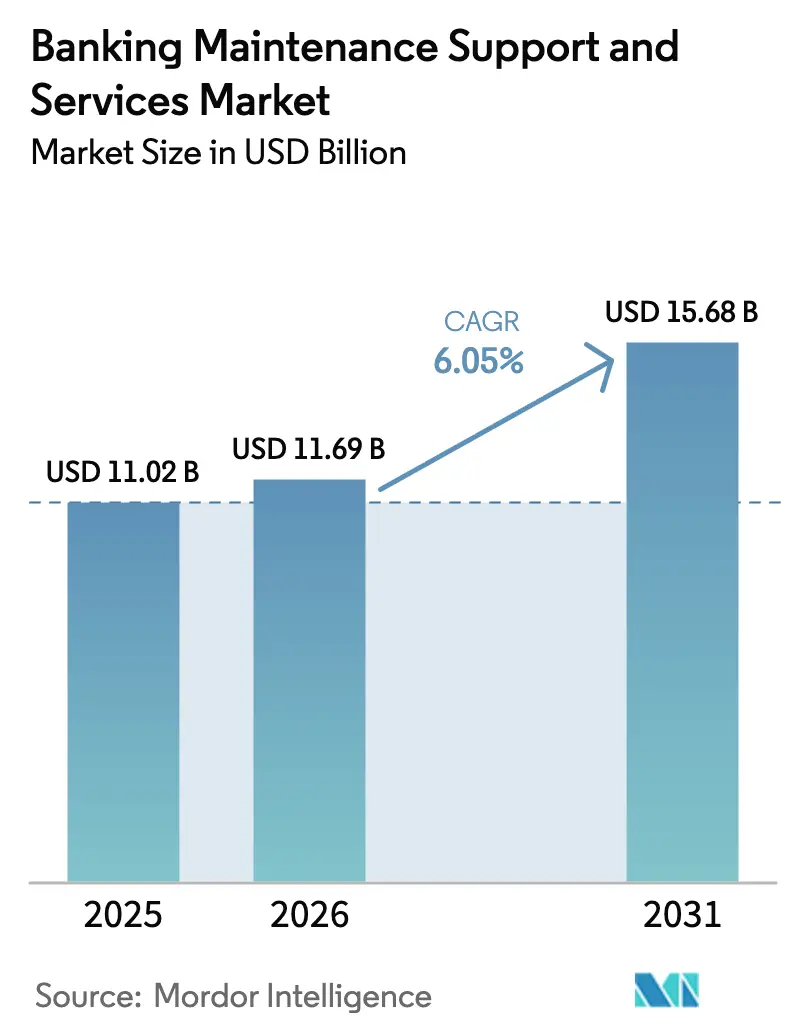
The Banking Maintenance Support and Services market size is expected to grow from USD 11.02 billion in 2025 to USD 11.69 billion in 2026 and is forecast to reach USD 15.68 billion by 2031 at 6.05% CAGR over 2026-2031. Greater spending on incident-response contracts, rapid core-platform refresh cycles and tighter uptime regulations are the primary demand catalysts. Vendors are fusing corrective maintenance with cyber-threat monitoring, while banks are bundling observability, patch management and regulatory-reporting support into single, outcome-based agreements. Cloud elasticity, consumption-based pricing and API-driven architectures are steering workloads toward hybrid arrangements that still retain mission-critical ledgers on-premises. Regional specialists are gaining share by offering sovereign-cloud services and ISO 20022 migration expertise as compliance deadlines approach.
Key Report Takeaways
- By service type, corrective and incident management services held 34.58% of the Banking Maintenance Support and Services market share in 2025, while cloud-based managed services are projected to expand at a 6.58% CAGR through 2031.
- By deployment model, on-premises contracts accounted for 59.10% of 2025 revenue; however, cloud-based engagements are projected to grow at a 7.12% CAGR through 2031.
- By bank type, retail and commercial institutions accounted for 70.55% of 2025 spending, whereas digital-only and neo-banks represented the fastest-growing client segment, with a 6.52% CAGR.
- By component, core banking platforms accounted for 39.88% of the 2025 outlays, while channel systems, ATMs, point-of-sale, online, and mobile systems are projected to rise at a 6.32% CAGR to 2031.
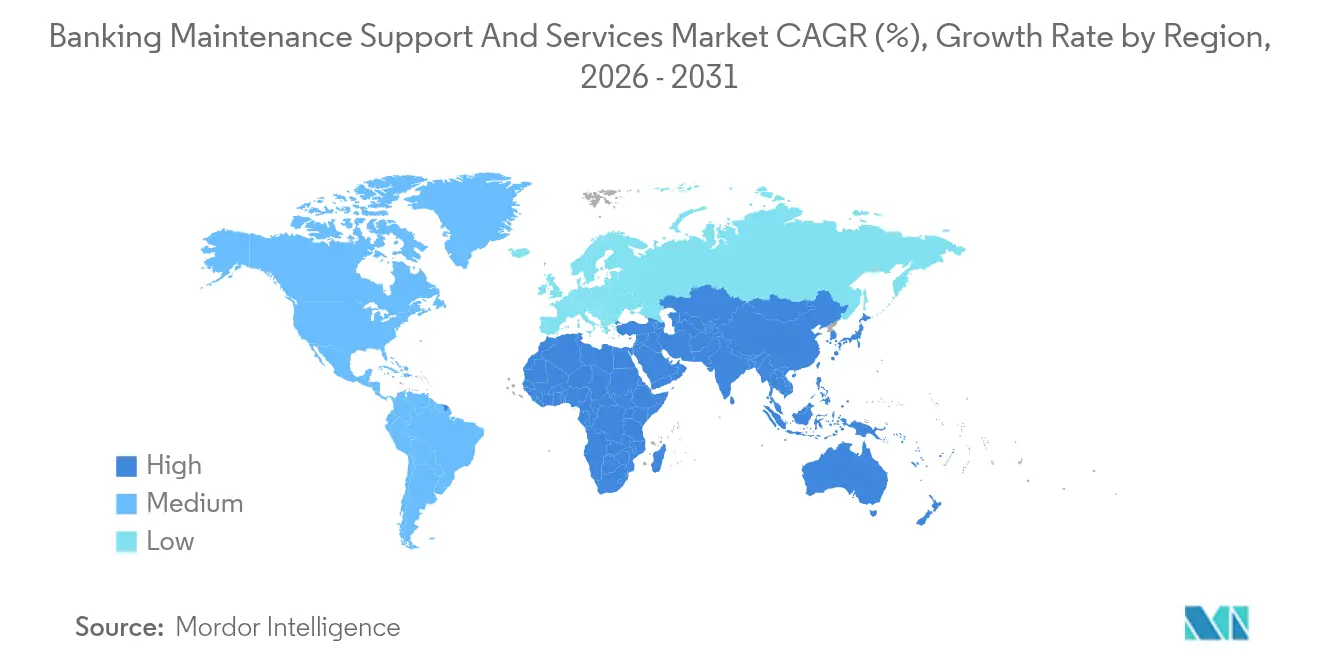
- By geography, Asia-Pacific captured 33.05% of global revenue in 2025 and is expanding at a 6.61% CAGR on the back of surging UPI and digital-yuan volumes.
Note: Market size and forecast figures in this report are generated using Mordor Intelligence’s proprietary estimation framework, updated with the latest available data and insights as of 2026.
Market Trends and Insights
Drivers Impact Analysis of Banking Maintenance Support And Services Market*
| Driver | (~) % Impact on CAGR Forecast | Geographic Relevance | Impact Timeline |
|---|---|---|---|
| Rapid Core-Banking System Obsolescence | +1.2% | North America, Europe, Global Tier-1s | Medium term (2-4 years) |
| Intensifying Cyber-Threat Landscape | +1.1% | APAC, North America, Global | Short term (≤ 2 years) |
| Regulatory Mandates for 24/7 Uptime | +0.9% | Europe, North America, APAC | Medium term (2-4 years) |
| Shift to X-as-a-Service Operating Models | +0.8% | North America, Western Europe, Global | Long term (≥ 4 years) |
| Cloud-Native Observability Toolchains | +0.7% | North America, Europe, APAC Tier-1 banks | Medium term (2-4 years) |
| ESG-Driven Decommissioning of Legacy Hardware | +0.5% | Europe, North America, Japan, Singapore | Long term (≥ 4 years) |
| Source: Mordor Intelligence | |||
Rapid Core-Banking System Obsolescence
End-of-life notices for mainframe operating systems are bringing forward refresh timelines. IBM ended extended support for z/OS 2.4 in September 2024, prompting 340 banks to migrate or accept 40% higher maintenance costs.[1] Temenos stated that 58% of its new-license bookings in 2024 originated from replacements of systems older than 15 years, with migrations averaging 18 months in parallel-run mode. FIS logged a 29% jump in core-modernization consulting engagements as banks seek ISO 20022-compliant platforms ahead of the November 2025 deadline. Hybrid support models are emerging, pairing mainframe JCL specialists with Kubernetes engineers to ensure data integrity during staged cut-overs. The result is steady demand for dual-skilled maintenance teams able to manage legacy and cloud-native platforms in tandem.
Intensifying Cyber-Threat Landscape
Ransomware assaults on core-banking environments reached 127 recorded events in 2024, with average demands of USD 4.2 million per incident. API exposure for open-banking has heightened vulnerability, as regulators flagged 2,300 inadequate-authentication cases during supervisory reviews. Zero-trust architecture adoption doubled year-over-year to 41%, fueling growth in bundled security-operations-center retainers. Cognizant noted that 68% of its banking clients now combine infrastructure and cybersecurity support under a single SLA, blurring maintenance and defense boundaries. Continuous configuration audits and rapid patch cycles have consequently become baseline contract inclusions.
Regulatory Mandates for 24/7 Uptime
The European Union’s Digital Operational Resilience Act (DORA) took effect in January 2025, compelling banks to classify ICT providers as critical and run annual penetration tests. Singapore’s revised Technology Risk Management rules require 99.95% channel availability and 2-hour regulatory access to incident logs. In the United States, the Federal Reserve mandates resumption of critical operations within 2 hours, formalizing restoration expectations. These benchmarks are driving premium-tier support contracts with 15-minute response times, as evidenced by 73% of Jack Henry’s community-bank clients upgrading in 2024. Vendor accountability for uptime is now contractual rather than aspirational.
Shift to X-as-a-Service Operating Models
Consumption-based pricing is displacing fixed-fee frameworks. Infosys’ pay-per-transaction plan charges USD 0.0012 per API call, aligning costs with actual workload volumes. Fiserv reported that 34% of its core-banking customers transferred infrastructure and application support risk to the vendor in exchange for revenue-share models. Capgemini’s predictive staffing algorithms cut labor expenses by 19% while raising first-call resolution to 82%. Such models favor automation and AIOps to protect vendor margins. Banks benefit from elastic pricing, while providers capture recurring, usage-linked revenue streams.
Restraints Impact Analysis of Banking Maintenance Support And Services Market*
| Restraint | (~) % Impact on CAGR Forecast | Geographic Relevance | Impact Timeline |
|---|---|---|---|
| High Vendor-Lock-In Switching Costs | -0.8% | North America, Europe, Global | Medium term (2-4 years) |
| Scarcity of L3 Talent for COBOL and Mainframes | -0.6% | North America, Western Europe, Global | Long term (≥ 4 years) |
| Capital Spending Freeze in Tier-2/3 Banks | -0.5% | North America, Europe, some APAC | Short term (≤ 2 years) |
| Rising Open-Source Support Reducing Contracts | -0.4% | APAC, Latin America, Global | Long term (≥ 4 years) |
| Source: Mordor Intelligence | |||
High Vendor-Lock-In Switching Costs
Oracle disclosures show exit fees of 18–22% of remaining contract value for early termination, dissuading migrations. A mid-tier European bank spent EUR 3.8 million(USD 4.42 million) extracting 18 years of data, extending its cloud timeline by 14 months. FIS retained 94% of top-100 clients in 2024, crediting renewal success to elevated switching friction rather than functionality. Proprietary data formats and IP restrictions force costly redevelopment of customized modules during platform shifts. Consequently, incumbent vendors maintain pricing power despite rising open-source alternatives.
Capital Spending Freeze in Tier-2/3 Banks
Community banks’ net-interest margins shrank 42 basis points in 2024, resulting in a 16% reduction in discretionary tech budgets.[2] Thirty-eight percent of Jack Henry’s Tier-3 clients postponed core migrations, opting for patch-only coverage. Cooperative banks in Europe trimmed IT capex to maintain Tier-1 capital ratios. The result is a bifurcated market in which Tier-1 institutions modernize aggressively, while smaller peers struggle with legacy assets.
*Our forecasts treat driver/restraint impacts as directional, not additive. The impact forecasts reflect baseline growth, mix effects, and variable interactions.
Banking Maintenance Support And Services Market Segment Analysis
By Service Type:
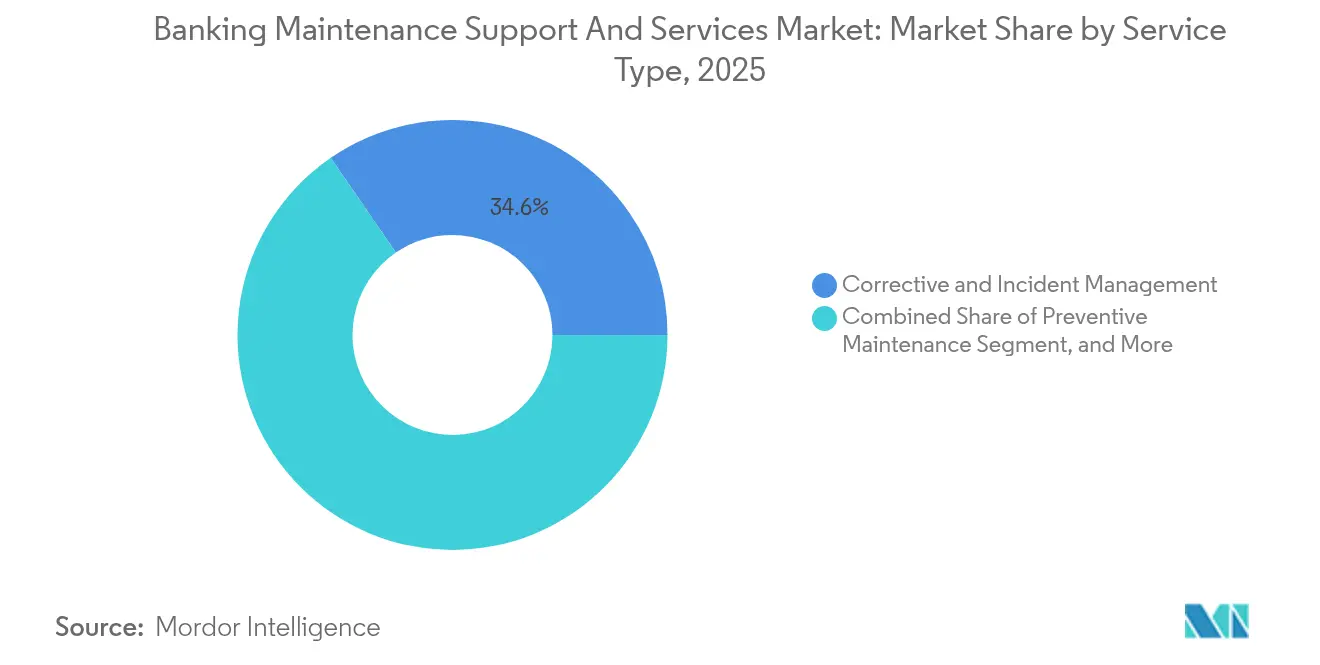
Incident Management Remains the Revenue AnchorCorrective and incident-management contracts produced the largest stream of revenue, accounting for 34.58% of Banking Maintenance Support and Services market size in 2025. Banks confront concurrent failures across legacy monoliths and microservices, resulting in high headcounts for break-fix and ticket-triage. Cloud-based managed services, however, are expected to grow at a 6.58% CAGR to 2031, reflecting the migration to subscription bundles that combine monitoring, patching, and response capabilities.
Preventive maintenance is being replaced by predictive analytics, which curtails scheduled downtime. Infosys clients trimmed maintenance windows by 34% after deploying failure-forecast models. ATM service contracts now integrate cash-optimization algorithms; NCR cut replenishment runs by 28%, adding software renewals to hardware deals. Compliance-driven patch management demand intensified with the release of PCI DSS 4.0, which halves the permissible patch windows, creating new revenue opportunities for automation-centric vendors.

By Deployment Model:
Hybrid Structures Balance Control and ElasticityOn-premises setups commanded 59.10% of 2025 spending, but cloud contracts will log the fastest 7.12% CAGR, aided by scalable consumption and freed capex. The Banking Maintenance Support and Services market share for on-premises models will erode as auditors gain comfort with sovereign-cloud controls.
Hybrid models dominate new projects. Two-thirds of Fiserv’s clients split customer-facing channels between AWS and Azure, while retaining batch settlement on mainframes. IBM’s mainframe support now includes migration road maps, embedding vendors early in lift-and-shift journeys. Dual-skilled engineers certified in z/OS and Kubernetes are in high demand, and ECB cloud guidelines clarify hybrid-support needs by allowing banks to park non-critical workloads in public clouds.
By Bank Type:
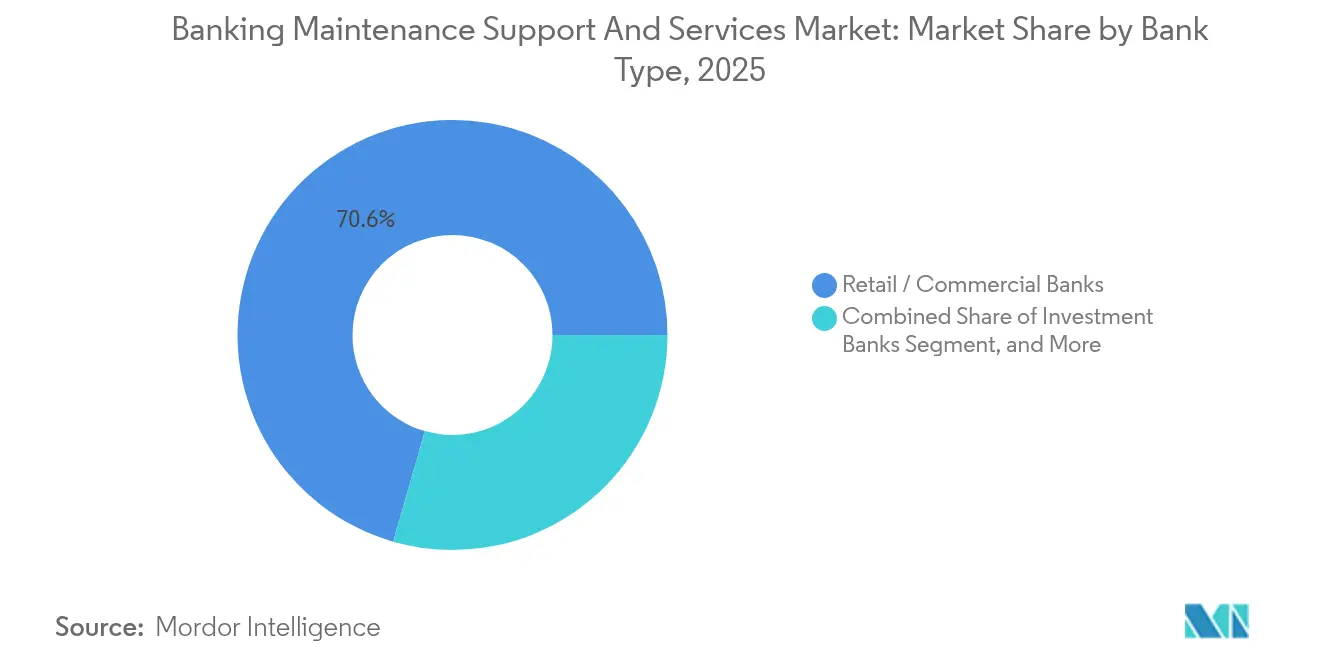
Neo-Banks Redefine VelocityRetail and commercial banks generated 70.55% of 2025 expenditure, underpinned by branch networks and ATM fleets that necessitate 24/7 support. Yet digital-only and neo-banks will post a 6.52% CAGR to 2031, reshaping the Banking Maintenance Support and Services market with CI/CD pipelines that need near-real-time rollback.
Chime averaged 47 daily code pushes in 2024, mandating automated monitoring frameworks that legacy quarterly release cadences cannot match. Nubank’s 180-person SRE organization maintains 18,000 TPS across Kubernetes clusters. Cooperative banks share sectoral bureaus to offset talent gaps, while investment banks pay premiums for sub-5-minute response on trading systems.
By Component Supported:
Core Platforms Dominate Spend, Channels AccelerateCore platforms absorbed 39.88% of 2025 budgets, as they process deposits, loans, and general ledger entries that define systemic resilience. Nevertheless, channel components are expected to grow at a 6.32% CAGR, driven by biometric ATMs, QR-code POS terminals, and increasing mobile traffic.
FedNow’s adoption by 850 U.S. banks illustrates how real-time settlement extends support scopes to 24/7 operations. Diebold Nixdorf observed an 18% increase in per-unit ATM maintenance costs due to the use of advanced hardware. Risk and compliance engines increase patch cycles, with a European Tier-1 bank operating 14 AML engines that require quarterly sanctions updates. Neglecting ancillary systems can lead to cascading failures, as a regional U.S. bank learned after an HR-system credential theft compromised core ledgers.
Geography Analysis
APAC Banking Maintenance Support and Services Market
Asia-Pacific posted the highest growth trajectory, reflecting transaction-volume surges from India’s UPI and China’s digital-currency pilots. Banks in India are negotiating outcome-based contracts tied to transaction throughput, compelling vendors to guarantee sub-second response across heterogeneous stacks. Chinese institutions, as they roll out e-CNY wallets, require simultaneous support for blockchain nodes and legacy core platforms, resulting in dual-skill hiring waves. Southeast Asian regulators, including Singapore’s MAS, mandate 99.95% channel availability, driving the uptake of premium support tiers among newly licensed digital banks.
North America Banking Maintenance Support and Services Market
North America remains a technology bellwether as FedNow instant payments migrate from overnight settlement to real-time. U.S. Tier-1 banks are accelerating the retirement of COBOL; early adopters report 12% operational cost savings after shifting to cloud-native cores. Canadian banks, governed by OSFI resilience frameworks, request unified observability across mainframes and public clouds. Vendor competition intensifies as hyperscalers co-sell managed-services bundles with partners specializing in financial-grade compliance.
Europe Banking Maintenance Support and Services Market
Europe’s agenda centers on DORA enforcement and ISO 20022 standardization. Banks face overlapping GDPR, PSD2 and Basel III obligations, creating a labyrinth of audit trails that must be maintained within two hours for regulators. Managed-services providers bundle compliance templates, automated incident-reports and third-party risk registers into SLA-backed offerings. Nordic banks pioneer green-data-center migrations, aided by abundant hydroelectric power, linking ESG metrics to maintenance KPIs.
Regulatory Landscape
Operational resilience and third-party ICT governance rules are shaping maintenance and support scopes, SLAs, and evidence requirements for banks and their vendors. In the European Union, the Digital Operational Resilience Act (DORA) became applicable in January 2025, formalizing ICT risk management, incident reporting, and oversight of critical ICT third parties. This has increased demand for continuous monitoring, audit-ready log retention, and threat-led testing support embedded in maintenance contracts. In the United States, the Federal Reserve requirement for banks to resume critical operations within 2 hours has pushed many institutions toward premium support tiers with tighter response and restoration commitments.
In Asia, regulators are tightening expectations around outsourcing and technology risk controls. The Reserve Bank of India set an April 2026 deadline for banks and All India Financial Institutions to align existing IT outsourcing agreements with its Managing Risks in Outsourcing Directions (2025), reinforcing obligations to manage sub-outsourcing chains and concentration risk for cloud and ICT vendors. In Singapore, MAS issued a 2026 consultation on proposed amendments to Technology Risk Management notices, emphasizing stronger IT asset management, risk registers, and system monitoring frameworks, which expands the compliance-driven workload for managed service providers supporting hybrid estates.
Value Chain Analysis
The value chain covers platform and hardware OEMs, systems integrators and managed service providers, hyperscale and sovereign cloud infrastructure, specialized security and observability tooling, and bank-side governance functions (risk, compliance, vendor management, and SRE/IT operations). Core banking and channel estates are typically run as hybrid environments, so service delivery centers on L2/L3 incident handling, patch and vulnerability remediation, configuration management, observability and logging, and regulatory reporting support. These activities are coordinated through ITSM workflows and change control to protect availability and auditability.
Upstream dependencies include OEM and ISV lifecycle policies (for example, IBM ending extended support for z/OS 2.4 in September 2024), which accelerate refresh and migration work and increase demand for dual-skilled teams across mainframe and cloud-native stacks. In execution, large migration and decommissioning programs extend parallel-run periods, lifting ticket volumes and testing demands. At the same time, cloud concentration risk and sub-outsourcing controls intensify vendor governance requirements. Intesa Sanpaolo completing a core IT migration to Google Cloud in July 2026, including decommissioning of legacy applications, highlights how hyperscalers and local data-center partners are taking a larger role alongside traditional banking IT support providers.
Competitive Landscape
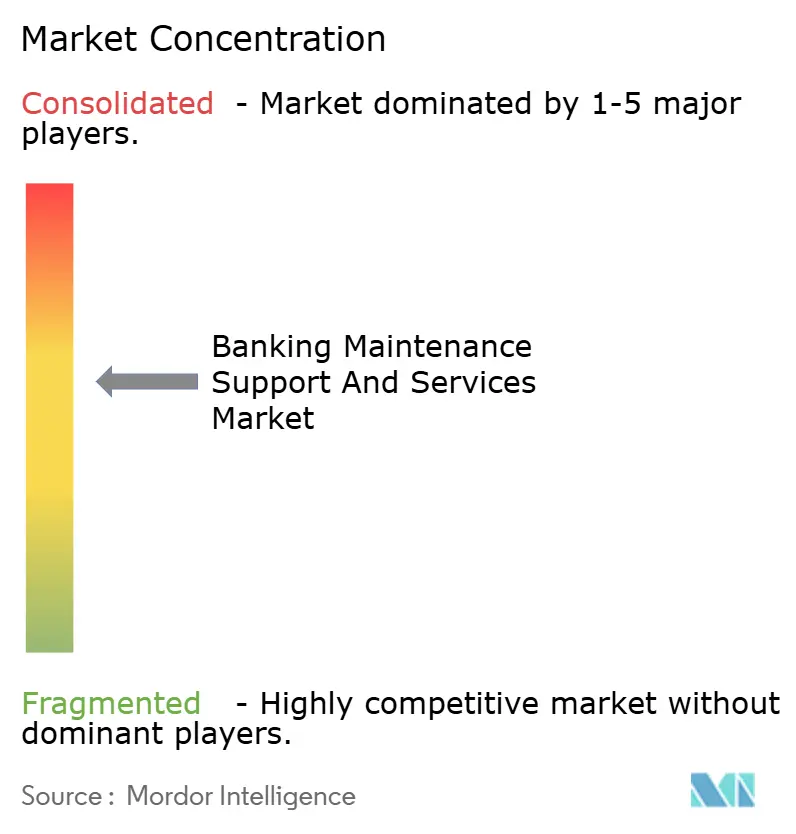
The Banking Maintenance Support and Services market is moderately fragmented, with the top 10 vendors controlling roughly 48% of the 2024 revenue, allowing specialized regional firms to flourish. Tata Consultancy Services leverages 12,000-seat hubs in India and Eastern Europe to deliver ISO 20022 migration and 24/7 incident management at 40–55% labor-cost savings. Temenos vertically integrated by purchasing a cloud consultancy for EUR 85 million (USD 98.93 million), enabling bundled software and migration engagements that curb reliance on third-party integrators. Revolut insourced 320 platform engineers to safeguard customer experience, highlighting how neo-banks prioritize in-house SRE talent.
DXC’s pending patent aggregates telemetry from mainframes and hyperscalers to cut incident resolution times. Intellect Design Arena’s DORA compliance module automatically generates incident reports, targeting mid-tier banks in Europe. Open-source ecosystems pressure price points; Apache Fineract deployments enable cost reductions, which commercial vendors respond to with lower-tiered subscription models.
Traditional hardware suppliers pivot toward software and managed services to offset declining ATM shipments. Diebold Nixdorf bundles biometric upgrade paths with predictive-maintenance analytics, while IBM offers cloud-transition assessments within mainframe support contracts. The result is convergence between systems integrators, software providers and hardware OEMs vying for the same recurring-revenue pools.
Banking Maintenance Support And Services Industry Leaders
-
NCR Corporation
-
Diebold Nixdorf, Incorporated
-
Fidelity National Information Services, Inc. (FIS)
-
Fiserv, Inc.
-
Temenos AG
- *Disclaimer: Major Players sorted in no particular order
Banking Maintenance Support And Services Market Companies Covered in this Report
- NCR Corporation
- Diebold Nixdorf, Incorporated
- Fidelity National Information Services, Inc. (FIS)
- Fiserv, Inc.
- Temenos AG
- Infosys Limited
- Tata Consultancy Services Limited
- Wipro Limited
- Hewlett-Packard Enterprise Company
- IBM Corporation
- DXC Technology Company
- Oracle Financial Services Software Limited
- Sopra Steria Group SA
- Jack Henry & Associates, Inc.
- Cognizant Technology Solutions Corporation
- Capgemini SE
- Atos SE
- Finastra
- Intellect Design Arena Limited
- Backbase
Read Analysis of Banking Maintenance Support And Services Companies
Market Opportunities and Future Outlook
A key whitespace is contract bundles that combine operational resilience evidence, security operations, and classic maintenance into a single SLA, which reduces fragmentation across toolchains and suppliers while meeting stricter uptime and audit-trail requirements. DORA-driven obligations, including incident reporting readiness, third-party oversight, and exit planning, along with supervisory attention on outsourcing concentration risk, are pushing banks to standardize monitoring, logging, and third-party risk registers across hybrid estates. That creates room for providers that can deliver continuous controls validation and audit-ready reporting as part of run services.
Modernization programs are also expanding maintenance scope rather than eliminating it, since migrations require parallel operations, dependency mapping, and disciplined decommissioning. Many large banks still rely on mainframe and COBOL for mission-critical workloads, including references to this in AWS discussions in May 2026, which keeps demand elevated for scarce L3 skills and for automation that compresses patch and release windows. Vendor road maps that support new rails such as ISO 20022 migration work, and new asset types like tokenized deposit and digital-currency capabilities, add further support needs across testing, observability, and compliance operations, particularly for banks running mixed estates that span legacy cores, API layers, and cloud-native channels.
Recent Industry Developments in Banking Maintenance Support And Services Market
- April 2026: FIS launched Lyriq, a platform that enables regulated financial institutions to issue, manage, and settle tokenized deposits and digital currencies. The release broadens the maintenance and support envelope for banks by adding new operational controls, monitoring requirements, and integration work across core platforms, risk systems, and reporting workflows.
- July 2025: Lloyds Banking Group and NCR Atleos announced new technology to advance branch modernization. The program increases the scope for ongoing managed services across self-service infrastructure, endpoint maintenance, and uptime-centric support models in a large retail banking environment.
- January 2024: Security Bank of Kansas City expanded its partnership with NCR Atleos to transform self-service banking. The expansion underscores continued demand for outsourced ATM and self-service maintenance, including remote monitoring, field service coordination, and software update support as banks refresh channel infrastructure.
Banking Maintenance Support And Services Market Report Scope and Research Methodology
Market Definition and Coverage
This market covers third-party and in-house delivered maintenance, support, and managed services that keep banking technology systems stable, secure, and available, including application upkeep, infrastructure operations, and incident resolution across bank IT environments.
Scope exclusions: We exclude one-time software license sales and hardware product revenues unless they are billed as part of an ongoing maintenance or support contract.
Segments Covered in This Report
- By Service Type
- Preventive Maintenance
- Corrective and Incident Management
- ATM Managed Services
- Software Upgrade and Patch Management
- Regulatory Compliance and Audit Support
- IT Infrastructure Support
- By Deployment Model
- Cloud
- On-Premises
- Hybrid
- By Bank Type
- Retail / Commercial Banks
- Cooperative and Mutual Banks
- Investment Banks
- Digital-only / Neo-banks
- By Component
- Supported Core Banking Platforms
- Channels (ATM / POS / Online / Mobile)
- Payment Processing Systems
- Risk and Compliance Systems
- Ancillary Systems (CRM, Treasury, HR)
- By Geography
- North America
- United States
- Canada
- Mexico
- South America
- Brazil
- Argentina
- Rest of South America
- Europe
- Germany
- United Kingdom
- France
- Italy
- Spain
- Rest of Europe
- Asia Pacific
- China
- Japan
- India
- South Korea
- Rest of Asia Pacific
- Middle East and Africa
- Middle East
- Saudi Arabia
- United Arab Emirates
- Turkey
- Rest of the Middle East
- Africa
- South Africa
- Nigeria
- Rest of Africa
- Middle East
- North America
Data Sources, Market Sizing, and Validation
Desk Research
Desk research was used to set the market boundary and to anchor the size model to real banking IT demand signals. We referred to public and official sources such as World Bank and IMF banking indicators, BIS and central bank publications, ISO and NIST cybersecurity guidance, and IT service management references from bodies like ITIL-related publications where available in the public domain. In addition, filings and investor presentations from listed IT service providers, annual reports from major banks, and credible press coverage helped us understand common contract structures and pricing levers.
To improve consistency, we also used paid subscriptions for company financials and intelligence, plus news and financials, mainly to validate revenue mixes and service-line exposure in banking. Import-export shipment-level data and global contracts and tenders were used only as directional checks where support deals had public procurement traces. The sources listed above are illustrative, and many other public documents and datasets were also reviewed for data collection, validation, and clarification.
Primary Interviews and Surveys
Primary work centered on interviews and structured surveys with bank CIO and operations teams, service delivery leaders, and support managers, as well as system integrators and managed service providers that run multiyear banking support contracts. Since this is a global market, we ensured coverage across major regions and then used the responses to confirm service scope, typical renewal cycles, SLA expectations, and how pricing changes when cloud, security, and regulatory work are bundled into support.
Distribution of primary research fieldwork respondents
| Company type | Respondent position | Region |
|---|---|---|
| Top tier: 25% | CXOs: 17% | APAC: 46% |
| Mid tier: 58% | Functional/Unit leaders: 37% | EMEA: 33% |
| Smaller Players: 17% | Managers: 46% | Americas: 21% |
Market-Sizing & Forecasting
The core model is built using a top-down approach where banking technology spend pools are reconstructed into a supportable base, which is then filtered by the share that typically goes to maintenance, managed operations, incident support, and ongoing upgrade and patch work. To keep the totals grounded, we corroborate the result with selective bottom-up approximations, such as sampled contract values by service line, volume of supported endpoints (like ATMs and key channel systems), and a sanity check of implied price per supported system.
A few inputs matter more than others in this market. We track indicators like the installed base of banking delivery channels that require upkeep, cloud migration pace in banks (which shifts work from on-prem operations to hybrid support), cybersecurity and compliance workload intensity, SLA coverage levels, and outsourcing penetration by bank type. Pricing is handled through a practical ASP logic where rate cards and contract bundles are converted into effective annual service values, and gaps are handled by using ranges agreed in interviews and then narrowing them using regional wage and utilization signals.
For forecasting, scenario analysis is used so that the base case reflects the most common renewal and transformation cadence discussed by practitioners, while also allowing sensitivity to macro factors like bank cost takeout cycles and regulatory change waves. Growth is then distributed by region using indicators such as banking digitization progress, channel expansion, and the maturity of managed services adoption.
Data Validation & Update Cycle
Validation is done in multiple passes so that the model does not drift away from what buyers and providers are actually seeing. We compare outputs against independent signals like banking IT budget direction, outsourcing adoption trends, and the implied spend per supported system, and then investigate variances that look too high or too low for a given region. When an anomaly is found, assumptions are revisited, and follow-up outreach is triggered to re-check pricing, scope bundling, or the mapping of service categories.
Before sign-off, the work is reviewed by another analyst to confirm arithmetic, scope alignment, and that the inputs are traceable to a clear data point or interview insight. Reports are refreshed annually, with interim updates when material events can change spend patterns, such as major regulatory deadlines or sharp shifts in cloud operating models. Prior to delivery, a final update pass is completed so clients receive the latest view available at the time of publication.
Mordor Intelligence's Banking Maintenance Support and Services Market Size Measured Against Other Published Estimates
Published market sizes for banking maintenance support and services often vary because researchers do not always count the same contract types, and they also choose different base years and currency conversion timing. Some studies include a wider perimeter of banking IT services, while others stay closer to pure maintenance and support work, which naturally changes the total value.
In this study, the refresh cadence and the point-in-time currency conversion are treated as key controls, since multi-year support deals can be repriced annually and often include pass-through items that should not be double-counted. The ASP logic is kept consistent by converting bundled SLAs and managed operations into an effective annual value, and the totals are re-checked against bank IT spend signals, a repeatable step that Mordor Intelligence applies to reduce swings caused by stale rate cards and outdated exchange rate assumptions.
Benchmark comparison
| Source | Market Size | Gaps in Research Methodology |
|---|---|---|
| Mordor Intelligence | USD 11.69 B (2026) | |
| Industry Data Platform A | USD 11.97 B (2025) | Uses a different base year and a component-driven scope that can pull in broader hardware and software maintenance buckets, which may not align with how banks separate managed operations from adjacent IT services. |
| Market Aggregator B | USD 10.40 B (2023) | Starts earlier in the cycle and appears to rely on a shorter forecast window with less visibility on repricing and bundling effects, which can understate later-period managed support expansions tied to cloud and compliance workloads. |
Across the three figures, the spread is mainly explained by timing choices and what gets counted inside a support contract versus adjacent IT work. By keeping service bundles normalized into annual values and then re-validating them against banking spend and operational scale indicators, the resulting number stays easier to reproduce and to update when conditions change.
Key Questions Answered in the Report
How large is the Banking Maintenance Support and Services market today?
The market stood at USD 11.69 billion in 2026 and is on track to reach USD 15.68 billion by 2031.
Which service type attracts the most spending?
Corrective and incident management services held 34.58% of global revenue in 2025.
What is driving faster growth in cloud deployments?
Consumption-based pricing and elastic capacity needs are propelling cloud contracts at a 7.12% CAGR through 2031.
Why is Asia-Pacific growing the fastest?
Massive transaction volumes from systems such as Indias UPI and Chinas digital-yuan pilots are pushing demand for 24/7 support.
How are regulations influencing maintenance contracts?
Frameworks like the EUs DORA and Singapores TRM guidelines impose strict uptime and audit-trail requirements, prompting banks to sign premium SLAs with rapid incident-response times.
Are open-source platforms affecting vendor revenues?
Yes, community-supported cores such as Apache Fineract enable cost-conscious banks to cut annual maintenance fees, applying price pressure on proprietary vendors.