
Bangladesh Used Car Market Size and Share
Market Overview
| Study Period | 2020 - 2031 |
|---|---|
| Forecast Data Period | 2026 - 2031 |
| Base Year Market Size (2025) | USD 1.54 Billion |
| Market Size (2026) | USD 1.65 Billion |
| Market Size (2031) | USD 2.31 Billion |
| Growth Rate (2026 - 2031) | 7.00 % |
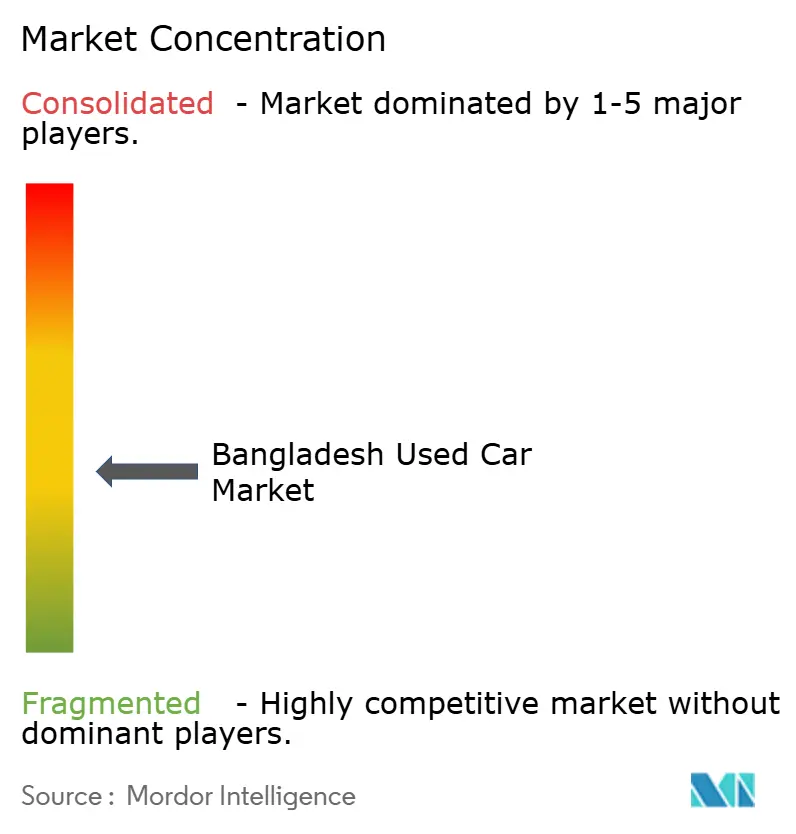
| Market Concentration | Medium |
Major Players *Disclaimer: Major Players sorted in no particular order Image © Mordor Intelligence. Reuse requires attribution under CC BY 4.0. | |
Bangladesh Used Car Market Analysis by Mordor Intelligence
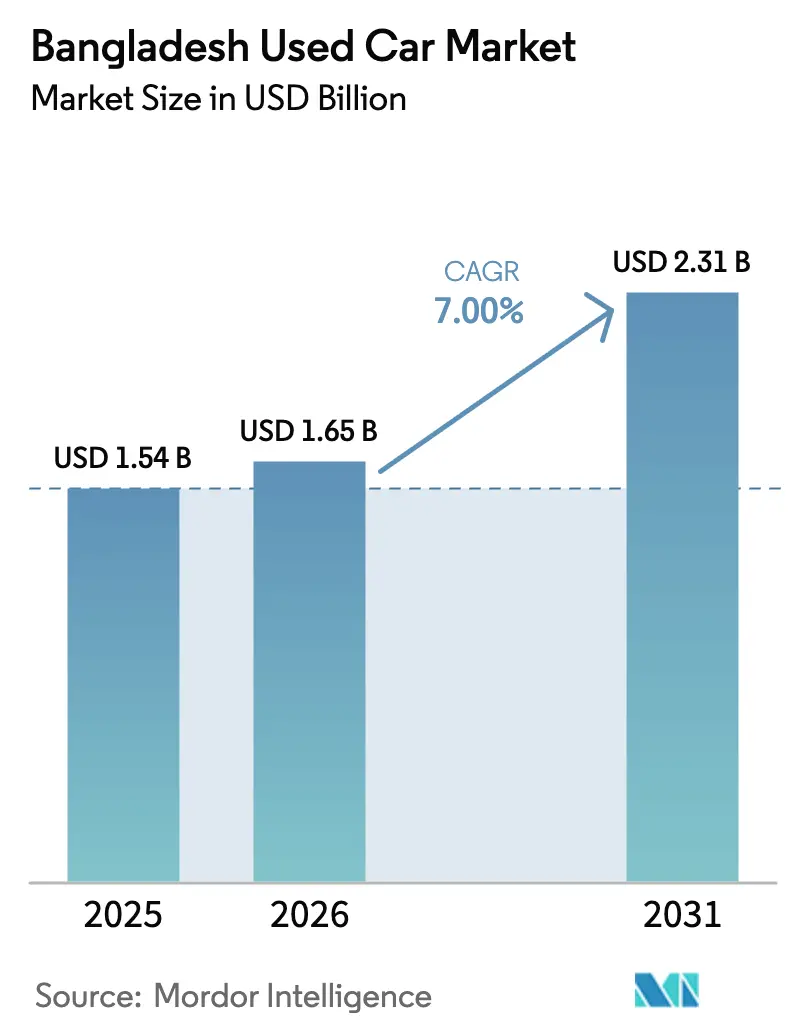
Bangladesh used car market size in 2026 is estimated at USD 1.65 billion, growing from 2025 value of USD 1.54 billion with 2031 projections showing USD 2.31 billion, growing at 7.00% CAGR over 2026-2031. Robust demand stems from rising new-car prices, widening fintech-enabled credit, and the government’s tight restrictions on older vehicle imports. Digital marketplaces now integrate inspection, financing, and logistics, which shortens transaction cycles and makes cross-regional trade viable. Demand is shifting to nearly-new stock aged below three years as buyers seek factory-grade features without paying showroom prices. Hybrid imports enjoy preferential duties that stimulate premium demand, while micro-lending pulls first-time owners from rural districts into the Bangladesh used car market.
Key Report Takeaways
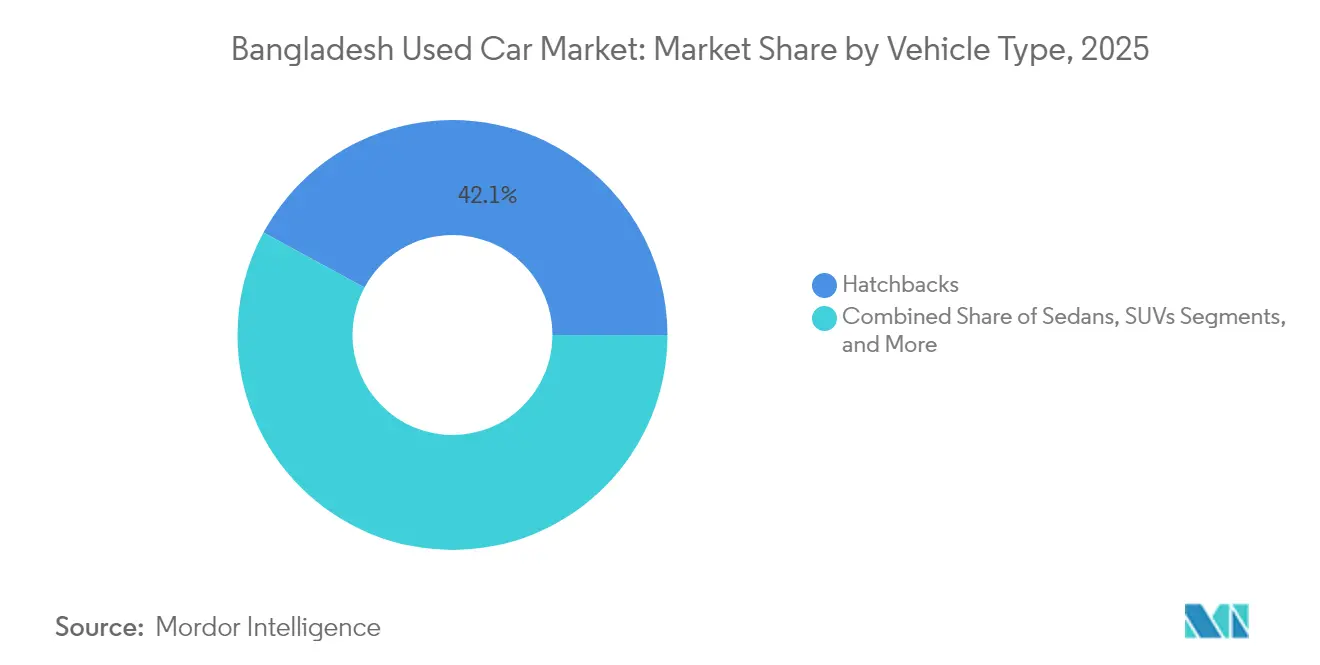
- By vehicle type, Hatchbacks led with a 42.10% share in the Bangladesh used car market in 2025, while sedans are projected to be the fastest-growing category at an 8.05% CAGR through 2031.
- By vendor type, unorganised dealers controlled 63.80% of Bangladesh's used car market share in 2025, but organised players are expanding the quickest at a 9.55% CAGR as digital platforms scale nationwide.
- By fuel type, Gasoline cars dominated with a 79.20% share in the Bangladesh used car market in 2025; battery-electric vehicles show the highest momentum, advancing at a 12.80% CAGR to 2031 on the back of duty incentives and charging rollout.
- By vehicle age, Units aged 5-8 years held the top position at 44.10% in the Bangladesh used car market share in 2025, yet the 0-3-year bracket is growing fastest at 9.05% CAGR as buyers pay premiums for nearly new features and warranty coverage.
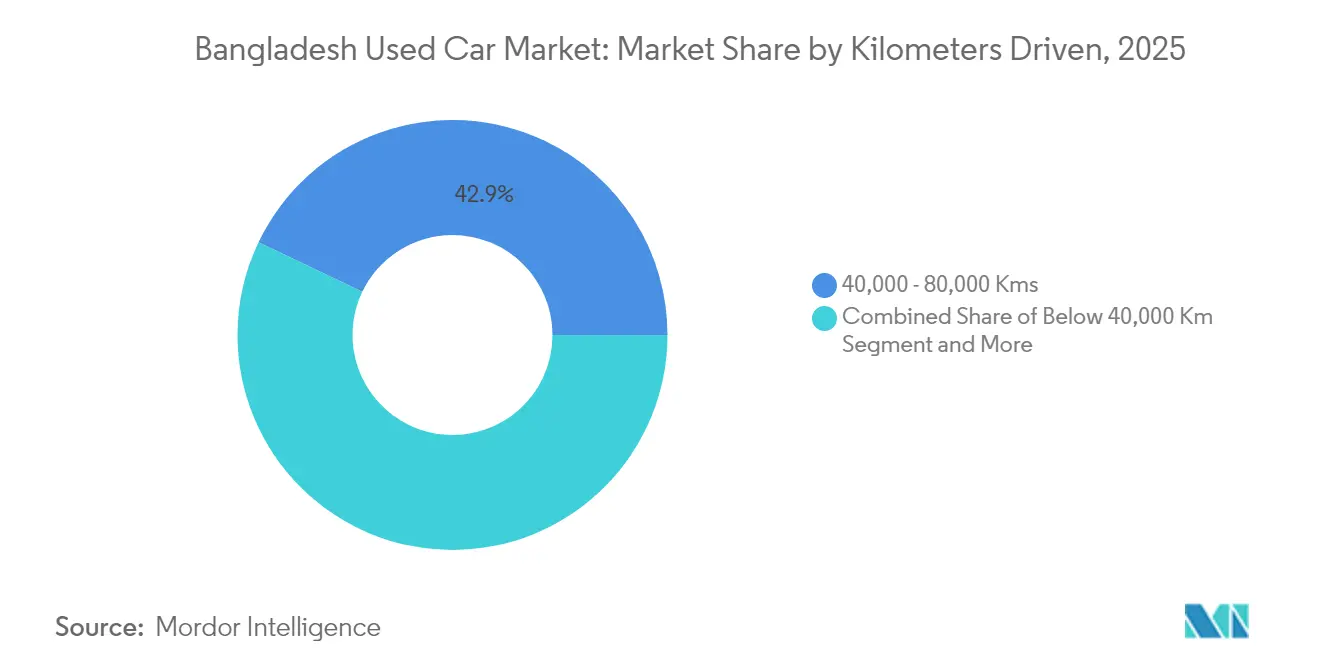
- By kilometres driven - Cars with 40,000-80,000 km accounted for 42.90% of the Bangladesh used car market sales in 2025, whereas sub-40,000 km inventory is set to rise most rapidly at a 11.70% CAGR because of higher residual values and lower maintenance risk.
- By price band - The USD 5,001-10,000 tier captured 35.90% share in the Bangladesh used car market in 2025; the USD 10,001-15,000 segment is expanding at the quickest 9.85% CAGR as income growth and fintech credit lift budgets.
- By sales channel - Offline outlets retained 67.10% share in the Bangladesh used car market in 2025, yet online platforms post the highest 11.05% CAGR thanks to integrated inspection, financing, and delivery services.
- By geography - Dhaka commanded 53.70% of the Bangladesh used car market revenues in 2025, while Sylhet & Mymensingh form the fastest-growing cluster at a 10.25% CAGR through 2031, powered by remittance-fuelled spending
Note: Market size and forecast figures in this report are generated using Mordor Intelligence’s proprietary estimation framework, updated with the latest available data and insights as of 2026.
Worldwide industry scale is not derived from any single country or region but from the combination of national and regional inputs. The used car market size of Mordor Intelligence integrates these into one global valuation.
Bangladesh Used Car Market Trends and Insights
Drivers Impact Analysis*
| Driver | (~) % Impact on CAGR Forecast | Geographic Relevance | Impact Timeline |
|---|---|---|---|
| Rising New Car Prices | +1.8% | National (Dhaka, Chittagong) | Medium term (2-4 years) |
| Higher Disposable Income & Motorisation | +1.2% | National (Dhaka, Chittagong, Sylhet) | Long term (≥ 4 years) |
| Fintech-Driven Auto Finance Access | +1.1% | National (rural, secondary cities) | Short term (≤ 2 years) |
| Growth of Online Used-Car Marketplaces | +0.9% | National (urban centers) | Short term (≤ 2 years) |
| Remittance-Driven Demand in Secondary Cities | +0.8% | Sylhet, Mymensingh, Chittagong | Long term (≥ 4 years) |
| Duty Cuts on Reconditioned Hybrids | +0.7% | National (premium urban buyers) | Medium term (2-4 years) |
| Source: Mordor Intelligence | |||
Rising Prices of New Cars
New-vehicle affordability has weakened because of customs duties. CIF value for sub-1500 cc models, while the Environmental Protection Surcharge applies to multiple ownership. Buyers, therefore, pivot to three-to-five-year-old cars that retain high-spec safety and infotainment features yet avoid steep first-year depreciation. The import ban on vehicles older than three years narrows the supply and keeps residual values firm, further channeling traffic toward the Bangladesh used car market.
Growing Disposable Income and Motorisation Rate
Bangladesh is on track to become the 21st-largest economy by 2039. Although per-capita income is USD 2,738, rising entrepreneurial income from cottage and small firms drives vehicle purchases outside Dhaka. These trends funnel aspirational buyers into sedans and compact SUVs, bringing structural depth to the Bangladesh used car market[1].
Micro-Lending and Fintech-Based Auto Finance Access
City Bank and bKash have issued nearly BDT 15 billion in nano loans to 523,000 borrowers, and Nagad’s planned AI-driven digital bank will extend collateral-free credit to informal workers. As lenders comply with central-bank mandates requiring 25% of their loan books to be allocated to SMEs, vehicle purchasing power is spreading to rural areas. Easy digital onboarding removes the historic barrier of in-person credit assessment, lifting unit sales across all price bands.
Government Duty Cuts on Reconditioned Hybrid Vehicles
Preferential tariffs on hybrid imports have spurred launches like BYD’s Sealion 6 DM-i and RANCON’s Proton X90. These models broaden the premium used-car pipeline before the 2025 phase-out of reconditioned imports, creating a time-limited surge in hybrid registrations that will soon cascade into second-owner transactions[2].
Restraints Impact Analysis*
| Restraint | (~) % Impact on CAGR Forecast | Geographic Relevance | Impact Timeline |
|---|---|---|---|
| Vehicle History Trust and Transparency Issues | -1.4% | National (secondary cities) | Medium term (2-4 years) |
| Weak Inspection and Certification Ecosystem | -1.1% | National (rural areas) | Long term (≥ 4 years) |
| FX Volatility Impacting Import Costs | -0.9% | National (premium import buyers) | Medium term (2-4 years) |
| Dhaka Congestion Policies and Registration Caps | -0.8% | Dhaka metro (spillover Chittagong) | Short term (≤ 2 years |
| Source: Mordor Intelligence | |||
Trust and Transparency Issues in Vehicle History
Roughly 479,000 cars once operated without valid fitness certificates, and more than 300,000 unfit vehicles remain on the road. Under-invoicing scandals show declared import prices for luxury units understating true cost by over 90%. The absence of a nationwide digital history registry burdens buyers with uncertainty, prompting them to pay premiums to organised dealers able to provide inspection and warranty cover.
Limited Organised Inspection / Certification Ecosystem
BRTA’s computerized test centers are expanding, yet coverage gaps persist in rural districts. Buyers often rely on informal mechanics for pre-purchase checks, which inflates post-sale repair risk and slows repeat purchases. Until inspection capacity scales, transaction velocity in the Bangladesh used car market will lag latent demand.
*Our forecasts treat driver/restraint impacts as directional, not additive. The impact forecasts reflect baseline growth, mix effects, and variable interactions.
Segment Analysis
By Vehicle Type: Hatchbacks Retain Pole Position Amid Rising Sedan Appeal
Hatchbacks contributed 42.10% of Bangladesh's used car market size in 2025, reflecting compact dimensions suited to congested lanes and limited parking. They remain the volume anchor, yet sedans are accelerating at 8.05% CAGR as remittance-rich families in Sylhet and Mymensingh upgrade for perceived status. Sedans also enjoy nascent local assembly—RANCON’s USD 100 million Proton line—cutting landed cost and widening choice. SUVs and MUVs occupy premium and multi-passenger niches, respectively, while pickups cater to last-mile logistics. This progression of aspirational purchasing broadens value bands and keeps the Bangladesh used car market vibrant across body styles.

By Vendor Type: Organized Dealers Capture Trust Premiums
Unorganized sellers still executed 63.80% of transactions in 2025, but organized outlets are growing at 9.55% CAGR. These operators guarantee titles, run multi-point inspections, and bundle credit, pushing higher ticket averages. The migration aids banks that must raise SME exposure and injects taxable transparency into the Bangladesh used car industry. As online-to-offline hybrids mature, dealers leverage centralized refurbishing hubs and data-driven pricing. Constrained by capital and compliance, informal traders risk customer attrition unless they affiliate with digital marketplaces that standardize processes.
By Fuel Type: EVs Signal Future Growth Phase
Gasoline powertrains held 79.20% of Bangladesh's used car market share in 2025, yet battery electric vehicles show a 12.80% CAGR due to tax holidays and falling battery costs. Hybrids benefit from duty discounts, while diesel and CNG remain functional for fleets seeking torque or cheaper fuel. BYD's Sealion 6 rollout underpins confidence in charging-network expansion. As early adopters cycle out their first EVs, a secondary flow of affordable electrics will take hold, giving Bangladesh's used car market fresh inventory aligned with sustainability goals.
By Vehicle Age: Near-New Units Command Top-Tier Pricing
Cars aged 5 - 8 years led with a 44.10% share, balancing budget and reliability, yet the 0-to-3-year inventory grows at 9.05% CAGR. Import caps on above 3-year vehicles restrict supply, bidding up values for recent models that still carry a residual factory warranty. Organized dealers excel in sourcing corporate fleet disposals with low mileage and documented maintenance. Older units above eight years fill price-sensitive rural demand but face tightening fitness oversight that may raise compliance costs.
By Kilometers Driven: Low-Mileage Stock Wins Buyer Confidence
Units within 40,000-80,000 km held a 42.90% share, aligning with typical usage bands for five-year-old imports. Sub-40,000 km vehicles—often ex-lease assets—expand at 11.70% CAGR as consumers equate lower odometer readings with longer life and resale upside. Digital history tools that verify mileage help sustain this premium. High-kilometer vehicles appeal to commercial operators seeking low capex, but their relative share is forecast to fall as fleets shift toward structured replacement cycles.
By Price Band: Middle-Income Buyers Shift Upmarket
The USD 5,001-10,000 tier accounted for 35.90% of Bangladesh's used car market size in 2025, cementing its role as the affordability sweet spot. Rising incomes and tailored financing lift the USD 10,001-15,000 bracket at 9.85% CAGR, where buyers secure newer sedans and compact SUVs. Digital lenders stretch installment horizons, letting customers absorb higher sticker prices. Cars above USD 15,000 remain niche but will gain as hybrid and electric residuals soften. Sub-USD 5,000 inventory shrinks as import restrictions squeeze the supply of older vehicles.
By Sales Channel: Online Platforms Scale National Reach
Offline dealers still managed 67.10% of sales in 2025, a testament to face-to-face trust in big-ticket purchases. Yet online channels surge at 11.05% CAGR as consumers grow comfortable transacting after virtual 360-degree tours and escrow-based payment. Marketplaces integrate valuation algorithms, finance offers, and delivery, compressing purchase windows. Offline sales channels, such as Peer-to-peer listings, prosper where platforms supply escrow and inspection, but organized dealer listings dominate due to inventory depth and ready financing.
Geography Analysis
Dhaka generated 53.70% of Bangladesh's used car market size in 2025. It's 20 million inhabitants, a clustered financial sector, and saturation of organized dealers make it the market's innovation lab. Severe congestion and potential registration caps, however, temper long-term volume growth. Urban policy shifts could nudge some demand toward ride-sharing or outlying districts, yet Dhaka's deep credit penetration and inventory diversity secure its lead.Chittagong ranks second, buoyed by port-driven commerce. Manufacturing clusters and logistics fleets need pickups and microbuses, feeding a pipeline of corporate disposals into the Bangladesh used car market. Proximity to the port eases import logistics, while cross-border trade with India and Myanmar sustains supply chains for spare parts and accessories.Sylhet & Mymensingh record the fastest 10.25% CAGR to 2031. High remittance inflows convert directly into vehicle upgrades as returning migrants favor sedans and compact SUVs. Lower congestion and rising road quality cut running costs, enhancing ownership appeal. Other emerging regions such as Khulna and Rajshahi trail but will accelerate as agribusiness mechanization and road projects improve income and accessibility, extending the Bangladesh used car market's geographic footprint.
Mordor Intelligence tracks the used car market across other major regions such as Africa, with additional country-level coverage spanning Myanmar, Sri Lanka, Kenya, Netherlands, Tanzania, South Africa, Portugal, and Egypt, each reflecting localized structural drivers, restraints and more.
Regulatory Landscape
Bangladesh used-car imports are governed through transport regulations, customs administration, and import-policy controls. The Road Transport Act, 2018 provides the overarching legal framework for vehicle regulation and road safety, while Bangladesh Customs uses formal valuation practices (including reference valuation guides such as the Yellow Book and Glass Guide) to assess duties on imported used vehicles, which feeds directly into landed costs and retail pricing.
On the trade side, used or reconditioned motor-car imports are subject to eligibility conditions that shape both supply quality and market mix. Imports face an age cap (commonly cited as up to five years from shipment), imports are generally required from the country of origin rather than third countries, and documentation such as certificates of age, model, and chassis is required (including Japan-linked appraisal documentation for Japan-origin vehicles). Procedural requirements, including a minimum gap between first registration and export or cancellation, and a minimum mileage threshold for reconditioned vehicles, further narrow the set of importable inventory and reinforce premiums for compliant, better-documented units.
Value Chain Analysis
Bangladesh's used-car value chain is anchored in import-led supply and a multi-layer distribution ecosystem. Inventory is sourced through overseas exporters and auction channels (commonly Japan for reconditioned vehicles), then cleared through Bangladesh Customs under defined documentation and valuation rules. This import dependence keeps availability sensitive to compliance requirements (age limits, origin restrictions, certification) and to clearance lead times, which in turn affects dealer stocking cycles and consumer choice.
Midstream, inventory is aggregated by unorganised dealers and organised retailers, with the latter increasingly adding standardized inspection, refurbishment, warranty packaging, and financing facilitation. Digital marketplaces such as Bhalogari.com, Garirbazar.com, Bikroy Motors, and similar platforms function as transaction enablers by connecting listings, inspections, credit offers, and delivery logistics, shortening the sales cycle and widening cross-regional demand beyond Dhaka. Downstream, vehicle registration and fitness compliance requirements create recurring service flows (testing, documentation support, aftersales), while parts and service networks support lifecycle maintenance. Alongside imports, local assembly and broader automotive ecosystem activity, including players such as IFAD Autos Ltd, Aftab Automobiles, Bangladesh Machine Tools Factory, Niloy-Hero Motors, and Runner Automobiles, influences parts availability and repair economics, feeding back into used-vehicle residual values.
Competitive Landscape
The industry is fragmented, yet scale advantages and regulatory alignment steer growth to organised dealers. Digital platforms deploy inspection protocols, transparent pricing, and warranty bundles that overcome legacy mistrust. Leading players integrate bank partnerships, which streamline loan approval and fortify customer loyalty.
Technology is an essential differentiator. Firms with AI-driven pricing and telematics-based warranty risk models can turn inventories faster and maintain tighter spreads. Customer acquisition costs fall when data-driven remarketing targets shoppers by preferred body style, budget, and geographic location.
White-space opportunities include certified pre-owned EV programs and rural micro-dealership franchises that piggyback on mobile-money networks. Government policy that denies future tax holidays to non-compliant SMEs places further pressure on informal operators, accelerating consolidation within the Bangladesh used car market.
Bangladesh Used Car Industry Leaders
-
Bhalogari.com
-
Car Haat
-
Navana Group
-
Bikroy Motors
-
Garirbazar.com
- *Disclaimer: Major Players sorted in no particular order
Market Opportunities and Future Outlook
A key opportunity in Bangladesh's used-car market is the build-out of formal, scalable trust infrastructure around vehicle condition, history, and compliance. The market context points to persistent transparency gaps, including a large pool of vehicles historically operating without valid fitness certification, alongside limited inspection coverage outside major cities. That creates room for organised dealers and platforms to expand standardized multi-point inspections, warranty-backed retailing, and digitally verifiable documentation workflows. It also aligns with the current market structure, where unorganised channels still account for most transactions, leaving certification-led differentiation opportunities in high-volume segments such as hatchbacks and in mid-priced units, as well as in the fastest-growing near-new bracket.
Powertrain mix is another area with clear execution pathways. FY2026-27 budget discussions and industry responses from BARVIDA point to a shifting duty environment that favors electric vehicles and plug-in hybrids relative to fossil-fuel vehicles, alongside exemptions for EV charging equipment. That policy direction supports curated used EV and hybrid programs (including battery-health checks, buyback or exchange schemes, and financing bundles). It also gives platforms a practical basis to develop price discovery and residual-value benchmarks for electrified inventory as early adopter vehicles enter secondary ownership and as charging equipment availability improves through the proposed duty treatment.
Recent Industry Developments
- June 2026: BARVIDA opposes FY2026-27 budget proposals to restructure engine capacity slabs for fossil fuel vehicles, increasing tax incidence. The move reflects regulatory friction affecting reconditioned fossil-fuel car imports. It hints at contraction risk for fossil-car imports and a possible shift toward alternative powertrain options and EVs.
- June 2026: Government of Bangladesh proposes lowering import duties for plug-in hybrid and electric vehicles and exemptions for EV charging equipment. The policy incentives support EV/PHEV adoption and charging infrastructure. It may accelerate EV/PHEV penetration and alter used car mix and imports.
- June 2026: GarirBazar reports a portfolio of more than 52,000 vehicle listings as of 1 June 2026. This milestone signals online marketplace scale in Bangladesh used-car segment. It indicates growing online sourced inventory and platform driven liquidity.
Research Methodology Framework and Report Scope
Market Definition and Coverage
For this report, the market is the total value generated from transactions of pre-owned passenger cars in Bangladesh, including imported reconditioned cars and locally traded used cars, across organized and informal selling channels.
Scope exclusions: The sizing does not count motorcycles, three-wheelers, buses, trucks, or spare parts and repair services tied to ownership.
Segmentation Overview
- By Vehicle Type
- Hatchback
- Sedan
- Sport Utility Vehicles (SUVs)
- Multi-Purpose Vehicles (MUVs)
- By Vendor Type
- Organised
- Unorganised
- By Fuel Type
- Gasoline
- Diesel
- Battery -Electric
- Hybrid
- Others
- By Vehicle Age
- 0 - 2 Years
- 3 - 5 Years
- 6 - 8 Years
- Above 8 Years
- By Kilometres Driven
- Below 40,000 km
- 40,000 - 80,000 km
- 80,000 - 120,000 km
- Above 120,000 km
- By Price Band
- Below USD 5,000
- USD 5,001 - 10,000
- USD 10,001 - 15,000
- Above USD 15,000
- By Sales Channel
- Offline Dealers
- Online Platforms
- By Region
- Dhaka
- Chittagong
- Sylhet and Mymensingh
- Rest of the Bangladesh
Data Sources, Market Sizing, and Validation
Desk Research
Desk research was used to build a clean fact base around vehicle inflows and circulation in Bangladesh, and how policy and duty structures affect used car supply and price formation. We relied on public statistics and official releases for directional baselines on imports, registrations, and household demand signals, which were then turned into model inputs.
Sources used typically include Bangladesh Road Transport Authority registration releases, National Board of Revenue customs and duty publications, Bangladesh Bureau of Statistics inflation and income indicators, and trade association updates on reconditioned vehicle imports and dealer activity. We also reviewed peer reviewed papers on local used car pricing behavior. In addition, company filings, dealer network disclosures, reputed press reporting, and paid subscriptions for company financials, patent databases, and import and export shipment level data were checked to cross-verify direction and timing. This list is not exhaustive, and many other sources were reviewed for data collection, validation, and clarification.
Primary Interviews and Surveys
We speak with dealers, importers, auction and inspection specialists, lenders, and resale-platform professionals in Bangladesh. Interviews and surveys clarify registration trends, import availability, transaction prices, selling periods, and informal activity. These findings help fill gaps in public data and triangulate the final model.
Distribution of primary research fieldwork respondents
| Company type | Respondent position |
|---|---|
| Top tier: 25% | CXOs: 15% |
| Mid tier: 55% | Functional/Unit leaders: 30% |
| Smaller Players: 20% | Managers: 55% |
Market-Sizing & Forecasting
Sizing starts from a top-down build where registration trends, reconditioned car import volumes, and policy-led affordability signals are used to reconstruct a demand pool for used passenger cars in Bangladesh, and then converted into value using observed price bands. Once that total is produced, it is corroborated with selective bottom-up checks such as dealer throughput ranges, sampled listings-to-sales conversion discussions, and typical ticket sizes by vehicle condition so the output stays realistic.
Key inputs that shaped the model include reconditioned vehicle import units by fiscal year, passenger vehicle registrations and renewal patterns, currency movement and duty incidence that affects landed cost, typical age and mileage mix of traded cars, and financing penetration by price band. For forecasting, we leaned on scenario analysis supported by expert views, because policy shifts, FX availability, and duty revisions can quickly change supply and pricing. Where direct volume evidence was thin for informal trades, gaps were handled using conservative shares anchored to registration stock turnover and then stress-tested in validation calls.
Data Validation & Update Cycle
Outputs were validated through triangulation across import volumes, registration momentum, and the implied average selling price trajectory, and then checked for year-to-year jumps that do not match policy or FX conditions. When variances showed up, we revisited assumptions and re-contacted select respondents to confirm whether the shift was real or a timing issue.
A multi-step review is followed before sign-off, including an independent analyst check of formulas, units, and currency conversions. Reports are refreshed annually, and interim updates are made when material events occur, such as duty changes or sharp currency movement. Before delivery, a fresh pass is completed so clients receive the latest updated view.
Mordor Intelligence's Bangladesh Used Car Market Size Versus Other Published Estimates
Published market size numbers can differ widely in this space because sources mix up what counts as a used car sale, which year they anchor on, and whether they price vehicles at landed cost, retail transaction value, or a blended average. Differences also come from how informal trading is treated, and whether import-led supply is assumed to translate directly into domestic sales within the same year.
The table shows a noticeable spread. In Mordor Intelligence's model, the value reflects passenger car transaction value in-country across imported reconditioned and locally traded used cars, rather than counting only the import-led reconditioned slice or extending into adjacent vehicle categories. The gaps usually get larger when FX timing is ignored in currency conversion, when aggressive price inflation is assumed without cross-checking buyer affordability, or when older research is carried forward without revalidating duties and registration momentum.
Benchmark comparison
| Source | Market Size | Gaps in Research Methodology |
|---|---|---|
| Mordor Intelligence | USD 1.54 B (2025) | |
| Trade Journal A | USD 0.59 B (2021) | Often reflects only the reconditioned import-driven market and relies on informal market-insider value statements, which can exclude locally traded used cars and newer price band shifts. |
| Regional Consultancy B | USD 3.80 B (2026) | Tends to use a broader revenue lens and forward pricing assumptions that can overstate average transaction values, while not clearly linking totals back to registrations, import units, and duty-driven affordability constraints. |
Taken together, the comparison suggests that scope choices and pricing logic are the main drivers of the gap, not just growth expectations. Our approach keeps the total traceable to observable signals like imports, registrations, and price bands, then it is pressure-tested with channel feedback so the number stays explainable and repeatable.
Key Questions Answered in the Report
What is the current value of the Bangladesh used car market?
The Bangladesh used car market is valued at USD 1.65 billion in 2026 and is forecast to reach USD 2.31 billion by 2031.
Which region leads in used-car sales?
High disposable incomes and a dense network of dealers have propelled Dhaka to account for 53.70% of the nation's sales.
How fast are electric vehicles growing in the Bangladesh used car market?
As incentives grow and charging infrastructure enhances, battery electric vehicles are set to witness a 12.80% CAGR surge from 2026 to 2031.
Why are organized dealers gaining share?
Addressing long-standing trust gaps in Bangladesh's used car industry, they offer inspection services, transparent pricing, and bundled financing.
What financing options support first-time buyers?
Platforms like bKash and City Bank now offer mobile-based nano loans, providing collateral-free credit. This innovation is making down-payments and installment plans significantly more accessible.