
Market Overview
| Study Period | 2020 - 2031 |
|---|---|
| Forecast Data Period | 2026 - 2031 |
| Base Year Market Size (2025) | USD 2.73 Billion |
| Market Size (2026) | USD 2.83 Billion |
| Market Size (2031) | USD 3.41 Billion |
| Growth Rate (2026 - 2031) | 3.76 % |
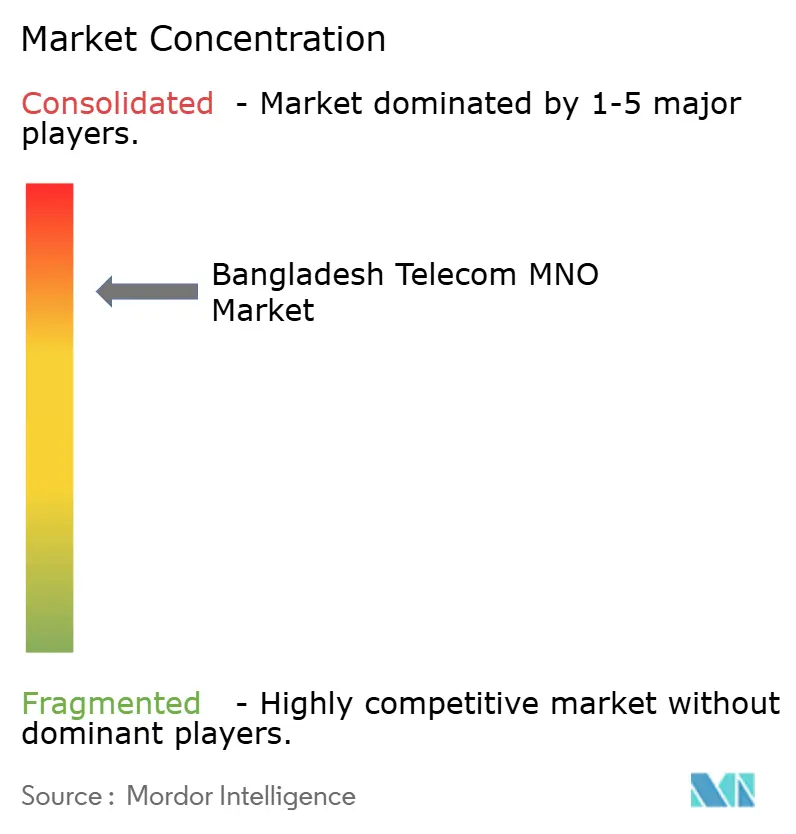
| Market Concentration | High |
Major Players *Disclaimer: Major Players sorted in no particular order Image © Mordor Intelligence. Reuse requires attribution under CC BY 4.0. | |
Bangladesh Telecom MNO Market Analysis by Mordor Intelligence
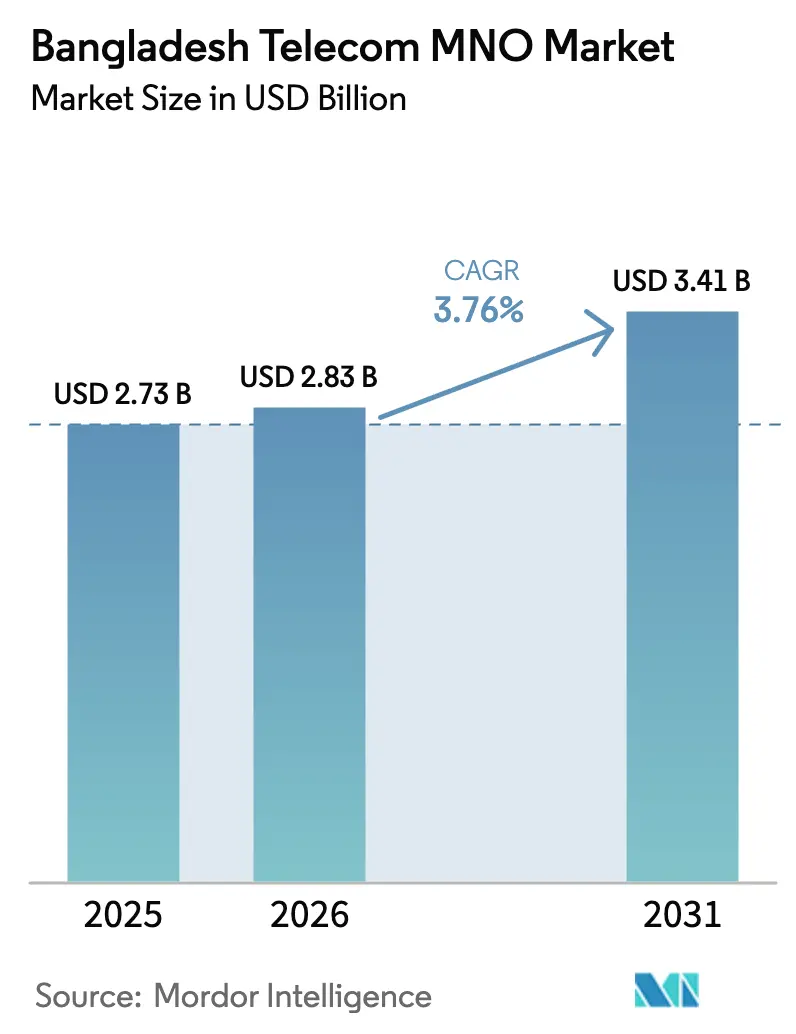
The Bangladesh Telecom MNO market size is expected to grow from USD 2.73 billion in 2025 to USD 2.83 billion in 2026 and is forecast to reach USD 3.41 billion by 2031 at 3.76% CAGR over 2026-2031.
This measured expansion reflects a shift from subscriber acquisition to value extraction as penetration nudges national saturation. Data-first usage patterns, an ambitious state-led digital agenda, and network-sharing efficiencies jointly sustain moderate revenue growth, even as high inflation and spectrum costs weigh on operator margins. Competition pivots around differentiated quality of service and bundled digital offerings rather than headline tariffs. Submarine-cable upgrades, rural fiber build-outs, and IoT pilots keep capital intensity elevated, yet they also widen future revenue pools. Operators simultaneously confront regulatory uncertainties and episodic internet shutdowns that can halt data traffic for 171 million citizens, undercutting daily revenues and denting investor sentiment.
Key Report Takeaways
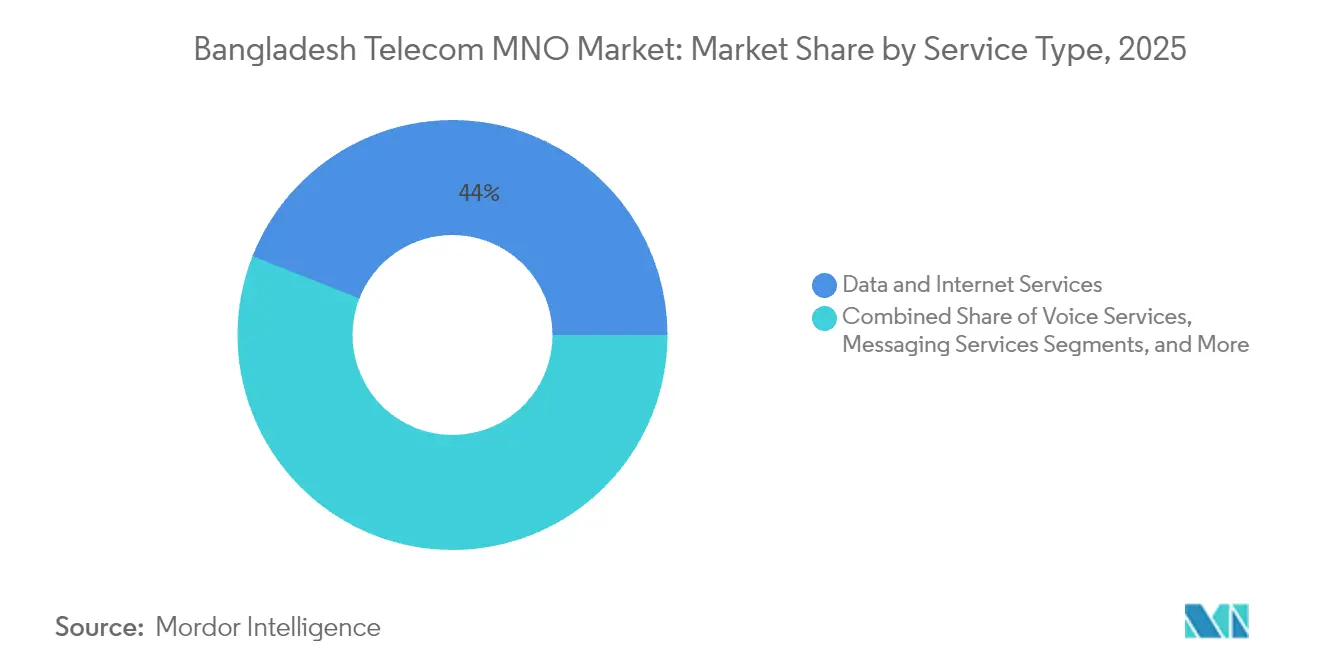
- By service type, data and internet services commanded 44.02% Bangladesh Telecom MNO market share in 2025; IoT and M2M services are projected to expand at a 3.99% CAGR through 2031.
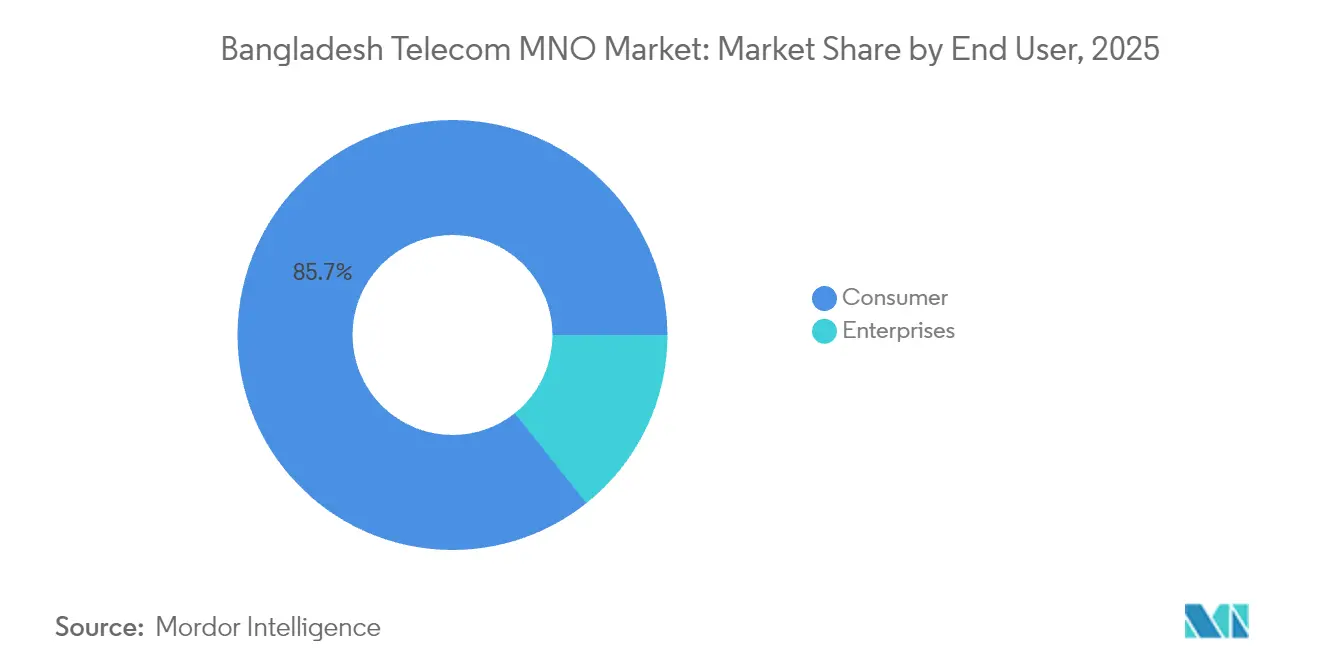
- By end-user, consumer services held 85.70% share of the Bangladesh Telecom MNO market size in 2025, while the enterprise segment is forecast to grow at 4.47% CAGR between 2026 and 2031.
Note: Market size and forecast figures in this report are generated using Mordor Intelligence’s proprietary estimation framework, updated with the latest available data and insights as of 2026.
Bangladesh Telecom MNO Market Trends and Insights
Drivers Impact Analysis*
| Driver | (~)% Impact on CAGR Forecast | Geographic Relevance | Impact Timeline |
|---|---|---|---|
| Surging mobile-data consumption driven by low-cost smartphones | +1.2% | National, with higher penetration in urban centers | Short term (≤ 2 years) |
| Accelerated 4G network expansion and refarming of 3G spectrum | +0.9% | National, prioritizing rural connectivity gaps | Medium term (2-4 years) |
| Rise of digital financial services boosting data monetisation | +0.7% | National, with rural areas showing highest growth | Medium term (2-4 years) |
| Government "Smart Bangladesh 2041" digital-inclusion agenda | +0.6% | National, with focus on government digitization | Long term (≥ 4 years) |
| 2025 launch of SEA-ME-WE-6 cable doubling int'l bandwidth | +0.4% | National, enabling data export opportunities | Short term (≤ 2 years) |
| Active RAN-sharing MoUs lowering rural rollout costs | +0.3% | Rural areas, particularly remote districts | Medium term (2-4 years) |
| Source: Mordor Intelligence | |||
Surging Mobile-Data Consumption Driven by Low-Cost Smartphones
Low-priced Android handsets have widened device affordability, pushing smartphone use from 40% in 2019 to a projected 69% in 2025 [1]. Higher-end screens and app ecosystems stimulate heavier video streaming and social-commerce engagement, nudging subscribers toward larger data bundles. The effect is visible in average data consumption, which leaped to 6.4 GB per user per month in 2024 from 3.1 GB in 2022. Operators now earn more than one-third of ARPU from data add-ons versus voice. Rural uptake is notable: village ownership of mobile phones rose from 29.85% to 56.07% within a decade, signaling a diminishing digital divide. These trends underpin recurring demand for spectrum and network densification, cementing the Bangladesh Telecom MNO market as a data-centric play.
Accelerated 4G Network Expansion and Refarming of 3G Spectrum
Spectrum-refarming and fresh 2.6 GHz allocations in 2024 enabled operators to light up an additional 14,000 4G sites, boosting coverage to 97% of the population [2]. Banglalink’s complete 3G switch-off freed contiguous blocks that now carry twice the LTE traffic with 20% lower latency. Robi and Banglalink’s active RAN-sharing pact cuts duplicate tower builds across 4,000 rural cells, trimming capex by 30% and reducing pay-back periods. Improved spectral efficiency allows operators to trial fixed-wireless access for SME broadband, opening new addressable pockets within the Bangladesh Telecom MNO market.
Rise of Digital Financial Services Boosting Data Monetization
Mobile money wallets, led by bKash’s 70 million customers, processed BDT 9,900 billion in FY 2024, up 30% year-on-year [3]. Each transaction journey, funding, authentication, and confirmation, relies on packet data, converting financial inclusion momentum into higher megabyte sales. Operators earn platform fees through API integrations and co-branded SIMs that bundle zero-rated wallet access with paid social-media packs. As rural merchants adopt QR codes for micro-payments, incremental data needs extend into villages where the Bangladesh Telecom MNO market previously earned only voice revenue. The interplay of fintech and telco ecosystems transforms prepaid subscribers into stickier multi-service users, elevating lifetime value.
Government “Smart Bangladesh 2041” Digital-Inclusion Agenda
The national blueprint targets universal e-government access, remote learning, and telemedicine, all of which demand resilient mobile bandwidth. Over 2,000 public-service portals already register 6 million monthly log-ins, and each interaction drives upstream traffic surges that operators monetize. Union Digital Centers extend official documents to 4,500 sub-districts via mobile hotspots, pressing networks to uphold consistent speeds even in far-flung char regions. Regulatory clarity on spectrum roadmaps and tower-sharing sweetens return profiles, prompting operators to front-load LTE carrier aggregation and test 5G non-standalone pilots. The policy thrust ensures a durable demand baseline for the Bangladesh Telecom MNO market while aligning private investment with socio-economic goals.
Restraints Impact Analysis*
| Restraint | (~)% Impact on CAGR Forecast | Geographic Relevance | Impact Timeline |
|---|---|---|---|
| High spectrum fees and telecom-specific taxation | -0.8% | National, affecting all operators equally | Long term (≥ 4 years) |
| Limited consumer willingness to pay for 5G premium | -0.5% | Urban areas initially, expanding nationwide | Medium term (2-4 years) |
| Fiber back-haul gaps outside district towns | -0.4% | Rural and semi-urban areas | Medium term (2-4 years) |
| Political unrest–led internet shutdowns hurting operator revenue | -0.3% | National, with urban centers most affected | Short term (≤ 2 years) |
| Source: Mordor Intelligence | |||
High Spectrum Fees and Telecom-Specific Taxation
Bangladesh’s reserve prices exceed regional medians by 35%, forcing each MHz to serve 1.2 million subscribers, triple the Indian norm, and inflating call-drop volumes [4]. Up-front auction payments and a 5% supplementary spectrum surcharge lift effective capital costs, squeezing free cash flow. With 3% of gross revenue already siphoned as regulatory fees, operators hesitate to participate in larger 5G allocations, delaying nationwide roll-outs. The narrowed fiscal capacity constrains the Bangladesh Telecom MNO market from realizing quicker quality-of-experience upgrades, keeping average download speeds at 14 Mbps versus 17 Mbps across lower-income ASEAN peers.
Political Unrest-Led Internet Shutdowns Hurting Operator Revenue
The July 2024 shutdown froze 4G data for 30 hours, erasing an estimated USD 32 million in sector revenue and hampering mobile banking, ride-hailing, and logistics operations. Frequent recourse to network blackouts injects uncertainty into investor cash-flow models, raising the weighted average cost of capital by 120 basis points for Bangladeshi telcos vis-à-vis frontier Asia benchmarks. Short-notice directives also expose operators to customer churn as reliability perceptions erode. Repeated disruptions threaten the Bangladesh Telecom MNO market’s shift toward enterprise contracts that demand stringent uptime service-level agreements.
*Our forecasts treat driver/restraint impacts as directional, not additive. The impact forecasts reflect baseline growth, mix effects, and variable interactions.
Segment Analysis
By Service Type: Data Services Drive Revenue Transformation
Data and Internet services command the largest market share at 44.02% in 2025, and IoT and M2M services lead forecast growth at 3.99% CAGR as smart-metering and asset-tracking pilots scale. Messaging stays relevant among 2G feature-phone bases, especially in coastal districts where cyclone warnings rely on SMS broadcasts. OTT video subscriptions doubled in Dhaka and Chattogram during 2024, signaling demand for higher-margin content partnerships. Operators now bundle zero-rated entry tiers before upselling HD streaming, lifting unit ARPU. As enterprises automate factories under the government’s industrial IoT subsidy, packetized telemetry inches upward, embedding long-tail growth within the Bangladesh Telecom MNO market.
Data centric monetization flips the historical revenue mix: blended ARPU rose 4% year-over-year despite inflation-adjusted tariff stagnation, solely on the back of larger data top-ups. Competitive differentiation focuses on network latency and content tie-ups with regional OTT firms. Early fixed-wireless access pilots leverage spare LTE capacity to supply 20 Mbps home broadband to 180,000 suburban households priced at BDT 799 (USD 7.3) monthly. Such cross-vertical innovation widens lifetime revenue streams beyond legacy voice.

By End-User: Enterprise Segment Accelerates Digital Adoption
Consumer services dominate with an 85.70% market share in 2025, reflecting Bangladesh's large population base and increasing mobile penetration across rural and urban areas. The enterprise segment represents the fastest-growing end-user category with a 4.47% CAGR forecast through 2031, driven by corporate digitization initiatives and government Smart Bangladesh 2041 programs requiring advanced connectivity solutions. SMEs seek secure VPN links and cloud-on-ramp solutions as they digitize supply chains and e-commerce storefronts. Large conglomerates in textiles and shipbuilding trial NB-IoT sensors for predictive maintenance, raising demand for private APNs and edge compute. Consumer services, though still dominant, plateau at sub-4% growth as penetration crests. Operators counter softness by repackaging unlimited social bundles and integrating micro-loan offers through MFS tie-ups to defend churn.
Grameenphone’s Super Core Data Center in Dhaka offers tier-III colocation to banks, while Robi Axiata’s Axentec facility secures ISO 27001 certification to lure export-oriented RMG manufacturers. Such assets let telcos upsell managed security and disaster-recovery services, deepening enterprise stickiness. Government outsourcing of ERP hosting for 48 ministries adds predictable 10-year contracts, de-risking investment. The convergence of cloud, connectivity, and IT services elevates the Bangladesh Telecom MNO market from commodity transport to an integrated digital-infrastructure partner.
Geography Analysis
Dhaka division houses 36% of active SIMs and commands 42% of data traffic, making the capital the revenue anchor of the Bangladesh Telecom MNO market. Chattogram and Sylhet follow as export-processing and expatriate hubs, each registering double-digit data growth in 2024. Yet policy incentives and tower-sharing cut rollout costs in Rajshahi and Rangpur, closing the urban-rural gap to a 7-percentage-point difference, the smallest in South Asia.
Rural fiber back-haul remains sparse beyond district towns. The state-backed Fiber@Home backbone now reaches 87,000 villages across 64 districts with one million core-km of cable, enabling LTE back-haul upgrades and lowering microwave dependency. Hills of Chittagong and wetlands of the Haor zone pose terrain challenges that elevate maintenance costs by 28% versus the plains. Non-geostationary satellite options, including Starlink’s pending entry, promise 100 Mbps downlinks to cyclone-prone islands, de-risking resilience.
International bandwidth climbs with the SEA-ME-WE-6 cable that lands at Cox’s Bazar in 2025, adding 126 Tbps design capacity and positioning Bangladesh as a South-to-Southeast Asia transit corridor. Wholesale sale-leaseback agreements let operators offload capacity on flexible terms, cushioning forex swings. Improved latency benefits offshore BPO providers in Sylhet that handle real-time voice support, reinforcing regional digital-employment clusters. Geographically balanced investments, therefore, anchor inclusive expansion of the Bangladesh Telecom MNO market.
Regulatory Landscape
The Bangladesh Telecommunication Regulatory Commission (BTRC) oversees licensing, spectrum, QoS, and tariff-related requirements for mobile operators and adjacent connectivity providers. In 2026, the BTRC scheduled a hybrid public hearing on August 19 to address consumer concerns such as network quality and tariff issues, reflecting continued scrutiny of service performance as data becomes a larger revenue driver.
Regulatory enforcement also covers wholesale connectivity and market conduct that can affect MNO service delivery. In July 2026, the BTRC upheld a Tk 3 crore administrative fine against Summit Communications Ltd for discriminatory bandwidth pricing, pointing to tighter compliance expectations across the wider telecom ecosystem. Parallel discussions referenced by the BTRC chairman at the ITU on commercial use of IMT spectrum for satellite-based services add another element to spectrum policy as satellite-to-mobile concepts move from pilots toward formal frameworks.
Competitive Landscape
Four major licensees, Grameenphone, Robi, Banglalink, and state-owned Teletalk, control a signifiant share of active SIMs, yet competition revolves around experience rather than price. Grameenphone, with 80 MHz of spectrum, sustains the highest EBITDA margin above 60% for nine straight quarters, reflecting entrenched scale efficiencies. Robi’s data-first positioning lifts its data ARPU to 62% of total, leading peers.
The 2024 Robi-Banglalink MoU for active RAN sharing reduces combined capex by USD 120 million over three years while expanding rural coverage by 9 percentage points. Regulatory reforms continue; the BTRC dismantled the IGW cartel in 2025, cutting international call termination fees 45% and liberating VOIP entrepreneurship. Looming entrants include satellite ISPs with 100% foreign ownership permission that could erode back-haul and direct-to-consumer segments in remote geographies.
Competitive strategy increasingly fuses content, cloud, and commerce. Operators launch super-apps bundling ride-hailing, payments, and micro-insurance to boost ecosystem lock-in. Enterprise IoT alliances with Japanese sensor makers open export manufacturing verticals. Collectively, these moves sustain growth in the Bangladesh Telecom MNO market while gradually diversifying revenue beyond traditional handset-based ARPU.
Bangladesh Telecom MNO Industry Leaders
-
Grameenphone Ltd.
-
Banglalink
-
Teletalk Bangladesh Limited
-
Robi Axiata Limited
- *Disclaimer: Major Players sorted in no particular order
Market Opportunities and Future Outlook
Satellite-to-mobile connectivity is emerging as a practical whitespace for improving coverage and resilience beyond terrestrial backhaul constraints in harder-to-reach areas such as the Chittagong Hill Tracts and coastal belts. As an evidence anchor, the BTRC granted experimental approval to Banglalink in May 2026 to test Direct to Cell (D2C) capabilities using its allocated 1920-1925 and 2110-2115 MHz spectrum in collaboration with Starlink, enabling SMS-type services where conventional radio and fiber economics are more challenging.
The clearest monetization headroom is in upgrading the data-led value proposition rather than only adding basic subscribers, given that data and internet services already account for 44.02% of 2025 revenue and enterprise connectivity is expanding faster than consumer. Non-expiry data packs launched by all four operators (Grameenphone, Robi, Banglalink, Teletalk) in 2026 also indicate product re-bundling around usage flexibility, supporting higher-tier plans tied to consistent QoS, fixed-wireless access for suburban households, and packaged enterprise solutions (private APNs, managed security, and IoT/M2M) that can ride on expanding LTE coverage and low-band spectrum deployments. With BTRC process milestones such as the August 2026 public hearing, operators also have scope to differentiate on measurable network quality and customer experience as pricing becomes more regulated and transparent.
Recent Industry Developments
- June 2026: VEON announces a USD 250 million anchor investment to attract up to USD 1 billion in foreign direct investment for Bangladesh. The update points to continued foreign funding appetite for Bangladesh telecom expansion and supports network and service scale-up.
- June 2026: Grameenphone begins nationwide deployment of 700-MHz spectrum. The rollout of low-band 700 MHz expands coverage nationwide, improving indoor and rural reach.
- April 2026: Banglalink signs agreement with Starlink Mobile to integrate satellite-to-mobile connectivity with terrestrial 4G LTE. The agreement supports satellite-enabled mobile connectivity expansion and helps bridge connectivity gaps in remote areas.
Research Methodology Framework and Report Scope
Market Definition and Coverage
For this study, the market is defined as operator generated revenue from telecom connectivity and related services delivered in Bangladesh, covering what subscribers and enterprise users pay for voice, mobile data and internet access, and other bundled service fees.
Scope exclusions: hardware sales (devices and routers), network equipment, and pure IT services that are not billed as telecom operator services are excluded.
Segmentation Overview
- Overall Telecom Revenue and ARPU
- Service Type
- Voice Services
- Data and Internet Services
- Messaging Services
- IoT and M2M Services
- OTT and PayTV Services
- Other Services (VAS, Roaming and International Services, Enterprise and Wholesale Services, etc.)
- End-user
- Enterprises
- Consumer
Data Sources, Market Sizing, and Validation
Desk Research
Desk research starts by aligning the market boundary with how telecom revenue and subscriber metrics are tracked in public reporting. We reviewed regulator releases and annual publications, such as Bangladesh Telecommunication Regulatory Commission statistics, plus government planning documents and national indicators from sources such as the Bangladesh Bureau of Statistics.
To convert activity into value, public disclosures were used to understand service mix and pricing patterns, including operator financial statements, investor materials, and audited notes where available. Supporting signals were also taken from trade bodies and standards sources, such as the International Telecommunication Union, and from peer reviewed telecom policy and economics studies. When a reconciliation check was needed across operators or time periods, we referenced paid subscriptions that provide company financial intelligence, patent coverage, and shipment level import and export visibility for relevant network inputs. The sources listed here are illustrative only, and many additional public documents and datasets were reviewed to clarify definitions, validate assumptions, and close data gaps.
Primary Interviews and Surveys
Bangladesh interviews and surveys cover mobile operators, enterprise connectivity buyers, distribution participants, and telecom specialists. We use their views to test subscriber activity, data use, voice and messaging mix, ARPU, pricing, and network investment, then reconcile gaps and triangulate assumptions in the final analysis.
Distribution of primary research fieldwork respondents
| Company type | Respondent position |
|---|---|
| Top tier: 30% | CXOs: 15% |
| Mid tier: 50% | Functional/Unit leaders: 30% |
| Smaller Players: 20% | Managers: 55% |
Market-Sizing & Forecasting
Sizing is built from a top down demand pool that is reconstructed using subscriber volumes and usage proxies, then translated into value using observed ARPU direction and service mix. For Bangladesh, the model leans on measurable indicators like the mobile subscriber base, smartphone and 4G to 5G migration, data consumption growth, voice and messaging monetization decay, and the pace of enterprise connectivity adoption, including IoT and M2M when billed by operators.
Bottom up checks are used selectively so totals stay realistic and explainable. These checks include sampled price plan ranges, channel level recharge and bundle patterns, and operator level revenue splits where disclosures allow it, with clear gap handling when a line item is reported differently across years. For forecasting, we rely on scenario analysis supported by a simple multivariate regression view, where the main drivers are subscriber growth, data usage growth, and ARPU progression under expected taxation and spectrum fee pressure. Assumptions were finalized only after stress testing against the direction of regulatory actions and the investment cycle discussed by interviewees.
Data Validation & Update Cycle
Outputs are validated through a step by step triangulation process, where modeled revenue is checked against independent signals such as regulator reported market activity, reported operator trends, and macro indicators that should move with connectivity demand. If a year shows an unusual jump or drop, we recheck the underlying inputs, confirm whether it is linked to one time items, and then revisit the assumption with follow up calls when needed.
Before sign off, the model goes through analyst review layers so unit logic, currency conversions, and time series continuity are consistent. Reports are refreshed annually, and interim updates are made when material events occur, such as major policy changes, pricing resets, or technology launches that shift adoption. Right before delivery, a final pass is completed so clients receive the latest updated view tied to the same repeatable steps.
Mordor Intelligence's Bangladesh Telecom Market Size Compared Against Other Published Estimates
Published market sizes for Bangladesh telecom can vary because authors do not always measure the same revenue pool, and the timing of currency conversion and the base year choice can also change the final number. Differences also come from how voice, data, and newer digital services are treated, especially when bundles and discounts are common.
The main gap comes from whether the estimate is strictly operator service revenue or whether adjacent areas like tower leasing, handset sales, and one time spectrum proceeds are blended in, and in Mordor Intelligence this market is kept to recurring MNO service revenue with volume checks using subscriber trends before ASP and ARPU paths are applied.
Benchmark comparison
| Source | Market Size | Gaps in Research Methodology |
|---|---|---|
| Mordor Intelligence | USD 2.73 B (2025) | |
| Industry Association A | USD 3.00 B (2025) | Often aligns to broader mobile sector revenue concepts and may reflect a higher implied revenue base when fiscal burden ratios are back solved, which can blur the difference between operator revenue and government levies or fees. |
| Trade Journal B | USD 2.45 B (2025) | Typically extrapolates from limited operator disclosures and applies conservative ARPU decline assumptions, which can undercount data monetization lift from 4G to 5G migration and bundle driven usage growth. |
The table shows that most of the spread is explained by scope choices and by how ARPU is projected when bundles and policy costs are changing. By keeping the revenue definition consistent and then verifying it against subscriber and usage direction, we can present a practical market value that can be rechecked as new regulator and operator disclosures are released.
Key Questions Answered in the Report
What is the current revenue value of the Bangladesh Telecom MNO market?
The market generates USD 2.83 billion in 2026 and is forecast to grow to USD 3.41 billion by 2031.
Which service category leads revenue contribution?
Data and Internet services lead with 44.02% of total 2025 revenue.
How fast is the enterprise segment growing?
Enterprise connectivity is projected to expand at a 4.47% CAGR between 2026 and 2031.
What impact does spectrum pricing have on operators?
Elevated reserve prices raise capital costs and limit network quality, subtracting 0.8 percentage points from forecast CAGR.
How significant are internet shutdowns for the sector?
The July 2024 blackout alone erased USD 32 million in telco revenue and underscored heightened regulatory risk.
Which geographic areas drive future growth?
Rural districts benefit from fiber back-haul extensions and network sharing, while Dhaka continues to dominate premium data usage.