
Market Overview
| Study Period | 2021 - 2031 |
|---|---|
| Forecast Data Period | 2026 - 2031 |
| Base Year Market Size (2025) | USD 328.84 Million |
| Market Size (2026) | USD 351.79 Million |
| Market Size (2031) | USD 493.23 Million |
| Growth Rate (2026 - 2031) | 6.98 % |
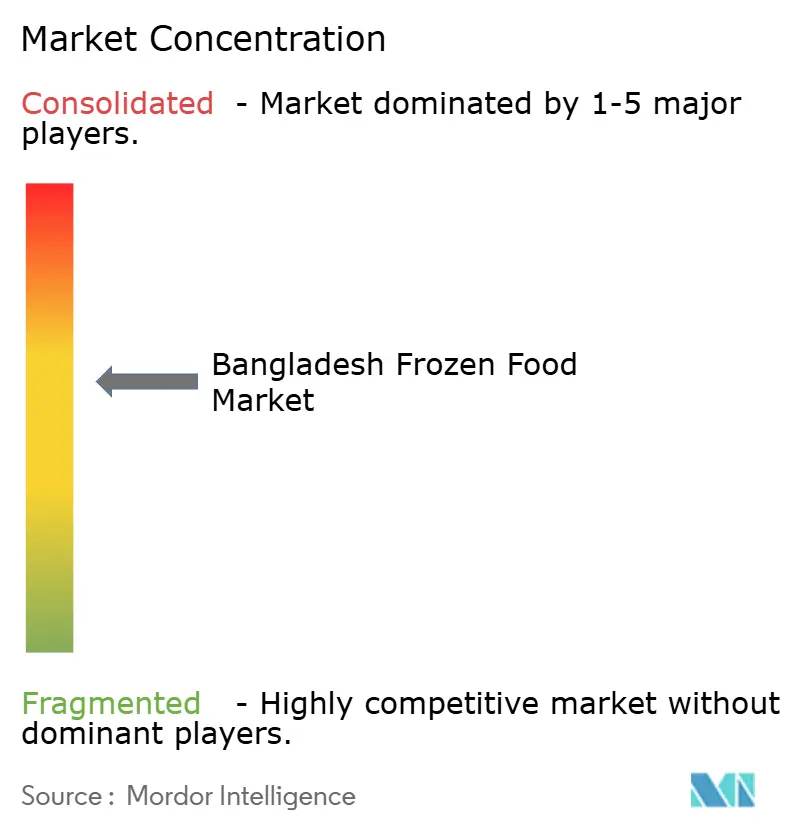
| Market Concentration | Medium |
Major Players *Disclaimer: Major Players sorted in no particular order Image © Mordor Intelligence. Reuse requires attribution under CC BY 4.0. | |
Bangladesh Frozen Food Market Analysis by Mordor Intelligence
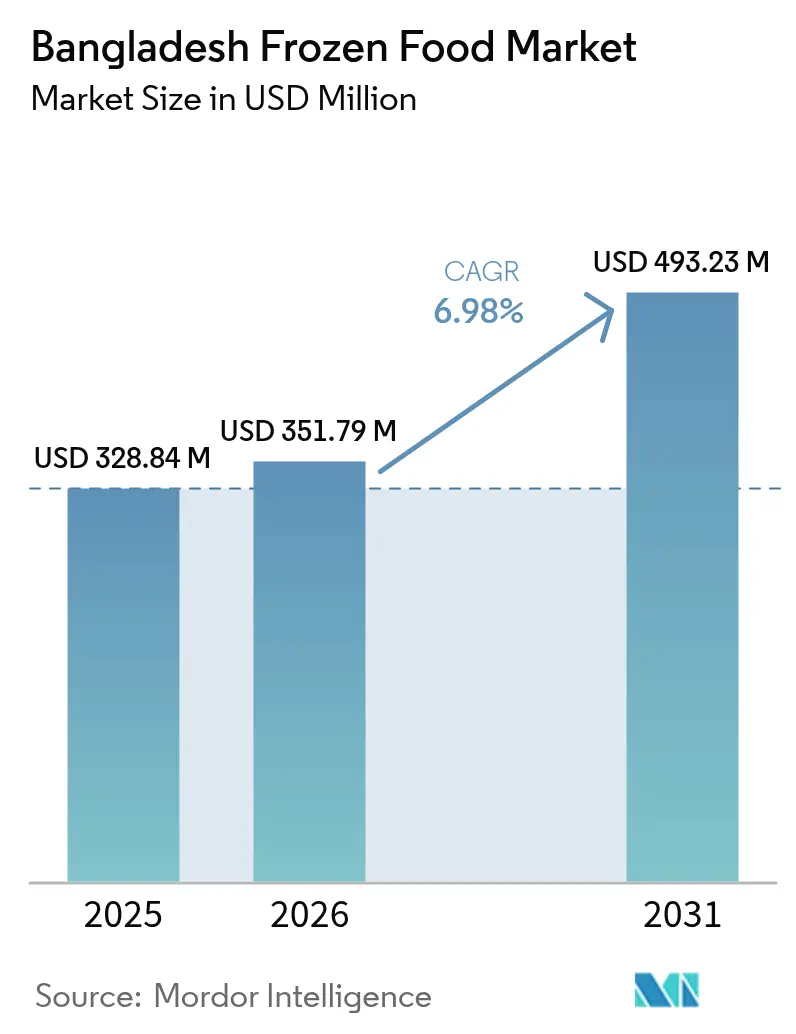
The Bangladesh frozen food market size is expected to grow from USD 328.84 million in 2025 to USD 351.79 million in 2026 and is forecast to reach USD 493.23 million by 2031 at 6.98% CAGR over 2026-2031. According to The International Finance Corporation (IFC), rapid urbanization, a burgeoning middle class with increasing disposable income, and infrastructure projects like the Bay Terminal are driving a consistent demand for convenient, long-shelf-life meal solutions. The growth of Bangladesh's frozen food market is further bolstered by rising export earnings from frozen seafood and government incentives for agro-processing. Meanwhile, the adoption of technology in cold-chain operations and HACCP-compliant processing plants is reducing quality-related losses. Additionally, modern retail formats are enhancing product visibility in urban centers. However, challenges remain: high import tariffs on certain ingredients and persistent consumer skepticism towards processed items in rural areas are moderating volume growth.
Key Report Takeaways
- By product type, frozen seafood led with a 34.02% share of the Bangladesh frozen food market in 2025, while frozen snacks and appetisers are projected to record a 9.08% CAGR through 2031.
- By product category, ready-to-cook formats commanded 41.05% of the Bangladesh frozen food market size in 2025, whereas ready-to-eat items exhibit the fastest trajectory at an 8.81% CAGR to 2031.
- By packaging type, flexible formats accounted for 87.05% of the Bangladesh frozen food market size in 2025, while rigid packs are advancing at a 7.58% CAGR on the back of premium product positioning.
- By distribution channel, off-trade outlets controlled 74.10% of the Bangladesh frozen food market share in 2025; on-trade sales are widening at an 8.29% CAGR as foodservice operators rely on frozen inputs to streamline operations.
Note: Market size and forecast figures in this report are generated using Mordor Intelligence’s proprietary estimation framework, updated with the latest available data and insights as of 2026.
Bangladesh Frozen Food Market Trends and Insights
Drivers Impact Analysis*
| Driver | (~) % Impact on CAGR Forecast | Geographic Relevance | Impact Timeline |
|---|---|---|---|
| Technological advancements in food processing | +1.2% | Dhaka and Chittagong industrial zones | Medium term (2-4 years) |
| Rising urban middle-class demand for convenience | +0.8% | Dhaka, Chittagong, Sylhet, Khulna urban clusters | Short term (≤ 2 years) |
| Government incentives for agro-processing | +1.1% | National, export-oriented zones | Long term (≥ 4 years) |
| Expansion of cold-chain infrastructure | +0.9% | Nationwide with urban–rural corridors | Medium term (2-4 years) |
| Halal-certified frozen export opportunities | +0.7% | National; outward to Middle East, Southeast Asia, Europe | Long term (≥ 4 years) |
| ASC-certified shrimp cluster farming momentum | +0.6% | Cox’s Bazar, Khulna, Barisal coastal belts | Medium term (2-4 years) |
| Source: Mordor Intelligence | |||
Technological advancements in food processing
In 2024, Bangladesh's food processing sector is witnessing a technological transformation. IoT-enabled monitoring systems and automated cold-chain solutions are enhancing efficiency throughout the value chain. The government has greenlit pilot farms for vannamei shrimp, harnessing smart aquaculture technologies. These advancements, as highlighted by research from Bangladesh Agricultural University, facilitate real-time monitoring of water quality and optimized feeding. Hermetic storage systems address quality control challenges by maintaining moisture variation at approximately 0.5% over 125 days, in contrast to the significant degradation typically observed with traditional methods. Processing facilities, drawing on the lessons learned from the 1997 EU ban, are increasingly adopting HACCP-compliant systems. Following the 1997 EU ban, market access was restored within 18 months, accompanied by systematic quality improvements. Furthermore, the adoption of AI-driven forecasting models, akin to those used by global cold-chain operators, is revolutionizing capacity planning. This shift not only slashes storage costs by up to 15% but also boosts inventory turnover rates.
Rising urban middle-class demand for convenience
In urban areas of Bangladesh, the growing middle class is reshaping food consumption habits. Although people have traditionally preferred freshly prepared meals, convenience foods are steadily gaining popularity. Modern retail outlets are expanding rapidly, with approximately 211 major supermarket branches now making a notable contribution to the national economy. This retail growth is strengthening the supply chain and helping frozen foods reach more city markets. In cities like Dhaka and Chittagong, busy professionals are increasingly opting for quick meal solutions, driving up demand for ready-to-eat products across the Bangladesh foodservice market and retail channels. However, concerns about food adulteration continue to deter some consumers. Many remain cautious about the safety of processed foods, creating a potential market for premium brands that emphasize quality, transparency, and proper certification.
Government incentives for agro-processing
Bangladesh's government is strategically promoting agro-processing industrialization, offering significant financial incentives that favor frozen food manufacturers and exporters. Under the latest budget, export-oriented agro-processing facilities are granted a 10% cash incentive on their export earnings. Additionally, there's a 15% VAT exemption on machinery imports, specifically for cold storage and processing equipment. Highlighting the importance of these measures, the World Bank Group's Bangladesh Country Private Sector Diagnostic emphasizes the need for reforms, such as digitizing customs classifications and expediting import clearances [1]. Such changes promise to reduce input costs for frozen food processors, especially those that rely on imported packaging and cold-chain equipment. Further bolstering these initiatives, the government has approved the Tk 13,525 crore Bay Terminal project[2]. This endeavor aims to enhance port efficiency and reduce the current 17.48-day container dwell time, a significant barrier to export competitiveness.
Expansion of cold chain infrastructure
Private sector investments are rapidly bolstering cold-chain infrastructure, as evidenced by Nippon Express's acquisition of a 20% stake in Cold Chain Bangladesh Limited, which indicates rising international interest in the market[3]. This strategic move aims to rectify significant infrastructure gaps, which currently result in postharvest losses of vegetables, such as cucumbers, and fruits, including mangoes, at the farm level. In its infrastructure development blueprint, the government is enhancing rural connectivity. This initiative aims to expand cold-chain access, moving beyond urban locales where limited refrigeration has hindered market growth. Cutting-edge cold-chain facilities are now harnessing AI-driven capacity planning systems. These innovations not only optimize storage but also curtail operational costs. Such technological advancements empower exporters to adhere to stringent international quality standards, all while minimizing waste that has been a drain on profitability.
Restraints Impact Analysis*
| Restraint | (~) % Impact on CAGR Forecast | Geographic Relevance | Impact Timeline |
|---|---|---|---|
| Inadequate cold-chain outside urban centres | -0.9% | Rural and semi-urban districts nationwide | Medium term (2-4 years) |
| High import tariffs and VAT on ingredients | -0.7% | Countrywide | Short term (≤ 2 years) |
| Supply chain inefficiencies | -0.6% | Ports and transport hubs | Medium term (2-4 years) |
| Consumer perception barriers | -0.4% | All regions, intensity varies by demographics | Long term (≥ 4 years) |
| Source: Mordor Intelligence | |||
Supply chain inefficiencies
Bangladesh’s frozen food industry is struggling to reach its full potential due to persistent inefficiencies in the country’s food supply chain. These weaknesses drive up storage costs and increase the risk of quality loss, especially for products that require strict temperature control. The situation is made worse by poor transportation infrastructure, particularly the shortage of refrigerated trucks, which forces producers to rely on less efficient transportation methods. As a result, handling risks rises and deliveries take longer. The agricultural supply chain is also highly fragmented, with multiple middlemen involved in the movement of fruits and vegetables. This creates information gaps and frequent price fluctuations, making it difficult for frozen food processors to plan their raw material purchases. Export-focused producers are hit hardest, as delays and inconsistent product quality can result in financial penalties and lost contracts abroad. Together, these challenges limit the expansion of the frozen food sector and weaken Bangladesh’s ability to compete in global markets.
Inadequate cold-chain outside urban centers
The lack of cold-chain infrastructure in rural and semi-urban regions of Bangladesh is limiting the reach of frozen food producers and driving up their distribution expenses. While major cities like Dhaka benefit from advanced cold storage facilities, rural areas continue to struggle with inadequate refrigerated transportation. This forces manufacturers to concentrate their operations in urban centers, reducing their overall market coverage and increasing per-unit delivery costs. To meet sporadic demand from rural areas, companies often have to maintain larger inventories in city warehouses, which adds further strain to logistics and storage management. The weak cold-chain network also affects export performance; inconsistent temperature control from production sites to ports can compromise product quality, leading to rejected shipments and damaging the reputation of Bangladeshi brands in international markets.
*Our forecasts treat driver/restraint impacts as directional, not additive. The impact forecasts reflect baseline growth, mix effects, and variable interactions.
Segment Analysis
By Product Type: Seafood Dominance Drives Export Growth
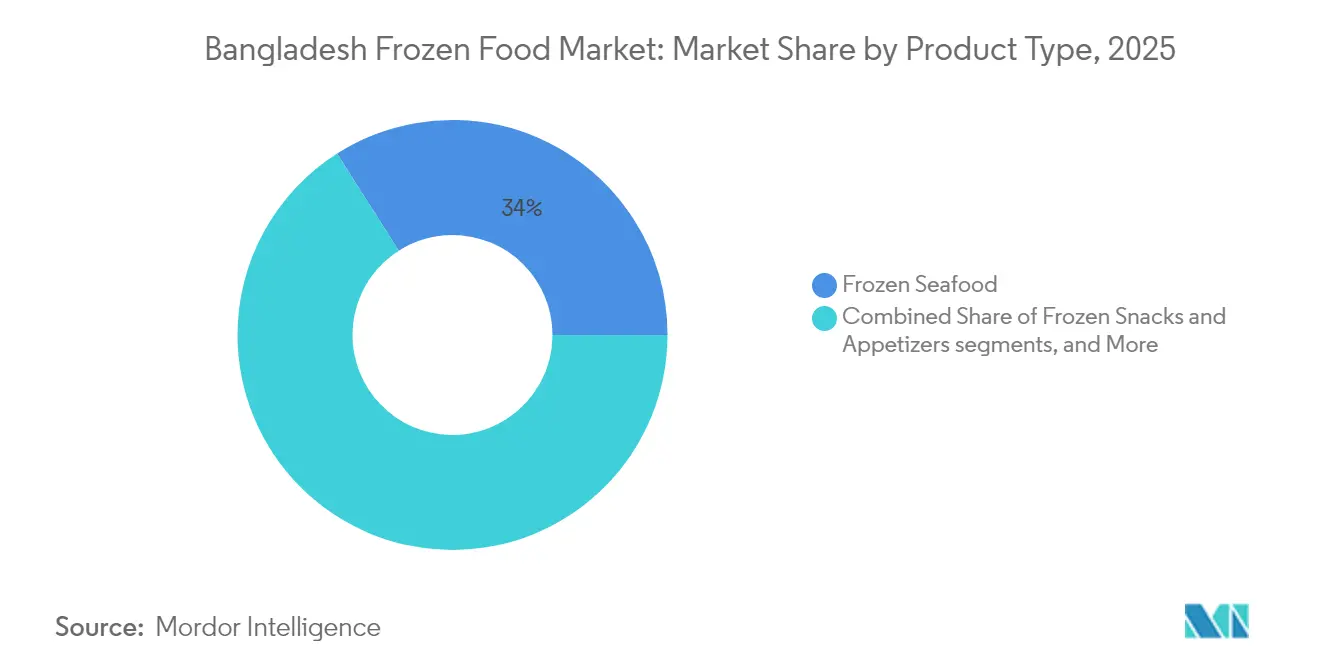
In 2025, frozen seafood accounted for the largest share of Bangladesh’s frozen food market, at 34.02%, benefiting from the country’s extensive coastline and robust aquaculture sector. That same year, the government approved pilot projects for farming vannamei shrimp, a move toward higher-value species that reflects growing global demand for sustainably sourced seafood. Frozen snacks and appetizers are experiencing rapid growth, with a projected annual growth rate of 9.08% through 2031. This rise is driven by increasing urbanization and the changing lifestyles of city professionals who prefer convenient meal options.
Frozen fruits and vegetables are also experiencing growth, supported by government initiatives aimed at reducing postharvest losses. However, the lack of reliable cold-chain facilities in rural areas continues to hinder smooth sourcing and distribution. The frozen meat and poultry segments are seeing stable growth, boosted by a rising appetite for protein among middle-income households. Meanwhile, frozen desserts and ice creams are thriving as disposable incomes increase and Western food habits become more popular. The expansion of modern retail, particularly supermarket chains with specialized frozen sections, is strengthening distribution networks and supporting growth across all categories. Ready meals and pre-cooked items are also gaining ground, as restaurants and food service businesses increasingly turn to frozen products for consistent quality and faster preparation.

By Product Category: Ready-to-Cook Leads Market Evolution
In 2025, ready-to-cook foods make up 41.05% of Bangladesh’s frozen food market, reflecting consumers’ desire for convenient meal options that still allow for some home cooking. This category has gained popularity because it aligns well with local traditions, allowing people to save time without compromising the satisfaction of preparing a meal themselves. Ready-to-eat products, though currently a smaller segment, are expanding rapidly with an annual growth rate of 8.81% expected through 2031. The trend is primarily driven by busy urban professionals who prefer quick, no-fuss meal solutions that fit their fast-paced lifestyles.
However, the rise of ready-to-eat foods faces some resistance, as many consumers remain cautious about the safety and quality of processed products. Even so, premium brands are addressing these concerns by emphasizing quality control, certification, and transparency in their ingredients. This approach resonates with educated city dwellers who value both convenience and assurance of safety, and are willing to pay extra for it. As consumer awareness grows and eating habits become more diverse, new opportunities are emerging in niche categories, such as specialized diets and ethnic frozen dishes. Overall, ready-to-cook products continue to appeal to consumers in transition between traditional and modern lifestyles, while ready-to-eat foods are becoming the choice of fully urbanized buyers seeking maximum convenience.
By Packaging Type: Flexible Solutions Drive Cost Efficiency
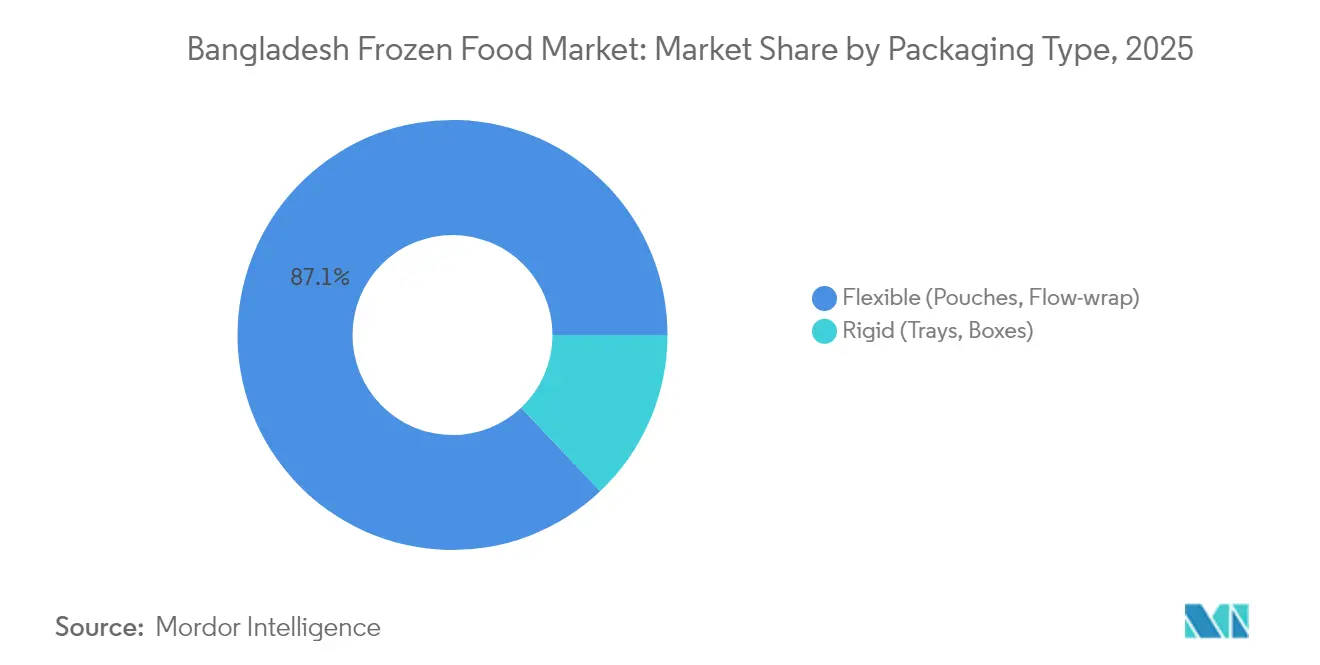
In 2025, flexible packaging, including pouches and flow wraps, leads the frozen food market with an 87.05% share. Its popularity stems from being cost-effective, easy to store, and well-suited for consumers seeking convenience, particularly in price-sensitive markets. These lightweight formats make efficient use of space in both retail and home settings while providing strong protection for frozen products at a lower material cost than rigid packaging. Rigid packaging, such as trays and boxes, is also gaining momentum, with a projected growth rate of 7.58% annually through 2031. This segment’s growth is largely driven by wealthier urban consumers who perceive rigid packaging as more premium and reflective of higher product quality.
The shift in packaging preferences highlights the growing maturity of Bangladesh’s frozen food market. Premium brands are turning to rigid formats to distinguish themselves and justify higher prices, while mass-market brands continue to rely on flexible options to remain affordable. At the same time, growing environmental awareness and stricter export requirements are steering the industry toward more sustainable packaging solutions. Innovations such as advanced barrier films and modified atmosphere packaging are helping extend shelf life, maintain product quality, and strengthen export competitiveness, especially for products traveling through longer distribution chains. Additionally, regulations around food safety labeling and export standards are increasingly influencing packaging choices, prompting greater investment in high-performance, globally compliant materials.
By Distribution Channel: Off-Trade Dominance with On-Trade Growth
In 2025, off-trade channels, including supermarkets, hypermarkets, convenience stores, and online platforms, lead Bangladesh’s frozen food market with a 74.10% share, serving both urban and rural customers. Major supermarket chains, such as Shwapno, with their extensive network of outlets, are strengthening their distribution in cities and gradually expanding into semi-urban areas. Although on-trade channels currently hold a smaller portion of the market, they are expected to grow rapidly at an annual rate of 8.29% through 2031. This rise is being driven by restaurants, hotels, and institutional foodservice providers that increasingly rely on frozen ingredients to improve efficiency, control costs, and maintain consistency.
The expansion of the on-trade segment reflects the growing professionalism of Bangladesh’s foodservice industry. Frozen ingredients help ensure uniform quality, simplify portioning, reduce labor needs, and minimize food waste. Meanwhile, online retail platforms are emerging as a significant sales channel, particularly for premium frozen products that appeal to urban consumers seeking convenience and variety. Convenience stores, though often underappreciated, are also becoming key players by catering to impulse buyers and offering small-pack options ideal for single households and busy city dwellers. Overall, the country’s distribution network for frozen foods is becoming more sophisticated, with modern retail formats emphasizing both accessibility and the need to maintain a reliable cold chain across diverse regions.
Geography Analysis
In Bangladesh, urban centers dominate the frozen food market, with the Dhaka metropolitan area leading the charge. Dhaka boasts the highest concentration of middle-class households, all of which have a penchant for convenience foods. Bolstered by a sophisticated retail landscape, featuring modern supermarkets and cold storage facilities, Dhaka adeptly caters to a diverse range of consumer segments. Chittagong, the nation's primary commercial port and industrial hub, ranks as the second-largest market. Here, export-driven food processing facilities not only bolster production but also fuel local demand for frozen goods. Chittagong's strategic positioning ensures smooth distribution to the southeastern rural areas and opens doors to international trade, introducing local consumers to global food trends.
Regional demand patterns highlight distinct product preferences. Coastal regions, steeped in a traditional fishing culture, show a pronounced affinity for frozen seafood. Meanwhile, Sylhet and Khulna, with their burgeoning middle-class populations, are embracing convenience foods, a shift driven by urbanization and evolving lifestyles. Investments in cold-chain infrastructure, such as Nippon Express's stake in Cold Chain Bangladesh Limited, are enhancing distribution efficiency in these secondary cities. While rural areas remain largely untapped due to limited refrigeration and traditional cooking methods, government efforts to bolster rural connectivity and cold storage access are slowly broadening the market's reach.
Frozen food companies are now setting their sights on tier-2 cities and semi-urban locales, where rising incomes and evolving lifestyles present fresh opportunities, moving away from the crowded metropolitan markets. Coastal regions, especially around Cox's Bazar and Khulna, are becoming hotspots for export-oriented production. Their closeness to raw materials and port facilities not only slashes logistics costs but also ensures adherence to global quality benchmarks. The government's ambitious Tk 13,525 crore Bay Terminal project promises to improve Bangladesh's global trade competitiveness and reduce import and export costs by increasing port operational efficiency and mobilizing private investment. As infrastructure improves and incomes rise, the frozen food market is gradually spreading its wings, reaching beyond its traditional urban confines.
Regulatory Landscape
Food safety and quality oversight for frozen foods in Bangladesh is anchored by the Bangladesh Food Safety Authority (BFSA) under the Food Safety Act 2013, supported by standards and conformity functions of the Bangladesh Standards and Testing Institution (BSTI). For temperature-sensitive categories, BFSA-aligned rules include requirements that samples for microbiological testing be stored and transported in frozen conditions around -18C (+/- 2C), reinforcing cold-chain discipline from plant to inspection and increasing the compliance premium for processors and logistics providers.
Product-specific compliance is shaped by BSTI Bangladesh Standards (BDS) that reference Codex frameworks for quick frozen foods, including standards for quick frozen fin fish and fish fillet blocks and codes of practice for processing and handling. On the trade side, the Export Policy 2024-2027 positions food processing and agricultural exports as priority areas, while the government review process for the Import Policy Order 2025-2028 (public feedback and revision cycle) signals ongoing adjustments to trade procedures and import rules that affect ingredients, packaging, and cold-chain equipment sourcing. The Bangladesh Trade Portal functions as the main government platform for current tariff lines, licensing, and procedural requirements for importers and exporters.
Value Chain Analysis
Bangladesh frozen foods move through a value chain that starts with fragmented primary supply (coastal aquaculture and capture fisheries for seafood, contract and spot procurement for poultry and produce), followed by processing in export-oriented and domestic plants that rely on blast freezing, cold storage, and compliance systems (HACCP/GHP practices are increasingly used for export readiness). Logistics then shifts product through refrigerated transport, distributor depots, and modern retail freezers, with off-trade channels concentrated in major urban clusters (notably Dhaka and Chittagong) where supermarket networks provide consistent cold-chain handling.
Bottlenecks remain concentrated in midstream and downstream temperature control, including inadequate refrigerated trucking outside major cities, fragmented handling with multiple intermediaries, and generator-dependent distribution that raises cost and spoilage risk. The chain is also adapting as seafood exporters diversify into frozen convenience and snack lines to keep factories running amid raw material shortages, repurposing existing freezing and compliance infrastructure. Institutional nodes shaping the chain include BFSA and BSTI (standards and enforcement) and industry coordination through the Bangladesh Frozen Foods Exporters Association (BFFEA), which in July 2026 engaged the Ministry of Finance monitoring cell in Khulna on export challenges, highlighting the continued dependence of export performance on coordinated policy and logistics improvements.
Competitive Landscape
In the Bangladesh frozen food market, established players engage in fierce competition, often employing vertical integration strategies. Meanwhile, emerging specialists carve out their niches, focusing on specific segments and seizing export opportunities. Golden Harvest Agro Industries and PRAN-RFL Group, with their vast distribution networks and strong brand recognition, dominate the market. In contrast, companies like Apex Foods, with their expertise in seafood processing, are adeptly capturing premium prices in the export market.
Technology adoption is becoming a focal point in the competitive landscape. Companies are channeling investments into IoT-enabled cold-chain monitoring and AI-driven demand forecasting, aiming to streamline inventory management and cut operational costs. These moves align with the best practices observed in global cold-chain operations. Larger players are broadening their horizons, expanding horizontally across diverse product categories. On the other hand, smaller firms are honing in on vertical specialization, targeting lucrative segments such as halal-certified exports and premium ready-to-eat products. This market structure paves the way for tech-savvy disruptors. These newcomers can tackle ongoing supply chain challenges, especially in rural distribution and export logistics, areas where established players grapple with infrastructure constraints.
Oversight by the Bangladesh Food Safety Authority and various government entities enforces regulatory compliance. While these regulations act as barriers to entry, favoring established firms with robust quality systems, they may inadvertently stifle innovation from smaller newcomers. As the competitive landscape shifts, there's a palpable sense of potential consolidation. Infrastructure investments and the push for export market growth demand significant capital. Such financial requirements might outstrip the capabilities of smaller players, setting the stage for strategic partnerships or acquisitions that could redefine market dynamics.
Bangladesh Frozen Food Industry Leaders
-
Golden Harvest Agro Industries Ltd
-
Pran-Rfl Group Ltd
-
McCain Foods
-
AG Agro Foods Limited
-
Kazi Farms Group
- *Disclaimer: Major Players sorted in no particular order
Market Opportunities and Future Outlook
Product innovation and import substitution are creating whitespace in frozen convenience foods beyond the traditional seafood export base. In May 2026, Planten Agro Limited and Alimento launched Gloryfry, a locally produced frozen French fries line using the Edison potato variety, signaling a move to build standardized, internationally competitive frozen potato formats domestically and reduce reliance on imported frozen inputs. At the same time, seafood processors have been widening into frozen snacks and ready formats (paratha, samosa, singara and similar lines) to better utilize existing freezing assets and manage volatility in shrimp raw material availability.
Export competitiveness is being shaped by policy-linked incentives and new investment platforms. Bangladesh Bank issued the FY2026-2027 export incentive circular with an 8% cash assistance rate for frozen shrimp (within specified ice-capping limits), while BFFEA discussions with the Ministry of Finance in July 2026 kept focus on financing and competitiveness constraints for exporters. Investment-led clustering in economic zones adds another pathway for capacity and compliance upgrades, including a USD 52.8 million commitment by Golden Oil Mills Ltd in the National Special Economic Zone for manufacturing facilities spanning frozen foods and related products. In parallel, shrimp-sector modernization programs (including proposals around Recirculating Aquaculture Systems and Biofloc Technology and dedicated shrimp economic zones) outline a technology and infrastructure agenda that can expand the supply base for frozen seafood while tightening traceability and quality controls needed for demanding export markets.
Recent Industry Developments
- July 2026: Golden Oil Mills Ltd committed to invest USD 52.8 million in the National Special Economic Zone to build manufacturing facilities covering frozen foods, food products, and specialty oils. The planned project ties new frozen-food capacity to an economic-zone platform designed to centralize utilities and logistics, supporting scale-up and compliance upgrades for processors operating beyond traditional urban clusters.
- May 2026: Nippon Express Holdings acquired a 20% stake in Cold Chain Bangladesh Limited (CCBL) to strengthen domestic logistics capabilities and expand end-to-end temperature-controlled services. The equity participation brings additional capital and process discipline into cold-chain operations, directly addressing a core constraint for nationwide frozen distribution and export reliability.
- October 2024: Sharika Foods and Amandala Limited (a subsidiary of Taufika Foods), alongside Lovello Ice Cream PLC, launched a broad frozen foods portfolio across major national retailers, including paratha, roti, nuggets, meatballs, and fishballs, expanding shelf space and strengthening distribution reach in Dhaka, Chittagong, and other urban clusters.
Research Methodology Framework and Report Scope
Market Definition and Coverage
For this methodology, the Bangladesh frozen food market means packaged food products that are kept and sold in frozen form across the country, across retail and foodservice, and counted in value terms at the point of sale.
Scope exclusions: Chilled (not frozen) foods, shelf-stable ambient ready meals, and household freezer appliances are excluded from the market value.
Segmentation Overview
- By Product Type
- Frozen Fruits and Vegetables
- Frozen Meat and Poultry
- Frozen Seafood
- Frozen-Cooked Ready Meals
- Frozen Snacks and Appetisers
- Frozen Desserts and Ice-cream
- Other Product Types
- By Product Category
- Ready-to-Eat
- Ready-to-Cook
- Other Categories
- By Packaging Type
- Flexible (Pouches, Flow-wrap)
- Rigid (Trays, Boxes)
- By Distribution Channel
- On-Trade
- Off-Trade
- Supermarkets / Hypermarkets
- Convenience Stores
- Online Stores
- Other Channels
Data Sources, Market Sizing, and Validation
Desk Research
Desk work started with building a clean view of Bangladesh food demand and cold chain readiness, because these two factors determine frozen food purchasing and availability. We used public statistics and references from organizations such as the Bangladesh Bureau of Statistics, Bangladesh Bank macro series, customs and trade releases from the National Board of Revenue, and food safety and labeling guidance from the Bangladesh Food Safety Authority.
To make the market model practical, we also reviewed open sources like FAO food balance sheets, UN Comtrade trade flows, and peer-reviewed articles on frozen storage and food loss reduction in South Asia. Company annual reports, investor presentations, and trusted press coverage were used to understand category pushes, retail expansion, and pricing moves. In a few spots, paid subscriptions for company financials and intelligence, news and financials, and shipment-level import and export data were used to cross-check scale and direction. These examples are not exhaustive, and other public sources were also referenced for data collection, validation, and clarification.
Primary Interviews and Surveys
We use interviews and surveys with processors, retailers, foodservice buyers, cold-chain operators, distributors, and regulatory specialists in Bangladesh. Their input helps validate secondary data, fill channel gaps, test price and volume assumptions, and triangulate the final analysis.
Distribution of primary research fieldwork respondents
| Company type | Respondent position |
|---|---|
| Top tier: 30% | CXOs: 15% |
| Mid tier: 50% | Functional/Unit leaders: 30% |
| Smaller Players: 20% | Managers: 55% |
Market-Sizing & Forecasting
Sizing was built using a top-down approach where national food demand signals and trade and production indicators are reconstructed into a realistic frozen category demand pool for Bangladesh, then shaped by the share that typically moves through frozen formats. To keep the total grounded, selective bottom-up approximations were also used, such as sampled price per kg by key categories multiplied by estimated sales volumes from channel checks, and supplier-side scale signals where disclosures were available.
Key inputs included cold storage and freezer availability trends in modern retail, import volumes for frozen categories, local processing activity for poultry and seafood, urban household income and working population indicators, and observed price changes by pack size in supermarkets and neighborhood outlets. Since the market can change with energy costs and cold chain reliability, scenario analysis was used for forecasting. The final view was aligned with what industry respondents described as the most likely route for distribution expansion and compliance adoption. Where small and informal outlets had limited data, we used conservative penetration assumptions and then pressure-tested them with retailer and distributor feedback.
Data Validation & Update Cycle
Validation was done by comparing outputs against independent signals, such as import totals for frozen categories, visible retail freezer presence, and reported processing expansion and export narratives, and then checking if the implied per capita consumption stayed reasonable. When variances appeared too wide, we rechecked the assumptions, revisited the underlying conversions, and contacted a few respondents again to confirm what changed.
Before sign-off, the model and narrative go through multiple analyst reviews so the calculation logic and market drivers remain consistent. The report is refreshed annually, and interim updates are made when material events occur, such as policy shifts that change import pricing or a major cold chain expansion. Right before delivery, a fresh review pass is completed so clients receive the latest updated view.
Mordor Intelligence's Bangladesh Frozen Food Market Sizing Compared With Other Published Estimates
Published market values for frozen food in Bangladesh can differ, even when the topic name looks the same, because each publisher decides what to count, which year to anchor on, and how to treat pricing and trade flows.
The main gap comes from whether export-oriented frozen seafood value and on-trade sales are included together with domestic retail packs. Mordor Intelligence counts frozen food sold in Bangladesh across channels while treating adjacent chilled convenience foods as out of scope, which shifts the total versus narrower retail-only or broader convenience food definitions.
Benchmark comparison
| Source | Market Size | Gaps in Research Methodology |
|---|---|---|
| Mordor Intelligence | USD 328.84 M (2025) | |
| Global Consultancy A | USD 307.04 M (2024) | Uses a different base year and may lean more on modern retail weighting and stated supermarket shares, which can under-represent traditional outlets and timing of price changes in fast-moving categories. |
| Industry Publisher B | USD 1.10 B (2024) | Appears to use a much broader scope that can blend convenience foods and a wider set of frozen categories, and may also embed export potential into the value, which inflates the market compared with domestic consumption based sizing. |
The spread in the table mostly reflects scope and counting rules rather than simple math errors. By keeping the demand pool tied to observable frozen category signals, then cross-checking with channel feedback and trade and pricing movements, we get a balanced number that can be repeated and updated in a clear way.
Key Questions Answered in the Report
How large is the Bangladesh frozen food market in 2026?
It is valued at USD 351.79 million and is projected to grow to USD 493.23 million by 2031.
Which segment contributes the most sales?
Frozen seafood leads with a 34.02% share, buoyed by established aquaculture and rising exports.
What is the fastest growing category?
Ready-to-eat products are forecast to expand at an 8.81% CAGR as urban professionals demand quick meals.
Which channel dominates distribution?
Off-trade outlets such as supermarkets and e-commerce together hold 74.10% of nationwide volume.
What infrastructure project will impact exports most?
The Bay Terminal at Chittagong port, once operational, will shorten container dwell times and cut logistics costs.