Bangladesh Foodservice Market Size and Share
Market Overview
| Study Period | 2021 - 2031 |
|---|---|
| Forecast Data Period | 2026 - 2031 |
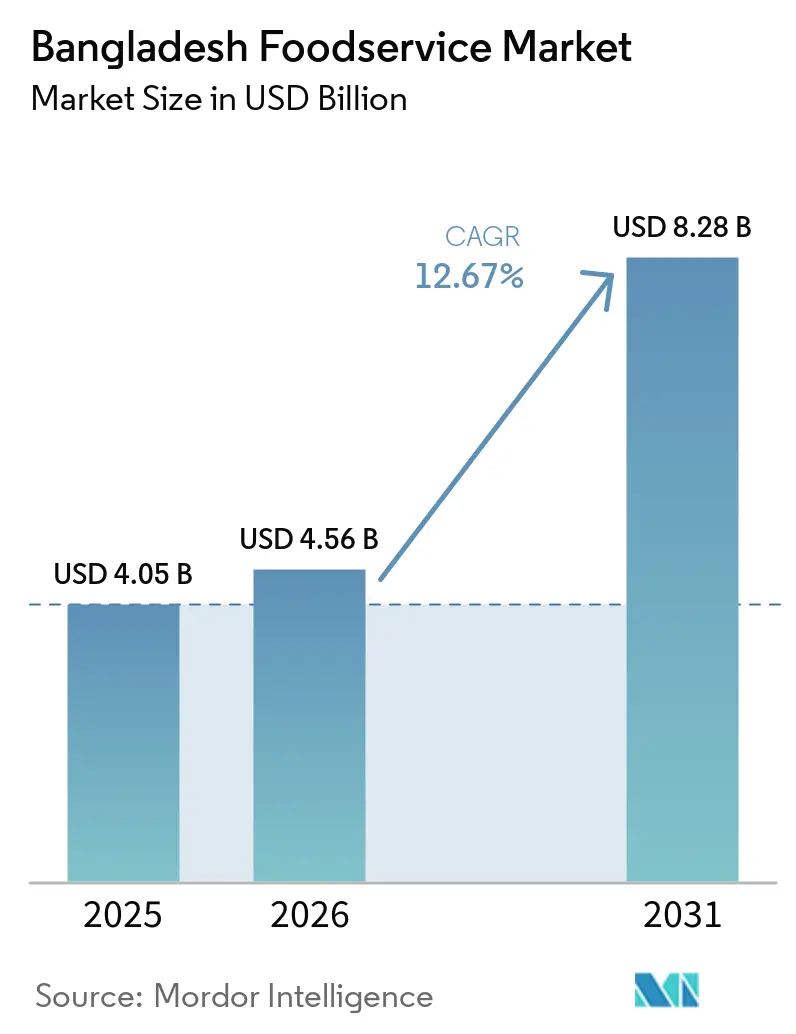
| Base Year Market Size (2025) | USD 4.05 Billion |
| Market Size (2026) | USD 4.56 Billion |
| Market Size (2031) | USD 8.28 Billion |
| Growth Rate (2026 - 2031) | 12.67 % |
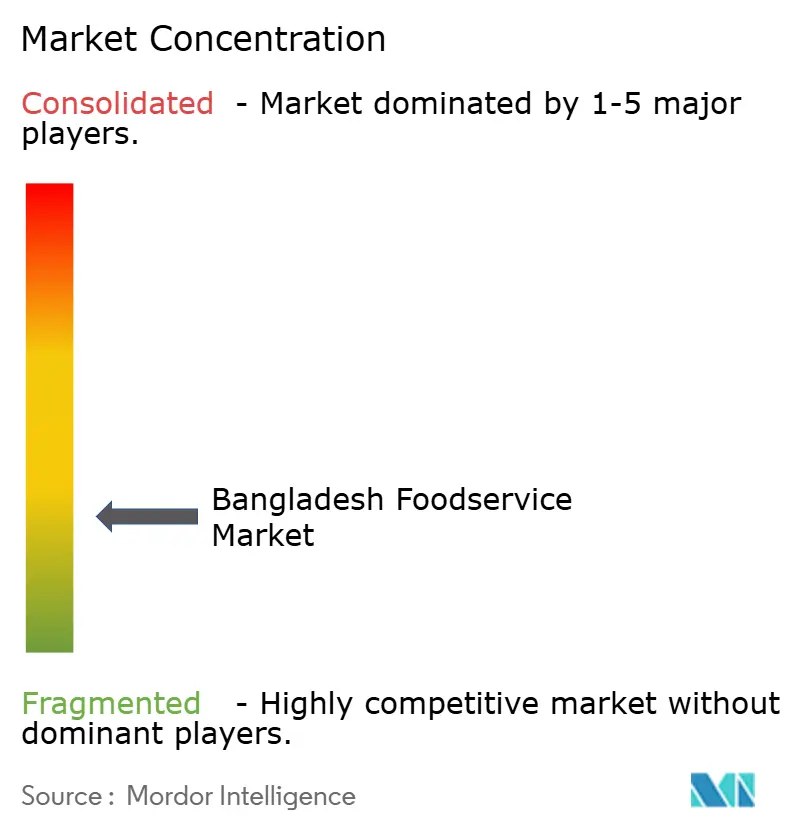
| Market Concentration | Low |
Major Players *Disclaimer: Major Players sorted in no particular order Image © Mordor Intelligence. Reuse requires attribution under CC BY 4.0. | |
Bangladesh Foodservice Market Analysis by Mordor Intelligence
The Bangladesh Foodservice Market size was valued at USD 4.05 billion in 2025 and is estimated to grow from USD 4.56 billion in 2026 to reach USD 8.28 billion by 2031, at a CAGR of 12.67% during the forecast period (2026–2031). The robust expansion stems from rising urban incomes, a digital payment ecosystem that now touches over 70 million mobile money users, and a youth-heavy population that eats out frequently. Remittance inflows of USD 30.3 billion in FY 2024-25 have lifted household purchasing power even as headline inflation moderates, allowing consumers to allocate more wallet share to discretionary dining. Delivery platforms, led by Foodpanda and Pathao Food, have pushed branded outlets into every district, while mega-malls such as Jamuna Future Park offer high-footfall hubs that accelerate chain roll-outs. Nonetheless, the Bangladesh foodservice market faces cost headwinds from fragmented cold-chain logistics, persistent power outages, and the rising compliance burden imposed by the Bangladesh Food Safety Authority. Operators that balance menu affordability with standardized hygiene, digital ordering, and multi-format footprints are best positioned to convert traffic growth into sustainable margins.
Key Report Takeaways
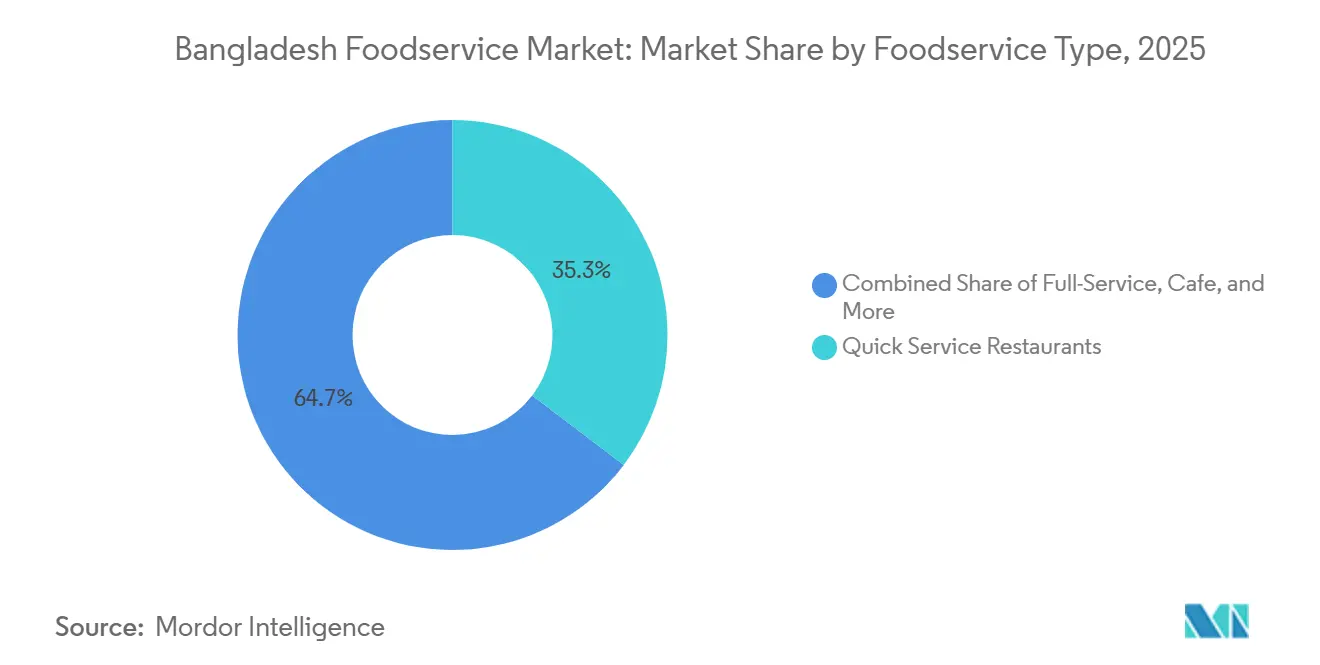
- By foodservice type, Quick Service Restaurants led with a 35.68% revenue share in 2025, while Full-Service Restaurants are on track to expand at a 14.26% CAGR through 2031.
- By outlet, the chained format held 67.89% of the Bangladesh foodservice market share in 2025, whereas independent outlets are forecast to grow at a 15.21% CAGR through 2031.
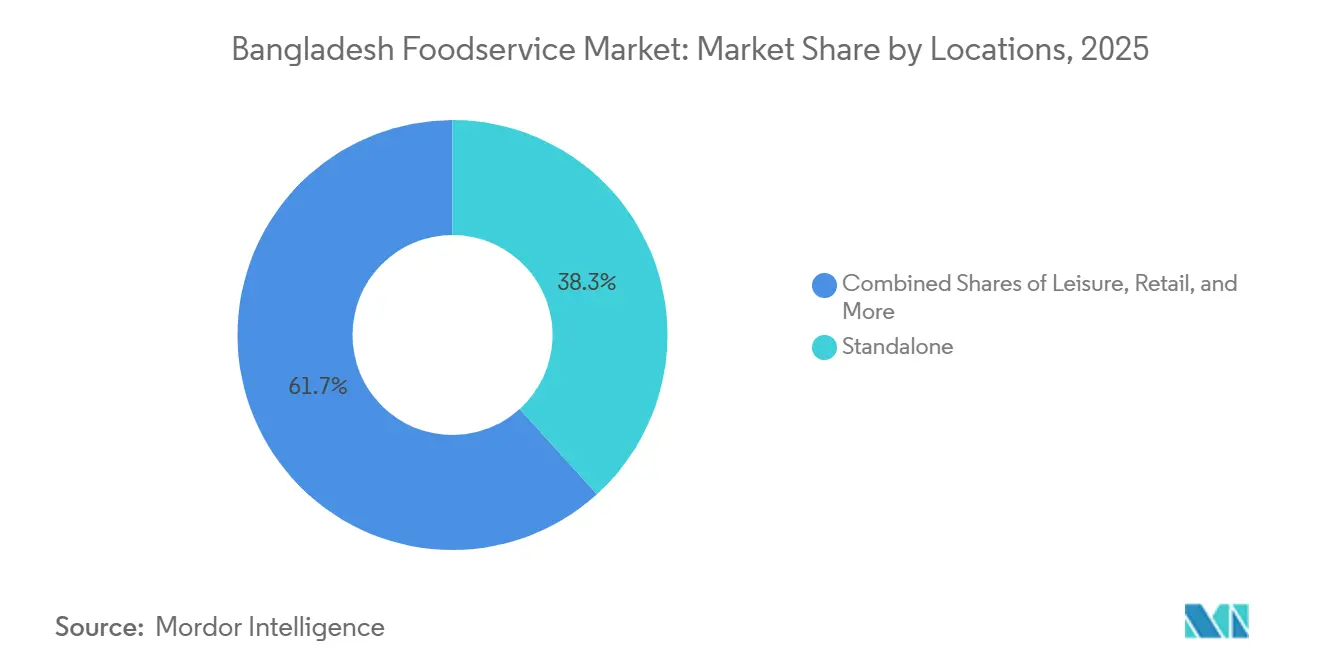
- By location, standalone venues accounted for 38.27% of sector revenue in 2025; retail sites anchored by large shopping centers are expected to rise at 15.58% CAGR over the same horizon.
- By service type, dine-in represented 52.38% of spending in 2025, yet takeaway is the fastest-moving channel with a projected 14.85% CAGR to 2031.
Note: Market size and forecast figures in this report are generated using Mordor Intelligence’s proprietary estimation framework, updated with the latest available data and insights as of January 2026.
Market Trends and Insights
Drivers Impact Analysis of Bangladesh Foodservice Market*
| Drivers | (~) % Impact on CAGR Forecasts | Geographic Relevance | Impact Timeline |
|---|---|---|---|
| Urbanization and Expanding Middle Class in Cities | +3.2% | National, concentrated in Dhaka, Chattogram, Sylhet | Long term (≥ 4 years) |
| Youth Population Preference for International Cuisines, Burgers, and Pizzas | +2.8% | National, with strongest adoption in Dhaka, Chattogram, university towns | Medium term (2-4 years) |
| Growth of Online Food-Delivery Platforms and Digital Payments | +2.5% | National, led by Dhaka and Chattogram metro areas | Short term (≤ 2 years) |
| Increasing Female Workforce Participation and Time-Poor Lifestyles | +1.9% | Urban centers (Dhaka, Chattogram, Sylhet, Gazipur) | Medium term (2-4 years) |
| Tourism and Infrastructure Improvements | +1.4% | National, with early gains in Dhaka, Cox's Bazar, Sylhet | Long term (≥ 4 years) |
| Government Support for Retail Hubs | +1.1% | National, prioritizing Dhaka, Chattogram, and planned economic zones | Long term (≥ 4 years) |
| Source: Mordor Intelligence | |||
Urbanization and Expanding Middle Class in Cities
Bangladesh's urban population grows by approximately 2 million people annually. The middle and affluent class, which stood at 19 million in 2020, is expected to reach 34 million by 2025. This expanding demographic, particularly in Dhaka, Chattogram, and emerging secondary cities, is driving demand for branded Quick Service Restaurants (QSR) and Full-Service Restaurants (FSR). According to the Boston Consulting Group, this consumption base is projected to position Bangladesh as the world's 9th-largest consumer market by 2030. The World Bank's April 2025 Country Private Sector Diagnostic indicates an annual demand for 150,000 housing units within the middle-income segment[1]. This housing demand is likely to spur growth in neighborhood foodservice clusters and mall-based dining, as new residential developments increasingly integrate commercial spaces. However, staple food prices, while moderating, remain elevated, reducing discretionary spending and shifting middle-class consumers toward value-focused QSRs instead of premium FSRs. With rising incomes and ongoing cost-of-living challenges, operators must carefully balance menu pricing and portion sizes to maintain customer visit frequency.
Youth Population Preference for International Cuisines, Burgers, and Pizzas
More than 70% of urban youth consume fast food 2-3 times per week. Gen-Z and university students prioritize convenience, hygiene, and social media appeal when selecting dining venues. Their preference for burgers, pizzas, and pan-Asian cuisines such as sushi, ramen, and dim sum is driving menu innovations at both global chains and local operators. In 2023, Transcom Foods, which manages over 50 KFC outlets and more than 30 Pizza Hut locations, reported revenue of Tk 5.12 billion (approximately USD 47 million), showcasing the profitability of Western quick-service restaurant (QSR) formats in Bangladesh. Meanwhile, the planned entry of Baskin-Robbins in November 2025, through a partnership with Bashundhara Group, signals a focus on dessert and café segments to capture youth spending beyond traditional meals. Local chains like PRAN's Fry Bucket, which operated 19 outlets in Dhaka as of May 2025, are competing by offering Korean chicken and rice meals at prices 20-30% lower than international franchises. This highlights affordability as a key factor in gaining market share. However, operators face the challenge of maintaining brand differentiation while catering to price-sensitive youth who compare options across delivery apps before placing orders.
Growth of Online Food-Delivery Platforms and Digital Payments
Foodpanda and Pathao Food, two prominent players in the food delivery market, collectively manage 60,000 daily orders across Bangladesh. Foodpanda, with a market share of 65-67%, operates in all 64 districts. In 2024, mobile financial services transactions rose to USD 158 billion, reflecting a 28% year-on-year growth. This expansion is further driven by the government's Bangla QR mandate, which is encouraging merchants to adopt digital payments. bKash, a leading mobile financial service provider, serves over 70 million customers and 550,000 merchants. Its integration with delivery platforms not only simplifies operations but also reduces cash-handling costs and fraud risks for restaurants. The government's Binimoy interoperable payments platform aims to increase cashless transactions from the current 15% to 50-60% over the next two decades, which is expected to streamline online ordering. However, challenges persist. By 2023, Foodpanda's losses had exceeded USD 91 million, highlighting the platform's economic fragility. High customer acquisition costs and narrow unit economics force operators to subsidize delivery fees to retain users. On the other hand, restaurants that successfully negotiate commission rates (typically 20-25% of the order value) and improve kitchen efficiency for delivery orders are likely to derive significant benefits from this channel.
Tourism and Infrastructure Improvements
By 2041, Bangladesh's National Tourism Master Plan aims to welcome 5.57 million international tourists, prioritizing infrastructure investments in Cox's Bazar, Sylhet, and Dhaka's diplomatic zones. The Asian Development Bank predicts GDP growth of 4% in FY2025 and 5% in FY2026, driven by public infrastructure projects and improved connectivity[2]. Similarly, Bashundhara City's food court, with 100 outlets, attracts up to 200,000 daily visitors, rising to 500,000-700,000 during festivals, creating significant demand for quick-service restaurants (QSR) and cafes. However, the World Bank's April 2025 Country Private Sector Diagnostic identifies port dwell times and customs clearance delays as factors that increase logistics costs by 30-40%. This issue disproportionately impacts foodservice chains reliant on imported ingredients, equipment, and packaging. Operators that localize supply chains by sourcing poultry, vegetables, and dairy domestically can benefit from lower costs and faster lead times. Nonetheless, achieving this requires investments in supplier training and cold-chain infrastructure.
Restraints Impact Analysis of Bangladesh Foodservice Market*
| Restraints | (~)% Impact on CAGR Forecasts | Geographic Relevance | Impact Timeline |
|---|---|---|---|
| Food Safety Standards Compliance | -1.8% | National, with stricter enforcement in Dhaka, Chattogram | Short term (≤ 2 years) |
| Fragmented Supply Chain and Inadequate Cold-Chain Infrastructure | -2.1% | National, acute in tier-2 cities and rural areas | Medium term (2-4 years) |
| Delivery Logistics Issues in traffic-Heavy Cities | -1.3% | Dhaka, Chattogram, and other metro areas | Short term (≤ 2 years) |
| Skilled Labor Shortages | -1.6% | National, most severe in Dhaka and Chattogram | Medium term (2-4 years) |
| Source: Mordor Intelligence | |||
Food Safety Standards Compliance
In February 2024, the Bailey Road fire incident, which resulted in numerous fatalities, prompted a nationwide crackdown on fire safety and building code compliance. Consequently, many restaurants were required to install sprinkler systems, improve emergency exits, and upgrade kitchen ventilation, with costs ranging from USD 4,500 to 18,000 per outlet. Operators unable to afford these upgrades now face potential closures or significant fines, disproportionately impacting independent outlets and smaller chains. The Bangladesh Food Safety Authority (BFSA) enforces the acquisition of 14 separate certificates, including those for hygiene, water quality, waste disposal, and ingredient sourcing. This process extends the pre-opening timeline by 3-6 months and depletes working capital that could otherwise support marketing or inventory. A December 2025 roundtable highlighted a critical issue: the Bangladesh Standards and Testing Institution (BSTI) lacks the capacity for timely testing. As a result, exporters are forced to certify food-grade packaging in India or Singapore.
Fragmented Supply Chain and Inadequate Cold-Chain Infrastructure
Cold-chain logistics account for 30-40% of total logistics costs in Bangladesh, yet infrastructure remains concentrated in Dhaka and Chattogram, leaving secondary cities and rural areas underserved. The World Bank's April 2025 Country Private Sector Diagnostic notes that port dwell times and customs clearance delays increase lead times for imported ingredients, equipment, and packaging, forcing restaurants to carry higher inventory buffers and tying up working capital. A December 2025 roundtable revealed that essential ingredient prices nearly doubled over a 3-4 month period in 2024, with one restaurant operator reporting daily ingredient budgets rising from USD 91 to 227 despite purchasing the same quantities. This volatility reflects fragmented procurement, where small operators lack bargaining power with suppliers and cannot hedge against price spikes. The frozen foods sector, which the Bangladesh Frozen Foods Exporters Association projects could reach USD 3 billion in exports within five years, is constrained by the same cold-chain gaps that limit domestic foodservice distribution. Operators that vertically integrate, sourcing poultry, vegetables, and dairy from captive farms or long-term contracts, can stabilize input costs, but this requires capital investment and agronomic expertise that most restaurant chains lack.
*Our forecasts treat driver/restraint impacts as directional, not additive. The impact forecasts reflect baseline growth, mix effects, and variable interactions.
Bangladesh Foodservice Market Segment Analysis
By Foodservice Type:
Full-Service Restaurants Capture Experience-Led DemandFull-Service Restaurants are forecast to widen their slice of the Bangladesh foodservice market size at a 14.26% CAGR to 2031. Quick Service Restaurants hold the highest 35.68% revenue share but rely heavily on platform-driven delivery, which exposes them to commission fees and price competition. The Bangladesh foodservice market is thus bifurcating: QSR formats chase throughput with standardized menus, while FSR operators invest in ambiance, chef-led menus, and table-side service that justify higher average checks. Premium cafés and dessert parlors are emerging as a third growth vector, benefiting from rising disposable incomes and strong social media influence on dining choices.
The broader Bangladesh foodservice market counts more than 481,000 outlets nationwide, yet only a small fraction fall into the full-service category. Chains such as Nando’s and Secret Recipe leverage global menu playbooks and international service standards to capture affluent family and business diners. Their higher per-guest spend offsets slower table turnover, yielding solid unit economics when occupancy is optimized. QSR stalwarts like KFC, Pizza Hut, and Burger King continue to open express stores in high-traffic malls, underscoring the enduring appeal of fast-casual convenience. This competitive balance keeps both formats integral to overall sector growth.

By Outlet:
Independents Gain Momentum Within Chained-Dominated LandscapeChained operators controlled 67.89% of 2025 revenue, yet independents are growing faster as neighborhood players adapt menus and pricing to hyper-local tastes. Independent outlets are forecast to grow at 15.21% CAGR during the forecast period. The Bangladesh foodservice market share held by independents is set to widen by 2031 because digital marketplaces now give small restaurants national visibility without heavy advertising spend. Many independents operate from compact premises with monthly fixed costs below Tk 50,000, enabling them to undercut chain pricing while safeguarding margins through owner-operator models.
Chains still enjoy bulk-procurement discounts, integrated cold-chain networks, and brand recognition. Transcom Foods’ multi-brand platform illustrates how scale reduces ingredient costs and amortizes marketing across concepts. Even so, independents using cloud kitchens and low-cost storefronts are carving niches in regional cuisines, vegan menus, and artisanal desserts, diversifying consumer choice and intensifying rivalry across the Bangladesh foodservice market.
By Location:
Retail Venues Outpace Standalone StoresStandalone locations accounted for 38.27% market share in 2025, but retail locations are growing at 15.58% CAGR as developers integrate foodservice into mixed-use complexes to drive dwell time and cross-shopping. The mega-malls offer captive audiences, centralized utilities (power, water, HVAC), and parking for 4,000+ vehicles, which lowers operating risk for foodservice tenants compared to standalone sites that must invest in backup generators and manage municipal service disruptions. Lodging and travel locations - including hotels, airports, and bus terminals - serve transient customers with limited price sensitivity, enabling operators to charge premiums of 15-25% over street-level pricing, but these sites require compliance with additional safety and hygiene certifications.
Leisure locations, including parks and entertainment venues, remain underdeveloped in Bangladesh, with most foodservice concentrated in Dhaka's diplomatic zones and Cox's Bazar's beachfront, where tourism infrastructure is nascent. The government's National Tourism Master Plan targets 5.57 million international tourists by 2041, which will drive demand for foodservice in leisure locations, but near-term growth is constrained by limited hotel capacity and seasonal demand volatility.
By Service Type:
Takeaway Gains as Digital Payments ScaleDine-in service held a 52.38% market share in 2025, reflecting Bangladeshi consumers' preference for social dining and the cultural importance of shared meals, yet takeaway is expanding at a 14.85% CAGR as mobile financial services adoption and delivery platform penetration reduce friction for off-premise consumption. bKash serves over 70 million customers and 550,000 merchants, while the government's Bangla QR mandate for trade licenses is accelerating digital payment acceptance at restaurants, which lowers cash-handling costs and improves transaction transparency. Delivery service, while growing rapidly, faces profitability challenges as Foodpanda's accumulated losses exceeded Tk 1,000 crore (USD 91 million) by 2023, driven by high customer acquisition costs, rider subsidies, and commission fees that compress restaurant margins.
Takeaway's faster growth reflects its lower cost structure: restaurants avoid delivery platform commissions (20-25% of order value) while customers pick up orders on their way home from work or errands, reducing wait times and maintaining food quality. Secret Recipe and PRAN's Fry Bucket have invested in dedicated takeaway counters and packaging that preserves temperature and presentation, which encourages repeat usage. Dine-in remains dominant because Bangladeshi consumers value the social experience of eating out, with families and friend groups preferring sit-down meals on weekends and holidays. However, dine-in operators face higher fixed costs (rent, utilities, and waitstaff) and longer breakeven timelines, which makes them vulnerable to footfall shocks such as the 30-35% decline experienced during the October 2024 political unrest. Operators that can flex between dine-in, takeaway, and delivery based on demand patterns, adjusting staffing, kitchen output, and marketing spend will capture more value across service types than those locked into a single format.
Geography Analysis
Dhaka and Chattogram together generate more than 60% of sector turnover, reflecting higher urban incomes, dense populations, and a critical mass of international franchises. Dhaka alone hosts an estimated 25,000 foodservice outlets, supported by malls such as Jamuna Future Park, which offers 3,000 seats and over 40 fast-food brands. Chattogram benefits from port-driven business travel and expatriate communities that sustain premium dining formats. Dhaka alone hosts 25,000 restaurants employing hundreds of thousands of workers, with mega-malls such as Jamuna Future Park (40+ fast-food outlets, 3,000-seat capacity) and Bashundhara City (100-outlet food court, 200,000 daily visitors) serving as anchor points for QSR and FSR operators, according to the Bashundhara City[3]
Secondary cities, Sylhet, Khulna, Rajshahi, and Mymensingh, are emerging as growth frontiers as urbanization spreads and middle-class households in these regions adopt eating-out behaviors. Foodpanda operates across all 64 districts, indicating that delivery infrastructure now reaches beyond metro areas, but cold-chain logistics and supplier networks remain concentrated in Dhaka and Chattogram, raising input costs for operators in secondary cities, according to the Boston Consulting Group. Delivery networks now span all 64 districts, but cold-chain and power reliability remain weaker outside the top metros, pushing up costs for perishable inventory.
Cox’s Bazar offers seasonal peaks tied to domestic tourism and nascent international arrivals targeted in the National Tourism Master Plan. Limited hotel capacity and infrastructure constraints cap short-term growth, yet operators establishing early presence secure first-mover advantages. On balance, geographic portfolio diversification anchoring in Dhaka for scale while planting seeds in tier-2 cities mitigates risk and maximizes exposure to the full Bangladesh foodservice market size trajectory.
Competitive Landscape
The Bangladesh foodservice market exhibits moderate fragmentation, with international franchises, local conglomerates, and independent operators competing across overlapping segments. Transcom Foods (KFC, Pizza Hut) and Golden Harvest (60+ outlets across multiple brands) dominate the chained QSR segment, while Jubilant FoodWorks' acquisition of Golden Harvest's stake in the Domino's Bangladesh joint venture in 2024 signals consolidation as operators seek scale to negotiate better supplier terms and absorb delivery platform commissions.
The entry of Baskin-Robbins in November 2025 via a Bashundhara Group partnership demonstrates that international brands are targeting niche segments - desserts and cafés - to avoid direct competition with entrenched QSR players. White-space opportunities exist in tier-2 cities (Sylhet, Khulna, Rajshahi), where branded foodservice penetration is low and middle-class households are adopting eating-out behaviors, as well as in specialized formats such as cloud kitchens and health-focused concepts, though the latter face consumer skepticism and capital constraints.
Technology adoption is a key differentiator, with Foodpanda and Pathao Food leveraging data-driven features such as buy-now-pay-later, rider allocation algorithms, and personalized recommendations to increase order frequency and customer lifetime value. However, Foodpanda's accumulated losses exceeding USD 91 million by 2023 reveal that platform economics remain fragile, and operators that can build direct ordering channels such as mobile apps and loyalty programs will reduce dependency on third-party platforms and retain more margin. Smaller contenders such as PRAN's Fry Bucket (19 outlets in Dhaka as of May 2025) are competing on price, offering Korean chicken and rice meals 20-30% below international franchise pricing, which appeals to price-sensitive youth and families. The competitive landscape will likely consolidate further as operators with strong balance sheets acquire distressed independents and smaller chains, while those lacking scale or differentiation exit the market.
Bangladesh Foodservice Industry Leaders
-
Herfy Food Service Company
-
Jubilant FoodWorks Limited
-
PRAN-RFL Group
-
The Manhattan Fish Market
-
Transcom Foods Limited
- *Disclaimer: Major Players sorted in no particular order
Bangladesh Foodservice Market Companies Covered in this Report
- Transcom Foods Ltd (KFC, Pizza Hut)
- Foodpanda Bangladesh (Delivery Hero)
- Pathao Food
- CP Bangladesh (Five-Star Chicken)
- Jubilant FoodWorks Bangladesh (Domino’s)
- Herfy Bangladesh
- PRAN-RFL Group (Fast-food and Catering)
- Manhattan Fish Market Bangladesh
- bb.q Chicken Bangladesh
- Burger King Bangladesh
- Takeout
- Pizza Inn Bangladesh
- Golden Harvest Foods and Restaurants
- Nando’s Bangladesh
- A&W Bangladesh
- Cold Stone Creamery Bangladesh
- Butlers Chocolate Café Bangladesh
- Gloria Jean’s Coffees Bangladesh
- Secret Recipe Bangladesh
- CP Five-Star Express Outlets
Recent Industry Developments in Bangladesh Foodservice Market
- November 2025: Hyatt Hotels Corporation debuted in Bangladesh with the opening of the 85-room Hyatt Place Dhaka Uttara. The hotel targets business travelers from import-export sectors with modern amenities, including King/Twin/Runway View rooms, all-day dining at Zing restaurant.
- January 2025: Domino's Pizza expanded in Bangladesh by opening its 37th restaurant, at Dargah Gate in Sylhet, marking the chain's second location in the city. The store offers the Cheeseverse range of 14 cheese-loaded pizzas, Oregano Rice, Garlic Bread, sides, and Choco Lava Delight desserts, with a 30-minute hot delivery.
- August 2024: Thailand's PTT Oil and Retail (PTT OR) signed a master franchise agreement with Bashundhara Group to launch Café Amazon in Bangladesh. The move taps Bangladesh's nascent coffee market, where tea dominates but consumption rises among youth.
Bangladesh Foodservice Market Report Scope
Bangladesh's foodservice market is segmented by foodservice type into cafes and bars, cloud kitchens, full-service restaurants, and quick service restaurants. Cafes and bars are further segmented into cuisines that include bars and pubs, café, juice/smoothie/desserts bars, and specialist coffee and tea shops. Full-service restaurants are further segmented into cuisines, which include Asian, European, and Latin American. Middle Eastern, North American, and Other FSR Cuisines. Quick service restaurants are further segmented into cuisines, which include bakeries, burgers, ice cream, meat-based cuisines, pizza, and other QSR cuisines. By outlet, the market is segmented into chain and independent outlets. By location, the market is segmented into leisure, lodging, retail, standalone, and travel. By service, the market is segmented into dine-in, takeaways, and delivery. The market sizing has been done in value terms in USD for all the abovementioned segments.
Segmentation Overview
| Café and Bars | By Cuisine | Bars and Pubs |
| Café | ||
| Juice/Smoothie/Desserts Bars | ||
| Specialist Coffee and Tea Shops | ||
| Cloud Kitchen | ||
| Full Service Restaurants | By Cuisine | Asian |
| European | ||
| Latin American | ||
| Middle Eastern | ||
| North American | ||
| Other FSR Cuisines | ||
| Quick Service Restaurants | By Cuisine | Bakeries |
| Burger | ||
| Ice Cream | ||
| Meat-based Cuisines | ||
| Pizza | ||
| Other QSR Cuisines |
| Chained Outlets |
| Independent Outlets |
| Leisure |
| Lodging |
| Retail |
| Sandalone |
| Travel |
| Dine-in |
| Takeaway |
| Delivery |
| By Foodservice Type | Café and Bars | By Cuisine | Bars and Pubs |
| Café | |||
| Juice/Smoothie/Desserts Bars | |||
| Specialist Coffee and Tea Shops | |||
| Cloud Kitchen | |||
| Full Service Restaurants | By Cuisine | Asian | |
| European | |||
| Latin American | |||
| Middle Eastern | |||
| North American | |||
| Other FSR Cuisines | |||
| Quick Service Restaurants | By Cuisine | Bakeries | |
| Burger | |||
| Ice Cream | |||
| Meat-based Cuisines | |||
| Pizza | |||
| Other QSR Cuisines | |||
| By Outlet | Chained Outlets | ||
| Independent Outlets | |||
| By Locations | Leisure | ||
| Lodging | |||
| Retail | |||
| Sandalone | |||
| Travel | |||
| By Service Type | Dine-in | ||
| Takeaway | |||
| Delivery | |||
Market Definition
- FULL-SERVICE RESTAURANTS - A foodservice establishment where customers are seated at a table, give their order to a server and are served food at a table.
- QUICK SERVICE RESTAURANTS - A foodservice establishment that provides customers convenience, speed, and food offerings at lower prices. Customers usually help themselves and carry their own food to their tables.
- CAFES & BARS - A type of foodservice business that include bars and pubs that are licensed to serve alcoholic drinks for consumption, cafes that serve refreshments and light food items, as well as specialty tea and coffee shops, dessert bars, smoothie bars, and juice bars.
- CLOUD KITCHEN - A foodservice business that utilizes a commercial kitchen for the purpose of preparing food for delivery or takeout only, with no dine-in customers.
| Keyword | Definition |
|---|---|
| Albacore Tuna | It is one of the smallest species of tuna found in the six distinct stocks known globally in the Atlantic, Pacific, and Indian oceans, as well as the Mediterranean Sea. |
| Angus beef | It is beef derived from a specific breed of cattle indigenous to Scotland. It requires certification from the American Angus Association to receive the "Certified Angus Beef" quality mark. |
| Asian cuisine | It includes full-service offerings in restaurants that serve cuisines from cultures such as Chinese, Indian, Korean, Japanese, Bengali, Southeast Asian, etc. |
| Average Order Value | It is the average value of all orders made by the customers at a foodservice establishment. |
| Bacon | It is salted or smoked meat that comes from the back or sides of a pig. |
| Bars & Pubs | It is a drinking establishment that is licensed to serve alcoholic drinks for consumption on the premises. |
| Black Angus | It is beef derived from a black-hided breed of cows that don't have horns. |
| BRC | British Retail Consortium |
| Burger | It is a sandwich consisting of one or more cooked beef patties, placed inside a sliced bread roll or bun roll. |
| Café | It is a foodservice establishment serving various refreshments (mainly coffee) and light meals. |
| Cafes & Bars | It is a type of foodservice business that include bars and pubs that are licensed to serve alcoholic drinks for consumption, cafes that serve refreshments and light food items, as well as specialty tea and coffee shops, dessert bars, smoothie bars, and juice bars. |
| Cappuccino | It is an Italian coffee drink that is traditionally prepared with equal parts double espresso, steamed milk, and steamed milk foam. |
| CFIA | Canadian Food Inspection Agency |
| Chained Outlet | It refers to a foodservice establishment that shares brands, operates in several locations, has central management, and standardized business practices. |
| Chicken Tender | It refers to chicken meat prepared from the pectoralis minor muscles of a chicken bird. |
| Cloud Kitchen | It is a foodservice business that utilizes a commercial kitchen for the purpose of preparing food for delivery or takeout only, with no dine-in customers. |
| Cocktail | It is an alcoholic mixed drink made with either a single spirit or a combination of spirits, mixed with other ingredients such as juices, flavored syrups, tonic water, shrubs, and bitters. |
| Edamame | It is a Japanese dish prepared with soybeans (harvested before they ripen or harden) and cooked in its pod. |
| EFSA | European Food Safety Authority |
| ERS | Economic Research Service of the USDA |
| Espresso | It is a concentrated form of coffee, served in shots. |
| European cuisine | It includes full-service offerings in restaurants that serve cuisines from cultures such as Italian, French, German, English, Dutch, Danish, etc. |
| FDA | Food and Drug Administration |
| Fillet Mignon | It is a cut of meat taken from the smaller end of the tenderloin. |
| Flank Steak | It is a cut of beef steak taken from the flank, which lies forward of the rear quarter of a cow. |
| Foodservice | It refers to the part of the food industry which includes businesses, institutions, and companies which prepare meals outside the home. It includes restaurants, school and hospital cafeterias, catering operations, and many other formats. |
| Franks | Also known as frankfurter or Würstchen, it is a type of highly seasoned smoked sausage popular in Austria and Germany. |
| FSANZ | Food Standards Australia New Zealand |
| FSIS | Food Safety and Inspection Service |
| FSSAI | Food Safety and Standards Authority of India |
| Full service restaurant | It refers to a foodservice establishment where customers are seated at a table, give their order to a server, and are served food at a table. |
| Ghost Kitchen | It refers to a cloud kitchen. |
| GLA | Gross Leasable Area |
| Gluten | It is a family of proteins found in grains, including wheat, rye, spelt, and barley. |
| Grain-fed beef | It is beef derived from cattle that have been fed a diet supplemented with soy and corn and other additives. Grain-fed cows can also be given antibiotics and growth hormones to fatten them up more quickly. |
| Grass-fed beef | It is beef derived from cattle that have only been fed grass as feed. |
| Ham | It refers to the pork meat taken from the leg of a pig. |
| HoReCa | Hotels, Restaurants and Cafes |
| Independent Outlet | It refers to a foodservice establishment that operates with a single outlet or is structured as a small chain with no more than three locations. |
| Juice | It is a drink made from the extraction or pressing of the natural liquid contained in fruit and vegetables. |
| Latin American | It includes full-service offerings in restaurants that serve cuisines from cultures such as Mexican, Brazilian, Argentinian, Colombian, etc. |
| Latte | It is a milk-based coffee that is made up of one or two shots of espresso, steamed milk, and a thin layer of frothed milk. |
| Leisure | It refers to foodservice offered as a part of a recreation business, such as sports arenas, zoos, movie theaters, and museums. |
| Lodging | It refers to foodservice offerings at hotels, motels, guesthouses, holiday homes, etc. |
| Macchiato | It is an espresso coffee drink with a small amount of milk, usually foamed. |
| Meat-based cuisines | This inlcudes food items like fried chicken, steak, ribs, etc. where meat is the primary ingredient for the dish. |
| Middle Eastern cuisine | It includes full-service offerings in restaurants that serve cuisines from cultures such as Arabic, Lebanese, Iranian, Israeli, etc. |
| Mocktail | It is an non-alcoholic mixed drink. |
| Mortadella | It is a large Italian sausage or luncheon meat made of finely hashed or ground heat-cured pork, which incorporates at least 15% small cubes of pork fat. |
| North American | It includes full-service offerings in restaurants that serve cuisines from cultures such as American, Canadian, Caribbean, etc. |
| Pastrami | It refers to a highly seasoned smoked beef, typically served in thin slices. |
| PDO | Protected Designation of Origin: It is the name of a geographical region or specific area that is recognized by official rules to produce certain foods with special characteristics related to location. |
| Pepperoni | It is an American variety of spicy salami made from cured meat. |
| Pizza | It is a dish made typically of flattened bread dough spread with a savory mixture usually including tomatoes and cheese and often other toppings and baked. |
| Primal cuts | It refers to the major sections of the carcass. |
| Quick service restaurant | It refers to a foodservice establishment that provides customers convenience, speed, and food offerings at lower prices. Customers usually help themselves and carry their own food to their tables. |
| Retail | It refers to a foodservice outlet inside a mall. shopping complex or a commercial real estate building, where there are other businesses operating as well. |
| Salami | It is a cured sausage consisting of fermented and air-dried meat. |
| Saturated fat | It is a type of fat in which the fatty acid chains have all single bonds. It is generally considered unhealthy. |
| Sausage | It is a meat product made of finely chopped and seasoned meat, which may be fresh, smoked, or pickled and which is then usually stuffed into a casing. |
| Scallop | It is an edible shellfish that is a mollusk with a ribbed shell in two parts. |
| Seitan | It is a plant-based meat substitute made out of wheat gluten. |
| Self-service kiosk | It refers to a self-order point-of-sale (POS) system through which customers place and pay for their own orders at kiosks, enabling totally contactless and frictionless service. |
| Smoothie | It is a beverage made by placing all the ingredients in a container and processing them together, without removing the pulp. |
| Specialty coffee & tea shops | It refers to a foodservice establishment that serves only various types of tea or coffee. |
| Standalone | It refers to a restaurants that have an independent infrastructure setup and not connected to any other business. |
| Sushi | It is a Japanese dish of prepared vinegared rice, usually with some sugar and salt, accompanied by a variety of ingredients, such as seafood—often raw—and vegetables. |
| Travel | It refers to foodservice offerings such as airplane food, dining on long-distance trains, and foodservice on cruise ships. |
| Virtual Kitchen | It refers to a cloud kitchen. |
| Wagyu Beef | It is beef derived from any of four strains of a breed of black or red Japanese cattle that are valued for their highly marbled meat. |
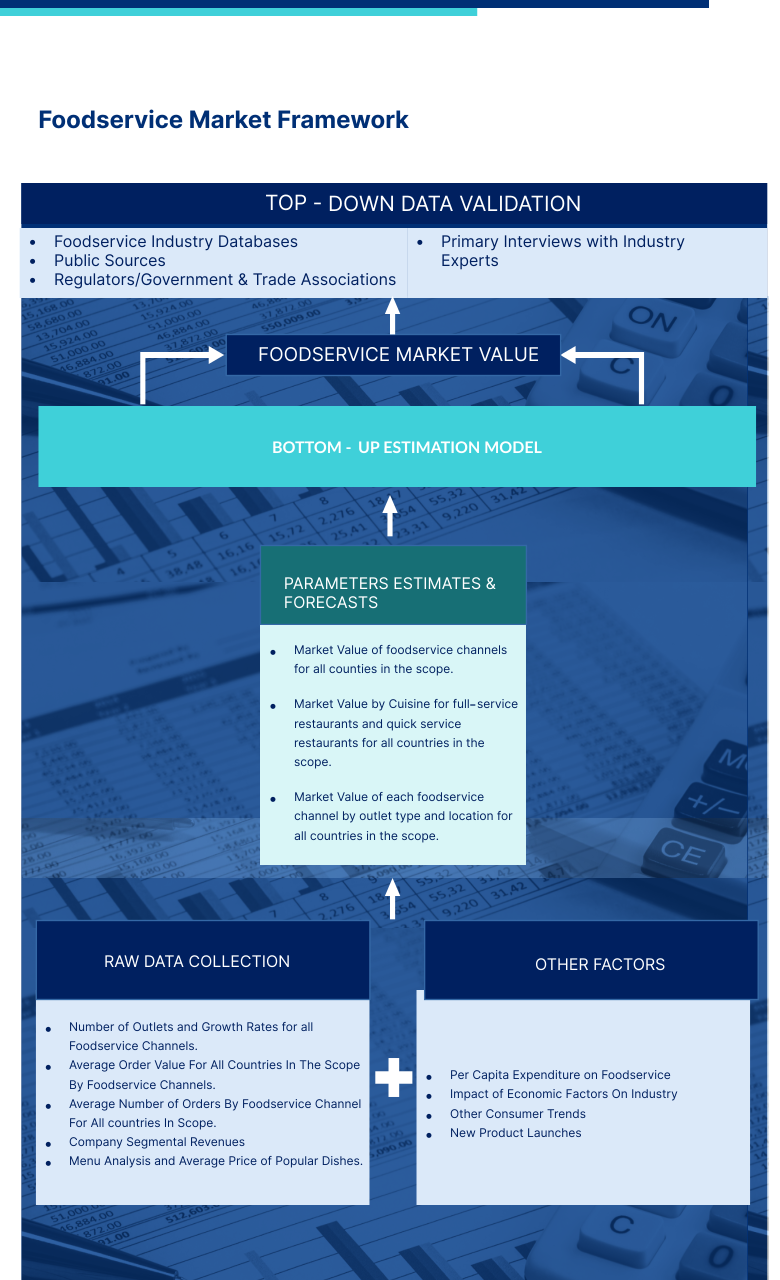
Research Methodology
Mordor Intelligence follows a four-step methodology in all our reports.
- Step-1: Identify Key Variables: In order to build a robust forecasting methodology, the variables and factors identified in Step 1 are tested against available historical market numbers. Through an iterative process, the variables required for the market forecast are set, and the model is built on the basis of these variables.
- Step-2: Build a Market Model: Market size estimations for the forecast years are in nominal terms. Inflation is considered for average order value, and it is forecasted as per predicted inflation rates in the countries.
- Step-3: Validate and Finalize: In this important step, all market numbers, variables, and analyst calls are validated through an extensive network of primary research experts from the market studied. The respondents are selected across levels and functions to generate a holistic picture of the market studied.
- Step-4: Research Outputs: Syndicated Reports, Custom Consulting Assignments, Databases & Subscription Platforms