
Market Overview
| Study Period | 2020 - 2031 |
|---|---|
| Forecast Data Period | 2026 - 2031 |
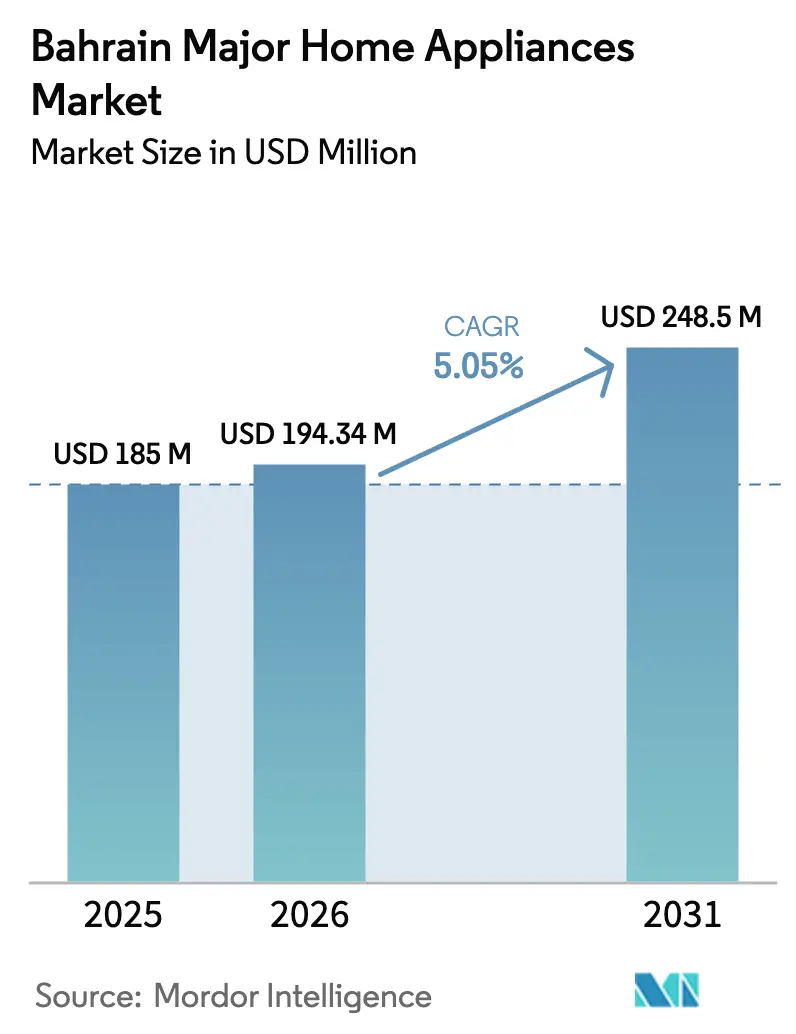
| Base Year Market Size (2025) | USD 185 Million |
| Market Size (2026) | USD 194.34 Million |
| Market Size (2031) | USD 248.5 Million |
| Growth Rate (2026 - 2031) | 5.05 % |
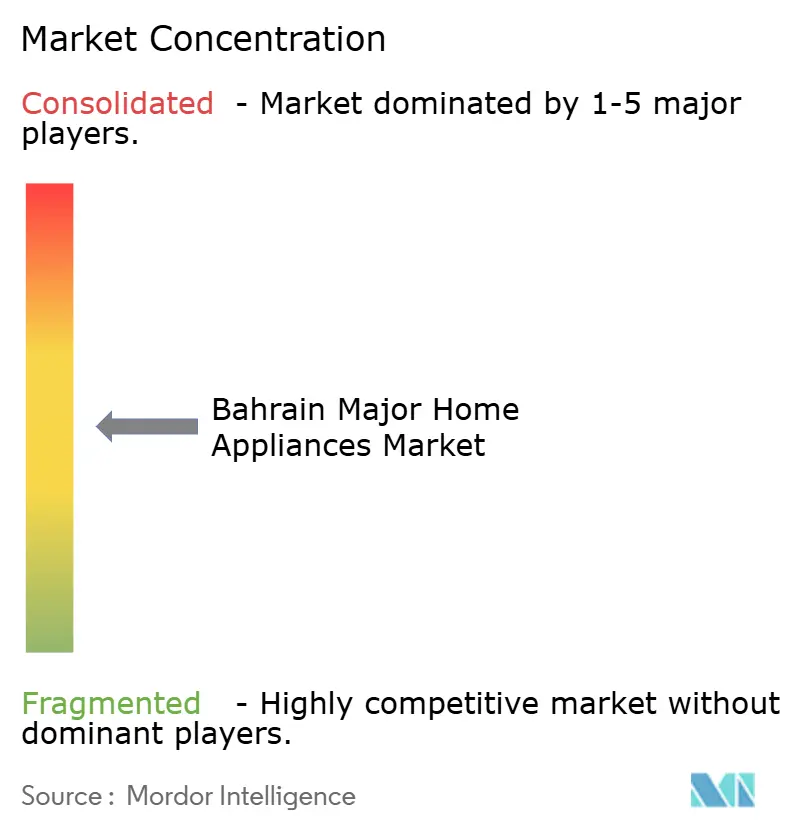
| Market Concentration | Medium |
Major Players *Disclaimer: Major Players sorted in no particular order Image © Mordor Intelligence. Reuse requires attribution under CC BY 4.0. | |
Bahrain Major Home Appliances Market Analysis by Mordor Intelligence
The Bahrain major home appliances market size in 2026 is estimated at USD 194.34 million, growing from 2025 value of USD 185 million with 2031 projections showing USD 248.5 million, growing at 5.05% CAGR over 2026-2031. Growth reflects the kingdom’s USD 30 billion infrastructure pipeline, rapid housing delivery, and a services-heavy economy that continually renovates retail and hospitality assets[1]. Manufacturers benefit from a young, digitally engaged consumer base, robust internet penetration, and government incentives that reward energy-efficient technologies aligned with Vision 2030. At the same time, supply chain turbulence and elevated freight costs are prompting inventory realignment, encouraging regional sourcing, and intensifying price competition[2]. The interplay of purchaser optimism, regulatory tightening on efficiency, and channel digitization positions the Bahrain major home appliances market for steady value creation across refrigerators, washing machines, air conditioners, and complementary categories.
Key Report Takeaways
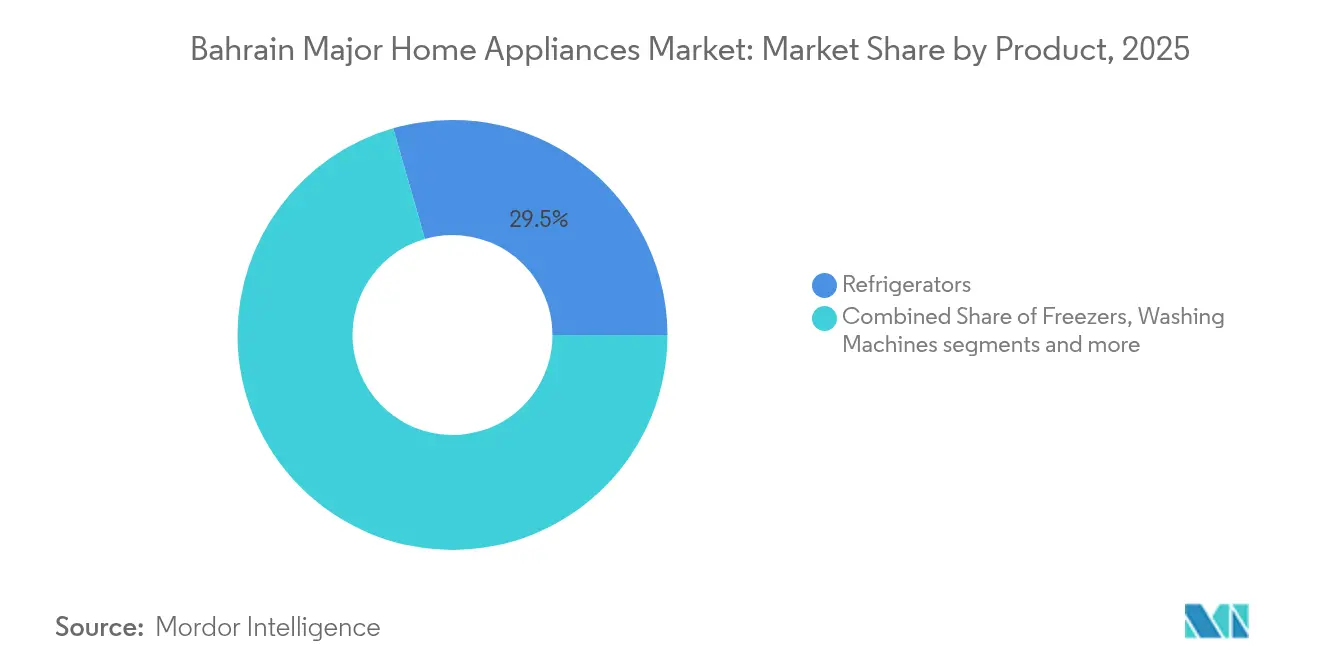
- By product, refrigerators led with 29.45% of Bahrain's major home appliances market share in 2025, while washing machines are poised for the fastest 5.72% CAGR through 2031.
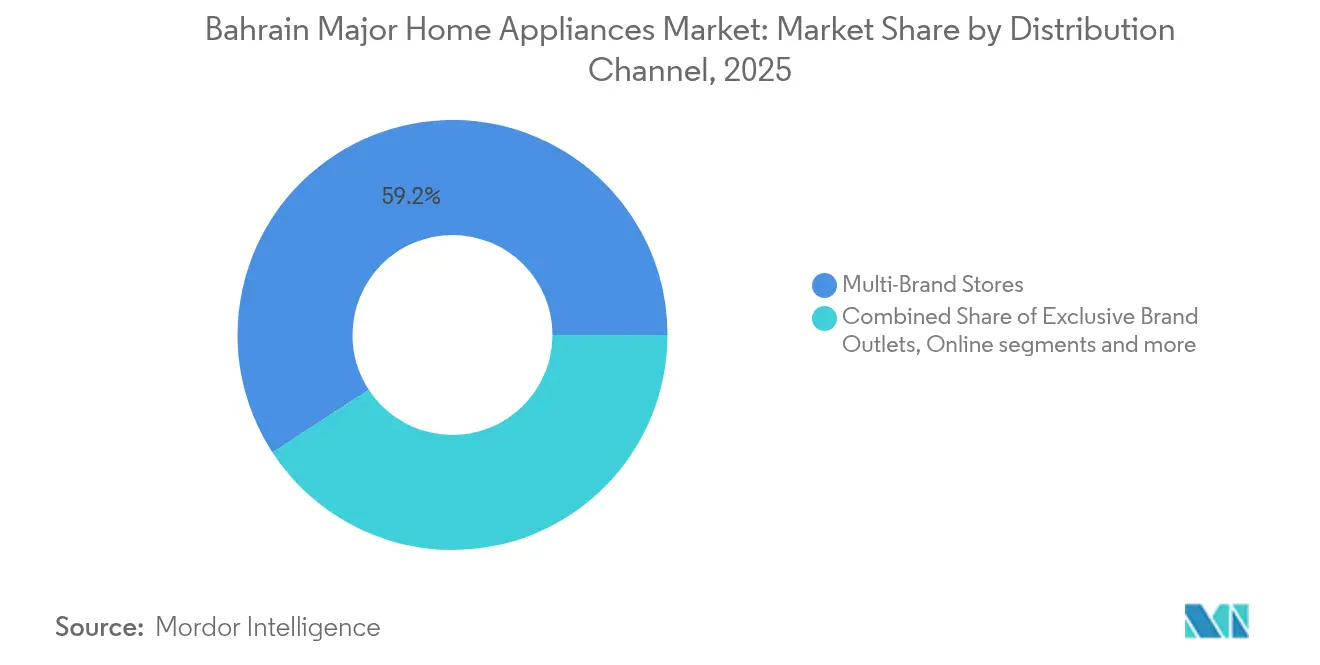
- By distribution channel, multi-brand stores held 59.20% of revenue in 2025, whereas online channels are set to expand at a 6.05% CAGR to 2031.
- By geography, Capital Governorate accounted for 44.40% of Bahrain's major home appliances market share in 2025; Northern Governorate is projected to climb at a 5.32% CAGR during 2026-2031.
Note: Market size and forecast figures in this report are generated using Mordor Intelligence’s proprietary estimation framework, updated with the latest available data and insights as of 2026.
Bahrain Major Home Appliances Market Trends and Insights
Drivers Impact Analysis*
| Driver | (~) % Impact on CAGR Forecast | Geographic Relevance | Impact Timeline |
|---|---|---|---|
| Rising Disposable Income and Housing Projects | +1.2% | National, concentrated in Capital and Northern Governorates | Medium term (2-4 years) |
| Mandatory Energy-Efficiency Labelling (MEPS) | +0.8% | National, with stronger adoption in urban areas | Long term (≥ 4 years) |
| Expansion of E-Commerce Fulfilment Capacity | +0.6% | National, led by Capital Governorate | Short term (≤ 2 years) |
| Demand for Smart & Connected Appliances | +0.9% | Capital and Muharraq Governorates primarily | Medium term (2-4 years) |
| Tourism-Driven Demand from Short-Stay Rentals | +0.4% | Capital and Muharraq Governorates | Short term (≤ 2 years) |
| Urbanization and Infrastructure Development | +1.1% | Northern and Capital Governorates | Long term (≥ 4 years) |
| Source: Mordor Intelligence | |||
Rising Disposable Income and Housing Projects
Bahrain is building 40,000 new housing units, of which 20,000 are already under construction, under a government-backed program that stimulates large-ticket household spending. Unit demand surges across refrigeration, laundry, cooking, and air-conditioning categories as new homeowners replace most of their appliances within a short period. The USD 7 billion BAPCO modernization and USD 3.5 billion King Hamad Causeway create jobs that raise middle-class earnings and underpin durable-goods purchases. As deliveries accelerate through 2030, the Bahrain major home appliances market will continue to benefit from first-time outfitting and replacement sales in newly occupied residences.
Mandatory Energy-Efficiency Labelling (MEPS)
GCC-wide Minimum Energy Performance Standards now influence specification choices, and Bahrain’s alignment with these codes is steering buyers toward higher-rated refrigerators, washing machines, and air conditioners. Residential usage accounts for 50% of GCC electricity, making efficient appliance selection a priority for both policymakers and households. Manufacturers able to verify superior kilowatt-hour performance receive an immediate competitive edge and avoid penalties linked to sub-standard models. Because national implementation often serves as a template for neighboring states, compliance success in Bahrain can open wider Gulf opportunities. Over the long term, mature enforcement should lift premium product penetration and moderate household energy bills, sustaining replacement cycles.
Expansion of E-Commerce Fulfilment Capacity
Major retailers logged 70% year-over-year online sales growth in 2024, while e-commerce captured 4.5% of total retail turnover[3]. Lulu Retail, for example, opened 21 additional stores and doubled down on last-mile delivery hubs that shorten appliance lead times to under 24 hours within Manama. Young digital natives appreciate comparison shopping, installment plans, and doorstep installation, encouraging large refrigerated or laundry items to shift online. Improved payment gateways and omnichannel inventory visibility further diminish historic barriers that favored physical showrooms. As a result, the Bahrain major home appliances market now rewards brands offering frictionless click-to-deliver journeys and unified after-sales support.
Demand for Smart & Connected Appliances
High smartphone penetration and reliable broadband services push consumers to expect home devices that self-diagnose, optimize energy, and integrate with voice assistants. Panasonic’s 2024 regional strategy introduced 74 new SKUs, including Matter-enabled refrigerators and AI-assisted washers, underscoring how intelligence has become a core value proposition[4]. In Bahrain’s urban districts, Wi-Fi-ready models command premium margins because buyers perceive long-term savings and convenience. Utility companies promoting peak-load management also encourage smart functionality that can throttle consumption in real time. These factors collectively expand the addressable customer base for connected appliances over the medium term, adding momentum to the Bahrain major home appliances market.
Restraints Impact Analysis*
| Restraint | (~) % Impact on CAGR Forecast | Geographic Relevance | Impact Timeline |
|---|---|---|---|
| Import-Price Volatility Linked to Global Freight | -0.8% | National, affecting all distribution channels and price points | Short term (≤ 2 years) |
| High Electricity Tariffs for Upper-Consumption Slabs | -0.6% | National, with stronger impact in residential high-consumption segments | Medium term (2-4 years) |
| Consumer Price Sensitivity | -0.5% | National, concentrated in middle and lower-income demographics | Short term (≤ 2 years) |
| Limited Domestic Manufacturing | -0.4% | National, affecting supply chain resilience and import dependency | Long term (≥ 4 years) |
| Source: Mordor Intelligence | |||
Import-Price Volatility Linked to Global Freight
Ocean freight rates surged past USD 20,000 per container in 2024 following Red Sea disruptions, raising landed costs in Bahrain’s import-dependent appliance sector. General rate increases of 140% squeezed mid-range suppliers with limited hedging capacity, prompting inventory cuts and lengthier stock-out periods. Retailers responded by favoring regional production, bulk orders, and shorter payment terms to manage cash flow. Consumers reacted to price inflation by postponing non-essential upgrades, amplifying price elasticity in categories like dishwashers. Although rates are expected to normalize gradually, the lingering volatility encourages contingency sourcing strategies for participants in the Bahrain major home appliances market.
High Electricity Tariffs for Upper-Consumption Slabs
Bahraini residential tariffs rise steeply once consumption passes designated thresholds, discouraging purchases of energy-intensive devices such as high-tonnage air conditioning systems[5]. Households in upper slabs frequently downgrade capacity or opt for inverter technology that limits peak draw. This behavior tempers overall unit sales, particularly in the peak summer quarter when electricity bills escalate. The policy simultaneously accelerates the adoption of advanced efficiency features, benefiting brands able to document clear savings. Over the medium term, the tariff structure will continue to shape the product mix, influencing how the Bahrain major home appliances market balances volume growth with efficiency upgrades.
*Our forecasts treat driver/restraint impacts as directional, not additive. The impact forecasts reflect baseline growth, mix effects, and variable interactions.
Segment Analysis
By Product: Refrigerators Lead, While Washing Machines Accelerate
Refrigerators captured 29.45% of Bahrain major home appliances market share in 2025, reflecting both indispensability and an 8-10 year replacement rhythm. The category’s consistent throughput sustains supplier economies of scale and underpins showroom traffic levels. Advancements in inverter compressors, modular storage, and smart diagnostics now allow brands to upsell premium lines without alienating price-sensitive shoppers. The Bahrain major home appliances market consequently sustains a broad pricing ladder ranging from basic top-mount designs to French-door models equipped with IoT dashboards.
Washing machines, projected to grow at a 5.72% CAGR to 2031, illustrate how urban lifestyles favor time-saving automation. Dual-income households increasingly demand larger drum capacity and wrinkle-free cycles that integrate with wardrobe care apps. Front-load sales are rising faster than top-load alternatives because of perceived water and energy advantages consistent with MEPS. Noise-reduction enhancements also matter in apartment settings common across Manama and Isa Town. Over the forecast window, laundry brands prioritizing slim-depth chassis and smartphone troubleshooting are well positioned to enlarge their Bahrain major home appliances market presence.

By Distribution Channel: Multi-Brand Dominance Faces Digital Disruption
Multi-brand stores accounted for 59.20% of retail value in 2025, underlining Bahraini shoppers’ preference for side-by-side model comparison and immediate stock availability. Within these showrooms, bundled discounts on refrigerator-washing machine pairs remain a proven conversion tactic. The Bahrain major home appliances market size attributable to physical retail is projected to grow modestly as chains refurbish displays and pivot toward experiential layouts featuring connected-home demos. Retailers also allocate greater floor space to high-margin built-in ranges that target villa renovations.
Online platforms, rising at a 6.05% CAGR, are transforming purchase journeys through enriched content, augmented-reality placement tools, and same-day deliveries within the Capital Governorate. A growing share of traffic originates from social commerce links that redirect directly to checkout, simplifying high-value transactions. Exclusive brand-outlet websites further enhance omnichannel cohesion by enabling in-store pick-up and free returns, reassuring hesitant first-time digital buyers. As fulfillment reliability improves, the Bahrain major home appliances market expects digital revenue percentage to climb into double digits before 2031, compressing negotiating margins for brick-and-mortar intermediaries yet widening overall consumer reach.
Geography Analysis
Capital Governorate retained 44.40% of Bahrain major home appliances market size in 2025, commanding enduring leadership within the market, reflecting higher disposable incomes, and dual demand from residential sectors. Manama’s shopping malls consolidate multiple showroom brands that display the latest inverter refrigerators, smart washers, and advanced cooking ranges. Industry feedback indicates urban consumers are more willing to pay a premium for smart functions that synchronize with energy-monitoring apps.
Northern Governorate is the fastest-growing territory, recording a 5.32% CAGR, buoyed by subsidized mortgage schemes and extensive road upgrades linking new suburbs to employment hubs. Developers bundle kitchen and laundry packages into turnkey hand-overs, creating bulk opportunities for manufacturers able to deliver on time and install at scale. Lower land costs also attract build-to-rent investors furnishing properties for expatriate professionals, a segment keen on mid-tier yet reliable appliance brands. Over the forecast horizon, the Bahrain major home appliances market expects Northern Governorate’s contribution to steadily rise, pressing retailers to establish service centers closer to expanding communities.
Muharraq Governorate maintains momentum through aviation and tourism synergies; proximity to the airport favors apartment rentals marketed on short-stay platforms. Property owners replace refrigerators and washers frequently to retain favorable guest reviews, channeling continuous replacement demand into the Bahrain major home appliances industry. Southern Governorate remains the smallest, but its industrial zones are upgrading worker accommodation and logistics depots, creating a niche for robust, low-maintenance appliances. Collectively, governorate trends underscore a gradual decentralization whereby suburban and ex-urban projects generate incremental volume even as Manama keeps its premium halo.
Value Chain Analysis
Bahrain's major home appliances value chain is import-led, with most finished goods sourced from global OEMs and routed through regional hubs in the UAE and Saudi Arabia before entering Bahrain. Upstream activity is driven by product design and manufacturing outside the country, while in-market value creation concentrates in importing, customs clearance, warehousing, merchandising, financing and installment plans, last-mile delivery, installation, and after-sales service.
Local distributors and retailers orchestrate the downstream chain by combining brand representation, multi-brand retail, service networks, and warranty administration. Integrated local groups such as Y.K. Almoayyed and Sons and Ashrafs WLL, along with multi-brand retailers such as Sharaf DG, LuLu Hypermarket, and Carrefour, serve as the main route-to-market and service nodes for refrigerators, washing machines, ovens, and air conditioners. Compliance and documentation requirements around product safety, EMC, and energy performance (anchored to Gulf Standardization Organization technical regulations) shape importer processes and product assortment decisions, while consumer protection obligations under Legislative Decree No. 35 of 2012 reinforce the need for clear product information, warranty terms, and repair or replacement handling through authorized service partners.
Competitive Landscape
The Bahrain major home appliances market features a moderately concentrated player set where Samsung, LG, and Haier capitalize on broad product spans, multichannel distribution, and intensive marketing. European suppliers such as Electrolux and BSH focus on premium niches that leverage heritage perception and quiet-operation engineering. Supplier ranking shifts quarterly as freight volatility, promotional intensity, and model-year launches spur share swings. BSH reported 14% Middle East turnover growth in 2024, crediting digital campaigns and regional warehousing near the capital. Haier leverages localized after-sales partnerships to increase consumer confidence within budget-tier segments.
Strategic consolidation is reshaping regional footprints. Arçelik purchased Whirlpool’s MENA business for EUR 20 million in 2024, adding production scale and brand rights that enhance bargaining power with GCC retailers. TCL forged a distribution alliance with Jashanmal to secure retail shelves and warranty coverage. Manufacturers emphasize inverter compressors, AI washing algorithms, and interoperability with voice assistants to comply with efficiency rules while differentiating on convenience. Extended-warranty bundling and trade-in programs, such as Samsung Gulf’s 2025 appliance exchange scheme, also aim to shorten replacement cycles.
Supply chain resilience occupies boardroom agendas. Elevated freight charges encourage near-market assembly, evidenced by BSH’s EUR 55 million plant in Egypt that earmarks half of output for GCC markets, including Bahrain. Sharp’s joint venture in Egypt to build 400,000 refrigerators annually by 2026 will further diversify. Brands with Middle Eastern capacity can promise quicker turnaround and lower landed costs, strengthening price competitiveness. Overall, technology leadership, omnichannel presence, and regional manufacturing will dictate share trajectories in the Bahrain major home appliances market.
Bahrain Major Home Appliances Industry Leaders
-
LG Electronics, Inc.
-
Haier Smart Home Co. Ltd.
-
Samsung Electronics Co. Ltd.
-
BSH Home Appliances
-
Panasonic Corporation
- *Disclaimer: Major Players sorted in no particular order
Market Opportunities and Future Outlook
Opportunities are strongest for suppliers that help consumers and commercial buyers meet tightening energy performance requirements across core categories, particularly refrigeration and air conditioning. Bahrain's standards and metrology framework under Legislative Decree No. 9 of 2016, supported by Ministry of Industry and Commerce (MOIC) technical regulations, creates room for manufacturers and importers that can document conformity and differentiate with higher-rated models and transparent energy claims. The approval of GSO 2769:2024 for household refrigerating appliances (energy performance and testing requirements) strengthens the premiumization runway in refrigerators and freezers. Ministerial Order No. 70 of 2015 also keeps energy-efficiency conformity for air conditioners (up to 70,000 BTU) central to product selection and tender specifications.
A second opportunity sits in digitally enabled service and replacement cycles that reduce total ownership cost, not just upfront price. The report context points to accelerating online-led purchase behavior and faster fulfillment in the Capital Governorate, which supports offerings that bundle installation, old-unit take-back, extended warranty, and app-based diagnostics into a single checkout experience. With limited domestic manufacturing and high import exposure, distributors that expand regional sourcing options and maintain compliant, fast-moving inventories across MEPS-relevant SKUs can capture share from new housing deliveries and refurbishment demand without relying on broad discounting.
Recent Industry Developments
- July 2026: LG Electronics expanded AI- and cloud-based predictive maintenance for commercial HVAC in the Middle East through its BECON cloud approach. The shift from reactive service to monitored performance and remote fault prediction raises the bar for after-sales capabilities tied to cooling equipment in Gulf markets.
- June 2026: LG Electronics launched the DUALCOOL AI air conditioner across the GCC, highlighting AI-driven energy management through the ThinQ app alongside airflow control features such as REAL DUAL Vane. For Bahrain distributors and retailers, the rollout reinforces the premium inverter AC proposition under energy-efficiency driven purchasing and supports upselling connected-home features.
- July 2024: Sharp Corporation and Egypt's Elaraby Group formed Horizon for Home Appliances Manufacturing Co. to build a refrigerator plant designed for 400,000 units of annual capacity starting March 2026. The project adds nearer-to-market supply for GCC demand and helps shorten lead times and diversify sourcing options for import-dependent markets such as Bahrain.
Research Methodology Framework and Report Scope
Market Definition and Coverage
For this report, the Bahrain major home appliances market is defined as the value of large household appliances sold in Bahrain for refrigeration, cooking, cleaning, dishwashing, and room air conditioning, tracked across the full selling chain in current USD.
Scope exclusions: Excluded from this market are small home appliances and non-appliance consumer electronics, even when they are sold through the same retail channels.
Segmentation Overview
- By Product
- Refrigerators
- Freezers
- Washing Machines
- Dishwashers
- Ovens (Incl. Combi & Microwave)
- Air Conditioners
- Other Major Home Appliances
- By Distribution Channel
- Multi-Brand Stores
- Exclusive Brand Outlets
- Online
- Other Distribution Channels
- By Geography
- Capital Governorate
- Muharraq Governorate
- Northern Governorate
- Southern Governorate
Data Sources, Market Sizing, and Validation
Desk Research
We started by mapping the demand pool and supply flow for major appliances in Bahrain, then aligned it with what can be cross-checked through public data. Foundational inputs were taken from official statistics and broad indicators, such as Bahrain household and population releases from national authorities, UN Comtrade trade tables for relevant appliance categories, and World Bank macro series used for inflation direction.
To avoid category trends relying on one data stream, our desk research also reviewed energy and efficiency-related publications from the International Energy Agency, plus retailer and distributor announcements that show promotion cycles, assortment shifts, and channel mix movement. We additionally used company filings and investor presentations where they disclosed regional appliance performance, and we used paid subscriptions for company financials and news, along with shipment-level import and export data to sanity-check unit flows and seasonality. These desk sources are not exhaustive, and we also used other public references to collect, validate, and clarify inputs.
Primary Interviews and Surveys
Next, we validated the market mechanics through interviews and structured surveys with stakeholders across the appliance value chain, including importers, distributors, organized retailers, independent dealers, and service partners. Since Bahrain is compact, the questions focused on sell-through behavior, typical price ladders, and replacement triggers by appliance type. We then cross-checked answers across customer cohorts and governorates to close data gaps.
Distribution of primary research fieldwork respondents
| Company type | Respondent position |
|---|---|
| Top tier: 29% | CXOs: 12% |
| Mid tier: 56% | Functional/Unit leaders: 33% |
| Smaller Players: 15% | Managers: 55% |
Market-Sizing & Forecasting
Sizing was built using a top-down and bottom-up blend, where the demand pool is first reconstructed from Bahrain's housing and household stock, appliance replacement cycles, and import-led supply availability, then adjusted using channel checks. In practice, we started from the active household base and product-level ownership and replacement patterns, before translating expected unit movement into value using typical average selling prices (ASP) by appliance type and channel.
A few variables carried most of the explanatory power in the model, including new housing completions and renovation activity, household formation and expat mix, summer-driven air conditioner demand, import unit and value trends by key HS codes, and the shift between offline retail and online or click-and-collect purchases. Where a clean unit series was not available, gaps were handled through import proxies, retailer seasonality patterns, and conservative smoothing so one-off shipments did not distort totals.
For forecasting, we relied mainly on scenario analysis, because purchase timing and price points can shift quickly with promotions, financing, and weather-driven peaks. Scenarios were anchored on a base case for household growth, replacement rates, and ASP movement, and then reviewed with interview inputs to keep the final trajectory practical for Bahrain's market context.
Data Validation & Update Cycle
We validated the final numbers through triangulation across independent signals, including import values versus implied consumption, category seasonality versus retailer promotion calendars, and cross-checks against macro affordability. If a category showed unusual jumps, it was flagged for a second-pass review, and follow-up calls were triggered to confirm whether the change was driven by pricing, units, or mix.
Before sign-off, results go through a multi-step analyst review so assumptions, formulas, and conversions stay consistent across the full time series. The report is refreshed annually, and interim updates are completed when material events occur, such as major policy shifts, sharp currency or freight changes, or visible channel disruptions. Right before delivery, we run a final freshness check so clients receive the latest updated view.
Mordor Intelligence's Bahrain Major Home Appliances Market Estimate Compared With Other Published Estimates
Published market sizes for Bahrain major home appliances often do not match, mainly because different firms count different product baskets and use different pricing and timing assumptions. The spread usually widens when one estimate mixes major appliances with adjacent categories, or when a study uses a different base year and then projects forward with a faster or slower price path.
Small appliances, such as countertop kitchen devices and personal care items, sit outside Mordor Intelligence's scope here, which keeps the total lower than studies that merge the full home appliance basket. Other gaps also come from how room air conditioners are treated (window and split units versus broader cooling equipment), whether trade data is converted using average annual exchange rates or a point-in-time rate, and how often channel-level ASPs are refreshed versus carried forward from older price points.
Benchmark comparison
| Source | Market Size | Gaps in Research Methodology |
|---|---|---|
| Mordor Intelligence | USD 185 M (2025) | |
| Trade Journal B | USD 276.10 M (2023) | This figure appears closer to a white-goods spend total reported for an earlier year, and it likely applies a wider basket and a longer forecast window with limited Bahrain-specific ASP updates. |
| Regional Consultancy A | USD 330 M (2024) | The estimate is presented as household appliances, which commonly blends major and small appliances and uses broad consumer spending assumptions that can overstate value for a compact market like Bahrain. |
Overall, the table shows that scope and price handling explain most of the difference, more than the country demand trend itself. By keeping the counted products tied to large-appliance replacement and installation-driven demand, and by checking value against unit movement signals, the final number stays traceable to inputs a buyer can understand and replicate.
Key Questions Answered in the Report
What is the current value of the Bahrain major home appliances market?
The market is valued at USD 194.34 million in 2026 with a 5.05% CAGR forecast to 2031.
Which product segment leads sales in Bahrain?
Refrigerators hold the top position with 29.45% share in 2025, while washing machines are expanding fastest at a 5.72% CAGR.
How important is online retail to appliance sales?
Online channels account for 4.8% of total retail sales and are growing at 6.05% CAGR as consumers embrace quick delivery and digital payment options.
Why are energy-efficient appliances gaining traction?
GCC Minimum Energy Performance Standards and rising electricity tariffs drive households toward efficient models that reduce power bills over time.
Which governorate offers the highest growth potential?
Northern Governorate, supported by large housing projects, is forecast to grow at 5.32% CAGR through 2031.
How are supply chain challenges being addressed?
Manufacturers are investing in regional factories and exploring multimodal logistics to offset volatile ocean freight rates and ensure timely product availability.