
Market Overview
| Study Period | 2020 - 2031 |
|---|---|
| Forecast Data Period | 2026 - 2031 |
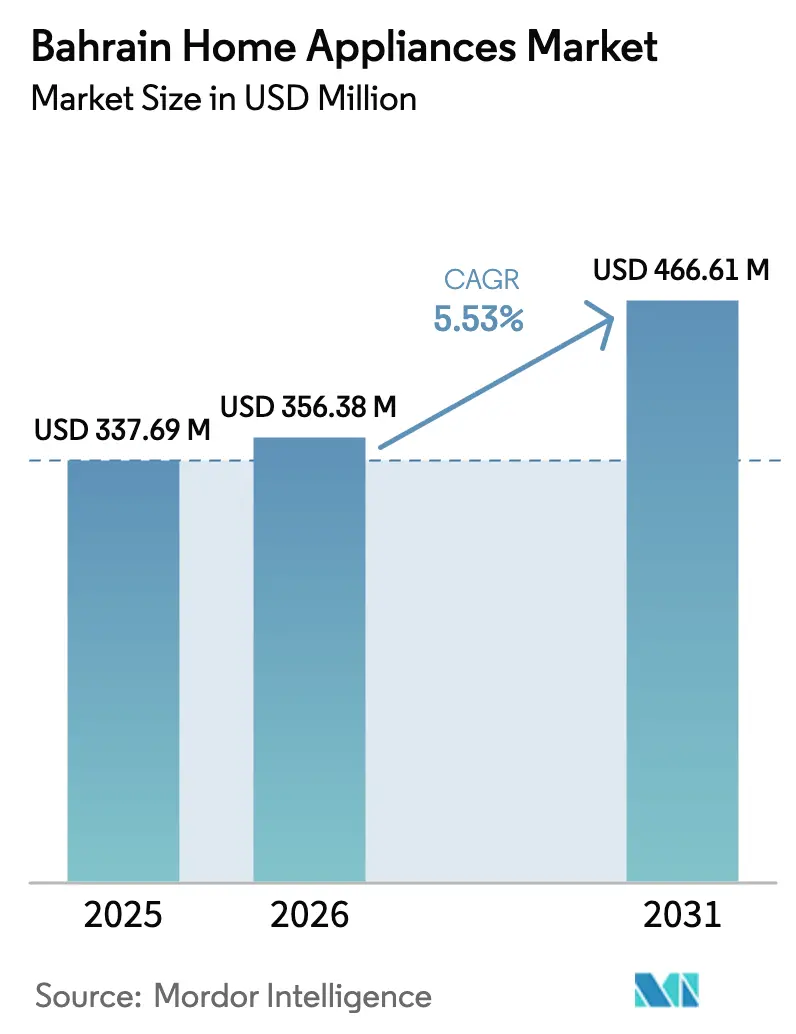
| Base Year Market Size (2025) | USD 337.69 Million |
| Market Size (2026) | USD 356.38 Million |
| Market Size (2031) | USD 466.61 Million |
| Growth Rate (2026 - 2031) | 5.53 % |
| Market Concentration | Medium |
Major Players *Disclaimer: Major Players sorted in no particular order Image © Mordor Intelligence. Reuse requires attribution under CC BY 4.0. | |
Bahrain Home Appliances Market Analysis by Mordor Intelligence
The Bahrain home appliances market size in 2026 is estimated at USD 356.38 million, growing from 2025 value of USD 337.69 million with 2031 projections showing USD 466.61 million, growing at 5.53% CAGR over 2026-2031. Robust economic diversification, record inward investment, and pro-manufacturing incentives keep the Bahrain home appliances market on a steady growth path despite supply-chain cost shocks. Stellar summer temperatures lift cooling-product volumes while the Golden License program and the Made in Bahrain 35% local-content requirement create sound economics for regional assembly lines. High disposable income, premium home ownership growth, and a consumer pivot toward smart, energy-efficient appliances reinforce replacement and upgrade cycles. Multi-brand retail chains remain the main sales conduit, yet rapid e-commerce uptake—supported by next-day fulfilment and omnichannel price transparency—adds new momentum. Nevertheless, freight-rate volatility and semiconductor shortages squeeze importer margins and heighten price sensitivity.
Key Report Takeaways
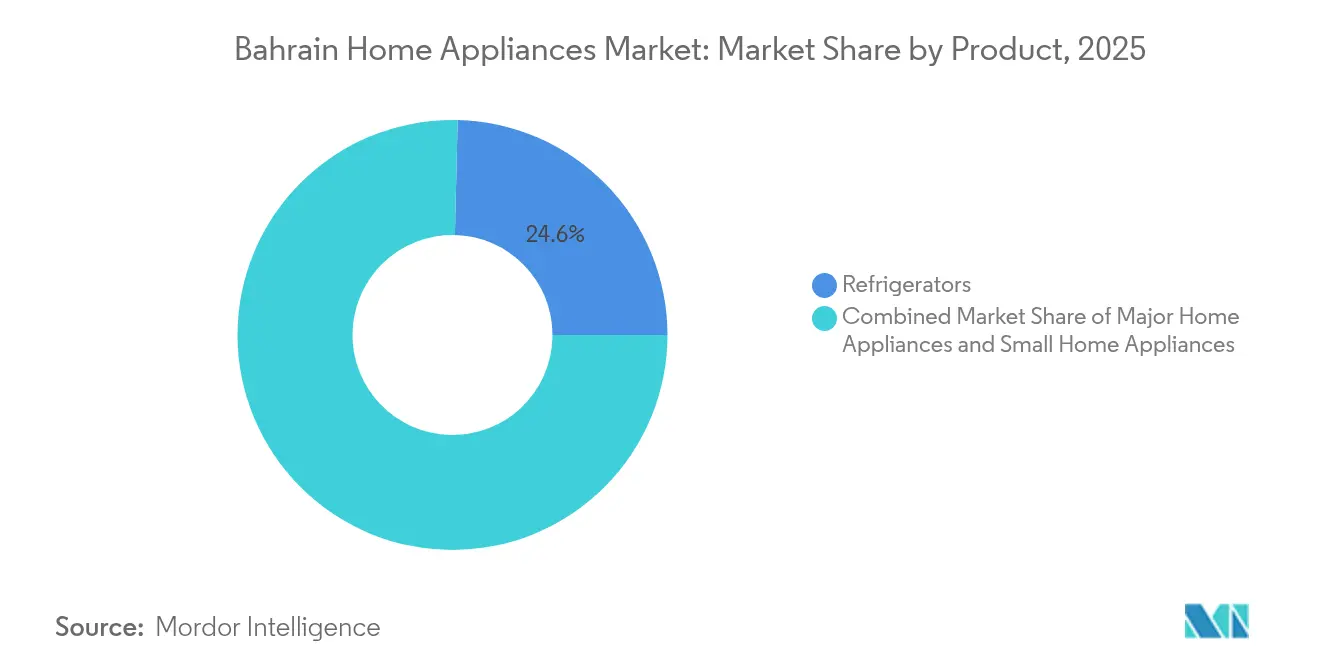
- By product category, refrigerators held 24.62% of the Bahrain home appliances market share in 2025, while air fryers are projected to advance at a 6.08% CAGR through 2031.
- By distribution channel, multi-brand stores accounted for 39.25% of the Bahrain home appliances market size in 2025; online channels are forecast to register a 6.44% CAGR between 2026-2031.
- By geography, the Capital Governorate commanded a 44.30% share of the Bahrain home appliances market size in 2025; the Northern Governorate is expected to post the fastest 5.58% CAGR to 2031.
Note: Market size and forecast figures in this report are generated using Mordor Intelligence’s proprietary estimation framework, updated with the latest available data and insights as of 2026.
Bahrain Home Appliances Market Trends and Insights
Drivers Impact Analysis*
| Driver | (~) % Impact on CAGR Forecast | Geographic Relevance | Impact Timeline |
|---|---|---|---|
| Rising disposable income & housing growth | +1.2% | Capital and Muharraq Governorates | Medium term (2-4 years) |
| Rapid adoption of smart & connected devices | +0.9% | National, led by the Capital Governorate | Long term (≥ 4 years) |
| Expansion of modern retail | +0.8% | Urban centres nationwide | Short term (≤ 2 years) |
| Golden License–driven local assembly | +0.7% | National manufacturing zones | Medium term (2-4 years) |
| Solar-energy subsidies for high-efficiency AC | +0.6% | Residential sector nationwide | Long term (≥ 4 years) |
| Severe summer heat boosts cooling demand | +0.4% | Peak impact during May–September across all governorates | Short term (≤ 2 years) |
| Source: Mordor Intelligence | |||
Rising Disposable Income & Housing Growth
Stronger non-oil GDP and active housing programs add fresh households that install full appliance suites within months of handover [1].Ministry of Housing and Urban Planning, “Housing Services Expansion Update 2025,” housing.gov.bh Premium income tiers are upgrading faster than the national average, which shortens replacement cycles and pushes retailers to stock higher-margin, feature-rich models. The six-month lag between housing starts and appliance purchases secures pipeline visibility for manufacturers. Higher earnings also soften the price penalty of energy-efficient SKUs, fuelling a premiumisation trend that underpins value growth across the Bahrain home appliances market.
Rapid Adoption of Smart & Connected Appliances
Strong nationwide 5G coverage and competitive data tariffs make always-on connectivity seamless for consumers. Samsung’s AI-enabled refrigerators and washers, launched in 2025, allow predictive maintenance alerts that pre-empt costly cooling failures during peak summer, cementing brand loyalty [2]Samsung Electronics, “Samsung SmartThings Energy Launch,” samsung.com. BSH’s Matter-ready ovens deepen cross-platform compatibility, removing ecosystem lock-in and encouraging broader uptake among tech-savvy households[3]BSH Hausgeräte GmbH, “Annual Report 2024,” bsh-group.com. As a result, smart SKUs command a widening price premium yet still outpace volume growth, lifting total revenue in the Bahrain home appliances market.
Expansion of Modern Retail (Hypermarkets & Online)
New hypermarkets offer shoppers live demos, bundle discounts, and instant pick-up that drive conversion. Lulu Group’s 70% year-over-year e-commerce surge in FY 2024 proves that convenience trumps legacy store loyalty when returns are friction-free and installation slots can be booked online [4]Lulu Group International, “Financial Highlights FY 2024,” lulugroupinternational.com. Retailers deploy predictive inventory algorithms to maintain optimal stock levels during summer air-conditioner peaks. Seamless click-and-collect services reduce last-mile costs and consolidate the Bahrain home appliances market’s multichannel future.
Golden License Spurring Local Assembly
Under the Golden License, appliance makers obtain accelerated permits, tax holidays, and 100% foreign ownership, lowering landed costs by 8%-10% and cutting delivery lead times from six weeks to four days. Local content quotas stimulate regional component sourcing and nurture a budding parts cluster. Manufacturers also gain preferential access to government procurement, enlarging addressable volume. The program reduces currency-volatility exposure for importers and keeps pricing stable for the Bahrain home appliances market during freight spikes.
Restraints Impact Analysis*
| Restraint | (~) % Impact on CAGR Forecast | Geographic Relevance | Impact Timeline |
|---|---|---|---|
| Global supply-chain volatility (freight & chips) | -0.8% | Global, affecting all import-dependent markets | Short term (≤ 2 years) |
| High import dependency | -0.6% | National, affecting all product categories | Medium term (2-4 years) |
| Intense price competition | -0.4% | National, concentrated in mass-market segments | Short term (≤ 2 years) |
| Water-scarcity rules limiting high-usage dishwashers | -0.3% | National, residential sector focus | Long term (≥ 4 years) |
| Source: Mordor Intelligence | |||
High Import Dependency
Heavy reliance on Asian suppliers concentrates risk in a handful of trade lanes, so a regional disruption—or an adverse tariff decision—can leave showrooms empty for weeks. Volatile commodity costs for steel and copper move straight into landed prices because local value-addition is limited. The Golden License and Made in Bahrain schemes seek to localise assembly, but component ecosystems take years to mature, meaning import exposure will remain high through the medium term. Until meaningful localisation occurs, currency shifts against the US dollar and renminbi will keep retail pricing unpredictable for the Bahrain home appliances market.
Water-Scarcity Rules Limiting High-Usage Dishwashers
Escalating block tariffs on household water make traditional dishwashers less attractive. New regulatory drafts propose a maximum of 9 litres per standard cycle, forcing R&D to spend on ultra-efficient jets and filtration. Without product upgrades, consumer adoption stays muted, capping category contribution to the Bahrain home appliances market.
*Our forecasts treat driver/restraint impacts as directional, not additive. The impact forecasts reflect baseline growth, mix effects, and variable interactions.
Segment Analysis
By Product: Refrigerators Lead Amid Air-Fryer Momentum
Refrigerators generated 24.62% of 2025 revenue, anchored in an essential need to keep perishables fresh under 40°C summer peaks. High-end, inverter-compressor models with smart diagnostics now outsell conventional units by 2:1 in major urban chains. At the same time, air fryers post the fastest 6.08% CAGR, helped by compact kitchens and health-oriented diets that pivot away from deep-frying. Midea, Philips, and Black+Decker each introduced dual-zone fryers in 2025, intensifying price wars yet expanding the overall Bahrain home appliances market. Washing machines sustain mid-single-digit growth, while dishwashers remain niche under water-tariff pressure. Air conditioners, second only to refrigerators in value, benefit from solar-subsidy induced upgrades to variable-speed compressors. Small appliances such as coffee makers, blenders, and robot vacuums rise in tandem with lifestyle upgrades, adding breadth to product-mix depth.
Ovens and microwave-oven combos witness renewed interest as consumer cooking behaviour blends quick-service convenience with home-made nutrition. LG’s InstaView and Haier’s AI-bake functions entice premium customers willing to pay 20% more for connected features. Haier’s success in upscale refrigeration reveals the potency of AI-centric differentiation. Across categories, manufacturers tailor Gulf-grade specifications such as reinforced compressor coils and anti-sand filtration, raising perceived durability and reinforcing loyalty in the Bahrain home appliances market.


By Distribution Channel: Multi-Brand Stores Hold Scale, Online Gains Speed
Multi-brand showrooms captured 39.25% of 2025 sales, offering one-stop comparison shopping and immediate pick-up, critical for bulkier goods that buyers prefer to inspect physically. These outlets rely on advanced ERP systems to adjust stock based on rolling 12-week demand forecasts, thus avoiding out-of-stock penalties in the Bahrain home appliances market. In parallel, the online arena is registering a robust 6.44% CAGR. Lulu’s app features real-time delivery slots and price-match guarantees that win trust among younger demographics. Check-out conversion rates climb when shoppers can bundle extended warranties and installation in a single click.
Exclusive brand outlets keep a loyal clientele via experiential displays, free design consultation, and same-day service response. Landmark Group’s USD 1 billion omnichannel expansion will introduce showroom-plus-digital formats in underserviced neighbourhoods, further reshaping channel mix. Traditional dealers remain relevant in rural pockets but lose share each year as urbanisation accelerates and smartphone penetration pushes consumers toward digital price discovery, deepening the Bahrain home appliances market transformation.
Geography Analysis
The Capital Governorate delivered 44.30% of national revenue in 2025 on the back of high per-capita income and dense premium retail footprints along Manama’s commercial corridors. Luxury apartment towers and bespoke villas generate sizeable contract orders for built-in refrigerators, smart ovens, and connected washers. Strong after-sales service networks shorten repair lead times to under 48 hours, favouring repeat purchases within the Bahrain home appliances market. Retailers pilot experiential zones that display solar-ready HVAC and voice-controlled kitchen suites, creating high-margin upsell opportunities ita.gov.
Northern Governorate, the fastest-expanding pocket, is slated to clock a 5.58% CAGR through 2031 as large master-planned communities—such as Salman Town—reach occupancy. Younger family profiles prize multi-function cookers and app-controlled vacuum robots, reinforcing volume growth. Retail majors have earmarked six new hypermarkets and dedicated click-and-collect hubs to meet swelling demand. The governorate’s expanding 10 Gbit fibre network underpins reliable smart-home connectivity, a prerequisite for advanced SKUs in the Bahrain home appliances market.
Muharraq Governorate rides a stable replacement demand linked to airport-driven commerce and hospitality refurbishments. Southern Governorate, with its industrial clusters, prefers rugged, value-priced appliances yet benefits from logistics efficiencies—central warehouses in the Capital can deliver within two hours, minimising last-mile cost. Bahrain’s compact landmass enables centralised distribution to supply all four governorates seamlessly, smoothing inventory imbalances and reinforcing competitive pricing discipline in the Bahrain home appliances market.
Value Chain Analysis
The Bahrain home appliances value chain is import-led. Most products come from Asian manufacturing bases and are routed through regional hubs in the UAE and Saudi Arabia before reaching distributors in Bahrain for domestic distribution. Compliance screening and documentation are concentrated at the point of import, with the Ministry of Industry and Commerce (MOIC) and the Bahrain Standards and Metrology Directorate (BSMD) requiring adherence to Gulf and IEC safety standards (for example, BH GSO IEC 60335-1:2023 for household appliance safety). This affects SKU selection, lead times, and working-capital needs for distributors.
In-market value addition is driven mainly by wholesale distribution, retailing, installation, and after-sales service rather than manufacturing. Established groups such as Y.K. Almoayyed & Sons, ALSALAM Group, Bahrain Gas Company, and Ashrafs WLL act as key conduits for brand access, warehousing, and service coverage. Multi-brand retail chains and omnichannel players coordinate last-mile delivery, installation scheduling, and warranty handling, while service capability and spare-parts availability become more visible during seasonal peaks for cooling products. Bottlenecks tend to cluster around freight-rate volatility, semiconductor-dependent product availability, and dependence on regional transshipment corridors that can extend replenishment cycles when upstream disruptions occur.
Competitive Landscape
Competitive rivalry is moderate. Samsung drives AI-tier leadership with on-device learning algorithms that improve chill-cycle efficiency, while LG stakes ground in health-oriented filter technology that claims 99% airborne pathogen reduction. BSH leverages German engineering credentials, dedicating 5.5% of revenue to R&D and launching Matter-compliant lines that foster ecosystem neutrality. Chinese entrants—Haier, Midea, TCL—keep eroding price points through vertically integrated factories and regional assembly tie-ups, including TCL’s 2024 partnership with Jashanmal to roll out inverter air conditioners in Bahrain and neighbouring states.
Local assembly, though nascent, is a defining differentiator: a Middle East-made washing machine reaches Bahrain shop floors four days after order confirmation compared with six weeks for imported stock. Brand equity further hinges on after-sales excellence. Lulu’s service centre promises a two-hour response within Manama, prompting rivals to outsource to third-party technicians. Sustainability credentials—PVC-free insulation, halogen-free circuit boards—are now core marketing hooks, echoing Vision 2030 imperatives and swaying environmentally conscious buyers in the Bahrain home appliances market.
Strategic manoeuvres in 2025 highlight the race for data-driven consumer intimacy:
- Samsung integrates its SmartThings Energy dashboard into new refrigerators, offering real-time consumption analytics;
- LG pilots a subscription model for water-purifier filters bundled with annual air-conditioner servicing;
Emerging disruptors like Dubai-based Barq ship micro-batch designer kettles direct to Bahraini consumers, proving that niche players can still carve profitable pockets in the Bahrain home appliances market.
Bahrain Home Appliances Industry Leaders
Samsung Electronics Co., Ltd.
LG Electronics Inc.
Whirlpool Corporation
Hitachi, Ltd.
Robert Bosch GmbH
- *Disclaimer: Major Players sorted in no particular order


Market Opportunities and Future Outlook
Energy-efficiency compliance is a commercialization lever for suppliers and retailers. As Bahrain tightens product access through labeling and minimum performance requirements under the Bahrain Energy Efficiency Scheme (BH-EE), including MEPS for air conditioners, suppliers can position higher-efficiency models to qualify for market access. The October 2024 approval of GSO 2769:2024 for household refrigerating appliances (up to 1,500 liters) further supports a standards-driven upgrade cycle that favors inverter, smart diagnostics, and higher-efficiency refrigeration models already gaining traction in premium retail formats in Bahrain.
Bahrain also has a practical go-to-market space around execution capabilities that reduce purchase friction and improve attach rates. Certified installation networks, faster warranty turnaround, and bundled digital services (delivery-slot booking, installation, and extended warranties) map to the country's growing omnichannel buying behavior. Report context also highlights the Golden License and Made in Bahrain local-content requirements, which support regional assembly and faster replenishment into Bahrain, helping distributors protect availability during summer peaks and supply shocks. For connected-appliance portfolios, Bahrain's connectivity and smart-home adoption trend creates room for differentiated offers around energy dashboards and remote monitoring, provided SKUs meet BTMD and BSMD safety and efficiency requirements for market access.
Recent Industry Developments
- July 2026: LG Electronics expanded its HVAC Academy network in the Middle East and Africa, positioning the LG MEA Hub Academy as a regional training and certification center. The expansion strengthens installation quality and after-sales consistency for HVAC systems, supporting premiumization as buyers shift toward energy-efficient and smart cooling solutions.
- July 2025: LG Electronics conducted an HVAC technical seminar in Bahrain tied to formalizing cooperation with local partner AGILE Trading for climate-control solution delivery. The program builds distributor capability and supports technical alignment, which can help accelerate deployments and reduce installation-related failures.
- November 2024: Landmark Group announced a USD 1 billion plan to expand its retail footprint, including omnichannel formats across the Gulf. The larger organized retail footprint and showroom-plus-digital models increase competitive pressure on pricing and merchandising while widening the route-to-market for both major and small appliances in Bahrain.


Research Methodology Framework and Report Scope
Market Definition and Coverage
For this study, the Bahrain home appliances market is defined as the value of newly sold household appliances used for cooking, cooling, washing, cleaning, and small kitchen and personal-care tasks, sold through retail and online channels within Bahrain.
Scope exclusions: We exclude repair services, spare parts and consumables, second-hand or refurbished units, and consumer electronics that are not typically classified as home appliances.
Segmentation Overview
- By Product
- Major Home Appliances
- Refrigerators
- Freezers
- Washing Machines
- Dishwashers
- Ovens (Incl. Combi & Microwave)
- Air Conditioners
- Other Major Home Appliances
- Small Home Appliances
- Coffee Makers
- Food Processors
- Grills & Roasters
- Electric Kettles
- Juicers & Blenders
- Air Fryers
- Vacuum Cleaners
- Other Small Home Appliances
- Major Home Appliances
- By Distribution Channel
- Multi-Brand Stores
- Exclusive Brand Outlets
- Online
- Other Distribution Channels
- By Geography
- Capital Governorate
- Muharraq Governorate
- Northern Governorate
- Southern Governorate
Data Sources, Market Sizing, and Validation
Desk Research
Desk research sets the boundaries and gives the hard numbers that can be checked. We used public sources such as Bahrain customs and trade statistics, official releases from the Information and eGovernment Authority, Central Bank of Bahrain macro indicators, and energy-efficiency or product safety references published by relevant government bodies. We also reviewed global datasets such as UN Comtrade and UN population and housing indicators to sense-check directionally if imports and household formation trends match the appliance demand story.
Alongside that, we relied on company filings, retailer announcements, press coverage, and category-level product launches to understand pricing, mix shifts, and channel intensity in Bahrain. A paid subscription for company financials and intelligence was used selectively to map distributor and retailer revenue exposure, and an import-export shipment-level database was used for cross-checking key HS-code flows. The desk source list mentioned here is illustrative, and many other public and paid sources were also referred to for data collection, validation, and clarification.
Primary Interviews and Surveys
Primary work was used to convert desk signals into realistic assumptions, especially on what is actually sold in Bahrain versus what is merely shipped in, and how promotions influence realized prices. We interviewed and surveyed a mix of brand-side executives, local distributors, large-format retailers, specialty stores, and service partners to validate volumes, category mix, channel splits, and expected price movement over the forecast period.
Distribution of primary research fieldwork respondents
| Company type | Respondent position |
|---|---|
| Top tier: 37% | CXOs: 12% |
| Mid tier: 48% | Functional/Unit leaders: 32% |
| Smaller Players: 15% | Managers: 56% |
Market-Sizing & Forecasting
Sizing was built using both top-down and bottom-up thinking, so the final number is practical and still traceable. On the top-down side, import and domestic distribution signals were used to reconstruct the sell-in pool for key appliance categories, which was then adjusted using channel and replacement-cycle insights to reflect sell-out conditions in Bahrain. The totals were then corroborated through selective bottom-up checks, such as sampled average selling price (ASP) by category times estimated unit volumes from retailer and distributor feedback, and then adjusted when mismatches appeared.
A few inputs mattered more than others in this market, so they were treated carefully. These included the split between major appliances and small appliances, household formation and housing completions that influence first-time purchases, replacement timing for core products like refrigerators and washing machines, seasonal promotion patterns around key retail periods, and the mix shift toward higher-efficiency or feature-rich models that changes ASP over time. Where gaps existed in category-level volume visibility, we used conservative share assumptions confirmed in interviews, and we kept the logic consistent across years so the trend line does not jump without a clear reason.
For forecasting, we used scenario analysis supported by simple time-series smoothing on the most stable drivers, and then we applied expert-agreed ranges for variables like ASP progression and channel expansion. The goal was not to overfit the forecast, but to keep the outlook linked to observable signals that can be rechecked in future refreshes.
Data Validation & Update Cycle
Validation is done in layers so the model output does not depend on a single assumption. We compare the final market totals against independent signals such as import trends, retailer expansion, macro demand indicators, and category-level pricing direction collected during interviews. Outliers are flagged and re-worked, and if the variance cannot be explained, the relevant assumption is reopened and respondents may be re-contacted.
Before sign-off, the model and its drivers go through at least one additional analyst review to ensure definitions, arithmetic, and growth logic remain consistent. Reports are refreshed annually, and interim updates are added when material events happen that can change demand, pricing, or supply. Right before delivery, a fresh review pass is done so clients receive the latest updated view available at that time.
Mordor Intelligence's Bahrain Home Appliances Market Sizing Compared With Other Published Estimates
Published market sizes for Bahrain home appliances can look far apart, even when the topic sounds the same, because the boundary conditions are often set differently and not always stated clearly. In our checks, we typically see gaps caused by what is counted as an appliance, whether the value is measured at retail price or a distributor level, and how online sales and promotions are treated.
Import flows by appliance-related HS codes, retailer price tracking, and interview-validated channel splits are the evidence that ties Mordor Intelligence to USD 337.69 M (2025) for Bahrain, since the number reflects only new appliance sales after removing services, parts, and irregular second-hand activity. Other estimates can drift when they fold in a wider consumer durables bucket, use an aggressive ASP uplift without testing discount intensity, or apply a multi-country growth curve that does not match Bahrain-specific replacement cycles and housing-driven demand.
Benchmark comparison
| Source | Market Size | Gaps in Research Methodology |
|---|---|---|
| Mordor Intelligence | USD 337.69 M (2025) | |
| Trade Journal A | USD 276.10 M (2023) | Uses a white-goods-only boundary and typically reflects older base-year pricing, which can understate value when small appliances and premium mix shifts are material. |
| Regional Consultancy B | USD 330.00 M (2024) | Often presents a single-point estimate built from high-level consumer durables assumptions, with limited visibility on promotion-driven ASP reductions and channel mix across modern trade and e-commerce. |
The spread across publishers is mainly explained by scope and valuation level, followed by how price realization is handled in a promotion-heavy retail environment. By keeping the counting rules simple and checking them against trade signals and primary inputs, the final number stays easy to reproduce and easier to use for planning.


Key Questions Answered in the Report
What is the current size of the Bahrain home appliances market?
It reached USD 356.38 million in 2026 and is forecast to hit USD 466.61 million by 2031 at a 5.53% CAGR.
Which product category generates the most revenue?
Refrigerators lead with a 24.62% 2025 share because food preservation is critical in Bahrain’s extreme heat.
How fast is online appliance retail growing?
Online channels are expanding at a 6.44% CAGR, helped by 70% year-over-year e-commerce gains at Lulu Group.
Why are manufacturers setting up local assembly in Bahrain?
The Golden License grants tax breaks and fast-track permits, trimming landed costs by up to 10% and cutting delivery lead times to days.
Which governorate is the fastest-growing appliance market?
Northern Governorate is projected to grow 5.58% annually through 2031 on the back of large housing projects.
How do water-scarcity rules affect dishwasher sales?
Higher block tariffs and upcoming efficiency standards curb demand for traditional dishwashers, keeping the category niche unless ultra-efficient models become mainstream.
Page last updated on:


 Your data is secure and never sold or shared.


