
Bacterial Biopesticides Market Size and Share
Market Overview
| Study Period | 2021 - 2031 |
|---|---|
| Market Size (2026) | USD 3.15 Billion |
| Market Size (2031) | USD 6.26 Billion |
| Growth Rate (2026 - 2031) | 14.70 % |
| Fastest Growing Market | Asia Pacific |
| Largest Market | North America |
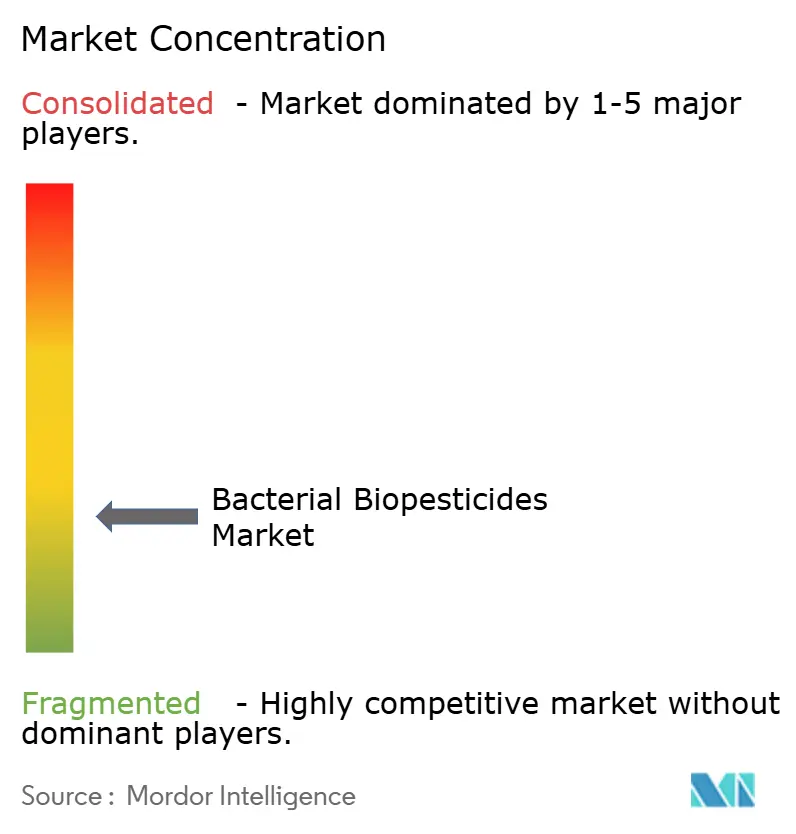
| Market Concentration | Low |
Major Players *Disclaimer: Major Players sorted in no particular order Image © Mordor Intelligence. Reuse requires attribution under CC BY 4.0. | |
Bacterial Biopesticides Market Analysis by Mordor Intelligence
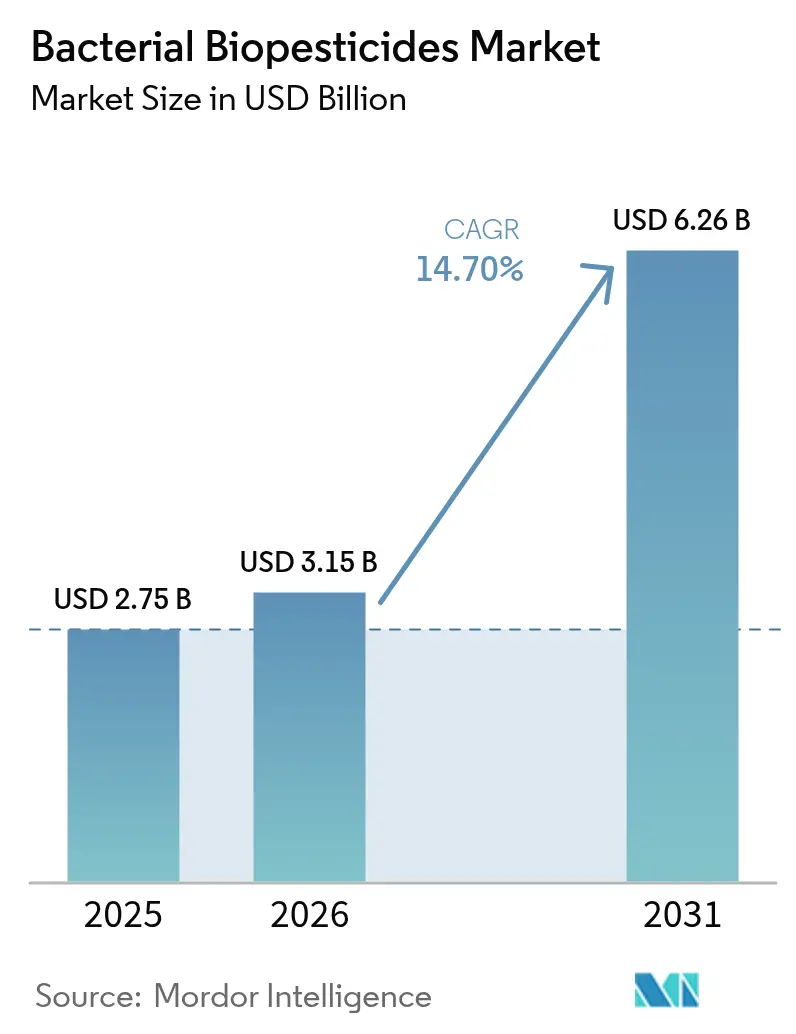
The Bacterial Biopesticides market size is expected to grow from USD 2.75 billion in 2025 to USD 3.15 billion in 2026 and is forecast to reach USD 6.26 billion by 2031 at 14.70% CAGR over 2026-2031. The market growth is driven by expedited regulatory approvals, increasing consumer demand for residue-free produce, expansion of organic farming, and technological advancements that enhance formulation stability and field efficacy. According to FiBL, the global organic farming area reached 98.9 million hectares in 2023, representing a 2.6% increase. Bacillus thuringiensis (Bt) dominates the market with a 74% revenue share, while Bacillus subtilis shows rapid growth due to its combined pest control and plant growth promotion capabilities. Precision seed treatment applications, liquid formulations for controlled-environment agriculture, and the consolidation of portfolios among major agrochemical companies support the market expansion. Adoption rate of the bacterial biopesticides is affected by cold-chain storage requirements and slower efficacy compared to chemical alternatives, as companies work to address these challenges in an increasingly competitive market.
Key Report Takeaways
- By product type, Bacillus thuringiensis held 73.60% of the bacterial biopesticides market share in 2025; Bacillus subtilis is positioned to grow at a 16.50% CAGR through 2031.
- By mode of application, foliar sprays led with 44.30% revenue contribution in 2025; seed treatment is forecast to expand at a 16.20% CAGR between 2026 and 2031.
- By crop type, fruits and vegetables accounted for 37.40% share of the bacterial biopesticides market size in 2025, whereas cereals and grains are projected to rise at a 15.10% CAGR to 2031.
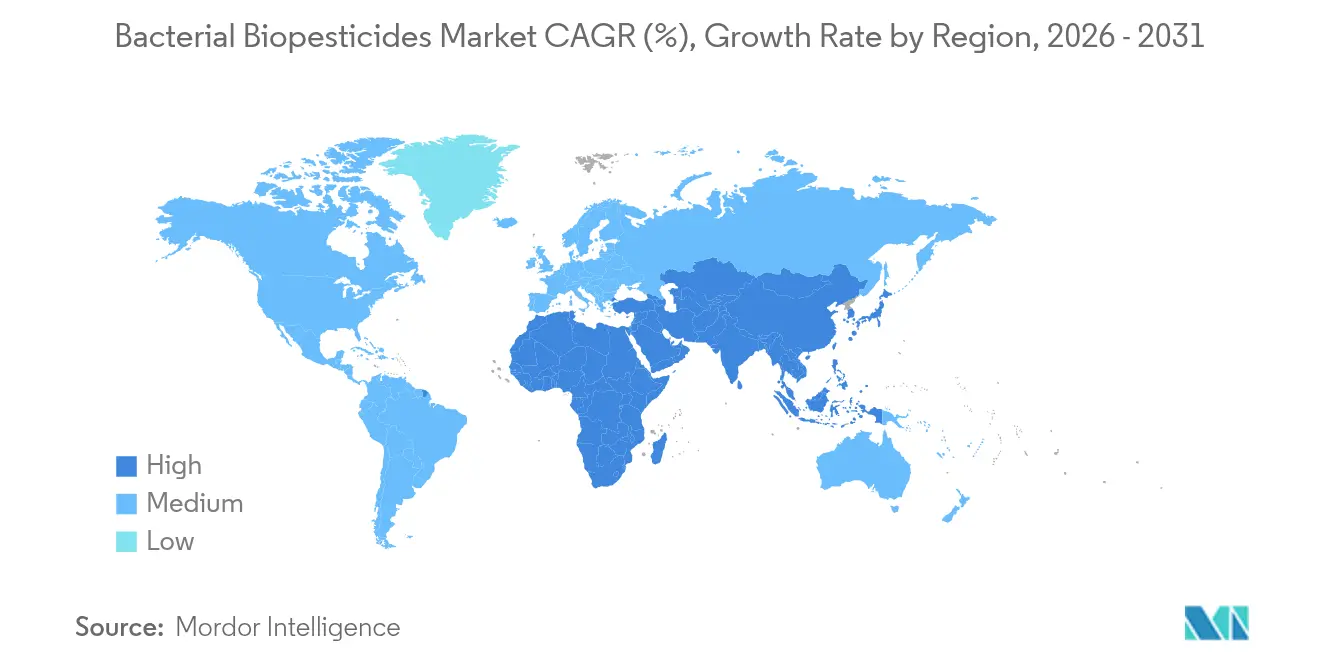
- By region, North America represented 37.50% of global sales in 2025, while Asia-Pacific is set to register the fastest 17.40% CAGR over the forecast horizon.
Note: Market size and forecast figures in this report are generated using Mordor Intelligence’s proprietary estimation framework, updated with the latest available data and insights as of 2026.
Market Trends and Insights
Drivers Impact Analysis of Bacterial Biopesticides Market*
| Driver | (~) % Impact on CAGR Forecast | Geographic Relevance | Impact Timeline |
|---|---|---|---|
| Regulatory and Policy Support | +2.8 | Global, with strongest influence in EU and North America | Medium term (~ 3-4 yrs) |
| Rising Awareness of the Harms of Conventional Pesticides | +1.9 | Global, particularly pronounced in Europe and North America | Medium term (~ 3-4 yrs) |
| Demand for residue-free produce driving Bt solutions | +2.4 | Global, with early adoption in developed markets | Short term (≤ 2 yrs) |
| Expansion of controlled-environment agriculture boosting demand for liquid bacterial formulations | +3.1 | North America, Europe, and urban centers in Asia-Pacific | Long term (≥ 5 yrs) |
| Increasing adoption of integrated pest management (IPM) strategies | +2.3 | Global, with highest impact in regions with strong agricultural extension services | Medium term (~ 3-4 yrs) |
| Technological advancements in formulation and delivery systems | +2.7 | Global, with initial adoption in developed agricultural markets | Medium term (~ 3-4 yrs) |
| Source: Mordor Intelligence | |||
Regulatory and Policy Support
The European approval process for biopesticides has reduced from nine years to approximately three years, addressing a backlog of over 100 pending substances. The European Commission intends to implement new EU regulations in 2025 to optimize biopesticide approval processes by Q4. The 2026 Biotech Act will focus on filling current regulatory gaps. Brazil has demonstrated similar progress by approving bio-insecticidal products derived from inactivated Burkholderia cells. The United States Environmental Protection Agency (EPA) is reducing application backlogs under FIFRA (Federal Insecticide, Fungicide, and Rodenticide Act). [3]United States EPA, “Guidance for Expedited Review of Biopesticides,” epa.gov These regulatory changes expand registration opportunities, reduce compliance costs, and enable smaller companies to enter the bacterial biopesticides market.
Rising Awareness of the Harms of Conventional Pesticides
Research demonstrating biodiversity loss and soil degradation from synthetic pesticides influences purchasing decisions in premium retail channels. A 2025 Massachusetts Institute of Technology study revealed that 31% of global agricultural soils faced high risks from pesticide contamination. North American and European retailers implement strict residue limits, favoring zero-residue biological products. As growers adapt to these requirements, bacterial agents have evolved from organic-only solutions to essential components of integrated pest management programs. This transition drives growth in the bacterial biopesticides market, especially for crops with short pre-harvest intervals.
Demand for Residue-Free Produce Driving Bt Solutions
Bacillus thuringiensis (Bt) protein's mode of action leaves no chemical residue, making it compliant with export maximum residue limits. Bt holds 74% of the bacterial biopesticides market due to its proven field effectiveness. New microencapsulated formulations enable their use in high-temperature regions and extend storage duration. Recent developments in UV-stable formulations allow applications beyond traditional evening spray periods, reinforcing Bt's dominant market position.
Expansion of Controlled-Environment Agriculture Boosting Liquid Formulations
The expansion of vertical farms and high-technology greenhouses has increased the demand for inputs that provide consistent results in controlled environments. China leads this expansion, accounting for 60% of global greenhouse facilities in 2024, according to NASA Earth Observatory. Liquid bacterial formulations are well-suited for these operations, as they can be administered through fertigation lines and misting systems. Recent developments in shelf-life technology, including a biobased carrier that maintains Gram-negative microbe viability for 540 days, have reduced storage costs and enabled market expansion in metropolitan areas. The parallel growth of controlled environment agriculture (CEA) and bacterial inputs creates a cycle that drives the bacterial biopesticides market forward.
Restraints Impact Analysis of Bacterial Biopesticides Market*
| Restraint | (~) % Impact on CAGR Forecast | Geographic Relevance | Impact Timeline |
|---|---|---|---|
| Cold-chain logistics limiting shelf-life of Biological biopesticides | -1.7 | Global, most severe in tropical regions and developing markets | Short term (≤ 2 yrs) |
| Production and Formulation Challenges | -1.2 | Global, with varying impact based on technological capabilities | Medium term (~ 3-4 yrs) |
| Perceived slower knock-down reducing adoption in farms | -2.1 | Global, particularly in regions with high pest pressure | Short term (≤ 2 yrs) |
| Higher costs compared to conventional pesticides | -1.9 | Global, most significant in price-sensitive markets and field crops | Medium term (~ 3-4 yrs) |
| Source: Mordor Intelligence | |||
Cold-Chain Logistics Limiting Shelf-Life of Biologicals
Live spore formulations typically lose viability at temperatures above 25°C, necessitating refrigerated transport and storage, which increases the final cost. This challenge is particularly significant in equatorial markets where small-scale distribution networks lack temperature-controlled storage facilities. While new encapsulation technologies are improving cell viability at room temperature and reducing distribution constraints, the processes for scale-up and regulatory approval require multiple growing seasons. These logistical limitations restrict market penetration, reducing the competitiveness of bacterial biopesticides against chemical pesticides that offer extended shelf life and minimal storage requirements.
Perceived Slower Knock-Down Reducing Adoption in Farms
Chemical insecticides typically eliminate pests within hours, while bacterial agents require several days, which makes growers hesitant to use them for immediate pest control. Field demonstrations combining bacterial products with selective chemicals in integrated pest management programs are changing this perception. Current research focuses on developing bacterial strains that produce higher toxin levels and complementary microbial combinations to achieve faster pest mortality while maintaining a residue-free status.
*Our forecasts treat driver/restraint impacts as directional, not additive. The impact forecasts reflect baseline growth, mix effects, and variable interactions.
Bacterial Biopesticides Market Segment Analysis
By Product Type:
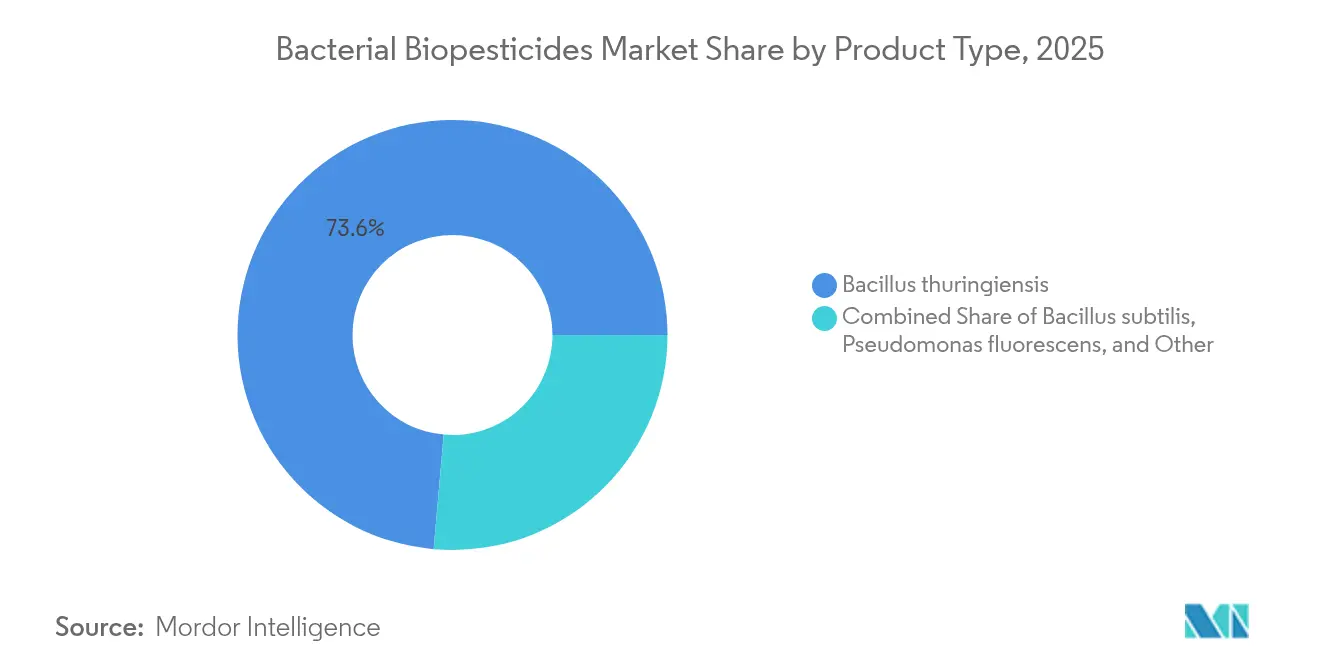
Bt Dominance and Emerging MultifunctionalsBt accounted for 73.60% of 2025 revenue, maintaining its dominant position in the bacterial biopesticides market. This market leadership stems from its targeted toxicity against lepidopteran larvae, extensive organic certifications, and regulatory acceptance worldwide. The market size for Bt products is projected to expand due to new encapsulation technologies that improve field persistence in high-UV conditions. A 2024 study confirmed Bt toxins' effectiveness against lepidopteran, coleopteran, hemipteran, dipteran, and nematode pests.
Bacillus subtilis shows strong growth potential with a projected 16.50% CAGR, driven by its dual benefits of disease suppression and plant growth promotion, particularly in high-value horticulture. Pseudomonas fluorescens has established its role in controlling soil-borne pathogens, while Serratia and Streptomyces species are gaining traction in specialized applications through their chitinase activity and antibiotic metabolite production capabilities.


By Mode of Application:
From Foliar Dominance to Seed-Centric DeliveryFoliar sprays accounted for 44.30% market share in 2025, driven by their flexibility in-season application across multiple crops and compatibility with conventional spraying equipment. The seed treatment segment is anticipated to grow at a 16.20% CAGR, supported by advances in polymer coatings and dormant spore technologies that maintain bacterial viability during storage and early germination phases. This approach integrates protection from the initial growth stage, reducing application requirements and increasing bacterial biopesticides adoption in seed applications. In 2024, the ICAR-Indian Institute of Oilseeds Research (IIOR) developed a biopolymer-based seed coating technology that preserves nutrient-mobilizing microbes, including microbial bio-agents used in biopesticides. This development improves microbial survival, increases crop yields by 25-30%, and enhances resilience under adverse climate conditions.
Soil drench applications remain important for growers managing nematodes and root diseases that are not effectively controlled by foliar applications. Post-harvest dip treatments serve a specialized role in extending shelf life for fresh produce supply chains seeking chemical-free alternatives. The diversity of application methods provides manufacturers with multiple revenue streams and reduces seasonal revenue fluctuations.
By Crop Type:
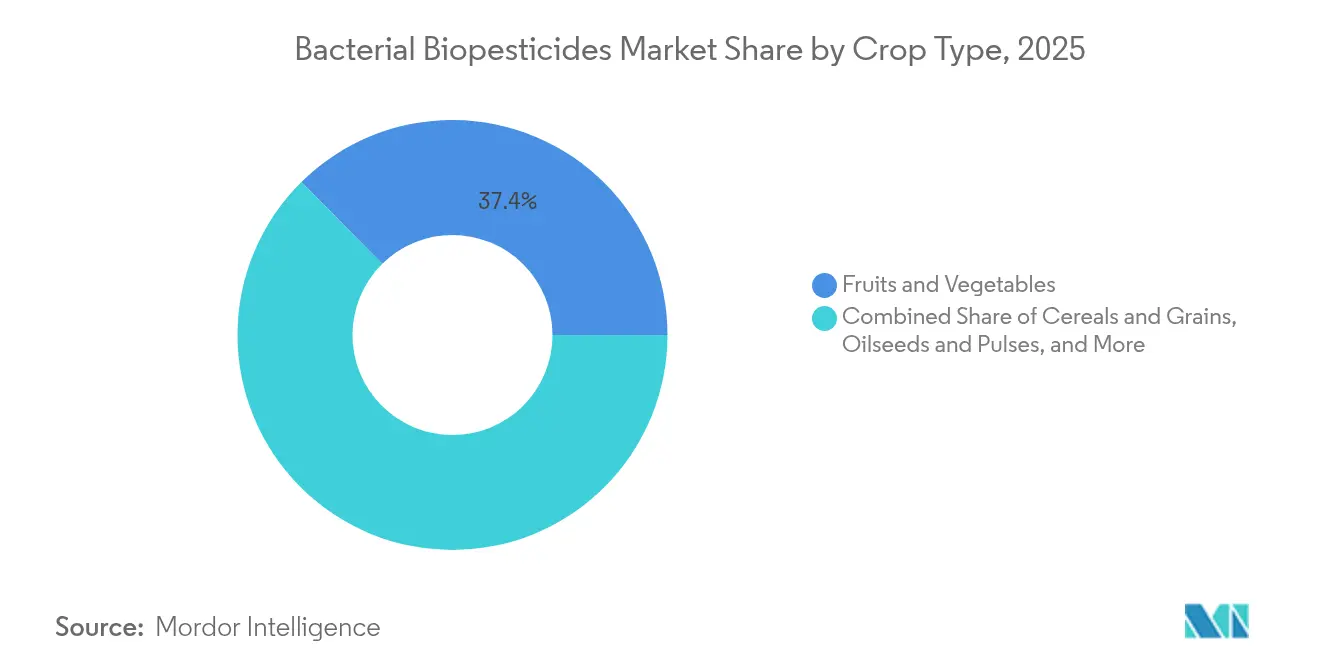
Specialty Crops Maintain Lead, Broadacre Gains PaceFruits and vegetables accounted for 37.40% of revenue in 2025, driven by premium pricing, short harvest cycles, and strict retailer residue requirements. The bacterial biopesticides market for this segment continues to grow with increasing greenhouse cultivation and export volumes. According to the Environmental Working Group (EWG) Dirty Dozen list, strawberries show the highest contamination, with 99% of samples containing pesticide residues. Spinach, kale, mustard greens, collard greens, and grapes also demonstrate significant contamination, with some containing more than 100 different pesticides.
The broadacre cereals and grains segment is anticipated to grow at a 15.10% CAGR. Decreasing formulation costs and efficient aerial application of liquid concentrates, covering thousands of hectares daily, make bacterial biopesticides economically viable for staple crops. The market expansion extends to oilseeds, pulses, and turf segments, driven by sustainability requirements and environmental concerns in urban areas.
Geography Analysis
North America Bacterial Biopesticides Market
North America maintained its dominant position with a 37.50% share of the 2025 global revenue. The United States drives market volumes through widespread integration of bacterial solutions in large-scale corn and soybean operations. Canadian greenhouse clusters strengthen regional demand by utilizing liquid inoculants compatible with hydroponic fertigation systems. In 2023, Canada's 920 commercial greenhouse vegetable operations produced 802,163 metric tons of vegetables, a 7% increase from 2022.
APAC Bacterial Biopesticides Market
Asia-Pacific demonstrates the strongest growth trajectory with an anticipated 17.40% CAGR through 2031. China's five-year green pest-control plan and India's bio-input subsidy programs encourage domestic production and adoption. Japan and Singapore's vertical farming operations provide established markets for liquid formulations specifically developed for controlled environment agriculture.
Europe Bacterial Biopesticides Market
Europe maintains strict regulations for biopesticides, though recent changes have accelerated their adoption. The European Commission's 2025 fast-track regulation reduced dossier review times to align with North American standards, enabling more product registrations and encouraging manufacturers to expand their EU product labels. The demand for biopesticides has increased through Scandinavian public procurement policies for school meals and Germany's Farm-to-Fork pesticide reduction targets, particularly benefiting Bt and B. subtilis foliar products. Eastern European grain producers have initiated Bacillus-based seed treatment trials in response to export markets' stricter residue requirements, expanding beyond traditional high-value horticultural applications.

Regulatory Landscape
Regulation of bacterial biopesticides continues to shift toward dedicated biological and bioinput pathways alongside conventional plant protection rules. In Brazil, Law No. 15.070 (enacted in December 2024) established a specific framework for bioinputs, including microbial biopesticides, and introduced registration obligations for biofactories as well as importers and exporters under the Ministry of Agriculture and Livestock (MAPA). This supports more formalized domestic production and trade.
In the European Union, Commission Regulation (EU) 2026/1123 (published May 2026) updated labeling requirements for plant protection products, replacing Regulation (EU) No 547/2011 and aligning label elements with updated mixture classification requirements. As a result, compliance attention is turning toward label content and classification for both biological and chemical products. In the United States, EPA oversight under FIFRA is complemented by water-discharge compliance, with the final 2026 Pesticide General Permit (issued December 2024) governing point source discharges of pesticides, including microbial pesticides. The permit period runs from October 31, 2026 through October 30, 2031, adding operational permitting considerations for certain application settings near waters of the United States.
Competitive Landscape
The bacterial biopesticides market consists of established agrochemical companies and specialized firms. Corteva's 2025 acquisition of Symborg enhanced its fermentation capabilities and expanded its portfolio of patent-protected Bacillus metabolites, indicating that major companies consider biologics as core assets. Bayer utilizes its distribution network to combine Bt sprays with traited seeds, creating integrated solutions that secure retail presence. Certis Biologicals, Valent BioSciences, and Koppert focus on developing fast-acting strains to reduce time-to-efficacy, particularly in markets where chemical pesticides remain the standard.
The market shows significant innovation through increased patent applications for chitinase-rich Streptomyces combinations and nano-emulsion carriers that enhance field durability. Industry collaboration is increasing, with Evonik providing encapsulation polymers to multiple manufacturers, while companies like Pivot Bio license fermentation technology to established seed producers. The main competitive focus for the next five years centers on microencapsulation, synergistic consortia, and metabolite stabilization technologies.
Regulatory differences across regions influence market strategies. Large companies pursue simultaneous registrations in the EU and the US, while smaller firms often begin in South America, where data requirements are less stringent. Companies developing formulations that do not require cold-chain storage can access emerging markets in Sub-Saharan Africa and Southeast Asia. While market consolidation continues, the top five companies maintain less than 80% of combined revenue, creating opportunities for new entrants focusing on specific crops, delivery methods, or regional markets.
Bacterial Biopesticides Industry Leaders
Koppert Biological Systems
BASF SE
Syngenta AG
Valent Biosciences LLC
Novonesis
- *Disclaimer: Major Players sorted in no particular order
Bacterial Biopesticides Market Companies Covered in this Report
- Certis Biologicals
- Valent BioSciences
- Bayer CropScience AG
- Syngenta AG
- Corteva Agriscience
- BASF SE
- UPL Limited
- FMC Corporation
- Nufarm Limited
- Koppert Biological Systems
- Novonesis

Market Opportunities and Future Outlook
Opportunities center on faster market access and clearer product differentiation as regulatory systems add defined lanes for biologicals and as growers prioritize residue-compliant tools across export and retail channels. A near-term commercialization gap is visible in greenhouse and other controlled-environment uses where compatibility with fertigation, misting, and short crop cycles matters. Health Canada published Proposed Registration Decision PRD2026-07 (April 2026) for AQUABAC II XT, a Bacillus thuringiensis subsp. israelensis-based biological larvicide, for greenhouse ornamentals. This reinforces Bt-derived actives beyond open-field insect control and supports portfolio extensions into specialty horticulture.
Product development is also moving beyond single-function pest suppression toward multi-functional strains and formulations that combine pest or disease management with plant growth-promoting effects. That direction aligns with integrated pest management programs and the seed-treatment delivery innovation already gaining traction in this market. High cumulative patent activity in biopesticides through 2024 points to sustained innovation investment across major geographies (notably China, the United States, and the European Union), which supports differentiated Bacillus-based metabolites, stabilization approaches, and delivery systems aimed at reducing cold-chain constraints and improving field persistence. Regulatory compendiums and risk-proportionate dossier frameworks in multiple countries also help multinational registration strategies, especially where manufacturers can standardize data packages across regions while tailoring labels and use-patterns for high-value crops and protected cultivation.
Recent Industry Developments in Bacterial Biopesticides Market
- July 2026: Syngenta partnered with Groundwork BioAg to commercialize mycorrhizal technology and soil carbon solutions across Latin America and Europe. The collaboration reinforces Syngenta's biologicals platform by pairing microbial capabilities with distribution reach in major agricultural regions.
- May 2026: BASF SE commissioned its BioHub fermentation plant at the Ludwigshafen site to support production of biological fungicides and biological seed treatments. The added in-house fermentation capacity helps secure supply of biological actives and supports scale-up for microbial-based crop protection programs.
- May 2024: Bioceres Crop Solutions received regulatory approval in Brazil for three bio-insecticidal and bio-nematicidal solutions derived from inactivated cells of its proprietary Burkholderia platform. The approval broadened the set of biological modes-of-action available in a major adopting market and validated a pathway for fully inactivated microorganism-based products.


Bacterial Biopesticides Market Report Scope and Research Methodology
Market Definition and Coverage
This market covers the revenues generated from formulated bacterial biopesticide products that are used to control pests and diseases in crops, where the main active ingredient is a live or spore-based bacterium and sales are captured at the manufacturer level.
Scope exclusions: We do not count biochemical biopesticides, plant-incorporated protectants, or custom application service revenues.
Segments Covered in This Report
- By Product Type
- Bacillus thuringiensis
- Bacillus subtilis
- Pseudomonas fluorescens
- Other Types
- By Mode of Application
- Foliar Spray
- Seed Treatment
- Soil Treatment
- Post-Harvest Treatment
- By Crop Type
- Fruits and Vegetables
- Cereals and Grains
- Oilseeds and Pulses
- Turf and Ornamentals
- Plantation Crops
- By Geography
- North America
- United States
- Canada
- Mexico
- Rest of North America
- South America
- Brazil
- Argentina
- Chile
- Rest of South America
- Europe
- Germany
- France
- United Kingdom
- Spain
- Italy
- Rest of Europe
- Africa
- South Africa
- Egypt
- Rest of Africa
- Asia-Pacific
- China
- India
- Japan
- South Korea
- Australia
- Rest of Asia-Pacific
- North America
Data Sources, Market Sizing, and Validation
Desk Research
Desk work started with building a clear demand context for biological crop protection and then narrowing it down to bacterial actives and finished formulations. We referred to public sources such as FAOSTAT for crop area and production signals, USDA and EPA publications for adoption and regulatory context, Eurostat for agri indicators, and OECD-FAO outlook views for medium-term crop fundamentals.
On the supply side, we screened company filings, investor presentations, and product registrations that describe where bacterial formulations are sold and what they are positioned to replace in pest management programs. In parallel, patent databases helped us spot formulation and strain trends that can shift product performance and pricing over time. We also used paid subscriptions for company financials and intelligence, and for news and financials, to keep track of launches, M&A, and distribution moves that can change the addressable revenue pool. The desk sources listed here are illustrative only, and we also checked other public sources to collect, validate, and clarify the data points used in the model.
Primary Interviews and Surveys
To make the model usable in the real world, we validated assumptions through expert interviews and structured surveys across the value chain, including manufacturers, formulators, distributors, and agronomy advisors who influence product choice at farm level. For a global view, discussions were balanced across APAC, EMEA, and the Americas so that crop calendars, regulatory timing, and adoption barriers such as storage and efficacy expectations could be checked and then reflected in the final sizing.
Distribution of primary research fieldwork respondents
| Company type | Respondent position | Region |
|---|---|---|
| Top tier: 27% | CXOs: 14% | APAC: 38% |
| Mid tier: 57% | Functional/Unit leaders: 29% | EMEA: 37% |
| Smaller Players: 16% | Managers: 57% | Americas: 25% |
Market-Sizing & Forecasting
Sizing begins with a top-down build, where crop area and protection spend signals are used to reconstruct the addressable demand pool for biological pest control, which is then filtered to bacterial, formulated products. For checks, we also ran selective bottom-up approximations using sampled price points by formulation type and expected treated area volumes, supported by supplier and channel feedback, and then adjusted totals when the two views did not line up.
A few practical inputs that guided the model (illustrative, not exhaustive) included organic and residue-sensitive acreage indicators, pest pressure and resistance narratives from agronomy discussions, registration and re-registration timing for bacterial actives, formulation mix shifts (liquid versus dry and shelf-life related choices), and typical application patterns such as seed treatment versus foliar use by crop group. For forecasting, scenario analysis was used so adoption pathways could be flexed based on expert views on regulatory speed, pricing progression, and substitution versus conventional chemistry. Where a bottom-up check had gaps for smaller countries or niche crops, we applied proxy ratios from similar agronomic regions and then re-tested the outcome with local interview inputs before finalizing.
Data Validation & Update Cycle
All outputs are triangulated through multiple checks, including trend sanity tests against crop fundamentals and cross-verification against supply-side signals such as product pipeline and channel expansion. When variances look unusual, we go back to the assumptions, re-check conversions and currency timing, and re-contact select respondents to confirm whether a real market shift has occurred.
Before sign-off, the model and narrative are reviewed in steps by another analyst so calculation logic and scope consistency are confirmed. Reports are refreshed annually, and material events that can quickly change the outlook are tracked for interim updates. Right before delivery, a fresh validation pass is completed so the numbers reflect the latest available public information and field feedback.
Mordor Intelligence's Bacterial Biopesticides Market Size Compared Against Other Published Estimates
Published market sizes for bacterial biopesticides can differ even when they look close, because each publisher makes its own choices on what counts as the market and how prices and adoption are projected. Differences also come from the year used as the reference point, how currency conversion is treated, and how quickly the model is refreshed after major regulatory or channel events.
Some estimates blend bacterial biopesticides with broader bacterial pesticides that can include adjacent categories and different revenue capture points. In the Mordor Intelligence framework, the number is limited to formulated products where a live or spore-based bacterium is the primary active ingredient, captured at manufacturer-level sales, and it excludes biochemical biopesticides and application service revenues.
Benchmark comparison
| Source | Market Size | Gaps in Research Methodology |
|---|---|---|
| Mordor Intelligence | USD 2.75 B (2025) | |
| Industry Publisher A | USD 2.76 B (2025) | Uses a broad segmentation view that may count non-crop uses and bundle adjacent biological control revenues, which can change the spend base even if the year matches. |
| Market Tracker B | USD 2.04 B (2024) | Uses a different base year and frames the category as bacterial pesticides with production and consumption tracking, which can shift the total depending on whether the model leans on volume and average price versus formulated product sales. |
The spread across the table is mainly explained by scope tightening and year selection, then by how revenues are captured along the chain. By keeping inputs tied to crop-linked demand signals, registration reality, and price checks from fieldwork, the final estimate stays traceable to repeatable steps that a buyer can follow and challenge if needed.


Key Questions Answered in the Report
What is the projected size of the bacterial biopesticides market by 2031?
The market is forecast to hit USD 6.26 billion by 2031, growing at 14.70% annually.
Which bacterial strain currently dominates sales?
Bacillus thuringiensis leads with a 73.60% revenue share, owing to its zero-residue profile and broad regulatory acceptance.
Why is seed treatment the fastest-growing application method?
Advances in polymer coatings and spore dormancy enable bacteria to survive storage and colonize seedlings, driving a 16.20% CAGR for seed treatments.
What regions will see the quickest uptake of bacterial biopesticides?
Asia-Pacific is set to grow at an 17.40% CAGR as China, India, and urban hubs adopt biological inputs to meet sustainability goals.
How are companies addressing cold-chain challenges?
New encapsulation carriers keep microbes viable for more than 500 days at ambient temperatures, reducing the need for refrigerated transport and storage.
Page last updated on:


 Your data is secure and never sold or shared.


