
India AYUSH And Alternative Medicine Market Size and Share
Market Overview
| Study Period | 2020 - 2031 |
|---|---|
| Forecast Data Period | 2026 - 2031 |
| Base Year Market Size (2025) | USD 24.87 Billion |
| Market Size (2026) | USD 26.53 Billion |
| Market Size (2031) | USD 36.62 Billion |
| Growth Rate (2026 - 2031) | 6.66 % |
| Market Concentration | Medium |
Major Players *Disclaimer: Major Players sorted in no particular order Image © Mordor Intelligence. Reuse requires attribution under CC BY 4.0. | |
India AYUSH And Alternative Medicine Market Analysis by Mordor Intelligence
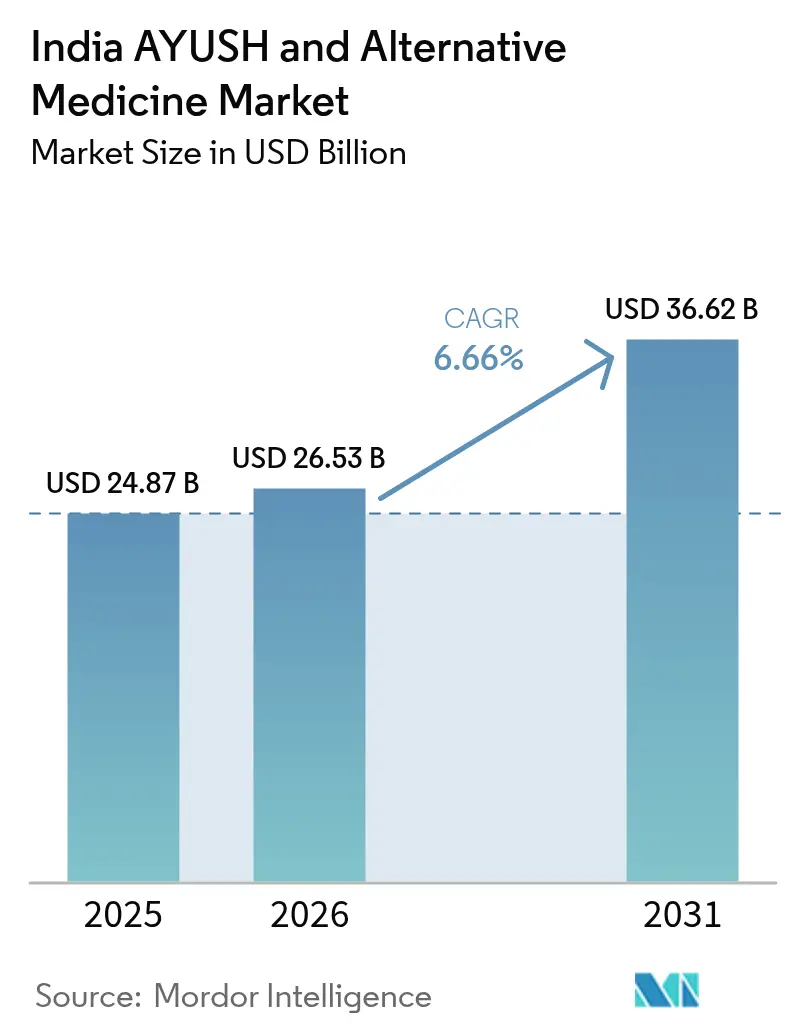
The India AYUSH and Alternative Medicine market size is expected to grow from USD 24.87 billion in 2025 to USD 26.53 billion in 2026 and is forecast to reach USD 36.62 billion by 2031 at 6.66% CAGR over 2026-2031. The mid-single-digit growth reflects the sector’s rapid alignment with modern insurance frameworks, production incentives, and digital distribution channels. Government directives mandating AYUSH coverage under all retail and public health plans remove the affordability barrier for nearly 400 million potential policyholders, while a USD 288 million Production Linked Incentive (PLI) scheme secures herb supplies and stabilizes prices. Global credibility rises after the World Health Organization (WHO) opened its Global Centre for Traditional Medicine (GCTM) in Jamnagar, positioning India as a scientific hub for validated traditional therapies. Simultaneously, e-commerce penetration crossed 25% of sector sales in 2024, catalyzing direct-to-consumer competition, QR-based product authentication, and AI-enabled dosage personalization. Companies with GMP-compliant plants leverage these shifts to capture premium demand, yet the market remains fragmented, creating ample room for consolidation and niche expansion.
Key Report Takeaways
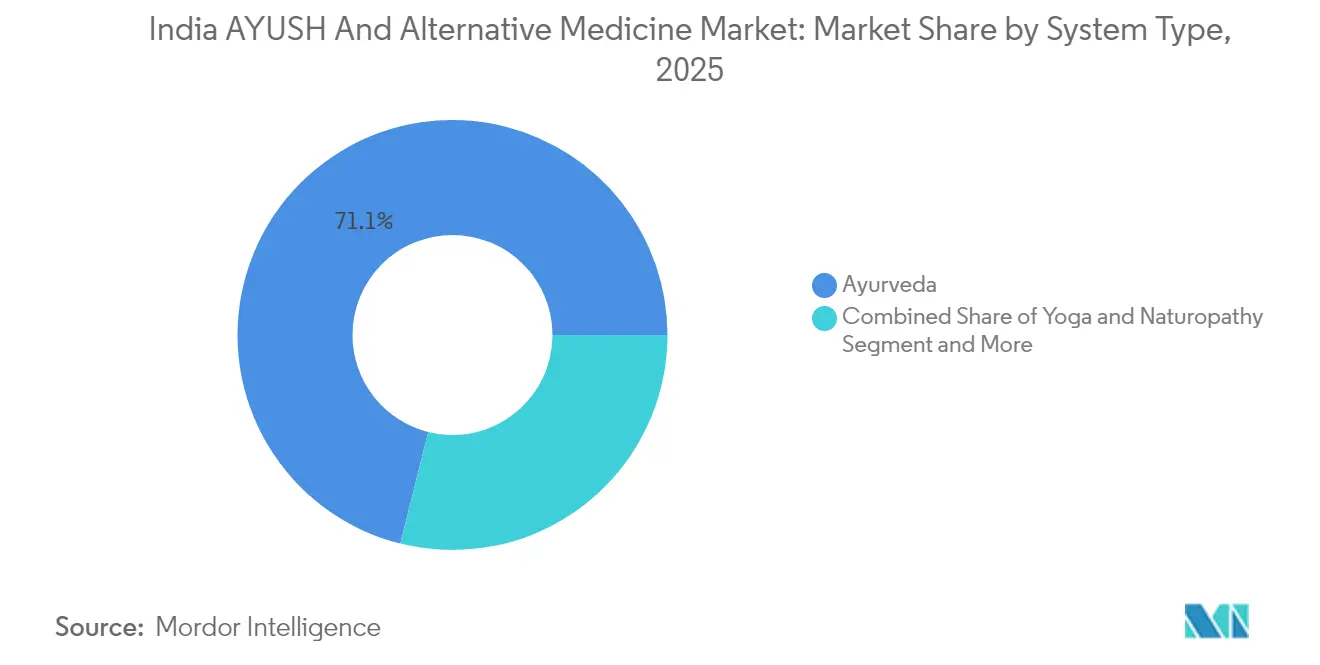
- By system type, Ayurveda led with 71.10% revenue share in 2025; Yoga & Naturopathy is projected to expand at a 14.79% CAGR through 2031.
- By product category, Classical Medicines held 37.20% of the India AYUSH and Alternative Medicine market share in 2025, while Personal-Care & Cosmeceuticals is forecast to advance at a 10.63% CAGR to 2031.
- By form, Tablets & Capsules commanded 45.10% of the India AYUSH and Alternative Medicine market size in 2025, whereas Patches & Topicals post the fastest 12.62% CAGR to 2031.
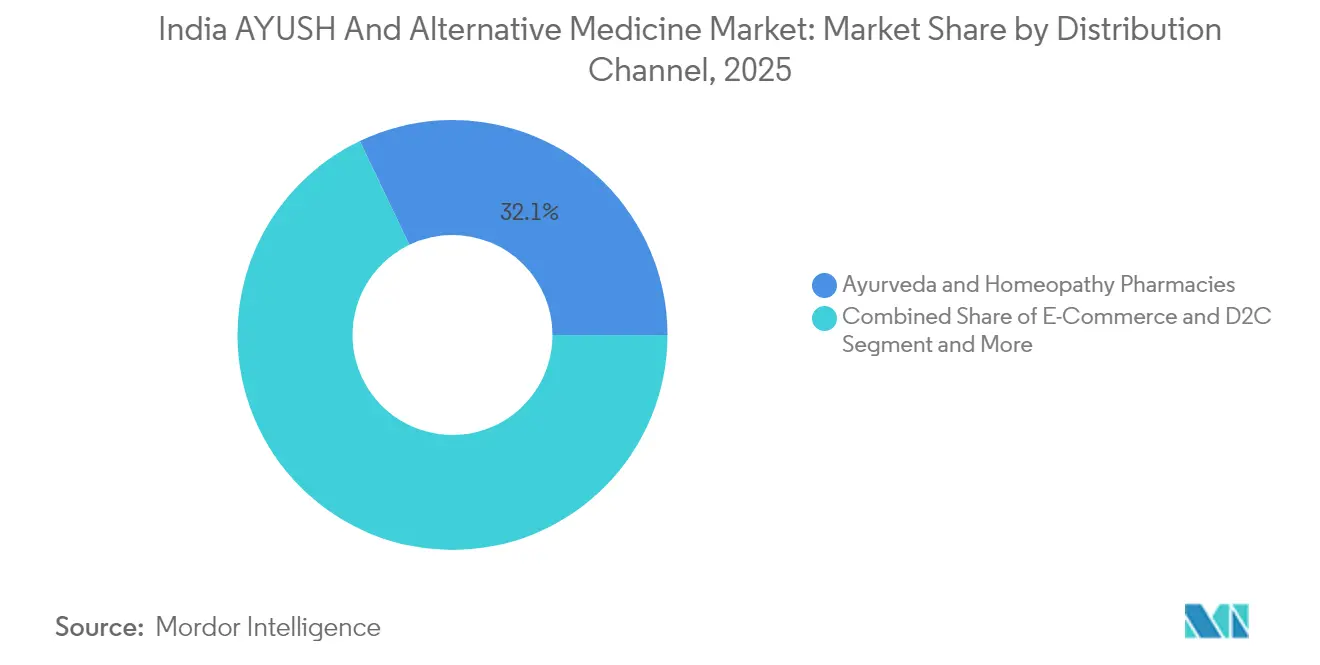
- By distribution channel, Ayurveda & Homeopathy pharmacies accounted for 32.10% of the India AYUSH and Alternative Medicine market share in 2025; e-commerce & D2C platforms are climbing at a 15.68% CAGR over the same horizon.
Note: Market size and forecast figures in this report are generated using Mordor Intelligence’s proprietary estimation framework, updated with the latest available data and insights as of 2026.
India AYUSH And Alternative Medicine Market Trends and Insights
Drivers Impact Analysis*
| Driver | (~) % Impact on CAGR Forecast | Geographic Relevance | Impact Timeline |
|---|---|---|---|
| Government insurance mandate for AYUSH treatments | +1.8% | National, early uptake in metro areas | Short term (≤ 2 years) |
| Accelerated e-commerce & D2C adoption for herbal products | +1.2% | Tier-1 & Tier-2 cities | Medium term (2-4 years) |
| Herbal raw-material PLI subsidy boosts domestic supply | +0.9% | Cultivation states | Long term (≥ 4 years) |
| WHO-GCTM recognition elevates export credibility | +0.7% | Export-oriented regions | Medium term (2-4 years) |
| AI-enabled personalized “Prakriti” formulations | +0.6% | Urban tech-enabled clinics | Long term (≥ 4 years) |
| Tele-AYUSH integration with Ayushman Arogya Mandir network | +0.5% | Rural and semi-urban areas | Medium term (2-4 years) |
| Source: Mordor Intelligence | |||
Government Insurance Mandate for AYUSH Treatments
The Insurance Regulatory and Development Authority of India mandated in April 2024 that every retail and public health plan reimburse 170 standardized AYUSH therapies, instantly converting previously out-of-pocket spending into claimable benefits. Initial actuarial skepticism eased after pilots in Karnataka and Kerala showed 22% lower average episode costs for chronic diabetes compared with allopathic care. Reimbursement also compels clinics to digitize records, accelerating outcome tracking and quality audits. Organized hospital chains scale faster under the new regime, yet informal practitioners race to upgrade premises and documentation to remain accredited. As a result, policy inclusion is expected to broaden the India AYUSH and Alternative Medicine market by nearly half within two years.
Accelerated E-Commerce & D2C Adoption for Herbal Products
Digital-native consumers now buy classical churnas, cosmeceuticals, and OTC nutraceuticals from branded websites and marketplace storefronts that guarantee QR-based authenticity tags. Direct-to-consumer start-ups exploit social media education campaigns and algorithmic recommendation engines to grow pan-India without costly brick-and-mortar logistics. Established brands, in turn, pivot to omnichannel, integrating in-clinic consult video chats and same-day fulfillment via hyper-local warehouses. While digital outreach lifts unit sales, it also heightens scrutiny; marketplace delistings jump when sellers fail real-time batch-testing audits. Consequently, only manufacturers with transparent supply chains and rapid customer-service loops sustain high ratings and repeat sales.
Herbal Raw-Material PLI Subsidy Boosting Domestic Supply
The National Medicinal Plants Board earmarked INR 2,400 crore in 2024 to co-fund greenhouse irrigation, organic certification, and GPS-enabled farm mapping for 45 cultivars covering 80,000 hectares nationwide[1]. Import dependence on Chinese licorice and Nepalese kutki has already fallen from 35% in 2023 to 27% in 2025, lowering input price volatility by 18%. Tiered subsidies favor marginalized farmers, which spreads risk geographically and improves climate resilience. Mandatory Good Agricultural and Collection Practices (GACP) audits now feed directly into blockchain ledgers demanded by leading exporters, creating a credible farm-to-vial trail that underpins export growth.
WHO-GCTM Recognition Elevates Export Credibility
WHO’s Global Centre for Traditional Medicine inaugurated in Jamnagar in late-2024 delivers globally accepted lab protocols for safety, pharmacovigilance, and efficacy, shrinking dossier approval times in the European Union and United States. Post-recognition, Indian finished-dose herbal exports climbed 14% in 2025, with ashwagandha capsules and turmeric curcumin extracts leading shipments. Joint translational research with American and Japanese universities opens the door to co-developed botanical drugs eligible for fast-track review. Enhanced credibility helps premium Ayurveda resorts in Kerala and Goa attract wellness tourists seeking physician-curated detox programs reimbursable by international insurers.
Restraints Impact Analysis*
| Restraint | (~) % Impact on CAGR Forecast | Geographic Relevance | Impact Timeline |
|---|---|---|---|
| Limited GMP compliance among MSME manufacturers | -1.1% | Traditional manufacturing clusters | Short term (≤ 2 years) |
| Insurance pricing caps compress clinic margins | -0.8% | Urban organized clinics | Medium term (2-4 years) |
| Raw-herb climate-risk supply shocks | -0.6% | Key cultivation belts | Short term (≤ 2 years) |
| Rising global scrutiny on heavy-metal contamination | -0.4% | Export-oriented plants | Long term (≥ 4 years) |
| Source: Mordor Intelligence | |||
Limited GMP Compliance Among MSME Manufacturers
Roughly 4,200 micro and small units still miss WHO-GMP thresholds for air-handling, in-process validation, and residual solvent testing, prompting multiple deadline extensions to March 2025[2]. Capital upgrades typically cost USD 60,000-240,000 per site, straining cash flows in a segment where average EBITDA margins hover near 9%. Non-compliance limits access to high-margin export orders and e-commerce platforms that mandate laboratory certificates. As insurers and marketplace portals tighten vendor rosters, sub-scale players face either attrition or acquisition by larger peers in search of incremental capacity.
Insurance Pricing Caps Compress Clinic Margins
Standardized reimbursement rates under Ayushman Bharat cap provider charges for panchakarma, kshar sutra, and leech therapy at levels 18-25% below urban private clinic rack rates. Multi-specialty chains absorb margin pressure by cross-selling proprietary medicines, wellness retreats, and nutraceutical subscriptions. Independent clinics, however, confront reduced earnings and may downscale or exit high-rent metros. Over time, market equilibrium will likely favor integrated delivery networks with diversified ancillary revenue streams.
*Our forecasts treat driver/restraint impacts as directional, not additive. The impact forecasts reflect baseline growth, mix effects, and variable interactions.
Segment Analysis
By System Type: Ayurveda Dominates While Yoga Wellness Surges
Ayurveda accounted for 71.10% of the India AYUSH and Alternative Medicine market in 2025, supported by 500,000 registered practitioners and a robust educational pipeline of 280 colleges. Yoga & Naturopathy, currently a smaller base, records the swiftest 14.79% CAGR through 2031, propelled by office-based stress disorders and social-media-amplified wellness retreats. Homeopathy maintains around 14.80% share, appealing to pediatric and chronic dermal cases that favor gentle dosing schedules. Unani and Siddha, while niche, leverage concentrated regional loyalty and benefit from tele-consult platforms that transcend geographic confines.
Digitization blurs system boundaries as integrative clinics bundle Ayurveda detox, Yogic breathing, and Homeopathic constitutional remedies under a single subscription. Insurance recognition further legitimizes cross-referrals, expanding each discipline’s patient pool. Nevertheless, Ayurveda’s entrenched pharmacopeia and industry-wide R&D spending ensure its continued dominance, even as newer modalities command media attention.

By Product Category: Classical Medicines Lead, Cosmeceuticals Accelerate
Classical Medicines contributed 37.20% to the India AYUSH and Alternative Medicine market size in 2025, anchored by chronic-disease protocols for joint pain, gastrointestinal issues, and metabolic disorders. Personal-Care & Cosmeceuticals outpace all other segments with a 10.63% CAGR, riding urban demand for natural skin-brightening creams, anti-aging serums, and sulfate-free shampoos. Nutraceuticals & Dietary Supplements garner rising share from lifestyle conditions such as non-alcoholic fatty liver disease, while Proprietary OTC combinations serve first-time herbal users seeking familiar pill formats. Regulatory clarity under the Food Safety and Standards Authority of India tightens label claims and boosts consumer confidence.
Brands increasingly launch cosmeceuticals as gateway offerings, then up-sell therapeutic lines after trust forms. Conversely, companies rooted in classical therapeutics diversify into beauty SKUs to smooth revenue seasonality. Supply-side investments in nano-emulsion and liposomal delivery unlock higher-potency cosmetic actives, blending traditional botanicals with modern cosmeceutical science.
By Form: Tablets Dominate, Topicals Show Innovation
Tablets & Capsules represent 45.10% of the India AYUSH and Alternative Medicine market share in 2025. Shelf-stable and easy to dose, the format suits chronic ailments requiring months-long adherence. Patches & Topicals post a 12.62% CAGR, thanks to transdermal analgesic plasters and herbal sheet masks that resonate with tech-savvy millennials. Oils & Ointments hold cultural cachet in post-partum care and sports massage, while Juices, Syrups, and Powders retain rural loyalty where consumers still prize traditional preparation rituals.
R&D momentum now concentrates on nano-encapsulated actives in dissolvable oral films and bi-layer tablets that phase-release over 12 hours. Manufacturers adopting continuous-manufacture lines achieve 40% lower per-unit costs and superior batch consistency, setting new quality benchmarks.
By Distribution Channel: Digital Transformation Reshapes Access
Ayurveda & Homeopathy pharmacies secured 32.10% of 2025 sales, sustained by in-store consultations and credible sourcing narratives. E-commerce & D2C channels, expanding at a 15.68% CAGR, empower consumers to compare ingredient transparency and third-party lab reports instantly. Modern trade aisles in supermarkets introduce impulse purchases in urban locales, while hospitals integrate in-house dispensaries endorsed by attending surgeons.
Brick-and-click hybrids emerge as the norm; pure-play online brands open flagship clinics for experiential therapies, whereas legacy store chains launch subscription models with auto-replenishment. Data analytics from digital outlets feed directly into new-product ideation, compressing feedback loops and refining packaging iterations in weeks rather than quarters.
Geography Analysis
Northern India leads current value contribution, with Uttar Pradesh and Punjab benefiting from proactive state insurance rollouts and large practitioner bases. Western hubs, notably Gujarat and Maharashtra, capture manufacturing investments spurred by proximity to the WHO-backed GCTM campus and a mature pharmaceutical supply chain. Southern states such as Kerala and Karnataka intertwine medical tourism with classical Panchakarma centers, attracting inbound travelers seeking detox packages now partly reimbursable by overseas insurers. Eastern corridors, including West Bengal and Odisha, show notable uptake through government primary-care centers stocked with AYUSH prescriptions. Across semi-urban districts, Tele-AYUSH connectivity mitigates physician shortages, creating new demand pockets. Rural heartlands adopt herb cultivation programs under the PLI subsidy, stabilizing farmer incomes and anchoring local processing units. Metropolitan metros remain the crucible for premium cosmeceuticals and personalized subscription plans, supplying critical volumes for digital storefronts.
Climate-sensitive hill regions in Uttarakhand diversify into greenhouse Isabgol and saffron cultivation, offsetting volatility from rain-fed crops. Coastal Andhra Pradesh and Tamil Nadu experiment with hydroponic Tulsi and Ashwagandha, leveraging brackish-water resilience. Meanwhile, exporters congregate near Nhava Sheva and Mundra ports, optimizing cold-chain lanes for heat-sensitive extracts. Taken together, these regional contrasts forge a geographically diverse growth matrix that guards the India AYUSH and Alternative Medicine market against localized shocks.
Regulatory Landscape
India's AYUSH and alternative medicine regulatory environment is anchored by the Ministry of Ayush, which administers key provisions applicable to ASU&H drugs under the Drugs and Cosmetics Act, 1940, alongside controls on promotions under the Drugs and Magic Remedies (Objectionable Advertisements) Act, 1954. Separately, the Insurance Regulatory and Development Authority of India (IRDAI) directive issued in April 2024 requiring reimbursement for 170 standardized AYUSH therapies has become a practical compliance trigger for providers and payers, encouraging clinics to adopt standardized documentation, claims-ready coding, and auditable treatment pathways.
Quality and safety oversight continues to tighten through coordinated enforcement with State Licensing Authorities and Drug Controllers, supported by central initiatives in the 15th Finance Cycle ending March 31, 2026 under the Central Sector Scheme for Augmenting Quality of Ayush Drugs (pharmacovigilance, lab standardization, and WHO-GMP compliance). Voluntary but market-shaping certification programs run by the Quality Council of India (QCI), including the Ayush Standard Mark and the WHO-GMP-aligned Ayush Premium Mark, are increasingly used as gating criteria by organized buyers, insurers, and digital platforms. The National Commission for Indian System of Medicine (NCISM) and the National Commission for Homoeopathy (NCH) oversee education and professional standards, while late-2025 regulatory emphasis on adverse drug reaction reporting and action on misleading advertisements points to more data-led surveillance and enforcement across products and claims.
Competitive Landscape
India’s AYUSH sector remains highly fragmented; the top 10 manufacturers collectively control significant domestic sales, leaving ample white space for regional specialists and digital insurgents. Patanjali Ayurved, Dabur India, and Himalaya Wellness retain scale advantages in distribution and advertising, yet face rising competition from e-commerce disruptors like Kapiva and Guduchi. These new entrants prioritize single-ingredient purity, rapid social-media engagement, and transparent lab analytics to capture health-conscious urban cohorts.
Strategic moves in 2025 include Dabur’s blockchain partnership for farm-level traceability and Himalaya’s acquisition of a minority stake in an AI formulation start-up. Simultaneously, regional cooperatives in Kerala pool capital to install shared GMP facilities, elevating smaller brands into export eligibility. Intellectual-property activity accelerates; the Indian Patent Office logged a 40% rise in Ayurveda and plant-based patent filings in 2024 versus 2023, driven by proprietary extraction technologies.
Cross-border alliances multiply as Japanese nutraceutical groups license Indian ashwagandha adaptogen blends, while European spa chains white-label Kerala herbal oils. Fragmentation nonetheless persists because consumer trust hinges on local practitioner endorsements and lineage authenticity. Consolidation is expected primarily in OTC and cosmeceutical verticals where marketing muscle outweighs practitioner gatekeeping.
India AYUSH And Alternative Medicine Industry Leaders
-
Himalaya Wellness
-
Baidyanath
-
Dabur India
-
Sydler India
-
Patanjali Ayurved
- *Disclaimer: Major Players sorted in no particular order

Market Opportunities and Future Outlook
A large near-term opportunity centers on evidence generation and compliance-led brand premiumization, supported by government and private initiatives focused on standardization, pharmacovigilance, and modern research infrastructure. The Union Budget 2026-27 raised the Ministry of Ayush allocation to INR 4,408.93 crore (20% increase), including a sharper increase for the National Ayush Mission, which reinforces public spend across primary care integration, capacity building, and quality programs that influence procurement and patient throughput. On the private side, Kapiva's January 2026 launch of a INR 50 crore innovation fund focused on Ayurvedic R&D, clinical validation, and AI-enabled applications shows a path for D2C brands to differentiate through trials, data, and traceability rather than price-led competition.
Institutional expansion and platform-led digitization also open whitespace for manufacturers, clinic networks, and technology vendors that can meet stricter documentation and quality requirements. Government plans to establish three new All India Institutes of Ayurveda and create five state-led Regional Medical Hubs with private-sector partnership expand the addressable market for standardized therapies, affiliated pharmacies, and referral-linked product bundles across metros and medical-tourism corridors. Digital public infrastructure programs (Ayush Grid, Ayurgenomics, and related platforms) and investments in research facilities such as the Central Ayurveda Research Institute (CARI) in Rohini, Delhi (INR 187 crore, 100-bed research hospital and advanced labs) provide additional routes for outcomes tracking, validated formulations, and export-ready dossiers. In exports and premium domestic channels, the WHO Global Centre for Traditional Medicine (GCTM) in Jamnagar supports credibility, while the tightening posture on quality, labeling, and ingredient standards favors WHO-GMP-compliant plants and certified supply chains.
Recent Industry Developments
- June 2026: Dabur India expanded its medicinal herb sourcing program to around 15,000 farmers and increased cultivation coverage to more than 15,000 acres to secure key botanical inputs. The expansion improves supply assurance for high-volume Ayurveda and wellness portfolios and reduces exposure to seasonal price swings in raw herbs.
- October 2025: Dabur India launched Dabur Ventures, a INR 500 crore investment platform to acquire stakes in digital-first businesses spanning personal care, health, and Ayurveda. This creates a structured route to bring D2C capabilities such as data-driven marketing, faster innovation cycles, and online distribution into a legacy AYUSH-linked portfolio.
- April 2024: IRDAI mandated that every retail and public health insurance plan reimburse 170 standardized AYUSH therapies, shifting a meaningful portion of AYUSH spending from out-of-pocket to claimable benefits. Standardized coverage has accelerated record digitization and audit readiness among providers, and it has improved the commercial viability of organized clinic chains and pharmacy-linked care models.
Research Methodology Framework and Report Scope
Market Definition and Coverage
This market is defined as the revenues generated in India from AYUSH and alternative medicine products and therapies, captured across common systems and purchase channels where the end user is located in India.
Scope exclusions: We exclude purely allopathic prescription drugs, medical devices, and hospital procedures that are not delivered or sold as part of AYUSH or alternative medicine care.
Segmentation Overview
- By System Type
- Ayurveda
- Homeopathy
- Unani
- Siddha
- Yoga & Naturopathy
- By Product Category
- Classical Medicines
- Proprietary / OTC Formulations
- Nutraceuticals & Dietary Supplements
- Personal-Care & Cosmeceuticals
- Others
- By Form
- Tablets / Capsules
- Powders / Churnas
- Juices / Syrups
- Oils / Ointments
- Patches / Topicals
- By Distribution Channel
- Ayurveda & Homeopathy Pharmacies
- Modern Trade & Supermarkets
- E-Commerce & D2C
- Hospitals & Clinics
- Other Distribution Channels
Data Sources, Market Sizing, and Validation
Desk Research
Desk research was used to map the industry boundary, build a year-wise context, and identify demand and supply indicators that can be checked independently. We relied on public sources such as Ministry of AYUSH publications, Government of India trade and customs statistics, Reserve Bank of India macro series for inflation and currency context, peer-reviewed journals on utilization and outcomes, and standards references such as pharmacopoeia and quality notifications.
To translate the narrative into measurable inputs, we also reviewed company annual reports, investor presentations, association websites that track practitioner and facility counts, and reputable press for channel shifts and policy milestones. A paid subscription focused on company financials and business intelligence was used selectively to standardize reported revenues and entity structures when public disclosures were inconsistent. These sources are illustrative and not exhaustive, and many other references were also used for data collection, validation, and clarification.
Primary Interviews and Surveys
Primary work was used to pressure-test the desk assumptions and close gaps on pricing, channel margins, and how product versus service revenues are booked in the AYUSH ecosystem. We spoke with stakeholders across manufacturers, distributors, retailers, clinics, and practitioners, then cross-checked the India-level picture by covering major consuming regions and different income cohorts.
Inputs from these discussions helped confirm what should be counted as market revenue, how quickly online channels are mixing into traditional purchase routes, and which therapy areas are seeing faster adoption, before finalizing model totals and growth rates.
Distribution of primary research fieldwork respondents
| Company type | Respondent position |
|---|---|
| Top tier: 33% | CXOs: 12% |
| Mid tier: 51% | Functional/Unit leaders: 30% |
| Smaller Players: 16% | Managers: 58% |
Market-Sizing & Forecasting
Sizing starts with a top-down demand reconstruction that links India consumption to observable signals such as the registered practitioner base and clinic footprint, the direction of household wellness spending, the expansion of formal retail and e-commerce, and trade flows for key herbal inputs and finished products. We then translate the demand signal into value using price bands validated in interviews. Where a time series is not perfectly aligned by year, we normalize it to the base timeline, remove one-off spikes, and apply conservative carry-forward assumptions until a better check is available.
Results are corroborated with selective bottom-up approximations, including sampled average selling prices by form factor, such as tablets, powders, syrups, oils, and topicals, multiplied by volume proxies, followed by channel checks for typical margins and discounting. Key model inputs include the share shift toward online and direct-to-consumer, mix changes between classical and proprietary products, changes in price by pack size, and the rate of consumer adoption for wellness and preventive use.
For forecasting, scenario analysis is used around a central case, since policy support, formalization, and consumer preference can move faster than a simple trend line. Growth assumptions are aligned to what primary respondents expect for price progression, channel expansion, and utilization, then applied consistently across the forecast period.
Data Validation & Update Cycle
Outputs are validated through triangulation across independent indicators so that no single stream drives the final number. We run variance checks by category and channel, compare implied per-capita spending against reasonable bounds, and review year-to-year jumps to confirm they align with real market events rather than model noise.
Before sign-off, the model and its assumptions go through multi-step analyst reviews, and respondents are re-contacted when large deviations show up in pricing, mix, or channel splits. Reports are refreshed annually, with interim updates if material events change demand or pricing meaningfully, and a final pre-delivery review is completed so clients receive the latest updated view.
Mordor Intelligence's India Ayush and Alternative Medicine Market Sizing Compared With Other Published Estimates
It is normal to see different market sizes for this space because each publisher draws the line differently between packaged products and service delivery, uses different timing for currency conversion, and may apply different assumptions for how prices move as buyers shift across channels.
When price bands are refreshed using current pack sizes and channel discounting, and when the USD conversion is applied consistently to the base-year timeline before cross-checking against mix and form-factor splits, Mordor Intelligence reduces swings that can come from one-time promotions and fast-growing online sales.
Benchmark comparison
| Source | Market Size | Gaps in Research Methodology |
|---|---|---|
| Mordor Intelligence | USD 24.87 B (2025) | |
| Industry Promotion Agency A | USD 24.00 B (2024) | Often presented as a broad sector headline and may blend product and service activity without a stable split, and it can be sensitive to the chosen reference year and currency conversion timing. |
| Global Research Publisher B | USD 5.60 B (2024) | Typically scoped to a narrower complementary and alternative medicine definition, which can undercount packaged AYUSH product sales and some retail channels that are counted in broader AYUSH builds. |
The spread mainly comes from what is counted, how services are treated versus packaged products, and when pricing and currency assumptions are locked for the year. By keeping the steps traceable to clear market signals and repeatable checks, the resulting size stays practical for planning and for tracking changes over time.
Key Questions Answered in the Report
What is the projected value of the India AYUSH and Alternative Medicine market by 2031?
The sector is expected to reach USD 36.62 billion by 2031 on a 6.66% CAGR.
Which system dominates sector revenue today?
Ayurveda leads with a 71.10% share of 2025 sales.
Which product category is expanding fastest?
Personal-Care & Cosmeceuticals are growing at a 10.63% CAGR through 2031.
How is e-commerce shaping distribution?
Online and D2C platforms, rising at a 15.68% CAGR, now compose a quarter of total sector sales.
What policy change has widened insurance access?
In April 2024, the Insurance Regulatory and Development Authority required all health plans to reimburse 170 AYUSH procedures.
Why is WHO-GCTM significant for exports?
The center's global safety and efficacy protocols smooth regulatory approvals abroad, boosting export momentum.