
Aircraft Autopilot System Market Size and Share
Market Overview
| Study Period | 2020 - 2031 |
|---|---|
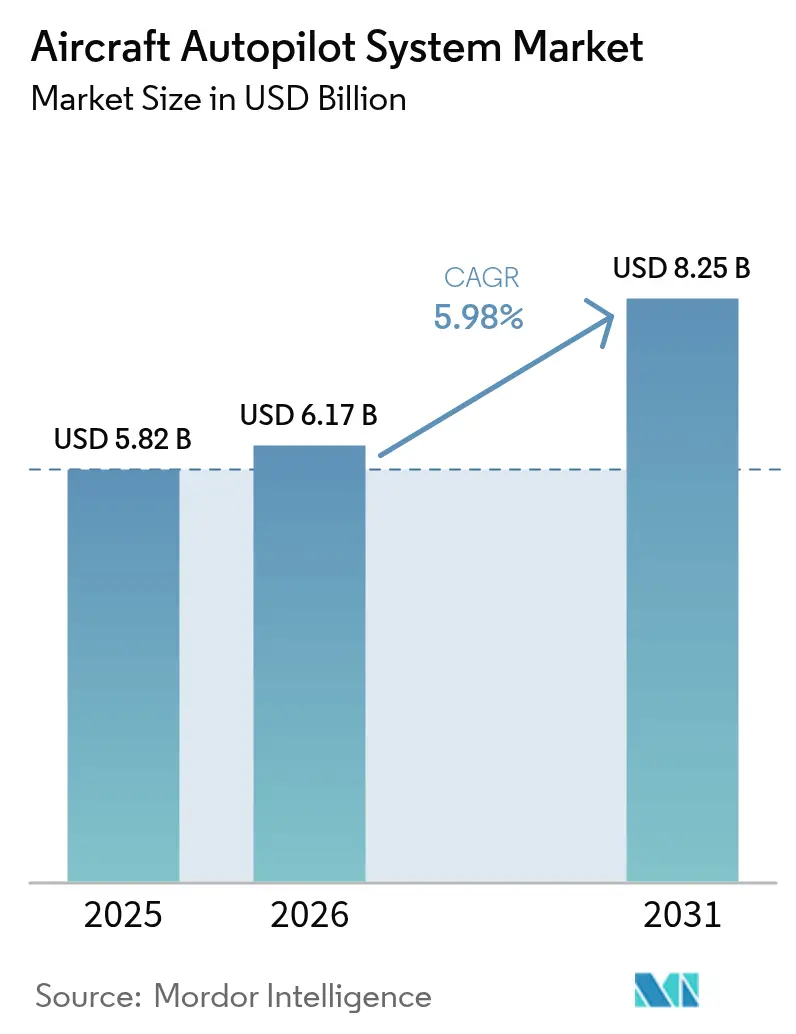
| Market Size (2026) | USD 6.17 Billion |
| Market Size (2031) | USD 8.25 Billion |
| Growth Rate (2026 - 2031) | 5.98 % |
| Fastest Growing Market | Asia Pacific |
| Largest Market | North America |
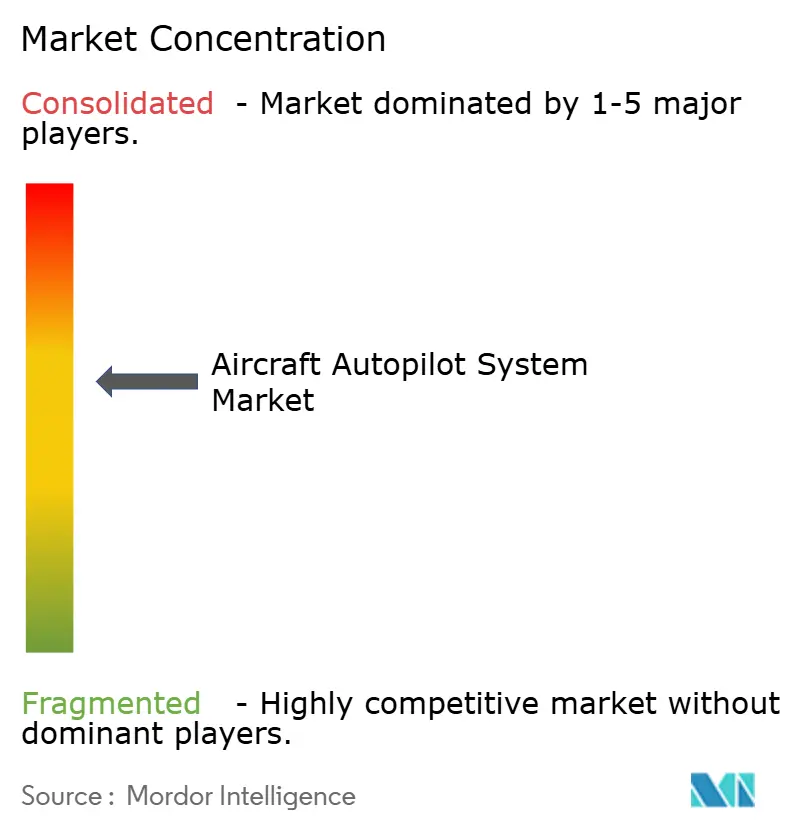
| Market Concentration | Medium |
Major Players *Disclaimer: Major Players sorted in no particular order Image © Mordor Intelligence. Reuse requires attribution under CC BY 4.0. | |
Aircraft Autopilot System Market Analysis by Mordor Intelligence
The aircraft autopilot system market size was valued at USD 5.82 billion in 2025 and estimated to grow from USD 6.17 billion in 2026 to reach USD 8.25 billion by 2031, at a CAGR of 5.98% during the forecast period (2026-2031). This trajectory reflects the sector’s pivot toward higher levels of cockpit automation as regulators, airlines, and defense agencies prepare for single-pilot commercial operations and wider unmanned flight adoption. Sustained recovery in commercial aviation, large order backlogs, and avionics modernization programs collectively reinforce demand, while artificial-intelligence-driven contingency management solutions unlock new platform opportunities. Leaders focus on software-defined architectures that extend system life cycles and enable over-the-air feature upgrades. Supply chain constraints in inertial sensors and rising cybersecurity compliance costs remain near-term pressure points. Yet, resilient capital spending by North American and Asia-Pacific operators keeps the aircraft autopilot system market on an expansion path.
Key Report Takeaways
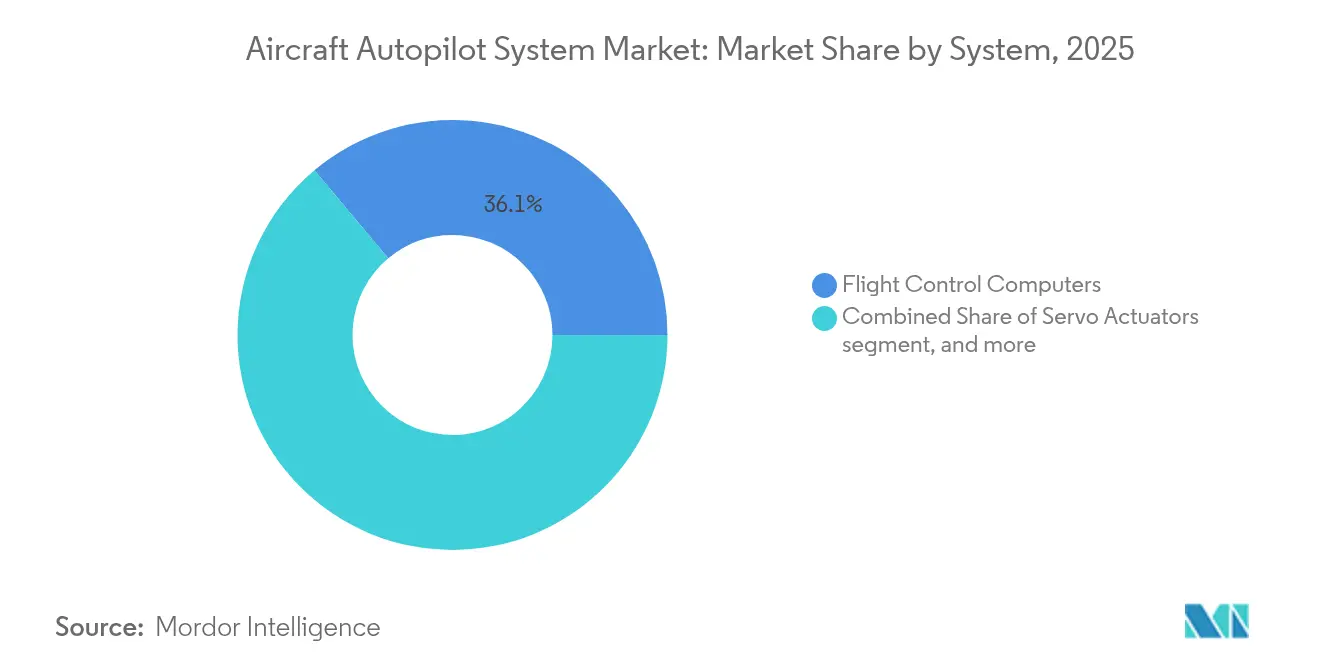
- By system, flight control computers held 36.10% of the aircraft autopilot system market share in 2025, whereas autopilot software suites are advancing at a 9.02% CAGR through 2031.
- By aircraft type, Narrow-body Jets led with 40.35% revenue share in 2025, while unmanned aerial vehicles are projected to expand at a 7.28% CAGR to 2031.
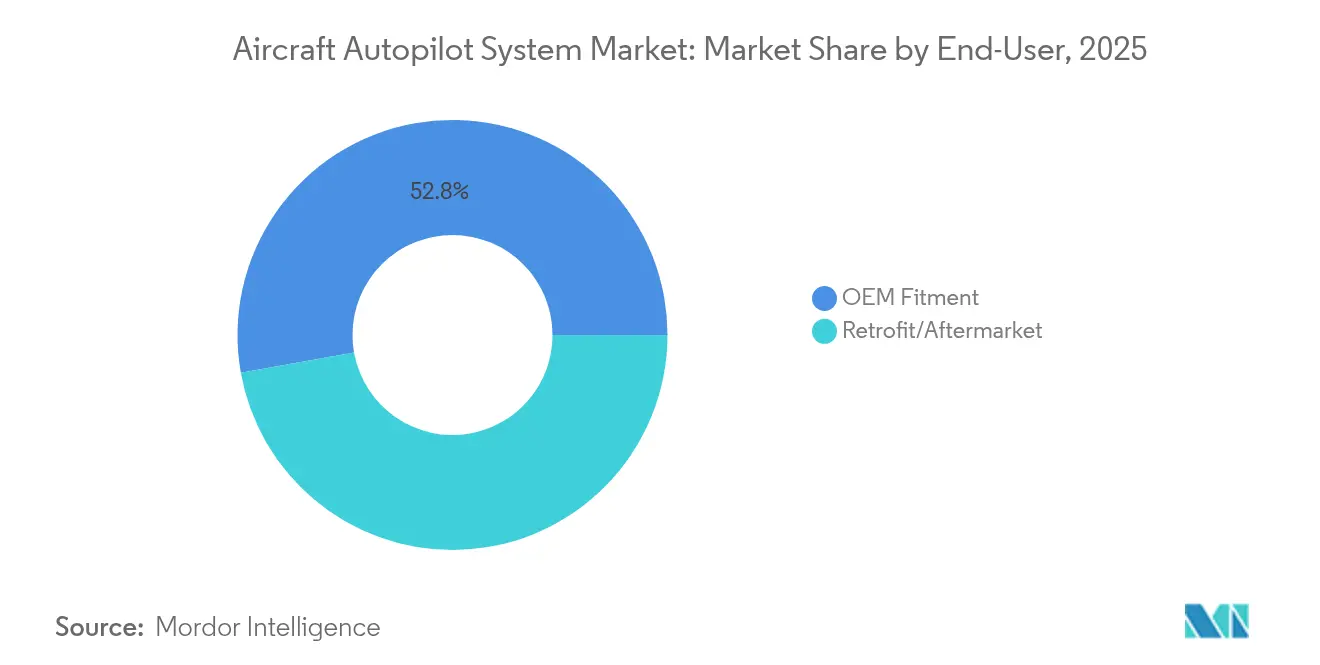
- By end-user, OEM fitment accounted for 52.80% of the aircraft autopilot system market in 2025; retrofit/aftermarket is the fastest-growing channel, with a 6.95% CAGR.
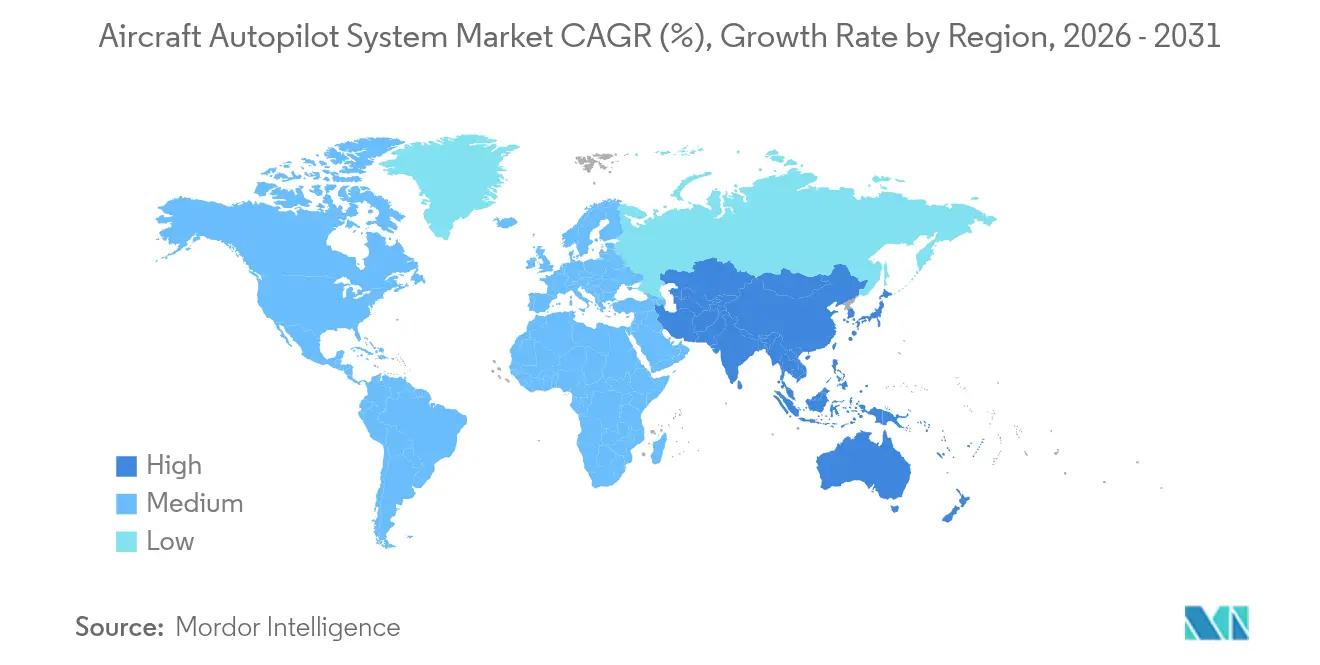
- By geography, North America commanded 42.90% share of the aircraft autopilot system market size in 2025, whereas Asia-Pacific is progressing at an 7.75% CAGR through 2031.
Note: Market size and forecast figures in this report are generated using Mordor Intelligence’s proprietary estimation framework, updated with the latest available data and insights as of 2026.
Global Aircraft Autopilot System Market Trends and Insights
Drivers Impact Analysis*
| Driver | % Impact on CAGR Forecast | Geographic Relevance | Impact Timeline |
|---|---|---|---|
| Rising commercial aircraft deliveries | +1.8% | Global, with concentration in North America and Asia-Pacific | Medium term (2-4 years) |
| Growing demand for advanced flight automation | +1.5% | Global, led by North America and Europe | Long term (≥ 4 years) |
| Fleet-wide avionics modernization programs | +1.2% | North America and Europe core, expanding to Asia-Pacific | Medium term (2-4 years) |
| Expansion of UAV and UAM operations | +1.0% | Global, with early adoption in North America and Europe | Long term (≥ 4 years) |
| AI-enabled contingency-management autopilots | +0.9% | North America and Europe early adoption, global expansion | Long term (≥ 4 years) |
| Move toward single-pilot commercial ops | +0.8% | North America and Europe regulatory leadership, global follow-on | Long term (≥ 4 years) |
| Source: Mordor Intelligence | |||
Rising Commercial Aircraft Deliveries
Boeing’s plan to raise B737 output toward 42 jets a month and Airbus’s intent to reach 75 A320-family units monthly underpin a steady production ramp that lifts autopilot installations. Asia-Pacific carriers drive a sizable share of these commitments, ensuring that integrated flight management and autopilot suites remain line-fit priorities. Suppliers expand manufacturing capacity for flight control computers and servo actuators to keep pace. The aircraft autopilot system market benefits directly because every forward-fit narrow-body or wide-body requires a certified digital autopilot with growth margins for future software features. The production outlook stabilizes revenue visibility for tier-one avionics vendors through 2030.
Growing Demand for Advanced Flight Automation
The FAA’s More Pilots, More Aircraft, Simplified Certification (MOSAIC) framework paves the way for aircraft that rely on automation layers to guard against loss of control, accelerating the adoption of high-authority autopilots.[1] Airlines specify weather-linked guidance, satellite-based augmentation, and integrated datalink functions to trim workload on congested routes. Academic research highlights digital flight assistants that contextualize sensor data and present actionable cues, reinforcing the value proposition of enhanced automation. These capabilities expand the aircraft autopilot system market as buyers transition from legacy rate-based systems to attitude-based, AI-supported solutions.
Fleet-wide Avionics Modernization Programs
Carriers extend airframe life by refitting legacy cockpits with touch-screen flight decks and performance-based navigation features. Collins Aerospace’s King Air upgrade package exemplifies how operators migrate to Pro Line Fusion autopilot logic, which cuts pilot workload and meets upcoming airspace mandates. The FAA’s performance-focused certification pathway shortens retrofit lead times, unlocking recurring aftermarket revenue. Mature fleets in Europe and North America sustain the aircraft autopilot system market during soft periods in new aircraft deliveries. Airlines spread capital outlays across multi-year programs, creating predictable demand for modular autopilot LRUs and software licenses.
AI-enabled Contingency-management Autopilots
Partnerships such as Honeywell and NXP Semiconductors integrate high-performance processors that enable real-time machine-learning models to execute weather avoidance, runway overrun prevention, and emergency descent logic. Military projects like Saab’s Centaur demonstrate reinforcement-learning agents maneuvering aircraft without pilot input during complex engagements. Commercial variants focus on autonomous diversion and landing sequences that protect passengers when the crew is incapacitated. These breakthroughs elevate the long-term growth ceiling of the aircraft autopilot system market by opening cargo and air-taxi niches that require limited or zero onboard crew.
Restraints Impact Analysis*
| Restraint | % Impact on CAGR Forecast | Geographic Relevance | Impact Timeline |
|---|---|---|---|
| High certification and compliance costs | −1.1% | Global, particularly stringent in North America and Europe | Medium term (2-4 years) |
| Cyber-security vulnerabilities in flight-control links | −0.8% | Global, with heightened concerns in defense applications | Short term (≤ 2 years) |
| Shortage of DO-178C qualified engineers | −0.6% | Global, most acute in North America and Europe | Medium term (2-4 years) |
| Supply-chain bottlenecks in MEMS/IMUs | −0.5% | Global, with particular impact on Asia-Pacific manufacturing | Short term |
| Source: Mordor Intelligence | |||
High Certification and Compliance Costs
The FAA’s System Safety Assessments rule mandates exhaustive verification to ensure catastrophic failure probabilities remain below 1 × 10⁻⁹ per flight hour, driving software validation budgets into the USD 5-15 million range per program.[2] DO-178C Level-A compliance requires multiple independent reviews and full code coverage, extending schedules by up to two years. Smaller innovators in the aircraft autopilot system industry often partner with primes to navigate these hurdles, which keeps market entry barriers high and consolidates share among incumbents.
Cyber-security Vulnerabilities in Flight-control Links
A 131% year-on-year rise in aviation cyber incidents heightened scrutiny on autopilot databus integrity. Proposed Equipment, Systems, and Network Information Security mandates force manufacturers to embed encryption, intrusion detection, and secure boot protocols that add hardware cost and verification cycles. Airlines confronted by the 2024 CrowdStrike incident faced network outages that exposed latent risk in connected cockpits, reinforcing procurement criteria that favor hardened solutions. The additional compliance load tempers near-term adoption speed in segments such as unmanned cargo aircraft, yet also encourages sales of upgraded secure flight control computers, indirectly supporting the aircraft autopilot system market over the medium term.
*Our forecasts treat driver/restraint impacts as directional, not additive. The impact forecasts reflect baseline growth, mix effects, and variable interactions.
Segment Analysis
By System: Software-Defined Architecture Gains Momentum
Flight Control Computers retained 36.10% of the aircraft autopilot system market share in 2025 because every commercial transport class aircraft mandates triple-redundant processing for pitch, roll, yaw, and speed commands. Conversely, Autopilot Software Suites are expanding at a 9.02% CAGR as operators shift toward cloud-updateable logic bundles that overlay predictive algorithms on existing hardware. Thales’s PureFlyt platform illustrates this pivot by optimizing real-time trajectories for fuel and noise benefits. The aircraft autopilot system market size for software-centric solutions is projected to reach USD 2.28 billion by 2031, mirroring broader aerospace digitalization. Hardware components like servo actuators and attitude sensors remain essential, yet margins migrate to proprietary code, differentiating approach, go-around, and emergency modes. Vendors invest in DevSecOps pipelines that shorten certification cycles and permit rapid deployment of AI functions, reinforcing the competitive importance of software road maps.
Airlines prefer line-replaceable units that isolate processing from I/O boards, allowing capability upgrades without deep mechanical changes. Open-architecture standards such as FACE in defense aviation and ARINC 653 in civil transport encourage cross-vendor interoperability, expanding addressable volume for niche software developers. As a result, new entrants leverage subscription-based licensing models, while established integrators bundle software warranties with extended service agreements. These shifts foster a layered ecosystem where the aircraft autopilot system market accommodates both tier-one primes and agile code specialists.

By Aircraft Type: UAVs Disrupt Traditional Hierarchies
Narrowbody Jets captured 40.35% of the aircraft autopilot system market size in 2025 on the strength of the A320neo and B737-8 production ramps that each embed autopilots as part of an integrated flight deck. Wide-bodies are recovering in tandem with long-haul traffic but remain below pre-2020 delivery levels. The disruptive force comes from UAVs, whose 7.28% CAGR through 2031 reflects procurement of MALE drones and burgeoning urban air mobility prototypes. UAV autopilots differ in weight, power, and certification path, yet they still rely on tightly coupled inertial and GNSS sensors. Sky-Drones Technologies has adopted 5G links and AI classifiers to navigate contested airspace, broadening its appeal among logistics operators.
Rotorcraft autopilot integration gains momentum following Garmin’s three-axis system for the Airbus H130, which stabilizes hover and cruise modes. Business jet buyers specify auto-throttle and auto-brake functions once reserved for airliners, compressing feature differentiation across aircraft classes. Overall, the aircraft autopilot system market finds new growth lanes as unmanned cargo and passenger concepts mature, challenging legacy suppliers to design lighter, standards-agnostic controllers that still meet transport-category reliability metrics.
By End-User: Retrofit Market Accelerates
OEM Fitment continues to dominate with a 52.80% share in 2025 because every airframe leaves the factory with a baseline autopilot certified for that type certificate. However, airlines and fractional owners are ramping retrofit campaigns that drive a 6.95% CAGR in aftermarket demand. The FAA’s Non-Required Safety Enhancing Equipment (NORSEE) pathway streamlines approvals for digital autopilots, enabling Garmin’s GFC 600 installations across piston and turboprop fleets. This policy shift elevates the aircraft autopilot system market size for retrofits to USD 2.55 billion by 2031. The aging A320ceo and B737-NG aircraft are prime targets for flight director and auto-throttle updates that align with the required navigation performance-authorization required (RNP-AR) routes.
MRO providers partner with avionics OEMs on power-by-the-hour contracts that bundle spares, software updates, and predictive diagnostics. Such models appeal to operators seeking fixed-cost predictability. Emerging leasing pools for autopilot line-replaceable units further reduce downtime during heavy checks. Consequently, the aircraft autopilot system market benefits from a virtuous cycle where retrofit activity extends airframe service life, and extended service life, in turn, demands incremental capability updates.
Geography Analysis
North America led the aircraft autopilot system market with 42.90% revenue share in 2025, supported by robust defense budgets and a quick rebound in domestic air travel. The FAA’s automation and cybersecurity regulation leadership makes the United States an early adopter of advanced autopilot features, reinforcing domestic procurement. Canada’s regional-jet fleet modernization and Mexico’s narrow-body expansion contribute incrementally. High utilization rates accelerate replacement cycles for flight control computers, locking in baseline demand. Honeywell, Collins Aerospace, and Garmin all maintain substantial production and engineering centers in the region, ensuring close alignment with customer requirements.
Asia-Pacific is the fastest-growing territory, advancing at an 7.75% CAGR through 2031. Middle-class air-travel adoption and defense modernization programs centrally drive China and India. Airbus forecasts the global fleet will double to 50,000 aircraft by 2044, with Asia-Pacific supplying most of that increment. Domestic OEMs such as COMAC integrate locally developed autopilot subsystems, while regional airlines launch large retrofit contracts to meet performance-based navigation mandates. Japan and South Korea invest in autonomous UAM ecosystems, exemplified by Thales’s unmanned traffic management testbed in Thailand. Varied certification regimes create customization overhead and foster partnerships between global primes and local system houses, widening the aircraft autopilot system market footprint.
Europe remains a mature yet innovation-centric market. EASA’s acceptance of Garmin Autoland on King Air platforms underscores regulatory openness to high-authority automation. Thales, Safran, and BAE Systems supply integrated autopilot and flight management packages across Airbus and Eurofighter programs. The European Defense Fund channels resources into AI-enhanced resilience features, such as the AIDA project that shields avionics buses from cyber intrusions. Middle East and Africa, while smaller in volume, register steady procurement from Gulf carriers and defense agencies upgrading transport and rotary fleets. Barrier factors include uneven economic conditions and regulatory capacity, yet the region still adds incremental value to the aircraft autopilot system market as wide-body utilization rebounds.
Regulatory Landscape
Certification and operational acceptance for aircraft autopilot systems are anchored to safety and software assurance expectations set by aviation authorities such as the FAA and EASA, including transport-category system safety assessment practices targeting catastrophic failure probabilities on the order of 1 x 10^-9 per flight hour. In the United States, the FAA Safety Framework for Aircraft Automation and related guidance continue to shape how advanced automation is substantiated. The FAA Reauthorization Act of 2024 (Public Law 118-63) adds a cadence of periodic review for significant regulations, increasing how often OEMs and suppliers must track changes that affect autopilot, flight director, and integrated flight guidance functions.
Regulatory coordination has become more explicit for emerging autonomy and AI-enabled capabilities. On June 18, 2026, the FAA and EASA publicly pledged cooperation to streamline approvals for advanced aviation technologies and harmonize certification pathways, signaling that cross-validation and aligned compliance artifacts are becoming central for globally marketed autopilot architectures. In Europe, EASA updates such as CS-ACNS Issue 5 (April 24, 2024) and ongoing NPAs in 2025 (including NPA 2025-02 and NPA 2025-11) reinforce movement toward clearer certification paths for modern avionics, including performance-based navigation-related functions and design/ETSO capability demonstrations that affect software-defined autopilot and flight guidance implementations.
Value Chain Analysis
The aircraft autopilot system value chain starts with upstream electronics and motion-sensing inputs, including processors, memories, power management, MEMS/IMUs, and GNSS-related components. It then moves into midstream module manufacturing, covering flight control computers, air-data and inertial reference units, servo actuators, and autopilot control panels. Tier-one avionics suppliers and airframers integrate these systems into flight decks, and commercialization proceeds through OEM line-fit channels and retrofit/aftermarket pathways supported by MRO networks, STC or validation activity, spares provisioning, and long-term software sustainment aligned to DO-178C and DO-254 style assurance and airline cybersecurity requirements.
Recent evidence points to supply-chain sensitivity across both specialized mechanical items and electronics. Boeing securing new stocks of specialized fasteners after the SPS Technologies disruption highlighted how fragile sole-source dependencies can be, while broader avionics constraints have been linked to semiconductor availability and rare earth element refining concentration. On the manufacturing services side, electronics partners such as LACROIX Electronics support the design and build of flight control computers and related avionics assemblies, helping scale production and qualification. Portfolio reshaping also affects downstream availability, as Innovative Aerosystems acquisition activity around legacy general aviation autopilot product lines illustrates how intellectual property, tooling, and installed-base support can shift, influencing parts availability, repair capacity, and upgrade road maps for Part 23 fleets.
Competitive Landscape
The market remains moderately consolidated, with the top five vendors holding roughly 65% collective revenue, anchored by Honeywell, Collins Aerospace, Safran, Thales, and Garmin. These leaders bundle hardware, software, and lifecycle support into end-to-end offerings that lock in long contracts. Honeywell’s strategic agreement with Bombardier, valued up to USD 17 billion across its term, exemplifies the scale of integrated avionics capture. Collins Aerospace leverages its Pro Line Fusion architecture across business and regional jets, while Safran capitalizes on dual-use capabilities that span commercial liners and combat aircraft.
Second-tier competitors differentiate via niche technologies. Moog supplies high-lift and primary actuation packages for the V-280 Valor Future Long-Range Assault Aircraft, accentuating its strength in electromechanical controls. Avidyne and Dynon Avionics target general aviation with affordable IFR-capable autopilots, using modularity to grow into light-turbine classes. Start-ups like Sky-Drones Technologies and UAV Navigation pursue the UAV and eVTOL segment where weight, cost, and algorithmic sophistication rank higher than traditional certification pedigree. Software-only disruptors license stabilized code that overlays existing flight control computers, broadening competitive intensity within the aircraft autopilot system market.
Strategic alliances and acquisitions accelerate the closure of capability gaps. Honeywell’s planned spin-off of Honeywell Aerospace intends to sharpen focus on autonomy and electrified propulsion by 2026. Regal Rexnord’s collaboration with Honeywell in eVTOL actuation and Curtiss-Wright’s joint cockpit voice recorder line demonstrate convergent interest in urban air mobility systems. These maneuvers aim to secure early mover status in new-generation platforms, thereby amplifying long-run share positions.
Aircraft Autopilot System Industry Leaders
-
Honeywell International Inc.
-
Collins Aerospace (RTX Corporation)
-
Garmin Ltd.
-
Thales Group
-
Safran SA
- *Disclaimer: Major Players sorted in no particular order
Market Opportunities and Future Outlook
Near-term whitespace is concentrated in retrofit-ready, software-centric autopilot upgrades for the large in-service Part 23 and utility aircraft base, where certification breadth and installation economics drive adoption. Garmin expanding FAA Supplemental Type Certification coverage for its GFC 600, including approvals announced in June 2026 for Air Tractor AT-802/AT-802A and Piper Matrix PA-46R-350T, illustrates how incremental STCs translate into new aircraft compatibility and aftermarket pull-through for servos, control panels, and software options. As operators pursue avionics modernization programs, demand rises for modular line-replaceable units and certified software loads that can be fielded without full cockpit redesign, supporting both independent avionics shops and OEM-backed retrofit centers.
Another opportunity area is the transfer and consolidation of legacy autopilot product lines, which can renew investment in sustaining engineering, spares, and digital refresh paths for aging platforms. In 2026, Innovative Aerosystems announced and documented acquisitions of general aviation autopilot-related assets and product lines from Honeywell, including production assets and intellectual property, signaling a focused strategy around integrated cockpit avionics for the installed Part 23 fleet. In defense and special-mission aviation, autonomy and mission-software layering on top of flight-control architectures is gaining program-level attention, illustrated by Collins Aerospace demonstrating Sidekick mission autonomy software on a U.S. Air Force Collaborative Combat Aircraft platform in 2026, reinforcing demand for autopilot-adjacent flight control computing, robust sensor integration, and cyber-hardened data buses in uncrewed and optionally crewed designs.
Recent Industry Developments
- June 2026: Garmin received FAA Supplemental Type Certification for the GFC 600 digital autopilot on Air Tractor AT-802/AT-802A models and the Piper Matrix PA-46R-350T. The added approvals expand the eligible installed base for digital autopilot retrofits and reinforce certification breadth as a competitive lever in general aviation. Broader aircraft coverage also supports avionics shop utilization and pulls through associated servos, control interfaces, and software options.
- April 2026: Innovative Aerosystems announced the acquisition of legacy Honeywell product lines spanning autopilot, nav/com, display, and transponder solutions for the Part 23 fleet. The deal shifts ownership of product support, tooling, and roadmap decisions for a legacy installed base, influencing availability of spares and upgrade pathways. It also reflects portfolio rationalization by large avionics groups and specialization by acquirers focused on integrated cockpit platforms.
- May 2025: Vertical Aerospace and Honeywell expanded their partnership for the VX4 eVTOL, with a focus on certifying flight-critical systems to stringent catastrophic failure probability targets. The move highlights how eVTOL programs are pushing high-assurance automation and flight-control architectures into new aircraft categories. It also strengthens the role of established avionics suppliers in providing certifiable autopilot-adjacent functions for emerging mobility platforms.
Research Methodology Framework and Report Scope
Market Definition and Coverage
This market is defined as revenue generated from aircraft autopilot systems that support automated flight control functions, including related onboard control and guidance elements sold for use in civil, commercial, and military aircraft.
Scope exclusions: This sizing excludes UAV autopilot demand and excludes retrofit spending on older-generation aircraft where the system is added after the aircraft is already in service.
Segmentation Overview
- By System
- Attitude and Heading Reference Systems
- Flight Director Systems
- Flight Control Computers
- Autothrottle and Thrust Management
- Air-data and Inertial Reference Units
- Servo Actuators
- Autopilot Software Suites
- By Aircraft Type
- Narrowbody Jets
- Widebody Jets
- Regional and Commuter Aircraft
- Business Jets
- Helicopters
- Unmanned Aerial Vehicles (UAVs)
- Urban Air Mobility/eVTOL
- By End-User
- OEM Fitment
- Retrofit/Aftermarket
- By Geography
- North America
- United States
- Canada
- Mexico
- Europe
- United Kingdom
- Germany
- France
- Italy
- Russia
- Rest of Europe
- Asia-Pacific
- China
- Japan
- India
- South Korea
- Australia
- Rest of Asia-Pacific
- South America
- Brazil
- Rest of South America
- Middle East and Africa
- Middle East
- United Arab Emirates
- Saudi Arabia
- Rest of Middle East
- Africa
- South Africa
- Rest of Africa
- Middle East
- North America
Data Sources, Market Sizing, and Validation
Desk Research
Desk research begins with building a consistent view of aircraft deliveries, fleet movements, and defense procurement timing, then mapping these into expected demand for autopilot systems on newly produced aircraft. We relied on public and official sources such as FAA and EASA airworthiness and avionics guidance, ICAO air transport statistics, IATA traffic and fleet outlook materials, and U.S. DOT and Eurostat transportation indicators to set the aviation activity baseline.
To keep assumptions practical, we also reviewed aircraft OEM and avionics supplier annual reports, 10-K style filings, investor presentations, and credible aviation press coverage for program ramp-ups, platform mix, and certification milestones. Along with public sources, a paid subscription for company financials and news helped cross-check revenue exposure and contract announcements, and a patent database was used to identify where flight control and guidance features are being emphasized. These inputs guide the model structure, but the source list is not exhaustive, since other public documents were also referenced for data collection, validation, and clarification.
Primary Interviews and Surveys
Primary work was used to confirm which aircraft categories and delivery streams drive the majority of autopilot installations, and to validate adoption differences across commercial aviation, business aviation, and military programs. We spoke with a mix of aircraft and avionics ecosystem participants, plus airline and MRO-side stakeholders, and then compared inputs across APAC, EMEA, and the Americas so the assumptions do not rely too heavily on a single geography.
Distribution of primary research fieldwork respondents
| Company type | Respondent position | Region |
|---|---|---|
| Top tier: 30% | CXOs: 16% | APAC: 45% |
| Mid tier: 52% | Functional/Unit leaders: 41% | EMEA: 35% |
| Smaller Players: 18% | Managers: 43% | Americas: 20% |
Market-Sizing & Forecasting
The core model is built using a top-down and bottom-up approach. Aircraft production and delivery schedules are translated into an install-base demand pool for autopilot-equipped new aircraft. Once that pool is set, market value is estimated using typical system content per aircraft type and expected pricing progression that follows platform mix and feature levels.
To ensure the totals are not only theoretical, outputs are corroborated with selective bottom-up approximations, such as sampled checks of unit volumes against known aircraft deliveries and channel discussions on typical content levels. This is followed by an ASP times volume reasonableness test. Key inputs used as sizing fingerprints include new aircraft deliveries by region, commercial passenger traffic growth as a proxy for fleet expansion, defense aircraft procurement and modernization timing, the share of advanced flight control features in new platforms, and currency normalization for large contract pricing.
For forecasting, scenario analysis is used so delivery-rate uncertainty and defense budget timing are reflected in a base case with upside and downside ranges, then centered using expert consensus gathered in interviews. Where bottom-up signals are incomplete for smaller aircraft categories, gaps are handled through conservative penetration assumptions tied back to certified aircraft categories and typical avionics content patterns.
Data Validation & Update Cycle
Validation is done by checking model outputs against independent signals, including aircraft delivery totals, fleet growth direction, and program-level ramp-up announcements, then reviewing any outliers that break expected relationships. When variances are material, follow-up discussions are triggered with the relevant respondent types so assumptions can be corrected before sign-off.
A multi-step internal review is completed so definitions, math, and year-to-year transitions stay consistent across regions and applications. The report is refreshed annually, and interim updates are made when aircraft program changes, procurement shifts, or regulatory events materially impact demand. Before delivery, a final analyst pass is completed so clients receive the latest updated view.
Mordor Intelligence's Autopilot System Market Estimate Compared With Other Published Estimates
Published market sizes for autopilot systems can look far apart because the scope and the timing are not consistent across sources. Differences also come from whether retrofit spending is counted, whether unmanned platforms are included, and how currency conversion and ASP progression are handled.
Some external estimates bundle autopilot demand across multiple platform domains and also mix retrofit with new installations. Mordor Intelligence counts only aircraft line-fit autopilot systems for civil, commercial, and military aircraft, with UAVs and older-aircraft retrofits excluded, so the value stays tied to new aircraft delivery-driven demand.
Benchmark comparison
| Source | Market Size | Gaps in Research Methodology |
|---|---|---|
| Mordor Intelligence | USD 6.17 B (2026) | |
| Global Market Publisher A | USD 6.10 B (2024) | Uses a different base year and often blends retrofit and line-fit demand into one total, which can shift the value depending on aircraft delivery timing and retrofit cycles. |
| Multi-domain Publisher B | USD 9.70 B (2024) | Aggregates autopilot systems across air, sea, subsea, and land platforms, so the figure is not directly comparable to an aircraft-only market definition. |
The spread in the table is mainly explained by what is included in scope and which year is being sized, rather than only different growth expectations. By tying the model to aircraft deliveries, platform mix, and validated content assumptions, we keep the total traceable to clear demand drivers and repeatable checks.
Key Questions Answered in the Report
What is the current value of the aircraft autopilot system market?
The aircraft autopilot system market stands at USD 6.17 billion in 2026, with a projected value of USD 8.25 billion by 2031.
Which region holds the largest aircraft autopilot system market share?
North America leads with 42.90% share in 2025, driven by strong defense spending and an early adoption climate for advanced automation.
Which system segment is growing the fastest?
Autopilot Software Suites are expanding at a 9.02% CAGR through 2031 as airlines transition to software-defined avionics architectures.
How quickly is the retrofit market growing?
Retrofit and aftermarket applications are increasing at a 6.95% CAGR as operators modernize in-service fleets with digital autopilots.
What is the biggest restraint to market growth?
High certification and compliance costs reduce speed to market for new entrants and add USD 5 to 15 million to program budgets.
Why are unmanned aerial vehicles important to this market?
UAVs post a 7.28% CAGR because defense and emerging urban air mobility operators require lightweight, AI-ready autopilot solutions.