
Autonomous Driving Software Market Size and Share
Market Overview
| Study Period | 2019 - 2031 |
|---|---|
| Market Size (2026) | USD 14.75 Billion |
| Market Size (2031) | USD 50.25 Billion |
| Growth Rate (2026 - 2031) | 27.78 % |
| Fastest Growing Market | Asia-Pacific |
| Largest Market | Asia-Pacific |
| Market Concentration | Medium |
Major Players *Disclaimer: Major Players sorted in no particular order Image © Mordor Intelligence. Reuse requires attribution under CC BY 4.0. | |
Autonomous Driving Software Market Analysis by Mordor Intelligence
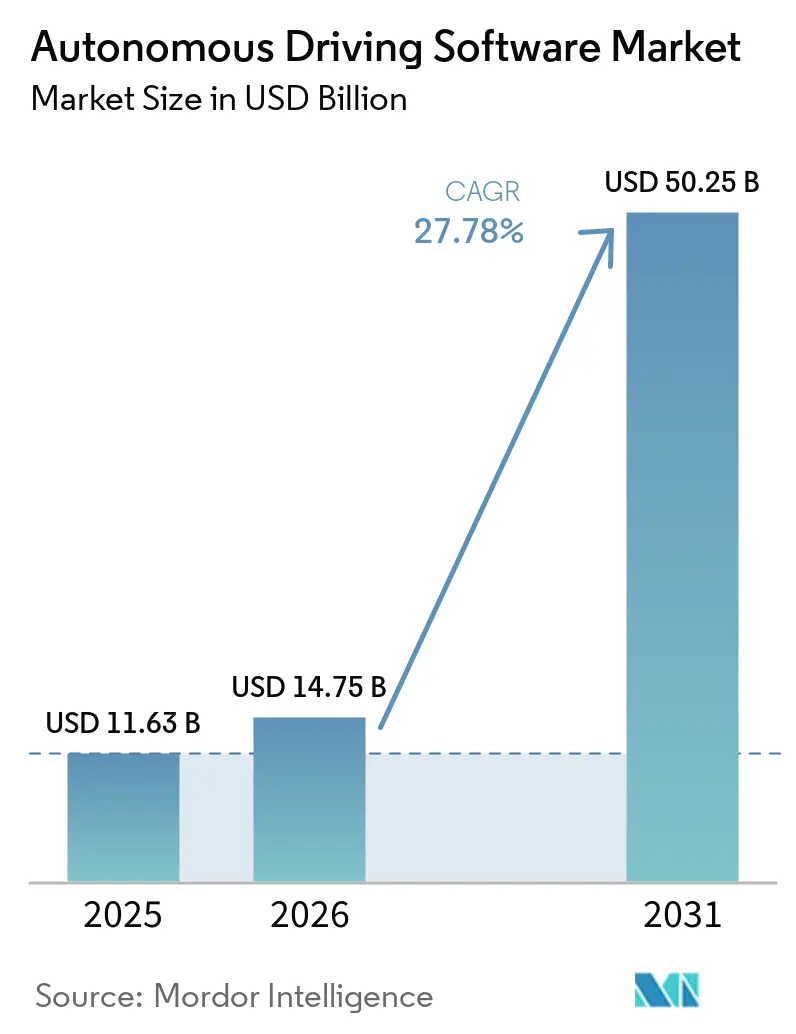
The autonomous driving software market size was valued at USD 11.63 billion in 2025 and is estimated to grow from USD 14.75 billion in 2026 to reach USD 50.25 billion by 2031, at a CAGR of 27.78% during the forecast period (2026-2031). Demand is spurred by mandatory advanced driver-assistance regulations, a rapid decline in sensor and compute costs, and original equipment manufacturers' pivots to software-defined vehicles. Platform ecosystems have overtaken hardware differentiation, so value now concentrates in perception, prediction, and decision-making code. Asia-Pacific leads revenue and volume thanks to China’s policy push, while Europe and the United States supply key validation and safety frameworks. Competitive momentum favors firms that can integrate hardware acceleration with cloud-native development, thereby shortening iteration cycles and unlocking recurring revenue through over-the-air updates.
Key Report Takeaways
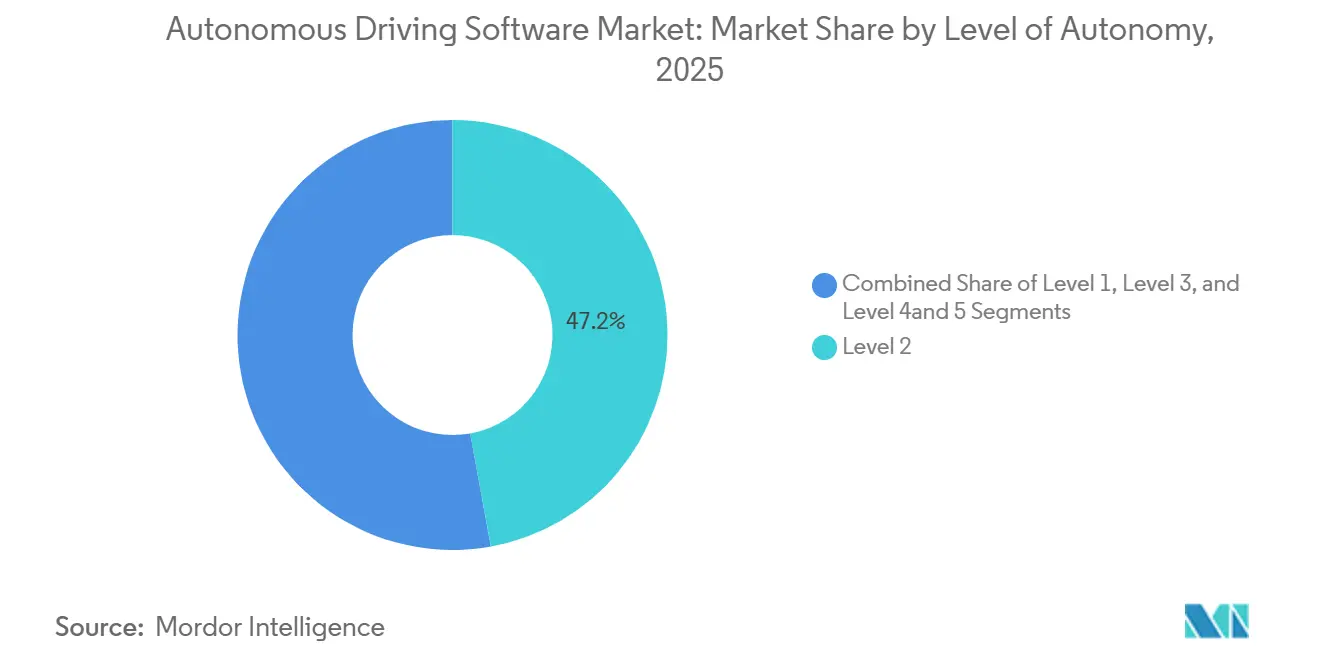
- By level of autonomy, Level 2 software held 47.15% of the autonomous driving software market share in 2025; Level 4 and 5 solutions are expected to expand at a 30.45% CAGR during the forecast period (2026-2031).
- By propulsion type, internal combustion platforms accounted for a 63.01% share of the autonomous driving software market in 2025. In contrast, electric vehicles are expected to register the fastest CAGR, at 31.48%, during the forecast period (2026-2031).
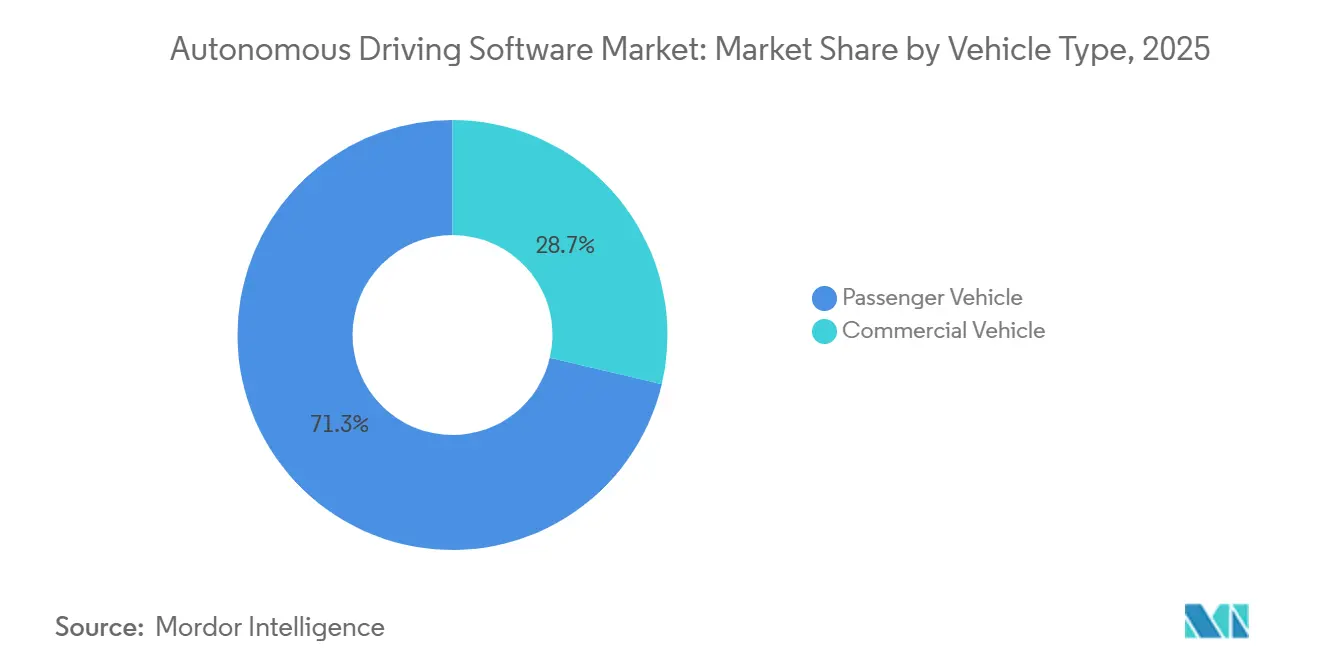
- By vehicle type, passenger cars led the autonomous driving software market with a 71.33% share in 2025; commercial vehicles are expected to grow at a 29.33% CAGR during the forecast period (2026-2031).
- By software type, perception and planning captured a 39.55% share of the autonomous driving software market in 2025, while chauffeur software is projected to rise at a 28.65% CAGR during the forecast period (2026-2031).
- By geography, the Asia-Pacific captured a 36.72% share of the autonomous driving software market in 2025 and is projected to grow at a 28.11% CAGR during the forecast period (2026-2031).
Note: Market size and forecast figures in this report are generated using Mordor Intelligence’s proprietary estimation framework, updated with the latest available data and insights as of January 2026.
Market Trends and Insights
Drivers Impact Analysis of Autonomous Driving Software Market*
| Driver | (~) % Impact on CAGR Forecast | Geographic Relevance | Impact Timeline |
|---|---|---|---|
| OEM Pivot to SDVs | +1.6% | Global, with North America & Europe leading adoption | Medium term (2-4 years) |
| Expanding ADAS Mandates | +1.4% | Europe, China, selective U.S. states | Short term (≤ 2 years) |
| LiDAR and Compute-Unit Costs Decline | +1.3% | Global, with APAC manufacturing advantages | Medium term (2-4 years) |
| Advanced Traffic-Management | +1.1% | Urban centers in North America, China, select European cities | Long term (≥ 4 years) |
| Cloud-Native Simulation | +0.9% | Global, concentrated in major automotive R&D hubs | Short term (≤ 2 years) |
| HD-Map-Free Perception Stacks | +0.8% | China primarily, with spillover to APAC markets | Medium term (2-4 years) |
| Source: Mordor Intelligence | |||
OEM Pivot To Software-Defined Vehicles
Global automakers are reorganizing around over-the-air feature delivery and subscription revenue. General Motors finalized full ownership of Cruise, while Volkswagen aligned with a ride-hailing platform to accelerate robotaxi rollout. Tesla gained significantly from its Full Self-Driving package in 2024, proving out monetization at scale. As per the company, the software's latest version boasts "enhanced data and training compute, a fivefold boost in parameter count, and various architectural enhancements"[1]Haley Cawthon, “Tesla Q3 profits boosted by rising Full Self-Driving revenue” TechTarget, Inc., automotivedive.com. Partnerships with public cloud providers support continuous integration pipelines, allowing weekly software releases that iterate perception and planning algorithms faster than traditional model-year cycles. Competitive pressure is therefore shifting capital expenditure from mechanical engineering toward data pipelines, synthetic-simulation tooling, and safety-case automation.
Expanding ADAS Mandates in Europe, China and United States
The European Union’s General Safety Regulation now requires emergency braking and lane-keeping on every new vehicle, effectively guaranteeing baseline demand for perception software[2]“Implementation of the General Safety Regulation,” European Commission, ec.europa.eu. China’s C-NCAP 2024 protocol applies similar pressure by tying five-star ratings to comprehensive driver-assist suites. In the United States, a mix of state-level testing programs and NHTSA safety guidelines supplies a federal framework that supports commercial pilots while maintaining consumer protection. The harmonization of core ADAS functions establishes a stepping-stone toward higher autonomy because suppliers can amortize R&D across multiple geographic programs, shaving cost per vehicle and accelerating feature road-maps.
Rapid Decline In LiDAR And Compute-Unit Costs Post-2025
Automotive LiDAR makers faced significant cost compression during 2025, mirrored by a robust reduction in high-performance computing modules between 2023 and 2024. Volume manufacturing shifts sensing hardware from premium models into mid-segment vehicles. Total sensor-compute bills that were previously high have dropped significantly, unlocking new addressable segments. As pricing drops, tier-one suppliers bundle multi-sensor suites with turnkey perception software, further reducing OEM integration friction and pulling forward autonomous driving feature adoption schedules.
Advanced Traffic-Management Pilots Enabling L4 Geo-Fenced Robo-Taxis
Waymo has achieved significant autonomous driving milestones across the United States cities, demonstrating the commercial viability of chauffeur-class software within geo-fenced environments. Urban partnerships integrate vehicle routing with municipal traffic-signal infrastructure, reducing pickup times and improving fleet utilization. Similar models unfold in Beijing and Shanghai, where dedicated robotaxi zones supply dense operational data that closes simulation-to-reality gaps. The resulting feedback loop lifts investor confidence and frees capital for expansion into freight corridors and suburban feeder routes.
Restraints Impact Analysis of Autonomous Driving Software Market*
| Restraint | (~) % Impact on CAGR Forecast | Geographic Relevance | Impact Timeline |
|---|---|---|---|
| Functional-Safety Talent Scarcity | -1.4% | Global, particularly acute in North America and Europe | Long term (≥ 4 years) |
| Fragmented Regulatory Approvals | -1.2% | United States primarily, with spillover effects globally | Medium term (2-4 years) |
| Thermal-Management Limits in EVs | -0.9% | Global, with particular challenges in hot climate regions | Short term (≤ 2 years) |
| Cyber-Security for OTA | -0.7% | Global, with varying regulatory frameworks by region | Medium term (2-4 years) |
| Source: Mordor Intelligence | |||
Scarcity Of Functional-Safety Talent For ISO 26262 And SOTIF
Industry demand for engineers qualified under ISO 26262 and SOTIF outstrips supply. Certification combines deep automotive safety know-how with machine-learning validation skills, a profile cultivated over multiple years of project experience. Leading suppliers report open positions unfilled for up to one year, stretching project timelines and raising salary costs. University programs are expanding, yet the talent gap will persist through the decade. Limited staffing slows safety-case preparation, which in turn delays regulatory clearance for Level 3-plus functions.
Fragmented Regulatory Approval Across U.S. States
The United States states possess individual autonomous-vehicle statutes, each with unique permitting, insurance, and reporting rules. Developers must maintain separate compliance tool-kits, elevating overhead and complicating multi-state fleet logistics. Although NHTSA sets baseline safety expectations, the absence of a harmonized national law stalls nationwide commercial rollouts, especially for freight carriers that cross multiple jurisdictions. The resulting uncertainty dampens capital investment and elongates commercialization timelines.
*Our forecasts treat driver/restraint impacts as directional, not additive. The impact forecasts reflect baseline growth, mix effects, and variable interactions.
Autonomous Driving Software Market Segment Analysis
By Level Of Autonomy:
Level 2 Scale And Level 4 / 5 MomentumLevel 2 held a 47.15% share in 2025 within the autonomous driving software market, anchored by adaptive cruise control and lane-centering functions rolled out across high-volume passenger platforms. Revenue flows from subscription packages that unlock enhanced driving convenience, creating steady cash flows while accustoming drivers to supervised automation features. Mandates in Europe and China force OEMs to embed these capabilities as standard equipment, ensuring baseline volume and predictable integration roadmaps.
Higher-autonomy Level 4 and 5 software is set to grow at a 30.45% CAGR during the forecast period (2026-2031), as commercial robotaxi and hub-to-hub freight services scale beyond pilot volume. Geo-fenced operating domains, combined with remote-assistance safety protocols, allow revenue operations without an in-vehicle driver. Regulatory pathways remain stringent, yet successful safety-case filings in select cities signal accelerating approvals. Investment funnels toward perception redundancy, behavioral prediction fidelity, and real-time fail-over mechanisms that meet functional safety targets.


By Propulsion Type:
Electric-Vehicle Integration AdvantagesInternal-combustion platforms held a 63.01% share of the autonomous driving software market in 2025, as legacy fleet architectures continue to dominate global sales. Hybrid systems face power management complexities that complicate the implementation of autonomous driving software. OEMs retrofit ADAS features via distributed electronic-control units, but thermal envelopes and 12-volt wiring constrain compute scalability. Software upgrades, therefore, face physical bottlenecks that limit roadmap agility.
Electric vehicles will advance at a 31.48% CAGR during the forecast period (2026-2031), leveraging high-voltage electrics and centralized compute to accommodate multi-sensor arrays and GPU-class processors. Cooling loops originally designed for battery packs now dissipate heat from AI workloads, solving a critical thermal hurdle. Over-the-air firmware orchestrates battery management and autonomous functions through a unified software stack, supporting continuous feature extension and heightening customer lifetime value.
By Vehicle Type:
Commercial Fleets Lead Uptake EconomicsPassenger cars accounted for 71.33% of the autonomous driving software market's 2025 revenue, driven by consumer demand for safety and convenience. Volume guarantees economies of scale for camera modules, radar, and domain controllers, thereby flattening unit cost curves that benefit the entire ecosystem. Marketing narratives reposition autonomy as a safety feature rather than a premium gadget, widening mass-market acceptance.
Commercial vehicles, however, will post the fastest 29.33% CAGR during the forecast period (2026-2031), because automation sharply reduces driver wage exposure and improves asset utilization. Long-haul routes exhibit stable traffic patterns, enabling efficient training of perception models and high miles-per-vehicle metrics. Fleet managers invest in tele-operations centers and predictive-maintenance analytics that slot directly into existing logistics software, simplifying operational change management.
By Software Type:
Perception Foundation And Chauffeur GrowthPerception and planning retained a 39.55% share of the autonomous driving software market size in 2025, functioning as the indispensable layer that converts raw sensor input into actionable world models. Continuous improvements in computer vision networks and LiDAR fusion algorithms extend detection range and improve classification accuracy, enhancing safety margins and enabling higher-speed operation. Cost-effective SoCs bundled with optimized neural-network accelerators push inference latency below 10 milliseconds, fulfilling stringent reaction-time requirements.
Chauffeur software will advance at a 28.65% CAGR during the forecast period (2026-2031), as end-to-end stacks combine perception, prediction, and control into cohesive decision engines capable of handling unstructured urban scenarios. Real-world miles harvested from commercial robotaxi fleets feed reinforcement-learning pipelines, improving long-tail competence: remote-assistance modules and operational-design-domain monitoring guarantee fail-safe fallback, a prerequisite for regulatory approval of unsupervised driving.
Geography Analysis
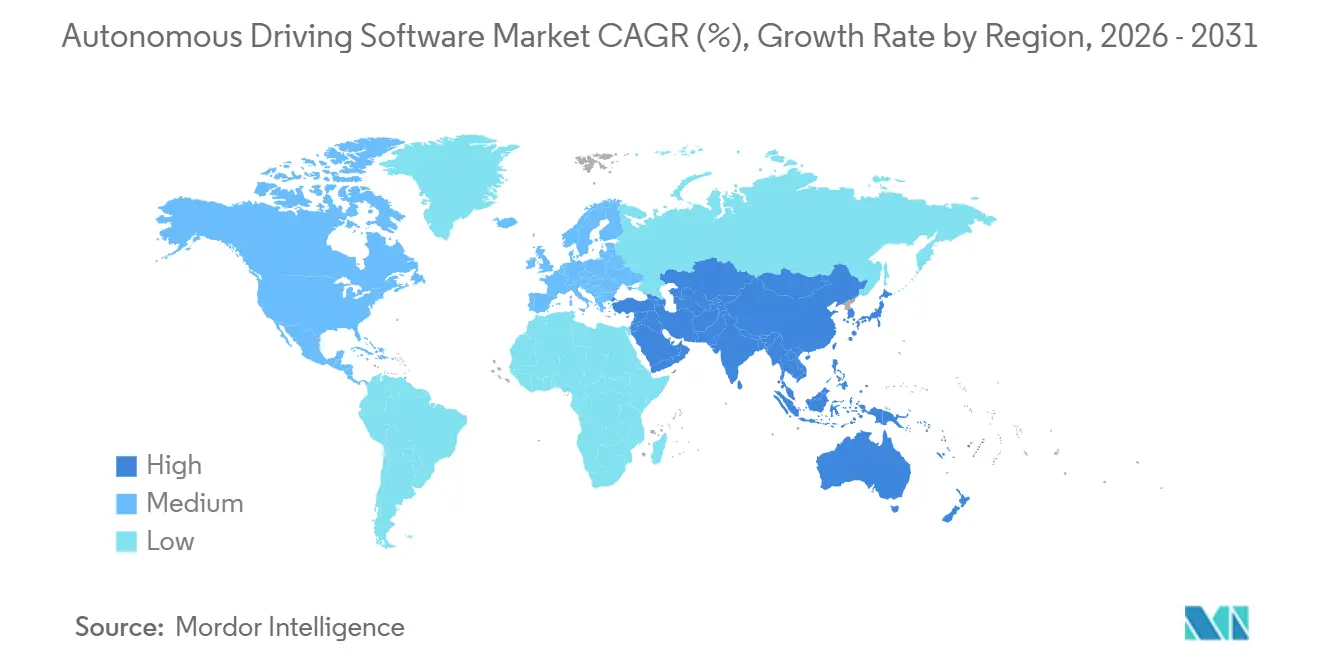
Asia-Pacific led with a 36.72% share of the autonomous driving software market in 2025 and is projected to grow at a 28.11% CAGR during the forecast period (2026-2031). Policymakers in China authorize large-scale pilot zones that cover mixed traffic, night conditions, and adverse weather. Domestic technology champions secure preferential access to public road-test mileage, amassing proprietary datasets that differentiate their perception models. Japan targets autonomous shuttles for rural mobility, while South Korea integrates 5G cellular vehicle-to-everything backbones to enhance situational awareness. Manufacturing scale in the region reduces hardware costs and accelerates the global diffusion of next-generation sensor stacks.
North America is expected to experience significant growth over the years. Silicon Valley start-ups leverage substantial venture capital to explore diverse autonomy niches, including sidewalk robots and autonomous middle-mile logistics. Regulatory sandboxes in California and Arizona allow public-road passenger services and ride-hailing integrations, helping validate commercial viability. Canada further supports the ecosystem through cold-weather testing corridors, which diversify data coverage and stress-test perception stacks under snow and ice conditions.
Europe maintains a coordinated regulatory environment and is set to witness significant growth during the forecast period. The General Safety Regulation requires uniform ADAS deployment, enabling suppliers to amortize development costs across the region’s large passenger-car base. Germany’s tier-one supplier cluster provides hardware-software integration expertise, while Scandinavian countries experiment with autonomous public transit pilots that feed operational insights back to the broader market. Harmonized privacy laws clarify data-handling obligations, smoothing cross-border fleet operations.

Competitive Landscape
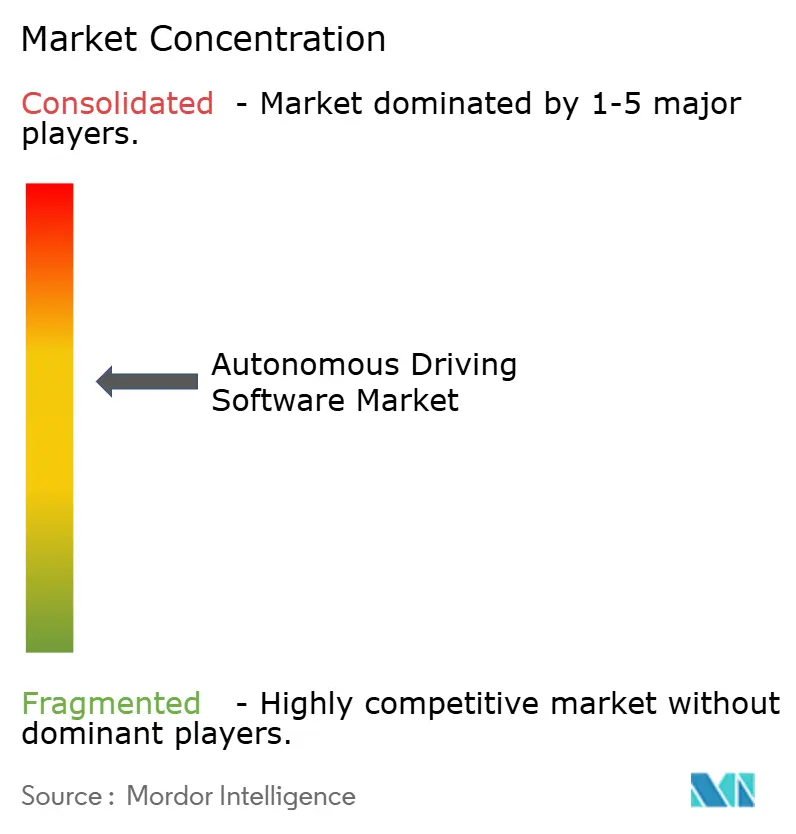
Market concentration remains moderate, leaving room for specialized entrants. NVIDIA packages high-performance compute with reference perception stacks and a simulation suite, enabling OEMs to accelerate development without full vertical integration. Mobileye leverages economies of scale from millions of EyeQ chips, offering a clear upgrade path from Level 2 to Level 4 on the same hardware footprint. Waymo adopts a vertically integrated approach that controls everything from proprietary sensors to service-delivery apps, prioritizing safety validation through high-mileage real-world operation.
Technology differentiation now hinges on data assets and software-tool-chain maturity. Companies that command petabyte-scale driving logs can iterate on neural network parameters rapidly, improving generalization to new geographies. Safety-case automation, including formal verification of planner logic and synthetic-scenario-based fault injection, emerges as a new battleground. Suppliers able to document ISO 26262 compliance at the code-artifact level win preferred-vendor status among risk-averse OEMs.
Strategic alliances are multiplying. Cloud providers pair edge-compute orchestration with scalable simulation back-ends, while automakers seek shared investment structures that distribute R&D burden across partners. Mergers and acquisitions target niche capabilities such as high-efficiency perception accelerators and end-to-end tool-chain traceability. Patent filings rose significantly in 2025, reflecting rising competition to secure algorithmic IP before mass commercialization.
Autonomous Driving Software Industry Leaders
NVIDIA Corporation
Mobileye (Intel Corporation)
Waymo LLC
Tesla, Inc.
Baidu, Inc.
- *Disclaimer: Major Players sorted in no particular order
Autonomous Driving Software Market Companies Covered in this Report
- NVIDIA Corporation
- Mobileye (Intel Corporation)
- Waymo LLC
- Tesla, Inc.
- Baidu, Inc.
- Continental AG
- Robert Bosch GmbH
- Aptiv PLC
- ZF Friedrichshafen AG
- Huawei Technologies Co., Ltd.
- Cruise LLC (General Motor Company)
- Oxa Autonomy Limited
- Qualcomm Technologies, Inc.
- Valeo SA

Recent Industry Developments in Autonomous Driving Software Market
- September 2026: STRADVISION, an AI company specializing in production-proven visual perception software, joins the Arm® Total Design for Physical AI ecosystem. With more than a decade of experience bringing advanced driver assistance systems (ADAS) and autonomous driving systems to market, STRADVISION announced this at Arm Everywhere in Shanghai, China.
- September 2026: Hyundai announced plans to integrate Nvidia's Hyperion 10 computing platform to launch Level 2+ systems in the first half of 2028, followed by Level 2++ systems in the second half of the year. The company targets the second half of 2029 for vehicles equipped with its proprietary Atria AI software.
- August 2026: Einride AB, a technology company advancing cost-efficient autonomous and electric freight transportation, and DAF Trucks, a leading truck manufacturer, announced a joint initiative to integrate Einride’s autonomous driving system, Einride Driver, into DAF’s premium vehicle platform. The companies will begin testing and validating key interfaces in 2026. In 2027, they will integrate and commission Einride’s autonomous driving software, followed by interface validation and functional testing on a DAF truck.
- August 2026: IDrive announced the launch of IDrive Autonomy Assisted Driving, a low-cost, licensable Level 2+ (L2+) driver-assistance platform. The platform provides automotive companies with a practical path to deploy advanced driver-assistance capabilities without having to develop an autonomous driving system from the ground up.


Global Autonomous Driving Software Market Report Scope
The scope includes segmentation by level of autonomy (level 1, level 2, level 3, and level 4 and 5), by propulsion type (internal combustion engine and electric), vehicle type (passenger vehicle and commercial vehicle), and software type (perception and planning software, chauffeur software, interior sensing software, and supervision/monitoring software). The analysis also covers regional-level segmentation, including North America, South America, Europe, Asia-Pacific, and the Middle East and Africa. Market size and growth forecasts are presented in USD by value.
| Level 1 |
| Level 2 |
| Level 3 |
| Level 4 and 5 |
| Internal Combustion Engine |
| Electric |
| Passenger Vehicle |
| Commercial Vehicle |
| Perception and Planning Software |
| Chauffeur Software |
| Interior Sensing Software |
| Supervision / Monitoring Software |
| North America | United States |
| Canada | |
| Rest of North America | |
| South America | Brazil |
| Argentina | |
| Rest of South America | |
| Europe | United Kingdom |
| Germany | |
| Spain | |
| Italy | |
| France | |
| Russia | |
| Rest of Europe | |
| Asia-Pacific | India |
| China | |
| Japan | |
| South Korea | |
| Rest of Asia-Pacific | |
| Middle East and Africa | United Arab Emirates |
| Saudi Arabia | |
| Turkey | |
| Egypt | |
| South Africa | |
| Rest of Middle East and Africa |
| By Level of Autonomy | Level 1 | |
| Level 2 | ||
| Level 3 | ||
| Level 4 and 5 | ||
| By Propulsion Type | Internal Combustion Engine | |
| Electric | ||
| By Vehicle Type | Passenger Vehicle | |
| Commercial Vehicle | ||
| By Software Type | Perception and Planning Software | |
| Chauffeur Software | ||
| Interior Sensing Software | ||
| Supervision / Monitoring Software | ||
| By Geography | North America | United States |
| Canada | ||
| Rest of North America | ||
| South America | Brazil | |
| Argentina | ||
| Rest of South America | ||
| Europe | United Kingdom | |
| Germany | ||
| Spain | ||
| Italy | ||
| France | ||
| Russia | ||
| Rest of Europe | ||
| Asia-Pacific | India | |
| China | ||
| Japan | ||
| South Korea | ||
| Rest of Asia-Pacific | ||
| Middle East and Africa | United Arab Emirates | |
| Saudi Arabia | ||
| Turkey | ||
| Egypt | ||
| South Africa | ||
| Rest of Middle East and Africa | ||


Key Questions Answered in the Report
What is the autonomous driving software market size in 2026?
The autonomous driving software market size is estimated at USD 14.75 billion, and is projected to grow at a 27.78% CAGR to reach USD 50.25 billion in 2031.
Which region leads adoption of autonomous driving software?
Asia-Pacific held 36.72% share in 2025, driven by supportive policy in China and rapid manufacturing scale-up.
Which autonomy level holds the largest commercial share?
Level 2 driver-assistance software led with 47.15% share in 2025 due to regulatory mandates and mass-market passenger-car rollouts.
Why are electric vehicles important to autonomous software growth?
Electric-vehicle architectures supply centralized compute power and thermal capacity that simplify integration of high-performance autonomous stacks.
Which vehicle segment is expanding fastest?
Commercial vehicles will post the fastest 29.33% CAGR because autonomous freight and delivery applications offer clear cost savings for fleet operators.
Page last updated on:


 Your data is secure and never sold or shared.


