
Autonomous Data Platform Market Size and Share
Market Overview
| Study Period | 2020 - 2031 |
|---|---|
| Market Size (2026) | USD 2.55 Billion |
| Market Size (2031) | USD 6.27 Billion |
| Growth Rate (2026 - 2031) | 19.72 % |
| Fastest Growing Market | Asia Pacific |
| Largest Market | North America |
| Market Concentration | Medium |
Major Players *Disclaimer: Major Players sorted in no particular order Image © Mordor Intelligence. Reuse requires attribution under CC BY 4.0. | |
Autonomous Data Platform Market Analysis by Mordor Intelligence
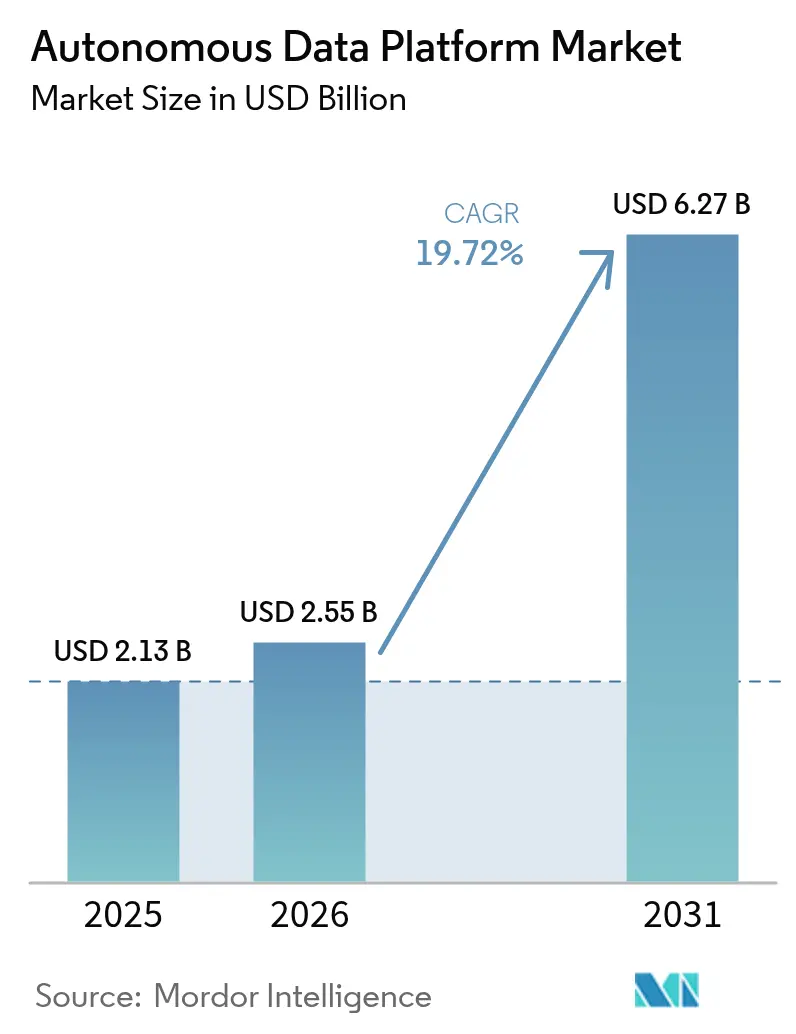
The autonomous data platform market size is expected to grow from USD 2.13 billion in 2025 to USD 2.55 billion in 2026 and is forecast to reach USD 6.27 billion by 2031 at 19.72% CAGR over 2026-2031. This growth path shows how enterprises are shifting from manually tuned data stacks toward fully autonomous, AI-first operations that reduce human intervention in storage, optimization, and lifecycle management. Cloud hyperscalers have turned autonomy into a core feature of their infrastructure portfolios, allowing users to provision, govern, and scale databases without specialized skills. Falling storage costs now let companies keep petabyte-scale historical data online, improving model accuracy and time-series analytics at manageable budgets. At the same time, regional data-sovereignty laws force organizations to architect multiregional replication strategies, creating demand for platforms that deliver low-latency performance while still enforcing residency controls. Competitive intensity is rising as established database vendors, lake house specialists, and hyperscalers race to embed automated performance tuning, self-healing features, and integrated Gen-AI copilots that democratize complex tasks.
Key Report Takeaways
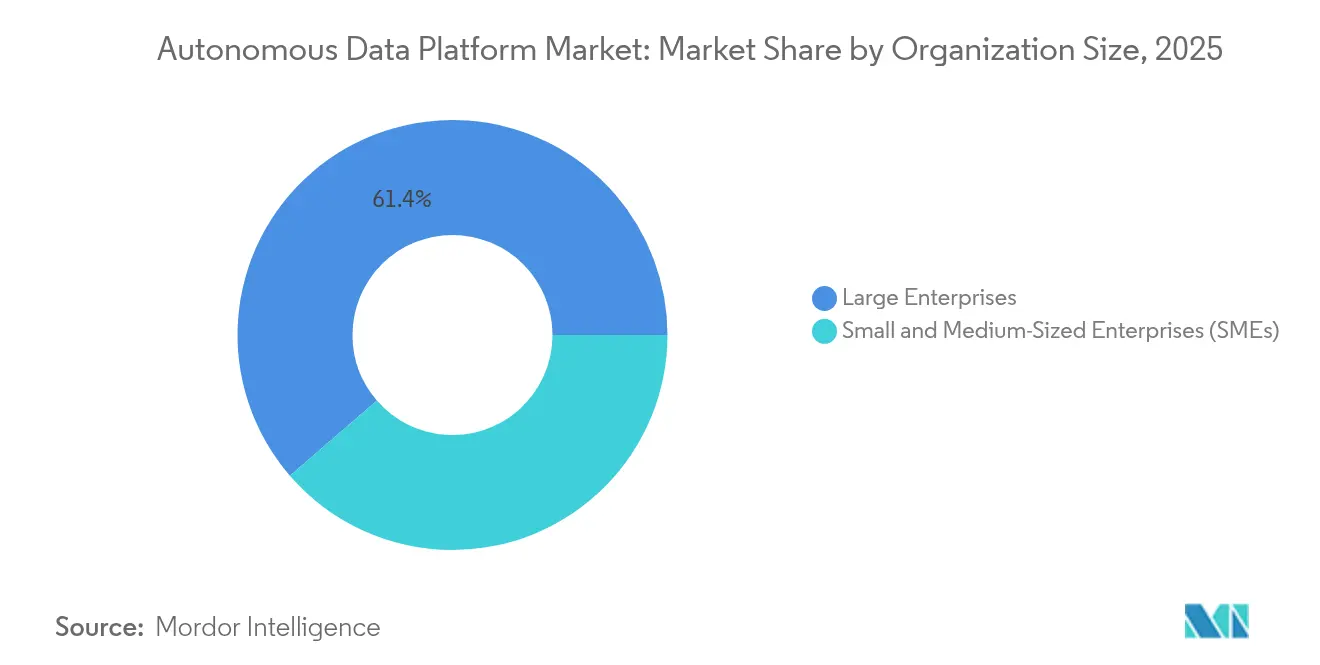
- By organization size, large enterprises held 61.35% of the autonomous data platform market share in 2025, while small and medium-sized enterprises are advancing at a 25.18% CAGR through 2031.
- By deployment type, the public-cloud segment captured 53.20% revenue share in 2025; hybrid configurations are forecast to expand at a 28.14% CAGR to 2031.
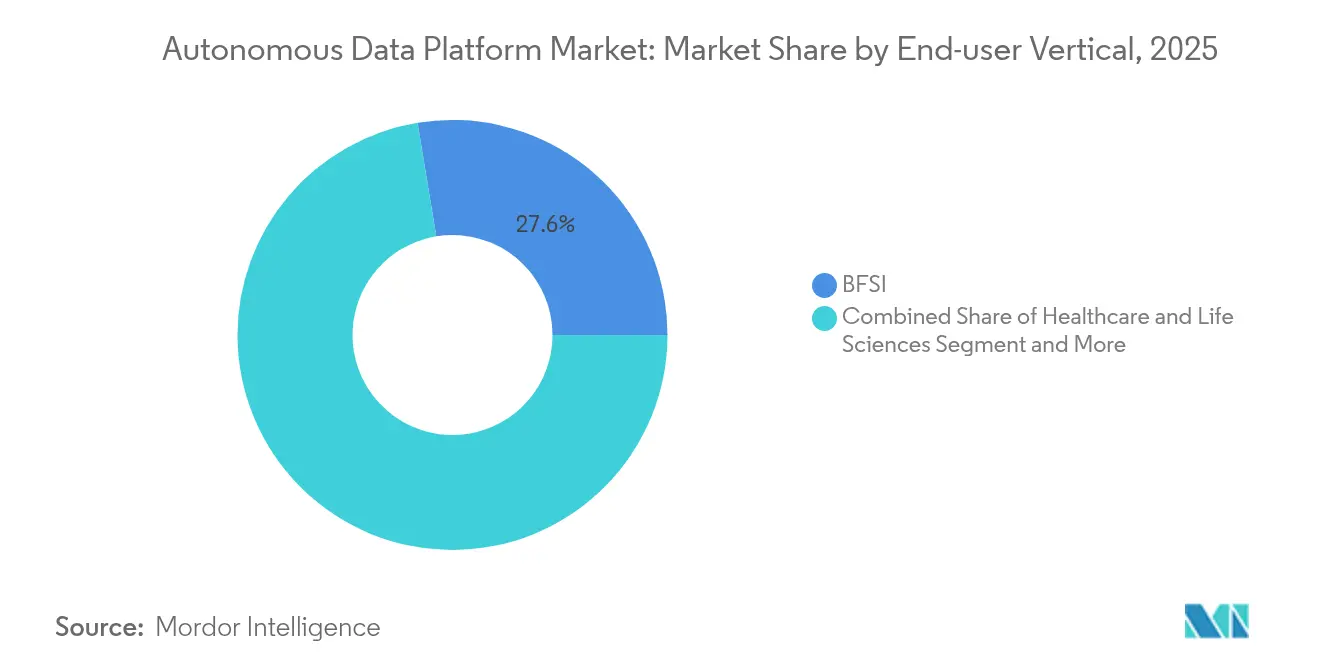
- By end-user vertical, banking, financial services, and insurance led with a 27.60% share of the autonomous data platform market size in 2025, whereas healthcare and life sciences are growing at a 24.61% CAGR through 2031.
- By component, platform and solution offerings accounted for a 69.20% share in 2025, while managed services are expanding at a 26.29% CAGR to 2031.
- By data type, unstructured data processing commanded a 56.30% share of the autonomous data platform market size in 2025, and semi-structured workloads are rising at a 29.76% CAGR through 2031.
- By geography, North America led with 40.60% revenue share in 2025; the Asia-Pacific region is on track for a 22.54% CAGR to 2031.
Note: Market size and forecast figures in this report are generated using Mordor Intelligence’s proprietary estimation framework, updated with the latest available data and insights as of 2026.
Market Trends and Insights
Drivers Impact Analysis of Autonomous Data Platform Market*
| Driver | (~) % Impact on CAGR Forecast | Geographic Relevance | Impact Timeline |
|---|---|---|---|
| AI-first data-ops strategies adopted by cloud hyperscalers | 4.20% | Global, with concentration in North America and Europe | Medium term (2-4 years) |
| Rapid fall in data-storage cost enabling petabyte-scale ingestion | 3.80% | Global, particularly benefiting APAC emerging markets | Short term (≤ 2 years) |
| Rising enterprise move toward data-mesh & fabric architectures | 3.10% | North America and Europe leading, APAC following | Long term (≥ 4 years) |
| Mandatory data-residency/sovereign-cloud rules in Europe & APAC | 2.90% | Europe and APAC core, spillover to MEA | Medium term (2-4 years) |
| Integration of Gen-AI copilots for low-code data engineering | 2.70% | Global, with early adoption in North America | Short term (≤ 2 years) |
| Industry-specific packaged analytics accelerators (banking, life-science) | 2.10% | Global, sector-specific concentration | Medium term (2-4 years) |
| Source: Mordor Intelligence | |||
AI-first data-ops strategies adopted by cloud hyperscalers
Cloud providers have begun embedding autonomous optimization, self-patching, and self-scaling directly into baseline services. Amazon earmarked USD 100 billion for AWS AI infrastructure in 2025, signalling that autonomy is now table stakes for large-scale data operations. Snowflake’s partnership with NVIDIA makes specialized retrieval and inference tooling available inside the data platform, removing the traditional gap between storage and model execution. Oracle’s autonomous database revenue jumped 104% year-over-year in fiscal 2025 as firms moved away from manual optimization to real-time, self-tuning services. These developments cut administration costs and shorten analytics cycles from hours to minutes, enabling frontline teams to run live experiments on production-grade datasets. [1]
Rapid fall in storage cost enabling petabyte-scale ingestion
The National Academies projects installed storage capacity will cross 26.3 zettabytes by 2030 while cost per terabyte keeps dropping. Enterprises can now keep historical video, sensor, and document archives online, raising AI model accuracy without prohibitive budgets. Western Digital research shows hard-disk drives still deliver favourable total cost of ownership for bulk data, so firms maintain cold-tier lakes without sacrificing margin. TELUS migrated 14 petabytes to Google BigQuery, shed 30% obsolete data, and optimized 200 pipelines that feed new Gen-AI use cases. Lower storage barriers push the autonomous data platform market toward always-on ingestion that fuels predictive systems and multimodal AI. [2]
Rising enterprise move toward data-mesh and data-fabric architectures
Enterprises are breaking up centralized warehouses and delegating ownership to domain teams that treat “data as a product.” Siemens built an enterprise-wide mesh on Snowflake that accelerates innovation and keeps governance centralized yet lightweight. German manufacturers report that traditional ETL pipelines cannot keep pace with demand for real-time analytics, forcing cultural change alongside technology upgrades. ABB unified 40 disparate ERP systems under a single mesh, unlocking multimillion-dollar savings and revenue growth. With data spread across business lines, autonomous platforms must self-discover metadata, auto-catalogue assets, and enforce policies at the edge.
Mandatory sovereignty rules in Europe and APAC
The EU Data Act enforces cloud portability and fee-free exits by 2027, reshaping provider selection criteria. India’s Digital Personal Data Protection Act and Japan’s pending AI Basic Law add regional layers that compel local replication, auditing, and policy enforcement. Amazon will invest AU$20 billion to build Australian data centers through 2029, reflecting how hyperscale’s chase compliance-ready regions. Enterprises that master multiregional governance gain faster market entry and reduced regulatory friction.
Restraints Impact Analysis of Autonomous Data Platform Market*
| Restraint | (~) % Impact on CAGR Forecast | Geographic Relevance | Impact Timeline |
|---|---|---|---|
| Ongoing skills gap for composite AI and MLOps orchestration | -2.80% | Global, particularly acute in APAC and emerging markets | Long term (≥ 4 years) |
| Escalating cloud egress fees impacting TCO | -2.10% | Global, with higher impact on multi-cloud deployments | Short term (≤ 2 years) |
| Persistent security debt from legacy ETL pipelines | -1.90% | North America and Europe, legacy system concentration | Medium term (2-4 years) |
| Vendor lock-in concerns hindering multicloud portability | -1.60% | Global, affecting large enterprise segments | Medium term (2-4 years) |
| Source: Mordor Intelligence | |||
Ongoing skills gap for composite AI and MLOps orchestration
End-to-end autonomous systems need niche skills covering distributed architectures, model governance, and real-time streaming. Upskilling programs such as IVADO’s MLOps boot camp attempt to shrink the gap yet demand still outstrips supply. A Fortune 100 healthcare firm relied on TrueFoundry specialists to deploy 30+ LLM use cases, cutting time-to-value but underscoring workforce dependence on outside talent. Without internal expertise, organizations struggle to operationalize autonomous features at scale, dampening ROI and adoption pace.
Escalating cloud egress fees impacting TCO
Large data transfers among clouds can double operating costs, especially for AI training workloads that shuffle terabytes daily. Google scrapped egress fees for customer exits, but AWS and Azure charges remain. Oracle offers 10 TB free each month, positioning itself as a lower-cost alternative for multicloud architectures. When fees surpass compute spend, architects may co-locate workloads sub-optimally, reducing the performance gains autonomy promises.
*Our forecasts treat driver/restraint impacts as directional, not additive. The impact forecasts reflect baseline growth, mix effects, and variable interactions.
Autonomous Data Platform Market Segment Analysis
By Organization Size:
SMEs Advance Platform DemocratizationLarge enterprises currently generate most revenue with a market share of 61.35%, yet small and medium-sized firms fuel the fastest expansion of the autonomous data platform market. The autonomous data platform market size attributable to SMEs is projected to widen swiftly thanks to natural-language copilots that replace code-heavy interfaces. Prophecy’s transformation assistant lets functional teams at consumer-focused brands orchestrate data flows without engineering backlogs. Meanwhile, mega-enterprises rely on federated data-mesh rollouts across geographies and business units, driving complex governance implementations that sustain platform vendors’ enterprise licensing streams.
SMEs view autonomous data tools as an equalizer that shortens innovation cycles. Case studies such as F45 Training’s deployment with Fiveonefour illustrate tangible returns, reporting 50% cost reductions and 10× faster development cycles on consumer analytics pipelines. As accessible pricing tiers spread, the autonomous data platform market gains a broader long-tail customer base, challenging vendors to maintain usability while preserving advanced enterprise functionality.

By Deployment Type:
Hybrid Configurations Address Sovereignty RequirementsPublic-cloud services deliver the bulk of current spending, yet hybrid models expand at a pace that reshapes the autonomous data platform market. Sovereignty concerns and performance optimization drive enterprises to keep sensitive workloads on-premises while bursting analytics and AI training to scalable public resources. Deutsche Bank’s phased data-platform migration blended on-premises systems with Google Cloud services for 20 million customers, proving hybrid’s compliance value.
The autonomous data platform market size tied to hybrid deployments is forecast to accelerate as frameworks such as the EU Data Act compel portability. Oracle’s Cloud@Customer nodal offering appeals to firms seeking public-cloud autonomy inside private facilities, indicating that location-agnostic control planes will define competitive positioning. Pure private-cloud growth slows because in-house hardware and skills cannot match public-cloud innovation velocity, nudging firms toward hybrid compromises.
By End-User Vertical:
Healthcare Accelerates Through AI IntegrationBFSI remains the single largest adopter with 27.60%, yet healthcare and life sciences produce the steepest trajectories in the autonomous data platform market. Banking institutions employ real-time risk scoring to meet tightening capital and liquidity mandates, whereas pharmaceutical leaders such as Sanofi use autonomous lake houses to speed analysis of real-world clinical data.
Health-sector growth is amplified by vast image, genomic, and clinical-trial files that benefit from autonomous scaling and policy-based lifecycle management. Sanofi reported accelerated drug-discovery analytics after moving workloads to Snowpark, underscoring the sector’s appetite for turnkey compliance and compute elasticity. Consequently, vendors craft HIPAA-ready blueprints and 21 CFR Part 11 attestations to win share as the autonomous data platform market expands in regulated life-science domains.
By Component:
Managed Services Address Complexity ChallengesPlatform software still captures most spending, yet managed services record the sharpest climbs because many enterprises outsource operations that exceed internal abilities. Fidelity Investments operates hundreds of models but cautions that creativity must coexist with governance, inspiring demand for managed MLOps orchestration. The autonomous data platform market size credited to managed services will keep widening as organizations favour outcome-based contracts that guarantee uptime, latency, and cost thresholds.
Vendors respond by bundling run-operations with product licenses or partnering with service specialists. ServiceNow’s acquisition of data. World shows how cataloging, lineage, and workflow automation converge under service umbrellas, offering a cradle-to-grave data pipeline managed by one provider. Differentiation increasingly hinges on measurable value such as performance benchmarks and financial savings rather than feature lists alone.
Geography Analysis
North America Autonomous Data Platform Market
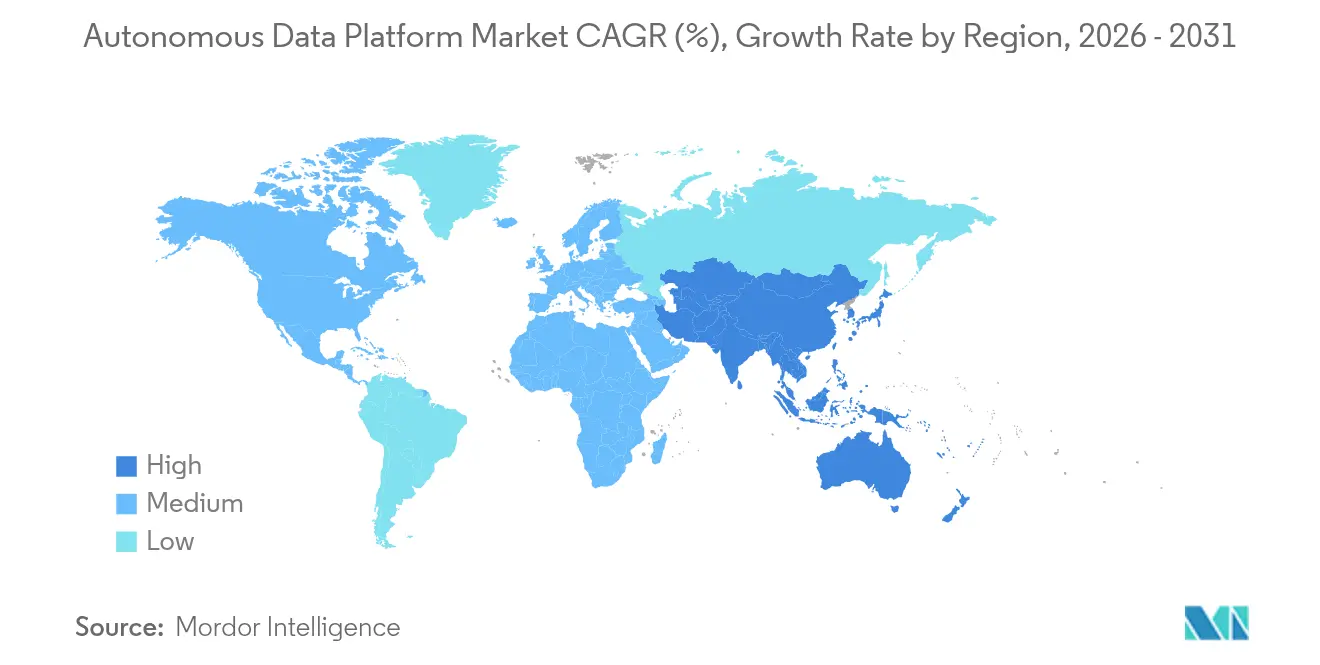
North America commanded 40.60% of autonomous data platform market share in 2025, underpinned by early adoption of AI-first strategies and substantial data-center investments. Amazon alone plans USD 150 billion for additional facilities that will run GPU clusters needed for large language models. Oracle’s infrastructure revenue surged 70% year-over-year in fiscal 2025 as enterprises embraced self-tuning databases that meet stringent uptime and compliance standards. A mature venture ecosystem funds specialized startups focusing on data observability, cataloging, and real-time AI, further enriching the regional technology stack.
APAC Autonomous Data Platform Market
The Asia-Pacific region shows the fastest CAGR at 22.54%, driven by India’s data-protection framework and Japan’s AI Basic Law proposal, both of which require tightly governed yet innovation-friendly platforms. Government programs funding digital public infrastructure shorten procurement cycles, letting firms adopt autonomous solutions early in their modernization journeys. Hyperscalers rapidly expand local zones to meet residency rules, while regional service providers create sovereign platforms that integrate with global clouds through standardized APIs.
EMEA and South America Autonomous Data Platform Market
Europe sustains growth through privacy leadership and the new Data Act, which mandates vendor-agnostic portability. Platform providers respond with open-format catalogs and zero-copy data-sharing innovations to reduce exit friction. The region’s insistence on explainability and audit trails favors autonomous platforms that embed lineage tracking and AI model governance by default. South America, the Middle East, and Africa trail in current adoption but show high project pipelines as telecom operators, banks, and public agencies pursue cloud-first roadmaps that leapfrog legacy infrastructure.
Regulatory Landscape
Autonomous data platforms operate under overlapping privacy, security, and AI governance regimes that shape data residency, portability, and auditability requirements for automated data operations. In the European Union, the EU AI Act (Regulation (EU) 2024/1689) introduces risk-based obligations for AI systems, including data governance expectations for high-risk use cases, and the European Commission published transparency guidelines under Article 50 in July 2026, with related obligations becoming applicable from 2 August 2026. Separately, the EU Data Act introduces cloud portability and switching provisions, reinforcing vendor selection criteria around exportability, open formats, and operational controls for cross-region replication.
In the United States, federal security and privacy compliance for cloud services is a key gating factor for regulated adopters. OMB Memorandum M-25-04 (January 2025) updated federal information security and privacy management guidance, and FedRAMP preview materials in 2026 introduced options such as the Security Decision Record construct, moving authorization artifacts toward continuously maintained, decision-oriented documentation for cloud systems. For data-intensive verticals, NIH notice NOT-OD-25-159 tightened expectations for controlled-access data repositories, increasing the need for platforms that can enforce policy-based access controls, monitoring, and evidence capture across autonomous workflows.
Value Chain Analysis
The value chain spans (1) infrastructure and connectivity, including hyperscale compute, storage media, networking, and cross-cloud interconnects; (2) core data platform layers, such as lakehouse storage formats, cataloging/metadata, governance, and security; and (3) autonomous orchestration layers that apply AI to tuning, lineage, quality, and self-healing across pipelines and workloads. Downstream, systems integrators and managed service providers operationalize deployments, particularly for hybrid and multicloud environments where egress fees, identity federation, and policy consistency constrain architecture choices.
Partnerships show how vendors are tightening integrations between domain applications, operational data, and AI execution. Kinaxis and Databricks (April 2025) connected Kinaxis Maestro with the Databricks Data Intelligence Platform to support AI-powered supply chain orchestration, while Cognite and Databricks (October 2025) announced bidirectional, zero-copy data sharing between industrial data and the Databricks platform, reducing replication overhead. The ecosystem is also shaped by reference architectures and open components, including AWS guidance in July 2026 for multicloud lakehouse designs using Apache Iceberg and AWS Lake Formation for unified governance. Bottlenecks remain around fragmented metadata, inconsistent semantic layers, and the need for domain ontologies to make autonomous decisioning reliable across organizational boundaries.
Competitive Landscape
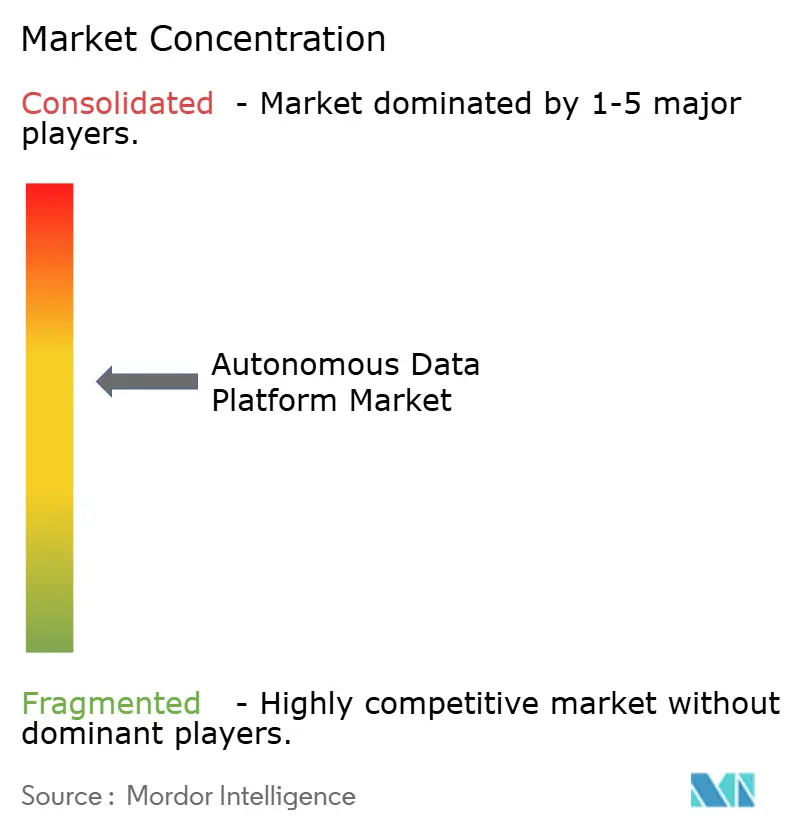
Competition centers on a handful of scale players contending with nimble specialists. Snowflake, Databricks, Oracle, and the hyperscale clouds invest heavily in autonomous optimizers, Gen-AI assistants, and cross-cloud interoperability. Snowflake’s patent portfolio spans adaptive query aggregation and zero-copy sharing, reinforcing its data-cloud vision. Databricks fuses structured and unstructured analytics under the lakehouse, while Oracle touts self-patching databases that run on dedicated, security-hardened hardware.
Acquisition activity underscores the premium on differentiated AI capabilities. Snowflake’s planned purchase of Crunchy Data aims to bring fully managed PostgreSQL into its ecosystem, whereas IBM’s intent to buy DataStax targets NoSQL and vector search features vital for retrieval-augmented generation. ServiceNow’s move for data. world blends workflow orchestration with cataloging, extending platform influence deeper into operational processes.
Emerging ventures focus on data mesh, domain accelerators, and observability. Many position themselves as neutral layers that sit above hyperscalers, promising reduced lock-in. Patent filings on auto-indexing, cache management, and privacy-preserving query rewrite signal perpetual innovation. Price competition intensifies around storage compression and autonomous workload placement, while value discussions shift toward measurable outcomes such as time-to-insight and cost-per-query rather than raw capacity. [4]
Autonomous Data Platform Industry Leaders
-
Amazon Web Services, Inc.
-
Microsoft Corporation
-
Snowflake Inc.
-
Oracle Corporation
-
Databricks, Inc.
- *Disclaimer: Major Players sorted in no particular order
Autonomous Data Platform Market Companies Covered in this Report
- Oracle Corporation
- International Business Machines Corporation
- Amazon Web Services, Inc.
- Teradata Corporation
- Qubole, Inc.
- MapR Technologies, Inc.
- Snowflake Inc.
- Microsoft Corporation
- Google LLC
- Cloudera, Inc.
- Databricks, Inc.
- Alteryx, Inc.
- Ataccama Corporation
- Gemini Data, Inc.
- Denodo Technologies, Inc.
- Zaloni, Inc.
- Informatica Inc.
- Paxata, Inc.
- Dremio Corporation
- Talend Inc.
Market Opportunities and Future Outlook
A near-term opportunity is compliance-ready autonomy for regulated and data-sovereignty constrained deployments, where platforms must combine automated operations with provable controls. The EU AI Act transparency guidance published by the European Commission in July 2026 (applicable from 2 August 2026) increases emphasis on operational transparency and documentation around AI-enabled workflows, while FedRAMP preview updates in 2026 and OMB M-25-04 (January 2025) keep federal-grade security expectations high for cloud services serving public-sector and adjacent contractors. Vendors and service partners that productize evidence capture, including lineage, policy enforcement, access decisions, and configuration drift remediation, have clearer whitespace in hybrid architectures that need consistent governance across regions and clouds.
Another opportunity is interoperability and trusted data sharing across federated ecosystems, supported by the shift from centralized platforms to data mesh and multi-party data exchange. Initiatives such as Gaia-X (Architecture Document, 25.05 release) and OS-Climate data commons architecture blueprints provide reference points for federated trust frameworks and shared schemas, aligning with enterprise demand for cross-domain data products and portable AI-ready datasets. This direction also supports agentic operations, where autonomous platforms supervise metadata, quality, and semantic consistency, reducing manual engineering effort while enabling safer reuse of data products across internal domains and external partners.
Recent Industry Developments in Autonomous Data Platform Market
- July 2026: Amazon Web Services published guidance on multi-cloud lakehouse architectures for agentic AI, detailing patterns built around open table formats such as Apache Iceberg and governance controls such as AWS Lake Formation. The emphasis on multicloud design and unified governance supports autonomous data platform deployments that span more than one cloud and require policy-consistent controls.
- May 2026: Snowflake announced an agreement to acquire Natoma, a Model Context Protocol platform, to improve how AI agents securely connect to enterprise applications and data. In the same period, Snowflake also committed to a five-year USD 6 billion investment in AWS infrastructure, signaling deeper capacity alignment for AI-heavy workloads running on the data cloud.
- April 2026: Oracle announced a multicloud networking partnership with AWS to provide private, high-speed connections for moving data between Oracle Cloud Infrastructure and AWS. By positioning cross-cloud connectivity and egress economics as first-order design parameters, the initiative reinforces multicloud interoperability as a competitive lever for autonomous data platforms.
Autonomous Data Platform Market Report Scope and Research Methodology
Market Definition and Coverage
For this study, the autonomous data platform market covers software platforms and related services that automate key data management tasks, such as ingestion, storage optimization, governance, security, and performance tuning, with minimal manual administration across cloud and on-premises setups.
Scope exclusions: This sizing does not count general-purpose BI tools, standalone ETL tools, or pure hardware infrastructure unless they are sold as part of an autonomous data platform offer.
Segments Covered in This Report
- By Organization Size
- Large Enterprises
- Small and Medium-Sized Enterprises (SMEs)
- By Deployment Type
- Public Cloud
- Private Cloud
- Hybrid Cloud
- By End-user Vertical
- Banking, Financial Services and Insurance (BFSI)
- Healthcare and Life Sciences
- Retail and Consumer Goods
- Media and Telecommunications
- Government and Public Sector
- Manufacturing
- By Component
- Platform / Solution
- Services
- Professional Services
- Managed Services
- By Data Type
- Structured Data
- Semi-Structured Data
- Unstructured Data
- By Geography
- North America
- United States
- Canada
- Mexico
- South America
- Brazil
- Argentina
- Rest of South America
- Europe
- United Kingdom
- Germany
- France
- Italy
- Spain
- Russia
- Rest of Europe
- Asia-Pacific
- China
- Japan
- India
- South Korea
- Australia and New Zealand
- Rest of Asia-Pacific
- Middle East and Africa
- Middle East
- Saudi Arabia
- United Arab Emirates
- Turkey
- Rest of Middle East
- Africa
- South Africa
- Rest of Africa
- Middle East
- North America
Data Sources, Market Sizing, and Validation
Desk Research
Desk research was used to build the starting structure for the market model and to set realistic ranges for adoption and spending. We referenced public sources such as the US Bureau of Economic Analysis, US Census Bureau business datasets, Eurostat, the OECD, and NIST publications for governance and security definitions that show up in customer buying requirements.
In parallel, filings and investor materials from relevant software providers, product documentation, reputable technology press coverage, and peer reviewed papers were checked to understand packaging shifts, including deeper automation coverage, governance-by-default approaches, and embedded AI assistant functionality. Where needed, paid subscriptions that track company financials, patent activity, and news signals were used to improve consistency of revenue mix and to spot regional inflection points. The sources named above are illustrative and not exhaustive, and many other public documents and databases were also reviewed to collect, validate, and clarify inputs.
Primary Interviews and Surveys
Primary work focused on expert interviews and surveys with platform product leaders, data engineering and governance owners, system integrators, and enterprise IT decision makers across APAC, EMEA, and the Americas. Discussions were used to confirm what buyers treat as an autonomous platform versus adjacent tools, and then to validate typical pricing logic, service attach rates, and deployment split assumptions.
Distribution of primary research fieldwork respondents
| Company type | Respondent position | Region |
|---|---|---|
| Top tier: 32% | CXOs: 15% | APAC: 44% |
| Mid tier: 53% | Functional/Unit leaders: 37% | EMEA: 29% |
| Smaller Players: 15% | Managers: 48% | Americas: 27% |
Market-Sizing & Forecasting
Sizing starts with a top-down build where enterprise data footprint growth and cloud adoption signals are translated into a practical demand pool for autonomous platform spending, which is then filtered by adoption readiness. We corroborate the output with selective bottom-up checks, including sampled price-per-workload or price-per-capacity patterns, service attachment levels, and channel feedback from integrators, and then totals are adjusted when the two views do not align.
Key inputs used in the model include cloud versus on-premises deployment mix, growth in managed data volumes and workloads, governance and security compliance intensity, average contract duration and renewal behavior, and the share of spend that shifts from manual operations to automation features. For forecasting, scenario analysis is applied around cloud migration speed, AI assistant packaging, and tool consolidation behavior in large enterprises. When a bottom-up check has gaps, for example where service revenues are bundled, ratios from primary feedback are applied and then rechecked against reported revenue mix patterns by region.
Data Validation & Update Cycle
Outputs are triangulated against independent signals such as enterprise software spending commentary, cloud infrastructure growth indicators, and observable shifts in platform subscription mix. If a large variance appears, it is investigated before sign-off. Anomaly checks are also run on implied pricing, penetration rates, and regional splits so the model does not drift into unrealistic combinations.
The work is reviewed in multiple steps, and respondents may be re-contacted when a key assumption changes, or when a new product packaging move impacts what gets counted as platform revenue. Reports refresh annually, with interim updates for material events, and a final pre-delivery pass is completed so clients receive the latest updated view.
Mordor Intelligence's Autonomous Data Platform Market Sizing Compared With Other Published Estimates
Published market sizes for autonomous data platforms often do not match because different publishers set different inclusion rules, choose different headline years, and apply different treatments for bundled services inside platform deals. Currency conversion timing and the aggressiveness of adoption assumptions also move totals up or down, especially in a fast-changing software category.
Some external estimates bundle broader analytics or data science platform revenues, and others count advisory, support, or maintenance lines as separately sized buckets that are added into the same total. For Mordor Intelligence, revenue is counted only when the offering is positioned as an autonomous data platform that automates core data management and lifecycle tasks, and standalone BI or ETL tools are excluded from the total even if they are used alongside the platform.
Benchmark comparison
| Source | Market Size | Gaps in Research Methodology |
|---|---|---|
| Mordor Intelligence | USD 2.13 B (2025) | |
| Industry Research Publisher A | USD 1.87 B (2024) | Anchors the headline number in an earlier year and can treat the base value as more software-only, which changes the starting point before growth is applied. |
| Trade Journal B | USD 2.80 B (2026) | Reports a forward-year value and includes additional components like advisory, support, or maintenance as added buckets, which can lift the reported total versus a tighter platform-only inclusion rule. |
The differences are mainly explained by the headline year chosen and whether adjacent services and supporting categories are rolled into the same revenue pool. By keeping inclusions tied to clear platform functionality, checking implied pricing and service attach rates, and then reviewing outliers before updates, the estimate stays traceable to repeatable inputs that decision makers can sanity-check.
Key Questions Answered in the Report
.What is the current size and growth outlook for the autonomous data platform market?
The autonomous data platform market reached USD 2.55 billion in 2026 and is on course for USD 6.27 billion by 2031, posting a 19.72% CAGR.
Which deployment model is growing fastest?
Hybrid cloud configurations are expanding at a 28.14% CAGR as firms balance latency, cost, and data-sovereignty obligations.
Why are healthcare and life-science firms adopting autonomous data platforms rapidly?
They need to process large clinical and genomic datasets securely and at speed, driving a 24.61% CAGR for the vertical through 2031.
How do sovereignty regulations influence platform choice?
Mandates such as the EU Data Act require easy portability and local data residency, pushing enterprises toward providers with multiregional compliance features.
What role do managed services play in adoption?
Managed services offset skills shortages in MLOps and governance, growing at a 26.29% CAGR as organizations seek turnkey operations.
What is the biggest technical restraint hindering wider rollout?
A persistent skills gap in composite AI and distributed MLOps orchestration slows enterprise ability to harness full autonomy, reducing overall CAGR by an estimated 2.8%.