
Automotive Voice Recognition System Market Size and Share
Market Overview
| Study Period | 2020 - 2031 |
|---|---|
| Market Size (2026) | USD 5.08 Billion |
| Market Size (2031) | USD 9.86 Billion |
| Growth Rate (2026 - 2031) | 14.17 % |
| Fastest Growing Market | Asia Pacific |
| Largest Market | North America |
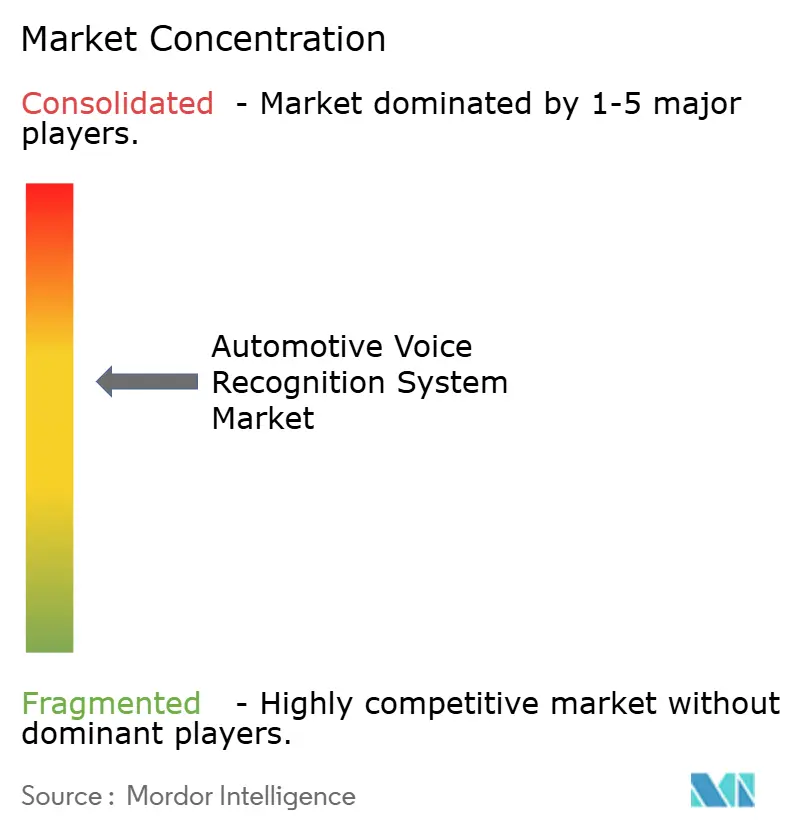
| Market Concentration | Medium |
Major Players *Disclaimer: Major Players sorted in no particular order Image © Mordor Intelligence. Reuse requires attribution under CC BY 4.0. | |
Automotive Voice Recognition System Market Analysis by Mordor Intelligence
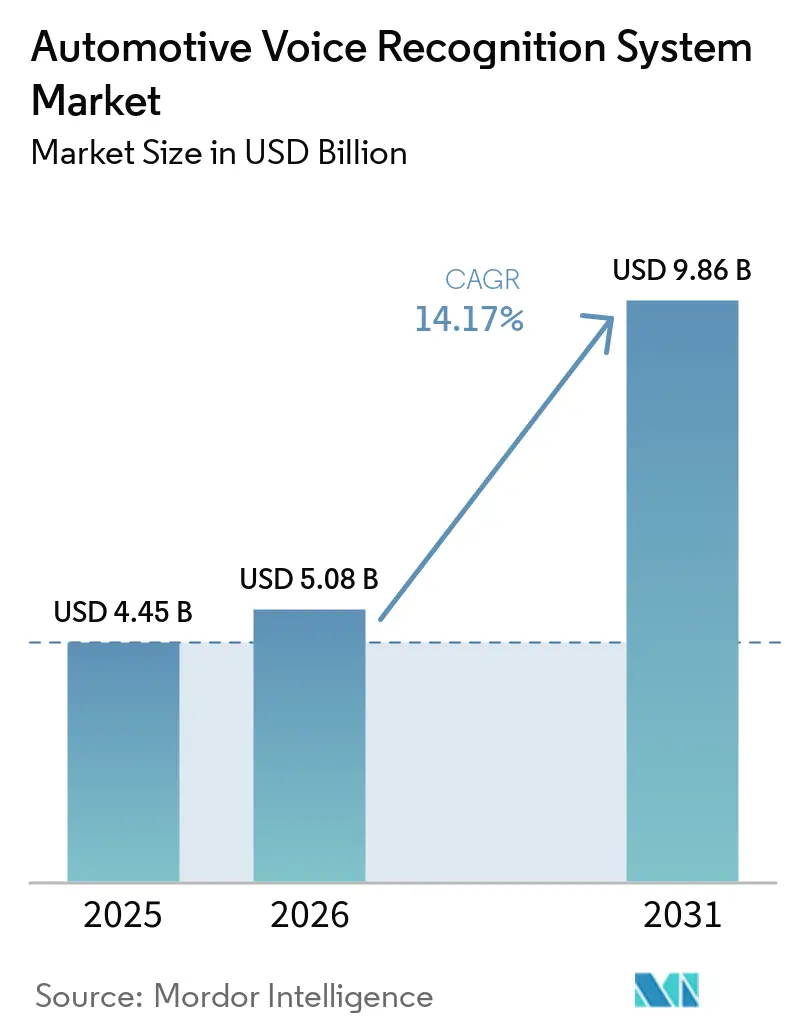
The Automotive Voice Recognition System market size was valued at USD 4.45 billion in 2025 and estimated to grow from USD 5.08 billion in 2026 to reach USD 9.86 billion by 2031, at a CAGR of 14.17% during the forecast period (2026-2031). Accelerating growth stems from three converging shifts: connected-car ecosystems now treat voice as the primary user interface, edge-AI chips slash on-device processing costs, and regulators tighten rules on distraction-free driving. Automakers have begun treating voice as a revenue engine, bundling subscription services and in-vehicle commerce that extend well beyond simple command execution.
Key Report Takeaways
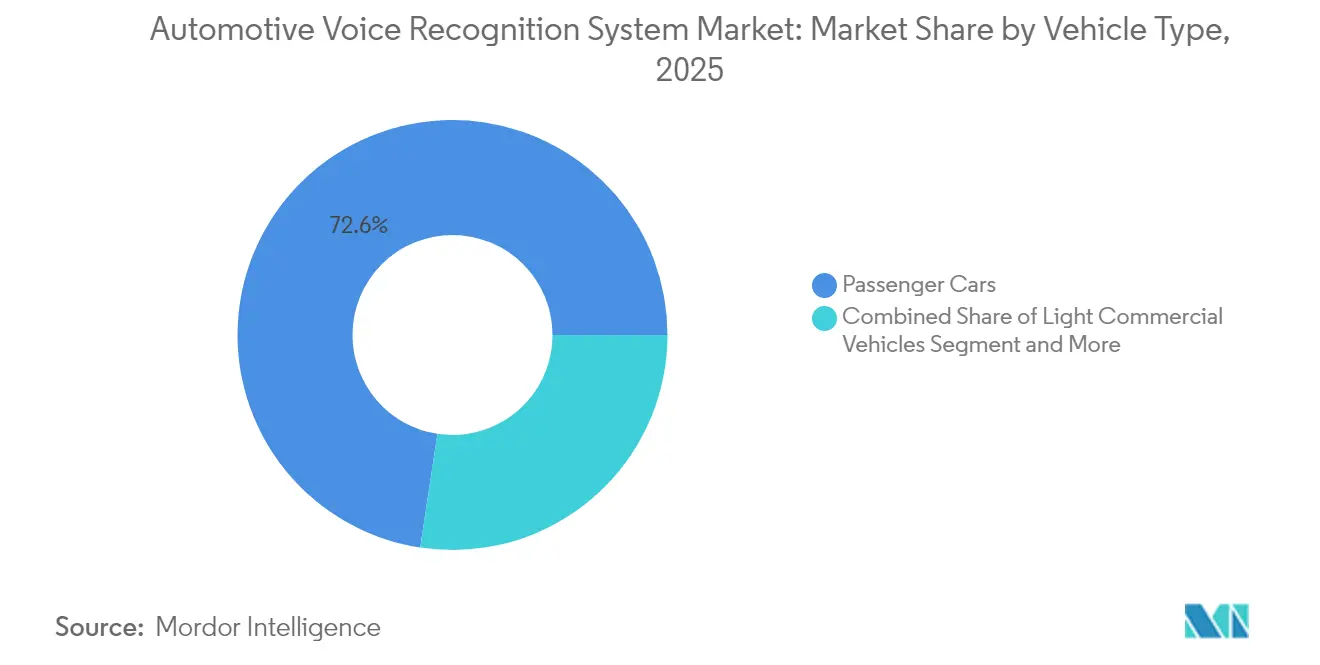
- By vehicle type, passenger cars led with 72.60% of the Automotive Voice Recognition System market share in 2025, while Commercial Vehicles are projected to expand at 14.62% CAGR through 2031.
- By technology, embedded solutions accounted for 53.80% of the Automotive Voice Recognition System market size in 2025; the Cloud-based segment is on track for the fastest 14.65% CAGR to 2031.
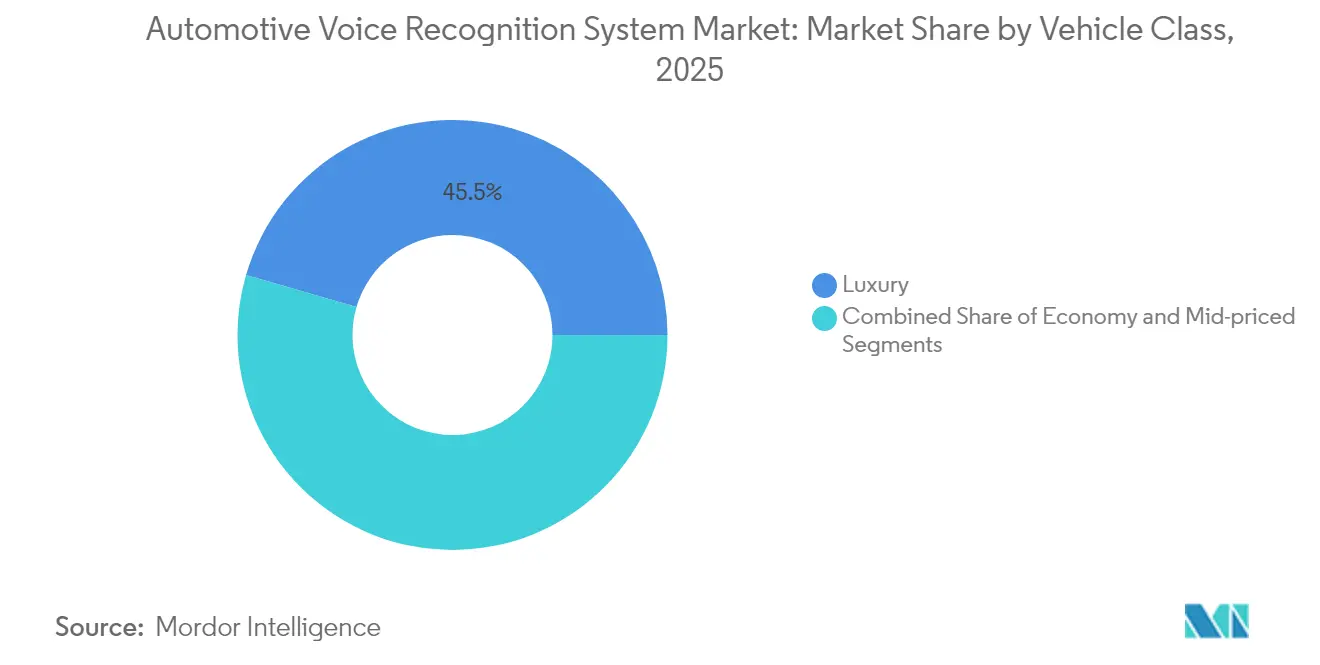
- By vehicle class, luxury models captured 45.50% revenue share in 2025, yet Economy vehicles are forecast to climb at 14.32% CAGR.
- By microphone array design, single-microphone layouts held a 31.70% share in 2025, whereas beam-forming arrays will post a 13.72% CAGR through 2031.
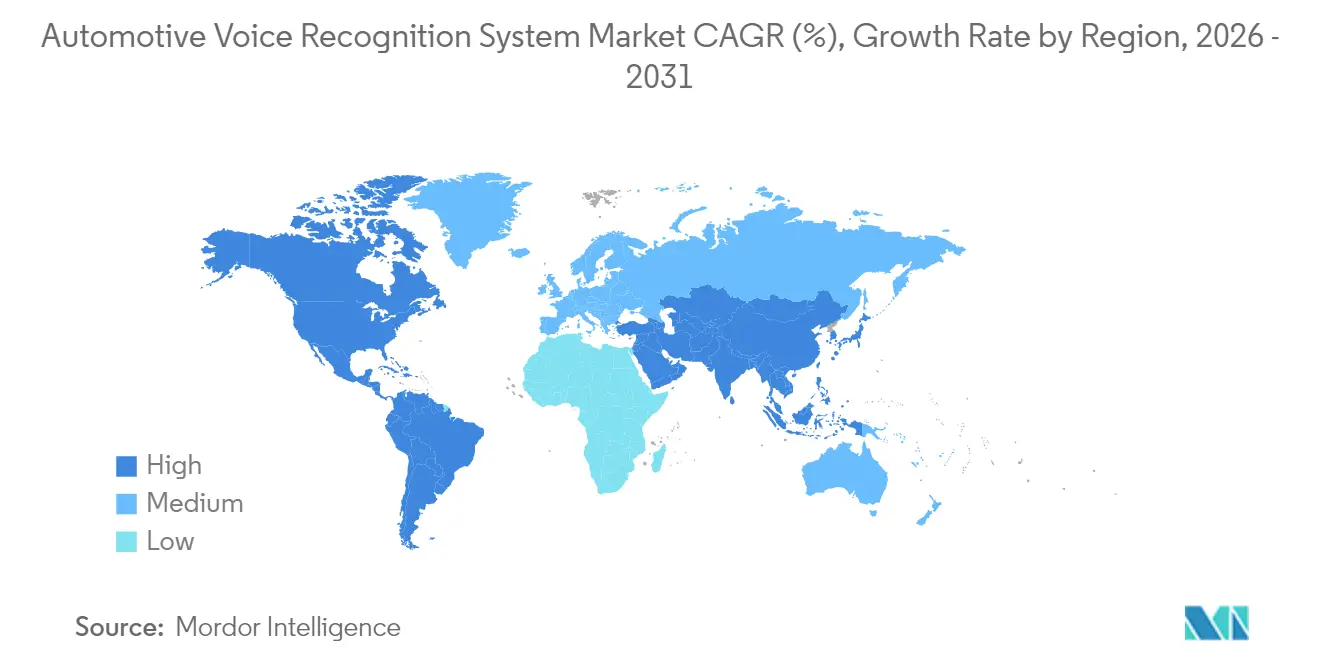
- By geography, North America maintained a 37.10% share in 2025; Asia Pacific is the high-growth region with a 14.78% CAGR to 2031.
Note: Market size and forecast figures in this report are generated using Mordor Intelligence’s proprietary estimation framework, updated with the latest available data and insights as of 2026.
Market Trends and Insights
Drivers Impact Analysis of Automotive Voice Recognition System Market*
| Driver | (~) % Impact on CAGR Forecast | Geographic Relevance | Impact Timeline |
|---|---|---|---|
| Connected-Car Ecosystems | +3.2% | Global (North America, Europe early) | Medium term (2-4 years) |
| Luxury and Premium Vehicle Penetration | +2.8% | North America, Europe, China | Short term (≤ 2 years) |
| In-Cabin Distraction Regulations | +2.1% | Europe, North America, APAC spillover | Long term (≥ 4 years) |
| Edge-AI Chip Cost | +1.9% | Global (manufacturing in APAC) | Medium term (2-4 years) |
| OEM Monetisation | +1.7% | North America, Europe, APAC expansion | Long term (≥ 4 years) |
| Driver-Health Monitoring Integration | +1.4% | Global (focus Europe, North America) | Long term (≥ 4 years) |
| Source: Mordor Intelligence | |||
Rising Adoption of Connected-Car Ecosystems
Connected-car platforms now link vehicle functions, smart-home devices, and third-party apps through a unified voice layer. Volkswagen’s rollout of Cerence Chat Pro enables conversational control over navigation, weather, and commerce from a single interface.[1] Over-the-air updates continually sharpen recognition accuracy and add new skills, helping brands keep pace with user expectations. Partnerships such as SoundHound AI with Tencent extend these benefits into mobility super-apps that bridge in-car and mobile experiences.[2] As ecosystems mature, authenticated voice commerce unlocks new revenue streams for automakers, further reinforcing voice as the default human-machine channel.
Surge in Luxury & Premium Vehicle Penetration
Premium marques deploy voice as a signature experience to justify higher sticker prices. The 2025 Mercedes-Benz S-Class introduced AI-powered assistants able to recognise individual occupants and anticipate preferences. Jaguar Land Rover’s collaboration with Cerence adds emotion detection and multilingual support to bolster brand differentiation. Such luxury rollouts absorb early cost premiums, allow software refinement in low-volume settings and pave the way for cost-down migration to mid-segment vehicles. Subscription add-ons in premium segments also validate monetisation models that mainstream brands later replicate.
Tighter In-Cabin Distraction Regulations
Regulatory frameworks increasingly mandate hands-free interaction capabilities, positioning voice recognition as essential safety technology rather than optional convenience features. In the United States, NHTSA’s Section 24220 mandate for driver-impairment detection from 2026 further boosts demand for speech-based monitoring capable of spotting drowsiness through vocal biomarkers. These rules lock voice into vehicle roadmaps regardless of consumer tastes. Further, the UN Economic Commission for Europe's new regulations for additional driver assistance systems further emphasize voice interaction as a key component of connected and automated mobility frameworks.[3]
Edge-AI Chip Cost Declines
Dramatic reductions in edge-AI chip costs are enabling on-device voice processing that addresses privacy concerns while improving response times and reducing connectivity dependencies. Syntiant's achievement of 100% acceleration in large language model performance for edge devices demonstrates how specialized processors make sophisticated voice recognition economically viable for mass-market vehicles. SoundHound AI's collaboration with NVIDIA to develop on-device voice assistants that operate without cloud connectivity illustrates how edge processing enables real-time responses while maintaining user privacy. These advances solve privacy and coverage gaps, letting OEMs run core commands locally and reserve the cloud for generative tasks.
Restraints Impact Analysis of Automotive Voice Recognition System Market*
| Restraint | (~) % Impact on CAGR Forecast | Geographic Relevance | Impact Timeline |
|---|---|---|---|
| Hardware Retrofit Costs | -2.3% | Global, with higher impact in price-sensitive markets | Short term (≤ 2 years) |
| Accent and Dialect Accuracy Gaps | -1.8% | APAC, South America, Africa, Middle East | Medium term (2-4 years) |
| Data-Privacy Compliance Burden | -1.5% | Europe and China core, expanding globally | Long term (≥ 4 years) |
| RF Interference from Multi-Sensor Cockpits | -1.2% | Global, with higher impact in premium vehicles | Medium term (2-4 years) |
| Source: Mordor Intelligence | |||
Up-Front Hardware Retrofit Costs
Substantial upfront investments required for voice recognition hardware integration create significant barriers for automakers operating in price-sensitive markets and existing vehicle retrofitting scenarios. These costs are compounded by the need for electromagnetic compatibility solutions to address RF interference, requiring additional shielding and filtering components that further increase implementation expenses. Cerence Link's OBD-port solution represents one approach to retrofit challenges, but such aftermarket solutions typically offer limited functionality compared to integrated systems. The cost burden is particularly acute for commercial vehicle operators who must balance voice system benefits against fleet acquisition costs, though emerging evidence suggests voice technology's operational efficiency gains can justify the investment over time.
Accent and Dialect Accuracy Gaps in Emerging Markets
Voice error rates remain 2–3× higher for Indian English or African dialects than for standard American English, frustrating users and denting brand perception. The challenge is compounded in markets like India, where multiple languages and regional dialects create complex recognition requirements that current systems struggle to address effectively. Until accent coverage improves, uptake in multilingual markets will lag headline growth.
*Our forecasts treat driver/restraint impacts as directional, not additive. The impact forecasts reflect baseline growth, mix effects, and variable interactions.
Automotive Voice Recognition System Market Segment Analysis
By Vehicle Type:
Commercial Fleets Drive Voice AdoptionPassenger Cars still command 72.60% of 2025 shipments, yet their growth curve will plateau relative to fleet-driven demand. Learnings from round-the-clock commercial duty cycles feed refinements back into consumer interfaces, raising reliability expectations. As regulatory thresholds tighten for distraction metrics, passenger models increasingly inherit fleet-proven microphone arrays and edge-processing chips, ensuring consistency across brand portfolios.
Commercial Vehicles, although contributing a smaller base, will outpace the broader Automotive Voice Recognition System market at a 14.62% CAGR through 2031. Fleet operators quantify return on investment via reduced distraction-related incidents and faster dispatch communications. Light commercial vans increasingly ship with voice-activated work-order logging, while heavy trucks pair assistants with telematics to vocalise predictive-maintenance alerts. These tangible savings persuade fleet owners to specify voice as standard spec, reinforcing unit volumes that, in turn, dilute per-vehicle costs for passenger cars.

By Technology:
Cloud-Based Solutions Accelerate Despite Privacy ConcernsEmbedded processing remains the workhorse, anchoring 53.80% of 2025 revenue because it satisfies GDPR-centred privacy norms and guarantees service in low-coverage zones. However, cloud-centric architectures are scaling fastest at 14.65% CAGR, propelled by generative-AI services impossible to host on 16-bit microcontrollers. Volkswagen’s ChatGPT integration shows how on-demand cloud reasoning augments local command sets while retaining sub-second response times.
Hybrid topologies now blend the two, running wake-word and HVAC commands on the device while routing knowledge queries to remote GPUs. This split satisfies data-protection regulators yet unleashes richer experiences, making hybrid likely to dominate the Automotive Voice Recognition System market share beyond 2028. Suppliers that orchestrate seamless hand-offs between edge and cloud thus occupy pivotal positions in OEM roadmaps.
By Vehicle Class:
Economy Segment Democratises Voice TechnologyLuxury cars captured 45.50% of 2025 spend because early adopters valued premium assistants with mood sensing and personalised lighting scripts. Yet the economy segment will post the sharpest 14.32% CAGR as microphone and DSP costs slide beneath USD 30 per vehicle. Manufacturers now pre-pack basic speech control for navigation, music, and calls in entry variants, mirroring the earlier diffusion path of touchscreen head-units.
Mid-segment sedans serve as a technology bridge, offering hybrid processing and over-the-air vocabulary expansions that acclimate mass-market buyers to voice. The democratisation loop is self-reinforcing: rising economy volumes widen data capture for accent fine-tuning, which then improves recognition further and unlocks additional use cases such as micro-commerce even in budget cars.
By Microphone Array Design:
Beam-Forming Technology EmergesSingle-mic solutions remain prevalent in small cars owing to minimal hardware and calibration needs. Dual-mic arrays gain share in midsize vehicles where cabin length demands directionality. The most dynamic segment is beam-forming arrays projected to grow at 13.72% CAGR. Suppliers such as Kardome squeeze six-speaker separation into one compact array, eliminating wiring complexity while isolating voice signals in noisy cabins.
HARMAN’s exterior beam-forming mics extend interaction to outside the vehicle, enabling drivers to open trunks or summon parking maneuvers verbally. As price points drop, beam-forming will shift from premium line-ups into mainstream, improving accuracy for occupants in all seat rows and supporting hands-free compliance for legislation targeting rear-seat distraction.
Geography Analysis
North America Automotive Voice Recognition System Market
North America accounted for 37.10% of 2025 revenue, underpinned by ubiquitous smartphone assistant usage and early embrace of in-car voice commerce. US OEMs bundle food-ordering, fuel-payment, and subscription media inside voice dashboards that expand recurring revenue streams beyond the original sale. Canada accentuates bilingual English-French processing, compelling suppliers to optimise language-switching algorithms. While regional growth cools from earlier highs, upcoming NHTSA driver-impairment mandates create a fresh floor for demand by 2026.
APAC Automotive Voice Recognition System Market
Asia Pacific is the fastest climber, with a 14.78% CAGR that will lift its Automotive Voice Recognition System market share materially by 2031. China’s domestic automakers embed Baidu and Tencent assistants as default user interfaces, leaning on 5G networks to serve generative AI queries. Great Wall Motor’s global expansion program relies on Cerence for multilingual rollout across right-hand and left-hand drive markets. India’s push for regional-language recognition fuels model training runs that raise system robustness worldwide. Japan emphasises elder-friendly features such as medication reminders, shaping inclusive design frameworks exported globally.
Europe Automotive Voice Recognition System Market
Europe maintains steady adoption, driven less by gadget enthusiasm than by safety and privacy regulation. GDPR steers OEMs toward on-device processing or consent-controlled cloud hand-offs, while Euro NCAP’s 2026 rating updates make hands-free control indispensable for touchscreen-heavy interiors. Volkswagen Group’s pan-brand ChatGPT upgrade demonstrates how European players reconcile privacy with AI capability through anonymised, opt-in data flows. Growing demand for multi-language support across 24 official EU tongues also pushes suppliers to invest in accent coverage.
Regulatory Landscape
Regulatory pressure is increasingly positioning in-vehicle voice interaction as a safety-critical HMI element rather than a convenience feature, bringing it into type-approval and safety management processes. In Europe, the EU AI Act frames certain vehicle AI as "high-risk" when it functions as a safety component under Union harmonisation legislation (notably the General Safety Regulation 2019/2144 and Type Approval Regulation 2018/858). It also ties conformity assessment to established UN-ECE type-approval pathways, including the Article 43(3) approach of integrating AI Act assessments into existing procedures.
For connected voice systems that rely on OTA feature delivery and cloud hand-offs, compliance is increasingly linked to UNECE WP.29 cybersecurity and software-update governance. This includes UNECE R155 (Cyber Security Management System) and R156 (Software Update Management System). At the system engineering level, functional safety expectations are anchored by ISO 26262 processes (hazard analysis, risk assessment, and traceability). UNECE WP.29 workstreams for automated driving functions are also shaping requirements around hands-free audio performance and intelligibility in vehicles equipped with advanced driving features.
Value Chain Analysis
The value chain covers microphone and acoustic front-end hardware (single, dual, and beam-forming arrays), in-cabin ECUs and edge-AI silicon that support embedded wake-word and core-command execution, and the software layer (ASR/NLU, dialogue management, and increasingly LLM-based agent orchestration). Tier-1 integrators and cockpit domain suppliers (including HARMAN, Bosch, and Continental) bundle microphones, amplifiers, and in-vehicle compute with voice stacks. Specialist voice-AI vendors such as Cerence and SoundHound AI provide automotive-grade recognition models, toolchains, and commerce-capable conversational layers that OEMs can integrate into brand assistants.
Cloud infrastructure and platform partners increasingly sit alongside traditional automotive suppliers as OEMs adopt hybrid architectures. These split workloads between on-device command execution and cloud reasoning. Recent partnerships show how the chain is being unbundled and recombined: Mercedes-Benz expanded work with Google Cloud around an Automotive AI Agent for the MBUX Virtual Assistant. SoundHound AI brought generative-AI voice capabilities into Lucid vehicles and partnered with Tencent Intelligent Mobility to embed conversational AI into intelligent cockpit solutions. On the OEM program side, Cerence expanded multi-year engagements (including JLR) and advanced deployments with Volkswagen Group through upgraded assistants, aligning with a procurement model where OEMs contract directly for AI software capabilities while using Tier-1s for validated hardware integration and vehicle-network access.
Competitive Landscape
Competition blends consumer-tech titans, automotive Tier-1s, and focused AI startups. Players like Cerence lead with supply deals covering a significant portion of light-vehicle production, leveraging domain-specific acoustic models and OEM toolkits. Tech conglomerates Microsoft, Amazon, and Google enter via Android Automotive OS and Alexa Auto integrations, offering cloud heft but limited car-grade acoustics. Continental, Bosch and HARMAN defend share by fusing microphones, amplifiers and software into turnkey cockpit modules, easing OEM validation cycles.
Strategic mergers intensify: Gentex bought VOXX to marry premium Klipsch audio with its mirror-based electronics, bolstering cabin acoustics critical for high-accuracy voice. SoundHound AI acquired Amelia to deepen natural-language reasoning and cross-sell solutions to automotive and enterprise clients. Startups such as Syntiant and Kardome carve niches in ultra-low-power silicon and beam-forming, respectively, pressuring incumbents to innovate or partner.
As OEMs pivot to software-as-a-service, revenue shifts to post-sale subscriptions. Suppliers able to furnish commerce APIs, OTA upgrade pipelines and data analytics gain long-term contracts. Consequently, the market rewards companies offering both deep acoustic science and cloud-scale monetisation platforms.
Automotive Voice Recognition System Industry Leaders
-
Alphabet Inc.
-
Amazon.com, Inc.
-
Cerence Inc.
-
Harman International (Samsung)
-
Nuance Communications (Microsoft)
- *Disclaimer: Major Players sorted in no particular order
Automotive Voice Recognition System Market Companies Covered in this Report
- Apple Inc.
- Alphabet Inc. (Google)
- Harman International Industries
- Nuance Communications Inc.
- Cerence Inc.
- Continental AG
- Amazon.com Inc.
- Bosch GmbH
- SoundHound AI Inc.
- IBM Corporation
- Sensory Inc.
- Baidu Inc.
- LG Electronics
- Valeo SA
- BlackBerry QNX
- iNAGO Corporation
- Yandex LLC
- Kardome Technology Ltd
- Voicebox Technologies
Read Analysis of Automotive Voice Recognition System Companies
Market Opportunities and Future Outlook
One clear opportunity is the migration from command-and-control voice to LLM-based, multi-intent agents that are tightly coupled to vehicle functions and content sources (owner manuals, settings, navigation, and commerce). This shift is visible in 2026 rollouts and announcements, including Google initiating Gemini availability for vehicles with Google built-in, and Volvo Cars rolling out Gemini via over-the-air updates to eligible models dating back to 2020. Renault also began an OTA update to replace Google Assistant with Gemini on vehicles using OpenR Link. By expanding from discrete commands to contextual dialog, the software content per vehicle grows and hybrid edge-cloud implementations gain traction to balance latency, privacy, and capability.
A second whitespace is embedded, privacy-preserving intelligence that reduces reliance on continuous connectivity and simplifies data-handling obligations as safety and cybersecurity expectations tighten. Mercedes-Benzs multi-year partnership with Liquid AI, focused on embedded, on-device large foundation models for in-car voice and language recognition, points to demand for on-device performance that still supports advanced interaction patterns. Standardization can also support scalable microphone and sensor integration for automated driving architectures, with ISO publishing ISO 23150-15:2026 for logical interfaces to microphone sensors and sensor clusters. This provides a clearer pathway for suppliers to industrialize beam-forming and multi-mic designs across vehicle lines.
Recent Industry Developments in Automotive Voice Recognition System Market
- January 2026: Cerence launched Cerence xUI, positioning it as a hybrid, agentic AI platform for automotive manufacturers, and named Geely Auto as a deployment partner for an LLM-powered in-car AI experience. The announcement pointed to a shift from fixed-command assistants toward orchestrated, multi-skill agents that can be deployed across OEM lineups with a defined software platform layer.
- September 2025: Cerence announced a collaboration with Suzuki Motor Corporation to provide an in-car assistant for the e VITARA battery electric vehicle. The program extends OEM adoption beyond premium segments and reinforces the role of dedicated automotive voice vendors in mass-market EV platforms.
- April 2024: Mercedes-Benz and Liquid AI announced a multi-year embedded AI partnership to deploy on-device voice and language models across multiple Mercedes-Benz model lines. This reflects a shift toward in-cabin intelligence with reduced reliance on cloud connectivity.
Automotive Voice Recognition System Market Report Scope and Research Methodology
Market Definition and Coverage
For this study, the market includes voice recognition systems used inside vehicles to understand spoken commands and convert them into actions for functions like calling, navigation, media, and vehicle settings. The scope covers embedded, cloud-based, and hybrid solutions sold for passenger and commercial vehicles across major regions.
Scope exclusions: We exclude general consumer voice assistants used outside vehicles, aftermarket standalone microphones not integrated with vehicle systems, and professional services that are not bundled with the voice recognition solution.
Segments Covered in This Report
- By Vehicle Type
- Passenger Cars
- Light Commercial Vehicles
- Heavy Commercial Vehicles
- By Technology
- Embedded
- Cloud-based
- Hybrid
- By Vehicle Class
- Economy
- Mid-priced
- Luxury
- By Microphone Array Design
- Single-mic
- Dual-mic
- Beam-forming mic
- By Geography
- North America
- United States
- Canada
- Rest of North America
- South America
- Brazil
- Argentina
- Rest of South America
- Europe
- Germany
- United Kingdom
- France
- Italy
- Spain
- Russia
- Rest of Europe
- Asia Pacific
- China
- Japan
- India
- South Korea
- Australia
- Rest of Asia Pacific
- Middle East and Africa
- Turkey
- Saudi Arabia
- United Arab Emirates
- South Africa
- Rest of Middle East and Africa
- North America
Data Sources, Market Sizing, and Validation
Desk Research
Desk research starts by mapping what is installed in vehicles today and how quickly that penetration is changing across key countries and vehicle classes. We used public sources such as US NHTSA road safety and distraction-related publications, the European Commission pages on transport and vehicle safety, Japan MLIT vehicle and safety references, and OICA production statistics, which help anchor both the vehicle parc and the new production base.
To turn the vehicle base into a revenue view, we reviewed company annual reports, earnings decks, and product literature describing in-vehicle infotainment and voice feature roadmaps. Patent databases were used selectively to understand where on-device and cloud voice processing is moving, which supports the timing of adoption assumptions. A paid subscription for company financials and intelligence, along with a news and financials feed, was used to cross-check supplier exposure, partnership announcements, and major design wins. These sources are illustrative only, and we also used other public and paid references to collect, validate, and clarify inputs.
Primary Interviews and Surveys
Primary work was used to sanity-check adoption rates, average selling price direction, and which features are counted as paid options versus bundled infotainment capability. We spoke with a mix of OEM-facing suppliers, software providers, and channel participants, and then checked the inputs across the Americas, EMEA, and APAC so regional take rates and regulation-driven behavior were not overgeneralized.
Distribution of primary research fieldwork respondents
| Company type | Respondent position | Region |
|---|---|---|
| Top tier: 37% | CXOs: 16% | APAC: 47% |
| Mid tier: 41% | Functional/Unit leaders: 37% | EMEA: 34% |
| Smaller Players: 22% | Managers: 47% | Americas: 19% |
Market-Sizing & Forecasting
The core model uses a top-down approach where vehicle production and parc indicators are reconstructed by region, and then converted into an addressable demand pool using voice feature penetration and fitment rates by vehicle class. After forming the volume base, we apply typical system value ranges and expected price changes for embedded versus cloud-based deployments.
Inputs that matter in this market include new vehicle production by region, the share of vehicles shipped with infotainment and connected features, voice recognition take rates for passenger and commercial vehicles, the split between embedded and cloud processing (which changes bill of materials and licensing), and the adoption pace of multilingual and natural language capability. We adjusted these variables using interview feedback where published data is thin, especially for option packaging and mid-cycle refresh impacts.
Forecasts were built using scenario analysis with a central case reflecting expected penetration increases and gradual ASP normalization as voice features move from premium trims into mid-priced vehicles. We used bottom-up checks selectively through sampled supplier revenue exposure, channel checks on typical per-vehicle value, and volume-by-ASP approximations for large producing regions. For gaps, we applied conservative penetration ranges rather than forcing precise figures where visibility is limited.
Data Validation & Update Cycle
Model outputs are triangulated against independent signals such as vehicle production trends, connected feature penetration, and observed launch cycles for infotainment platforms. When an outlier appears, we recheck the assumptions behind take rate, regional mix, or pricing, and trigger follow-up calls if the variance cannot be explained by a documented event.
Before sign-off, the work goes through multiple analyst review steps so the arithmetic, definitions, and implied growth rates stay consistent across regions and years. Reports are refreshed annually, and interim updates are made when material events occur, such as major regulation changes or step shifts in OEM rollout plans. Right before delivery, a final pass ensures the latest public indicators and news checks are reflected.
Mordor Intelligence's Automotive Voice Recognition System Market Size Measured Against Other Published Estimates
Published figures for this market do not always align, even when the topic name looks the same, because the boundary of what is counted can shift quietly. Differences usually come from whether the estimate counts only in-vehicle voice recognition software and modules, or if it also includes adjacent in-car voice assistant content, hardware, and wider infotainment bundles.
Vehicle production by region, observed infotainment rollout cycles, and voice feature take-rate checks are the evidence points used to keep the estimate tied to installed systems and realistic pricing, which is why Mordor Intelligence reports a higher 2026 value than some smaller-scope publications that anchor on earlier base years.
Benchmark comparison
| Source | Market Size | Gaps in Research Methodology |
|---|---|---|
| Mordor Intelligence | USD 5.08 B (2026) | |
| Trade Journal A | USD 3.20 B (2025) | Uses an earlier base year and mixes a narrower definition that often excludes embedded-only systems that are bundled with infotainment, which compresses the revenue captured per vehicle. |
| Global Consultancy B | USD 4.49 B (2029) | Starts from a 2022 base and reports a shorter horizon, and the build appears to rely more on supplier-reported shipments with limited adjustment for regional take-rate differences and option packaging. |
The table shows that most of the spread is explained by base year choice and what gets counted as part of a voice recognition system versus a broader cockpit feature set. By keeping inputs traceable to vehicle volumes, take rates, and realistic per-vehicle value ranges, the final number stays reproducible and easier to stress-test when assumptions change.
Key Questions Answered in the Report
What is the current value of the Automotive Voice Recognition System market?
The Automotive Voice Recognition System market size stood at USD 5.08 billion in 2026 and is forecast to reach roughly USD 9.86 billion by 2031.
Which vehicle segment is growing the fastest?
Commercial Vehicles are expanding at a 14.62% CAGR as fleet owners adopt voice to cut distraction and streamline dispatch.
How will upcoming Euro NCAP rules affect adoption?
Euro NCAP’s 2026 mandate for physical buttons elevates voice as the safest way to manage secondary tasks, ensuring continued deployment across new models.
What technology architecture is likely to dominate?
Hybrid systems that process simple commands on-device while sending complex queries to the cloud are expected to command the majority share post-2028.
Why are edge-AI chips important for voice?
Falling silicon costs allow large language models to run locally, boosting privacy, lowering latency and enabling reliable service even where connectivity is poor.