
Automotive Ventilated Seats Market Size and Share
Market Overview
| Study Period | 2020 - 2031 |
|---|---|
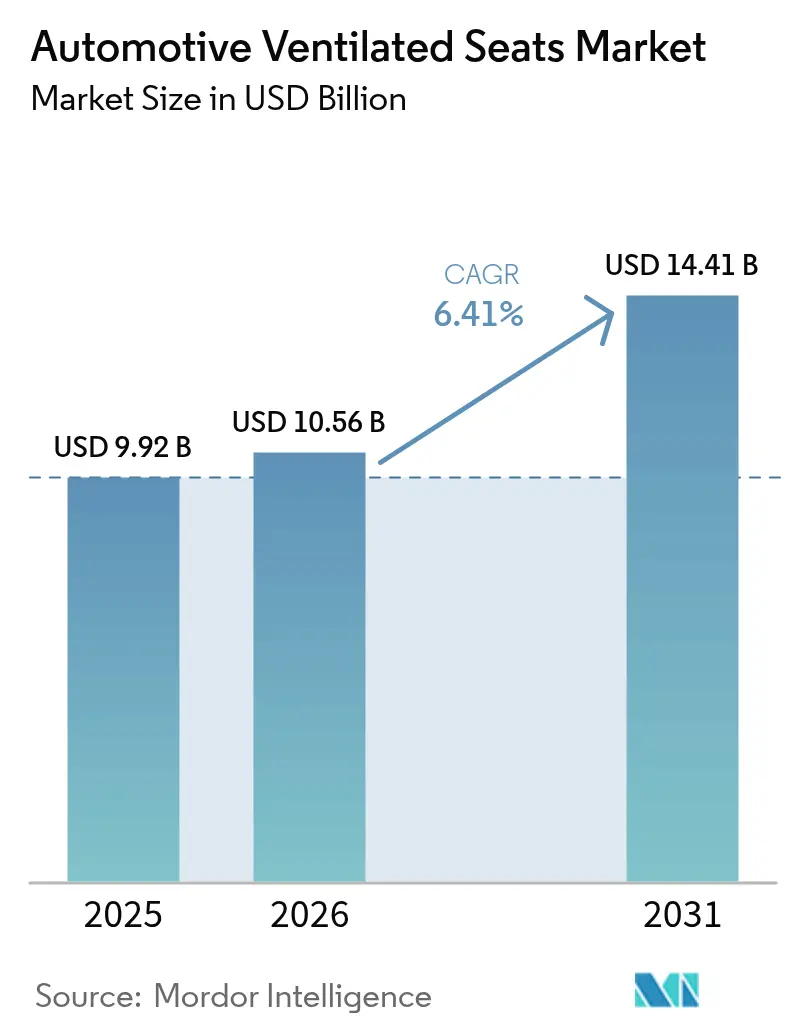
| Market Size (2026) | USD 10.56 Billion |
| Market Size (2031) | USD 14.41 Billion |
| Growth Rate (2026 - 2031) | 6.41 % |
| Fastest Growing Market | Asia Pacific |
| Largest Market | Asia Pacific |
| Market Concentration | Medium |
Major Players *Disclaimer: Major Players sorted in no particular order Image © Mordor Intelligence. Reuse requires attribution under CC BY 4.0. | |
Automotive Ventilated Seats Market Analysis by Mordor Intelligence
The Automotive ventilated seats market size was valued at USD 9.92 billion in 2025 and estimated to grow from USD 10.56 billion in 2026 to reach USD 14.41 billion by 2031, at a CAGR of 6.41% during the forecast period (2026-2031). Current growth comes from automakers pairing seat-level HVAC with broader electrification strategies, micro-blower efficiency gains, and falling perforated-foam costs. Asia-Pacific leads demand as Chinese electric-vehicle production scales, while North American and European OEMs widen fit rates in mid-range models. Competitive dynamics remain moderate because established thermal-comfort suppliers still control core component technology, but start-ups focused on sustainable materials and energy-saving algorithms are adding pressure. Over the next five years, regulatory attention on driver fatigue, along with premium shared-mobility upgrades, is set to keep the ventilated seats market on a steady expansion path.
Key Report Takeaways
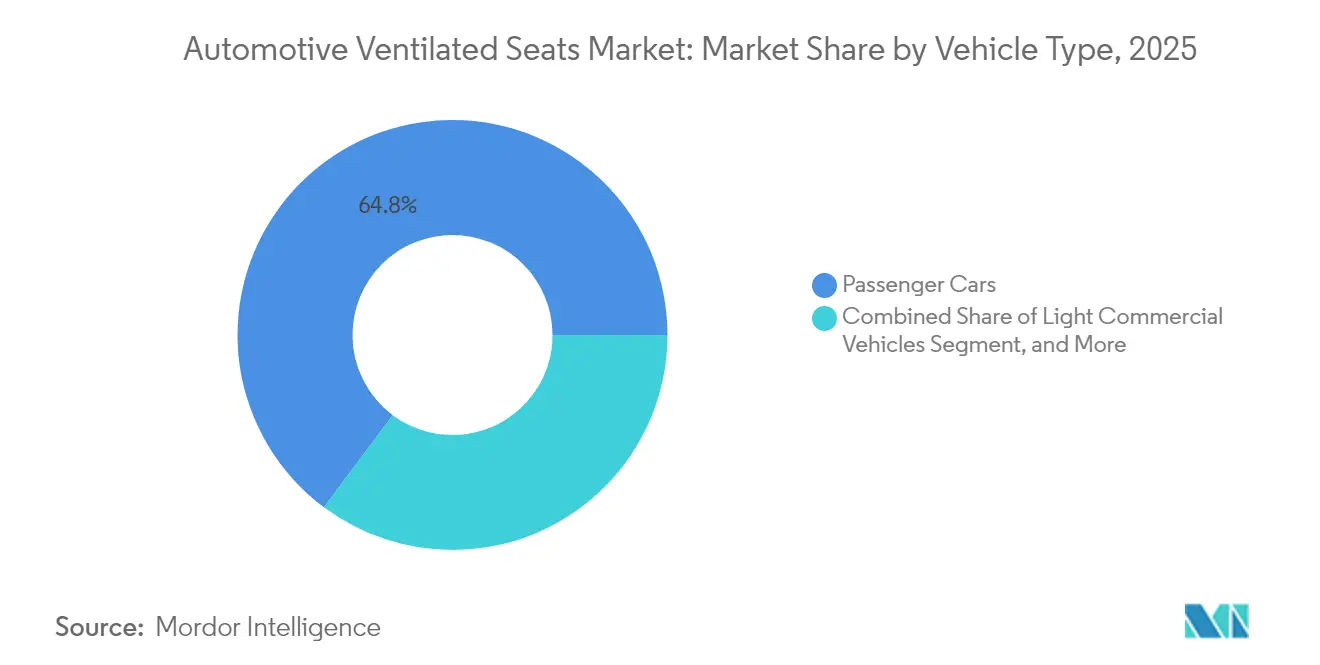
- By vehicle type, passenger cars held 64.80% of the ventilated seats market share in 2025; the segment also records the fastest 8.05% CAGR through 2031.
- By propulsion, the Internal Combustion Engine held 78.60% of the market share. On the other hand, battery electric vehicles are projected to post a 12.10% CAGR to 2031, the quickest pace among powertrains in the ventilated seats market.
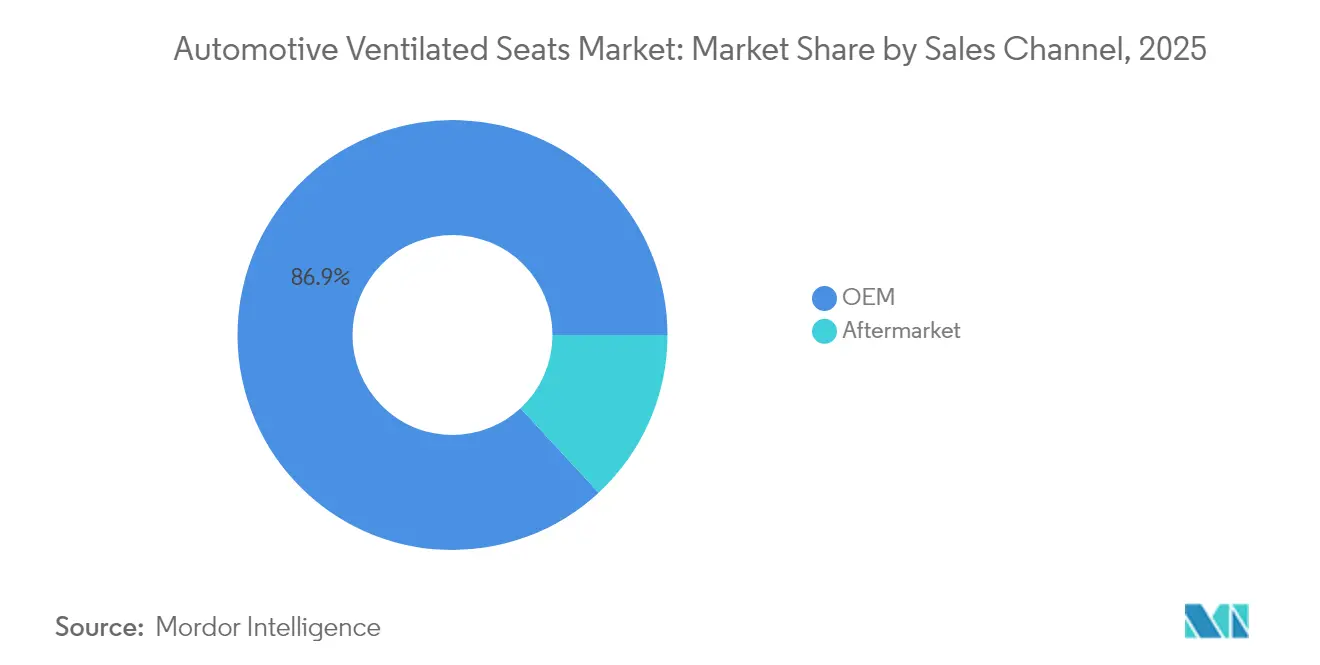
- By sales channel, the OEM segment commanded 86.90% share of the ventilated seats market size in 2025, while the aftermarket is forecast to expand at 8.95% CAGR through 2031.
- By seat-trim material, synthetic leather accounted for 47.80% of the ventilated seats market size for seat materials in 2025 and is expected to grow at an 7.98% CAGR.
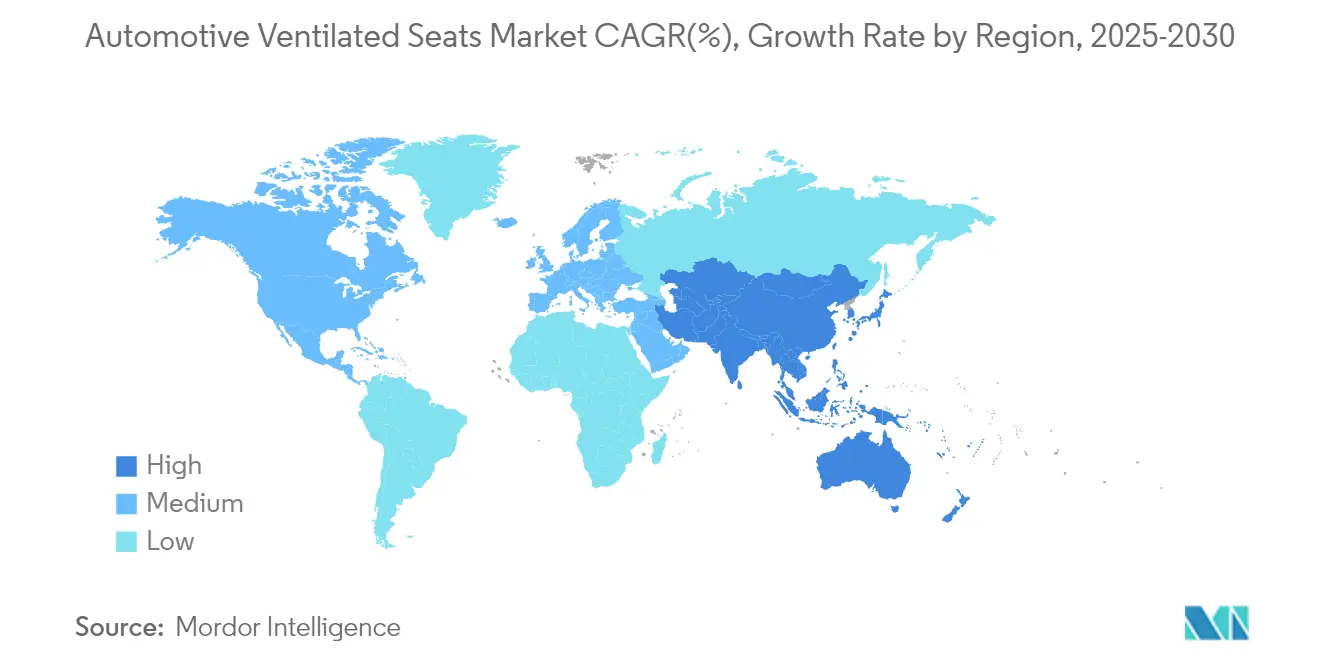
- By geography, Asia-Pacific dominated with a 45.00% share in 2025 and is advancing at an 8.45% CAGR through 2031.
Note: Market size and forecast figures in this report are generated using Mordor Intelligence’s proprietary estimation framework, updated with the latest available data and insights as of 2026.
Market Trends and Insights
Drivers Impact Analysis of Automotive Ventilated Seats Market*
| Driver | (~) % Impact on CAGR Forecast | Geographic Relevance | Impact Timeline |
|---|---|---|---|
| Surge in EV sales enabling seat-level HVAC | +2.1% | China, Europe, North America | Long term (≥ 4 years) |
| Rising consumer demand for enhanced cabin comfort | +1.8% | Global; premium uptake in North America & Europe | Medium term (2 – 4 years) |
| OEM feature-differentiation in mid-range models | +1.2% | Asia-Pacific core; spill-over to North America | Short term (≤ 2 years) |
| Cost decline in micro-blower and perforated-foam technologies | +0.9% | Global manufacturing hubs, especially Asia-Pacific | Medium term (2 – 4 years) |
| Fatigue-health regulations | +0.6% | Europe, North America; expanding to Asia-Pacific | Long term (≥ 4 years) |
| Premium shared-mobility fleet upgrades | +0.4% | Urban centers worldwide, led by China & North America | Short term (≤ 2 years) |
| Source: Mordor Intelligence | |||
Rising Consumer Demand for Enhanced Cabin Comfort
Cabin expectations have shifted as cars become mobile living spaces. Ventilated seats now rank among the three most requested comfort features in hot-climate purchase surveys, and ownership cycles extending beyond a decade reinforce demand for upgrades. In high-temperature regions, localized seat cooling delivers faster relief than conventional air-conditioning, making it a critical differentiator in retail showrooms. Ride-sharing passengers add further pressure by normalizing premium amenities across price segments. Collectively, these factors place comfort at the center of brand-loyalty strategies and extend the addressable ventilated seats market.
OEM Feature-Differentiation in Mid-Range Models
Automakers in the USD 25,000–40,000 bracket are bundling ventilated seats to raise transaction prices without a luxury-brand badge. Lear’s ComfortMax modules, reaching production in 2025, deliver 40% quicker thermal response while cutting seat part count by half, lowering assembly complexity[1]Lear Corporation, “ComfortMax Seats Deliver Faster Thermal Response,” learnercorp.com. Modular kits allow wider model-mix coverage, accelerating penetration in Asia-Pacific, where value-conscious buyers accept moderate price premiums for tangible comfort.
Surge in EV Sales Enabling Seat-Level HVAC
Electric-vehicle architectures lack waste engine heat, making localized climate control vital for range preservation. Hyundai’s radiant heating concept trims HVAC energy draw by 17% yet keeps cabin comfort intact. Chinese battery-electric vehicles combine perforated foam with predictive software that pre-conditions seating surfaces, offsetting up to 30% of range loss in extreme weather. As EV sales climb, ventilated seats shift from optional luxury to functional energy-efficiency hardware, lifting the long-term growth curve of the ventilated seats market.
Cost Decline in Micro-Blower and Perforated-Foam Technologies
High-volume production in Xiamen and Suzhou is lowering micro-blower pricing while raising airflow and lowering noise. Delta Electronics’ PWM-controlled seat blowers now ship with EMC shielding and compact vibration mounts[2]Delta Electronics, “Automotive Seat Ventilation Blower Series,” delta.com. Parallel advances in laser-perforated synthetic leather and low-density polyurethane foams reduce component weight by 15% while preserving tactile quality. The resulting bill-of-materials savings unlock a broader mid-range customer base.
Restraints Impact Analysis of Automotive Ventilated Seats Market*
| Restraint | (~) % Impact on CAGR Forecast | Geographic Relevance | Impact Timeline |
|---|---|---|---|
| High system cost and complex integration | −1.4% | Global; particularly impacting emerging markets | Medium term (2 – 4 years) |
| Reliability and maintenance concerns | −0.8% | All regions; higher impact in harsh climates | Long term (≥ 4 years) |
| EV range anxiety over HVAC energy draw | −0.6% | EV-adopting regions, primarily Europe and China | Short term (≤ 2 years) |
| Cabin acoustic targets limiting fan noise levels | −0.4% | Premium vehicle segments globally | Medium term (2 – 4 years) |
| Source: Mordor Intelligence | |||
High System Cost and Complex Integration
Factory installations require tailored seat frames, wiring, and software calibration, keeping unit costs elevated for emerging-market models. Retrofit packages add hurdles such as air-path routing and controller CAN bus adaptation. Safety certification under Federal Motor Vehicle Safety Standard 207 mandates structural integrity checks whenever ventilation modules are inserted, prolonging validation cycles and constraining the ventilated seats market’s reach[3]National Highway Traffic Safety Administration, “Federal Motor Vehicle Safety Standard 207,” nhtsa.gov.
Reliability and Maintenance Concerns
Long service life in dusty or humid regions can cause clog perforations and fatigue in blower assemblies. Peer-reviewed HVAC reliability studies show blower modules account for half of all thermal-system failures, underscoring design-for-durability priorities. OEMs now embed self-diagnostics that flag restricted airflow, while Hyundai Transys’ eco-friendly slab padding improves wear resistance and VOC performance in one step. Even so, maintenance complexity still tempers buyer confidence outside premium segments.
*Our forecasts treat driver/restraint impacts as directional, not additive. The impact forecasts reflect baseline growth, mix effects, and variable interactions.
Automotive Ventilated Seats Market Segment Analysis
By Vehicle Type:
Passenger Cars Drive Premium AdoptionPassenger cars generated the majority share in 2025, capturing 64.80% of the ventilated seats market share amid an 8.05% CAGR outlook through 2031. Sport Utility Vehicle drive volume by bundling the feature in popular trim packs. Extended commute times and growing interest in driver-assistance packages amplify demand for seat-level climate control, especially where summer heatwaves lengthen. Fleet operators of light commercial vans are beginning to evaluate reduced fatigue benefits, yet upfront price gaps continue restraining adoption in heavy trucks and buses.
The segment’s momentum is set to expand the overall ventilated seats market size as mid-range sedans and compact Sport Utility Vehicles introduce value-grade modules that reuse premium components. Specialist suppliers are offering scalable platforms that drop into multiple body styles without major redesign, accelerating time to market. Over the forecast period, regional mandates targeting driver wellness could lift penetration in commercial passenger shuttles and ride-hailing fleets, reinforcing the passenger-car segment’s leadership.


By Propulsion Type:
Electric Vehicles Accelerate InnovationInternal-combustion platforms still dominate at 78.60% in 2025, yet battery electric vehicles are on a steeper trajectory with a 12.10% CAGR to 2031. The BEV tacker is propelled by the need to mitigate HVAC-induced range loss, prompting integration of seat ventilation with battery-thermal strategies. Yanfeng’s Smart Cabin Seats create individual micro-climates to cut cabin heat-soak before the main HVAC starts, exemplifying how BEV packaging flexibility benefits ventilated seat design. Hybrid and plug-in hybrid models play a transitional role, offering OEMs a testbed for advanced comfort algorithms without full EV constraints.
Rapid BEV growth means the ventilated seats market size linked to electric drivetrains is set to outpace the overall market. Suppliers that can miniaturize blowers and unify heating, cooling, and haptic feedback into one module stand to gain from tight EV packaging envelopes. Regulatory incentives that reward energy-efficient HVAC will further tilt development budgets toward BEV-optimized seating systems.
By Sales Channel:
Aftermarket Momentum BuildsOEM-installed systems retained 86.90% share in 2025, consistent with manufacturer warranty expectations and seamless design integration. Yet, the aftermarket is projected to post a 8.95% CAGR as owners of older vehicles seek comfort upgrades without replacing the entire car. Universal retrofit kits with plug-and-play controllers and slim blower modules are reducing labor time, broadening installer networks.
Despite momentum, aftermarket penetration faces obstacles including dependent air-path requirements and compatibility with airbag sensors. Seat suppliers are addressing these issues through detailed fitment guides and pre-tested wiring harnesses. As vehicle lifespans extend, the sizeable parc of eligible vehicles will keep the aftermarket a relevant growth pocket within the overarching ventilated seats market.
By Seat-Trim Material:
Synthetic Leather Dominates PerformanceSynthetic leather accounted for 47.80% of the ventilated seats market in 2025 and is forecast to grow 7.98% annually as engineered permeability supports stronger airflow than natural hides. Surface treatments resist UV degradation and staining, making them suitable for high-traffic ride-sharing fleets. Genuine leather retains prestige value but remains cost-intensive and difficult to perforate uniformly.
Material science advances are now aligning durability with sustainability. Dow’s collaboration with Adient and JLR is piloting closed-loop recycled foams that cut carbon while maintaining mechanical resilience. Such circularity efforts strengthen the synthetic category’s cost-competitiveness and environmental profile, supporting broader OEM adoption across segments.
Geography Analysis
APAC Automotive Ventilated Seats Market
Asia-Pacific held 45.00% of the ventilated seats market in 2025 and is expanding at an 8.45% CAGR through 2031. China anchors regional demand: electric vehicles already comprise 45% of its new-car sales, and localized suppliers such as QIANZE deliver 1,000 ventilated seat sets each month, helping OEMs contain costs. Japanese and South-Korean firms add technology depth; Hyundai Transys, for example, earned national certification for VOC-reduced padding that enhances airflow. Hot and humid Southeast-Asian climates further boost user appeal, while government subsidies on energy-efficient components align with ventilated seat adoption.
North America Automotive Ventilated Seats Market
North America’s mature passenger-car parc fosters steady replacement demand as comfort features migrate down-segment. Extended vehicle ownership cycles encourage retrofit activity, and collaborative programs between General Motors and Lear Corporation bring modular ComfortMax units to high-volume nameplates. Commercial fleets are evaluating ventilated driver seats to comply with forthcoming fatigue-management guidelines, creating new volume opportunities.
Europe Automotive Ventilated Seats Market
Europe focuses on premium integration and life-cycle emissions. FORVIA’s truck seat solution trimming CO₂ impact by 40% is emblematic of regional sustainability evolution. Legislative pressure on recyclability drives adoption of foam and cover stocks derived from post-consumer waste, positioning European OEMs at the forefront of circular seat component sourcing.
LATAM and MEA Automotive Ventilated Seats Market
Emerging markets across Latin America, the Middle East, and Africa show latent demand, but price sensitivity and service-network gaps slow penetration; localized assembly partnerships are expected to ease these hurdles by the late forecast years.

Regulatory Landscape
Automotive ventilated seats are regulated mainly through broader seating-system and occupant-protection rules, rather than ventilation-specific mandates. In the United States, Federal Motor Vehicle Safety Standard (FMVSS) No. 207 for seating systems anchors structural integrity and anchorage requirements that OEMs and Tier suppliers must validate when integrating ventilation hardware into seat frames and cushions. NHTSA also opened a May 2025 NPRM to remove obsolete requirements from FMVSS 207, indicating ongoing housekeeping of legacy seating provisions.
Internationally, UNECE regulations shape homologation pathways for seat strength and crash performance in many markets. UN Regulation No. 17 remains a common reference for seats and anchorages, while the EU published UN Regulation No. 80 in 2026 for seat strength in large passenger vehicles and UN Regulation No. 94 in 2026 for frontal-collision occupant protection. These texts influence seat structure design, validation, and documentation for programs that include ventilated seat modules.
Value Chain Analysis
The value chain starts with upstream materials and subcomponents, including seat trim (perforated synthetic leather, genuine leather, fabrics), molded foams, and airflow-path elements such as ducts and 3D spacer mesh that preserve air channels under occupant load. Electronics and electromechanical inputs cover micro-blowers or fans, motors, vibration mounts, wiring harnesses, controllers, and increasingly software logic that tunes airflow and noise. Tier-2 specialists supply motors and blowers, while Tier-1 seat integrators, including Lear, Adient, FORVIA, Toyota Boshoku, and others, combine ventilation with heating, massage, and lumbar systems into complete seat assemblies validated to OEM requirements.
Manufacturing and integration focus on repeatable airflow performance and NVH control, supported by processes such as precision perforation, foam molding with integrated air distribution features, and assembly steps that keep ducts and channels from collapsing. Tier-1 suppliers often run just-in-time/just-in-sequence delivery to OEM assembly plants and coordinate end-of-line testing for airflow, noise, and electrical diagnostics before shipment. Product-level moves such as Leggett Dynamics introducing a smart brushless motor in June 2026 reflect a push to simplify integration and support software-defined seating architectures, shifting the emphasis from discrete parts toward integrated comfort modules.
Competitive Landscape
The ventilated seats market features a cluster of large incumbents centered on thermal management technology. Gentherm, posting USD 1.5 billion in 2023 and adding USD 2.6 billion in fresh automotive awards. Lear, Adient, and Faurecia (FORVIA) are integrating blower control, massage, and heating into unified modules; Lear’s latest iteration cuts component count by 50% while exceeding previous airflow metrics. These firms also pursue vertical control of foam chemistry and electronic drivers to secure supply continuity.
Start-up competition centers on energy-optimized algorithms and sustainable cover stocks. Material specialists are trialing shape-memory alloys and bio-based polyurethane blends that promise lower operating currents. Delta Electronics and other Tier-II motor suppliers are climbing the value chain by adding turnkey airflow subsystems. Patent filings on low-pressure airflow paths and smart control logic are rising, signaling intensifying R&D. Moderate market concentration is likely to persist as new entrants capture niche contracts. At the same time, top suppliers defend scale advantages through multi-year sourcing agreements.
Automotive Ventilated Seats Industry Leaders
Faurecia
Adient PLC
Lear Corporation
Toyota Boshoku Corporation
Gentherm Inc.
- *Disclaimer: Major Players sorted in no particular order

Automotive Ventilated Seats Market Companies Covered in this Report
- Faurecia SE
- Adient PLC
- Lear Corporation
- Toyota Boshoku Corporation
- TS Tech Co. Ltd.
- Hyundai Transys
- Magna International Inc.
- Continental AG
- Gentherm Inc.
- Brose Fahrzeugteile
- Denso Corporation
- NHK Spring Co.
- Tachi-S Co.
- Yanfeng Automotive Interiors
- Hanon Systems
- Marelli Corporation
- ebm-papst Group
- Grammer AG
- Johnson Electric Holdings
- Proseat GmbH

Market Opportunities and Future Outlook
The clearest opportunity is in modular, configurable seat architectures that let OEMs scale ventilated seating into mid-range trims while managing complexity and validation burden. Recent platform launches such as Adient's ModuGo (August 2025), which integrates heating, ventilation, and massage into a modular seat concept, reflect OEM needs to standardize components across nameplates and control variant proliferation as ventilated seats move beyond premium-only fitments. This also supports the aftermarket portion of the scope, where like-for-like replacement assemblies benefit from standardized interfaces and reduced part counts.
Electrification continues to expand the addressable base for seat-level thermal systems designed to reduce cabin HVAC load, and current R&D emphasizes deeper functional integration beyond blower-only ventilation. Academic demonstrations in 2025-2026, including seat-integrated heat pump concepts and seat-surface evaporator-coil control using neural-network approaches, point to pathways toward more efficient localized thermal management that can align with BEV energy strategies. Supply-chain evidence of just-in-time complete seat deliveries for high-volume EV programs, such as Brose Sitech's supply for VW ID models, also highlights how EV platforms create recurring, program-scale pull for ventilated seat assemblies and related airflow subsystem innovation.
Recent Industry Developments in Automotive Ventilated Seats Market
- June 2026: Gentherm discussed the expanding penetration of climate-controlled seating in a June 2026 filing, framing heated and cooled or ventilated functions as increasingly mainstream content in seat programs. The disclosure reinforces supplier focus on scalable thermal-comfort modules and the supporting electronics and controls needed to lift fit rates beyond premium segments.
- February 2026: FORVIA Seating announced it won a multi-year project to supply complete car seat sets for Luxeed, a premium Chinese electric brand under Chery, with production scheduled to start in August 2026. The award strengthens FORVIA's exposure to Chinese EV programs where comfort features such as ventilated seating are used for trim differentiation and volume scale.
- August 2025: Adient unveiled its ModuGo modular seating concept that integrates heating, ventilation, and massage into a configurable architecture aimed at simplifying production and speeding seat design changes. The platform approach supports faster rollout of ventilated seat content across multiple vehicle lines while reducing integration complexity for OEM assembly operations.


Automotive Ventilated Seats Market Report Scope and Research Methodology
Market Definition and Coverage
This market covers the value of ventilated automotive seat systems used to move air through the seat cushion and backrest so occupants feel cooler and less sweaty, typically through perforated surfaces. We size it across vehicle production and replacement demand where ventilated seating is a defined feature.
Scope exclusions: We exclude retrofit blower add-on kits for legacy seats and seat-climate systems built for buses and off-road equipment.
Segments Covered in This Report
- By Vehicle Type
- Passenger Cars
- Hatchback
- Sedan
- Sport Utility Vehicle
- Multi-Purpose Vehicle
- Light Commercial Vehicles
- Medium and Heavy Commercial Vehicles
- Buses and Coaches
- Passenger Cars
- By Propulsion Type
- Internal Combustion Engine (ICE)
- Hybrid & Plug-in Hybrid
- Battery Electric Vehicle (BEV)
- By Sales Channel
- OEM
- Aftermarket
- By Seat-Trim Material
- Genuine Leather
- Synthetic Leather (PU, PVC)
- Fabric
- By Geography
- North America
- United States
- Canada
- Rest of North America
- South America
- Brazil
- Argentina
- Rest of South America
- Europe
- Germany
- United Kingdom
- France
- Spain
- Italy
- Russia
- Rest of Europe
- Asia-Pacific
- China
- Japan
- India
- South Korea
- Rest of Asia-Pacific
- Middle East and Africa
- Saudi Arabia
- United Arab Emirates
- South Africa
- Rest of Middle East and Africa
- North America
Data Sources, Market Sizing, and Validation
Desk Research
Desk research starts by building the demand pool and the industry context, then it is used to sanity check the model outputs. Public sources such as OICA vehicle production statistics, U.S. NHTSA and EPA publications, the European Commission transport and type-approval releases, and national customs trade statistics help us map where vehicles are built and shipped, which in turn informs feature penetration.
We also refer to sources such as automaker annual reports, investor presentations, supplier press releases, and reputable automotive trade media for feature rollout timing and trim-level positioning. When required, a paid subscription for company financials and news is used to track revenue cues and strategic changes, and a patent database is reviewed to understand technology direction, including airflow channels, fan designs, and perforation concepts. This list is illustrative only, and many other public sources were also used for data collection, validation, and clarification.
Primary Interviews and Surveys
Primary work focuses on validating fitment rates, pricing logic, and what is actually counted as a ventilated seat versus adjacent comfort features. We speak with OEM-side seating and procurement contacts, component suppliers, distributors, and service ecosystem participants across APAC, EMEA, and the Americas, so assumptions can be checked against real quoting and adoption patterns.
Distribution of primary research fieldwork respondents
| Company type | Respondent position | Region |
|---|---|---|
| Top tier: 33% | CXOs: 12% | APAC: 47% |
| Mid tier: 50% | Functional/Unit leaders: 36% | EMEA: 29% |
| Smaller Players: 17% | Managers: 52% | Americas: 24% |
Market-Sizing & Forecasting
Sizing begins with a top-down build where vehicle production by region is reconstructed, then converted into a ventilated-seat demand pool using penetration rates by vehicle class and expected option take-up. Once the unit base is built, values are calculated using blended average selling prices that reflect OEM-installed content and like-for-like replacement sales, and then currency is kept consistent for the modeled year.
To keep the totals practical, we cross-check the outcome with selective bottom-up approximations, such as sampled seat-system quotes, supplier shipment direction, and channel checks on replacement pricing. These triangulation points are then used to adjust outliers. Key inputs include light vehicle production trends, EV and premium trim mix shifts, ventilated-seat fitment rates by region, fan and airflow architecture cost movement, and replacement cycle assumptions tied to vehicle age. Forecasts are developed using scenario analysis supported by expert views on premiumization, climate comfort demand, and how quickly ventilated seating moves into mid-range trims. Gaps are handled by using proxy penetration curves from comparable comfort features when direct data is thin.
Data Validation & Update Cycle
Outputs are validated by comparing the modeled value to independent signals such as seat-content per vehicle, regional build shares, and observed pricing bands from interviews, then variances are investigated before sign-off. When a number looks off, assumptions are revisited, and targeted re-contacts are triggered to confirm whether the issue is penetration, pricing, or scope interpretation.
Each report is refreshed annually, and interim checks are done when material events occur, including major model launches, regulation changes affecting vehicle mix, or supply disruptions that shift seat content. Before delivery, we run a final update pass so the client receives the most current view available at the time.
Mordor Intelligence's Automotive Ventilated Seats Market Sizing Compared With Other Published Estimates
Published market sizes for ventilated seats can vary even when the topic name looks identical, because researchers do not always count the same products, channels, and vehicle set. Differences also come from the year chosen as the anchor, the way prices are blended across trims, and how quickly assumptions are refreshed when new models launch.
The main gap comes from whether retrofit add-on kits and broader seat-climate assemblies are included. Here, Mordor Intelligence counts only factory-installed and like-for-like replacement ventilated seat assemblies, and keeps pricing tied to validated OEM and premium aftermarket ASPs by region and model year.
Benchmark comparison
| Source | Market Size | Gaps in Research Methodology |
|---|---|---|
| Mordor Intelligence | USD 9.92 B (2025) | |
| Global Consultancy A | USD 10.66 B (2025) | Uses a wider inclusion set for channel and seat content in some cuts, which can lift the unit base or the blended ASP versus a strict ventilated-seat assembly definition. |
| Regional Consultancy B | USD 9.98 B (2025) | Applies more aggressive long-range growth assumptions and may smooth penetration gains faster across vehicle classes, which can shift the implied 2025 level depending on back-casting choices. |
The spread in the table is mainly explained by scope edges and how penetration and ASPs are handled across trims and regions. By keeping the demand pool anchored to vehicle builds and validated fitment and pricing checks, the estimate stays traceable to a few clear inputs that can be reviewed and updated in a repeatable way.


Key Questions Answered in the Report
How big is the ventilated seats market in 2026?
The ventilated seats market size stands at USD 10.56 billion in 2026.
Which vehicle segment leads adoption of ventilated seating?
Passenger cars dominate with 64.80% market share in 2025 and show an 8.05% CAGR through 2031.
Why are ventilated seats important for electric vehicles?
Localized seat cooling cuts HVAC energy demand and helps protect driving range, making the technology integral to EV comfort strategies.
Which region offers the highest growth potential?
Asia-Pacific leads with 45.00% revenue share and the fastest 8.45% CAGR thanks to China’s expanding EV base and deep manufacturing capacity.
What materials are most used in ventilated seat covers?
Synthetic leather holds 47.80% of segment revenue because engineered perforations boost airflow while containing costs.
Page last updated on:


 Your data is secure and never sold or shared.


