
Automotive Valves Market Size and Share
Market Overview
| Study Period | 2020 - 2031 |
|---|---|
| Market Size (2026) | USD 27.73 Billion |
| Market Size (2031) | USD 29.17 Billion |
| Growth Rate (2026 - 2031) | 1.02 % |
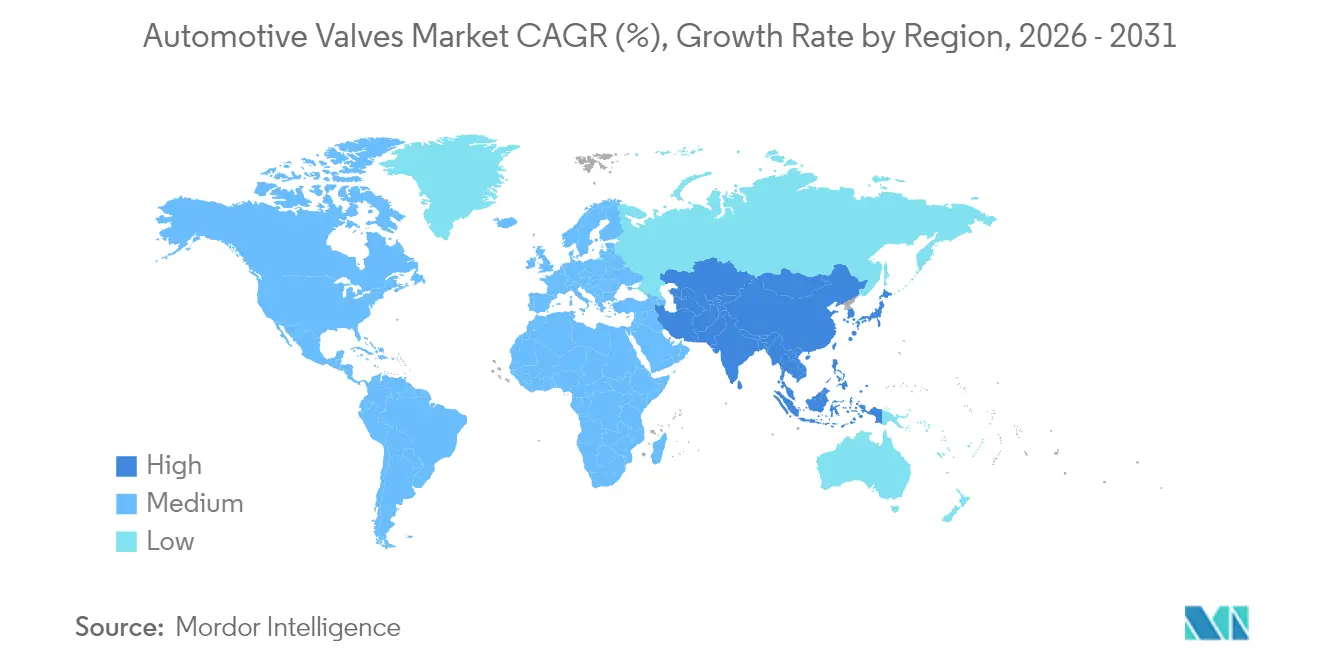
| Fastest Growing Market | Asia Pacific |
| Largest Market | Asia-Pacific |
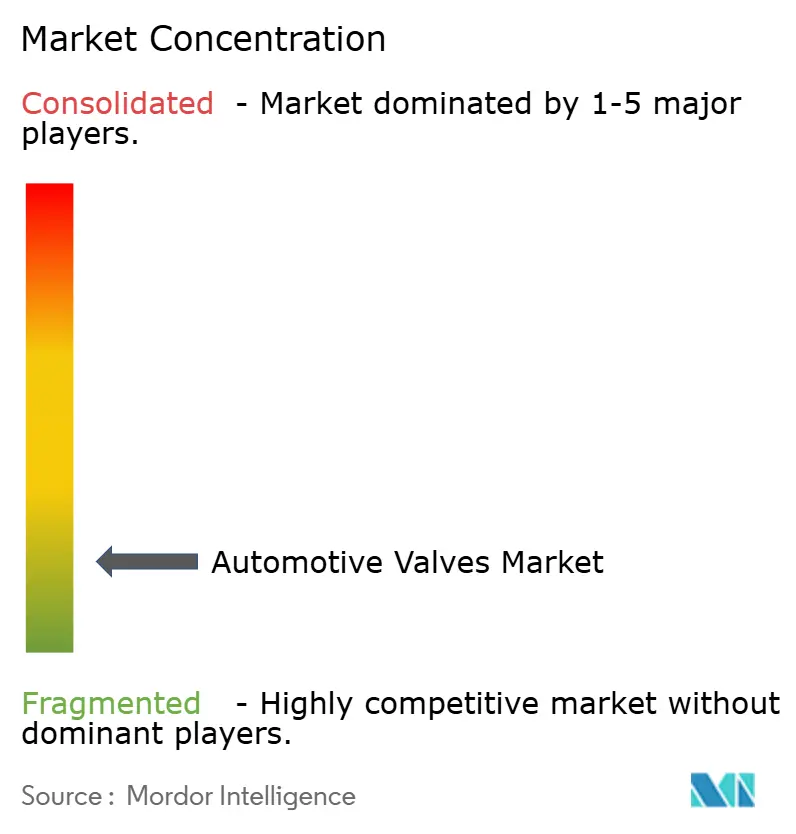
| Market Concentration | Low |
Major Players
*Disclaimer: Major Players sorted in no particular order Image © Mordor Intelligence. Reuse requires attribution under CC BY 4.0. |
|
Automotive Valves Market Analysis by Mordor Intelligence
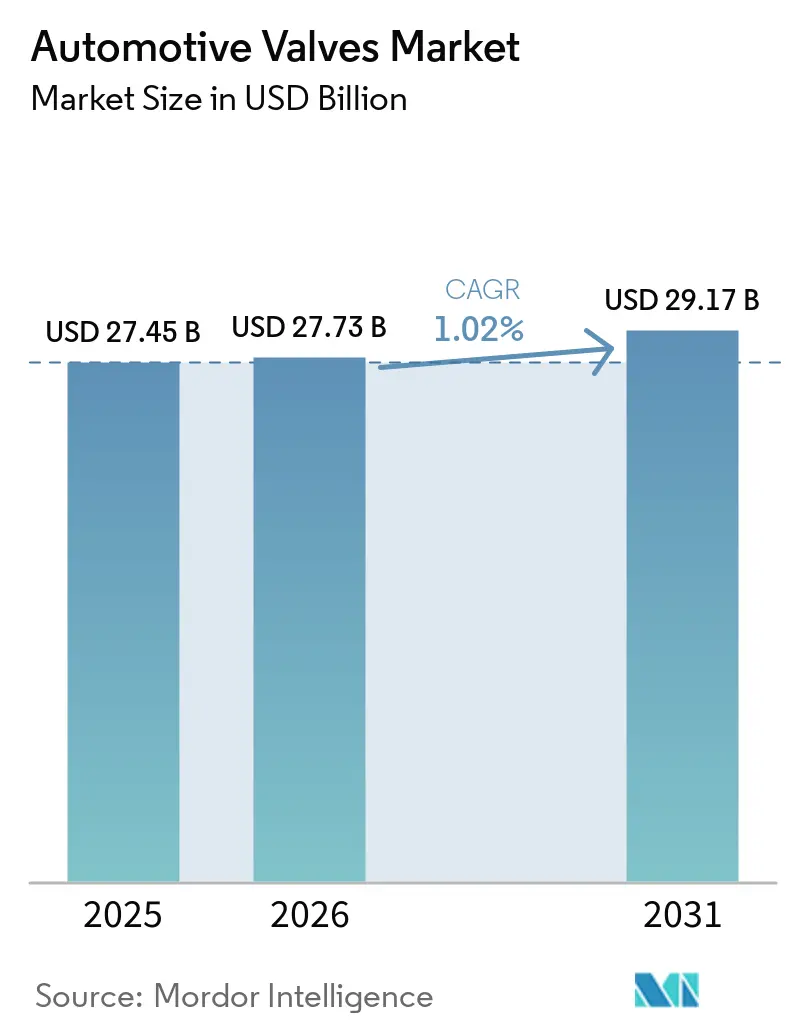
The Automotive Valves market size is expected to grow from USD 27.45 billion in 2025 to USD 27.73 billion in 2026 and is forecast to reach USD 29.17 billion by 2031 at 1.02% CAGR over 2026-2031. Demand holds steady because internal-combustion engines (ICEs) remain dominant in commercial fleets, while battery-electric and hybrid models add new thermal-management circuits that require precision valves. Turbo-penetration, Euro 7 and EPA 29 emissions mandates, and over-the-air (OTA) diagnostics accelerate the shift toward smart, heat-resistant components.
Key Report Takeaways
- By application, engine valves led with 40.87% revenue share of the automotive valves market in 2025, while electric coolant valves are projected to grow at 6.82% CAGR to 2031.
- By vehicle type, passenger cars held 71.12% of the automotive valves market share in 2025; medium and heavy commercial vehicles recorded the fastest CAGR at 2.06% through 2031.
- By function, hydraulic valves accounted for 43.12% share of the automotive valves market size in 2025, and electric/solenoid valves are advancing at 1.69% CAGR to 2031.
- By material, steel represented 46.68% share of the automotive valves market size in 2025; titanium and alloy valves expand at 1.52% CAGR through 2031.
- By propulsion type, internal combustion engine represented 77.62% share of the automotive valves market size in 2025; hybrid powertrains (HEV/PHEV) expand at 1.78% CAGR through 2031.
- By sales channel, the OEM channel accounted for 75.74% of the automotive valves market share in 2025, while the aftermarket is projected to expand at a 1.31% CAGR through 2031.
- By geography, Asia–Pacific commanded 52.01% revenue share in 2025, while the same region posts a 3.08% CAGR to 2031.
Note: Market size and forecast figures in this report are generated using Mordor Intelligence’s proprietary estimation framework, updated with the latest available data and insights as of 2026.
Market Trends and Insights
Drivers Impact Analysis of Automotive Valves Market*
| Driver | (~) % Impact on CAGR Forecast | Geographic Relevance | Impact Timeline |
|---|---|---|---|
| Electrified Thermal-management Architecture Boom | +0.25% | Global, led by China and Europe | Long term (≥ 4 years) |
| ICE Downsizing and Turbo-penetration | +0.20% | Global, strongest in Europe and China | Medium term (2-4 years) |
| Tightening Euro 7/EPA 29 norms | +0.15% | Europe and North America, spillover to Asia-Pacific | Short term (≤ 2 years) |
| Smart valves with OTA Diagnostics | +0.12% | North America and Europe, expanding to Asia-Pacific | Medium term (2-4 years) |
| Hydrogen-ICE Pilots in CV Segment | +0.08% | Europe and North America, trials in Japan | Long term (≥ 4 years) |
| Localization Mandates in India and Indonesia | +0.06% | Asia-Pacific core, India and Indonesia focus | Short term (≤ 2 years) |
| Source: Mordor Intelligence | |||
Electrified Thermal-management Architecture Boom
Battery electric and hybrid vehicles require sophisticated thermal management systems that create entirely new valve applications beyond traditional ICE cooling circuits. Electric coolant valves emerge as the fastest-growing segment at 7.25% CAGR, driven by the need to manage battery pack temperatures, power electronics cooling, and cabin heating without engine waste heat. Rheinmetall's advanced coolant valve portfolio demonstrates the technical complexity required, featuring demand-based control and low flow resistance designs optimized for hybrid and electric vehicle applications. The integration of multiple cooling circuits in EVs battery, motor, power electronics, and cabin requires precise valve coordination that traditional ICE systems never demanded. Sanhua Automotive's specialization in thermal expansion valves, electric expansion valves, and refrigerant solenoid valves illustrates the market's evolution toward integrated thermal solutions
ICE Downsizing and Turbo-penetration
Smaller displacement engines dominate new passenger-car programs in Europe and China, and turbochargers heighten operating temperatures. Premium titanium alloys resist these thermal loads and enable tighter valve-timing windows that help manufacturers comply with Euro 7 and EPA 29. Cummins introduced a hydrogen-ICE turbocharger in April 2025 that illustrates how boosting technology migrates to alternative fuels, blending conventional valve know-how with new combustion demands, and lifting average unit prices across the automotive valves market.
Tightening Euro 7/EPA 29 norms
Starting November 2026, Euro 7 extends regulatory durability to 8 years/160,000 km and mandates onboard monitoring. Exhaust-gas-recirculation (EGR) valves must now survive longer exposure to corrosive gases, prompting OEMs to specify stainless steels with high chromium content and invest in variable valve-timing (VVT) systems that cut nitrogen-oxide peaks X. North America’s heavy-duty EPA 29 standard mirrors these targets for the 2027 model year, so suppliers that engineer cross-regional platforms gain scale advantages.[1]"International Council on Clean Transportation", Automotive Industry Trend, theicct.org.
Smart Valves with OTA Diagnostics
Sensors, near-field communication chips, and dual-core microcontrollers turn valves into data nodes. Parker Hannifin’s DFplus Generation IV proportional valve logs cycle counts and sends alerts to the vehicle gateway, which can push firmware updates to recalibrate flow curves, reducing unexpected downtime for fleet operators. Smart valve adoption accelerates in premium segments first, then cascades to volume applications as costs decline and regulatory requirements for emissions monitoring intensify. The convergence of mechanical precision and digital intelligence creates differentiation opportunities for suppliers capable of integrating both domains.
Restraints Impact Analysis of Automotive Valves Market*
| Restraint | (~) % Impact on CAGR Forecast | Geographic Relevance | Impact Timeline |
|---|---|---|---|
| China Export-rebate Cuts on Pneumatic Sub-assemblies | –0.30% | China exports, global supply chains | Short term (≤ 2 years) |
| ICE-plant Repurposing in Europe 2027-30 | –0.15% | Europe, spill-over to North America | Medium term (2-4 years) |
| Nickel and Titanium Price Super-cycle | –0.10% | Global supply chains | Medium term (2-4 years) |
| BEV Electronics Replacing Multiple Valve Sets | –0.08% | Global, strongest in China & Europe | Long term (≥ 4 years) |
| Source: Mordor Intelligence | |||
Nickel and Titanium Price Super-cycle
Material cost inflation creates significant margin pressure for valve manufacturers, particularly those utilizing premium alloys in high-performance applications. Titanium and alloy valves, despite representing the fastest-growing material segment at 5.55% CAGR, face cost headwinds that may limit adoption in price-sensitive applications. The automotive industry's increasing reliance on advanced materials for lightweighting and performance enhancement coincides with supply chain constraints and geopolitical tensions affecting raw material availability. U.S. countervailing duties on aluminum extrusions from China, including automotive components, exemplify how trade policies compound material cost pressures.[2]“The Daily Journal of the United States Government”, Federal Register, www.federalregister.gov.
BEV Electronics Replacing Multiple Valve Sets
Battery-electric vehicles eliminate fuel, EGR, and crankcase-ventilation valves, cutting lifetime part demand even as they add thermal-management circuits. With BEVs projected to reach 56% of new light-duty sales by 2032, many traditional valve lines face volume declines, challenging Tier 2 suppliers to redeploy tooling or exit the automotive valves market. While BEVs create new opportunities in thermal management valves, the volume and value potential cannot fully offset the loss of high-volume ICE applications like intake and exhaust valves. The timing of this transition varies by region, with China leading BEV adoption and Europe following aggressive electrification mandates, while North America and emerging markets maintain ICE dominance longer. Suppliers must navigate this transition carefully, balancing continued ICE investment with BEV capability development to avoid stranded assets.
*Our forecasts treat driver/restraint impacts as directional, not additive. The impact forecasts reflect baseline growth, mix effects, and variable interactions.
Automotive Valves Market Segment Analysis
By Application:
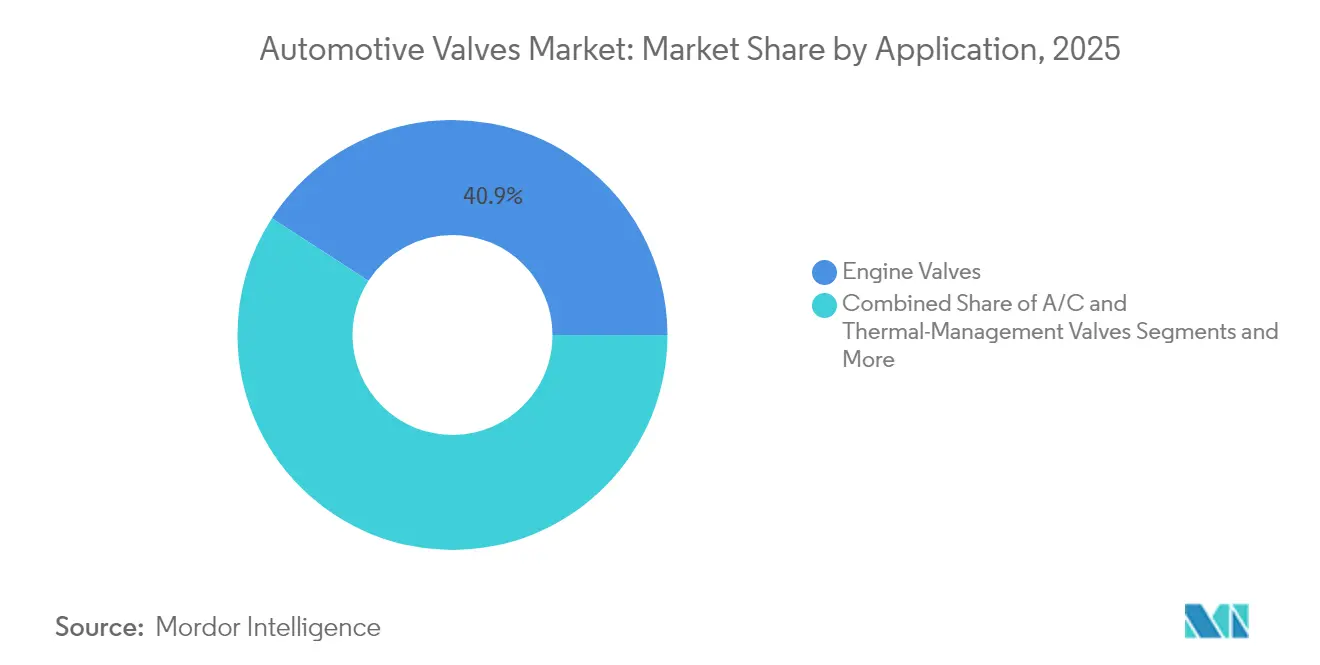
Engine Valves Hold Scale While Coolant Valves AccelerateEngine valves generated the largest revenue slice in 2025, equal to 40.87% of the automotive valves market.This strong contribution makes the automotive engine valve market an important component of the broader automotive valves industry, particularly across intake, exhaust, and variable valve-timing applications. Turbocharged downsized engines, cylinder-deactivation strategies, and VVT upgrades keep intake and exhaust valves critical, yet electric coolant valves deliver a 6.82% CAGR because every hybrid or BEV needs multi-loop thermal control. End-users now pay premiums for wear-resistant face coatings and sodium-filled stems that mitigate hot-spot formation under turbo boost.
Digital twins simulate flow across motor, battery, and cabin loops. This integration forces coolant valve makers to embed temperature and pressure sensors, adding electronics content per unit. Conversely, demand for fuel-injection valves softens in BEVs but persists in plug-in hybrids and emerging hydrogen-ICE programs. The re-mix of combustion and electric requirements expands lifetime value per vehicle even as overall unit volumes migrate.


By Vehicle Type:
Commercial Fleets Sustain GrowthPassenger cars represented 71.12% of the automotive valves market revenue in 2025, yet medium and heavy commercial vehicles locked in the highest 2.06% CAGR. Long-haul trucking retains diesel and hydrogen-ICE routes that use robust valve chemistries and longer duty-cycle designs. Hydrogen pilot fleets from MAN and Cummins demand modified seats and stem coatings to accommodate higher water content and combustion variability. Commercial duty cycles require extended service intervals, sometimes 40,000 operating hours, so fleet operators prioritize predictive diagnostics embedded in valve firmware.
Urban bus and delivery fleets electrify fastest, but heavy tractors and construction machinery rely on ICE optimization, prolonging demand for turbo waste-gate valves, EGR, and after-treatment actuators. Passenger-car architectures converge on small-displacement hybrids, cutting high-flow valve counts yet adding electronic coolant modules that offset some volume losses .
By Function:
Electric Solenoids Outpace Hydraulic MainstaysHydraulic valves retained 43.12% revenue share in 2025 and populate brake boosters, steering racks, and transmission control units. Electric and solenoid valves jump 1.69% CAGR because OTA-enabled intelligence, duty-cycle monitoring, and linear positioning accuracy appeal to OEMs shifting toward software-defined vehicles. Dual-coil, direct-acting solenoids now handle rapid switching in integrated thermal-management modules, replacing multiple mechanical valves and reducing leak paths.
Hybrid actuation blends electro-hydraulic principles to minimize energy draw and meet cybersecurity rules. The function spectrum thus blurs, but electronically commutated solenoids capture outsized value in advanced powertrains and elevate average selling prices in the automotive valves market.
By Material:
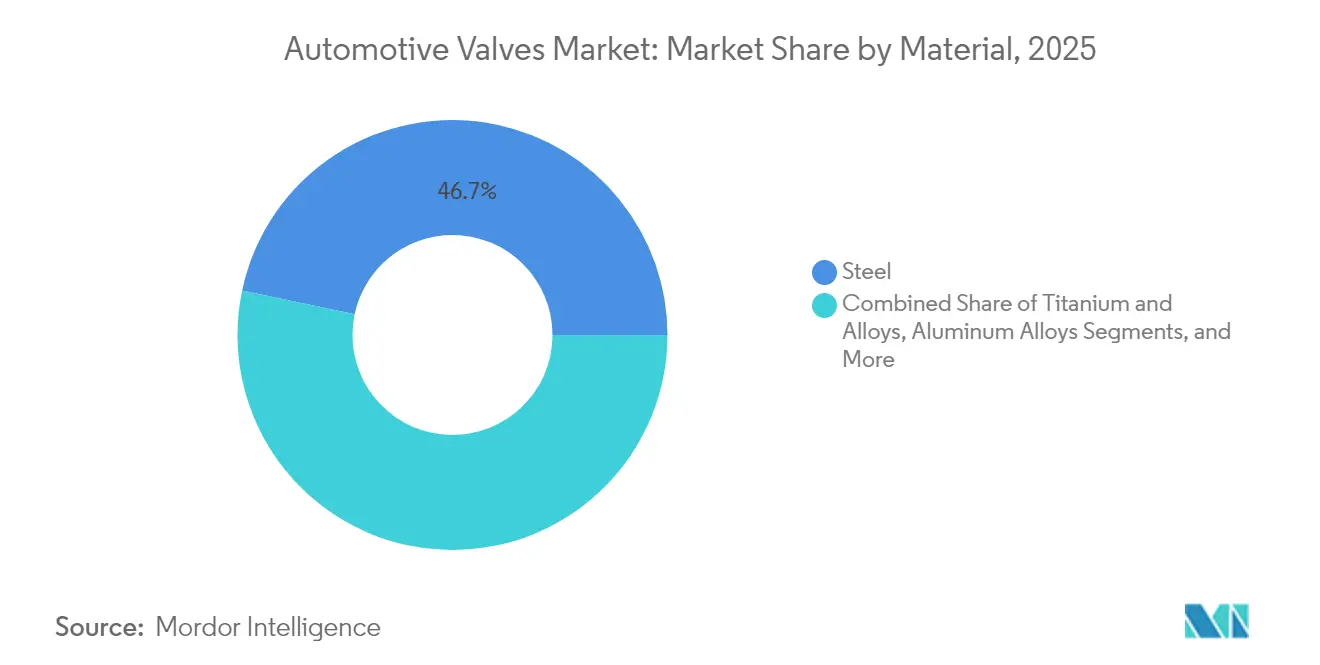
Steel Is Ubiquitous, Premium Alloys Gain ShareCost-efficient steel controlled 46.68% of the automotive valves market revenue in 2025. Alloyed steels remain the default for intake and exhaust duties, yet titanium and nickel-based alloys notch a 1.52% CAGR thanks to turbo-era heat loads and mass-reduction targets. Lightweight multiphase steels offer middle-ground solutions for valves that balance price and performance, while ceramics emerge for select high-abrasion duties. Trade-driven price volatility encourages OEMs to dual-source raw materials and explore additive-manufacturing routes for near-net-shape valve heads.
Recyclability and lifecycle carbon metrics influence material choice. Closed-loop steel scrap programs help OEMs meet ESG targets, while titanium recycling remains nascent, limiting widespread use outside premium segments.
By Propulsion:
Hybrid Complexity Drives Premium DemandInternal combustion engine applications dominate the automotive valves market with approximately 77.62% share in 2025, reflecting the continued prevalence of traditional powertrains across global vehicle production, while hybrid powertrains (HEV/PHEV) represent the fastest-growing segment at 1.78% CAGR through 2031. Hybrid systems require sophisticated valve architectures that combine traditional ICE components with advanced thermal management solutions for battery cooling, electric motor temperature control, and integrated cabin heating systems.
ICE applications face gradual market share erosion as electrification mandates intensify, particularly in European and Chinese markets where regulatory pressures accelerate the transition timeline. However, commercial vehicle segments maintain strong ICE demand due to payload and range requirements that favor diesel and emerging hydrogen combustion technologies. Hybrid powertrains benefit from regulatory incentives and consumer acceptance as a bridge technology, with plug-in hybrid variants requiring the most sophisticated valve systems due to their dual-mode operation capabilities.
By Sales Channel:
Aftermarket Remains EssentialOEM programs accounted for 75.74% of the 2025 automotive valves market sales, but the aftermarket posts a 1.31% CAGR on the back of older vehicle fleets and multi-platform part commonality. Independent workshops depend on modular valve kits with integrated sensors to service modern powertrains. European consumers keep vehicles for 12 years on average, sustaining demand for replacement exhaust control and high-pressure fuel pump valves that meet Euro 7 durability. In North America, ride-share and delivery fleets pursue preventive maintenance, boosting smart valve retrofits that unlock condition-based service intervals.
EV adoption will eventually curb ICE-specific aftermarket volumes, yet new battery-coolant valves and refrigerant solenoids open fresh categories. Regional e-commerce portals favor tier-two suppliers who bundle diagnostic software alongside physical parts, preserving margins even as distribution structures evolve.
Geography Analysis
APAC Automotive Valves Market
Asia–Pacific occupied 52.01% of the 2025 automotive valves market revenue. China’s localization rules and India’s 100% FDI policy anchor investment, while Thailand and Vietnam build supply-chain depth for regional OEM hubs. Hyundai’s USD 3 billion India plan underscores long-term confidence in local valve production, and Indonesia’s export incentives attract pneumatic assembly lines. Cost competitiveness plus vast domestic demand safeguard Asia-Pacific growth despite geopolitical risk. Asia-Pacific is anticipated to witness the fastest growth at 3.08% CAGR during the forecast period.
South America and Turkey Automotive Valves Market
South America is expected to witness prominent demand for automotive valves. Stellantis’ Brazilian Real 30 billion Brazil project and BYD’s USD 1 billion Turkish plant highlight OEM interest in cost-effective manufacturing zones proximal to raw materials. Brazil’s Rota 2030 program offers tax breaks for low-emission technologies, motivating suppliers to install EGR and coolant-valve production cells. Argentina’s component-localization push widens supplier footprints, balancing currency volatility.
EMEA and North America Automotive Valves Market
Europe and North America are mature but innovation-intensive. Euro 7 and EPA 29 spark investment in advanced EGR and VVT valves across Germany, France, and the United States. Turkey prospers as a bridge market, having produced 1.4 million vehicles in 2023 and ranking first in European commercial-vehicle output. Middle East & Africa gains traction, led by Saudi Arabia’s USD 2.9 billion 2024 automotive cluster that includes EV cooling-valve lines targeting regional export corridors.

Regulatory Landscape
Automotive valve design and validation are being reshaped by emissions durability requirements, safety approvals for alternative-fuel systems, and trade rules that affect component sourcing. In Europe, Euro 7 introduces tighter durability and onboard monitoring requirements, with mandatory compliance starting in November 2026 for new types of M1 and N1 vehicles and their components. This shift is pushing suppliers toward higher-temperature alloys, corrosion-resistant EGR architectures, and traceability aligned with longer warranty horizons.
For hydrogen and gaseous-fuel applications, harmonized standards and approval frameworks are increasingly a gating factor for market access, including ISO 19887-1:2024 requirements for hydrogen-fueled vehicle fuel system valves across 25 to 70 MPa classes, and UNECE vehicle regulations used by multiple markets for type approval. In China, GB/T 44851.4-2025 (manual valves for LNG fuel systems) took effect on March 1, 2026, reinforcing the need for region-specific compliance roadmaps. In North America, the US EPA multi-pollutant standards phase in from model year 2027 through 2032, and trade and tariff administration adds complexity. A Federal Register notice opened an inclusions window from April 1 to April 14, 2026 for the Section 232 automobile parts tariff inclusions process, influencing sourcing decisions and localization strategies for valve-related subassemblies.
Value Chain Analysis
Automotive valve value chains begin with specialty metals and engineered polymers, then move through precision forming and finishing before reaching OEM and aftermarket distribution channels. For engine and high-temperature exhaust duties, suppliers use specialty alloys and superalloy inputs (nickel, chromium, cobalt, molybdenum), which are converted via forging (upsetting/extrusion), multi-axis machining (faces, stems, grooves), and heat treatment routes such as nitriding and other hardening processes. Coating steps add wear and corrosion resistance for EGR and boosted applications. Electrified thermal-management and mechatronic valves also introduce upstream dependencies on coils, sensors, and electronics-grade cleanliness during assembly.
Key bottlenecks concentrate in capital-intensive tooling and qualification. Precision forging die lead times (often 12 to 20 weeks), constrained capacity for specialized coatings, and long OEM validation and PPAP cycles (commonly 12 to 24 months) limit supplier switching and make program awards sticky once validated. Compliance constraints, including EU REACH and ELV requirements affecting materials and surface treatments, increase documentation and process-control needs across tiers. Downstream, Tier 1 integrators package valves into assemblies (thermal modules, emissions subsystems, brake and transmission hydraulics) for OEMs, while distributors and e-commerce portals expand aftermarket reach for modular kits that increasingly bundle diagnostic support alongside physical components.
Competitive Landscape
The supply base remains moderately fragmented. Denso, Bosch and BorgWarner leverage extensive ICE portfolios while channeling R&D toward smart thermal-management valves and hydrogen-ready hardware. BorgWarner’s “Charging Forward” targets USD 10 billion EV revenue by 2027, evidencing capital redeployment without abandoning profitable turbo and EGR lines.
Medium players like Valeo and Pierburg specialize in coolant and vacuum valves, partnering with semiconductor vendors to embed diagnostics. Continental’s planned 2025 spin-off of its Automotive unit signals portfolio focus, echoing Aptiv’s earlier electronics tilt. Digital factory programs, such as Continental’s DIAZI, trim lead times and enhance traceability, critical for Euro 7 warranty compliance.
Consolidation accelerates as raw-material inflation and software investments strain smaller Tier 2 suppliers. Recent private-equity deals, including Apollo Fund X’s injection into Tenneco’s clean-air division, give cash-intensive valve programs breathing room for retooling. White-space opportunities cluster around hydrogen-ICE airflow control, integrated thermal-management modules, and OTA-upgradable solenoid valves.
Automotive Valves Industry Leaders
-
Denso Corporation
-
BorgWarner Inc.
-
Robert Bosch GmbH
-
Valeo SE
-
AISIN Corporation
- *Disclaimer: Major Players sorted in no particular order
Automotive Valves Market Companies Covered in this Report
- Denso Corporation
- Robert Bosch GmbH
- BorgWarner Inc.
- Valeo SA
- Hitachi Astemo Ltd.
- Aisin Corporation
- Cummins Inc.
- Eaton Corporation plc
- Johnson Electric Holdings
- Mahle GmbH
- Continental AG
- Knorr-Bremse AG
- Tenneco Inc.
- Rheinmetall Automotive
- VOSS Automotive
- Mitsubishi Electric Corp.
- Woodward Inc.
- TiAL Sport Inc.
- Schaeffler AG
- Marelli Holdings

Market Opportunities and Future Outlook
White-space opportunities are concentrating where hybridization and thermal-management complexity increase the amount of valve content per vehicle, while emissions durability is raising specification intensity for the remaining ICE and hybrid platforms. Euro 7 compliance starting November 2026 for new types in Europe tightens durability and monitoring requirements, benefiting suppliers that can deliver higher-temperature materials, robust EGR architectures, and electronically controlled actuators that hold calibration over longer service lives. Hydrogen-ICE and hydrogen fuel system programs also create an adjacent opportunity set, where valve suppliers aligned with ISO 19887-1:2024 and UNECE hydrogen safety approvals can supply high-pressure architectures alongside conventional valvetrain upgrades.
Manufacturing investment and portfolio moves provide concrete indicators of where suppliers are placing capacity and focus. In October 2025, Nittan India Tech inaugurated an expanded facility at Sri City, Andhra Pradesh, doubling capacity from 1 million to 2 million valves per month, underscoring India as a production and export hub for engine-valve programs. On the product and corporate-structure side, Eaton announced in February 2026 the initiation of a strategic spin-off of its Mobility business into an independent entity oriented around mobility technologies, including valvetrain solutions such as sodium-cooled hollow head valves. The move reinforces ongoing specialization in high-heat, high-durability components while electrified thermal-management demand grows.
Recent Industry Developments in Automotive Valves Market
- May 2026: BorgWarner won a conquest program award in Asia for a torsional assist (TA) variable cam timing (VCT) system for a Japanese OEMs next-generation hybrid engine. The program underlines continued investment in advanced valvetrain control hardware that supports higher-efficiency combustion and hybrid operating modes. It also strengthens BorgWarners position in hybrid-focused powertrain platforms where valve timing precision and durability drive differentiation.
- May 2026: DENSO introduced nine new part numbers to its Thermal range, including engine cooling thermostats, available from May 2026. The update broadens coverage in thermal-management components that interface with coolant control strategies used in ICE, hybrid, and electrified architectures. For the independent aftermarket, the additions improve service availability for newer cooling-system designs where precise flow control supports efficiency and emissions durability.
- July 2024: Valeo expanded its EGR valve portfolio with 46 new references, extending its original equipment manufacturing know-how into the aftermarket. The wider catalog supports replacement demand as emissions systems age and regulators tighten durability expectations for in-use vehicles. It also increases competitive intensity in aftermarket EGR categories where parts availability and application coverage influence share.


Automotive Valves Market Report Scope and Research Methodology
Market Definition and Coverage
For this methodology, the automotive valves market includes valves used in passenger and commercial vehicles across core systems, where demand comes from OEM fitment and aftermarket replacement.
Scope exclusions: This sizing does not count industrial, building, or pipeline valves that are not designed and sold for automotive applications.
Segments Covered in This Report
-
By Application Type
-
Engine Valves
- Intake Valves
- Exhaust Valves
- Variable Valve-Timing Valves
- Cylinder-Deactivation Valves
-
A/C and Thermal-Management Valves
- Expansion Valves
- Coolant Control Valves
- Fuel-System Valves
- EGR Valves
- Brake and Safety Valves (ABS, Proportioning)
-
Engine Valves
-
By Vehicle Type
- Passenger Cars
- Light Commercial Vehicles
- Medium and Heavy Commercial Vehicles
-
By Function Type
-
Pneumatic
- Conventional
- Smart Mechatronic
-
Hydraulic
- Direct-acting
- Pilot-operated
-
Electric / Solenoid
- Stepper-motor
-
Pneumatic
-
By Material Type
- Steel
- Titanium and Alloys
- Aluminum Alloys
- Ceramics and Composites
-
By Propulsion
- Internal-Combustion Engine (ICE)
- Hybrid Powertrain (HEV/PHEV)
-
Sales Channel
- OEM
- Aftermarket
-
Geography
-
North America
- United States
- Canada
- Rest of North America
-
South America
- Brazil
- Argentina
- Rest of South America
-
Europe
- Germany
- United Kingdom
- France
- Italy
- Spain
- Russia
- Rest of Europe
-
Asia-Pacific
- China
- Japan
- India
- South Korea
- Australia and New Zealand
- Rest of Asia-Pacific
-
Middle East and Africa
- Turkey
- Saudi Arabia
- UAE
- Israel
- South Africa
- Egypt
- Rest of Middle East and Africa
-
North America
Data Sources, Market Sizing, and Validation
Desk Research
Desk research started by mapping the demand pool for vehicles and the main systems that use valves, then linking that to replacement patterns in the vehicle parc. We pulled public time series and technical references to avoid building assumptions from a single viewpoint, and we kept notes on year-to-year changes in vehicle production and trade.
Typical inputs came from sources such as OICA vehicle production releases, national transport statistics for vehicle registrations and parc, US EPA and EU emissions and compliance documentation, and UN Comtrade trade statistics for relevant parts flows. We also reviewed patent databases for directional signals on materials and actuation, and used company filings and investor presentations to sanity check major product lines and end markets. In addition, we referred to paid subscriptions for company financials and intelligence, and for shipment-level import and export checks where disclosures were limited. These sources are illustrative, and many other public documents and datasets were also used for data collection, validation, and clarification.
Primary Interviews and Surveys
Primary work focused on confirming how valve demand splits between OEM programs and replacement, and how pricing and mix are moving across engine, thermal management, EGR, fuel system, and related uses. We spoke with a mix of component suppliers, distribution participants, and technical or commercial leaders who track platform changes and service demand, and then used those inputs to close gaps left by public data. Since this is a global market, feedback was balanced across major manufacturing and vehicle demand centers so regional production shifts were not over- or under-weighted.
Distribution of primary research fieldwork respondents
| Company type | Respondent position | Region |
|---|---|---|
| Top tier: 33% | CXOs: 14% | APAC: 41% |
| Mid tier: 53% | Functional/Unit leaders: 41% | EMEA: 37% |
| Smaller Players: 14% | Managers: 45% | Americas: 22% |
Market-Sizing & Forecasting
The sizing begins with a top-down build where vehicle production, vehicle parc, and system-level fitment rates are used to reconstruct the demand pool for automotive valves, and then value is derived using region-sensitive average selling prices. To keep the totals realistic, we corroborate the result with selective bottom-up approximations, such as sampled supplier revenue splits, channel checks on aftermarket turnover, and ASP times unit logic on representative valve families.
Key inputs used in the model include global and regional vehicle production by vehicle type, the installed base and scrappage trends that shape replacement demand, the share of ICE versus hybrid and BEV production that changes valve mix, emissions and thermal-management related adoption signals that affect content per vehicle, and observed pricing movement tied to materials and manufacturing complexity. Where direct unit disclosures were not available, we filled gaps using proxy indicators from trade flows and expert-confirmed mix assumptions, and then adjusted to remove double counting across OEM and aftermarket routes.
Forecasting was done using scenario analysis anchored to expected vehicle production and powertrain mix outlooks, followed by expert checks on how fast content per vehicle and pricing are likely to move. In periods where signals diverged, the range was narrowed only after reconciling the assumptions back to measurable indicators like production plans, parc trends, and replacement cycles.
Data Validation & Update Cycle
Outputs were checked against independent signals, including vehicle production totals, parc growth, and the expected split between OEM demand and service replacements, and then large variances were investigated before sign-off. If a region or application line showed an unusual jump, we revisited the underlying drivers, re-checked conversions and pricing, and re-contacted relevant experts to confirm whether the change was real or model-driven.
Before publication, the model and write-up go through multiple analyst reviews so definitions, units, and assumptions stay consistent across the full time series. The report is refreshed annually, and interim updates are made when material events change market direction. Right before delivery, a final pass is completed to ensure the latest public statistics and relevant developments are reflected.
Mordor Intelligence's Automotive Valves Market Size Measured Against Other Published Estimates
Published market values for automotive valves often differ because the scope boundaries are not always the same, and because some studies use different base years, pricing logic, and currency timing. Differences also show up when one estimate leans more on OEM production volumes, while another leans more on broad parts trade or replacement demand without clearly separating the two.
The table shows a spread that mainly comes from what is counted as an automotive valve and how quickly pricing and mix are refreshed. In the Mordor Intelligence model, the scope stays tied to valves used in defined automotive applications (engine, thermal management and A/C, fuel system, EGR, and similar), with OEM and aftermarket treated as distinct demand routes before totals are combined.
Benchmark comparison
| Source | Market Size | Gaps in Research Methodology |
|---|---|---|
| Mordor Intelligence | USD 27.73 B (2026) | |
| Trade Publisher A | USD 25.67 B (2024) | Uses an earlier base year and often applies a single blended pricing curve across applications, which can understate mix shifts from thermal-management and electronics-linked valves in newer platforms. |
| Industry Commentary B | USD 23.89 B (2025) | Leans heavily on a narrower demand build tied to conventional engine-related valves and may not consistently capture non-engine valve demand in HVAC and adjacent vehicle systems across regions. |
Across the three figures, the practical difference is less about math and more about scope discipline and the variables used to translate vehicles into valve demand. When the demand pool is built from vehicle output and parc signals, and then checked with supplier and channel reality checks, the market total becomes easier to trace and repeat year after year.


Key Questions Answered in the Report
What is the current size of the automotive valves market?
The market is valued at USD 27.73 billion in 2026 and is projected to reach USD 29.17 billion by 2031.
Which valve segment is expanding fastest?
Electric coolant valves show the highest 6.82% CAGR through 2031, driven by growth in battery-electric and hybrid thermal-management loops.
How will Euro 7 affect valve demand?
Euro 7 raises durability to 8 years/160,000 km and tightens NOx limits, lifting demand for premium EGR and VVT valves that resist corrosion and enable precise combustion control.
Why are commercial vehicles important for valve suppliers?
Medium and heavy commercial vehicles retain ICE powertrains longer and require robust, high-duty valves, posting the strongest 2.06% CAGR among vehicle types.
What role do smart valves play in modern powertrains?
Smart valves integrate sensors and OTA diagnostics, enabling predictive maintenance and precise flow control, supporting OEM moves toward software-defined vehicles.
How does material cost volatility influence valve design?
Rising nickel and titanium prices pressure margins and drive exploration of alternative alloys and additive-manufacturing approaches that balance cost with thermal performance.
Page last updated on:


 Your data is secure and never sold or shared.


