
Automotive Transmission Market Size and Share
Market Overview
| Study Period | 2019 - 2031 |
|---|---|
| Market Size (2026) | USD 163.39 Billion |
| Market Size (2031) | USD 209.73 Billion |
| Growth Rate (2026 - 2031) | 5.12 % |
| Fastest Growing Market | South America |
| Largest Market | Asia-Pacific |
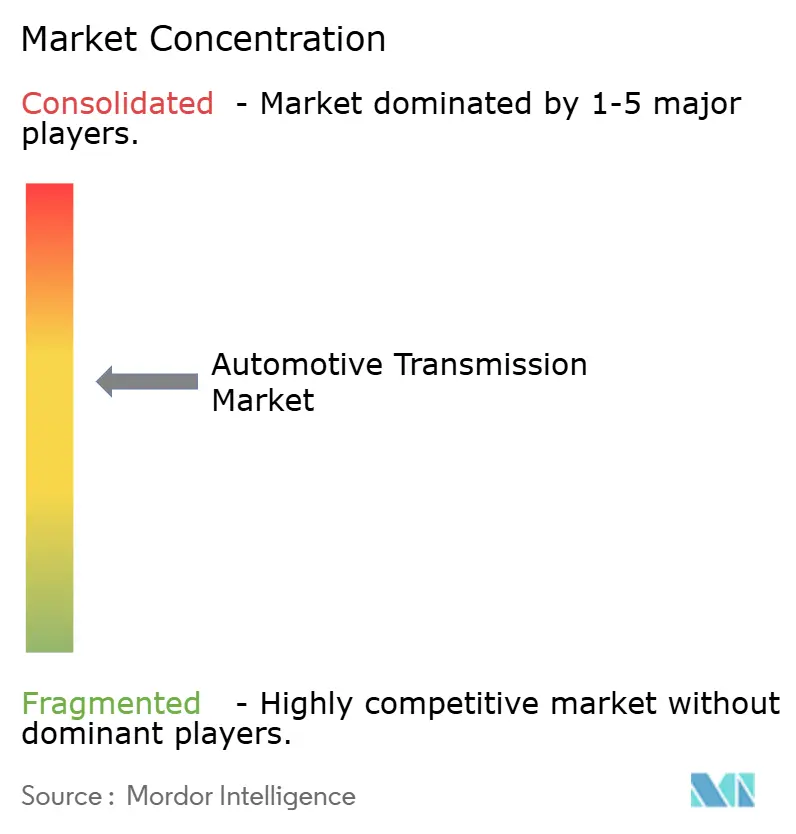
| Market Concentration | Medium |
Major Players *Disclaimer: Major Players sorted in no particular order Image © Mordor Intelligence. Reuse requires attribution under CC BY 4.0. | |
Automotive Transmission Market Analysis by Mordor Intelligence
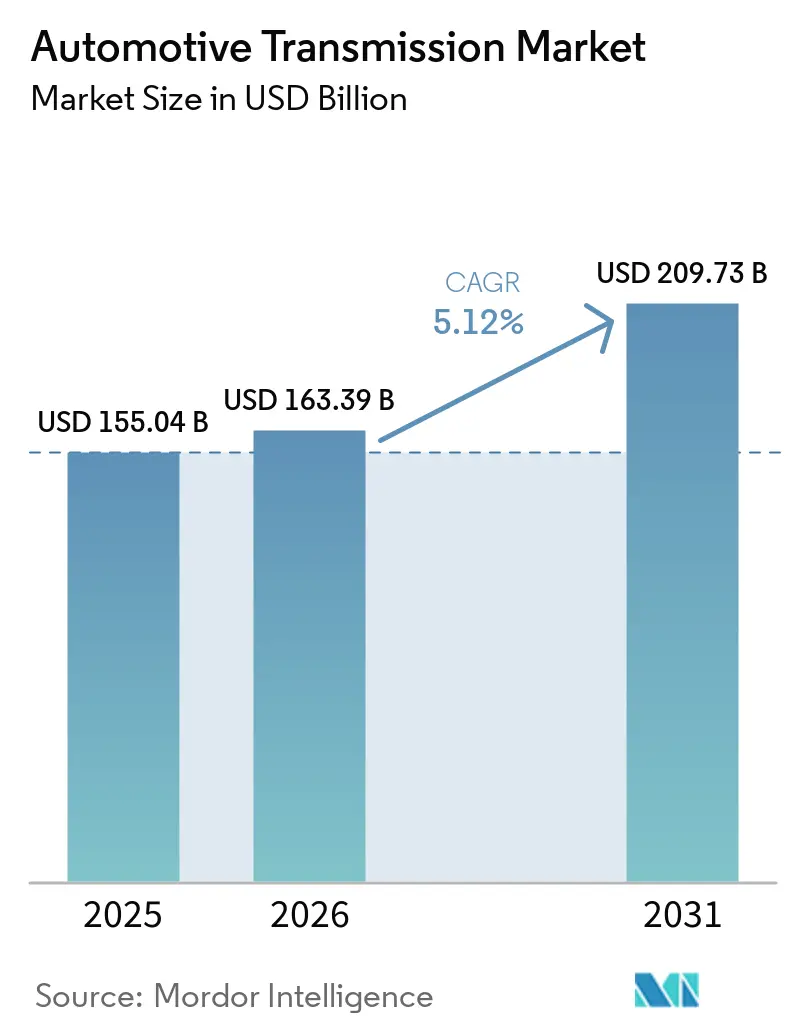
The automotive transmission market size is expected to grow from USD 155.04 billion in 2025 to USD 163.39 billion in 2026 and is forecast to reach USD 209.73 billion by 2031, growing at a 5.12% CAGR during the forecast period (2026-2031). Growth hinges on the rapid pivot from manual gearboxes toward software-defined, electrified drivelines, reinforced by tighter Corporate Average Fuel Economy standards in the United States and parallel mandates across the European Union and China. Automatic units retained demand leadership, yet dual-clutch systems are outpacing all rivals as performance-minded buyers seek sub-200-millisecond shifts without sacrificing fuel economy. Passenger-car domination continues, but light commercial fleets are electrifying more quickly as e-commerce logistics firms retrofit vans with automated manual transmissions to address driver shortages.
Key Report Takeaways
- By transmission type, automatic systems led the automotive transmission market, accounting for a 41.03% revenue share in 2025. Meanwhile, dual-clutch units are forecast to grow at a 5.89% CAGR through 2031.
- By vehicle type, passenger cars accounted for 64.79% of the automotive transmission market share in 2025; light commercial vehicles posted the fastest growth at a 5.62% CAGR through 2031.
- By propulsion technology, internal-combustion engines accounted for 72.94% of the automotive transmission market size in 2025, yet fuel cell electric vehicles registered the highest 6.34% CAGR through 2031.
- By sales channel, OEM fitments dominated the automotive transmission market with a 90.88% share in 2025, whereas the aftermarket expanded at a 6.21% CAGR through 2031.
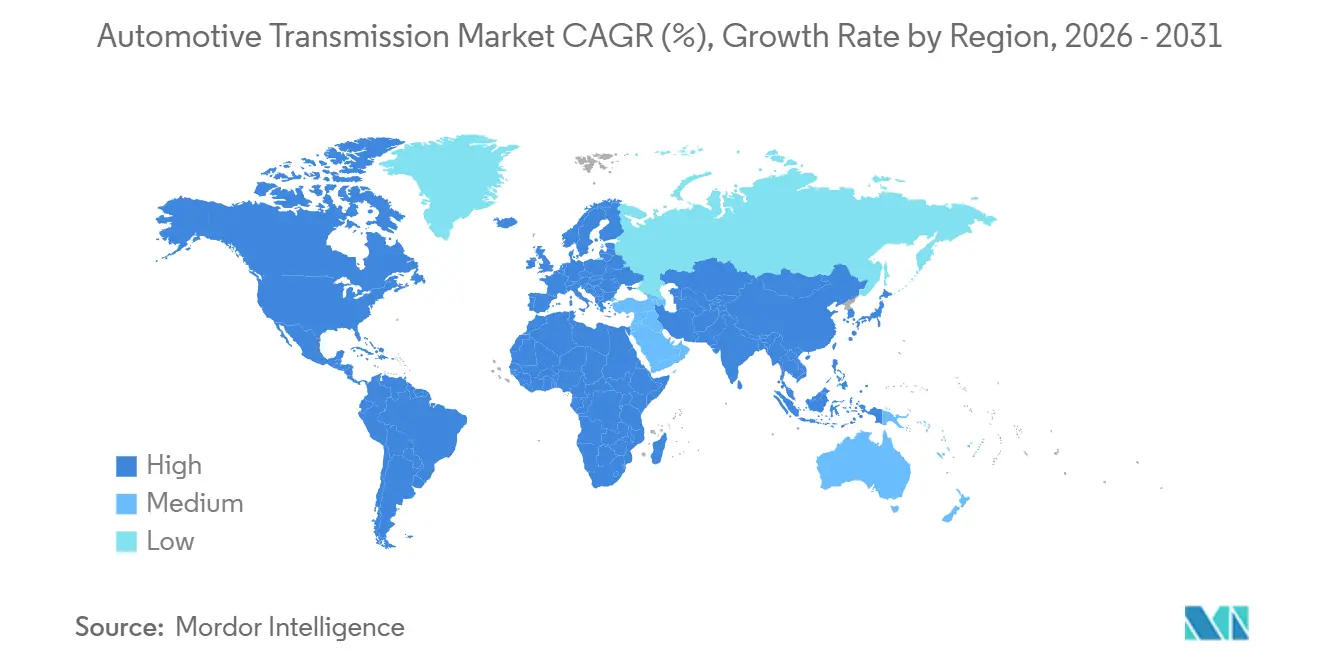
- By geography, the Asia-Pacific region led the automotive transmission market with a 43.67% revenue share in 2025, while South America is projected to post the fastest growth at a 6.28% CAGR through 2031.
Note: Market size and forecast figures in this report are generated using Mordor Intelligence’s proprietary estimation framework, updated with the latest available data and insights as of January 2026.
Market Trends and Insights
Drivers Impact Analysis of Automotive Transmission Market*
| Driver | (~) % Impact on CAGR Forecast | Geographic Relevance | Impact Timeline |
|---|---|---|---|
| Rapid Growth of Hybrid and BEV E-axle | +1.5% | Global, with China and Europe leading adoption | Short term (≤ 2 years) |
| Tightening Global CO₂ Regulations | +1.2% | Global, with EU and North America leading | Medium term (2-4 years) |
| Consumer Shift Toward Automatic and DCT | +0.8% | Asia-Pacific core, expanding to emerging markets | Long term (≥ 4 years) |
| Commercial-Vehicle Demand for AMT | +0.6% | North America and Europe primarily | Medium term (2-4 years) |
| Silicon-Carbide Inverter Cost Decline | +0.4% | Global, with early adoption in premium segments | Long term (≥ 4 years) |
| Software-Defined "shift-by-wire" Enabling OTA Feature Monetization | +0.3% | North America and Europe initially | Medium term (2-4 years) |
| Source: Mordor Intelligence | |||
Rapid Growth of Hybrid and BEV E-Axle Transmissions
Electrified drivelines merge motor, inverter, and reduction gear into compact e-axles that can cut weight by 18 kilograms versus six-speed automatics, as demonstrated by BYD’s 8-in-1 unit on the Seal in 2024. Hyundai’s P1+P2 hybrid layout, launched in April 2025, features a 44-kilowatt motor positioned between the engine and a six-speed automatic transmission, allowing for a pure-electric launch without separate transmission control[1]. NIO’s four-in-one drive in the ET7 achieves 91.5% system efficiency by integrating torque vectoring into the inverter firmware.
Tightening Global CO₂/Fuel-Economy Regulations
The U.S. 2027-2031 CAFE rules finalized in 2024 demand a 58-mile-per-gallon fleet average by 2031, compelling eight-plus-speed automatics that keep engines in optimum efficiency bands[2]. Euro 7, effective January 2025, limits on-road nitrogen oxides to 60 mg/km, pushing diesel models toward 10-speed units that curb transient spikes. China’s revised dual-credit system rewards plug-in hybrids that exceed 80 km electric range, accelerating clutchless hybrid gearboxes. India’s CAFE Phase 2 imposes penalties of INR 25,000 per gram of CO₂ above 113 g/km, thereby accelerating the adoption of intelligent manuals with automated clutches.
Consumer Shift Toward Automatic and DCT for Comfort/Performance
Automatic penetration in India jumped in 2024 as urban stop-and-go traffic amplified driver fatigue from clutch use. Hyundai’s eight-speed wet DCT, fitted to the Sonata N Line in 2024, achieved 95% mechanical efficiency and a 0.4 l/100 km fuel benefit. Volkswagen’s DQ381 seven-speed DCT posts sub-150-millisecond shifts, removing torque interruption during hard acceleration. As costs converge, dual-clutch systems are increasingly appearing in C-segment sedans priced below USD 25,000, reinforcing momentum for the automotive transmission market worldwide. Gains in comfort and performance together sustain the migration away from stick shifts in both mature and emerging regions.
Commercial-Vehicle Demand for AMT to Address Driver Shortage
The United States faced 78,000 unfilled heavy-truck driver positions in 2024, motivating fleets to adopt automated manuals that reduce training from six weeks to 10 days[3]. Allison’s TC10 AMT introduced predictive grade-based logic in 2024, resulting in a 3-5% reduction in fuel consumption compared to manual driving. Eaton’s Cummins Endurant HD handled 1,850 Nm torque and shipped 45,000 units in 2024, proving heavy-haul readiness. Consequently, fleets view AMTs as indispensable for retention and safety, while strengthening the trajectory of the automotive transmission market.
Restraints Impact Analysis of Automotive Transmission Market*
| Restraint | (~) % Impact on CAGR Forecast | Geographic Relevance | Impact Timeline |
|---|---|---|---|
| High System Cost | -0.9% | Global, with premium segments less affected | Short term (≤ 2 years) |
| Supply-Chain Volatility | -0.7% | Global, with Asia-Pacific manufacturing concentration | Medium term (2-4 years) |
| Limited Thermal Window for Ultra-Low-Viscosity ATF | -0.5% | Global, with hot climate regions most affected | Medium term (2-4 years) |
| Cyber-Security Compliance Costs | -0.4% | North America and EU primarily, expanding globally | Long term (≥ 4 years) |
| Source: Mordor Intelligence | |||
High System Cost and Complexity of Multi-Speed Electrified Drivelines
Adding an extra ratio inflates EV drivetrain cost by USD 400–600. It increases weight by 22 kilograms, as seen in Porsche’s Taycan, which also requires dedicated cooling to manage oil temperatures of up to 180 °C. Tesla and BYD avoid this cost by optimizing single-speed gearing for 90% of driving cycles. Hybrid e-CVTs face similar bill-of-materials pressure, with Toyota’s e-CVT requiring a battery capable of 50 kW continuous discharge, which raises pack cost by USD 1,200. These premiums limit near-term proliferation beyond premium nameplates, tempering broader growth in the automotive transmission market.
Supply-Chain Volatility in Precision-Forged Gears and Bearings
A January 2025 fire at SKF’s Gothenburg bearing facility removed 18% of European needle-roller output, forcing ZF and Aisin to air-freight inventory from Japan at a 22% cost penalty. Ring-gear lead times lengthened to 28 weeks in mid-2025 as alloy steel suppliers rationed nickel amid market turbulence. Schaeffler’s effort to qualify an Indian bearing source delayed its P2+ hybrid launch by two quarters. Dual-clutch units bear a significant risk because they use four to six tapered-roller bearings each, compared to two in classic automatics. The disruption highlights the fragility of the automotive transmission supply chain.
*Our forecasts treat driver/restraint impacts as directional, not additive. The impact forecasts reflect baseline growth, mix effects, and variable interactions.
Automotive Transmission Market Segment Analysis
By Transmission Type:
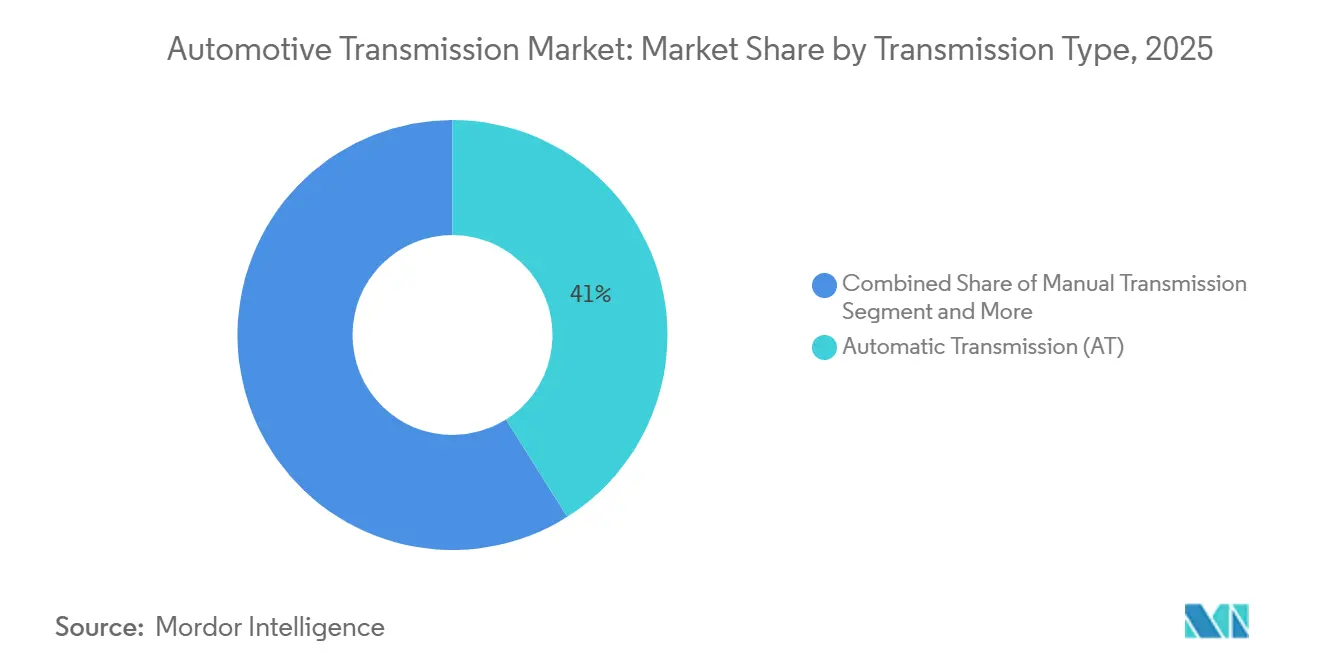
Automatic Dominance Faces DCT ChallengeAutomotive automatic transmission systems retained a leading 41.03% share of the automotive transmission market in 2025, anchored by North American pickups and SUVs that value towing and refinement. Dual-clutch units are projected to grow at a 5.89% CAGR through 2031. Continuously variable designs, once favored for their infinite ratio spread, now struggle to satisfy performance expectations despite JATCO’s CVT9 launch with a 9.0:1 ratio range. Manual gearboxes persist mainly in entry-level Asian models, thanks to a USD 300 cost advantage over intelligent manuals.
Automatic dominance in full-size pickups, dual-clutch acceleration in compact cars, and emerging two-speed EV gears together shape the future mix. The automotive transmission market for dual-clutch units is expected to expand as tooling amortization reduces per-unit costs. Two-speed EV boxes count as “Others” but carry strategic weight for premium range extension in models like Audi’s e-tron GT. Suppliers, therefore, diversify portfolios across all mechanisms to defend relevance.

By Vehicle Type:
Commercial Segments Drive InnovationPassenger cars accounted for a 64.79% share of the automotive transmission market in 2025, while light commercial vehicles are expected to record a 5.62% CAGR through 2031, as e-commerce fleets prioritize low-maintenance electric drivetrains. Ford’s E-Transit reduced service expenses 40% versus diesel predecessors through a single-speed reduction gear rated at 430 Nm. Mercedes-Benz’s eSprinter adopted a two-speed automotive gearbox to sustain a payload advantage of 1,045 kilograms.
The automotive transmission market for AMT-equipped heavy trucks is poised to grow steadily as carriers link safety gains to lower insurance premiums. Passenger cars bifurcate into eight-speed automatics for ICE platforms and single-speed drives for mainstream BEVs under USD 40,000. Tata’s Ace EV shows intelligent manual viability within small electrified commercial vehicles in India. Volvo Trucks’ FH Electric features a two-speed I-Shift for improved gradeability, though its USD 350,000 price currently limits adoption.
By Propulsion Technology:
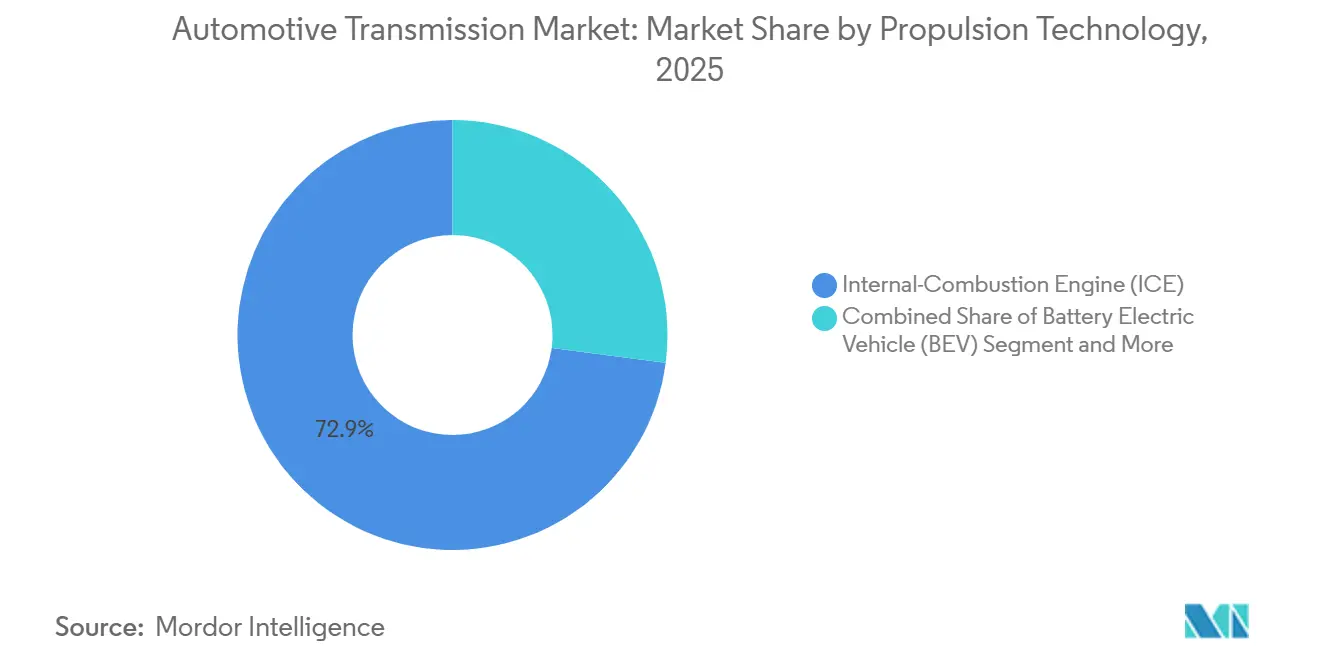
Electrification AcceleratesInternal-combustion engines represented a 72.94% share of the automotive transmission market in 2025. Still, fuel-cell electric vehicles will advance at a segment-leading 6.34% CAGR through 2031, as Toyota and Hyundai push hydrogen for payload-sensitive commercial fleets. Battery-electric cars priced under USD 40,000 often utilize single-speed gearsets because adding a second ratio can erode their margin. BYD’s Dolphin employs a fixed 10.39:1 gear to achieve 0–100 km/h in 7.5 seconds.
The automotive transmission market size for dedicated hybrid gearboxes expands as dual-motor architectures meet revised Chinese credit multipliers. ICE powertrains have evolved to 10-speed automatics, such as Ford’s 10R80, which keeps the 3.5-liter EcoBoost under 2,000 rpm at highway speeds. Premium BEVs, led by Porsche’s Taycan, validate two-speed layouts that extend range on high-speed cycles. Consequently, suppliers must balance traditional planetary expertise with emerging e-axle competencies.
By Sales Channel:
Aftermarket Complexity Creates OpportunitiesOEM factory-fit units captured a 90.88% share of the automotive transmission market in 2025, as deeply integrated control software discourages component swapping. Continental’s shift-by-wire module requires a cryptographic handshake with the body controller, effectively locking out unauthorized replacements. Still, the remanufacturing aftermarket is expected to post a 6.21% CAGR through 2031, as fleets pursue life-cycle cost savings of 40–60% compared to new units.
The automotive transmission market size within remanufacturing could expand further, as Class 8 trucks typically undergo 1.2 replacements over a one-million-mile lifespan. Powertrain warranties such as Ford’s 10-year/150,000-mile plan introduced in 2024 heighten genuine parts demand. Battery-electric single-speed drives pose a structural headwind for the aftermarket, yet heavy-duty fleets keep the channel buoyant.
Geography Analysis
APAC Automotive Transmission Market
In 2025, the Asia-Pacific region held a 43.67% share of the automotive transmission market, fueled by strong BEV sales in China and significant growth in India's adoption of intelligent manuals, especially for sedans priced below USD 15,000. China's revised dual-credit system now allocates 1.6 credits per plug-in hybrid, encouraging OEMs to utilize dedicated hybrid transmissions, such as BYD's DM-i.
The Americas Automotive Transmission Market
South America represents the fastest-growing territory, with a 6.28% CAGR through 2031, as Brazil’s Rota 2030 initiative subsidizes locally built automatics to achieve 12% fleet-level efficiency by 2028. Argentina’s import tariff on fully built gearboxes spurred local dual-clutch assembly for Volkswagen and Fiat. In 2025, North America's automotive transmission market experienced a notable increase, with 10-speed automatics dominating pickups like the Ford F-150, while single-speed drives became the preferred choice for crossovers, exemplified by the Mustang Mach-E.
Europe Automotive Transmission Market
Meanwhile, Europe is gravitating towards dual-clutch systems, highlighted by Germany's substantial share of DCTs in passenger vehicles in 2025. In 2025, the United Kingdom experienced a surge in new BEV registrations, dampening the demand for conventional automatics. Concurrently, France is expanding Renault's clutchless four-speed E-Tech across its mainstream models.
Regulatory Landscape
Fuel-economy and emissions rules continue to push transmission design toward higher-ratio-count automatics, hybrid-dedicated gearboxes, and integrated e-axles. In the European Union, Euro 7 Regulation (EU) 2024/1257 (adopted in April 2024) adds new technical requirements for vehicle emissions and durability expectations, reinforcing the need for calibrated shift strategies and powertrain controls to meet on-road compliance across M1 and N1 vehicle categories.
In the United States, 2026 also brought notable regulatory uncertainty alongside modernization work relevant to transmission systems and controls. The EPA finalized a rescission of the 2009 Greenhouse Gas Endangerment Finding in February 2026 and proposed changes to the timing of certain light- and medium-duty emissions compliance requirements in May 2026. In March 2026, NHTSA proposed amendments to FMVSS No. 102 to accommodate ADS-equipped vehicles without manual controls, easing certain transmission shift position display requirements. At the state level, California Air Resources Board (CARB) criteria pollutant exhaust standards and test procedures for model year 2026 vehicles remain a key anchor for calibration and validation planning.
Value Chain Analysis
The value chain covers alloy steel and forged blanks, precision machining of gears, shafts, and housings, friction elements (clutches and linings), bearings, mechatronics (valve bodies, actuators, and sensors), and embedded software for shift control, before moving into assembly, end-of-line testing, and OEM integration. Supplier actions show how production footprints and platform localization influence sourcing: ZF reported its TraXon modular transmission system surpassed 1.5 million units in cumulative production by February 2026, while AISIN began contract manufacturing Mazda six-speed automatic transmissions at its AISIN Drivetrain Inc. facility in Indiana in April 2026 to support North American supply.
Downstream, OEM factory-fit remains dominant as transmissions are increasingly tied to vehicle cybersecurity and integrated controls, while remanufacturing expands where life-cycle cost is central. Operational constraints include long lead times for high-precision gear manufacturing equipment and specialized friction materials, along with extended validation cycles for new architectures that blend hardware with software and require high-RPM durability testing. Regional industrialization also shapes availability and platform launch cadence, as shown by Stellantis Betim (Brazil) reaching 17 million transmissions in April 2026 and Schaeffler starting volume production of its MultiMode dedicated hybrid transmission in May 2026 across ICE, hybrid, and electrified driveline programs.
Competitive Landscape
The top five suppliers accounted for a significant portion of the global passenger-car volume in 2025, indicating moderate concentration. JATCO focused on CVT leadership, while Hyundai Transys captured internal demand for six-speed and hybrid models.
Smaller innovators target white-space niches. Punch Powertrain’s dedicated hybrid gearbox enables 130 km/h electric cruising, making it an appealing option for European cities that are enforcing diesel bans. Schaeffler’s 100 kW P2+ module enables automakers to retrofit existing eight-speed cases, thereby shortening launch cycles by a year.
Technology leadership now revolves around software. Continental’s shift-by-wire unlocks subscription revenues and hardens cybersecurity. Magna filed a 2024 patent for an integrated coolant pathway that trims e-axle mass by 4.2 kilograms. Meanwhile, ZF’s ReLife and Allison’s ReTran aim to dominate remanufacturing as sustainability metrics rise. Competitive intensity thus pivots from volume share to IP depth and software monetization within the evolving automotive transmission market.
Automotive Transmission Industry Leaders
-
ZF Friedrichshafen AG
-
Aisin Corporation
-
Schaeffler AG
-
Magna International Inc.
-
JATCO Ltd.
- *Disclaimer: Major Players sorted in no particular order
Automotive Transmission Market Companies Covered in this Report
- ZF Friedrichshafen AG
- Aisin Corporation
- JATCO Ltd.
- Hyundai Transys Inc.
- Magna International Inc.
- Allison Transmission Inc.
- Schaeffler AG
- Eaton Corporation plc
- BorgWarner Inc.
- Continental AG
- Punch Powertrain NV
- GKN Automotive Limited
- Toyota Motor Corp. (Hybrid e-CVT)
- Valeo SA
- Tremec Corporation
- Dana Incorporated
Market Opportunities and Future Outlook
Manufacturing retooling that supports both high-volume ICE automatics and electrified transmissions remains a clear opportunity area, anchored by announced capital programs and new production launches. In April 2026, General Motors announced USD 830 million of investments across three US propulsion facilities, including USD 300 million to expand 10-speed transmission capacity at Romulus, Michigan. In Europe, Stellantis began producing electrified dual-clutch transmissions (eDCT) at Mirafiori in April 2024 as part of a EUR 240 million site investment, showing an industrial pathway for hybridized DCT supply into mainstream platforms.
Commercial and fleet use cases provide additional whitespace where duty cycles favor automated shifting, robustness, and serviceability, including fully automatic units for buses and heavy trucks and dedicated hybrid transmissions for mixed-usage operations. Allison Transmission began a multi-year USD 100 million expansion of its Chennai, India manufacturing facility in October 2024 to increase capacity for fully automatic transmissions, aligning with demand centers where uptime and operating cost drive procurement. On the product side, software-defined shift controls, torque management, and wear compensation expand the addressable content for suppliers that can support embedded controls and validation toolchains, while modular X-in-1 e-powertrain architectures and dedicated hybrid transmissions increase what OEMs can standardize across propulsion modules and regions.
Recent Industry Developments in Automotive Transmission Market
- June 2026: JATCO expanded adoption of its X-in-1 e-powertrain series, including a 5-in-1 system used on the new Nissan Kicks launched in Japan. The supplier focus on integrated motor-inverter-reducer architectures compresses packaging and simplifies OEM sourcing. Wider deployment across nameplates also increases the need for scalable software and thermal-management validation in electrified driveline modules.
- March 2026: ZF launched its PowerLine 8-speed automatic transmission on the Freightliner M2 106 Plus, supported by US-based production at Gray Court, South Carolina. Localized output strengthens supply continuity for North American commercial-vehicle OEMs and fleets while shortening logistics loops for service parts. The launch also reinforces the continuing role of multi-speed automatics in medium-duty efficiency and drivability upgrades.
- May 2025: Cummins unveiled its heavy-duty X15 Euro 6 engine paired with the Eaton Cummins Endurant 18-speed transmission at the Brisbane Truck Show. The integrated powertrain positioning highlighted continued co-development between engine and transmission suppliers around fuel-economy and performance targets. It also pointed to sustained demand for high-torque automated shifting solutions in heavy-duty applications where total cost of ownership is tightly managed.
Automotive Transmission Market Report Scope and Research Methodology
Market Definition and Coverage
This market covers the value of automotive transmission systems supplied for on-road vehicles, including manual, automated, and automatic variants, and counted at the point of component and system supply into the vehicle ecosystem.
Scope exclusions: We exclude powertrain parts outside the transmission assembly (for example, complete engines, standalone differentials, and EV traction motors) and we also exclude maintenance and repair services.
Segments Covered in This Report
- By Transmission Type
- Manual Transmission
- Intelligent Manual Transmission (iMT)
- Automated Manual Transmission (AMT)
- Automatic Transmission (AT)
- Dual-Clutch Transmission (DCT)
- Continuously Variable Transmission (CVT)
- Others (Planetary, 2-speed EV gearboxes etc.)
- By Vehicle Type
- Passenger Cars
- Light Commercial Vehicles
- Medium and Heavy Commercial Vehicles
- Buses and Coaches
- By Propulsion Technology
- Internal-Combustion Engine (ICE)
- Hybrid Electric Vehicle (HEV/PHEV)
- Battery Electric Vehicle (BEV)
- Fuel Cell Electric Vehicles (FCEV)
- By Sales Channel
- Original Equipment Manufacturer (OEM) Factory-Fit
- Aftermarket/Remanufactured
- By Geography
- North America
- United States
- Canada
- Rest of North America
- South America
- Brazil
- Argentina
- Rest of South America
- Europe
- Germany
- United Kingdom
- France
- Italy
- Spain
- Russia
- Rest of Europe
- Asia-Pacific
- China
- Japan
- India
- South Korea
- Rest of Asia-Pacific
- Middle East and Africa
- Turkey
- United Arab Emirates
- Saudi Arabia
- South Africa
- Rest of Middle East and Africa
- North America
Data Sources, Market Sizing, and Validation
Desk Research
Desk research starts by mapping the demand pool with official vehicle production and parc signals, and then linking that demand to transmission fitment patterns. We used public sources such as OICA for vehicle production, the International Energy Agency for electrification direction, US EPA fuel economy trends, and Eurostat trade data where parts flows help sense regional build and sourcing shifts.
On the supply side, annual reports, investor presentations, and regulatory filings were reviewed to understand product mix, regional exposure, and any pricing commentary tied to content. Patent databases were also checked to see where design activity is moving (for example, multi-speed automatics versus e-axle related solutions), and paid subscriptions focused on company financials and news helped keep corporate actions and plant changes current. The sources listed here are illustrative, and many other public and paid references were used to collect data, validate assumptions, and clarify open questions.
Primary Interviews and Surveys
Primary work is used to pressure test our assumptions on transmission penetration by vehicle class and region, and also to confirm how pricing moves when content changes, such as gear count, hybridization, and electronics. We spoke with a mix of transmission suppliers, vehicle manufacturers, distributors, and independent technical experts across major vehicle producing hubs so gaps from desk research could be closed and key model inputs could be triangulated.
Distribution of primary research fieldwork respondents
| Company type | Respondent position | Region |
|---|---|---|
| Top tier: 36% | CXOs: 15% | APAC: 39% |
| Mid tier: 48% | Functional/Unit leaders: 29% | EMEA: 36% |
| Smaller Players: 16% | Managers: 56% | Americas: 25% |
Market-Sizing & Forecasting
The core build uses a top-down approach where vehicle production by region is reconstructed and then converted into transmission value using fitment rates by transmission type and average selling prices that differ by vehicle class. To keep this grounded, the totals are cross-checked with selective bottom-up approximations from supplier revenue exposure, channel discussions on mix shifts, and sampled ASP times volume math for major transmission families.
Inputs that matter in this market include passenger car versus commercial production, the share of automatic and dual-clutch adoption, average forward-gear count trends, hybrid and battery-electric share (which changes the transmission content), and regional localization patterns seen through trade and capacity announcements. Where interview feedback shows mixed practices (for example, whether mild hybrids are treated as needing a conventional gearbox), we keep the assumption explicit and then size the impact as a sensitivity.
For forecasting, scenario analysis is used so different paths for electrification speed, automatic penetration, and pricing progression can be reflected without overfitting the model. We also apply simple smoothing to reduce one-time swings in production, and then assumptions are rechecked with experts before the final forecast is locked.
Data Validation & Update Cycle
Outputs are validated through multiple checks, including comparing implied transmission value per vehicle against known technology mix and checking regional totals against trade and production direction. When numbers move too sharply, the driver is traced back to one or two variables, and the assumption is either corrected or documented with supporting evidence.
A second analyst reviews the model logic, inputs, and calculations before sign-off, and any large variances trigger follow-up questions with respondents. Reports are refreshed annually, with interim updates when material events occur (such as major platform shifts, regulations, or plant announcements). Right before delivery, we run a final update pass so the published view reflects the latest available information.
Mordor Intelligence's Automotive Transmission Market Size Compared Against Other Published Estimates
Published market values for automotive transmissions can look far apart because the counting rules are not the same, even when the titles sound similar. Differences usually come from what gets included (full transmission systems versus broader drivetrain sets), what year is treated as the base, and how pricing is carried forward when the mix is shifting.
In this market, the biggest gap drivers are whether e-axles and traction drive units are grouped into the transmission total, whether aftermarket repair and remanufacturing is blended with OEM supply, and how automatic versus manual share is applied across regions and vehicle types. Currency timing also matters because large volumes sit in Asia, and some sources lock an older exchange rate instead of updating with the sizing year, which can swing the USD total.
Benchmark comparison
| Source | Market Size | Gaps in Research Methodology |
|---|---|---|
| Mordor Intelligence | USD 155.04 B (2025) | |
| Trade Journal A | USD 67.24 B (2024) | Uses a narrower definition that appears to emphasize selected transmission categories, and the base year and currency handling are not clearly tied back to vehicle production and fitment assumptions. |
| Global Consultancy B | USD 226.23 B (2024) | Likely folds adjacent drivetrain and electrified drive-unit content into the total, which inflates value versus a transmission-only view, and the method is not transparent on how EV architectures are treated. |
The spread in the table mainly points to scope alignment issues and how electrified drivetrains are counted. By separating transmission assemblies from broader drivetrain content and by linking value back to vehicle build and mix drivers, the number is kept traceable to repeatable inputs, a modeling choice applied by Mordor Intelligence.
Key Questions Answered in the Report
What is the projected value of the automotive transmission market by 2031?
The market is forecast to reach USD 209.73 billion by 2031, growing at a 5.12% CAGR.
Which transmission type is expected to grow the fastest through 2031?
Dual-clutch transmissions are set to register the quickest 5.89% CAGR, driven by their efficiency and rapid shift capability.
How are tightening fuel-economy rules shaping transmission design?
Regulations such as U.S. CAFE and Euro 7 push automakers toward eight-plus-speed automatics and hybrid-dedicated gearboxes that keep engines in peak efficiency ranges.
Why are automated manual transmissions gaining traction in heavy trucks?
AMTs reduce driver training time, improve fuel economy up to 5%, and help fleets cope with chronic driver shortages.
Which region leads global revenue, and which is growing fastest?
Asia-Pacific leads with 43.67% of 2025 revenue, while South America is the fastest-growing at a 6.28% CAGR to 2031.
What role does software play in modern transmissions?
Shift-by-wire systems enable over-the-air feature unlocks, allowing OEMs to sell subscription-based driving modes without hardware changes.