
Automotive Suspension System Market Size and Share
Market Overview
| Study Period | 2019 - 2031 |
|---|---|
| Market Size (2026) | USD 151.71 Billion |
| Market Size (2031) | USD 204.46 Billion |
| Growth Rate (2026 - 2031) | 6.15 % |
| Fastest Growing Market | Middle East and Africa |
| Largest Market | Asia Pacific |
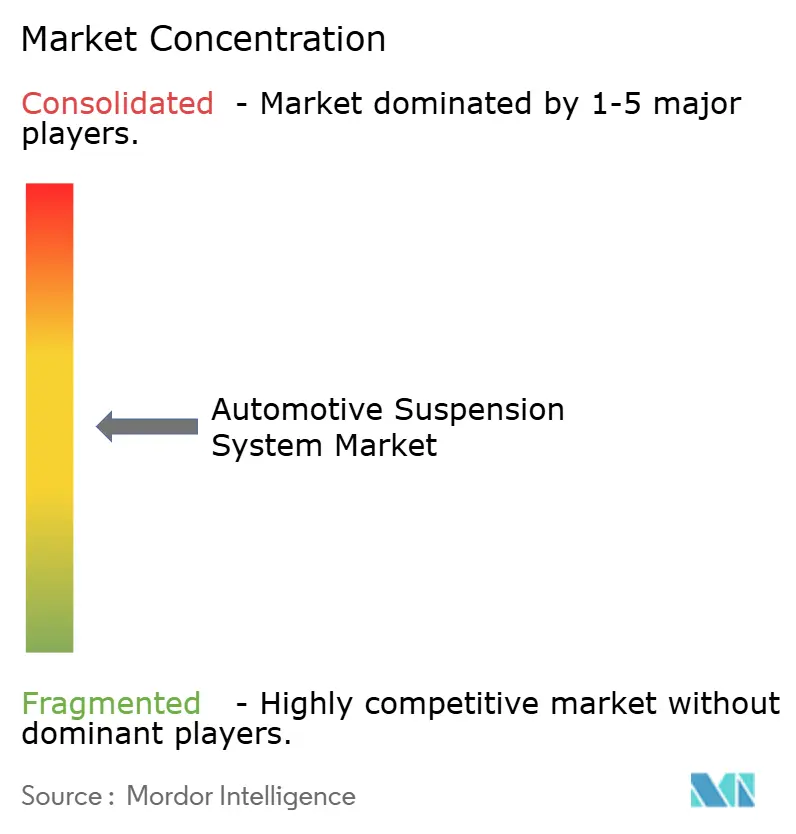
| Market Concentration | Medium |
Major Players *Disclaimer: Major Players sorted in no particular order Image © Mordor Intelligence. Reuse requires attribution under CC BY 4.0. | |
Automotive Suspension System Market Analysis by Mordor Intelligence
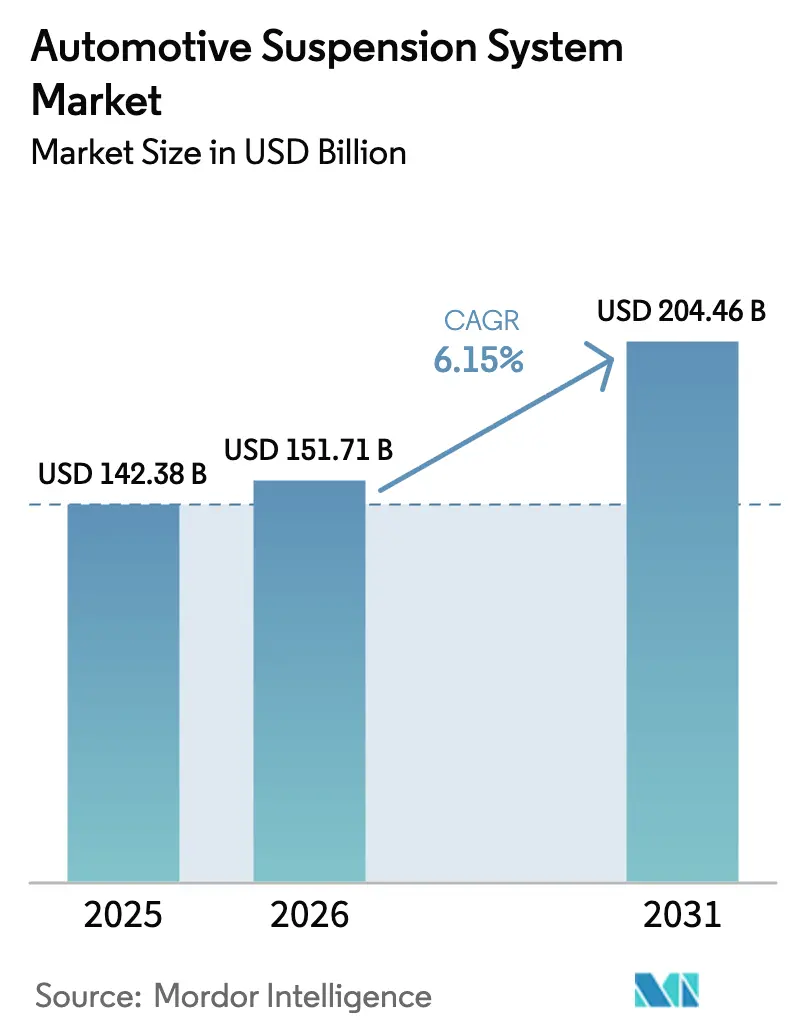
The automotive suspension system market size is expected to grow from USD 142.38 billion in 2025 to USD 151.71 billion in 2026 and is forecast to reach USD 204.46 billion by 2031, advancing at a 6.15% CAGR during the forecast period (2026-2031), as electrification and software-defined vehicle architectures reshape chassis design priorities. Demand is shifting from ride comfort alone toward digitally coordinated damping that feeds data to advanced driver-assistance systems, satisfying UN R171 lane-keeping response windows while improving energy efficiency in battery-electric vehicles. The OEM integration of suspension control units with centralized domain controllers is driving a surge in demand for sensors and ECUs. At the same time, subscription-based over-the-air unlocks are transforming adaptive damping into recurring revenue streams. The Asia-Pacific region emerged as the dominant contributor to revenue. However, the Middle East and Africa are experiencing the fastest growth, driven by Saudi Arabia's significant investment in Lucid. The industry's component mix is increasingly favoring electronic hardware. Moreover, there's a notable shift from traditional MacPherson struts to multi-link geometries, facilitating independent wheel control in dual-motor electric vehicles (EVs).
Key Report Takeaways
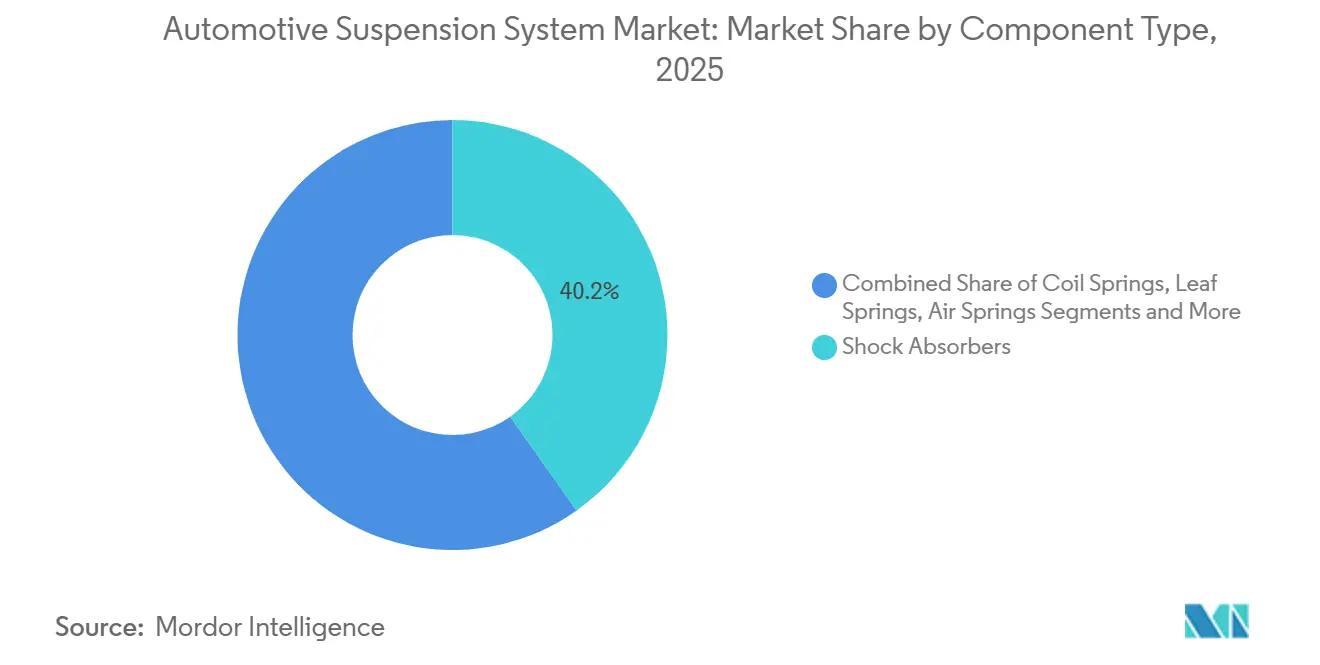
- By component type, shock absorbers held 40.21% of the automotive suspension system market share in 2025, while electronic control units and sensors are projected to expand at a 9.22% CAGR through 2031.
- By suspension system type, passive systems accounted for 64.32% of the automotive suspension systems market share in 2025; semi-active systems are forecast to grow at an 8.74% CAGR through 2031.
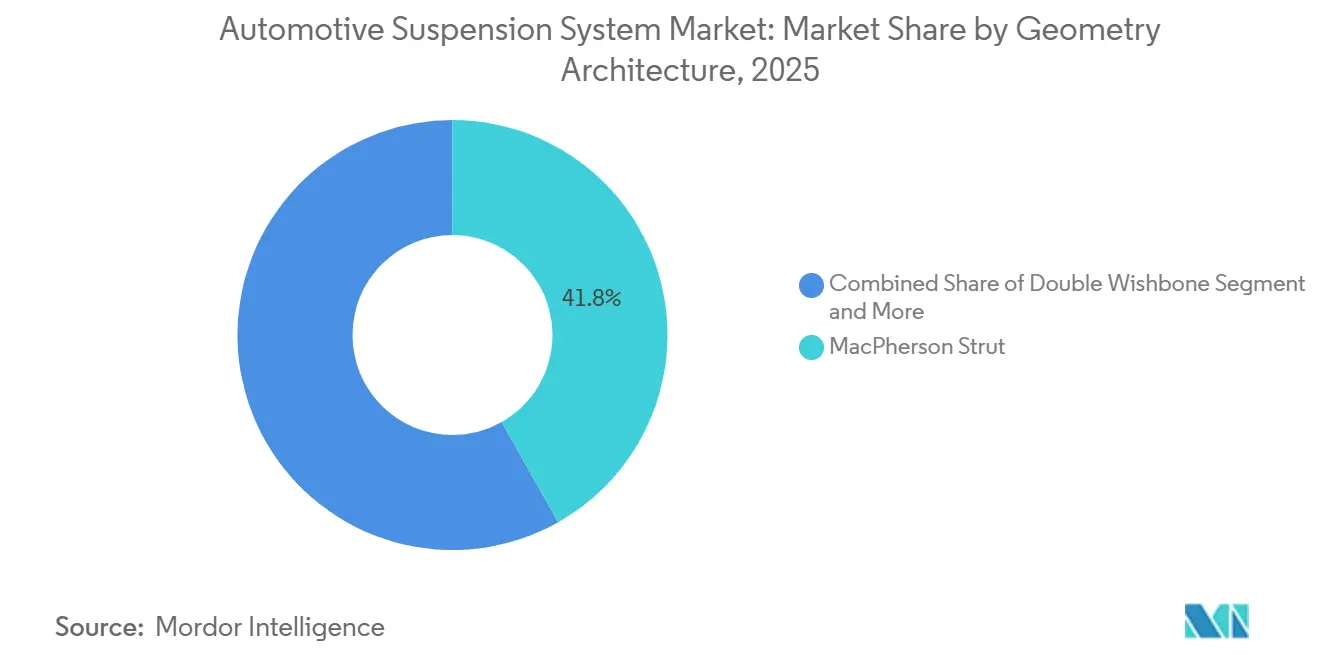
- By geometry, MacPherson strut layouts dominated the automotive suspension systems market, accounting for a 41.82% share in 2025; multi-link architectures are projected to grow at an 8.08% CAGR over the forecast period.
- By vehicle type, passenger cars accounted for 58.92% of the automotive suspension system market share in 2025. Additionally, electric passenger vehicles are expected to advance at a 10.71% CAGR during 2026–2031.
- By sales channel, OEM shipments accounted for 73.44% of the automotive suspension system market share in 2025, and the aftermarket segment is expected to grow at a 7.64% CAGR through 2031.
- By propulsion, ICE vehicles comprised 85.23% of the automotive suspension system market share in 2025, while electric and hybrid vehicles are projected to register a 14.89% CAGR through 2031.
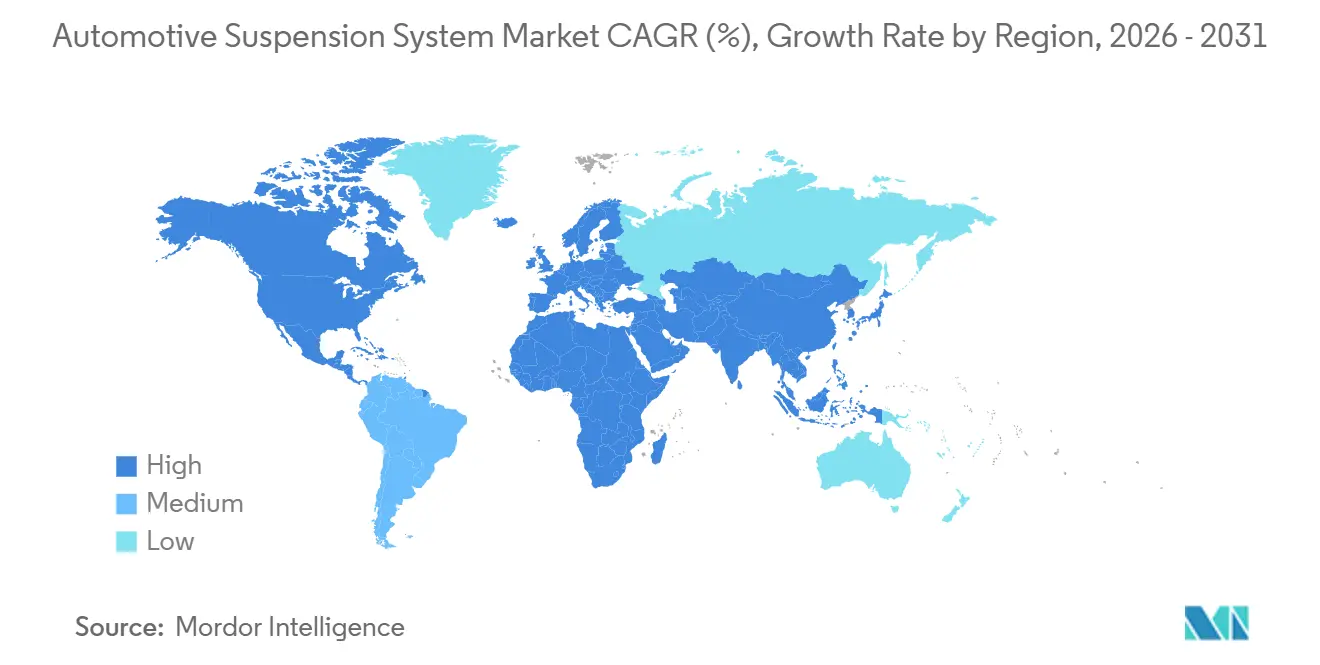
- By geography, the Asia-Pacific region led with 48.96% of the automotive suspension system market share in 2025, and the Middle East and Africa are anticipated to post the fastest regional growth at a 7.65% CAGR during the forecast period.
Note: Market size and forecast figures in this report are generated using Mordor Intelligence’s proprietary estimation framework, updated with the latest available data and insights as of January 2026.
Market Trends and Insights
Drivers Impact Analysis of Automotive Suspension System Market*
| Driver | (~) % Impact on CAGR Forecast | Geographic Relevance | Impact Timeline |
|---|---|---|---|
| Electrification-Driven Chassis Redesign | +1.8% | Asia-Pacific core (China, South Korea), spill-over to North America and Europe | Long term (≥4 years) |
| ADAS-Linked Chassis Safety Push | +1.3% | Europe (UN R171, EU 2019/2144), North America (NHTSA NCAP updates) | Short term (≤2 years) |
| Rising Demand for Ride Comfort & Handling | +1.2% | Global, with premium-segment concentration in North America, Europe, and China | Medium term (2–4 years) |
| Rapid SUV & Premium Sales in Emerging Markets | +0.9% | India, Southeast Asia, Middle East | Medium term (2–4 years) |
| OTA Upgrades Unlock Active Suspension | +0.7% | North America, Europe, China (premium OEMs) | Short term (≤2 years) |
| 3D-Printed Composite Parts Cut Tooling Costs | +0.3% | North America (prototyping hubs), Europe (motorsport-derived applications) | Long term (≥4 years) |
| Source: Mordor Intelligence | |||
Electrification-Driven Lightweight Adaptive Suspensions
Mahindra's BE 6e SUV, equipped with die-cast aluminum lower arms, enhances isolation indices on India's rugged roads. ZF's sMOTION, integrating air springs with active anti-roll bars, reduces mass compared to traditional steel coil counterparts, allowing electric vehicles to regain lost driving range. The European Commission's LEVA program has endorsed a 3D-printed thermoplastic composite arm, which is lighter than its forged steel counterpart and meets ECE crash standards. Toyota's bZ4X, using finite element analysis, has achieved weight reduction through a hollow stabilizer bar. Following this trend, Hendrickson's PRIMAAX EX has successfully reduced axle weight in electric delivery vans, a move that commercial fleets have echoed.
Regulatory Push for ADAS-Linked Chassis Safety
In Europe, UN R171 mandates lane-keeping and subtly advocates semi-active damping, as passive systems struggle to stabilize lateral loads within a crucial time window [1]. Continental observed a significant reduction in lane-departure incidents with the installation of electronically controlled dampers. The EU regulation 2019/2144 emphasizes the importance of stable tire contact during emergency braking. In response, ZF’s sMOTION technology pre-compresses the dampers before autonomous braking is activated. Meanwhile, NHTSA's 2025 initiative aims to certify automatic emergency braking systems for higher speeds, thereby amplifying the U.S. market's appetite for active safety features. Additionally, ISO 26262 has designated suspension ECUs as safety-critical, a move that extends development cycles but also underscores the importance of certified suppliers.
Increasing Demand for Enhanced Ride Comfort and Handling
Genesis introduced downloadable damping maps on its GV60, allowing buyers to subscribe to the "Dynamic Plus" package, turning suspension tuning into a software revenue stream [2]. Continental's MK C2 controller integrates ABS data with suspension-stroke feedback to enhance aquaplaning response and improve wet stopping performance [3]. BMW's Neue Klasse RFQ requires advanced Ethernet links to enable predictive damping algorithms to utilize camera feeds in real-time. Consequently, multi-link rear setups, offering independent toe and camber control, are replacing traditional torsion beams in battery-heavy sedans, aligning performance goals with luxury-segment standards.
Rapid SUV and Premium-Vehicle Sales in Emerging Economies
India has experienced a significant rise in SUV registrations, with a notable increase in the adoption of independent rear suspension. Tata's Harrier facelift transitioned to a multi-link geometry, reducing body roll while meeting ground clearance requirements. In Saudi Arabia, a major venture with Lucid is set to assemble air-suspended sedans annually, enhancing regional capacity for Continental and ZF modules. In the Gulf, luxury models increasingly rely on air springs, as high ambient temperatures can cause steel coils to sag. In Southeast Asia, the premium segment has grown, supported by local assembly initiatives of BMW and Mercedes-Benz vehicles featuring adaptive damping, which helps avoid tariffs.
Restraints Impact Analysis of Automotive Suspension System Market*
| Restraint | (~) % Impact on CAGR Forecast | Geographic Relevance | Impact Timeline |
|---|---|---|---|
| High Cost of Smart Suspension | -0.9% | Global, acute in price-sensitive segments (India, Southeast Asia, Latin America) | Medium term (2–4 years) |
| Reliability Issues in Harsh Conditions | -0.6% | Middle East, Africa, Rural India, Northern North America | Long term (≥4 years) |
| Cybersecurity and Safety Compliance Burden | -0.4% | Europe (UN R155, ISO 26262), North America (NHTSA cybersecurity framework) | Short term (≤2 years) |
| MR-Fluid and Sensor Supply Bottlenecks | -0.4% | Global, concentrated supplier base (China, Japan, U.S.) | Short term (≤2 years) |
| Source: Mordor Intelligence | |||
High Upfront and Lifecycle Cost of Smart Suspension Architectures
Volkswagen, facing higher vehicle build costs due to semi-active hardware, has limited adaptive damping to higher-priced Tiguan trims. This strategic move safeguards the company's margins. While air-spring compressors require replacement after a certain distance, overshadowing the lifetime costs of coil springs, India sees a higher failure rate in semi-active dampers within a specific distance. The issue arises from solenoid valves clogging with ferrous dust. In contrast, passive units report a significantly lower failure rate. Although subscription pricing eases entry costs, only a small percentage of price-sensitive buyers continue paying after the free trial period.
Reliability and Maintenance Challenges in Harsh Conditions
Magnetorheological dampers experience a significant reduction in lifespan when ambient temperatures exceed a threshold, primarily due to accelerated seal wear caused by fluid oxidation. ZF issued a recall for sMOTION units in Canada and Scandinavia, responding to cracked air-spring bellows at extremely low temperatures. Following a notable failure rate of suspension ECUs in Southeast Asia—attributed to salt-fog ingress—Toyota enhanced the bZ4X connector seals to a higher standard. The challenge is further exacerbated by a shortage of diagnostic tools, with only a small percentage of independent workshops in India equipped to recalibrate semi-active dampers.
*Our forecasts treat driver/restraint impacts as directional, not additive. The impact forecasts reflect baseline growth, mix effects, and variable interactions.
Automotive Suspension System Market Segment Analysis
By Component Type:
Sensors and Control Units Accelerate Value CreationThe automotive suspension system market for electronic control units and sensors is expanding at a 9.22% CAGR through 2031, driven by the 8–12 accelerometers and multiple ride-height sensors required per vehicle. Shock absorbers still accounted for 40.21% of 2025 revenue, but monotube upgrades, priced at USD 55–75, are holding their value even as volumes shift toward adaptive variants. Changes in the mix now prioritize monotube heat-dissipation efficiency, a key requirement for regenerative-braking duty cycles in electric vehicles (EVs). While shipments of coil and leaf springs remained stable, air-spring modules for Class 8 trucks have increased their share of North American axles.
Innovations on the horizon include thermoplastic-elastomer bushings, which maintain consistent stiffness across a wide temperature range, leading to a significant reduction in NVH complaints. Magnetorheological engine mounts, which utilize the same MR fluid as dampers, are isolating powertrain shocks in hybrids. This development is set to increase the content per vehicle for suppliers like Parker. Chinese monotube suppliers have captured a notable share of Asia-Pacific absorber revenue by pricing themselves lower than their Japanese counterparts, while adhering to GB/T 21510 quality standards.

By Suspension System Type:
Semi-Active Solutions Bridge Cost and PerformancePassive designs accounted for 64.32% of the automotive suspension system market share in 2025, but are ceding share as semi-active content rises due to volume-driven cost reductions; Ford's decision to standardize continuously controlled damping across all F-150 Lightning models underscores a significant trend. The growing adoption of semi-active systems, with a CAGR of 8.74%, is elevating the role of electronic components in the automotive suspension market, while proprietary control algorithms further solidify supplier dominance. While active hydraulically driven systems hold a smaller share of the market, they're finding a niche in luxury EVs. For instance, in the Mercedes-Benz EQS, cabin tilt control effectively reduces perceived lateral forces.
Price sensitivity keeps passive systems in the sub-USD 25,000 market segment, especially given the steep ISO 26262 validation costs for electronics. Torsion beams, which constitute a significant portion of the global compact-car output, are facing a shift. This is mainly due to EU lane-keeping mandates that are pushing for the replacement of these setups with independent systems. There's a notable regional disparity: Europe shows higher adoption rates for semi-active systems than Asia-Pacific, highlighting differing consumer valuations of automotive refinement.
By Vehicle Type:
Electrified Passenger Cars Impose New Design ConstraintsPassenger cars accounted for 58.92% of the automotive suspension system market share in 2025, driven by the growth of electric variants at a 10.71% CAGR through 2031, as OEMs integrate adaptive damping to compensate for battery height and center-of-gravity shifts. Light commercial vehicles are transitioning from leaf springs to multi-link coils to comply with pedestrian safety regulations. Ford's Transit Custom has successfully improved unladen ride comfort. While heavy trucks represent a smaller share of units sold, they account for a significant share of component value. This is mainly due to Class 8 air-spring modules, which are engineered to support heavy axle loads.
Price segmentation in the market is distinctly defined. Vehicles in the lower price range predominantly feature passive MacPherson struts. For those in the mid-range, semi-active systems have become the norm. Meanwhile, premium cars are equipped with advanced active hydraulics. To compensate for a higher center of gravity compared to internal combustion engine sedans, EV sedans like Hyundai's Ioniq 6 have stiffer anti-roll bars. Furthermore, commercial vans are now incorporating air-leveling systems to optimize aerodynamics across varying payloads, as demonstrated by the improved drag performance of Mercedes-Benz's eSprinter.
By Geometry/Architecture:
Multi-Link Assemblies Climb the Adoption CurveMacPherson struts captured 41.82% of the automotive suspension system market share in 2025, thanks to integrated strut-tower packaging that saves up to USD 28 per corner. Yet, multi-link setups are expanding at an 8.08% CAGR through 2031, because they decouple toe and camber. Take Audi's e-tron GT, for instance, which showcases a negative camber under lateral load. While double-wishbones have long been a premium feature, they're ceding ground to optimized multi-links. These multi-links not only cut the ball-joint count but also reduce assembly time and warranty risks.
Entry-level cars still favor torsion beams, prioritizing cost over dynamic finesse. Yet, Hyundai's Elantra N opts for a multi-link rear suspension, ensuring it meets stability benchmarks. With platform electrification, the shift from traditional longitudinal powertrains to batteries offers newfound layout flexibility.
By Sales Channel:
Digital Aftermarket Unlocks New Revenue PoolsOEM lines retained 73.44% of the automotive suspension system market share in 2025, as vertically integrated plants, such as ZF’s in-house line at Volkswagen Zwickau, shaved logistics costs. The aftermarket, however, is growing at a 7.64% CAGR due to vehicle aging in North America and Europe, where the average fleet age has reached 12.6 years. Online platforms report significant growth in coil-overs, underscoring the strength of digital sales.
Remanufactured semi-active dampers are gaining traction: a suspension system refurbishes units at a lower cost than the original price while still delivering high performance. Meanwhile, a company is pioneering a hybrid approach with its OTA unlocks, charging a monthly fee for adaptive damping, all without the need to ship hardware, thus carving out a new service revenue stream.
By Propulsion:
Battery-Electric Vehicles Catalyze SpecializationIn 2025, internal combustion engine vehicles commanded a dominant 85.23% share of the automotive suspension system market. Meanwhile, electrified vehicles, equipped with 400–700 kg battery packs, are turning to specialized damping solutions. The demand for electric and hybrid cars is set to grow at an impressive 14.89% CAGR, extending through 2031. Highlighting this trend, BYD's Seal employs frequency-selective dampers to counteract low-frequency body movements caused by the battery's weight. This is paired with a dual-motor torque vectoring system for superior roll control. Similarly, Tesla's revamped Model 3 features a cutting-edge air suspension that not only lowers the ride height but also boosts range by minimizing drag.
Hybrid systems introduce distinct challenges: Toyota's Crown Hybrid uses MR-fluid engine mounts that can stiffen rapidly to mitigate vibrations during engine start-stop. Given that regenerative braking significantly increases damper compression cycles, there's a need for upgraded seals and fluids. While internal combustion engine (ICE) programs continue to lead in volume, they undergo less frequent geometric redesigns; for instance, Ford's Mustang retains the MacPherson layout, making only minor adjustments to the spring rate.
Geography Analysis
APAC Automotive Suspension System Market
The Asia-Pacific region accounted for 48.96% of the automotive suspension system market share in 2025, as China's light-vehicle production saw local OEMs, such as BYD, equipping their Seal sedans with adaptive dampers. In India, a booming SUV market led Tata to implement multi-link rear axles, which reduced body roll and aligned with benchmarks set by the Hyundai Tucson. To reduce unit labor costs, Japanese suppliers relocated absorber production to Thailand and Vietnam, resulting in a drop in Japan’s regional share. Highlighting the push for localization, Hyundai Mobis inaugurated a plant in Indonesia, aiming to produce suspension modules annually.
North America and Europe Automotive Suspension System Market
North America and Europe accounted for a significant portion of the turnover, with a noticeable tilt towards semi-active content. Ford’s F-150 Lightning set a precedent by making adaptive damping standard, achieving full penetration across its sales. ZF’s production line in Germany successfully delivered sMOTION units for BMW and Mercedes-Benz. Europe's lane-keeping regulations have driven the adoption of semi-active installations. Meanwhile, North America's aftermarket experienced a revenue boost, driven by the surge in e-commerce demand for adjustable coilovers. In Canada, frigid winters are prompting pickup buyers to opt for air-springs, ensuring optimal ground clearance.
MEA and South America Automotive Suspension System Market
The Middle East and Africa, although they held a smaller share of the 2025 volume, are pacing the global growth chart at a 7.65% CAGR through 2031. Saudi Arabia's Lucid joint venture plans to produce air-suspended cars annually, establishing new regional supply chains for Continental and ZF. In the UAE, luxury car demand skews heavily towards adaptive damping systems, a move aimed at combating the sweltering desert heat. While South Africa's power supply challenges led to a dip in car production, a weaker rand bolstered exports to Europe, seeing an uptick. In response to Egypt's high import tariffs, Tenneco is setting up a damper plant in the Suez zone. South America accounted for a small market share, with Argentina witnessing a surge after lifting caps on component imports.
Regulatory Landscape
The automotive suspension system market operates under global vehicle safety and type-approval regimes that increasingly link chassis behavior to ADAS outcomes and software compliance. In Europe, UNECE WP.29 regulations and ISO/TC 22 road-vehicle standards anchor supplier validation for electronically controlled dampers and suspension ECUs, while functional-safety and cybersecurity expectations, such as ISO 26262 and UN R155 referenced in OEM requirements, increase documentation and testing burdens for suppliers integrating sensors, ECUs, and over-the-air update capability into suspension modules.
In July 2026, the European Commission reinforced enforcement under the General Safety Regulation framework tied to Regulation (EU) 2019/2144, including tighter type-approval compliance expectations and constraints on software updates that can affect type-approved characteristics. In the United States, NHTSA defect investigations focused on suspension hardware durability on EV platforms, including the May 2026 preliminary investigation into 114,922 Rivian R1S and R1T vehicles regarding rear toe link assembly separations, increase scrutiny on design margins, field monitoring, and traceability for links, arms, and fasteners supplied into OEM programs.
Value Chain Analysis
The value chain spans raw materials, including spring steel, aluminum castings or forgings, elastomers, and MR fluid where applicable, and electronics such as sensors, microcontrollers, and power electronics. It runs through subcomponent machining, module assembly, and calibration. Tier-1s such as ZF, Continental, and Tenneco integrate dampers, air springs, compressors, height sensors, and suspension ECUs into vehicle-platform modules supplied through OEM channels, which represented 73.44% of market shipments in 2025, while distribution partners and digital channels support replacement dampers and springs and increasingly include semi-active remanufacturing activity.
Recent tie-ups point to consolidation toward combined mechanical-electronic offerings and localization in high-growth manufacturing bases. In May 2026, Bosch Limited and TSF Group companies, Brakes India Private Limited and Wheels India Limited, announced a 50:50 joint venture to engineer and manufacture electronically controlled and software-driven modules for air compression, air processing, air suspension, and air parking brakes in India, tightening local sourcing for air-suspension architectures. Earlier, Gabriel India signed a technical assistance agreement with TracTive Suspension BV in February 2025 to manufacture electronically adjustable suspension technologies in India, and Sharda Motor Industries signed a technology license with Donghee Industries in October 2025 to locally produce control arms, torsion beams, and sub-frames, improving domestic availability of key chassis structures for OEM platforms.
Competitive Landscape
Market dynamics are evolving, distinguishing between vertically integrated Tier-1s, specialized actuator experts, and regionally-focused suppliers driven by cost. ZF and Continental dominate the semi-active revenue landscape. They achieve this by incorporating suspension ECUs with brake and stability functions into domain controllers, effectively reducing wiring mass. ZF’s sMOTION, now a standard feature in BMW and Mercedes-Benz models, utilizes crowd-sourced maps and high-rate sensor streams to pre-load dampers ahead of potholes, resulting in a significant reduction in vertical acceleration. Meanwhile, Multimatic’s TrueActive hydraulic actuators, capable of delivering high roll control in milliseconds, have found a niche with Aston Martin in the hypercar segment, where their unit cost is deemed negligible.
Chinese suppliers are reshaping the pricing landscape. BWI’s semi-active damper undercuts Continental's offering while boasting the prestigious ISO 26262 ASIL-D certification, making it a preferred choice for mid-tier EVs. In a strategic move, Continental invested significantly to acquire a majority stake in Jingwei Hirain to leverage its patent portfolio. Meanwhile, newcomers like Divergent Technologies, leveraging additive manufacturing, are revolutionizing the industry by reducing prototyping cycles with their 3D-printed suspension nodes, hinting at quicker hardware rollouts. Schaeffler’s innovative 48-volt ball-screw actuators not only promise substantial energy efficiency over traditional hydraulic pumps but also eliminate the need for the fluid reservoir found in older active-roll systems.
Automotive Suspension System Industry Leaders
-
ZF Friedrichshafen AG
-
Continental AG
-
Tenneco Inc.
-
KYB Corporation
-
Hitachi Astemo Ltd.
- *Disclaimer: Major Players sorted in no particular order
Automotive Suspension System Market Companies Covered in this Report
- Continental AG
- ZF Friedrichshafen AG
- Tenneco Inc.
- KYB Corporation
- Hitachi Astemo Ltd.
- Thyssenkrupp AG
- Mando Corporation
- Marelli Corporation
- Hyundai Mobis Co. Ltd.
- BWI Group
- Sogefi SpA
- Parker LORD Corporation
- Benteler International AG
- Fox Factory Holding Corp.
- Hendrickson International
- Showa Corporation
Market Opportunities and Future Outlook
Electrification and software-defined vehicle architectures create whitespace for suspension suppliers that can combine lightweight hardware with sensing, control software, and validation-ready electronics. Vehicle dynamics targets tied to ADAS functions and higher EV curb weights lift demand for semi-active and active control strategies that coordinate suspension dynamics with braking and stability systems, supporting content expansion for ECUs, sensors, and integrated control algorithms already reflected in OEM moves toward centralized domain controllers.
Manufacturing-led opportunities center on weight reduction and functional integration in arms, links, and uprights, where additive manufacturing and topology optimization support parts consolidation and lighter designs. Marelli markets ultra-lightweight composite suspension components against aluminum and steel, reflecting supplier investment in composite architectures designed to reduce mass while maintaining stiffness targets. On localization, the May 2026 Bosch-TSF joint venture in India for electronically controlled air-suspension related modules highlights near-term openings for domestic production, calibration capability, and software integration across air-suspension compressors, processing units, and control electronics for locally built passenger and commercial vehicles.
Recent Industry Developments in Automotive Suspension System Market
- June 2026: Tenneco (Monroe Ride Solutions) broadened its Monroe Intelligent Suspension portfolio in Europe with a new CVSA2 variant using steel tube dampers and dual electro-hydraulic valves aimed at premium applications. The launch strengthens Monroe’s semi-active offering in a region where ADAS-linked stability requirements support higher penetration of electronically controlled damping. It also raises competitive pressure on Tier-1s supplying integrated damper hardware plus control capability to European OEM platforms.
- June 2025: ZF announced series production of its OptiRide electronically controlled air suspension (ECAS) for Hyundai commercial vehicle applications. Moving ECAS into series production expands ZF’s addressable content per vehicle in the commercial segment, where air management, ride-height control, and durability drive higher module value. The program also supports wider adoption of air-suspension architectures beyond premium passenger vehicles.
- June 2024: Tenneco introduced an advanced Hydraulic Rebound Stop system for Monroe OE Solutions passive dampers. The technology targets improved ride and handling by controlling end-of-travel events within passive damper architectures, supporting OEM efforts to enhance comfort without the full cost of semi-active systems. It also differentiates Monroe’s passive portfolio as automakers balance cost, durability, and NVH requirements.
Automotive Suspension System Market Report Scope and Research Methodology
Market Definition and Coverage
This market is defined as the value of suspension systems and key suspension parts used in road vehicles, covering factory fitment and replacement demand, where the product directly manages ride, handling, and load transfer.
Scope exclusions: We exclude two-wheelers and motorsport applications, and we do not count standalone performance upgrade kits that are not part of normal OEM or service replacement demand.
Segments Covered in This Report
- By Component Type
- Coil Springs
- Leaf Springs
- Air Springs
- Shock Absorbers
- Stabilizer / Anti-roll Bars
- Suspension Arms & Links
- Electronic Control Units and Sensors
- Other Components
- By Suspension System Type
- Passive Suspension
- Semi-Active Suspension
- Active Suspension
- By Geometry /Architecture
- MacPherson Strut
- Double Wishbone
- Multi-Link
- Torsion Beam / Twist Beam
- Other Geometries
- By Vehicle Type
- Passenger Cars
- Light Commercial Vehicles
- Heavy Commercial Vehicles
- By Sales Channel
- Original Equipment Manufacturer (OEM)
- Aftermarket
- By Propulsion
- Internal-Combustion-Engine Vehicles
- Electric & Hybrid Vehicles
- By Geography
- North America
- United States
- Canada
- Rest of North America
- South America
- Brazil
- Argentina
- Rest of South America
- Europe
- Germany
- United Kingdom
- France
- Italy
- Spain
- Russia
- Rest of Europe
- Asia-Pacific
- China
- India
- Japan
- South Korea
- Rest of Aisa-Pacific
- Middle East and Africa
- Saudi Arabia
- United Arab Emirates
- South Africa
- Egypt
- Turkey
- Rest of Middle East and Africa
- North America
Data Sources, Market Sizing, and Validation
Desk Research
Desk research was used to build the starting demand pool and to keep assumptions grounded in public signals that can be checked. We referenced sources such as vehicle production and registrations from official transport statistics, trade flows from customs portals, and safety or type approval documentation from regulators that indirectly points to suspension architecture shifts.
To convert those signals into a usable model, we also reviewed supplier annual reports and investor presentations for mix commentary, along with association publications and reputed automotive press for technology adoption cues like air suspension penetration and the spread of electronic damping. In parallel, we used paid subscriptions for company financials and intelligence, plus patent databases, to cross-check where product roadmaps are moving and whether revenue patterns match the demand story. The desk sources listed here are illustrative only, and many other public and paid references were used for data collection, validation, and clarification during the work.
Primary Interviews and Surveys
Primary interviews and surveys were conducted with suspension value chain participants such as component suppliers, vehicle makers, distributors, and service channel experts, so assumptions from desk research could be corrected early. For a global market like this, feedback was balanced across APAC, EMEA, and the Americas, with questions focused on OEM take rates, replacement cycles, and pricing movements that are often not visible in public data.
Distribution of primary research fieldwork respondents
| Company type | Respondent position | Region |
|---|---|---|
| Top tier: 27% | CXOs: 13% | APAC: 47% |
| Mid tier: 59% | Functional/Unit leaders: 31% | EMEA: 31% |
| Smaller Players: 14% | Managers: 56% | Americas: 22% |
Market-Sizing & Forecasting
Market sizing was constructed using a top-down approach where global vehicle production, parc signals, and channel splits are converted into suspension demand by applying fitment rates and replacement timing for major vehicle categories. Once the demand pool was built, average selling prices were applied by system type and sales channel (OEM versus aftermarket), and then totals were rolled up by region before being reconciled to the global number.
To keep the model practical and repeatable, we relied on a small set of market fingerprints that materially change the totals, such as passenger car versus commercial vehicle mix, adoption rate of semi-active and active systems, air suspension penetration in premium vehicles, average replacement intervals for wear parts, and steel and aluminum price movement that can lift or compress ASPs. Forecasts were produced using scenario analysis, where base assumptions on production growth, electrification mix, and feature take rates were stress-tested through interview feedback, and then adjusted when outliers appeared. When bottom-up data was incomplete in smaller regions or niche systems, gaps were handled by proxying from similar vehicle classes and then re-checking the implied spend per vehicle for reasonableness.
Data Validation & Update Cycle
Validation is done in layers so the final number is not driven by one assumption. Model outputs are compared against independent signals such as implied suspension spend per vehicle, reported revenue direction from major suppliers, and the observed split between OEM and replacement channels, and then any large variances are investigated.
Before sign-off, the work is reviewed by a second analyst who checks formulas, unit conversions, and whether the regional totals reconcile to the global view. If a major mismatch is found, follow-up calls are triggered with relevant respondents to re-test the specific assumption that moved the result. Reports are refreshed annually, with interim updates when material events occur, and a final pre-delivery scan is completed so clients receive the latest updated view.
Mordor Intelligence's Automotive Suspension System Market Estimate Compared With Other Published Estimates
Published market sizes for automotive suspension often do not match, even when the topic label looks the same, because the counting rules and channel coverage can differ in subtle ways. Differences usually show up around what is treated as a full system versus a parts-only view, which sales channel is included, and how pricing is converted and updated across regions.
Some published figures fold two-wheelers and a wider set of off-road applications into the same total, which pushes the value upward or changes the growth profile. For Mordor Intelligence, the market is counted for road vehicle suspension systems and their directly relevant parts, and two-wheelers and motorsport use are excluded, with OEM and aftermarket priced consistently by channel so the roll-up stays comparable across regions.
Benchmark comparison
| Source | Market Size | Gaps in Research Methodology |
|---|---|---|
| Mordor Intelligence | USD 151.71 B (2026) | |
| Industry Publisher A | USD 61.57 B (2022) | Uses an earlier base year and a narrower market construction that can behave like a components-led view, and it also includes two-wheelers in the vehicle scope, which changes comparability versus road-vehicle-only totals. |
| Industry Publisher B | USD 51.10 B (2025) | Primarily reflects a parts-focused system framing and a different time horizon, and the vehicle scope includes categories like two-wheelers and off-road vehicles, which shifts the demand pool away from passenger and commercial road vehicles. |
Taken together, the spread is mainly explained by scope and base-year choices, followed by how OEM versus replacement pricing is treated in the roll-up. By tying the total to vehicle output, channel splits, and realistic pricing progression, we keep the estimate traceable to clear inputs that can be re-checked as conditions change.
Key Questions Answered in the Report
What is the projected value of the automotive suspension system market in 2031?
The market is forecast to reach USD 204.46 billion by 2031.
How fast is the automotive suspension system market growing?
It is expanding at a 6.15% compound annual growth rate between 2026 and 2031.
Which suspension system type is gaining share the fastest?
Semi-active systems are advancing at an 8.74% CAGR through 2031.
How are electrification trends influencing suspension design?
Battery-electric vehicles require lighter adaptive components to offset pack mass and integrate real-time damping with energy-management software.