
Automotive Printed Circuit Board (PCB) Market Size and Share
Market Overview
| Study Period | 2020 - 2031 |
|---|---|
| Market Size (2026) | USD 12.90 Billion |
| Market Size (2031) | USD 16.91 Billion |
| Growth Rate (2026 - 2031) | 5.56 % |
| Fastest Growing Market | Asia Pacific |
| Largest Market | Asia Pacific |
| Market Concentration | Medium |
Major Players
*Disclaimer: Major Players sorted in no particular order Image © Mordor Intelligence. Reuse requires attribution under CC BY 4.0. |
|
Automotive Printed Circuit Board (PCB) Market Analysis by Mordor Intelligence
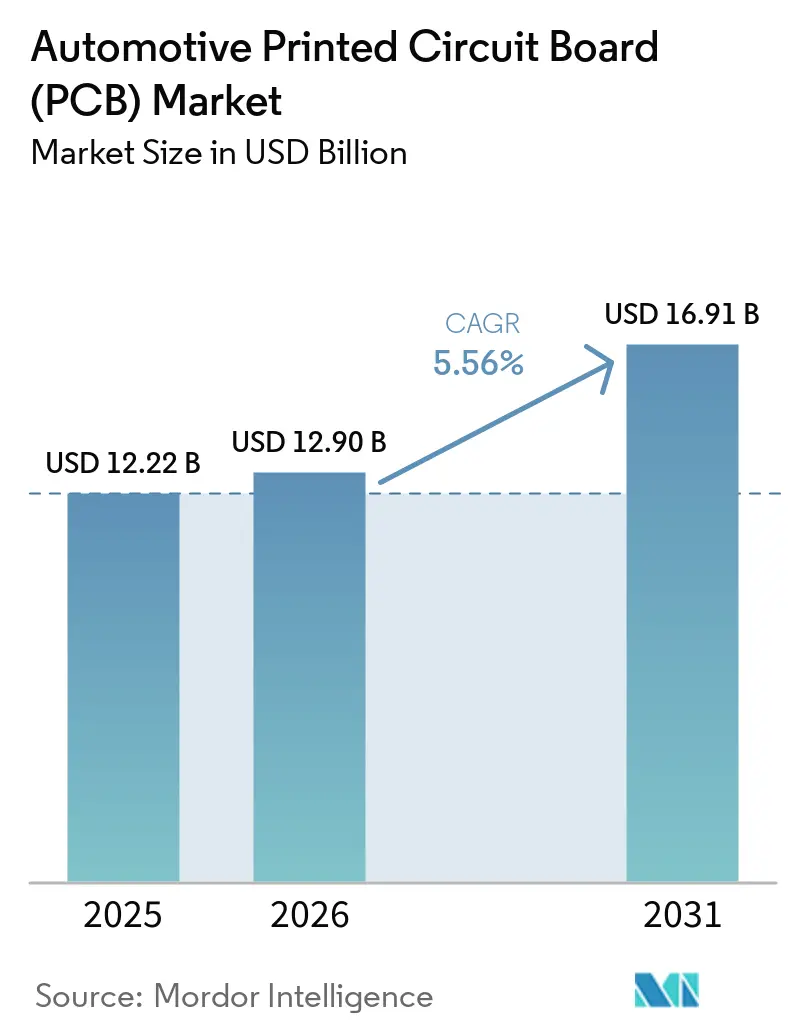
The automotive printed circuit board market size is expected to grow from USD 12.22 billion in 2025 to USD 12.9 billion in 2026 and is forecast to reach USD 16.91 billion by 2031 at 5.56% CAGR over 2026-2031. Growth stems from the rapid shift toward software-defined vehicles that depend on increasingly sophisticated boards to connect high-performance compute, safety sensors, and electrified drivetrains. Mandatory advanced driver-assistance standards, the proliferation of battery-electric platforms, migration to 48 V power nets, and always-connected infotainment expand the addressable automotive printed circuit board market opportunity. Silicon-carbide traction inverters and domain controllers now operate beyond 175 °C, pushing designers toward high-density interconnect and rigid-flex architectures that enhance thermal spreading and signal integrity.
Key Report Takeaways
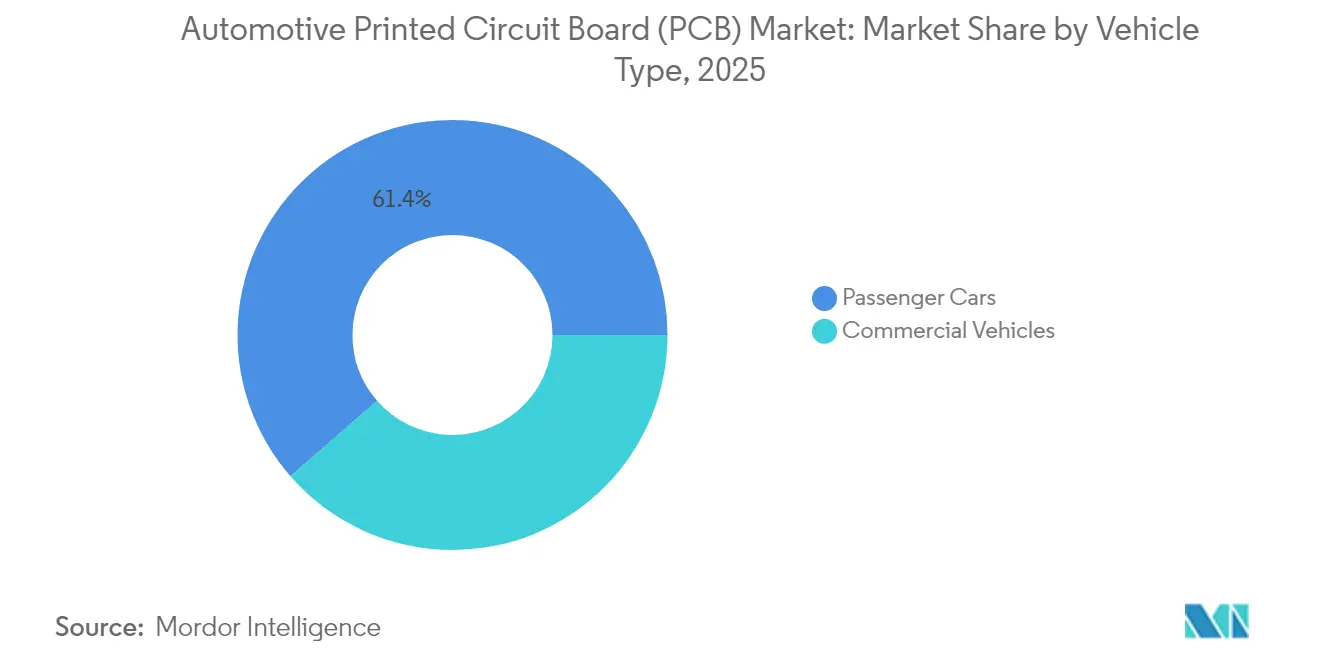
- By vehicle type, passenger cars held 61.42% of the automotive printed circuit board market share in 2025, carrying the fastest CAGR from 6.74% to 2031.
- By propulsion type, internal-combustion powertrains retained 54.96% of the automotive printed circuit board market size in 2025, while battery electric vehicles advance at an 18.29% CAGR through 2031.
- By PCB type, single-layer boards led with 37.92% of the automotive printed circuit board market share in 2025, whereas high-density interconnect solutions are on track for an 11.07% CAGR through 2031.
- By substrate, rigid materials dominated with 69.55% automotive printed board market share in 2025; rigid-flex options post the highest 13.18% CAGR.
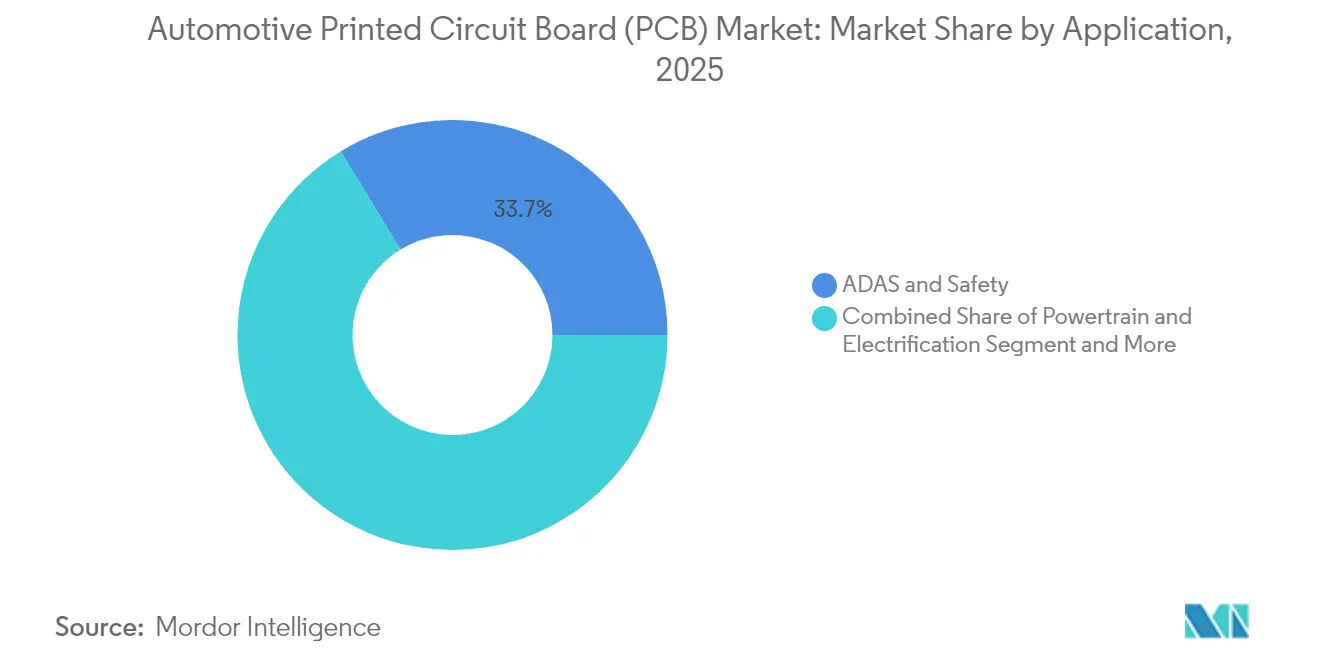
- By application, ADAS and safety systems accounted for 33.71% of the automotive printed circuit board market size in 2025; autonomous-driving compute is projected to grow at 13.86% CAGR.
- By level of automation, SAE Level 0-2 systems controlled 82.12% of the automotive printed board market size in 2025, while Level 4-5 solutions log a 14.78% CAGR through 2031.
- By geography, Asia-Pacific commanded 60.05% share of the automotive printed board market size in 2025 and is set for an 8.18% CAGR to 2031.
Note: Market size and forecast figures in this report are generated using Mordor Intelligence’s proprietary estimation framework, updated with the latest available data and insights as of 2026.
Market Trends and Insights
Drivers Impact Analysis of Automotive Printed Circuit Board (PCB) Market*
| Driver | (~) % Impact on CAGR Forecast | Geographic Relevance | Impact Timeline |
|---|---|---|---|
| Rising EV Sales to Fuel PCB Demand | +1.8% | Global, with Asia-Pacific and North America leading adoption | Medium term (2-4 years) |
| ADAS And Safety Regulations | +1.2% | EU and North America primary, expanding to Asia-Pacific | Short term (≤ 2 years) |
| Connected-Infotainment Proliferation | +0.9% | Global, with premium segment leadership in North America and EU | Medium term (2-4 years) |
| Transition to 48V Vehicle Architectures | +0.7% | North America and EU early adoption, Asia-Pacific following | Long term (≥ 4 years) |
| HDI And Flex Board Need | +0.6% | Global, with premium OEMs driving initial deployment | Long term (≥ 4 years) |
| OTA-Upgradable ECUs | +0.5% | Global, with software-defined vehicle leaders prioritizing | Medium term (2-4 years) |
| Source: Mordor Intelligence | |||
Rising EV Sales to Fuel PCB Demand
Electric vehicles embed three to four times more board area than combustion cars, swelling volumes across the automotive printed circuit board market. Battery-management systems cycle between –40 °C and 85 °C and still uphold sub-millivolt measurement accuracy, forcing the adoption of thermally conductive laminates rated above 160 °C glass-transition. Copper-heavy layouts tackle inverter currents yet intensify material spend, particularly as spot copper prices increase. Programs that migrate to 800 V architectures impose wider creepage gaps, accelerating demand for advanced dielectrics to maintain insulation without expanding board footprint.
Mandatory ADAS and Safety Regulations
The EU’s General Safety Regulation II makes automatic emergency braking, lane-keeping, and driver monitoring compulsory from July 2024. Parallel rulemaking in the United States requires AEB on light vehicles by 2029[1]“Federal Motor Vehicle Safety Standards; Automatic Emergency Braking Systems for Light Vehicles,” Federal Register, federalregister.gov. Radar and lidar assemblies must sustain tight impedance at 77 GHz, driving high-density interconnect uptake. ISO 26262 Automotive Safety Integrity Level D raises documentation and validation thresholds, effectively rewarding incumbent suppliers within the automotive printed circuit board market that already operate qualified lines.
Connected-Infotainment Proliferation
Digital cockpits integrate multiple 4K displays, Wi-Fi 6E, 5G, and premium audio in one head unit. Boards must support PCIe Gen 4, automotive Ethernet, and MIPI interfaces inside cramped packaging while isolating from 48 V transient spikes. Secure boot, dual-bank flash, and hardware root-of-trust add layers and power draws. Flexible and rigid-flex boards enable curved OLED dash panels, a design lever that elevates differentiation for OEMs courting Gen-Z buyers. These additions swell the layer count and the average selling price in the automotive printed circuit board market.
Transition to 48 V Vehicle Architectures
Migrating to 48 V cuts harness mass up to 85% and slashes I²R losses by 75%, yet raises creepage requirements on power boards. Dual-voltage topologies persist because legacy 12 V devices remain; this forces designers to partition high- and low-voltage domains inside single substrates without cost-prohibitive spacers. Plants that refine etch uniformity on thick-copper lanes and certify against 48 V arcing secure long-term contracts across the automotive printed circuit board market[2]Christian Cruz, "The Power of 48 V: Relevance, Benefits, and Essentials in System-Level Applications", Analog Devices, analog.com.
Restraints Impact Analysis of Automotive Printed Circuit Board (PCB) Market*
| Restraint | (~) % Impact on CAGR Forecast | Geographic Relevance | Impact Timeline |
|---|---|---|---|
| Complex Design and Integration Challenges | -0.8% | Global, with higher impact in emerging automotive markets | Medium term (2-4 years) |
| Copper-Price Volatility | -0.6% | Global, with particular pressure on high-volume manufacturers | Short term (≤ 2 years) |
| Sic Power Modules' Thermal-Reliability Issues | -0.4% | Global, affecting premium EV segment primarily | Long term (≥ 4 years) |
| Lengthy ISO 26262 Safety-Audit Cycles | -0.3% | Global, with stricter enforcement in EU and North America | Long term (≥ 4 years) |
| Source: Mordor Intelligence | |||
Complex Design and Integration Challenges
Modern vehicles juggle RF, power, and digital subsystems in centimeters of board real estate. Silicon-carbide modules sustain over 175 °C, so materials need low-expansion coefficients. Shortages of engineers versed in automotive functional-safety layout slow time-to-market. Incumbents that automate design-for-reliability cut-and-try loops enlarge their hold on the automotive printed circuit board market.
Copper-Price Volatility Squeezing Margins
Every multilayer board rides copper pricing. High-density interconnect stack-ups with heavy copper pours see cost spikes when metal markets tighten. Large vendors hedge, but smaller fabs lack bargaining weight and retreat from capital-intensive automotive bids, nudging consolidation within the automotive printed circuit board market.
*Our forecasts treat driver/restraint impacts as directional, not additive. The impact forecasts reflect baseline growth, mix effects, and variable interactions.
Automotive Printed Circuit Board (PCB) Market Segment Analysis
By Vehicle Type:
Passenger Cars Drive Market ExpansionPassenger cars accounted for 61.42% of the automotive printed circuit board market size in 2025 and are expanding at a 6.74% CAGR to 2031. Feature-rich cabins, advanced parking assistance, and 48 V networks multiply the board area to more than 5 m² in premium trims. Commercial fleets emphasise durability, adopting metal-core or thick-copper FR-4 for brake and suspension controllers exposed to vibration. Passenger-car electrification and connectivity motives thus anchor volume growth that reinforces the scale economics of the automotive printed circuit board market.
Commercial vans remain a strategic subsector as e-commerce logistics pivot toward zero-emission zones. Predictive maintenance telematics sparks demand for ruggedised telematics PCBs. The bus and truck segments take longer to shift because of infrastructure gaps. However, when they adopt electric drivelines, board power densities climb sharply, underpinning fresh revenue streams for the automotive printed circuit board market.


By Propulsion Type:
Electric Powertrains Reshape PCB RequirementsICE vehicles dominated the automotive printed circuit board market size with a 54.96% share in 2025, while battery electric vehicles recorded an 18.29% CAGR, becoming the high-growth engine of the automotive printed circuit board industry. Battery-management, inverter, and on-board-charger boards now require dielectric breakdown strengths above 40 kV/mm to satisfy 800 V systems. Hybrid modules overlay combustion and electric domains, doubling thermal zones and complicating ground isolation. Internal-combustion vehicles remain the majority volume but shift toward turbo-48V mild hybrids, ensuring baseline demand.
In BEVs, thermally conductive yet electrically insulating fillers in prepregs cool power MOSFETs, extending range. Hybrid designs embed isolated gate drivers on the same board as engine controllers, shrinking wiring harnesses. The propulsion mix divergence across regions shapes localised design centre specialisations, all fuelling diversification in the automotive printed circuit board market.
By PCB Type:
HDI Technology Drives InnovationSingle-layer panels kept 37.92% of the automotive printed circuit board market share in 2025, servicing lighting and simple sensor tasks. High-density interconnect formats post an 11.07% CAGR through 2031, as radar front ends stipulate stacked vias and laser-drilled microvias under 75 µm. Automotive printed circuit board market suppliers with sequential lamination and resin plugging dominate premium ADAS bids.
Rigid-flex deployments marry inflexible compute sections to tail flexes that remove connectors, raising reliability. These architectures reduce assembly time by up to 30%, an attractive lever for OEM cost control. Entry-level cars stick with double-layer FR-4 where density needs lag, sustaining volume for cost-optimised board shops and balancing product mix across the automotive printed circuit board market.
By Substrate:
Rigid Substrates Dominate Current ApplicationsRigid FR-4 and metal-core formats capture 69.55% of the automotive printed circuit board market size in 2025. They withstand moisture ingress, vibration, and thermal cycles repeated millions of times. Rigid-flex combinations deliver the fastest 13.18% CAGR to 2031, slashing harness weight in steering-wheel controls and door modules. Metal-core boards migrate from LED headlights into DC-DC converters, their aluminium backplanes doubling as heat sinks.
Thermally conductive polymeric substrates pop up in 2027-plus BEV inverters, promising mass cuts critical for range. Flexible polyimide remains the go-to for bend zones and rotating parts. Circuit material choice thus hinges on application thermal and mechanical stress rather than price alone, a trend lifting value capture per unit within the automotive printed circuit board market.
By Application:
ADAS Systems Lead Electronic Content GrowthADAS and safety boards accounted for a share of 33.71% in the automotive printed circuit board market size in 2025 as regulations tightened. Millimeter-wave radar arrays use eight-layer HDI with in-plane phase-matched nets that require ±2% impedance control. Autonomous compute, though small today, houses stacked high-bandwidth memory on interposers, chasing a 13.86% CAGR that will upscale volumes for high-layer-count shops in the automotive printed circuit board market.
Power-train electrification pushes thick-copper planes and buried busbars. Body comfort stays cost-sensitive yet still upgrades to CAN-FD or automotive Ethernet, adding layers incrementally. Infotainment drives the adoption of flexible OLED backing boards. These diverse applications create a balanced portfolio that shields the automotive printed circuit board market from swings in any single vehicle subsystem.
By Level of Automation:
Higher Autonomy Drives PCB ComplexitySAE Level 0-2 vehicles dominate 82.12% of the automotive printed circuit board market share, but Level 4-5 prototypes deliver a 14.78% CAGR. Level 3 boards gracefully transfer control between driver and machine by juggling redundant CPUs, dual power regulators, and safety monitors. Full autonomy boards exceed 1 TB/h data throughput and embed liquid-cooling cold plates into multilayer stack-ups.
Lockstep micro-controllers, watchdogs, and instantaneous checksum comparators trigger more complexity than consumer electronics of similar compute power. Suppliers who co-design board and cooling hardware position themselves as strategic partners to autonomy program leaders, securing higher-margin contracts inside the automotive printed circuit board market.
Geography Analysis
APAC Automotive Printed Circuit Board (PCB) Market
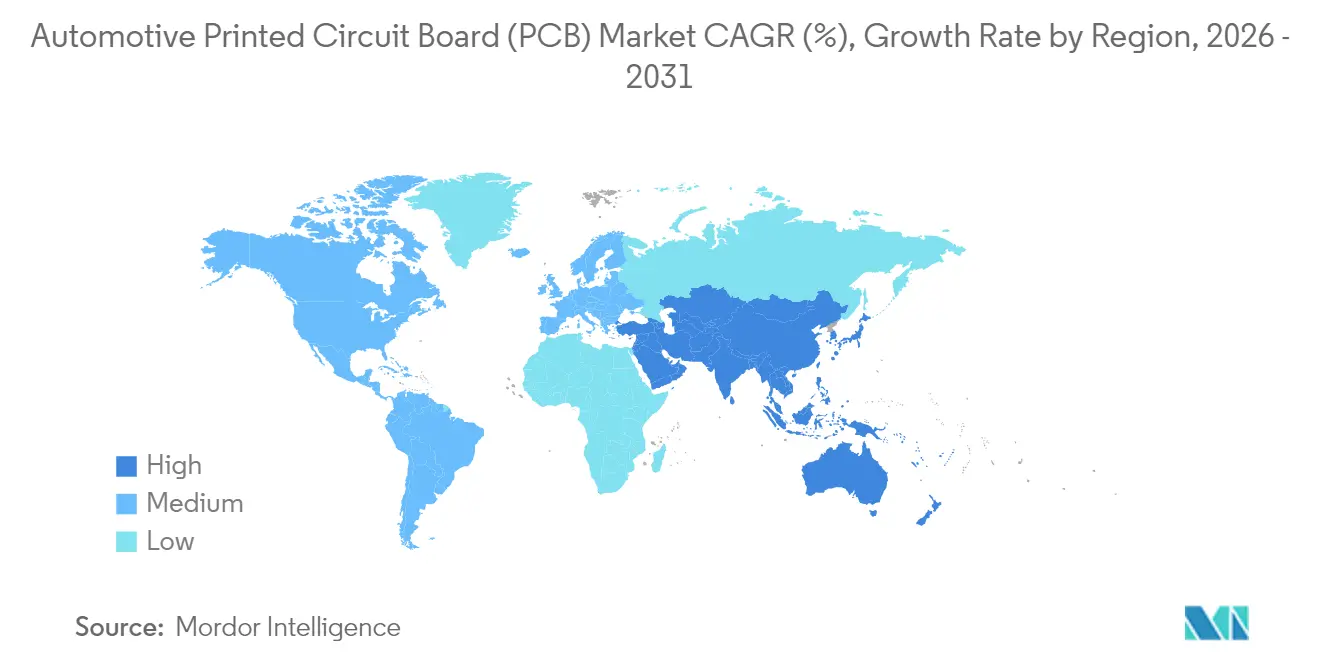
Asia-Pacific captured 60.05% of the automotive printed circuit board market size in 2025 and is forecast to post an 8.18% CAGR to 2031, cementing its status as the volume bedrock of the automotive printed circuit board market. China leads with scaled factories and seasoned operators; yet rising wages and geopolitical tensions drive “China + 1” sourcing. Thailand, Malaysia, and Vietnam roll out incentives and modern fabs capable of HDI and rigid-flex builds, granting OEMs supply-chain resilience.
North America Automotive Printed Circuit Board (PCB) Market
North America holds a moderate share but owns high-value niches, such as silicon-carbide inverters, radar arrays, and cybersecurity-hardened telematics. Design-service boutiques around Detroit and Austin shorten prototype iterations, which is crucial for start-ups launching electric pickups. Policy incentives that foster domestic substrate and chip output may gradually close the cost gap versus Asia and lift on-shore board bookings, enriching the regional slice of the automotive printed circuit board market.
EMEA and South America Automotive Printed Circuit Board (PCB) Market
Europe, on the other hand, remains an engineering powerhouse. Premium German and Swedish marques enforce ISO 26262 traceability and zero-ppm contracts, favouring supply chains with automated optical inspection and X-ray via-fill validation. The continent pioneers 48 V and zonal architectures, keeping domestic design consultancies pivotal to advancing the automotive printed circuit board market. South America and the Middle East/Africa contribute modestly today, but local assembly plants in Brazil and Morocco seek regional board sources to dodge import tariffs.

Regulatory Landscape
Automotive PCB qualification is governed less by a single PCB-specific law and more by automotive-grade safety, quality, and reliability frameworks used by OEMs and Tier-1s, including IATF 16949 for quality management, ISO 26262 for functional safety (ASIL A-D), and component qualification expectations anchored by AEC-Q100/Q200. On the product compliance side, the European Commission-administered RoHS Directive and REACH Regulation continue to shape materials selection and supplier declarations for laminates, finishes, and assembly materials used in automotive electronics.
Trade policy and vehicle safety mandates also influence sourcing decisions and PCB content. In the United States, Section 232 measures introduced a 25% tariff on certain automobiles and parts from May 2025, and the US Department of Commerce established a recurring quarterly inclusions process (January, April, July, October) for petitions to adjust coverage for automotive parts. This can affect landed costs for electronics-heavy modules. In Europe, ADAS requirements under the EU General Safety Regulation II have been in force since July 2024, increasing the deployment of safety-related electronics and strengthening audit and traceability requirements that extend to PCB fabricators and EMS partners.
Value Chain Analysis
The automotive PCB value chain starts with upstream raw materials and chemistry, including copper foil, specialty laminates (high-Tg FR-4, thermally conductive dielectrics, and RF materials for radar), and solder mask and surface-finish chemistries. It then moves into PCB fabrication steps such as imaging, etching, lamination, drilling (including laser microvias for HDI), via-fill, and surface finishing. Downstream, boards go through assembly (SMT, test, conformal coating) into Tier-1 modules such as ADAS sensors, domain controllers, infotainment, and BMS/inverter controls, before reaching OEM vehicle platforms. Qualification gates commonly require PPAP and long validation cycles referenced at roughly 18 to 36 months for new supply introductions.
Bottlenecks increasingly concentrate in HDI capacity, advanced materials availability, and automotive-grade component lead times that constrain module build schedules. That, in turn, raises the value of multi-region production footprints and closer material partnerships. This shows up in initiatives including the June 2026 strategic cooperation between Schweizer Electronic AG and Ascent Circuits to manufacture automotive and industrial PCBs in India for customers in Europe and the United States, and the July 2025 cooperation between DuPont and Zhen Ding Tech Group focused on high-end automotive PCB innovation for interconnect and thermal management. As OEMs reduce supplier counts, fabricators that pair certified quality systems (IATF 16949) with advanced process capability (sequential lamination, fine-line, rigid-flex) and localized logistics improve their position in design-in and long-term awards.
Competitive Landscape
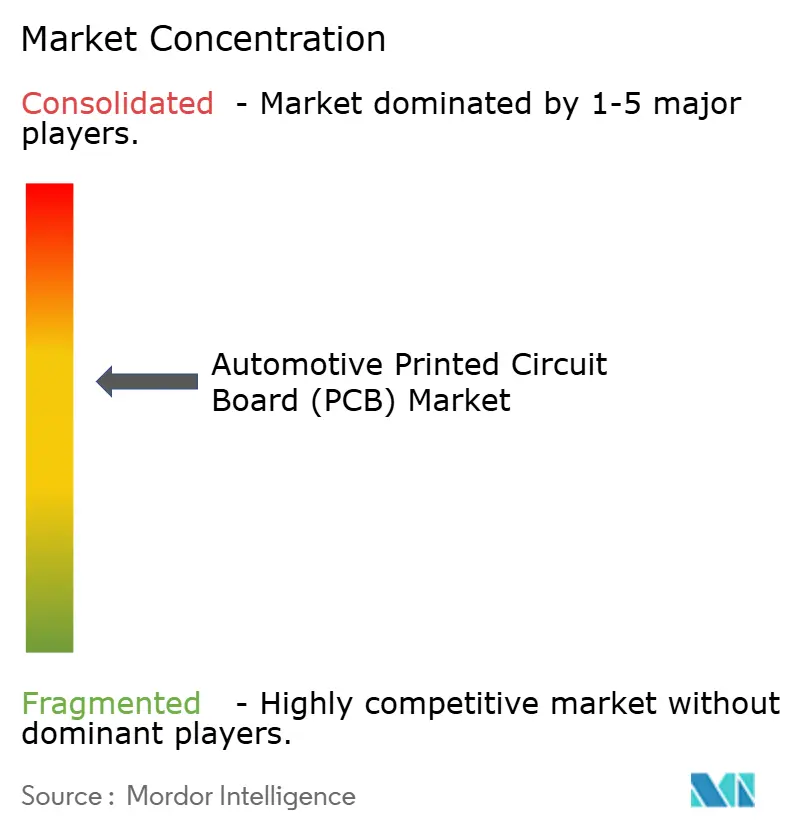
The automotive printed circuit board market is moderately consolidated, with the top five companies controlling a substantial global revenue share. Consolidation accelerates as automakers prefer fewer partners able to deliver design, simulation, fabrication, and assembly under a single quality-management system. Thermally enhanced HDI capability forms a moat that deters commoditised rivals.
Suppliers differentiate through process technology. Via-fill and back-drill accuracy at sub-100 µm, resin-coated copper for flex stiffeners, and embedded-component techniques reduce board count and harness length. Plants that run AEC-Q200 screening on laminates and employ automotive statistical-process control secure multiyear awards. Vendors acquiring EDA toolchains, as seen when Renesas bought Altium, integrate schematic capture and manufacturing knowledge, enabling “shift-left” validation and tighter collaboration with OEM E/E architects.
Strategic moves include metal-core innovation for traction inverters, dielectric formulations for 48 V boards, and pre-certified reference layouts that cut six months of development time. Partnerships between board fabricators and semiconductor houses create turnkey modules encompassing substrate, driver ICs, and thermal interface. Such vertical integration boosts entry barriers and tilts bargaining power toward established players, strengthening their foothold in the automotive printed circuit board market.
Automotive Printed Circuit Board (PCB) Industry Leaders
-
Samsung Electro-Mechanics
-
Unimicron Technology Corp.
-
Meiko Electronics Co. Ltd
-
TTM Technologies Inc.
-
Amitron Corporation
- *Disclaimer: Major Players sorted in no particular order
Automotive Printed Circuit Board (PCB) Market Companies Covered in this Report
- Unimicron Technology Corp.
- Chin Poon Industrial Co. Ltd
- Meiko Electronics Co. Ltd
- TTM Technologies Inc.
- Samsung Electro-Mechanics Co. Ltd
- CMK Corporation
- AT&S AG
- Nippon Mektron Ltd
- Zhen Ding Technology Holding
- Shennan Circuits Co. Ltd
- Ibiden Co. Ltd
- Kinwong Electronic Co. Ltd
- Amitron Corporation
- Tripod Technology Corp.
- Daeduck Electronics Co. Ltd
- KCE Electronics PCL
- STMicroelectronics N.V.
- Infineon Technologies AG
- Sanmina Corp.
- Flex Ltd.
Read Analysis of Automotive Printed Circuit Board (PCB) Companies

Market Opportunities and Future Outlook
An immediate opportunity is the migration toward advanced HDI, rigid-flex, and thermally enhanced stack-ups required by software-defined vehicles, ADAS sensor suites, and electrified powertrains operating at higher temperatures and voltages. Capacity build-outs and technology upgrades in 2026 also indicate where suppliers are placing bets: AT&S confirmed expansion at Kulim, Malaysia (including plant 2 fit-out and a new site for IC substrate cores and advanced PCBs) supported by EUR 1.5 to 2.0 billion in customer-financed agreements, while Synopex announced an additional KRW 15 billion investment at Yen Phong, Vietnam to expand flexible PCB module production for EV batteries and install a 2.2-meter SMT line. Together, these moves point to a gap for suppliers that can combine advanced fabrication with assembly and test services close to OEM and Tier-1 footprints.
A second opportunity set is regionalization and near-shoring, as OEMs and Tier-1s look for shorter lead times and reduced cross-border risk for electronics-intensive modules. JOYNEXT opened a new 13,300 square meter manufacturing facility at Oborniki Slaskie in Poland in April 2026, doubling on-site area for automotive electronics and consolidating assembly steps, which signals growing European pull for localized electronics production and supports PCB and PCBA demand. In Asia, equipment commissioning for complex multilayer production, such as Zhejiang Lingchao Electronic Technology Co., Ltd. adding laser direct imaging and automated vertical continuous copper plating lines in July 2026, reflects ongoing process modernization for higher-layer-count automotive designs, especially in ADAS, infotainment, and power electronics where signal integrity and thermal performance are differentiators.
Recent Industry Developments in Automotive Printed Circuit Board (PCB) Market
- July 2026: Unimicron Technology Corp. announced a plan to raise NT$45 billion through a global share sale, supporting raw material purchases and operational flexibility. The funding action strengthens procurement capacity in a market where specialty laminates and copper-related inputs can be constraining, helping the company protect delivery commitments for automotive-grade programs.
- April 2026: Meiko Electronics Co., Ltd. resolved to establish MEIKO ELECTRONICS YEN QUANG CO., LTD in Phu Tho Province, Vietnam with USD 50 million capital. The move expands its ASEAN footprint and supports localization needs from automotive electronics customers managing multi-country sourcing and just-in-sequence supply expectations.
- December 2024: Ventec International Group unveiled a USD 17 million automotive PCB materials manufacturing facility in Thailand, targeting output of 150,000 sheets per month by Q1 2026. New regional materials capacity helps shorten supply lines for high-Tg and automotive-grade laminate needs, supporting broader HDI and rigid-flex build activity in Southeast Asia.


Automotive Printed Circuit Board (PCB) Market Report Scope and Research Methodology
Market Definition and Coverage
This market is counted as the value of printed circuit boards that are designed, qualified, and sold for use inside vehicles, where boards are used to mount and connect electronic components across vehicle systems.
Scope exclusions: We exclude general-purpose PCBs sold into consumer and industrial devices even when similar board constructions are used.
Segments Covered in This Report
-
By Vehicle Type
- Passenger Cars
- Commercial Vehicles
-
By Propulsion Type
- ICE Vehicles
- Battery Electric Vehicles (BEV)
- Hybrid and Plug-in Hybrid Vehicles
-
By PCB Type
- Single-Layer
- Double-Layer
- Multi-Layer
- High-Density Interconnect (HDI)
- Rigid-Flex / Flexible
-
By Substrate
- Rigid (FR-4 and metal-core)
- Flexible Polyimide
- Rigid-Flex
-
By Application
- ADAS and Safety
- Powertrain and Electrification
- Body and Comfort
- Infotainment and Connectivity
- Autonomous Driving Compute
-
By Level of Automation
- SAE Level 0 - 2
- SAE Level 3
- SAE Level 4 - 5
-
By Geography
-
North America
- United States
- Canada
- Rest of North America
-
South America
- Brazil
- Argentina
- Rest of South America
-
Europe
- Germany
- United Kingdom
- France
- Russia
- Rest of Europe
-
Asia-Pacific
- China
- Japan
- India
- South Korea
- Rest of Asia-Pacific
-
Middle East and Africa
- Saudi Arabia
- United Arab Emirates
- Turkey
- South Africa
- Rest of Middle East and Africa
-
North America
Data Sources, Market Sizing, and Validation
Desk Research
Desk work starts with pinning down the real demand pool for automotive electronics and the parts content that typically sits on PCBs. We refer to public sources such as OICA vehicle production statistics, US International Trade Commission trade data, Eurostat Comext, UN Comtrade, and NHTSA and UNECE regulatory publications that indicate the pace of safety and electrification feature adoption. Technical context is supported using sources such as IEEE and SAE papers (for typical PCB use in ADAS, power electronics, and infotainment) and patent databases that show where designs are moving, including HDI density and thermal management.
After that, we align the model with what suppliers and buyers disclose through annual reports, earnings decks, and reputable press coverage about electronics content growth in vehicles. Where available, we also use paid subscriptions focused on company financials and intelligence, news and financials, and patent databases to fill gaps around revenue splits, plant footprints, and timing of program ramps. The desk sources listed here are not exhaustive, and we used additional public references for data collection, cross-checking, and clarification.
Primary Interviews and Surveys
Primary work is used to confirm what the desk numbers cannot fully show, especially how PCB content per vehicle changes by platform and feature set. We speak with a mix of board manufacturers, material and process stakeholders, and automotive electronics supply chain roles, and then we validate with OEM and Tier supplier facing functions that see demand signals. Since this is a global market, inputs are checked across APAC, EMEA, and the Americas so regional production shifts and pricing differences do not distort totals.
Distribution of primary research fieldwork respondents
| Company type | Respondent position | Region |
|---|---|---|
| Top tier: 25% | CXOs: 12% | APAC: 51% |
| Mid tier: 61% | Functional/Unit leaders: 38% | EMEA: 29% |
| Smaller Players: 14% | Managers: 50% | Americas: 20% |
Market-Sizing & Forecasting
Sizing is built using a top-down demand reconstruction, where vehicle production by region is converted into an addressable electronics build and then translated into PCB value using feature penetration and content assumptions. For example, the model uses vehicle output by powertrain, ADAS fitment rates, infotainment and connectivity take-rates, and the share of electrified platforms that drive higher board count in battery management and power control. Pricing is kept practical by tracking typical shifts in mix, including movement toward multilayer and HDI boards, higher temperature requirements, and greater use of rigid-flex in space-constrained modules.
To keep the totals grounded, the result is then corroborated with selective bottom-up checks, such as sampling supplier revenue exposure to automotive PCBs, cross-checking import-export patterns for PCB categories, and applying reasonable ASP x volume ranges for key vehicle electronics modules. When company disclosures do not separate automotive PCB revenue cleanly, we bridge the gap using product-mix cues, capacity and end-market commentary, and follow-up validation in interviews.
For forecasting, scenario analysis is used because this market moves with a few visible drivers that can change direction quickly, such as EV build plans, semiconductor supply normalization, and safety feature regulation timing. The base case blends vehicle production outlooks with expert-agreed assumptions on content per vehicle and mix-driven pricing, which are then stress-tested under slower or faster electrification and ADAS adoption paths.
Data Validation & Update Cycle
Validation happens in layers so a single data series does not decide the final number. We compare the model outputs against independent signals, such as regional vehicle builds, known electronics content direction, and trade and capacity indicators, and then investigate outliers that break expected relationships like PCB value per vehicle or sudden region mix shifts.
Before sign-off, another analyst reviews key assumptions, math logic, and year-over-year movements, and follow-up calls are triggered when a variance cannot be explained by a clear driver. Reports are refreshed annually, with interim updates when material events occur, and a final pre-delivery review is done so clients receive the most current view available at the time of purchase.
Mordor Intelligence's Automotive Printed Circuit Board Pcb Market Sizing Compared With Other Published Estimates
Published market sizes for automotive PCBs often spread out because the counted scope and the conversion from vehicles to PCB value are not handled the same way. Differences usually come from what is included in the product boundary, how pricing is moved over time, and how aggressively EV and ADAS content is assumed.
The main gap comes from whether estimates fold in non-automotive end-use boards or count broader electronic assemblies. In that case, Mordor Intelligence keeps the total tied to boards qualified for vehicle programs, then cross-checks the value with vehicle production, feature penetration, and mix-driven ASP movement.
Benchmark comparison
| Source | Market Size | Gaps in Research Methodology |
|---|---|---|
| Mordor Intelligence | USD 12.22 B (2025) | |
| Global Consultancy A | USD 11.69 B (2025) | Often relies more on disclosed revenue and a single value chain view, which can undercount content growth from ADAS and electrification when vehicle mix shifts faster than supplier reporting splits. |
| Regional Consultancy B | USD 9.52 B (2024) | Uses an earlier base year and may apply conservative content-per-vehicle assumptions, and the year mismatch also brings currency timing and OEM build-cycle effects into the comparison. |
The table shows that the spread is largely explained by scope choices, base-year timing, and how content growth is translated into price and volume changes. By anchoring the sizing to repeatable demand drivers and then checking it with supplier and trade-based sanity tests, the final value stays traceable and easier to defend when users update assumptions.


Key Questions Answered in the Report
What is the projected size of the automotive printed circuit board market by 2031?
The automotive printed circuit board market size is projected to reach USD 16.91 billion by 2031 on a 5.56% CAGR trajectory.
Which vehicle category contributes the largest revenue share?
Passenger cars represent 61.42% of the automotive printed circuit board market due to high electronics content.
Why is high-density interconnect technology growing quickly?
HDI boards enable compact routing for radar, camera, and zonal controllers, driving an 11.07% CAGR within the automotive printed circuit board market.
How does copper-price volatility influence board suppliers?
Spikes increase material costs, pressuring margins; larger suppliers hedge, but smaller fabs face consolidation risks in the automotive printed circuit board market.
Which region shows the fastest growth outlook?
Asia-Pacific leads growth with an 8.18% CAGR, anchored by China’s capacity and Southeast Asia’s new fabs.
What capabilities do automakers value most in board partners?
Integrated design-to-manufacture services, ISO 26262 compliance, and advanced thermal-management know-how are paramount inside the automotive printed circuit board market.
Page last updated on:


 Your data is secure and never sold or shared.


