
Market Overview
| Study Period | 2020 - 2031 |
|---|---|
| Market Size (2026) | USD 55.92 Billion |
| Market Size (2031) | USD 71.96 Billion |
| Growth Rate (2026 - 2031) | 5.17 % |
| Fastest Growing Market | Middle East and Africa |
| Largest Market | Asia Pacific |
| Market Concentration | Medium |
Major Players *Disclaimer: Major Players sorted in no particular order Image © Mordor Intelligence. Reuse requires attribution under CC BY 4.0. | |
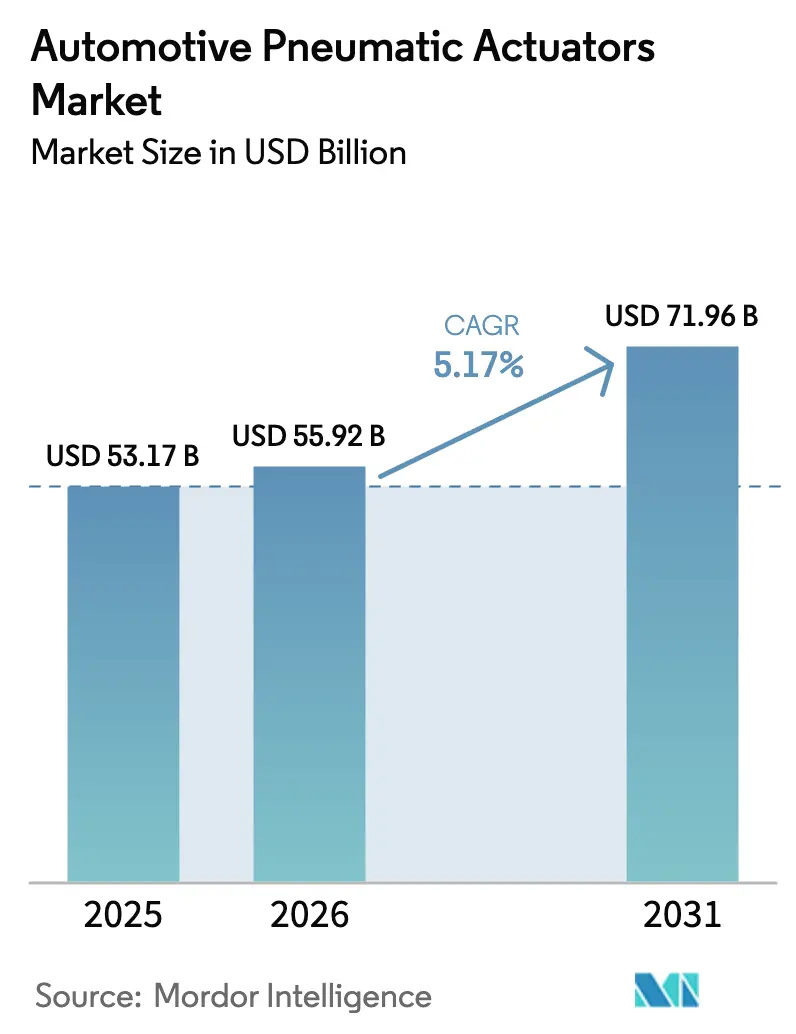
Automotive Pneumatic Actuators Market Analysis by Mordor Intelligence
The Automotive Pneumatic Actuators Market size was valued at USD 53.17 billion in 2025 and estimated to grow from USD 55.92 billion in 2026 to reach USD 71.96 billion by 2031, at a CAGR of 5.17% during the forecast period (2026-2031). Despite competition from energy-efficient electric actuators, vehicle makers continue to rely on pneumatic devices for safety, powertrain, and chassis functions. Stricter emission regulations and the growing adoption of ADAS drive demand, with Asia-Pacific leading due to strong supply chains. At the same time, the Middle East and Africa, as well as South America, see rapid growth from expanding local assembly programs.
Key Report Takeaways
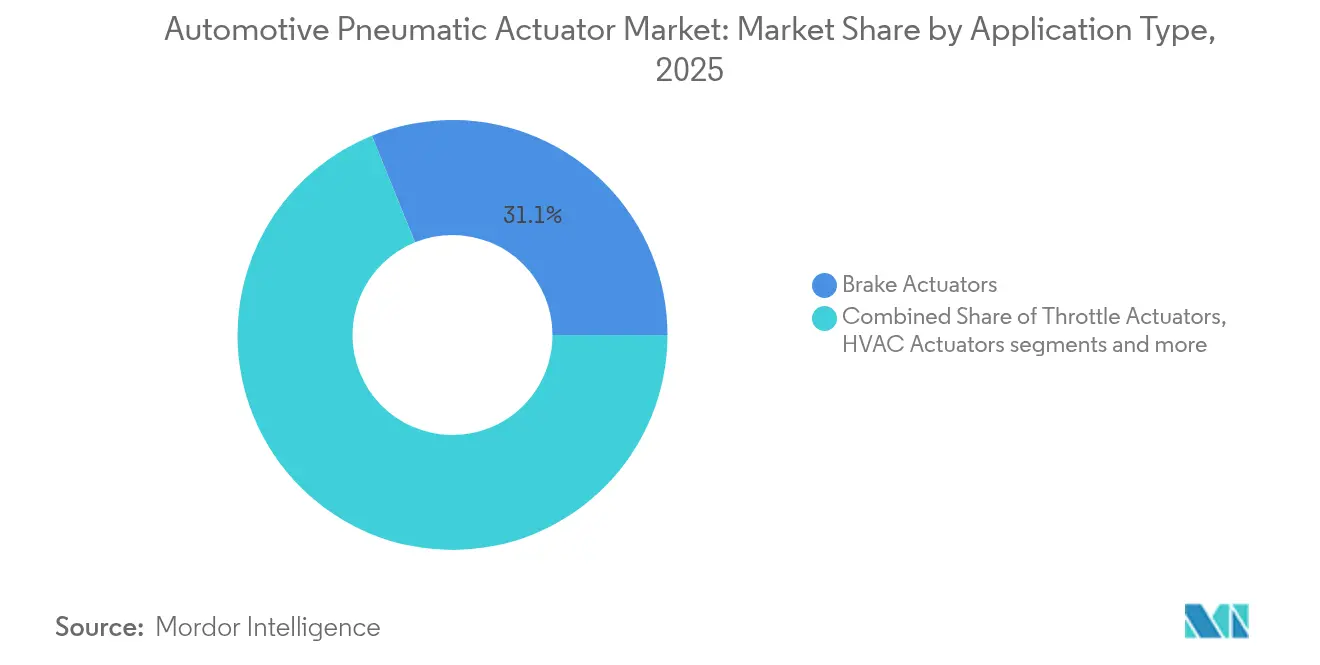
- By application type, brake actuators led with 31.12% automotive pneumatic actuators market share in 2025, while turbocharger wastegate actuators are projected to grow at a 6.43% CAGR through 2031.
- By vehicle type, passenger cars accounted for 56.05% of the automotive pneumatic actuators market size in 2025, yet heavy commercial vehicles are expected to register the fastest 5.63% CAGR to 2031.
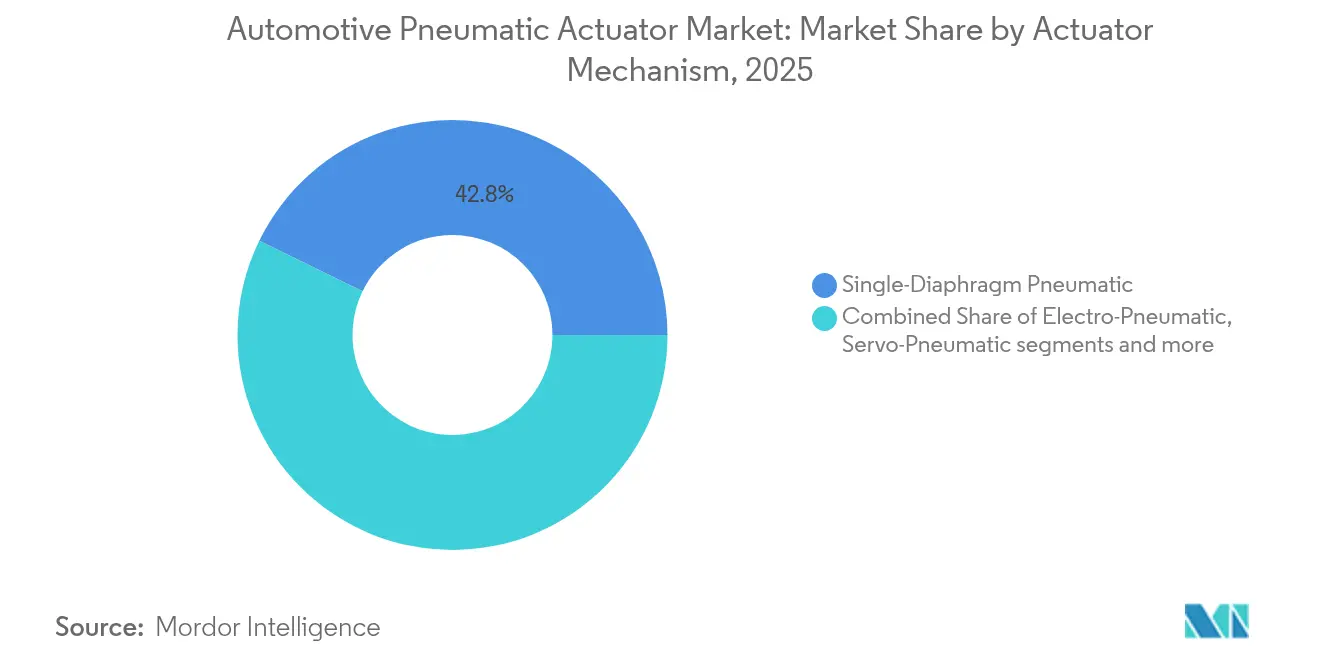
- By actuator mechanism, single-diaphragm designs held 42.78% of the automotive pneumatic actuators market share in 2025, whereas electro-pneumatic hybrids are forecast to post a 6.08% CAGR through 2031.
- By Sales Channel, OEM programs dominated distribution with 72.45% revenue share of the automotive pneumatic actuators market in 2025, whereas the aftermarket is projected to grow at a 5.05% CAGR through 2031
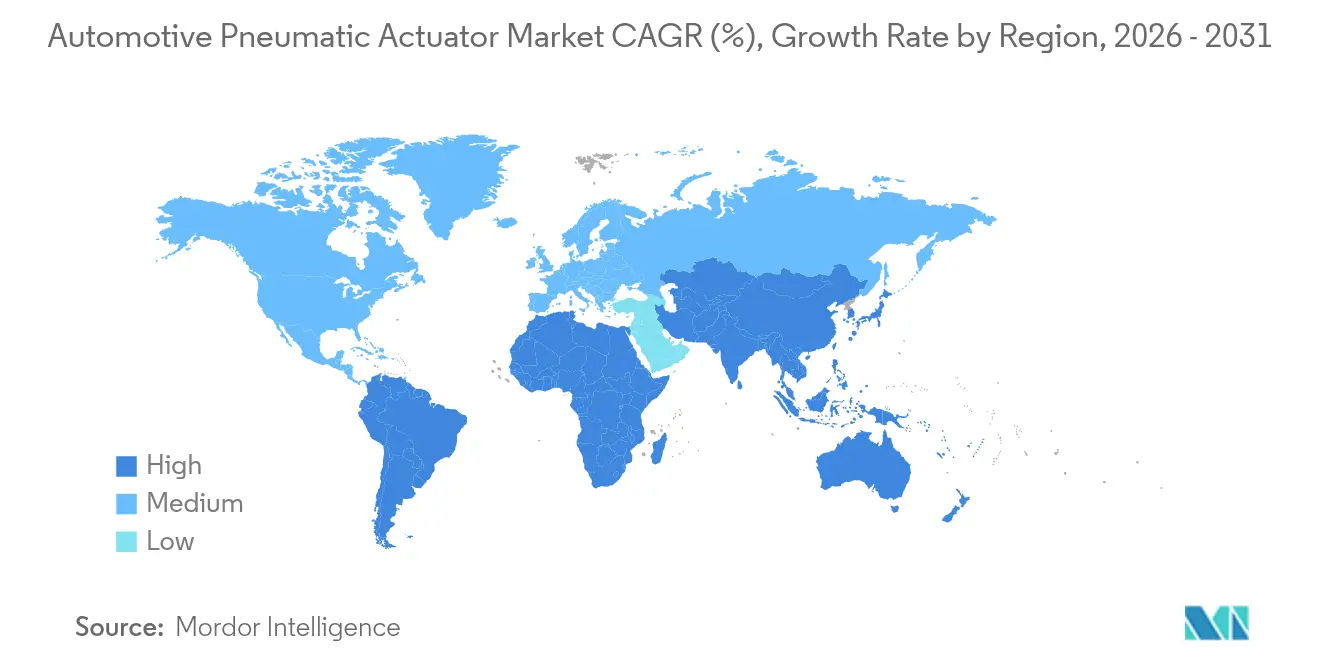
- By region, Asia Pacific captured 45.08% revenue share of the automotive pneumatic actuators market in 2025, while Middle East and Africa is advancing at an 7.42% CAGR to 2031.
Note: Market size and forecast figures in this report are generated using Mordor Intelligence’s proprietary estimation framework, updated with the latest available data and insights as of 2026.
Market Trends and Insights
Drivers Impact Analysis of Automotive Pneumatic Actuators Market*
| Driver | (~) % Impact on CAGR Forecast | Geographic Relevance | Impact Timeline |
|---|---|---|---|
| Stricter emission norms driving precise air-fuel control | +1.5% | Global, EU and North America leading | Short term (≤ 2 years) |
| Increasing global vehicle production | +1.2% | Global, with Asia-Pacific core concentration | Medium term (2-4 years) |
| ADAS proliferation demanding accurate actuation | +1.1% | Global, with premium segment focus | Medium term (2-4 years) |
| Lightweighting trend for fuel economy | +0.8% | North America and EU, spill-over to Asia-Pacific | Long term (≥ 4 years) |
| Hydrogen ICE valve-timing adoption | +0.3% | Japan, Germany, select Asia-Pacific markets | Long term (≥ 4 years) |
| OTA-enabled actuator software monetisation | +0.2% | North America and EU premium segments | Long term (≥ 4 years) |
| Source: Mordor Intelligence | |||
Stricter emission norms driving precise air-fuel control
The US EPA’s Phase 3 heavy-duty standards enacted in 2024 tighten NOx thresholds, compelling diesel makers to refine EGR and dosing strategies that rely on high-resolution pneumatic valves.[1]United States Environmental Protection Agency, “Control of Air Pollution from New Motor Vehicles: Heavy-Duty Engine and Vehicle Standards,” epa.gov Similar Euro 7 drafts trigger demand peaks in Europe. Field-valid testing replaces laboratory cycles, forcing actuators to sustain precision under real-world vibration and temperature excursions. Suppliers with electro-pneumatic packages that close the digital feedback loop enjoy distinct bidding advantages. The regulatory timetable accelerates award decisions, locking in revenue visibility for the forecast period.
Increasing global vehicle production
Rising light-duty and heavy-duty volumes lift baseline demand across all pneumatic applications because every unit assembled carries multiple actuator points. The Japan Automobile Manufacturers Association confirmed that OEM schedules for 2025 still embed pneumatic solutions in brake, throttle, and EGR circuits to assure fuel efficiency and compliance.[2]Japan Automobile Manufacturers Association, “Motor Vehicle Statistics 2024,” jama.or.jp Platform sharing further magnifies volumes because a single actuator family can now be fitted across sibling models, raising economies of scale for suppliers. Western manufacturers are repositioning final-assembly footprints toward Southeast Asia, which encourages actuator makers to co-locate module lines. The production rebound therefore secures near-term growth in the automotive pneumatic actuators market even as electric rivals sharpen their cost proposition.
ADAS proliferation demanding accurate actuation
Higher-level driver-assistance features, from automated emergency braking to traffic-jam assist, need actuators capable of millisecond response to electronic control-unit commands. Hybrid electro-pneumatic devices handle the power density of air pressure while executing digital set-points from the vehicle network. Standard Motor Products broadened its electronic parking brake lineup in 2025 to support newest collision-avoidance algorithms.[3]“Standard Adds Electronic Parking Brake Actuators,” Standard Motor Products, smpcorp.com This integration imperative keeps the automotive pneumatic actuators market aligned with overarching software-defined-vehicle themes rather than sidelined by pure electrics.
Lightweighting trend for fuel economy
OEM fuel-efficiency roadmaps push actuator engineers toward composite housings and thin-wall metal stampings. Independent research on automotive composites confirms that substituting steel casings with carbon-fiber reinforced plastics can cut actuator weight by 35% without sacrificing strength. Lighter HVAC blend door modules and seat-adjust mechanisms directly translate into measurable consumption gains in homologation tests. The initiative also encourages function integration—merging two or more pneumatic roles into a single housing—which trims harness length and simplifies line installation, making cost-out and weight-out objectives mutually reinforcing.
Restraints Impact Analysis of Automotive Pneumatic Actuators Market*
| Restraint | (~) % Impact on CAGR Forecast | Geographic Relevance | Impact Timeline |
|---|---|---|---|
| Shift toward energy-efficient electric actuators | -1.8% | Global, led by premium segments | Medium term (2-4 years) |
| Complexity & high maintenance cost of pneumatics | -0.9% | Global, particularly aftermarket | Short term (≤ 2 years) |
| Shortage of high-grade elastomers for seals | -0.6% | Global supply chain impact | Short term (≤ 2 years) |
| Tier-1 decarbonisation curbing pneumatic R&D | -0.4% | EU and North America focus | Long term (≥ 4 years) |
| Source: Mordor Intelligence | |||
Shift toward energy-efficient electric actuators
Electromechanical systems convert battery power into motion with up to 80% efficiency, dwarfing the 20% ceiling of air-driven counterparts. The delta becomes more pronounced in electric cars, where every watt saved extends range. Line-builders are also migrating their welding robots and material-handling arms to electric cylinders for tighter path accuracy. Yet pneumatics still dominates the highest-force nodes, such as heavy truck drum brakes, where compressed air is already integral to the vehicle platform. Consequently suppliers are channeling R&D toward mixed-technology actuators that preserve pressure-based force while embedding low-energy position control.
Complexity & high maintenance cost of pneumatics
Compressed-air architectures need dryers, reservoirs, and leak-proof couplings, all of which add to bill-of-material and service labor. Fleet operators report seal replacement intervals of 18–24 months on brake chambers, compared with 60-plus months for sealed electric alternatives. Reduced downtime expectations under predictive-maintenance programs place pneumatics at a cost disadvantage. The aftermarket channel takes the biggest margin impact because independent garages must carry a broader parts inventory and specialized leak-test equipment.
*Our forecasts treat driver/restraint impacts as directional, not additive. The impact forecasts reflect baseline growth, mix effects, and variable interactions.
Automotive Pneumatic Actuators Market Segment Analysis
By Application Type:
Brake systems drive market leadershipBrake chambers and parking brake caliper units commanded 31.12% share of the automotive pneumatic actuators market in 2025. Their presence is mandated across every passenger and commercial vehicle variant, cementing baseline volume. Electromechanical parking brakes are penetrating luxury sedans, but heavy truck drum brakes still rely on air chambers that deliver high clamping force at low unit cost. Turbocharger wastegate actuators follow as the fastest riser, posting a 6.43% CAGR because downsized gasoline engines depend on accurate boost management to meet power and emission targets. Throttle valves, HVAC blend doors, and EGR butterflies retain mid-single-digit growth, each backed by regulatory or comfort imperatives.
Pneumatic fuel-injection rail regulators survive in certain flex-fuel layouts popular in Brazil, while door-lock plungers remain common in cost-sensitive hatchbacks. Across the board, suppliers experiment with smart pressure sensors embedded in actuator bodies to supply health data back to the vehicle control network. The enhancements prolong relevance of pneumatically powered devices even as direct electric motor drives tighten competitive gaps. Overall, the application mix underscores why the automotive pneumatic actuators market maintains double-digit billion-dollar revenues: it spans mandatory safety, emissions, and comfort functions that every vehicle must carry.


By Vehicle Type:
Commercial segments accelerate growthPassenger cars generated 56.05% of 2025 revenue, reflecting sheer production volume across global plants. Yet heavy commercial vehicles are projected to pace the automotive pneumatic actuators market size expansion with a 5.63% CAGR. Fleet operators prize the durability of air-brake and air-suspension circuits under intense duty cycles, while stricter CO₂ quotas push for optimized compressor management rather than wholesale technology swaps. Light commercial vans track e-commerce parcel demand and achieve a robust CAGR on the back of city-logistics growth. Construction and mining equipment are, chiefly for high-temperature exhaust-flap controllers and robust steering stabilizers.
Two-wheelers remain a micro-segment concentrated in select Asian economies, yet scooter OEMs are trialing low-pressure air servos for automatic clutch actuation. The diversity highlights a bifurcation: suburban passenger cars gravitate toward compact electric drives for NVH advantages, whereas high-payload vehicles sustain pneumatics for force density and proven maintainability. That divergence shapes future platform strategies of tier-1 suppliers, compelling them to produce modular families that scale from micro to heavy-duty ratings without rewriting qualification protocols.
By Actuator Mechanism:
Electro-pneumatic hybrids lead innovationSingle-diaphragm designs still anchored 42.78% of 2025 volume because they deliver reliable linear throw at minimal parts count. Nevertheless, electro-pneumatic hybrids top the growth tables at 6.08% CAGR. In these units a small brushless motor operates a piloting valve, trimming pressure proportionally to digital commands while the diaphragm multiplies force on the output rod. The architecture reconciles the long-travel force of pneumatics with the closed-loop precision of electronics. Vacuum-boost varieties persist in gasoline platforms, though the shift to turbocharged or battery-electric powertrains shrinks the availability of manifold vacuum, driving incremental adoption of electrically driven compressors.
Servo-pneumatic and rack-and-pinion formats handle off-highway steering and loader-bucket articulation, environments that mandate explosion-safe operation around volatile dust clouds. Rotary-vane types occupy niche cabin-comfort tasks such as vent-door swing in premium HVAC modules. The richness of mechanisms means no single technology can claim ubiquity, and that diversity insulates the automotive pneumatic actuators market from sudden obsolescence, at least in mixed powertrain fleets projected for the next decade.
By Sales Channel:
OEM integration complexity sustains dominanceOriginal-equipment contracts controlled 72.45% of global turnover in 2025 because braking and emission parts must clear stringent homologation tests before line-side delivery. Automakers favor long-term supply agreements tied to platform life cycles extending seven years or more, preserving predictable call-off schedules for vendors. The aftermarket grows at 5.05% CAGR, supported by global vehicle fleet age exceeding 11 years, yet faces structural drag where electric swap-out kits promise maintenance-free miles. Independent distributors invest in training to service air-systems diagnostics, but compressed-air leak repairs remain labor-intensive.
OEM pull is unlikely to dissipate given the functional safety classification of most pneumatic modules. Even when electric replacements surface, carmakers frequently dual-source to hedge technical risk, which prolongs lifecycle demand for incumbent air units. Suppliers therefore reinforce Tier-0.5 engineering programs—co-designing winter-test campaigns and cyber-security audits—to retain bench spots on future model launch bills.
Geography Analysis
APAC Automotive Pneumatic Actuators Market
Asia-Pacific generated 45.08% of global revenue in 2025, underpinned by China’s multi-brand passenger car output and Japan’s high-precision valve competence. The region is forecast to post a 6.84% CAGR as supply bases in Vietnam, Thailand, and India climb the value curve, making in-region sourcing attractive for global nameplates. Electro-pneumatic R&D centers in South Korea exploit the country’s advanced semiconductor ecosystem to integrate pressure MEMS sensors onto actuator PCBs, heightening competitive edge. Notwithstanding electric-vehicle penetration, cost-optimized sub-compact segments still install pneumatically driven HVAC and turbo wastegate units, securing volume for suppliers.
EMEA Automotive Pneumatic Actuators Market
Middle East & Africa stands out as the fastest-growing cluster at a robust CAGR of 7.42%. Saudi Vision 2030 industrial policy lures CKD assembly lines, each demanding localized actuator content for commercial trucks that service construction booms. The UAE leverages free-zone logistics to re-export spare parts kits deeper into African markets. Turkey’s customs-union access to Europe boosts its component exports, compelling pneumatic suppliers to expand Izmir and Bursa facilities. These dynamics re-orient procurement away from trans-continental shipping toward near-market production, shortening lead times and cutting freight emissions.
South America Automotive Pneumatic Actuators Market
In South America, flex-fuel engine architectures unique to the region stimulate EGR and fuel-rail actuator demand because ethanol blends alter combustion stoichiometry daily. Local content rules push multinational suppliers to site elastomer curing presses in Minas Gerais rather than import seal stacks. Argentine heavy-truck assembly rebounds after currency stabilization measures, adding lift for high-capacity brake chambers. Currency volatility and political risk temper the outlook, yet installed base inertia keeps the automotive pneumatic actuators market resilient in the hemisphere.

Regulatory Landscape
Emissions and safety compliance remain the key regulatory anchors for pneumatic actuation content, especially in braking and engine air-management functions. In the European Union, Euro 7 (Regulation (EU) 2024/1257) tightens requirements under the type-approval framework, and approval authorities are set to refuse type-approval for new vehicle types that do not meet the updated requirements from 29 November 2026. This raises the bar on durability and real-world performance for actuators used in EGR and related control loops.
Braking system requirements also continue to be shaped by UNECE frameworks, including EU-adopted rules such as Regulation (EU) 2016/194 aligned with UN/ECE braking regulations. The result is sustained validation and documentation burden for brake chambers and related pneumatic hardware. On trade policy, the United States maintains Section 232 measures applying a 25% ad valorem tariff on specified imported automobile parts, with a recurring inclusions process managed by the Bureau of Industry and Security. In March 2026, BIS opened the April 2026 inclusions window, reinforcing the need for supply-chain cost management and localization strategies for imported actuator subcomponents.
Value Chain Analysis
The value chain runs from upstream metals and polymers to precision component making and Tier-1 integration. Key inputs include aluminum for housings, specialty steels for pistons and shafts, and high-grade elastomers for seals and diaphragms, followed by machining, forming, surface treatment, and assembly of cylinders, valves, and brake-chamber modules. As electro-pneumatic hybrids gain share within pneumatic architectures, electronics content such as pressure sensors, control boards, and connectors increases the portion of value-add accruing to actuator makers. This shift pushes suppliers toward combined mechatronics and validation capabilities alongside mechanical fabrication.
Midstream production is concentrated in established automotive manufacturing hubs, with high-tolerance pneumatic component capability notably clustered across Germany, Japan, and China, before moving into Tier-1 system integrators that deliver complete modules to OEMs under IATF 16949 quality requirements and automotive PPAP routines. Downstream logistics relies on JIT/JIS delivery into OEM assembly plants for OEM programs, the largest sales channel in 2025. The aftermarket depends on distributor networks and service-channel diagnostics for leak testing and seal replacement, which makes parts availability and standardized serviceability practical differentiators.
Competitive Landscape
The supplier arena shows moderate concentration. Continental, Bosch, and Denso leverage decades-deep brake and powertrain portfolios, plus tight integration at OEM program-management levels. Their established validation labs and geographic footprint allow quick pivoting when automakers add regional sourcing clauses. Continental’s 2024 re-organization placed actuator and motion-control activities into a dedicated division designed to accelerate decision making under volatile demand. Bosch anchors its competitive moat around high-volume machining and in-house elastomer compounding that cushions seal-shortage shocks.
Consolidation continues as suppliers chase scale and cross-portfolio synergies. The Schaeffler-Vitesco tie-up finalized in October 2024 created a EUR 600 million synergy roadmap by combining drivetrain electronics with mechanical actuation depth. Mid-tier companies focus on niche strengths: HEINZMANN specializes in heat-resistant EGR valves operating at 750 °C for diesel commercial engines, while small German and Japanese houses craft miniature servo-pneumatics for motorcycle ABS. New entrants from the industrial automation field attempt to transplant electric-cylinder know-how into vehicles, sparking technology cross-pollination.
Material innovation forms the next battleground. Suppliers investing in fluorine-rich elastomer chemistries secure superior ozone and biofuel resistance, a differentiator as E-fuel blends proliferate. Lightweight metal-matrix components that pair aluminum skins with polymer cores cut unit mass by double digits, aligning with OEM fuel-economy rules. Market share therefore hinges on how quickly incumbents can integrate electronics, software, and advanced materials into legacy air-powered architectures. Those unable to evolve risk ceding programs to agile electrification specialists over the five-year horizon.
Automotive Pneumatic Actuators Industry Leaders
Denso Corporation
Robert Bosch GmbH
Continental AG
Emerson
Hitachi Astemo Ltd
- *Disclaimer: Major Players sorted in no particular order

Automotive Pneumatic Actuators Market Companies Covered in this Report
- Robert Bosch GmbH
- Continental AG
- Denso Corporation
- Emerson (ASCO Valve)
- Hitachi Astemo Ltd
- CTS Corporation
- Schrader Duncan Ltd
- Rotex Automation
- Nucon Industries Pvt Ltd
- Magneti Marelli SpA
- Mitsubishi Electric Corp
- Del-Tron Precision Inc
- Procon Engineering
- Valeo SA
- Aisin Corporation
- Mahle GmbH
- BorgWarner Inc

Market Opportunities and Future Outlook
A whitespace is emerging around smart, electronically controlled pneumatic modules that reduce component count while improving controllability and diagnostics for commercial vehicles. ZF Commercial Vehicle Solutions pointed in this direction in June 2025 by moving its fifth-generation OptiRide ECAS into serial production for Hyundai Motor Company buses. The design consolidates solenoid valves and pressure sensors into a single smart pneumatic actuator, supporting tighter integration and simplifying platform installation for OEM customers.
Electrification and automation in commercial vehicles are also driving demand for new air-generation and safety architectures that keep pneumatics relevant alongside electric alternatives. In June 2026, Bosch, Brakes India Private Limited, and Wheels India Limited announced a 50:50 joint venture to engineer and manufacture electronically controlled and software-driven modules covering air compression, air processing, air suspension, and air parking brakes, with operations planned to commence by end-2026. Separately, Knorr-Bremse presented oil-free compressor technology for high-voltage architectures at IAA Transportation 2026 and communicated a path toward redundant braking systems for Level 4 autonomous commercial vehicles, aligning pneumatic subsystems with higher functional-safety and redundancy requirements in automated trucking.
Recent Industry Developments in Automotive Pneumatic Actuators Market
- June 2026: Bosch, Brakes India Private Limited, and Wheels India Limited announced a 50:50 joint venture to engineer, manufacture, and sell electronically controlled and software-driven modules spanning air compression, air processing, air suspension, and air parking brakes. Operations are planned to commence by end-2026, strengthening local capability for integrated air-system modules used in pneumatic actuation-heavy commercial vehicle platforms.
- June 2025: ZF Commercial Vehicle Solutions commenced series production of its fifth-generation OptiRide Electronically Controlled Air Suspension (ECAS) system for Hyundai Motor Company buses. The design consolidates solenoid valves and pressure sensors into a single smart pneumatic actuator, reducing component count and simplifying vehicle integration for OEM customers.
- June 2024: Kongsberg Automotive won a contract worth over EUR 55 million in estimated lifetime revenue to supply Dog Clutch Actuators, with production starting in 2025 at its Wuxi, China, plant. The award underlines ongoing OEM demand for high-volume actuator manufacturing capacity in Asia, supporting scale economics and platform-level sourcing strategies.


Automotive Pneumatic Actuators Market Report Scope and Research Methodology
Market Definition and Coverage
This market covers revenues earned from pneumatic actuators used in vehicles, where compressed air (or vacuum-assisted pneumatics) creates linear or rotary movement to perform a mechanical function in the vehicle.
Scope exclusions: We exclude electric-only and hydraulic actuators, along with repair kits and standalone valves that are not sold as actuator units.
Segments Covered in This Report
- By Application Type
- Throttle Actuators
- Fuel Injection Actuators
- Brake Actuators
- Exhaust Gas Recirculation Actuators
- Turbocharger Wastegate Actuators
- HVAC Actuators
- Door Lock Actuators
- Others
- By Vehicle Type
- Passenger Cars
- Light Commercial Vehicles
- Medium and Heavy Commercial Vehicles
- Off-Highway Vehicles
- Two-Wheelers
- By Actuator Mechanism
- Single-Diaphragm Pneumatic
- Vacuum-Boost Pneumatic
- Electro-pneumatic (EP)
- Servo-pneumatic
- Rack-and-Pinion
- Rotary-Vane
- By Sales Channel
- OEM
- Aftermarket
- By Geography
- North America
- United States
- Canada
- Rest of North America
- South America
- Brazil
- Argentina
- Rest of South America
- Europe
- Germany
- United Kingdom
- France
- Spain
- Italy
- Russia
- Rest of Europe
- Asia-Pacific
- China
- India
- Japan
- South Korea
- Australia and New Zealand
- Rest of Asia-Pacific
- Middle East and Africa
- Saudi Arabia
- United Arab Emirates
- Turkey
- Egypt
- South Africa
- Rest of Middle East and Africa
- North America
Data Sources, Market Sizing, and Validation
Desk Research
Desk work was used to build the first set of guardrails for volumes, pricing direction, and where demand sits by region and vehicle category. We typically start from public vehicle production and registrations, then link that to where pneumatic actuation is still used across powertrain, chassis, and body functions.
Sources referenced include public statistics and documents such as national transport and vehicle-registration agencies, customs and trade statistics portals, automotive association publications, standards and regulatory releases that affect emissions and safety requirements, and peer-reviewed engineering journals for technology adoption signals. We also review company filings and investor presentations for revenue mix cues, along with reputable press and association websites for program launches and platform changes. To close gaps, we selectively use paid subscriptions for company financials and news intelligence, patent databases, and shipment-level trade records where available. The desk sources listed here are illustrative, and we checked many other public references for data collection, validation, and clarification.
Primary Interviews and Surveys
Primary inputs were gathered through expert interviews and structured surveys with actuator suppliers, system integrators, vehicle-platform stakeholders, and aftermarket channel participants. We used these conversations to confirm fitment assumptions (where pneumatics are used, and where they are being substituted), to sanity-check average selling price movement, and to validate regional pacing across APAC, EMEA, and the Americas.
Distribution of primary research fieldwork respondents
| Company type | Respondent position | Region |
|---|---|---|
| Top tier: 30% | CXOs: 12% | APAC: 46% |
| Mid tier: 54% | Functional/Unit leaders: 42% | EMEA: 32% |
| Smaller Players: 16% | Managers: 46% | Americas: 22% |
Market-Sizing & Forecasting
Sizing starts with a top-down build where vehicle production and parc indicators are converted into a demand pool using pneumatic actuator fitment rates by vehicle type and key applications, which are then multiplied by blended prices to arrive at regional and global totals. Once the first totals are formed, they are corroborated with selective bottom-up checks, such as supplier revenue roll-ups for pneumatic lines, sampled price bands from channel checks, and application-level volume estimates to adjust any over or under counts.
To keep the model tied to real market behavior, we track a short list of inputs that can be explained and updated each year. These include vehicle production by region and category, the share of platforms using pneumatic versus electro-mechanical actuation in specific functions, emissions and safety rule changes that influence actuator content per vehicle, OEM versus aftermarket mix, and observed pricing trends for common mechanisms (for example, single-diaphragm and electro-pneumatic variants). Where a bottom-up signal is missing for a smaller geography or niche vehicle class, we handle gaps by applying validated proxy ratios from similar markets, then rechecking totals against trade and production signals.
Forecasts are built using scenario analysis supported by a simple multivariate regression view for demand drivers that show steady relationships over time, such as production outlook, regional platform mix, and replacement cycles. Final assumptions are only locked after they are rechecked with primary experts, especially when substitution risk or regulation-driven shifts could change the adoption curve faster than expected.
Data Validation & Update Cycle
Validation is done in steps so the final number is not driven by a single data series. We triangulate market totals across production-led demand pools, application-level sanity checks, and price progression logic, and then compare the output with independent signals like OEM program activity and trade flows.
When an outlier is found, such as a region growing faster than its vehicle output would suggest, the assumptions are reopened and relevant experts are re-contacted to confirm if a real mix shift is happening. Before sign-off, the model is reviewed by another analyst to catch unit errors, double counting, and currency timing mismatches. Reports are refreshed annually, with interim updates when material events occur, and a final pre-delivery pass is completed so clients receive the most current view.
Mordor Intelligence's Automotive Pneumatic Actuators Market Size Versus Other Published Estimates
Published market values for automotive pneumatic actuators can look different across sources, even when they use the same headline label. The gaps usually come from how each study decides what is inside the market, which year and pricing basis is used, and how aggressively future adoption or substitution is assumed.
Some published figures fold in adjacent hardware and air-handling content around the actuator, which can push the value up quickly. For Mordor Intelligence, only actuator unit revenues are counted across OEM and aftermarket, and electric-only or hydraulic actuators, repair kits, and standalone valves are kept out, so the number stays tied to a repeatable fitment and pricing model.
Benchmark comparison
| Source | Market Size | Gaps in Research Methodology |
|---|---|---|
| Mordor Intelligence | USD 53.17 B (2025) | |
| Trade Journal A | USD 53.17 B (2025) | The published number is aligned on the year, but the scope description is broader and lists extra application buckets without clarifying exclusions, which can lead readers to assume related pneumatic hardware is included. |
| Regional Consultancy B | USD 69.49 B (2030) | This figure is a forward-year projection that reflects a higher CAGR path and a shorter forecast window, and it can differ based on assumed price uplift and faster adoption across added vehicle classes and applications. |
Across the table, most of the spread is explained by scope choices and timing choices, not by arithmetic. By keeping the model anchored to vehicle output, application fitment, and practical price checks, the resulting series stays transparent and easy to update when platform mix or regulations shift.


Key Questions Answered in the Report
What is the current value of the automotive pneumatic actuators market?
The market stands at USD 55.92 billion in 2026 and is projected to reach USD 71.96 billion by 2031.
Which application segment leads the market?
Brake actuators command the largest slice with 31.12% market share in 2025, reflecting their mandatory safety role.
Why do heavy commercial vehicles post faster growth than passenger cars?
Fleet operators emphasize durability and high clamp force, driving a 5.63% CAGR for heavy trucks versus lower growth in car segments that increasingly adopt electric actuation.
How significant is Asia-Pacific in this landscape?
Asia-Pacific holds 45.08% of global revenue, supported by dense assembly capacity and integrated supply chains, and is forecast to grow at a 6.84% CAGR.
What technology trend defines future product design?
Electro-pneumatic hybrids form the main innovation path, pairing pneumatic power with electronic precision to meet ADAS and emission-control requirements.
Which factor poses the greatest restraint?
The shift toward high-efficiency electric actuators subtracts 1.8 percentage points from the forecast CAGR due to energy-savings imperatives across premium segments.
Page last updated on:


 Your data is secure and never sold or shared.


