
Automotive Over-the-Air Updates Market Size and Share
Market Overview
| Study Period | 2019 - 2031 |
|---|---|
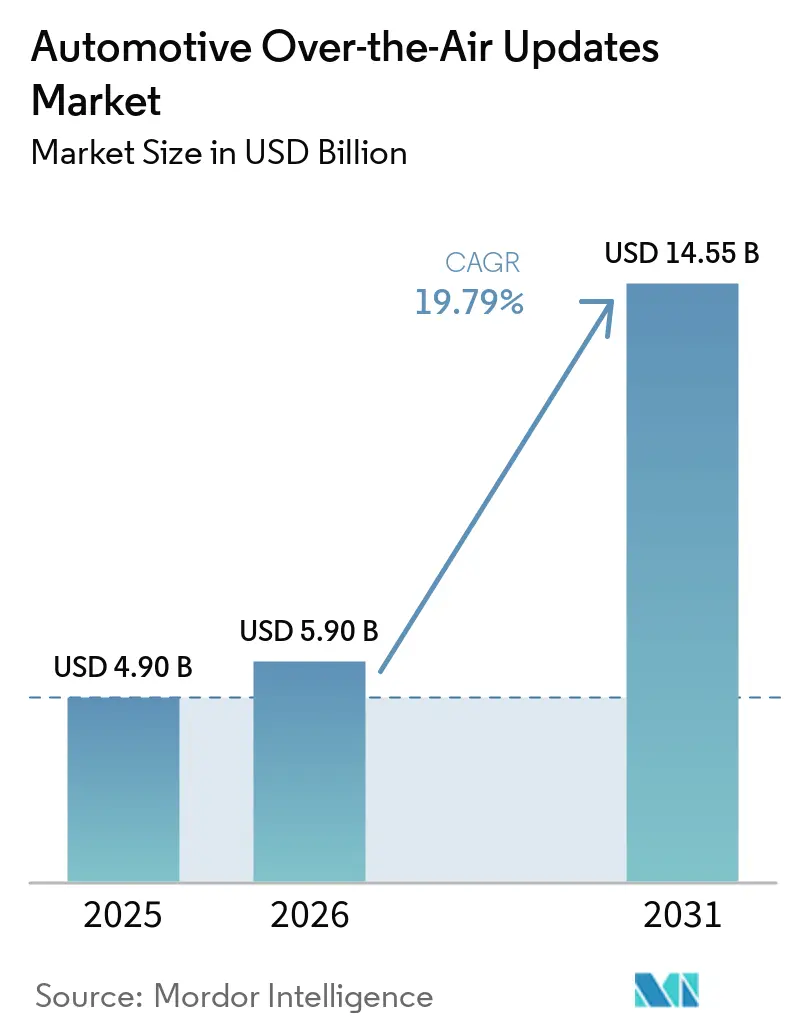
| Market Size (2026) | USD 5.90 Billion |
| Market Size (2031) | USD 14.55 Billion |
| Growth Rate (2026 - 2031) | 19.79 % |
| Fastest Growing Market | Asia-Pacific |
| Largest Market | North America |
| Market Concentration | Medium |
Major Players *Disclaimer: Major Players sorted in no particular order Image © Mordor Intelligence. Reuse requires attribution under CC BY 4.0. | |
Automotive Over-the-Air Updates Market Analysis by Mordor Intelligence
The automotive over-the-air updates market size was valued at USD 4.90 billion in 2025, is estimated at USD 5.90 billion in 2026, and is forecast to reach USD 14.55 billion by 2031 at a 19.79% CAGR over 2026-2031. System architectures are shifting from hardware-centric designs to software-defined platforms that can accept feature, performance, and security enhancements across the entire vehicle life cycle. Early electric vehicle (EV) adopters demonstrate higher update frequency because battery management, thermal control, and autonomous-driving algorithms evolve continuously. Global regulations now treat secure and traceable software updating as a prerequisite for type approval, obliging automakers to invest in scalable back-end infrastructure. Commercial fleets value predictive maintenance delivered through remote updates, which reduces unscheduled downtime and raises vehicle utilization. Competitive strategies vary: vertically integrated brands capture full software margin while legacy manufacturers rely on tier-1 suppliers to accelerate deployment.
Key Report Takeaways
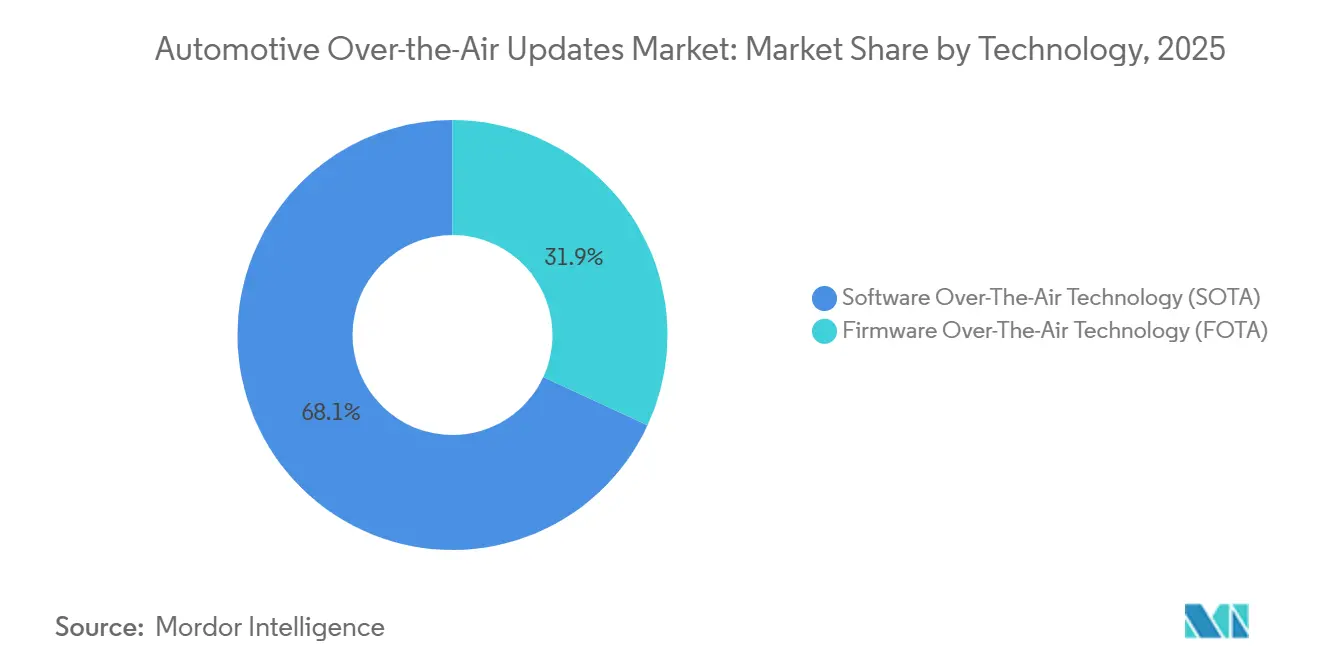
- By technology, firmware over-the-air deliveries are expected to advance at a 22.74% CAGR through 2031, while software over-the-air accounted for a 68.14% revenue share in 2025.
- By application, telematics control units led with 36.25% revenue share of the automotive over-the-air updates market in 2025, while safety and security updates are projected to expand at a 21.34% CAGR through 2031.
- By propulsion, internal-combustion vehicles held 75.03% share of the automotive over-the-air updates market size in 2025, yet electric vehicles are projected to increase at a 27.46% CAGR between 2026 and 2031.
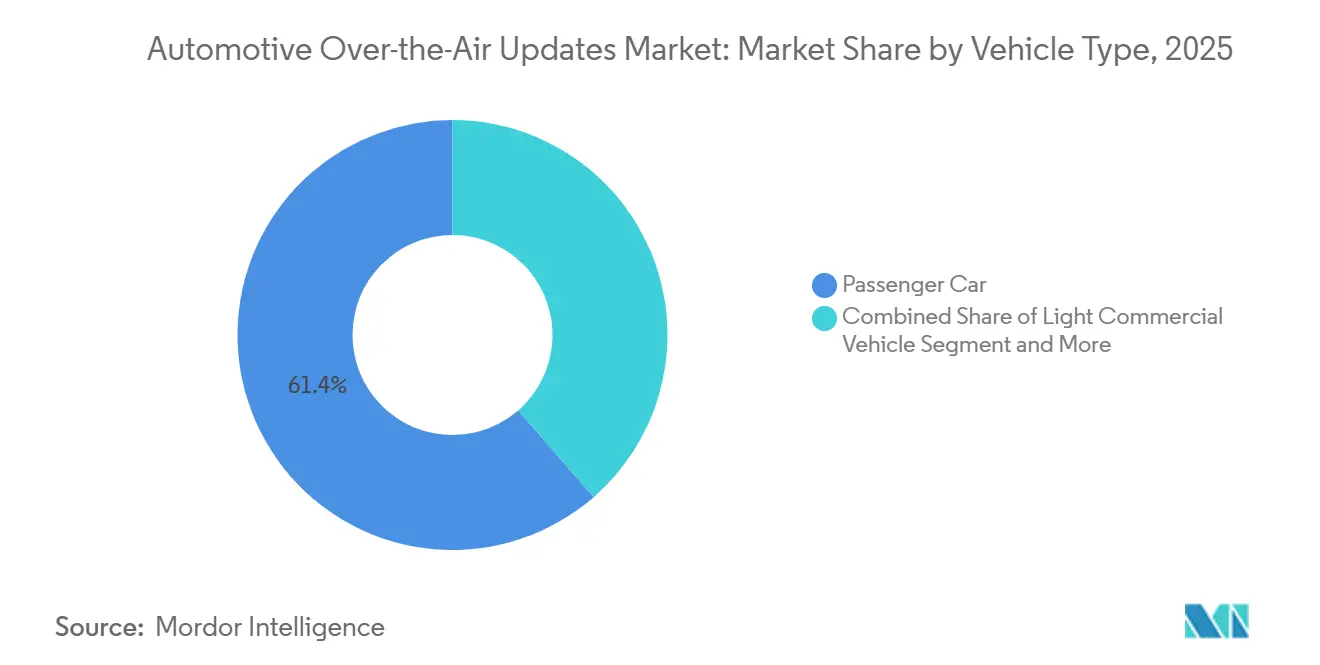
- By vehicle type, passenger cars captured 61.35% share in 2025 and are anticipated to expand at a 20.58% CAGR to 2031.
- By communication type, cellular networks accounted for 70.34% of the automotive over-the-air updates market share in 2025, whereas satellite connectivity is forecast to grow at a 25.17% CAGR to 2031.
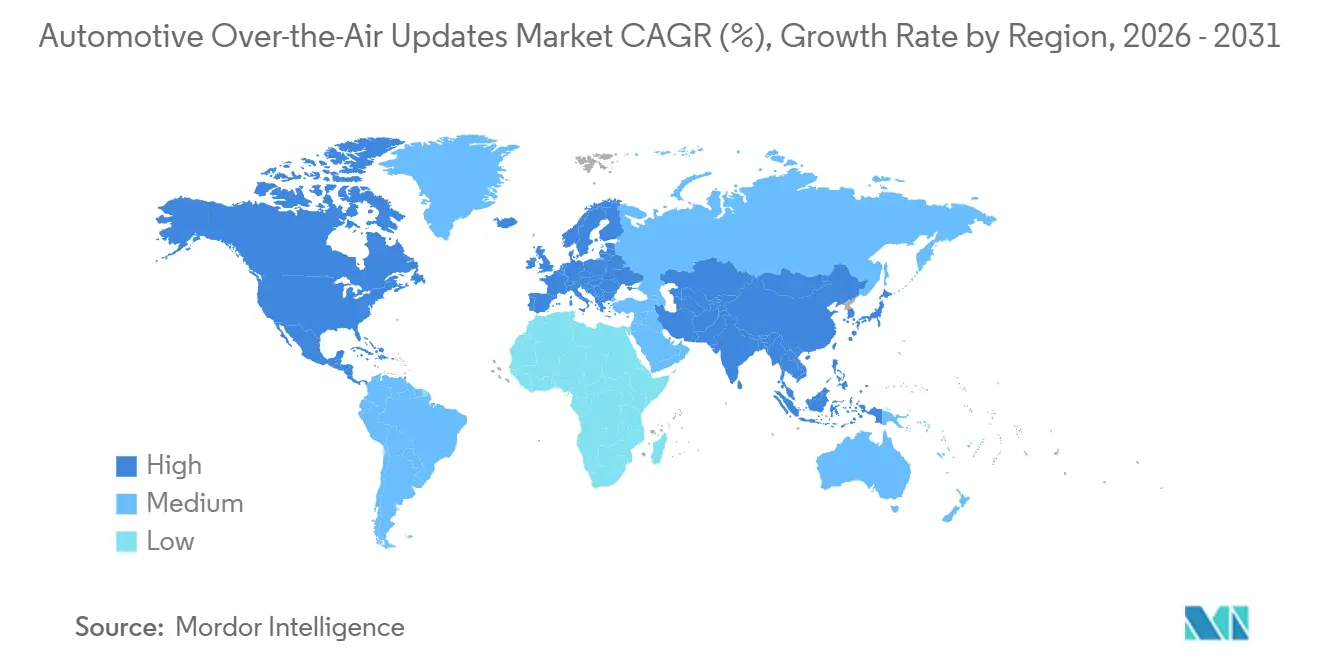
- By geography, North America accounted for 44.12% revenue share in 2025, while Asia-Pacific is set to expand at a 20.15% CAGR.
Note: Market size and forecast figures in this report are generated using Mordor Intelligence’s proprietary estimation framework, updated with the latest available data and insights as of January 2026.
Market Trends and Insights
Drivers Impact Analysis of Automotive Over-the-Air Updates Market*
| Driver | (~) % Impact on CAGR Forecast | Geographic Relevance | Impact Timeline |
|---|---|---|---|
| Electrification and SDV Architectures | +4.5% | Global with concentration in China, North America, Northern Europe | Medium term (2-4 years) |
| Connected-Car and Telematics Penetration | +3.8% | North America, Western Europe, urban Asia-Pacific | Short term (≤2 years) |
| Safety-Recall and Cyber-Security Compliance | +3.2% | Global, led by EU, China, Japan, North America, India | Short term (≤2 years) |
| Feature-as-a-Service Monetization Models | +2.5% | North America, Western Europe, premium China segments | Medium term (2-4 years) |
| Satellite Coverage for Remote Delivery | +1.8% | Rural Canada, Brazil, Australia, Russia, Middle East, Africa | Long term (≥4 years) |
| OTA Off-Load via EV-Charging | +1.2% | EV-dense markets in China, Norway, California, Netherlands | Long term (≥4 years) |
| Source: Mordor Intelligence | |||
Electrification and SDV Architectures Demanding Frequent Updates
Battery electric vehicles rely on sophisticated software to manage energy use, thermal behavior, and regenerative braking. Tesla’s early 2025 range-recalibration update illustrated how post-sale firmware can resolve consumer concerns without hardware modification [1]. Domain-controller topologies that replace dozens of discrete electronic control units streamline validation, shorten test cycles, and enable weekly release cadences. Volkswagen’s zonal architecture rollout in 2026 reduced wiring harness weight, lowering bill-of-materials cost while supporting faster integration. Automakers adopting virtualization tools report shorter development programs because software and hardware tasks progress in parallel. The cumulative effect is higher feature velocity, which strengthens customer retention and supports subscription revenue.
Widespread Connected-Car and Telematics Penetration
Telematics control units act as gateways for cellular, Wi-Fi, and satellite data, holding a notable share of 2025 application revenue. Volvo Trucks delivered about 10,000 updates per day in 2025, cutting unplanned maintenance and bringing 80% of its global fleet to the same software baseline within six months [2]. eSIM technology empowers automakers to dynamically negotiate carrier terms, significantly reducing firmware push costs in competitive markets. Passenger vehicles featuring native Google infotainment platforms are required to keep pace with smartphone ecosystems, leading to an increased baseline update frequency. As connectivity tariffs continue to decline, it paves the way for more extensive service bundles, encompassing navigation refreshes, diagnostics, and in-car commerce.
Regulatory Push on Safety-Recall and Cyber-Security Compliance
UNECE WP.29 regulations UN R155 and UN R156, enforceable for new vehicle types after July 2024, require documented cybersecurity and update management systems across 54 signatory countries [3]. China's GB 44495-2024 and the European Union's upcoming Cyber Resilience Act impose similar requirements, transforming OTA capability from a competitive edge to a fundamental necessity. While physical recalls are significantly costlier, remote remediation offers a more economical solution, underscoring the incentive to adhere. India's AIS 189 and AIS 190 standards, now mandating update capabilities, are set to impact the world's third-largest light-vehicle market, amplifying the compliance-driven prospects. Automakers that overlook regulatory deadlines risk facing type-approval holdups and potential market exclusion, thereby constraining their launch timelines.
Feature-as-a-Service Monetization Models for OEMs
Traditional hardware margins now find a valuable ally in recurring software revenue. In recent years, Tesla's Full Self-Driving subscription has emerged as a significant source of annual recurring revenue. Meanwhile, BMW pulled the plug on its heated-seat trial, citing customer pushback against paying for dormant hardware. Ford, eyeing fleet operators and long-distance commuters, has pegged its BlueCruise hands-free driving feature at a monthly fee post-introductory phase. By 2026, surveys reveal that a majority of global automakers monetize at least one software-enabled feature. Regular, significant updates not only extend ownership cycles but also boost residual values and reduce customer-acquisition costs.
Restraints Impact Analysis of Automotive Over-the-Air Updates Market*
| Restraint | (~) % Impact on CAGR Forecast | Geographic Relevance | Impact Timeline |
|---|---|---|---|
| ECU Architectures and Fragmented Software | −3.0% | Mature fleets in North America, Europe, Japan | Medium term (2-4 years) |
| Security and Data-Privacy Vulnerabilities | −2.5% | EU and North America with strict GDPR and CCPA regimes | Short term (≤2 years) |
| Backend-Cloud Bandwidth Cost | −1.8% | India, Southeast Asia, Latin America, Sub-Saharan Africa | Medium term (2-4 years) |
| Slow Multi-Brand Certification | −1.5% | Cross-border markets in Europe, Americas, Asia | Short term (≤2 years) |
| Source: Mordor Intelligence | |||
Legacy ECU Architectures and Fragmented Software Stacks
Many vehicles built before 2020 contain over 100 electronic control units that communicate via CAN or LIN buses, each running proprietary code. Comprehensive remote update coverage would require exhaustive integration testing across thousands of software combinations, a process that can take months. The eSync Alliance is promoting standardized packaging and delta-update formats that reduce payload size, yet adoption remains voluntary. Volkswagen’s internal Cariad unit encountered multi-year delays while attempting to unify disparate platforms, ultimately moving to incremental controller upgrades. As a result, legacy fleets often restrict OTA to infotainment modules, forfeiting opportunities for safety or emissions improvements.
Cyber-Security and Data-Privacy Vulnerabilities
In 2025, VicOne documented numerous automotive cyber-incidents, with ransomware being a significant portion of the cases. Public disclosures, like the CVE-listed vulnerability in the Nissan Leaf, highlight the risks of unsecured telematics APIs in exposing sensitive data. Furthermore, GDPR's enforcement actions on mishandling user consent not only emphasize the importance of compliance but also introduce financial penalties on top of remediation costs. While ISO/SAE 21434 mandates a thorough threat and risk assessment throughout the software lifecycle, the degree of implementation varies significantly among mid-tier suppliers. Additionally, while robust encryption and authentication enhance security, they can also prolong download times, prompting some vehicle owners to postpone updates and inadvertently compromising safety.
*Our forecasts treat driver/restraint impacts as directional, not additive. The impact forecasts reflect baseline growth, mix effects, and variable interactions.
Automotive Over-the-Air Updates Market Segment Analysis
By Technology:
Firmware Growth Signals Deeper Control IntegrationFirmware deliveries reached deeper vehicle layers once considered untouchable through wireless means. The automotive over-the-air updates market size for firmware is projected to register a 22.74% CAGR because powertrain, battery, and chassis controllers shift to centralized architectures that simplify validation. Automakers benefit from field calibrations that extend component life, such as thermal-management tweaks that improve fast-charging durability.
Software over-the-air remains essential for infotainment and navigation, and held 68.14% revenue share in 2025 as consumer expectations make many updates free. The coexistence of both pathways obliges manufacturers to maintain two toolchains: one with safety-critical sign-off gates and another tuned for rapid user-experience enhancements. As containerization matures, firmware modules may adopt partial virtualization, further blurring lines between the two methods. Developers emphasize delta-file packaging and staged rollouts, moving away from monolithic images to reduce cellular cost and downtime. Autonomous-driving feature stacks exemplify the converging paths, where perception algorithms update weekly while actuator firmware follows a quarterly rhythm.
By Application:
Safety Takes Center Stage as Digital Recalls RiseTelematics gateways generated the largest 36.25% slice of 2025 application revenue, reflecting their role as data conduits. Safety and security updates now show the fastest 21.34% CAGR because regulators demand prompt remediation of potential hazards. The automotive over-the-air updates market share attributable to safety patches is set to climb sharply through 2031 as cyber-incident disclosure obligations tighten. Remote diagnostics let fleet managers apply predictive analytics that cut downtime, proving the economic value of always-connected systems. Infotainment updates maintain high transaction counts, yet average revenue per event is modest because consumers expect map refreshes at no cost.
OEMs integrate intrusion-detection agents inside gateways, feeding cloud dashboards that can isolate anomalies and trigger targeted patching within hours. Joint ventures between automakers and cybersecurity specialists aim to operationalize ISO 24089 validation flows, ensuring audit-ready evidence for type-approval authorities. Over time, safety and convenience domains will converge, with driver-monitoring algorithms updating as frequently as playlist curators.
By Propulsion:
EV Platforms Redefine Update EconomicsInternal-combustion vehicles dominated the installed base with 75.03% share in 2025, but attracted fewer full-vehicle updates because fragmented legacy software adds complexity. Battery electric vehicles, designed natively around centralized domain controllers, can accept whole-car images in a single campaign. The automotive over-the-air updates market size linked to EV platforms is forecast to expand at a 27.46% CAGR, reflecting both unit growth and higher update frequency. OTA delivery keeps EV range estimates current as battery chemistry ages, which improves customer satisfaction. Plug-in hybrids benefit from some EV attributes yet still carry separate powertrain stacks, raising integration overhead.
As charging infrastructure proliferates, EVs also enjoy Wi-Fi offload at depots, cutting per-vehicle data cost. Meanwhile, aftermarket gateway kits for legacy combustion models offer infotainment updates but rarely touch powertrain ECUs due to liability concerns. The performance-tuning community watches how over-the-air torque unlocks may upend traditional remapping shops once regulatory pathways stabilize.
By Vehicle Type:
Fleet Economics Drive Higher IntensityPassenger cars captured 61.35% of 2025 revenue because of their global volume, and they are forecast to grow at 20.58% CAGR as subscription bundles spread to mid-segment buyers. Commercial fleets, particularly heavy trucks, deliver more updates per vehicle each year because predictive maintenance directly influences uptime fees. Volvo Trucks achieved 80% baseline uniformity within six months by orchestrating daily updates across its connected fleet, a cadence impractical for individual owners.
Fleet-management portals combine routing, diagnostics, and compliance reporting within a single dashboard, raising willingness to pay for premium services. In the passenger space, premium brands lead adoption of hands-free driving subscriptions, while mass-market players bundle voice assistants and safety-camera analytics. Regional regulations that mandate electronic logging devices for commercial drivers indirectly boost telematics hardware penetration, increasing the future market addressable for OTA features.

By Communication Type:
Multi-Mode Links Secure Coverage and CostCellular remained the backbone, delivering 70.34% of OTA traffic in 2025 thanks to 5G expansion in urban corridors. Nevertheless, satellite connectivity is expected to log a 25.17% CAGR because highways, mining sites, and agricultural zones lack reliable terrestrial coverage. Dual-mode telematics chips switch automatically, selecting the least-cost path while ensuring continuity for critical uploads. Wi-Fi at home or public charging stations handles map packages and media libraries, sparing high-volume cellular bills.
By caching payloads close to subscribers, edge-nodes are helping to reduce latency, thus benefiting the automotive over-the-air updates market. While regulators have set aside spectrum for vehicle-to-everything services, it's anticipated that these will primarily transmit minor safety updates, leaving larger images to be handled by broadband channels. Industry forecasts predict that by 2028, NR-NTN chipsets will become more affordable, paving the way for satellite options to become financially accessible, even for mid-tier vehicles.
Geography Analysis
North America Automotive Over-the-Air Updates Market
North America accounted for 44.12% of the 2025 market value, anchored by Tesla’s vertically integrated software stack and by subscription rollouts from Ford, General Motors, and Stellantis. The U.S. Auto Data Privacy and Autonomy Act under debate in Congress would formalize breach-reporting timelines, raising compliance expenditure yet protecting consumers [4]. Canada’s patchy cellular coverage is spurring early satellite trials, with Subaru partnering with Starlink for map updates in remote provinces. The FCC finalized Cellular-V2X spectrum in 2024, supporting corridor pilots where infrastructure pushes micro updates to passing vehicles. Competitive tension encourages domestic semiconductor suppliers to prioritize automotive cybersecurity features in new telematics chipsets.
APAC Automotive Over-the-Air Updates Market
Asia-Pacific is projected to post a 20.15% CAGR during 2026-2031, driven by China’s rapid EV penetration and weekly release cadences at NIO, XPeng, and BYD. China’s GB 44495-2024 embeds secure update capability into all new vehicle approvals, ensuring uniform adoption by both state-owned and private brands. Japan’s Mobility DX Platform promotes common APIs but focuses on domestic use cases, while South Korea leverages national 5G buildout to position itself as a tier-1 hardware hub. India’s AIS 189 and AIS 190 make secure update systems mandatory, and domestic automakers cooperate with cloud hyperscalers to host regional edge nodes that cut bandwidth cost. Growing two-wheel EV fleets also demand lightweight update mechanisms, opening adjacent segments.
EMEA, South America and Oceania Automotive Over-the-Air Updates Market
Europe's regulatory framework is stringent, but legacy systems slow progress. UNECE WP.29 regulations are in place, yet historic manufacturers face challenges with outdated wiring and supplier networks. Volkswagen prioritized supply-chain readiness by introducing zonal architecture in China before Europe. The EU's Cyber Resilience Act will enforce accountability for insecure code, driving brands to adopt penetration testing and continuous monitoring. Satellite providers view Arctic transport corridors as opportunities to showcase non-terrestrial reliability. South America, the Middle East, and Africa, though smaller in market value, leverage hybrid connectivity to address remote coverage gaps. Brazilian regulators promote domestic cloud hosting to reduce cross-border data costs, while the Gulf states' growing EV adoption supports premium OTA services with localized features. In Australia and South Africa, mining companies use satellite-backed telematics in heavy trucks, ensuring over-the-air calibrations for autonomous haulage certifications.
Competitive Landscape
The market shows moderate fragmentation. Vertically integrated OEMs such as Tesla and Rivian update entire software stacks internally, retaining full margin while assuming development risk. Established manufacturers frequently partner with tier-1 suppliers like Continental, Bosch, Aptiv, and Harman, exchanging a share of revenue for proven orchestration platforms and compliance documentation. Emerging middleware vendors, including Sibros, Sonatus, Excelfore, and Wind River, concentrate on data-pipeline efficiency rather than radio hardware, claiming significant payload-size reductions through deduplication and binary delta encoding. These independent layers appeal to mid-size automakers that lack the scale to build in-house yet seek differentiation above commodity connectivity.
Fleet operators represent an attractive white space, demanding dashboards that manage mixed-brand inventories and diverse software baselines. Tier-1 suppliers respond by extending cloud back ends that can supervise both their own and competitors’ gateways, although data-ownership questions persist. Satellite connectivity introduces new entrants from aerospace, prompting automotive alliances that pair ground-based modems with multi-orbit constellations. Competitive advantage will increasingly rest on the ability to certify secure, multi-bearer pipelines quickly when regulators issue fresh directives.
Strategic moves in 2025-2026 illustrate the spectrum of approaches. Volvo Cars shipped its largest update ever, adding conversational AI to 2.5 million vehicles across 85 nations, an example of scale when an OEM controls both cloud infrastructure and in-vehicle compute. indie Semiconductor partnered with Mahindra on driver-monitoring stacks that receive frequent perception-algorithm improvements, demonstrating value in targeting feature-specific domains. Kia India activated plant-level remote updating to minimize dealer preparation time, signaling the expansion of OTA beyond post-sale scenarios into production logistics. Continuous iteration becomes the norm as customers expect vehicles to gain capabilities throughout ownership.
Automotive Over-the-Air Updates Industry Leaders
-
Tesla, Inc.
-
Volkswagen AG
-
General Motors Company
-
Hyundai Motor Company
-
Toyota Motor Corporation
- *Disclaimer: Major Players sorted in no particular order

Automotive Over-the-Air Updates Market Companies Covered in this Report
- Tesla, Inc.
- Volkswagen AG
- General Motors Co.
- Hyundai Motor Company
- Toyota Motor Corp.
- BMW AG
- Mercedes-Benz Group AG
- Ford Motor Co.
- Stellantis N.V.
- Volvo Car Corp.
- Renault Group
- Nissan Motor Co., Ltd.
- SAIC Motor Corp.
- Geely Automobile Holdings
- Continental AG
- Robert Bosch GmbH
- Harman International
- Aptiv PLC
- Sibros Technologies Inc.
- Sonatus Inc.
- Excelfore Corp.
- Wind River Systems
- NXP Semiconductors N.V.
Recent Industry Developments in Automotive Over-the-Air Updates Market
- March 2026: Volvo Cars rolled out a new multimedia interface with Google Gemini AI to approximately 2.5 million vehicles via over-the-air update, covering models built after 2020.
- February 2026: indie Semiconductor and Mahindra & Mahindra agreed to equip Electric Origin SUVs with CABIN EYE perception software that will receive continuous updates to enhance safety functions.
- January 2026: Li Auto released its OTA 8.2 package, refining driver assistance, cockpit interaction, and electric-powertrain settings across its entire lineup.
- November 2025: Kia India introduced plant-level remote OTA capability for Connected Car Navigation Cockpit systems, enabling vehicles to ship with the latest software from the factory.
Global Automotive Over-the-Air Updates Market Report Scope
The scope includes segmentation by technology (software over-the-air technology and firmware over-the-air technology), application (electronic control unit, infotainment, safety and security, telematics control unit, and others), propulsion (internal combustion engine and electric vehicle (battery electric vehicle, hybrid electric vehicle, and plug-in hybrid electric vehicle)), vehicle type (passenger car, light commercial vehicle, and heavy commercial vehicle), and communication type (cellular (3G, 4G LTE, and 5G), wi-fi, satellite, dedicated short-range communication, and vehicle-to-everything). The analysis also covers regional-level segmentation, including North America, South America, Europe, Asia-Pacific, and Middle East, and Africa. Market size and growth forecasts are presented by value in USD.
Segmentation Overview
| Software Over-The-Air Technology (SOTA) |
| Firmware Over-The-Air Technology (FOTA) |
| Electronic Control Unit (ECU) |
| Infotainment |
| Safety and Security |
| Telematics Control Unit (TCU) |
| Others |
| Internal Combustion Engine (ICE) | |
| Electric Vehicle | Battery Electric Vehicle (BEV) |
| Hybrid Electric Vehicle (HEV) | |
| Plug-In Hybrid Electric Vehicle (PHEV) |
| Passenger Car |
| Light Commercial Vehicle |
| Heavy Commercial Vehicle |
| Cellular (3G, 4G LTE, 5G) |
| Wi-Fi |
| Satellite |
| Dedicated Short-Range Communication (DSRC) |
| Vehicle-to-Everything (V2X) |
| North America | United States |
| Canada | |
| Rest of North America | |
| South America | Brazil |
| Argentina | |
| Rest of South America | |
| Europe | Germany |
| United Kingdom | |
| France | |
| Italy | |
| Spain | |
| Rest of Europe | |
| Asia-Pacific | China |
| Japan | |
| India | |
| South Korea | |
| Rest of Asia-Pacific | |
| Middle East and Africa | Saudi Arabia |
| United Arab Emirates | |
| Turkey | |
| South Africa | |
| Rest of Middle East and Africa |
| By Technology | Software Over-The-Air Technology (SOTA) | |
| Firmware Over-The-Air Technology (FOTA) | ||
| By Application | Electronic Control Unit (ECU) | |
| Infotainment | ||
| Safety and Security | ||
| Telematics Control Unit (TCU) | ||
| Others | ||
| By Propulsion | Internal Combustion Engine (ICE) | |
| Electric Vehicle | Battery Electric Vehicle (BEV) | |
| Hybrid Electric Vehicle (HEV) | ||
| Plug-In Hybrid Electric Vehicle (PHEV) | ||
| By Vehicle Type | Passenger Car | |
| Light Commercial Vehicle | ||
| Heavy Commercial Vehicle | ||
| By Communication Type | Cellular (3G, 4G LTE, 5G) | |
| Wi-Fi | ||
| Satellite | ||
| Dedicated Short-Range Communication (DSRC) | ||
| Vehicle-to-Everything (V2X) | ||
| By Geography | North America | United States |
| Canada | ||
| Rest of North America | ||
| South America | Brazil | |
| Argentina | ||
| Rest of South America | ||
| Europe | Germany | |
| United Kingdom | ||
| France | ||
| Italy | ||
| Spain | ||
| Rest of Europe | ||
| Asia-Pacific | China | |
| Japan | ||
| India | ||
| South Korea | ||
| Rest of Asia-Pacific | ||
| Middle East and Africa | Saudi Arabia | |
| United Arab Emirates | ||
| Turkey | ||
| South Africa | ||
| Rest of Middle East and Africa | ||
Key Questions Answered in the Report
How large will spending on over-the-air vehicle updates become by 2031?
The automotive over-the-air updates market size is projected to hit USD 14.55 billion by 2031 at a 19.79% CAGR over 2026-2031.
Which vehicle propulsion type drives the highest growth in remote updates?
Electric platforms are forecast to expand at 27.46% CAGR because they rely on centralized software architectures that simplify whole-vehicle firmware delivery.
What application area shows the fastest revenue expansion?
Safety and security updates deliver the highest 21.34% CAGR as automakers use remote fixes to avoid costly physical recalls.
Why are satellite links gaining traction for automotive updates?
Dual-mode telematics that roam between cellular and satellite fill coverage gaps on highways and remote regions, enabling secure delivery when terrestrial networks are unreachable.