
Automotive NVH Materials Market Size and Share
Market Overview
| Study Period | 2020 - 2031 |
|---|---|
| Market Size (2026) | USD 14.74 Billion |
| Market Size (2031) | USD 19.72 Billion |
| Growth Rate (2026 - 2031) | 5.99 % |
| Fastest Growing Market | Asia Pacific |
| Largest Market | Asia Pacific |
| Market Concentration | Medium |
Major Players *Disclaimer: Major Players sorted in no particular order Image © Mordor Intelligence. Reuse requires attribution under CC BY 4.0. | |
Automotive NVH Materials Market Analysis by Mordor Intelligence
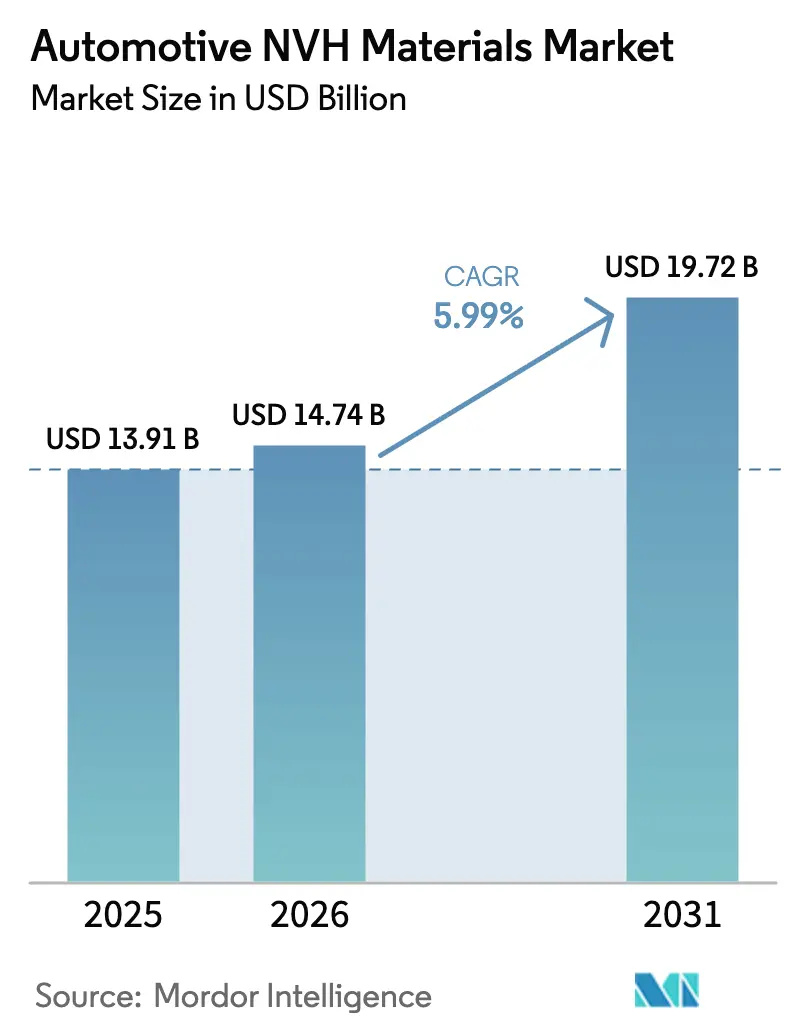
The Automotive NVH Materials Market size is expected to grow from USD 13.91 billion in 2025 to USD 14.74 billion in 2026 and is forecast to reach USD 19.72 billion by 2031 at 5.99% CAGR over 2026-2031. Premium-grade acoustic comfort, stricter noise regulations, and the shift toward electrified drivetrains give sustained momentum to material suppliers across every vehicle class. Manufacturers are blending lightweight polymers with active noise control electronics to balance mass reduction and cabin serenity. Scale-driven acquisitions and regional manufacturing footprints continue to shape supplier strategies as automakers request integrated, system-level NVH packages. As a result, the Automotive NVH materials market is positioned for resilient growth even while propulsion technologies diversify.
Key Report Takeaways
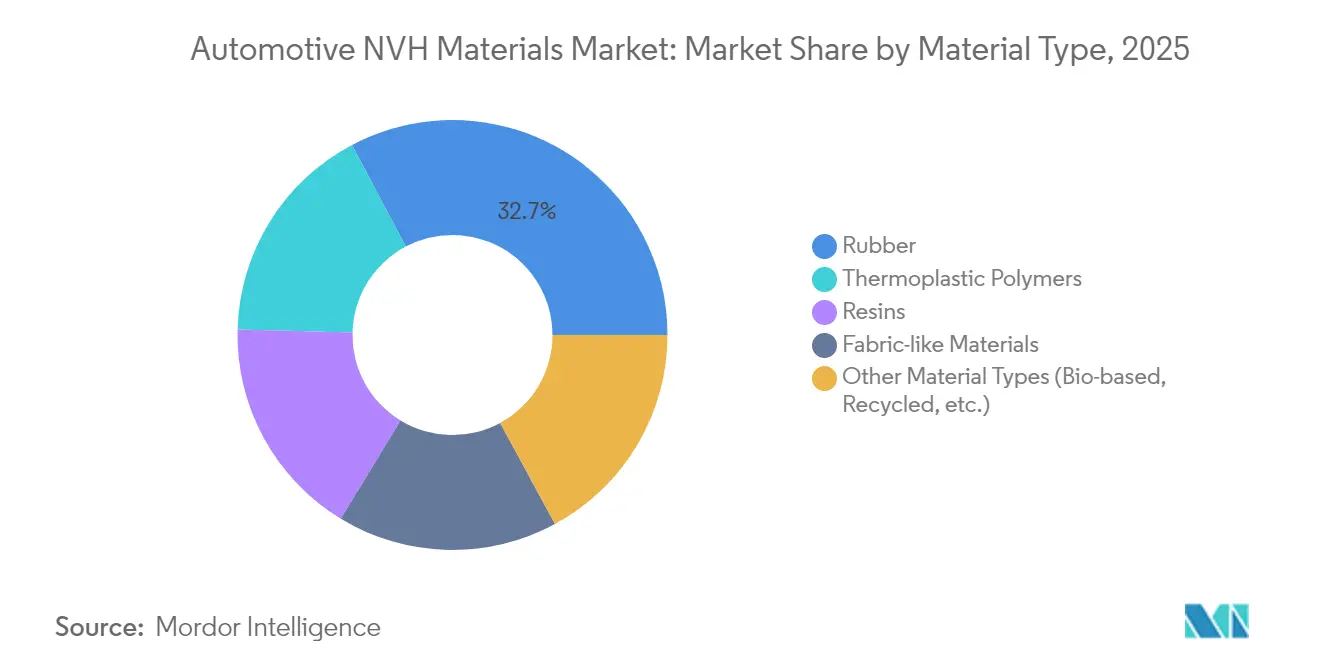
- By material type, rubber led with 32.74% of Automotive NVH materials market share in 2025, while other material types such as bio-based and recycled polymers are forecast to post the fastest 6.79% CAGR through 2031.
- By vehicle type, passenger cars accounted for 64.78% of the Automotive NVH materials market size in 2025 and are projected to expand at 7.57% CAGR between 2026-2031.
- By propulsion, internal combustion engine vehicles held 68.55% share in 2025; hybrid electric vehicles exhibit a 6.82% CAGR through 2031.
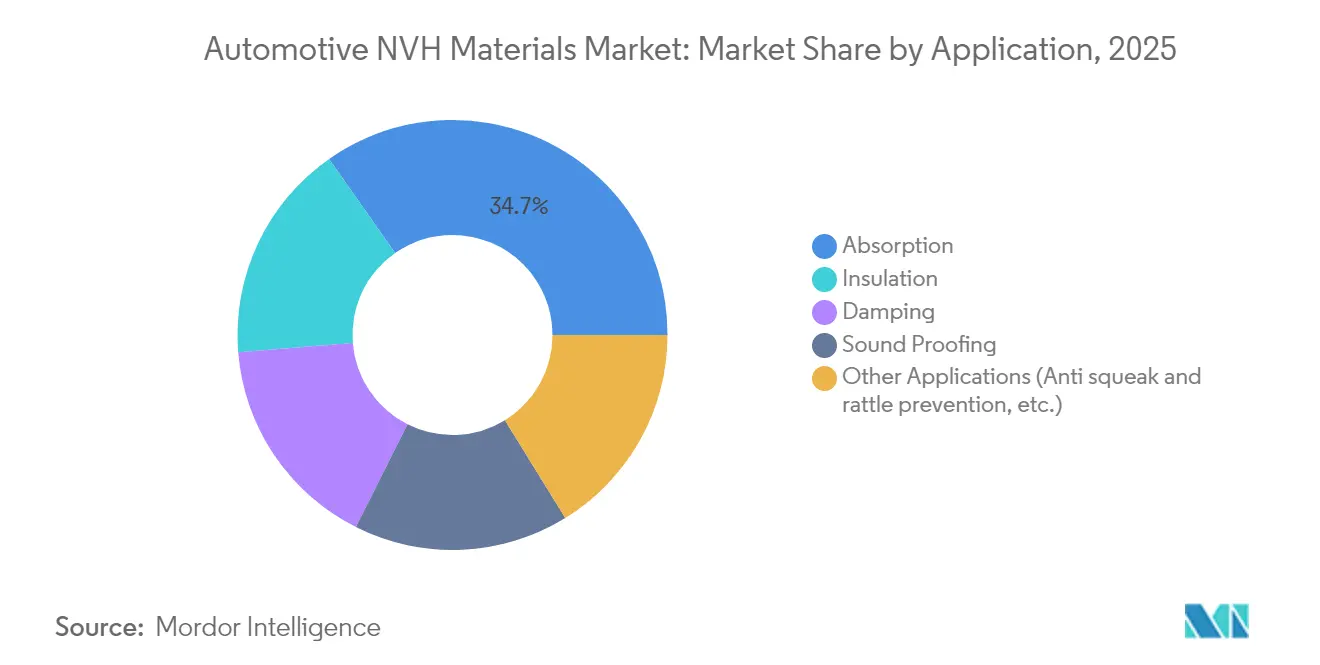
- By application, absorption captured 34.73% revenue share in 2025; insulation is set to advance at a 6.94% CAGR to 2031.
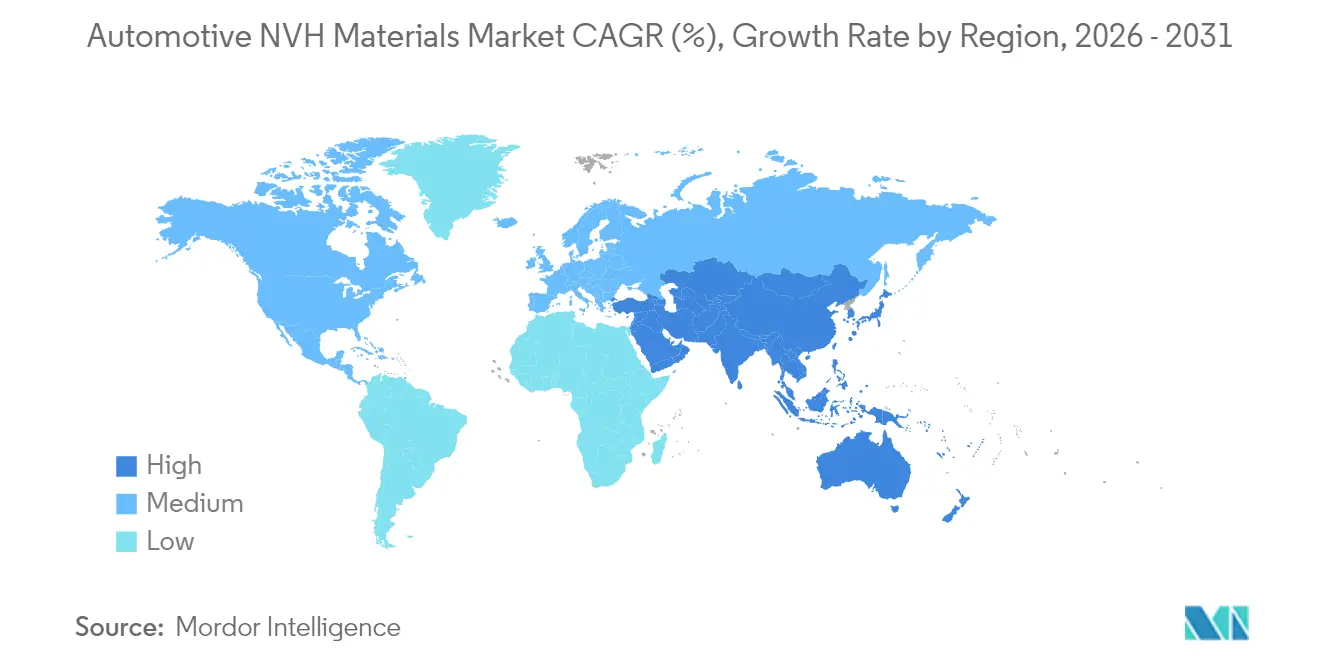
- By geography, Asia-Pacific dominated with 46.78% share in 2025 and remains the fastest-growing region at 6.66% CAGR.
Note: Market size and forecast figures in this report are generated using Mordor Intelligence’s proprietary estimation framework, updated with the latest available data and insights as of 2026.
Market Trends and Insights
Drivers Impact Analysis of Automotive NVH Materials Market*
| Driver | (~) % Impact on CAGR Forecast | Geographic Relevance | Impact Timeline |
|---|---|---|---|
| Stringent cabin-noise legislation and rising comfort expectations | +1.8% | Global (EU & North America lead) | Medium term (2-4 years) |
| Booming EV and hybrid output exposing high-frequency NVH gaps | +0.7% | Global | Medium term (2–4 years) |
| Light-weighting strategies pivoting to polymer and composite NVH media | +1.2% | Global, accent on premium segments | Long term (≥ 4 years) |
| Premium and luxury vehicle proliferation demanding acoustic branding | +0.5% | North America & Europe | Medium term (2–4 years) |
| Increasing usage of automotive NVH materials in passenger vehicles | +0.4% | Global | Long term (≥ 4 years) |
| Source: Mordor Intelligence | |||
Stringent Cabin-Noise Legislation and Rising Comfort Expectations
European Union Regulation 540/2014 tightened permissible exterior and interior noise limits, forcing OEMs to adopt higher-performance NVH materials that can pass compliance tests without adding unwanted mass[1]. Consumer awareness of quiet cabins also matured, encouraging mainstream brands to roll out features such as Honda’s Active Noise Control system across multiple model lines. Suppliers therefore observe non-discretionary demand that is insulated from macroeconomic cycles, since failing noise tests triggers financial penalties and brand damage. Automakers now frame interior sound quality as a branding device; BMW’s HypersonX program for Neue Klasse electric cars underscores the marketing weight attached to tailor-made acoustic signatures. The overlap of regulation and customer expectation cements a multi-year growth runway for advanced absorption, damping and insulation media.
Booming EV and Hybrid Output Exposing High-Frequency NVH Gaps
Electric motors reveal inverter whine and road-tire harmonics that traditional rubbers suppress poorly. Ascend Materials’ Vydyne Anti-Vibration Technology cuts cabin noise by up to 84%, proving that engineered polyamides can outperform legacy foams in the 3 kHz–4 kHz range. Hyundai’s Road-Noise Active Noise Control halves low-frequency disturbance through real-time phase inversion, letting carmakers mix lighter fabrics with electronic counterwaves for a refined ride. The urgency grows as Asia-Pacific factories accelerate battery-electric production, amplifying the need for composite mats and acoustic metamaterials tailored to high-frequency NVH profiles. As a result, the Automotive NVH materials market records its quickest contract wins in new EV platforms.
Light-Weighting Strategies Pivoting to Polymer and Composite NVH Media
Every kilogram shaved from a vehicle helps OEMs meet fleet CO₂ rules, so suppliers fuse acoustic and structural roles into multi-layer laminates. Material Sciences Corporation’s MSC Smart Steel trims panel mass by 35% while retaining comparable damping, supporting lower fuel use without cabin noise penalties. Thyssenkrupp’s bondal composite achieves up to 20 dB inverter noise reduction and adds electromagnetic shielding, illustrating the system benefits of hybrid laminates. Bio-infused alternatives, such as Toyoda Gosei’s cellulose-reinforced polypropylene, bring environmental credits while resisting impact in bumper beam trials. These developments show how weight cuts and acoustic targets converge, lifting demand for polymer-rich solutions across premium and mass segments.
Premium and Luxury Vehicle Proliferation Demanding Acoustic Branding
Sound design now anchors brand identity. BMW employs composer Hans Zimmer to create exclusive EV drive tones that communicate brand personality while masking high-frequency motor noise. Academic work at the Technical University of Munich confirms that a “solid” door-close sound raises perceived quality and purchase intent. As luxury attributes trickle into compact classes, suppliers must offer materials whose impedance characteristics enable fine tuning rather than blunt absorption. Mini’s four-mode sound worlds for its next EV series underline that acoustic branding extends beyond top-range sedans and into lifestyle models. The Automotive NVH materials market therefore benefits from higher content per vehicle as soundscapes become a differentiator.
Restraints Impact Analysis of Automotive NVH Materials Market*
| Restraint | (~) % Impact on CAGR Forecast | Geographic Relevance | Impact Timeline |
|---|---|---|---|
| Threat of substitutes from alternative technologies | −0.6% | Global | Medium term (2–4 years) |
| Feed-stock price volatility for petro-rubber and PU foams | −0.5% | Global | Short term (≤ 2 years) |
| Fire-safety hurdles for recycled foams | −0.4% | Europe & North America | Short term (≤ 2 years) |
| Source: Mordor Intelligence | |||
Feed-Stock Price Volatility for Petro-Rubber and PU Foams
Synthetic rubber prices swing with crude-derived butadiene supply. Spot Asian quotes surpassed USD 3,000 per ton in 2024, prompting Continental and Goodyear to lift tire prices and forcing NVH suppliers to pass on cost or lose margin. Budget segments are least able to absorb spikes, so some automakers scale back premium acoustic packs or delay launches. Supply disruptions such as rare-earth magnet shortages that idled a Ford plant in 2024 reveal the vulnerability of global feed-stock chains. The Automotive NVH materials market thus faces near-term expense pressure until hedging and localized sourcing strategies mature.
Fire-Safety Hurdles for Recycled Foams
United States FMVSS 302 caps burn rates at 102 mm per minute, and many recycled PU foams fail unless blended with halogenated flame retardants now under health scrutiny[2]. Europe imposes parallel standards, while UL 94 V-0 ratings for electric-drive components create stricter hurdles. The regulatory friction slows commercial rollouts of sustainable acoustic pads. Scientific groups report catalyst systems that allow 30% recycled content to pass V-0, but mass-scale economics remain unproven. Until safer additives reach wide adoption, sustainability gains compete with fire-safety mandates and restrain segment expansion.
*Our forecasts treat driver/restraint impacts as directional, not additive. The impact forecasts reflect baseline growth, mix effects, and variable interactions.
Automotive NVH Materials Market Segment Analysis
By Material Type:
Bio-Innovation Drives Sustainability TransitionRubber held the leading 32.74% share of the Automotive NVH materials market in 2025 because of its all-round vibration isolation performance and mature supply base. However, bio-based and recycled polymers clock a 6.79% CAGR as legislation and OEM carbon targets accelerate material substitution. The Automotive NVH materials market size for other types of polymer materials like bio-based and recycled polymers is projected to rise sharply once large-volume vehicle programs commit to lower-footprint interiors. Huntsman’s ACOUSTIFLEX HR BIO foam provides over 9% bio content while matching legacy PU resilience, demonstrating parity between green chemistry and ride refinement. LANXESS complements this shift with Tepex composites boasting more than 80% renewable feedstock for structural inserts.
Fabric-like non-woven sheets grow along lightweighting and recyclability goals. Milliken’s 50% lighter textile liner exceeds rivals in absorption and can reenter polymer streams at end of life. Mycelium-grown absorbers studied on ScienceDirect effectively damp 1 kHz cabin frequencies while biodegrading naturally. Over the forecast horizon, composite laminates that merge rubber skins with natural-fiber cores could unlock new cost-plus-sustainability value for Tier 1 suppliers. As those technologies scale, the Automotive NVH materials market will pivot from petro-heavy menus toward hybrid and renewable formulations. Acoustic metamaterials designed with periodic voids cancel 2.0–2.3 dB of low-frequency drone without mass, pointing to a future where geometry replaces heavier mass-law solutions. Such multifunctional approaches blur the historical lines between absorption, damping and insulation.

By Vehicle Type:
Passenger Cars Drive Market EvolutionPassenger cars dominated the Automotive NVH materials market with 64.78% share in 2025 yet still deliver the highest 7.57% CAGR to 2031. The surge reflects rising per-unit content rather than sheer volume, as compact crossovers receive luxury-style acoustic packages to justify sticker prices. Light commercial vehicles benefit from parcel fleet electrification: Autoneum’s new Commercial Vehicle unit develops floor systems tuned to silent e-vans that amplify road roar. Heavy trucks adopt thicker dash mats to meet fatigue and safety guidelines for long-haul drivers. Two-wheelers and micro-mobility categories begin to integrate slimline damping strips as urban sound rules tighten. Consequently, the Automotive NVH materials market records wider application breadth, and suppliers must tailor acoustic, durability and cost attributes to vastly different duty cycles. Passenger car growth confirms that premium-feel acoustics are no longer confined to top-end sedans but span the mainstream showroom.
By Propulsion Type:
Electrification Reshapes NVH RequirementsInternal combustion engine platforms still command 68.55% of revenue in 2025 because of the installed base. Hybrid electric vehicles, however, expand at 6.82% CAGR, presenting unique dual-frequency challenges that spur fresh material recipes. The Automotive NVH materials market share for battery electric vehicles is rising as pure EV lines multiply, demanding attenuation of high-pitch inverter tones without adding kilos that erode driving range.
Fuel-cell electric prototypes introduce hydrogen pump pulsation noise, creating a niche for low-mass diaphragms with broadband damping. Active noise cancellation complements lightweight foams: Hyundai’s RANC proves that control algorithms allow thinner floor sections while maintaining 50% interior noise cuts. Suppliers must therefore serve legacy ICE orders while pivoting R&D to electrified-specific solutions, enlarging the addressable Automotive NVH materials market size for smart composites and electronic hybrids.
By Application:
Insulation Technologies Lead Growth TrajectoryAbsorption pads accounted for 34.73% of revenue in 2025 because they are the default solution for airborne engine and road noise. Meanwhile, insulation products post the fastest 6.94% CAGR thanks to thermal management demands in battery electric platforms. Where battery packs raise cabin heat loads, suppliers combine aerogel particles with non-woven fibers to reduce both sound power by 40% and HVAC energy draw by 30%. Damping layers shift from asphalt sheets to BASF’s low-VOC LASD spray, trimming weight and installation time while maintaining frequency coverage. The Automotive NVH materials market size for insulation systems is projected to capture incremental gains each time an OEM launches a dedicated electric skateboard.
Geography Analysis
APAC Automotive NVH Materials Market
Asia-Pacific commanded 46.78% of the Automotive NVH materials market in 2025 and is forecast to grow at 6.66% CAGR, anchored by China, Japan and South Korea. Autoneum’s majority buyout of Jiangsu Huanyu strengthens local supply depth as Chinese OEMs demand quicker design-to-production cycles. Japanese conglomerates reorganize around EV parts, opening white space for NVH specialists who grasp battery-related acoustic profiles. South Korean material groups like Toray ramp capacity for sound-absorbing carbon-fiber sheets, signaling continued specialization. New assembly hubs in Thailand and Indonesia attract Japanese and Chinese Tier 1s that want tariff-free ASEAN access.
Europe and Punjab Automotive NVH Materials Market
Europe maintains significant market presence driven by stringent regulatory frameworks and premium vehicle manufacturing concentration, with EU Regulation 540/2014 establishing comprehensive noise emission standards that directly influence NVH material specifications . German OEMs push suppliers toward acoustic branding, as BMW’s HypersonX project illustrates. Regulations further stimulate recycled polymer adoption, although FMVSS-equivalent fire standards slow mass uptake. Freudenberg’s EUR 42 million Punjab plants underscore European players’ strategy to serve global demand with localized output.
The Americas and MEA Automotive NVH Materials Market
North America balances strict fire-safety code FMVSS 302 with a patchy supply base for specialty rubbers. Ford’s magnet shortage episode highlighted the urgency of regional resilience. AURELIUS Private Equity’s USD 1 billion acquisition of Teijin Automotive Technologies expands composite capabilities onshore, positioning the buyer for growth in EV acoustics. South America and the Middle East & Africa offer early-stage openings as local content mandates rise, yet economic swings and infrastructure gaps temper immediate volume.
Value Chain Analysis
The value chain starts with upstream petrochemical and rubber feedstocks and intermediates that shape cost and availability for core NVH chemistries, including polyurethane systems, polypropylene and polyethylene resins, bitumen-based damping media, butyl rubber, and mineral fillers. These inputs then move into compounding, foaming, and nonwoven or textile conversion, before Tier 1 and Tier 2 manufacturers fabricate tuned NVH parts such as dash insulators, floor systems, wheel-arch liners, and underbody shields for OEM platforms.
Validation and integration requirements, particularly on electrified platforms, influence how value is captured across the chain. OEMs increasingly request system-level acoustic packages and shorter design-to-production cycles. Distribution is also shifting toward more direct relationships for key resin and elastomer families, while concentrated production for certain PU intermediates, such as propylene oxide and polyether polyols, centered in Germany, China, and the United States, creates supply risk for specialized grades. This risk pushes suppliers toward dual sourcing, regional manufacturing footprints, and tighter technical collaboration with OEMs and Tier 1 integrators.
Competitive Landscape
The Automotive NVH materials market is moderately fragmented, with top suppliers like Autoneum, 3M, and BASF leveraging proprietary chemistries, global tooling, and OEM collaborations to maintain their positions, while facing competition from agile entrants in smart materials. Innovation drives competition, with BASF’s low-density LASD sprays reducing weight and labor. Sustainability is critical, as seen in Dow’s bio-based NORDEL REN EPDM, which cuts CO₂ emissions by 90%. Regional expansions include Freudenberg’s new plants in India for localized NVH solutions and Chinese firms focusing on recycled thermoplastics, intensifying price competition. The market revolves around acoustic science, weight management, and sustainability, with consolidation offering scale advantages as automakers streamline supplier panels.
Automotive NVH Materials Industry Leaders
-
BASF
-
Dow
-
Autoneum
-
3M
-
Sumitomo Riko Company Limited
- *Disclaimer: Major Players sorted in no particular order

Automotive NVH Materials Market Companies Covered in this Report
- 3M
- Autoneum
- BASF
- Dow
- DuPont
- ElringKlinger AG
- FoamPartner (Recticel)
- Freudenberg SE
- Henkel AG and Co. KGaA
- Huntsman Corporation
- Saint Gobain
- Sumitomo Riko Company Limited
- Tenneco Inc.
- Wolverine Advanced Materials
Market Opportunities and Future Outlook
Electrification-related NVH and thermal-acoustic integration creates whitespace for multifunctional materials and parts that reduce component count while meeting new acoustic signatures and safety constraints. Henkel’s introduction of a high-damping structural adhesive, Teroson EP 52, is positioned to combine bonding strength with vibration control in EV architectures. Autoneum’s Ultra-Silent front trunk solution, built on a polyester-based approach, is entering series supply for BEVs with up to 70% recycled content, reflecting demand for lightweight, more recyclable NVH constructions beyond traditional foams and heavy mats.
Material circularity and polymer processing investments also expand opportunity for suppliers that can satisfy OEM end-of-life and design-for-recycling requirements without weakening flammability performance. Borealis’ Europe investment activity, including EUR 49 million at Burghausen to expand polypropylene capabilities, supports greater availability of advanced PP grades and compounding routes for lightweight interior and underhood NVH components. In parallel, technical work on acoustic metamaterials and tuned EPDM layer integration for low-frequency noise continues to build headroom for targeted frequency attenuation, where conventional mass-law approaches add weight, reinforcing the shift toward engineered geometries, monomaterial concepts, and validated EV-ready NVH systems.
Recent Industry Developments in Automotive NVH Materials Market
- July 2026: Sumitomo Riko announced its high-rigidity urethane eAxle cover was adopted for the Lexus RZ. The design combines sound absorption with rigidity in a single structure, supporting weight reduction and simplified assembly versus multi-material constructions.
- June 2026: Autoneum announced a production-ready battery lid solution for BEV packs, unveiled at Battery Show Europe 2026 in Stuttgart. The solution integrates multifunctional protection and flame-shield functionality and is designed for mica-free production, aligning with sustainability goals and reducing supply-chain risk in battery-pack components.
- March 2024: Autoneum announced expansions in Asia with new plants in Changchun, China, and Pune, India, to produce NVH components such as inner dashes and interior floor insulators. Bringing capacity closer to major automotive hubs shortens lead times for OEM platforms and strengthens localization of NVH supply as regional vehicle production grows.
Automotive NVH Materials Market Report Scope and Research Methodology
Market Definition and Coverage
This market covers materials used in vehicles to reduce cabin and component noise, vibration, and harshness (NVH), where revenue is counted when NVH products are sold into automotive manufacturing and related fitment channels.
Scope exclusions: It excludes non-automotive building acoustics materials and standalone noise testing services that do not involve selling NVH material products.
Segments Covered in This Report
- By Material Type
- Rubber
- Thermoplastic Polymers
- Resins
- Fabric-like Materials
- Other Material Types (Bio-based, Recycled, etc.)
- By Propulsion Type
- Internal Combustion Engine (ICE) Vehicles
- Hybrid Electric Vehicles (HEV/PHEV)
- Battery Electric Vehicles (BEV)
- Fuel-Cell Electric Vehicles (FCEV)
- By Vehicle Type
- Passenger Cars
- Light Commercial Vehicles
- Heavy Commercial Vehicles
- Two-Wheelers and Micro-Mobility
- By Application
- Absorption
- Damping
- Insulation
- Sound Proofing
- Other Applications (Anti squeak and rattle prevention, etc.)
- Geography
- Asia-Pacific
- China
- India
- Japan
- South Korea
- Rest of Asia-Pacific
- North America
- United States
- Canada
- Mexico
- Europe
- Germany
- United Kingdom
- France
- Italy
- Rest of Europe
- South America
- Brazil
- Argentina
- Rest of South America
- Middle East and Africa
- Saudi Arabia
- South Africa
- Rest of Middle-East and Africa
- Asia-Pacific
Data Sources, Market Sizing, and Validation
Desk Research
Desk research was used to set the industry boundaries, build a clean historical baseline, and create sensible input ranges before we spoke to market participants. We relied on public and official sources such as vehicle production statistics from OICA, trade and tariff data from UN Comtrade, macro indicators from the World Bank, and regulatory and safety references from NHTSA and the European Commission, along with selected patent and standards lookups.
We also reviewed company filings, annual reports, investor presentations, and reputable press to track capacity moves, product launches, and where NVH content is trending in new vehicle platforms, including EV-related acoustic treatments. Where needed, paid subscriptions for company financials and intelligence, patent databases, and shipment-level import-export views were used to confirm directional signals and remove obvious outliers. These desk sources are not exhaustive, and we checked many additional public references to collect, validate, and clarify data points.
Primary Interviews and Surveys
Primary work focused on interviews and structured questionnaires with material suppliers, automotive component stakeholders, OEM-facing commercial teams, and independent industry experts. For a global market, respondent input was balanced across APAC, EMEA, and the Americas so assumptions on vehicle mix, NVH content per vehicle, and pricing behavior could be checked and adjusted where desk research was thinner.
Distribution of primary research fieldwork respondents
| Company type | Respondent position | Region |
|---|---|---|
| Top tier: 26% | CXOs: 13% | APAC: 45% |
| Mid tier: 60% | Functional/Unit leaders: 42% | EMEA: 33% |
| Smaller Players: 14% | Managers: 45% | Americas: 22% |
Market-Sizing & Forecasting
The core model starts with a top-down build where vehicle production and parc trends are converted into an NVH demand pool using application-level penetration and average material content ranges, then translated into value using region-specific pricing. To keep totals realistic, we cross-check with selective bottom-up approximations, including supplier revenue alignment from sampled disclosures, channel checks on typical price bands, and sanity checks using material usage intensity by vehicle class.
Key inputs used in the model include global and regional vehicle production by powertrain type, the share of vehicles adopting heavier acoustic packages, lightweighting substitution patterns that change material mix, average thickness and grams per square meter assumptions for common NVH uses, and resin and fiber price direction that influences realized ASPs. Forecasts are built using scenario analysis supported by short-run trend smoothing, where the production outlook, electrification share, and pricing normalization are adjusted together so the curve stays consistent with what respondents report in program awards. When supplier coverage or regional disclosure has gaps, missing pieces are filled using proxy ratios tied to vehicle output and validated material-content ranges, then rechecked against the total value build.
Data Validation & Update Cycle
Validation is done through several passes so the final totals do not rely on a single input series. We compare the market outputs with independent signals such as vehicle production, trade flow direction for key NVH material inputs, and observed pricing movement, and then investigate any large variances before internal sign-off.
If a major event shifts the outlook, such as sharp raw material price swings, production disruptions, or a regulation-led content change, the assumptions are revisited and the relevant experts are re-contacted. Reports are refreshed annually, and a final pre-release review is completed so the delivered numbers reflect the latest available data and currency timing.
Mordor Intelligence's Automotive Nvh Materials Market Size Measured Against Other Published Estimates
Published market values for automotive NVH materials can differ even when the topics sound the same, because the scope boundary, price timing, and what is counted as automotive-grade NVH vary between publishers. Differences can also come from older currency conversions or from using a single price point rather than tracking how ASPs move across regions and material mixes.
Refresh cadence and currency timing matter more than most people expect in this market, since raw material costs and vehicle builds can shift within the year and change realized pricing. In our work, those checks are handled as part of the update process, and that refresh-led discipline is a key reason the 2026 value of USD 14.74 B is presented with the approach used by Mordor Intelligence.
Benchmark comparison
| Source | Market Size | Gaps in Research Methodology |
|---|---|---|
| Mordor Intelligence | USD 14.74 B (2026) | |
| Industry Publisher A | USD 14.19 B (2025) | Uses a different base year and can embed a region-share heavy view that changes the blended ASP when converted to a single USD figure, which makes year-on-year comparisons look tighter or wider than they are. |
| Industry Publisher B | USD 10.40 B (2023) | Anchors on an earlier year and may apply a broader set of forms and applications with a different start year for growth, which can understate current pricing normalization and NVH content growth in newer vehicle platforms. |
The spread across sources mainly comes from year selection, how prices are translated into USD, and whether ASP progression is updated alongside recent material and vehicle mix changes. By keeping the build traceable to production-linked demand indicators and rechecking price and conversion timing during updates, the final number stays easier to reconcile to real industry movement.
Key Questions Answered in the Report
What is the current size of the Automotive NVH materials market?
The market is valued at USD 14.74 billion in 2026 and is forecast to reach USD 19.72 billion by 2031.
How are electric vehicles affecting NVH material demand?
EV platforms expose high-frequency noise previously masked by engines, driving demand for lightweight composites and active noise technologies that meet new acoustic profiles.
Which region is the largest consumer of Automotive NVH materials?
Asia-Pacific leads with 46.78% market share in 2025 and also posts the fastest 6.66% CAGR.
What role do regulations play in material selection?
Standards like EU Regulation 540/2014 and US FMVSS 302 set strict limits on noise and flammability, making high-performance, compliant materials mandatory for OEM programs.