
Automotive Electric Fuel Pumps Market Size and Share
Market Overview
| Study Period | 2019 - 2031 |
|---|---|
| Market Size (2026) | USD 11.07 Billion |
| Market Size (2031) | USD 13.65 Billion |
| Growth Rate (2026 - 2031) | 4.27% CAGR |
| Fastest Growing Market | Middle East and Africa |
| Largest Market | Asia Pacific |
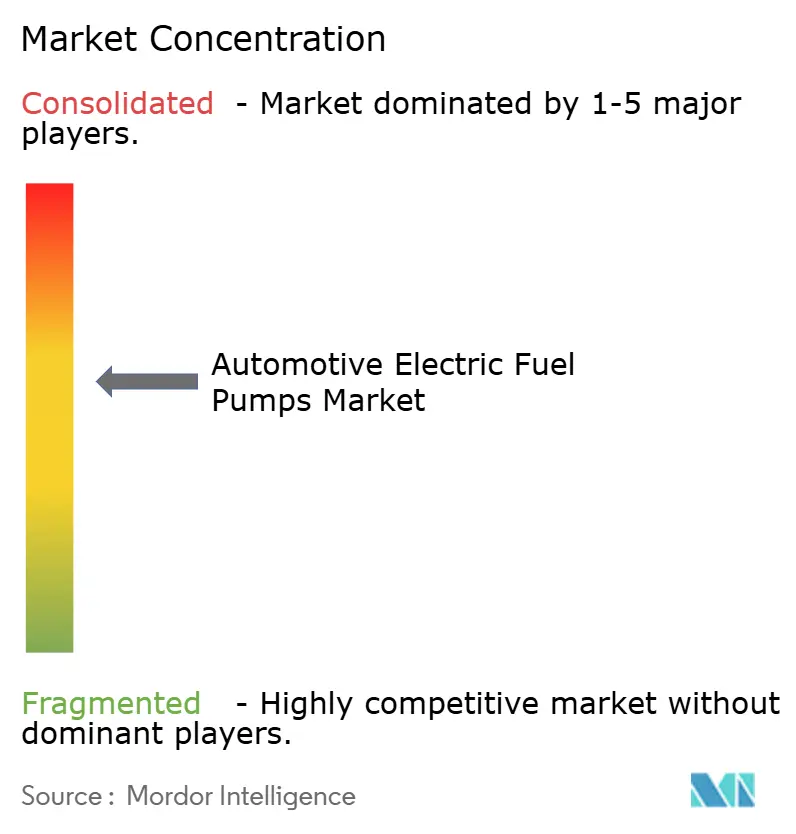
| Market Concentration | Medium |
Major Players
*Disclaimer: Major Players sorted in no particular order Image © Mordor Intelligence. Reuse requires attribution under CC BY 4.0. |
|
Automotive Electric Fuel Pumps Market Analysis by Mordor Intelligence
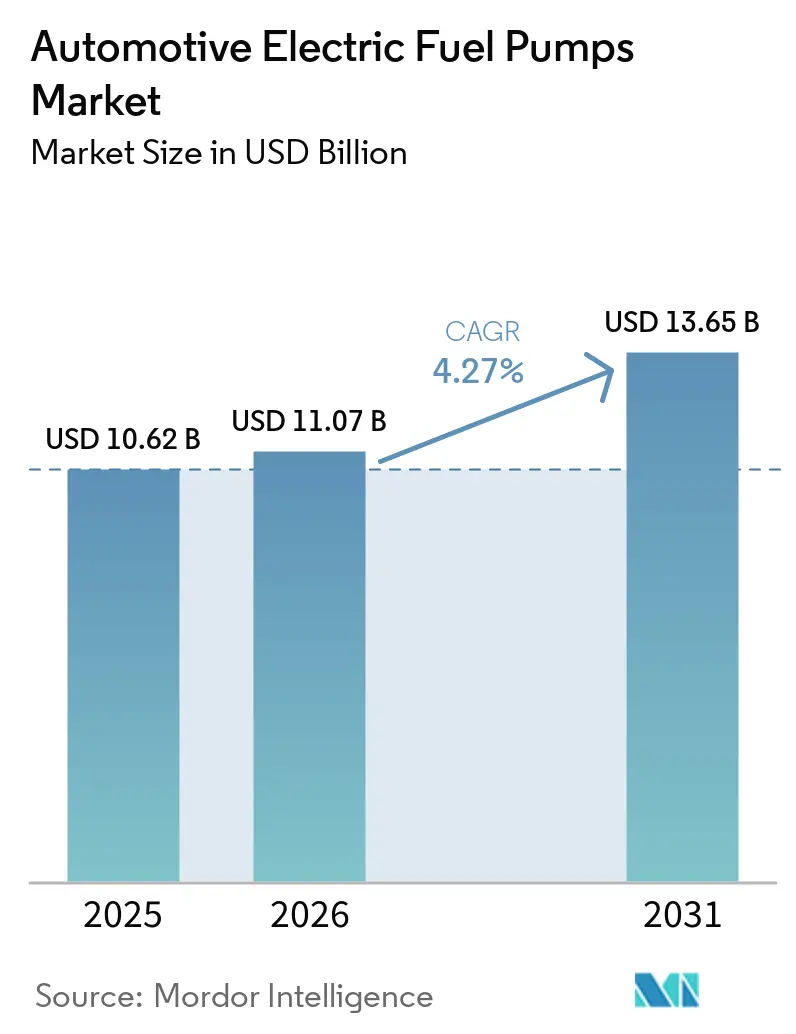
The automotive electric fuel pumps market size is projected to expand from USD 10.62 billion in 2025 and USD 11.07 billion in 2026 to USD 13.65 billion by 2031, registering a CAGR of 4.27% between 2026 and 2031. Intensifying gasoline-direct-injection (GDI) penetration, Euro 7 durability mandates, and a wholesale pivot toward brushless direct-current (BLDC) architectures are lifting unit value even as battery-electric vehicles shrink the internal-combustion engine (ICE) parc. OEMs are embedding pressure sensors, CAN connectivity, and AI-ready diagnostics in pumps to comply with on-board fuel and vapor-monitoring rules, creating a technology-upgrade cycle that offsets volume headwinds. Hydrogen and synthetic e-fuels are emerging as complementary growth vectors, spurring niche demand for corrosion-resistant, high-pressure pumps. Supply-chain risk remains material as praseodymium-neodymium magnet prices soar and counterfeit parts proliferate in price-sensitive regions.
Key Report Takeaways
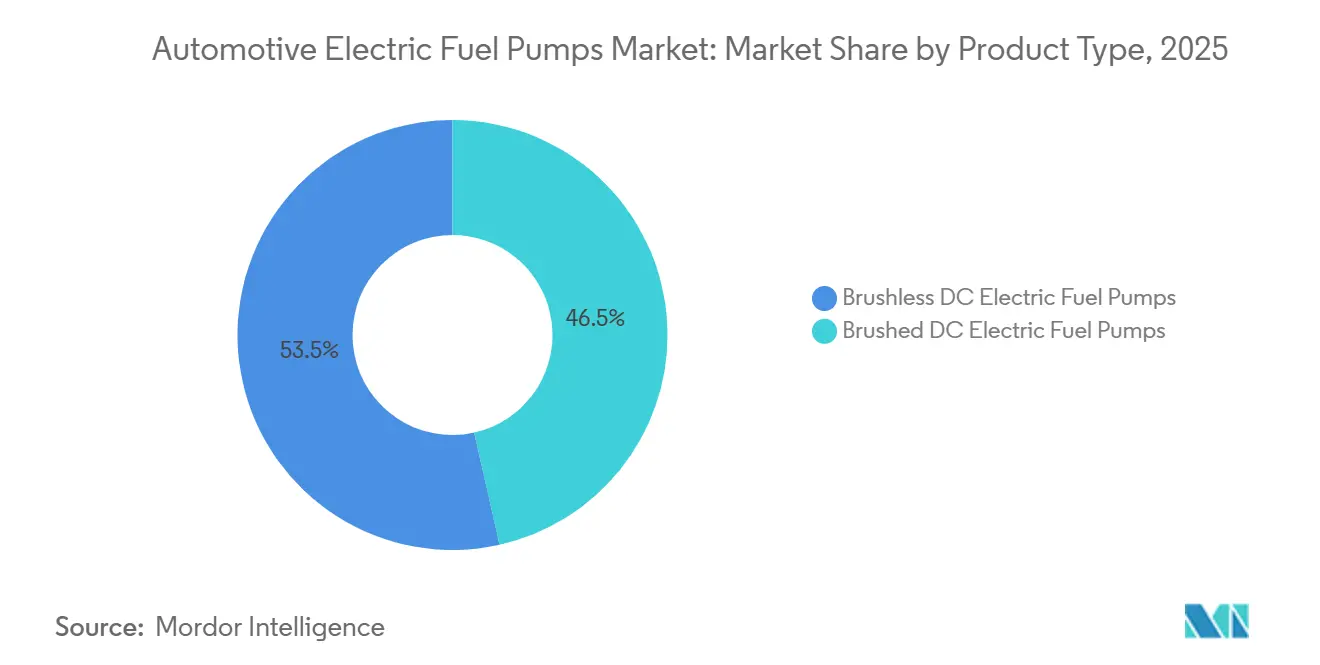
- By product type, brushless DC pumps led with 53.47% of the automotive electric fuel pumps market share in 2025, while brushed DC posted the fastest projected CAGR at 4.34% through 2031.
- By technology, turbine pumps commanded a 61.21% share of the automotive electric fuel pumps market in 2025, and sliding-vane pumps are forecasted to exhibit the highest CAGR of 4.46% to 2031.
- By vehicle type, passenger cars held 73.46% revenue share in 2025; commercial vehicles are advancing at a 4.36% CAGR to 2031.
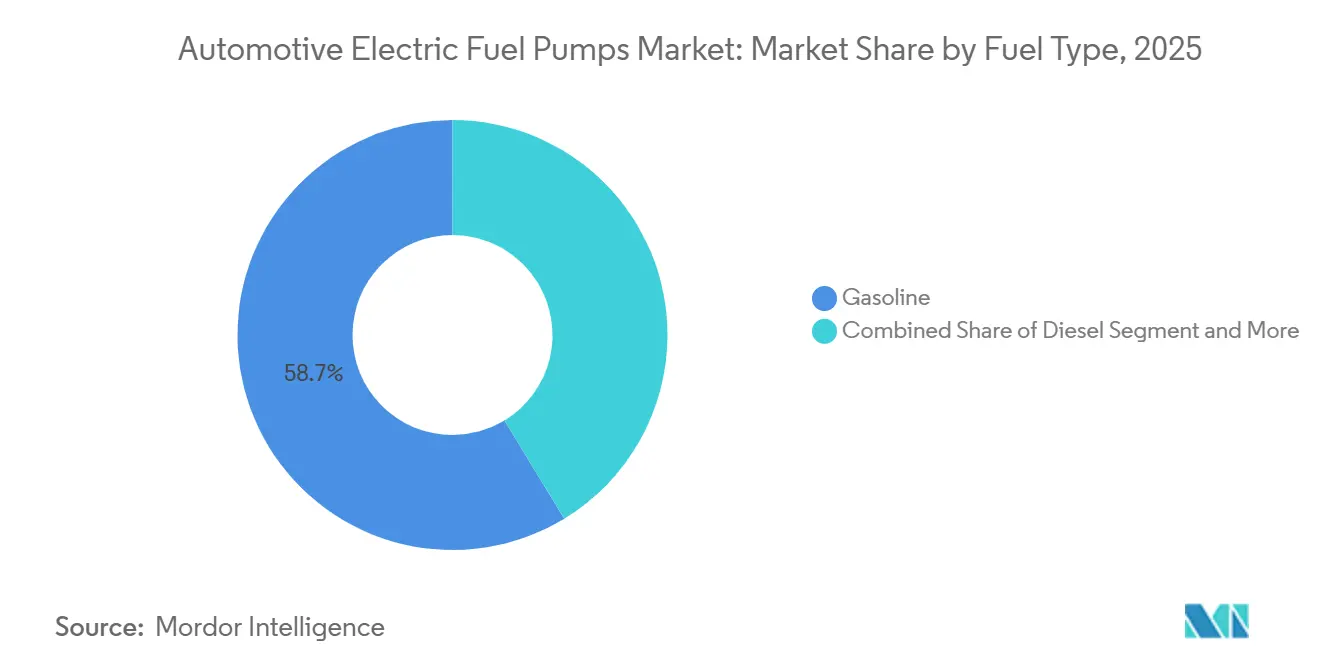
- By fuel type, gasoline pumps accounted for 58.72% of the 2025 value, whereas hydrogen pumps are set to record the strongest 4.31% CAGR toward 2031.
- By distribution channel, OEM sales represented 67.73% of the 2025 total market size; the aftermarket is expanding at a 4.42% CAGR to 2031.
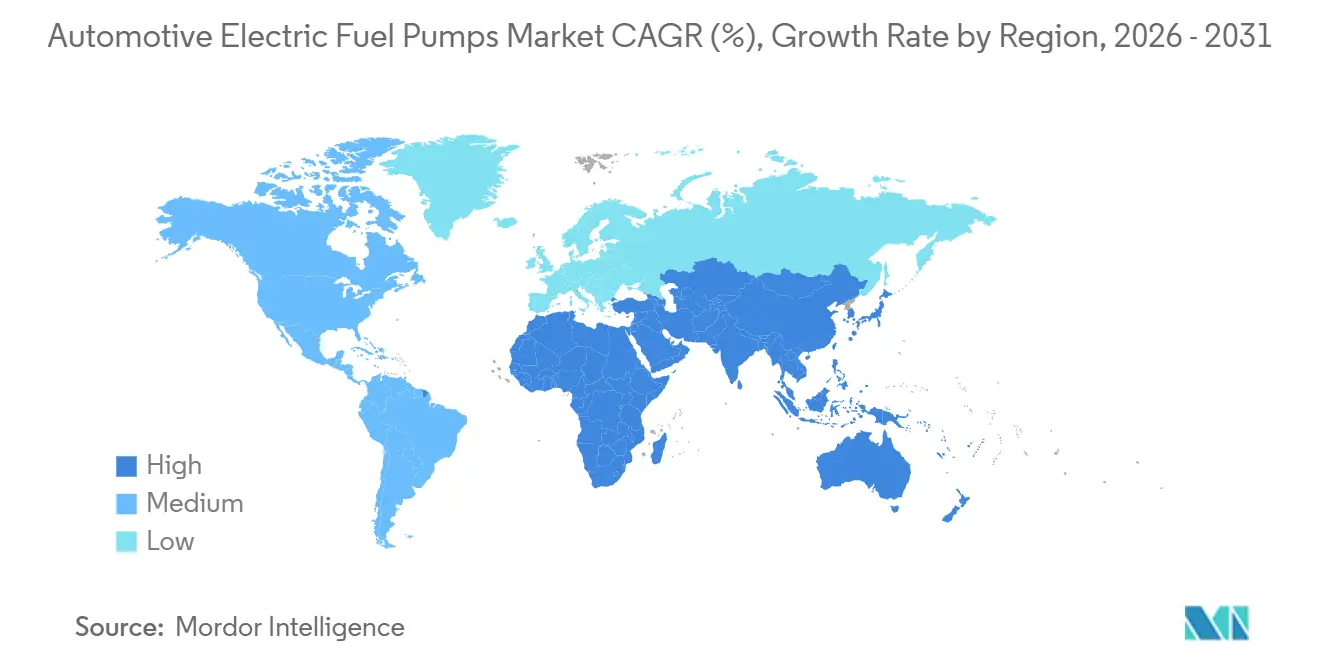
- By geography, Asia Pacific captured 38.26% of the automotive electric fuel pumps market share in 2025; the Middle East & Africa is poised for a 4.39% CAGR through 2031.
Note: Market size and forecast figures in this report are generated using Mordor Intelligence’s proprietary estimation framework, updated with the latest available data and insights as of January 2026.
Global Automotive Electric Fuel Pumps Market Trends and Insights
Drivers Impact Analysis*
| Driver | (~) % Impact on CAGR Forecast | Geographic Relevance | Impact Timeline |
|---|---|---|---|
| Stricter Global Emission Regulations | +1.2% | North America and EU, expanding to Asia Pacific | Long term (≥ 4 years) |
| Rapid Growth Of Gasoline Direct-Injection Systems | +0.9% | Global, led by North America and Europe | Medium term (2-4 years) |
| Rising Demand For Fuel-Efficient Passenger Vehicles | +0.8% | Global, with concentration in Asia Pacific and Europe | Medium term (2-4 years) |
| OEM Shift Toward Brushless DC Pumps | +0.7% | Global, with early adoption in premium segments | Short term (≤ 2 years) |
| Integration Of AI-Enabled Predictive Maintenance In Pumps | +0.4% | North America and EU, pilot programs in Asia Pacific | Long term (≥ 4 years) |
| Emerging Low-Carbon E-Fuels | +0.3% | EU and select North American markets | Long term (≥ 4 years) |
| Source: Mordor Intelligence | |||
Stricter Global Emission Regulations For ICE Powertrains
Euro 7 durability rules require pumps to operate fault-free for 200,000 km or ten years[1]"Euro 7 – UN transposition plan," European Commission, unece.org, a specification that legacy brushed motors rarely meet. North American standards and California’s hybrid pathway add further impetus by keeping gasoline hybrids in production, so high-spec pumps stay integral to adherence strategies. These overlapping policies raise the minimum technical baseline and pull in features such as integrated pressure sensors and corrosion-resistant alloys. Longer warranties tied to the rules also push OEMs to demand predictive maintenance capabilities for early fault detection. Collectively, the stepped-up legislation locks in a multi-year replacement and upgrade cycle that favors technology leaders.
Rapid Growth of Gasoline Direct-Injection Systems
Gasoline direct-injection (GDI) now dominates new gasoline-engine programs, and every GDI engine requires a high-pressure, electronically controlled feed pump. Automakers are standardizing on sensor-equipped modules that log pressure data over CAN networks and comply with on-board fuel-monitoring rules mandated under Euro 7. Suppliers view this regulatory push as a chance to upsell premium pumps rather than defend low-margin legacy units. Added electronics increase bill-of-materials value, which cushions revenue even while the ICE parc contracts. As GDI spreads from premium vehicles into affordable segments, volume leverage is generating steady demand for brushless designs that maintain tight flow control. The net effect is a structural tailwind that lifts average selling prices across the market.
Rising Demand For Fuel-Efficient Passenger Vehicles
High energy prices and strict fleet-average targets keep efficiency high on consumer and fleet agendas. Carmakers answer with turbo-charged downsized engines whose combustion windows are narrow and intolerant of fuel-delivery errors. This drives a preference for electronically commutated brushless pumps that can modulate flow instantly during start-stop events, cutting wasted fuel while maintaining drivability. Hybrid powertrains multiply pump duty cycles, further heightening durability requirements. Suppliers that supply quiet, low-vibration units gain favor because cabin noise sensitivity rises as engines switch off more often. Taken together, efficiency pressure translates into a sustained mix shift toward premium pump architectures rather than cheap commodity modules.
OEM Shift Toward Brushless DC Pumps For Durability & NVH
Brushless DC (BLDC) pumps remove carbon brushes, eliminating a common wear item and lowering electromagnetic interference that can upset modern vehicle networks. OEM warranty data show brushless units slash in-field failure rates, trimming recall exposure and service-bay costs. They also run quieter, a benefit that matters as vehicles adopt near-silent electric drive for portions of the duty cycle. Euro 7 and California regulations amplify these gains because frequent engine restarts in hybrids will otherwise accelerate brush wear. Suppliers integrate current-signature analytics so fleets can spot anomalies days before a hard failure, tying pumps into broader predictive-maintenance platforms. As these capabilities prove their worth, BLDC quickly becomes the default specification across new programs.
Restraints Impact Analysis*
| Restraint | (~) % Impact on CAGR Forecast | Geographic Relevance | Impact Timeline |
|---|---|---|---|
| Proliferation Of Battery-Electric Vehicles | -1.8% | Global, concentrated in China, EU, and California | Long term (≥ 4 years) |
| Counterfeit Aftermarket Pumps | -0.6% | Global, with highest impact in Asia Pacific and MEA | Medium term (2-4 years) |
| Raw-Material Price Volatility | -0.5% | Global, with acute impact in Asia Pacific manufacturing hubs | Short term (≤ 2 years) |
| High Upfront Cost | -0.4% | North America and EU, expanding to premium Asia Pacific segments | Medium term (2-4 years) |
| Source: Mordor Intelligence | |||
Proliferation of Battery-Electric Vehicles Reducing Addressable ICE PARC
In Q1 2026, battery electric vehicles (BEVs) significantly impacted European sales, reducing the need for internal combustion engine (ICE) pump installations. In China, BEVs have exited the replacement cycle permanently, while North America's EV market slowdown, driven by tariffs, is temporary. Premium segments are electrifying rapidly, leading to decreased demand for brushless DC (BLDC) modules.
Counterfeit Aftermarket Pumps Undermining OEM Volumes
Developing markets are inundated with substandard pumps, often lacking essential components such as seals and pressure regulation, leading to frequent failures. In response, Bosch is broadening its genuine SKU offerings to encompass late-model Asian vehicles. However, a significant price gap remains. The safety risks posed by counterfeit parts are highlighted by recalls of faulty CP4 diesel pumps contaminated with metal debris.
*Our forecasts treat driver/restraint impacts as directional, not additive. The impact forecasts reflect baseline growth, mix effects, and variable interactions.
Segment Analysis
By Product Type: Brushless DC Outpaces Brushed Designs
Brushless DC pumps accounted for 53.47% of 2025 revenue, reflecting OEM confidence in their long life and low noise. Engineers appreciate that electronic commutation supports rapid pressure ramp-up during hybrid restarts without spark interference. Design modularity lets the same brushless core serve saddle tanks, low-profile cells, and in-tank modules, trimming platform costs. Suppliers exploit the modularity to shorten validation cycles, winning business even on value-oriented vehicle lines. Aftermarket installers also favor brushless upgrades because they reduce comebacks linked to premature brush wear.
Brushed pumps remain common in legacy programs but increasingly occupy the budget tier while conceding new-model share. Cost sensitivity keeps them viable in markets where affordability trumps durability; however, their shorter life invites warranty tension for export models shipped to regions with longer statutory coverage. Some automakers specify brushed units only for variants aimed at markets with lenient durability laws. As residual demand focuses on price, component makers face margin pressure and little room for technical differentiation. Over time, brushless growth at a 4.34% CAGR erodes the brushed installed base and nudges suppliers to scale down investment in brushed production.


By Technology: Turbine Pumps Retain Commanding Lead
Turbine pumps held 61.21% share in 2025, primarily because their flow is smooth enough for today’s precise injection strategies. OEMs rarely revalidate entire fuel systems mid-cycle, so once a turbine design proves itself, follow-on models tend to retain the architecture. Tight packaging and low pulsation make turbines easy to integrate with pressure sensors mandated under Euro 7. Component suppliers bundle turbines with integrated level senders and vapor-management valves to create plug-and-play modules. That bundling increases switching costs and cements incumbent positions.
Sliding-vane pumps, although a minority, are gaining ground on trucks and off-highway vehicles because of their robustness, posting the fastest 4.46% CAGR within the technology mix. Their tolerance for fuel quality variations appeals in developing markets where filtration standards can be inconsistent. Manufacturers refine vane geometries to lower noise, narrowing an NVH gap that once disqualified them from passenger cars. Hybrid powertrains seeking higher inlet suction often default to vane units that can draw fuel from complex tank shapes. As regulations tighten for heavy-duty segments, suppliers expect vane adoption to keep expanding, albeit off a smaller base than turbines.
By Vehicle Type: Commercial Fleets Accelerate Uptake
Passenger cars accounted for 73.46% of demand in 2025 due to their sheer production volume, with pumps embedded in millions of global builds. Yet, commercial vehicles log the highest 4.36% CAGR through 2031. Commercial-vehicle operators are modernizing fleets to meet urban air-quality rules, leading to faster adoption of sensor-rich pumps that ease compliance documentation. Fleet managers value predictive diagnostics that fit into telematics dashboards, and suppliers provide ready APIs for integration. Aftermarket distributors report commercial customers replacing serviceable but unsmart pumps early to gain data visibility. The result is a clear shift toward higher-value units on vans and trucks.
Commercial vehicles also favor brushless designs because long operating hours punish mechanical commutation. Service life is critical: downtime costs exceed the component premium, making a durability upgrade an easy choice. Regulations that limit in-service emissions force fleets to keep pumps at peak performance, reinforcing scheduled replacements rather than run-to-fail attitudes. Passenger-car demand stays large, but its growth moderates as daily commuters migrate to battery-electric options where pumps are absent.
By Fuel Type: Gasoline Dominant, Hydrogen Rising
Gasoline systems accounted for 58.72% of the market in 2025, supported by steady light-vehicle output and the retreat of diesel in Europe. Engine downsizing strategies still rely on gasoline pumps that hold pressure during frequent start-stop transitions. Suppliers differentiate with ethanol-compatible seals that anticipate future low-carbon blends. Gasoline’s ubiquity guarantees high annual volumes, anchoring factory utilization for global Tier-1s. Even as electrification advances, the installed gasoline fleet ensures a multi-year tail for replacement demand.
Hydrogen pumps remain niche but headline technology, as regulators back fuel-cell trucks for long-haul duty. Pilot fleets require corrosion-resistant materials and gas-tight connectors, pushing suppliers into new metallurgical research. Interest builds as infrastructure funding accelerates, particularly under Germany’s EUR 220 million (~ USD 257 million) program. Component makers see the segment’s 4.31% CAGR as a hedge against shrinking gasoline volumes. Early movers secure field data that raises the barrier for late entrants, mirroring the early advantage turbine makers enjoyed in GDI.

By Distribution Channel: Aftermarket Gains Momentum
OEM fitment delivered 67.73% of 2025 sales, owing to guaranteed installation on every new vehicle. Aftermarket shipments are set to clock a 4.42% CAGR, outstripping OEM line-fit growth. Automakers lock suppliers into multi-year contracts that assure baseline volume, and warranty terms drive adoption of high-spec modules. Yet vehicle lifespans continue to lengthen, expanding the pool of out-of-warranty cars and trucks that need replacement parts. Independent garages gravitate toward modules that install quickly and carry technical support, fueling branded aftermarket growth.
The aftermarket also benefits from owners upgrading to brushless units when original brushed pumps fail early. Counterfeit parts press margins in cost-focused regions, but brand owners blunt that threat with extended warranties and tamper-evident packaging. They widen SKU coverage to minimize situations where mechanics fall back on unverified generics. Logistic hubs use data analytics to forecast demand, ensuring shelf availability that rivals grey-market distributors. Consumers, aware of safety recalls linked to sub-standard pumps, increasingly request genuine replacements even if they cost more.
Geography Analysis
Asia Pacific accounted for 38.26% of global revenue in 2025, reflecting its status as both the largest vehicle-production hub and a key exporter of fuel-system modules. Regional governments actively court investment in component plants, creating dense supplier clusters that shorten automakers' lead times. Local producers leverage economies of scale to supply domestic and export programs, but quality variability poses a risk of counterfeiting. OEMs respond by requiring traceable serial numbers and encrypted software in pump controllers. These controls reinforce the region’s importance while gradually raising technical standards across supply chains.
Europe’s tightening emission landscape shrinks new-ICE installations, yet Euro 7’s sensor and durability mandates elevate pump unit value. Germany’s hydrogen infrastructure funding and BMW’s eFuel factory will ensure continued experimentation in alternative fuels[2]James Darley, "Inside BMW's New Fossil Fuel-Free EV Factory," Energy Magazine, energydigital.com. Meanwhile, counterfeit pumps remain scarce thanks to stringent parts-approval regimes, sustaining premium aftermarket demand.
The Middle East and Africa record the fastest 4.39% CAGR through 2031, propelled by an aging fleet that still relies on internal-combustion engines for everyday mobility. Low battery-electric penetration means replacement pumps remain a necessity, not a discretionary upgrade. Harsh operating conditions encourage fleets to choose robust designs over the cheapest option, lifting average selling price. Parts distributors expand education campaigns warning against counterfeit risks to protect customer safety and brand reputation. These efforts, coupled with infrastructure investments, gradually increase acceptance of higher-spec pumps across the region.

Competitive Landscape
The Automotive Electric Fuel Pump market is moderately concentrated. Bosch, Denso, and Continental anchor the top tier, complemented by diversified players such as BorgWarner and TI Fluid Systems that hedge ICE exposure with electrified driveline portfolios. BorgWarner’s spin-off of its fuel-systems unit into PHINIA exemplifies the strategic split: PHINIA doubles down on advanced combustion with a 500-bar GDI launch and the acquisition of Swedish Electromagnet for hydrogen-injection know-how.
TI Fluid Systems secures significant lifetime BEV and PHEV bookings while continuing to ship large volumes of fuel-delivery modules, reflecting a dual-track strategy. Bosch pushes into hydrogen with its CryoPump and compact gas compressor, capturing early-stage heavy-truck refueling infrastructure. Hitachi Astemo’s patent on electromagnetic valve-drive devices integrates current-signature analysis for noise mitigation, hinting at software-defined pumps that anticipate the adoption of predictive maintenance.
Regional specialists fill white spaces: Concentric’s purchase of Officine Mazzocco Pagnoni adds vane-pump expertise for heavy trucks, and Pricol leverages cost-advantaged Indian manufacturing to serve aftermarket demand in Asia and Africa. Counterfeit parts exert downward margin pressure, prompting brand owners to differentiate through extended warranties, technical hotlines, and AI-driven diagnostics that cannot be replicated by unlicensed producers.
Automotive Electric Fuel Pumps Industry Leaders
-
Robert Bosch GmbH
-
Denso Corporation
-
Continental AG
-
BorgWarner
-
TI Fluid Systems Plc
- *Disclaimer: Major Players sorted in no particular order

Recent Industry Developments
- January 2026: Marelli showcased an e-transmission cooling pump and flex-fuel technology prototypes at Auto China 2026.
- December 2025: Stanadyne introduced its GX-Series high-pressure GDI performance pumps for race and street platforms.


Global Automotive Electric Fuel Pumps Market Report Scope
The Automotive Electric Fuel Pumps market is analyzed across product type, technology, vehicle type, fuel type, distribution channel, and region.
By Product Type, the market is segmented into Brushed DC Electric Fuel Pumps and Brushless DC Electric Fuel Pumps. By Technology, the market is segmented into Turbine Style Pumps, Sliding Vane Pumps, and Roller Cell Pumps. By Vehicle Type, the market is segmented into Passenger Cars (Hatchback, Sedan, Sports Car, and SUV and Crossover) and Commercial Vehicles (Light Commercial Vehicles and Medium & Heavy Commercial Vehicles). By Fuel Type, the market is segmented into Gasoline, Diesel, CNG & LPG, and Hydrogen. By Distribution Channel, the market is segmented into OEM and Aftermarket. By Region, the market is segmented into North America (United States, Canada, and Rest of North America), South America (Brazil, Argentina, and Rest of South America), Europe (United Kingdom, Germany, Spain, Italy, France, Russia, and Rest of Europe), Asia Pacific (India, China, Japan, South Korea, and Rest of Asia Pacific), and Middle East and Africa (United Arab Emirates, Saudi Arabia, Turkey, Egypt, South Africa, and Rest of Middle East and Africa).
Market forecasts are provided in terms of Value (USD) and Volume (Units).
| Brushed DC Electric Fuel Pumps |
| Brushless DC Electric Fuel Pumps |
| Turbine Style Pumps |
| Sliding Vane Pumps |
| Roller Cell Pumps |
| Passenger Cars | Hatchback |
| Sedan | |
| Sports Car and Coupe | |
| SUV and Crossover | |
| Commercial Vehicles | Light Commercial Vehicles (LCV) |
| Medium & Heavy Commercial Vehicles (MCV & HCV) |
| Gasoline |
| Diesel |
| CNG & LPG |
| Hydrogen |
| OEM |
| Aftermarket |
| North America | United States |
| Canada | |
| Rest of North America | |
| South America | Brazil |
| Argentina | |
| Rest of South America | |
| Europe | United Kingdom |
| Germany | |
| Spain | |
| Italy | |
| France | |
| Russia | |
| Rest of Europe | |
| Asia Pacific | India |
| China | |
| Japan | |
| South Korea | |
| Rest of Asia Pacific | |
| Middle East and Africa | United Arab Emirates |
| Saudi Arabia | |
| Turkey | |
| Egypt | |
| South Africa | |
| Rest of Middle East and Africa |
| By Product Type | Brushed DC Electric Fuel Pumps | |
| Brushless DC Electric Fuel Pumps | ||
| By Technology | Turbine Style Pumps | |
| Sliding Vane Pumps | ||
| Roller Cell Pumps | ||
| By Vehicle Type | Passenger Cars | Hatchback |
| Sedan | ||
| Sports Car and Coupe | ||
| SUV and Crossover | ||
| Commercial Vehicles | Light Commercial Vehicles (LCV) | |
| Medium & Heavy Commercial Vehicles (MCV & HCV) | ||
| By Fuel Type | Gasoline | |
| Diesel | ||
| CNG & LPG | ||
| Hydrogen | ||
| By Distribution Channel | OEM | |
| Aftermarket | ||
| By Region | North America | United States |
| Canada | ||
| Rest of North America | ||
| South America | Brazil | |
| Argentina | ||
| Rest of South America | ||
| Europe | United Kingdom | |
| Germany | ||
| Spain | ||
| Italy | ||
| France | ||
| Russia | ||
| Rest of Europe | ||
| Asia Pacific | India | |
| China | ||
| Japan | ||
| South Korea | ||
| Rest of Asia Pacific | ||
| Middle East and Africa | United Arab Emirates | |
| Saudi Arabia | ||
| Turkey | ||
| Egypt | ||
| South Africa | ||
| Rest of Middle East and Africa | ||


Key Questions Answered in the Report
What is the projected value of the automotive electric fuel pumps market by 2031?
The automotive electric fuel pumps market size is forecast to reach USD 13.65 billion by 2031.
Which product type currently leads global revenue?
Brushless DC pumps led with 53.47% automotive electric fuel pumps market share in 2025, reflecting OEM preference for durability and low NVH.
Which regional market is expanding the fastest?
The Middle East and Africa post the highest 4.39% CAGR to 2031, driven by aftermarket replacement in aging ICE fleets .
How are Euro 7 rules influencing pump design?
Euro 7 mandates extended durability and on-board fuel-mass monitoring, compelling OEMs to adopt sensor-integrated, BLDC pumps that support 200,000 km service life.
Page last updated on:






