
Automotive Digital Cockpit Market Size and Share
Market Overview
| Study Period | 2020 - 2031 |
|---|---|
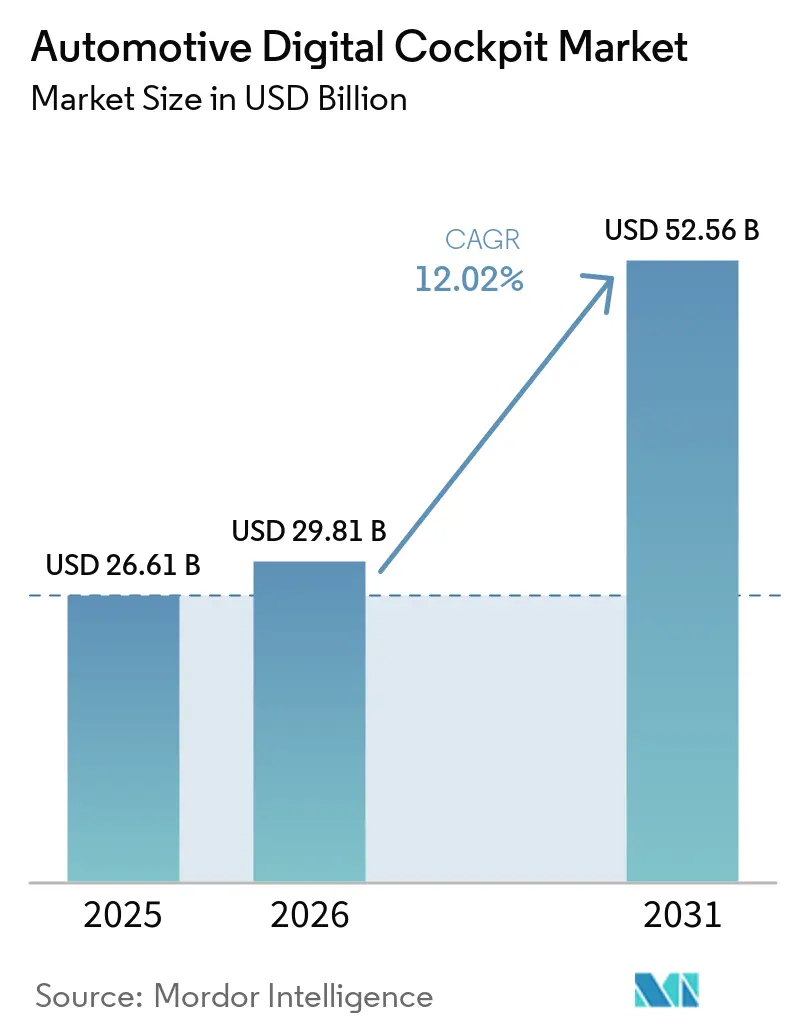
| Market Size (2026) | USD 29.81 Billion |
| Market Size (2031) | USD 52.56 Billion |
| Growth Rate (2026 - 2031) | 12.02 % |
| Fastest Growing Market | Asia Pacific |
| Largest Market | Asia Pacific |
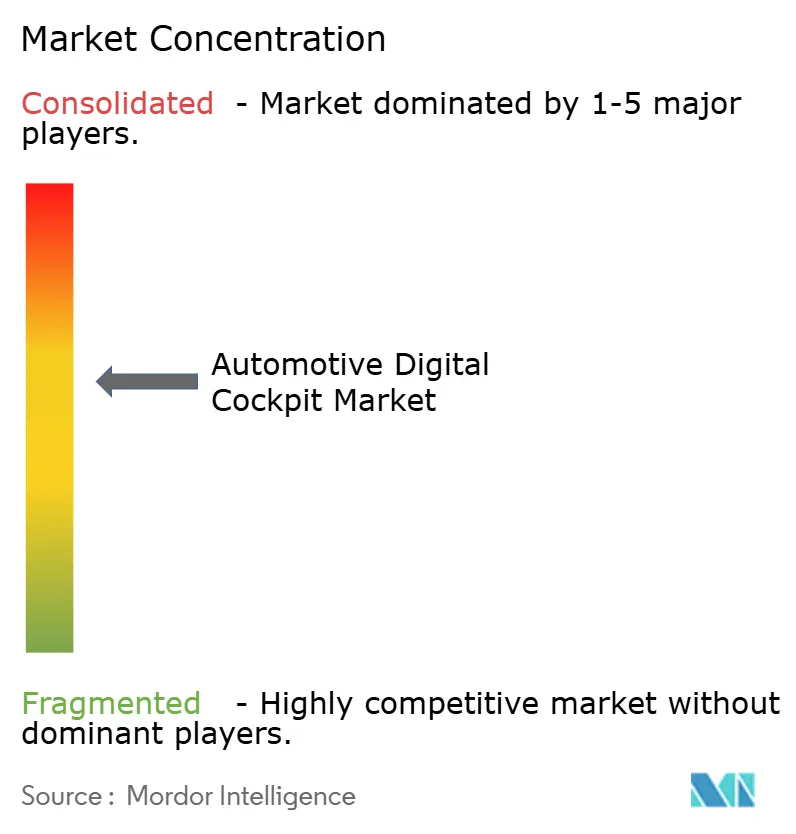
| Market Concentration | Medium |
Major Players *Disclaimer: Major Players sorted in no particular order Image © Mordor Intelligence. Reuse requires attribution under CC BY 4.0. | |
Automotive Digital Cockpit Market Analysis by Mordor Intelligence
Automotive digital cockpit market size in 2026 is estimated at USD 29.81 billion, growing from 2025 value of USD 26.61 billion with 2031 projections showing USD 52.56 billion, growing at 12.02% CAGR over 2026-2031. The market’s growth is anchored in the automotive shift toward software-defined vehicles, tightening safety mandates, and mounting consumer expectations for seamless in-car connectivity. Carmakers are merging infotainment, driver-assistance, and vehicle controls into domain controller platforms that lower the bill of materials cost while supporting over-the-air upgrades. Battery-electric architectures accelerate adoption by supplying the power and network bandwidth needed for high-resolution displays and AI functions. Competitive intensity is rising as semiconductor vendors, display specialists, and traditional Tier-1s all vie to supply next-generation cockpits, prompting automakers to favor long-term platform agreements that assure cybersecurity compliance and functional-safety certification.
Key Report Takeaways
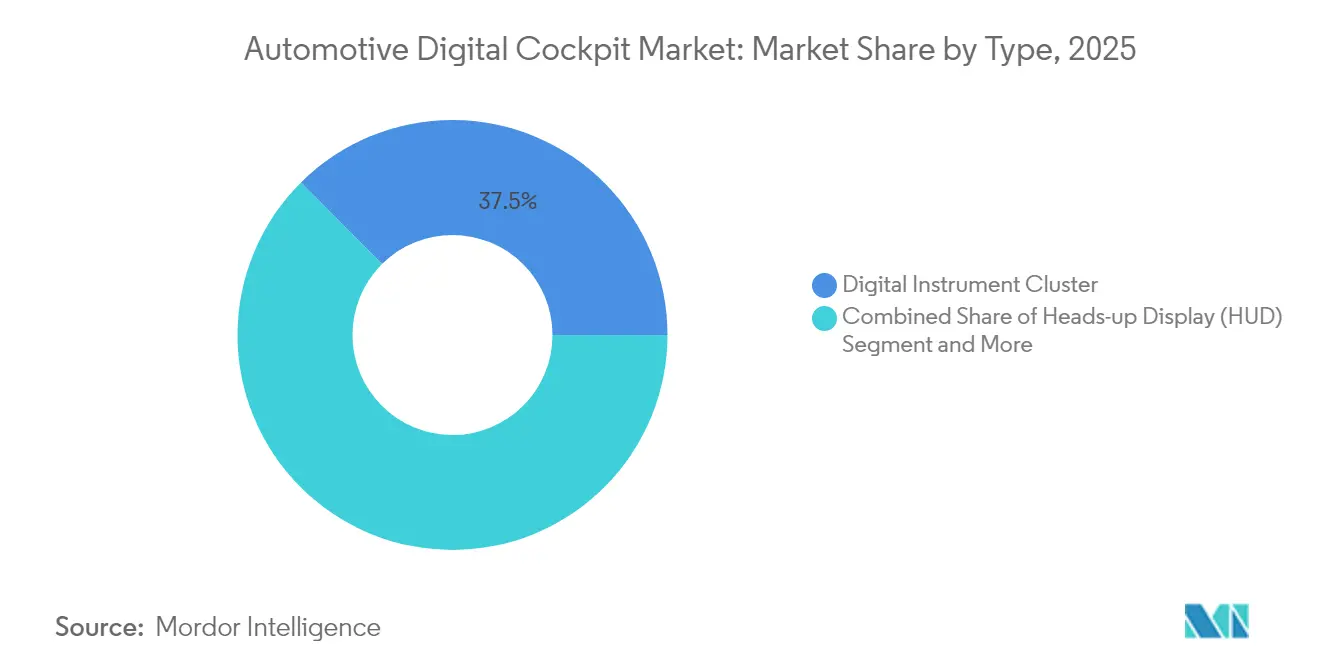
- By type, digital instrument clusters led the automotive digital cockpit market share by 37.45% in 2025, while heads-up displays are set to expand at an 18.05% CAGR to 2031.
- By vehicle type, passenger cars accounted for 68.89% of the automotive digital cockpit market size in 2025; light commercial vehicles show the fastest growth at 14.33% CAGR through 2031.
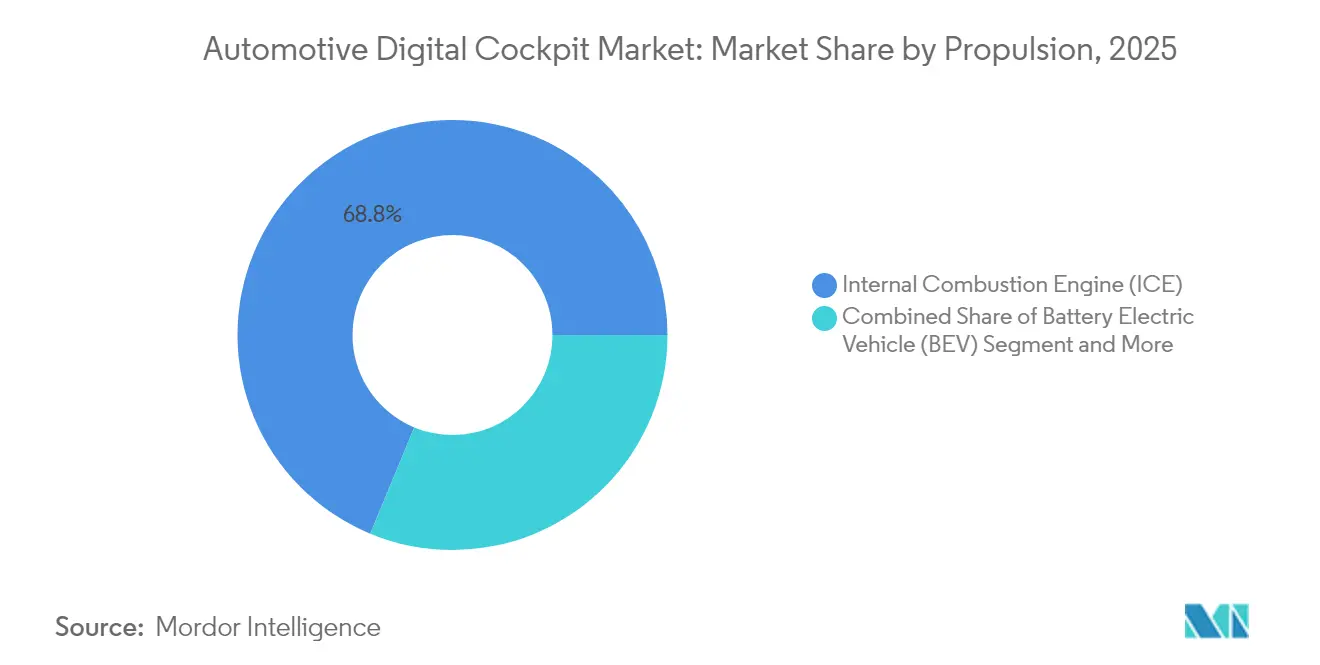
- By propulsion, ICE vehicles captured 68.75% of the automotive digital cockpit market size in 2025, while battery electric vehicles (BEVs) are advancing at an 18.05% CAGR to 2031.
- By sales channel, the OEM-fitted segment held 91.25% of the automotive digital cockpit market's revenue share in 2025, outpacing aftermarket solutions with a 13.58% CAGR.
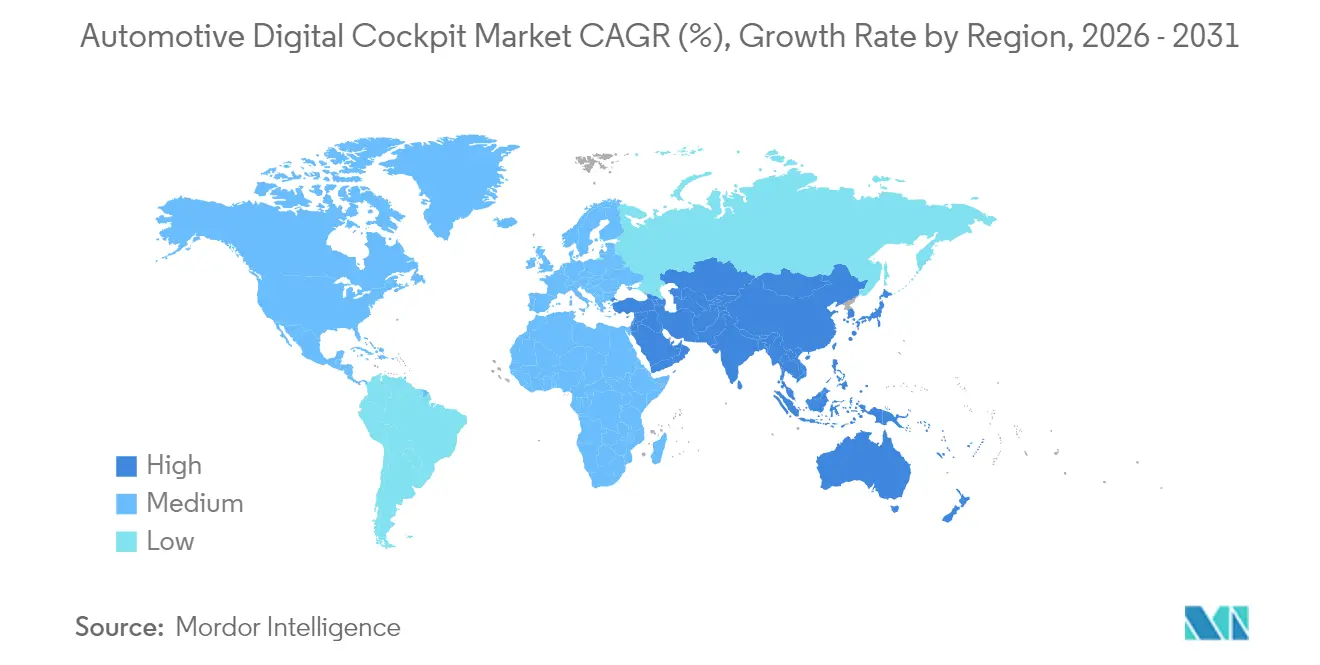
- By region, Asia-Pacific commanded 39.42% of the automotive digital cockpit market share in 2025 and is projected to grow at a 14.44% CAGR through 2031.
Note: Market size and forecast figures in this report are generated using Mordor Intelligence’s proprietary estimation framework, updated with the latest available data and insights as of 2026.
Global Automotive Digital Cockpit Market Trends and Insights
Drivers Impact Analysis*
| Driver | (~)% Impact on CAGR | Geographic Relevance | Impact Timeline |
|---|---|---|---|
| Immersive Infotainment Demand | +3.2% | Global, with premium adoption in North America and Europe | Medium term (2-4 years) |
| Mandatory ADAS and Safety Regulations | +2.8% | Global, led by EU GSR II and NHTSA requirements | Short term (≤ 2 years) |
| EV Software-Defined Cockpits | +2.1% | APAC core, spill-over to North America and Europe | Long term (≥ 4 years) |
| Centralized Domain Controllers | +1.8% | Global, with early adoption in premium segments | Medium term (2-4 years) |
| In-car Subscription Revenue | +1.4% | North America and Europe, expanding to APAC | Long term (≥ 4 years) |
| Android Automotive Adoption | +0.9% | Global, with accelerated adoption in emerging markets | Medium term (2-4 years) |
| Source: Mordor Intelligence | |||
Surging Consumer Appetite for Immersive Infotainment
Carmakers are designing cabins around multi-screen layouts and AI voice assistants that mimic smartphone experiences. TCL CSOT’s panoramic HUD and 32:9 center displays preview the next design language, while Honda’s forthcoming ASIMO OS embeds machine-learning personalization. Content partnerships, such as Visteon–TuneIn, add streaming media to the dashboard. Premium brands further reinforce the trend. For instance, Audi’s A6 Sportback e-tron combines an 11.9-inch virtual cluster with a 14.5-inch OLED touch screen for vivid graphics.
Mandatory ADAS and Safety Regulations
Regulatory mandates are catalyzing the integration of advanced driver assistance systems with digital cockpit platforms, creating synergies that enhance both safety and user experience while reducing system complexity. EU General Safety Regulation II updates require mandatory advanced driver-assistance features in all passenger vehicles, all of which must present intuitive, real-time alerts. Qualcomm and Bosch responded with a mixed-criticality computer that hosts infotainment and ADAS workloads on one SoC, reducing latency and wiring. This convergence is further accelerated by functional safety standards like ISO 26262 ASIL-B compliance requirements, which are driving innovation in automotive display technologies and LED driver architectures.
EV Platforms Favoring Software-Defined Cockpits
Electric vehicles provide centralized power and Ethernet backbones that consolidate more than 50 ECUs into a few domain controllers, a shift Intel claims cuts wiring length by 60% while freeing energy for high-bandwidth displays. Stellantis projects software revenue to reach EUR 20 billion by 2030 on the back of cockpit-based digital services. Chinese OEMs are further amplifying the trend by leveraging software-defined cockpits to differentiate their offerings.
Centralized Domain Controllers Slashing BOM Cost
Moving infotainment, ADAS, and cluster rendering onto a single board lowers component count, validation cycles, and long-term maintenance. The cost benefits extend beyond hardware to software development and maintenance, as centralized platforms enable shared computing resources and simplified over-the-air update mechanisms. Infineon and MediaTek’s entry-level reference design meets ASIL-B and demonstrates how mass-market vehicles gain access to multi-display packages while shaving up-front cost.
Restraints Impact Analysis*
| Restraint | (~)% Impact on CAGR | Geographic Relevance | Impact Timeline |
|---|---|---|---|
| High System Cost | -2.1% | Global, with acute impact on emerging markets | Short term (≤ 2 years) |
| Cybersecurity and Data-Privacy Risk | -1.8% | North America and EU, expanding globally | Medium term (2-4 years) |
| Advanced-Node SoC Shortages | -1.6% | Global, with critical impact on premium segments | Short term (≤ 2 years) |
| Driver-Distraction Regulations | -1.2% | EU and North America, with regulatory spillover | Medium term (2-4 years) |
| Source: Mordor Intelligence | |||
High Upfront System and Validation Cost
Achieving ISO 26262 ASIL-B for cockpit displays demands redundant power rails, fault-injection testing, and exhaustive software audits, all of which inflate non-recurring engineering spend. HARMAN alone employs more than 500 engineers on cockpit programs, underscoring the labor intensity. Smaller OEMs delay rollouts, and some legacy models were withdrawn in Europe when new cybersecurity rules took effect in 2024.
Escalating Vehicle-Cybersecurity and Data-Privacy Liabilities
UN ECE R155/R156 rules and equivalent EU statutes oblige automakers to patch vulnerabilities for at least 10 years, raising recurring costs. BlackBerry’s expanded tie-up with Marelli shows the move toward hardened micro-kernels and intrusion-detection gateways inside the cockpit. Data-privacy provisions now require on-screen consent flows and localized cloud storage, adding software complexity but opening service revenue for compliance tools.
*Our forecasts treat driver/restraint impacts as directional, not additive. The impact forecasts reflect baseline growth, mix effects, and variable interactions.
Segment Analysis
By Type: Multi-Screen Integration Drives Premium Adoption
In 2025, digital instrument clusters commanded a 37.45% of the automotive digital cockpit market share, serving as the primary interface for speed, range, and ADAS alerts. Heads-up displays, however, are setting the pace with an 18.05% CAGR, pushed by OEM demand for automotive cockpit electronics and augmented-reality overlays that keep drivers’ eyes forward. The digital cockpit market is also shifting toward panoramic CIDs, passenger-indulgent PIDs, and camera-based driver-monitoring modules that help satisfy Euro NCAP driver-attention ratings.
Center stack screens now stretch beyond 15 inches, enabled by higher pixel densities and low-power LTPO backplanes that limit heat. Envisics’ second-generation holographic HUD debuted in GM’s 2024 Cadillac Lyriq, highlighting cross-segment trickle-down of once-premium tech. TCL CSOT’s 32:9 combo display merges cluster and infotainment on a single surface, heralding further component consolidation. Growing demand for immersive experiences guarantees that multi-display packages remain a growth lever for the digital cockpit market.

By Vehicle Type: Commercial Segments Accelerate Digitalization
In 2025, passenger cars led the automotive digital cockpit market, securing a 68.89% share and witnessing a 13.92% annual growth. Consumers now expect the same cloud-linked services in a compact hatchback that they once saw only in luxury sedans, forcing volume brands to stretch cockpit feature lists. Digital cockpit market adoption in light commercial vehicles is quickening as fleets seek telematics integration that pairs route planning with driver-condition monitoring.
Medium and heavy trucks increasingly require electronic logging devices, and domain-controller cockpits satisfy this mandate while supporting predictive maintenance analytics. BYD’s roll-out of 21 models with self-developed cockpit chips demonstrates how cost-optimized designs are scaling into workhorse vans and pickups. This divergence means light commercial vehicles may outpace passenger cars in incremental unit growth, even though the latter still dominate the digital cockpit market size.
By Propulsion: Electric Platforms Enable Advanced Integration
In 2025, internal-combustion vehicles commanded a dominant 68.75% share of the automotive digital cockpit market. Yet, many new ICE models now arrive with over-the-air-ready domain controllers to future-proof cabin electronics. Battery-electric vehicles are projected to register the fastest growth rate of 18.05% through 2031 as flat-floor architectures make room for larger displays and zonal power distribution. EV platforms supply stable 48-V or high-voltage rails that simplify active-matrix mini-LED backlighting and GPU-rich compute clusters.
Hybrids act as a bridge, sharing EV conveniences like plug-in firmware upgrades while leveraging existing 12-V harnesses. The shift toward electrification accelerates cockpit innovation, as automakers leverage the clean-sheet design opportunities presented by EV platforms to implement next-generation cockpit architectures that would be difficult to retrofit into conventional vehicles.
By Sales Channel: OEM Integration Dominates Market Strategy
In 2025, OEM-installed systems dominated the automotive digital cockpit market with a 91.25% share and are projected to grow at a 13.58% CAGR due to their alignment with vehicle-wide E/E architecture. Automakers validate cybersecurity, functional safety, and user-interface consistency before a model ever leaves the plant, eliminating many integration pitfalls seen in retrofits.
Aftermarket demand persists, served by niche upgrade specialists offering 12.3-inch TFT clusters for recent pickups or luxury SUVs. Yet rising encryption of in-vehicle networks and central-compute architectures mean retrofit options are shrinking. Consequently, future digital cockpit market volume will remain OEM-centric, with aftermarket channels focusing on accessories rather than full domain-controller replacements.
Geography Analysis
In 2025, the Asia-Pacific region dominated the digital cockpit market, accounting for 39.42% of global revenues. Projections indicate a robust growth rate of 14.44% CAGR for the region, extending through 2031. China’s EV boom, propelled by aggressive subsidies and local component ecosystems, has turned domestic brands into cockpit technology exporters; Volkswagen, GM, and Nissan have licensed Chinese HMI stacks for local-market variants. Japan reinforces the region’s software push: DENSO plans to quadruple software revenue to JPY 800 billion by 2035, and Toyota’s Arene OS aims to deliver cross-model cabin experiences.
Europe is projected to maintain a medium pace, driven by the continent’s leadership in premium marques that anchor cockpit R&D budgets. EU General Safety Regulation II forces the adoption of smart clusters capable of presenting mandatory warnings. Yet compliance costs remain high; several low-volume models exited production in 2024 after cybersecurity rules took effect. German OEMs counter by concentrating resources on digital-first platforms such as BMW’s NEUE KLASSE, which prioritizes user-centric HUDs over analog gauges.
North America is expected to deliver a steady 8.94% CAGR. The region’s large SUV and pickup segments demand high-brightness displays visible under direct sunlight, spurring innovation in optical bonding and anti-reflective coatings. NHTSA’s broadened NCAP adds blind-spot, lane-keep, and pedestrian braking criteria, effectively mandating advanced HMIs. Meanwhile, Stellantis’ USD-denominated software revenue goals illustrate how cockpit-tied digital services can become a core margin contributor.
Regulatory Landscape
Type-approval and consumer-safety frameworks increasingly tie digital cockpit architectures to cybersecurity and software-update governance. UNECE UN R155 (Cybersecurity Management System) and UN R156 (Software Update Management System) require OEMs and suppliers to evidence audited management processes for vehicle cybersecurity and OTA update controls, not only component-level testing. A key compliance milestone is 1 July 2024, when UN R155 cybersecurity requirements apply to certain newly issued vehicle types, reinforcing secure-by-design cockpit ECUs, incident response, and patching processes across the supply base.
Standards and guidance also shape cockpit software engineering and validation. ISO 24089:2023 for road-vehicle software update engineering supports UN R156 compliance, with Amendment 1 published in July 2024, while the US NHTSA Cybersecurity Best Practices for the Safety of Modern Vehicles (updated 2022) is widely used as a reference for risk-based security in connected infotainment and cluster systems. In Europe, UK Vehicle Certification Agency guidance and third-party conformity assessment and certification services (including TÜV SÜD and UL Solutions programs around SUMS and update engineering) are increasingly used to demonstrate readiness for type approval, influencing supplier selection for cockpit domain controllers and HMI software stacks.
Value Chain Analysis
The automotive digital cockpit value chain begins with semiconductor IP, SoCs, memory, display panels, touch controllers, optical bonding materials, and camera and sensing modules. It then moves to Tier-1 integration of cockpit domain controllers, clusters, HUD optics, telematics units, and software stacks (OS, middleware, HMI, security), followed by OEM validation for functional safety and cybersecurity and finally factory fitment through OEM channels. Platform consolidation is tightening the coupling between compute and software suppliers, with OEMs increasingly contracting long-term platform agreements to secure advanced-node compute and align certification artifacts such as ISO 26262 and cascaded cybersecurity requirements across multi-display systems.
Recent partnership and localization activity shows the chain reorganizing around centralized compute and software-defined vehicle programs. In May 2026, Stellantis expanded its partnership with Qualcomm to adopt Snapdragon Digital Chassis platforms across next-generation architectures spanning cockpit, connectivity, and driver-assistance building blocks, and it also expanded collaboration with Applied Intuition to integrate Vehicle OS and Cabin Intelligence into the STLA Brain platform. In July 2026, Kakao Mobility and Renault Korea signed an MOU to jointly develop next-generation in-vehicle infotainment and navigation technology, reflecting the growing role of software and mapping partners alongside traditional Tier-1 integrators. Separately, navigation ecosystems are becoming more cross-border, as shown by the HERE Technologies and Amap alliance announced in November 2025 to co-develop AI-driven navigation and cockpit solutions for Chinese automakers expanding internationally.
Competitive Landscape
Market concentration is moderate, with the top five suppliers holding around half of the combined share, leaving white-space for specialized display, OS, and cybersecurity entrants. Continental, Bosch and DENSO are the top performers, while technology companies like Qualcomm are rapidly gaining ground through semiconductor platforms that enable next-generation cockpit functionality.
Strategic alliances define the field. Bosch and Qualcomm unveiled a scalable central computer that merges infotainment and ADAS, allowing automakers to tier features via software licenses. Continental plans to spin off its Automotive Technologies unit, freeing capital to intensify investment in immersive HMIs and secure-by-design software.
Furthermore, HARMAN maintains a 500-engineer cockpit practice and recently became an Android Auto certification partner, ensuring rapid integration of Google apps. Patent filings focus on augmented-reality visualization and haptic feedback, as illustrated by a keyboard-driven tactile interface patent that could migrate from consumer electronics to vehicles. The convergence of software, silicon, and optics positions digitally fluent suppliers to capture disproportionate value in the evolving digital cockpit market.
Automotive Digital Cockpit Industry Leaders
-
Robert Bosch GmbH
-
Continental AG
-
DENSO Corporation
-
Visteon Corporation
-
Harman International
- *Disclaimer: Major Players sorted in no particular order
Market Opportunities and Future Outlook
Localization and capacity buildouts across cockpit hardware and subassemblies are creating near-term whitespace for suppliers that can shorten lead times while meeting OEM-grade validation for software updates and cybersecurity. Examples include ADAYO Foryou Group starting production at its Dongxing plant in Huizhou (January 2026) for intelligent cockpit products such as domain controllers and smart displays, Maticon commencing production of smart cockpit functional parts in Taicang (January 2026) with stated annual capacity of 2 million sets, and JOYNEXT opening a new manufacturing facility in Oborniki Slaskie, Poland (April 2026), expanding production space to about 26,000 square meters for infotainment and cockpit control systems. These steps support region-specific sourcing strategies, particularly for Europe and China, where OEM programs increasingly require stable supply and compliance-ready software update processes.
A second opportunity area sits at the intersection of multiscreen HMI software, navigation, and SDV-ready cockpit domain controllers. OEMs are standardizing platforms that support OTA updates and faster feature iteration, with June 2026 work showing demand for reusable software layers, such as KPIT Technologies collaborating with Basemark to integrate the Rocksolid software platform into multiscreen HMI solutions. OEM program selection also reflects platform pull, including Mazda selecting Panasonic Automotive Systems cockpit domain controller technology for the redesigned CX-5 with an SDV architecture supporting OTA updates (reported in July 2026). At the same time, HMI design is adapting to safety-scoring and regulatory signals that favor tactile controls for critical functions, which creates room for hybrid interfaces combining large displays with physical or haptic controls while keeping a unified cockpit software layer.
Recent Industry Developments
- April 2026: Robert Bosch GmbH and Qualcomm expanded their collaboration to include ADAS solutions alongside cockpit computing, centered on the Snapdragon Ride Flex SoC approach. The partnership reinforces cross-domain consolidation, enabling OEMs to run infotainment and driver-assistance workloads on fewer high-performance computers. It also supports efforts to reduce wiring and integration complexity.
- April 2025: Robert Bosch GmbH reported receiving its first customer order in China for a high-performance computer featuring AI, with series production planned at a six-digit unit scale. This adds an industrialization signal from a major China program for centralized cockpit computers. It also increases competitive pressure on alternative Tier-1 compute platforms.
- May 2024: Continental AG introduced a cross-domain high-performance computer platform for software-defined vehicles that can host cockpit, safety, and parking functions on a single computing platform using a Snapdragon Ride Flex SoC. This highlighted the architectural shift from distributed ECUs toward centralized compute. It further tightened requirements for mixed-criticality software integration across the cockpit stack.
Research Methodology Framework and Report Scope
Market Definition and Coverage
For this methodology, the automotive digital cockpit market is defined as the revenue earned from in-vehicle digital cockpit systems that combine driver information, infotainment, and related in-cabin human machine interface functions, whether sold as modules or integrated solutions for passenger and commercial vehicles.
Scope exclusions: We exclude non-automotive display demand and general consumer electronics devices that are not designed and qualified for in-vehicle cockpit use.
Segmentation Overview
- By Type
- Heads-up Display (HUD)
- Digital Instrument Cluster
- Center Stack Display
- Advanced Driver-Monitoring Camera
- Telematics/Connectivity Control Unit
- By Vehicle Type
- Passenger Cars
- Light Commercial Vehicles
- Medium and Heavy Commercial Vehicles
- By Propulsion
- Internal Combustion Engine (ICE)
- Battery Electric Vehicle (BEV)
- Hybrid and Plug-in Hybrid (HEV/PHEV)
- By Sales Channel
- OEM-fitted
- Aftermarket Retro-fit
- By Geography
- North America
- United States
- Canada
- Rest of North America
- South America
- Brazil
- Argentina
- Rest of South America
- Europe
- Germany
- United Kingdom
- France
- Italy
- Spain
- Rest of Europe
- Asia-Pacific
- China
- Japan
- South Korea
- India
- Rest of Asia-Pacific
- Middle East and Africa
- United Arab Emirates
- Saudi Arabia
- Morocco
- South Africa
- Rest of the Middle East and Africa
- North America
Data Sources, Market Sizing, and Validation
Desk Research
Desk research starts by mapping vehicle production and sales by region to a realistic cockpit demand pool, which is then linked to feature take-rates and indicative pricing ranges. We used public sources such as OICA vehicle production releases, U.S. NHTSA safety information, the European Commission mobility and type approval publications, and UN Comtrade trade flows for relevant electronics categories.
To keep the sizing inputs grounded, we also reviewed company annual reports and investor presentations, reputable press releases on cockpit platform launches, and patent databases to understand feature direction (for example, multi-display cockpits and cockpit domain controllers). In a few places, we relied on paid subscriptions for company financials and shipment-level trade intelligence to cross-check supplier exposure and import patterns before assumptions were finalized. The desk sources listed here are illustrative rather than exhaustive, and many other public documents and datasets were also referred to for data collection, validation, and clarification.
Primary Interviews and Surveys
Primary work was used to validate fitment rates, typical bill-of-material splits inside the cockpit, and pricing movement by screen size and technology, where public disclosures are usually limited. We spoke with a mix of OEM-side product stakeholders, component suppliers, and channel participants across APAC, EMEA, and the Americas. Feedback from these interviews and surveys was used to adjust assumptions that showed high variance versus observed vehicle programs.
Distribution of primary research fieldwork respondents
| Company type | Respondent position | Region |
|---|---|---|
| Top tier: 36% | CXOs: 14% | APAC: 51% |
| Mid tier: 48% | Functional/Unit leaders: 32% | EMEA: 30% |
| Smaller Players: 16% | Managers: 54% | Americas: 19% |
Market-Sizing & Forecasting
The market value is reconstructed using a top-down and bottom-up approach, where vehicle production and sales by region are translated into a cockpit demand pool using feature penetration assumptions, and then converted into revenue using average selling price ranges for key cockpit blocks. To keep the totals grounded, results are corroborated with selective bottom-up approximations, such as sampled supplier revenue exposure to cockpit programs, channel checks on module pricing, and volume times ASP tests for high-penetration features.
Inputs that materially shape the model include global passenger and commercial vehicle production, adoption rates for digital instrument clusters and center stack displays, screen size mix (below 7 inch, 7 to 10 inch, and larger formats), the move toward cockpit domain controllers, and propulsion mix because EV platforms often carry richer display and software content. For forecasting, scenario analysis is used and it is supported by expert views on the pace of multi-screen cockpit rollout, expected content per vehicle in mid-segment cars, and price normalization as scale improves. Where a clean roll-up is hard because cockpit content is bundled into packages, we fill gaps using program-weighted ASP bands and then re-check the output against vehicle feature announcements and supplier commentary so the final curve stays believable.
Data Validation & Update Cycle
Validation is done through repeated checks across the model layers so the output stays aligned with real automotive build and content signals. We compare outputs with independent metrics such as vehicle production trends, platform launch cadence, and observed pricing ranges, and then anomalies are reviewed and resolved before sign-off.
When a region, vehicle class, or technology line shows a sharp swing, selected experts are re-contacted to confirm whether it is a true market shift or an assumption issue. Reports are refreshed annually, with interim updates when material events occur, such as regulation changes, major model launches, or supply constraints. Before delivery, an analyst completes a fresh pass so clients receive a current view rather than an older snapshot.
Mordor Intelligence's Automotive Digital Cockpit Market Size Measured Against Other Published Estimates
Published market sizes for automotive digital cockpit can differ because the cockpit bundle is not defined the same way across sources, and because base years and price assumptions move quickly as display mix changes. Currency timing, treatment of OEM-fit versus retrofit, and how bundled cockpit packages are handled are also common reasons the totals do not line up.
The table shows a spread that mainly comes from what is counted inside the cockpit value and from the reference year used for pricing and volumes. Under Mordor Intelligence's scope, aftermarket retro-fit is counted alongside OEM-fitted systems, and the value is built across HUD, digital instrument cluster, center stack display, and driver-monitoring camera content. This can push the current-year number above narrower equipment-only views.
Benchmark comparison
| Source | Market Size | Gaps in Research Methodology |
|---|---|---|
| Mordor Intelligence | USD 29.81 B (2026) | |
| Global Research House A | USD 26.04 B (2024) | Uses an earlier base year and a more limited equipment definition that is presented mainly by display or application buckets, which can undercount integrated cockpit controller content and retro-fit value. |
| Industry Publisher B | USD 34.74 B (2025) | Includes a wider component set and applies a different price ladder by screen size and autonomy mix, which can raise totals if adoption assumptions for large displays and premium trims are higher. |
Overall, the differences look less like arithmetic errors and more like scope and input choices that shift the counted content per vehicle and the applied ASP path. Our model is kept repeatable by tying revenue to vehicle volumes, penetration signals, and a clear pricing structure. Totals are adjusted only when validation checks and expert feedback point to a consistent mismatch.
Key Questions Answered in the Report
What is the current size of the digital cockpit market?
The market generated USD 29.81 billion in 2026 and is on course to approach USD 52.56 billion by 2031 at a 12.02% CAGR.
Which region leads global demand for digital cockpits?
Asia-Pacific holds 39.42% of global revenue owing to China’s rapid EV adoption and local suppliers’ competitive pricing.
Why are battery-electric vehicles critical to cockpit growth?
EV platforms supply centralized power and zonal wiring that simplify high-performance computing and multi-screen integration, propelling an 18.05% CAGR for BEV cockpit sales.
How are safety regulations influencing cockpit design?
EU GSR II and NHTSA NCAP updates require real-time ADAS alerts, pushing automakers toward domain-controller cockpits that combine safety and infotainment on unified displays.
What challenges could slow digital cockpit adoption?
High up-front validation costs and growing cybersecurity liabilities can delay rollouts, especially for smaller OEMs and cost-sensitive vehicle segments.