
Automotive Air Purifier Market Size and Share
Market Overview
| Study Period | 2020 - 2031 |
|---|---|
| Market Size (2026) | USD 2.33 Billion |
| Market Size (2031) | USD 3.78 Billion |
| Growth Rate (2026 - 2031) | 10.11 % |
| Fastest Growing Market | Asia Pacific |
| Largest Market | Asia Pacific |
| Market Concentration | Medium |
Major Players *Disclaimer: Major Players sorted in no particular order Image © Mordor Intelligence. Reuse requires attribution under CC BY 4.0. | |
Automotive Air Purifier Market Analysis by Mordor Intelligence
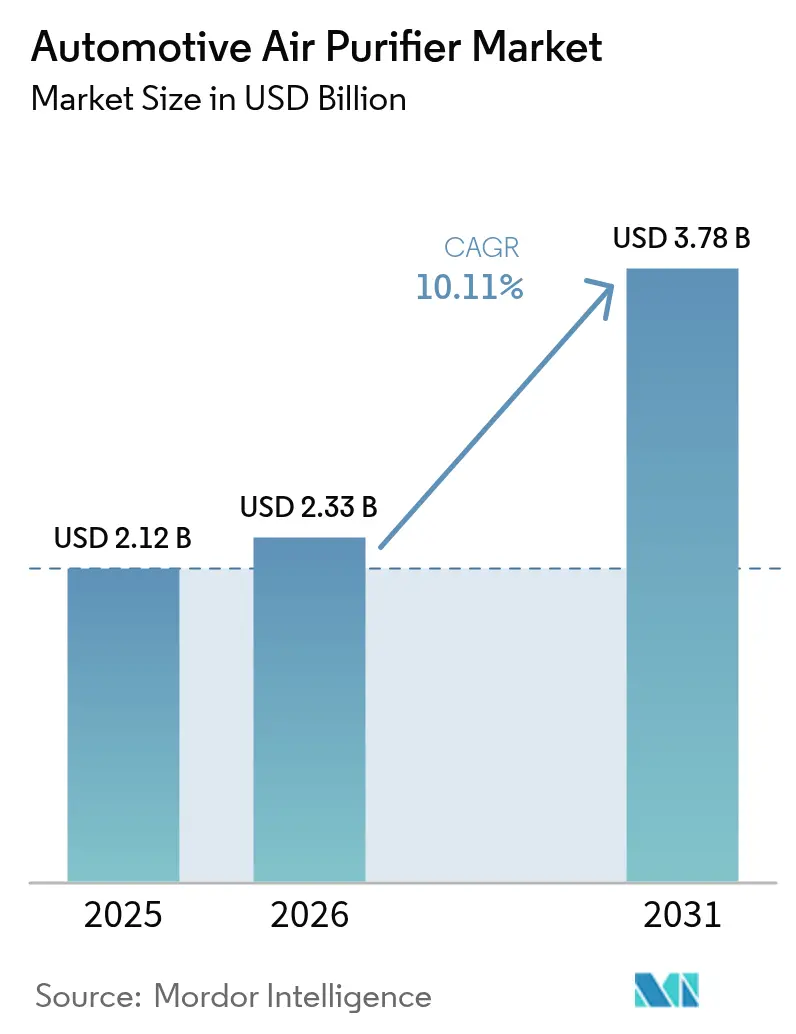
The automotive air purifier market size in 2026 is estimated at USD 2.33 billion, growing from 2025 value of USD 2.12 billion with 2031 projections showing USD 3.78 billion, growing at 10.11% CAGR over 2026-2031. Rising expectations for interior air quality, tighter vehicle emission rules, and lower filter media costs are propelling demand across model ranges. The Euro 7 framework, published in May 2024, mandates in-cabin emission limits from November 2026, while China VI-B standards that took effect in July 2023 apply similar requirements, prompting automakers to fit advanced purification systems as baseline equipment. Asia-Pacific steers overall growth as megacity pollution heightens consumer health awareness and electric-vehicle (EV) production scales quickly. Passenger cars remain the primary revenue contributor, but battery electric models deliver the highest incremental volume as their ample auxiliary power and wellness positioning accelerate technology uptake. Suppliers have responded with multistage devices that blend HEPA filtration, activated carbon, and ultraviolet (UV-LED) disinfection, allowing automakers to balance performance, cost, and packaging constraints.
Key Report Takeaways
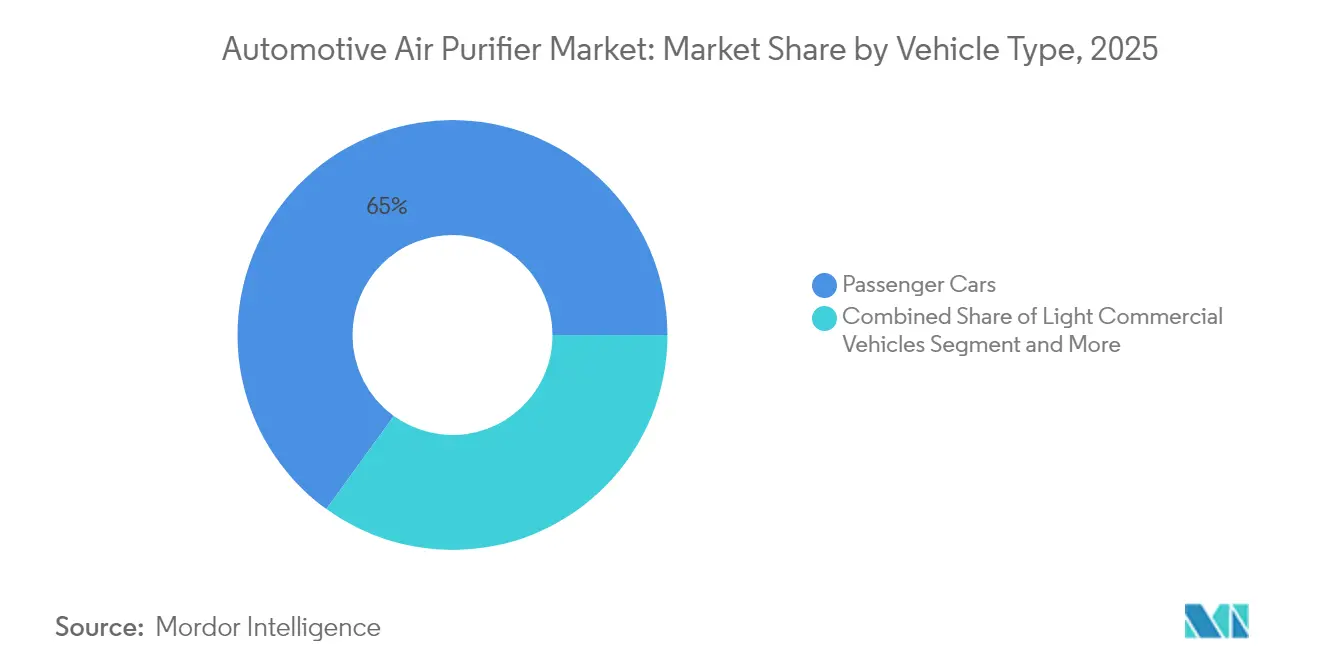
- By vehicle type, passenger cars led with 65.02% revenue contribution in 2025; light commercial vehicles are forecast to advance at an 11.12% CAGR to 2031.
- By technology, HEPA media captured 47.12% of 2025 revenues, while UV-LED units are set to climb at a 11.94% CAGR.
- By installation type, HVAC-integrated factory systems accounted for 57.74% of the automotive air purifier market size in 2025 and will rise at a 10.68% CAGR through 2031.
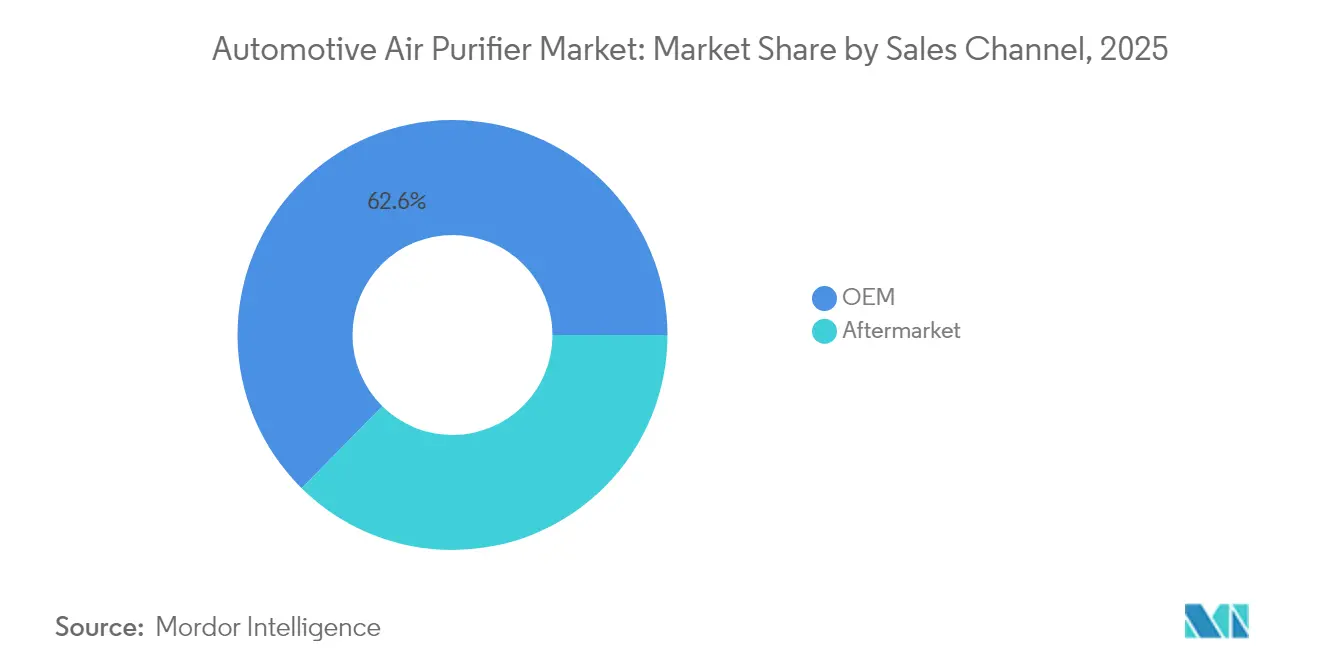
- By sales channel, OEM contributed with 62.62% share in the automotive air purifier market, while the aftermarket channel is set to grow at an 11.03% CAGR.
- By vehicle propulsion, internal-combustion models retained 61.60% of the automotive air purifier market share in 2025,whereas battery electric vehicles posted the swiftest expansion at an 17.66% CAGR through 2031.
- By geography, Asia-Pacific dominated at 39.04% share in 2025 and will log the highest regional growth at an 10.87% CAGR.
Note: Market size and forecast figures in this report are generated using Mordor Intelligence’s proprietary estimation framework, updated with the latest available data and insights as of 2026.
Global Automotive Air Purifier Market Trends and Insights
Drivers Impact Analysis*
| Driver | (~) % Impact on CAGR Forecast | Geographic Relevance | Impact Timeline |
|---|---|---|---|
| Rising In-cabin PM2.5 Concerns in Megacities | +2.1% | Asia-Pacific core, spill-over to Middle East and Africa | Medium term (2-4 years) |
| Stricter China VI-B and Euro 7 Interior Air-quality Rules | +1.8% | China and European Union, extending to North America | Short term (≤ 2 years) |
| Automaker Push for Wellness-oriented Cabin Features | +1.4% | Global, premium segments first | Medium term (2-4 years) |
| HEPA Cost Decline from Melt-blown Capacity Additions | +1.2% | Global manufacturing hubs | Long term (≥ 4 years) |
| AI-enabled Smart Scent and Pathogen-sensing Modules | +0.9% | North America and EU premium markets | Long term (≥ 4 years) |
| Mandatory filtration for robotaxis and shared-mobility fleets | +0.7% | Urban centers worldwide | Medium term (2-4 years) |
| Source: Mordor Intelligence | |||
Rising In-Cabin PM2.5 Concerns in Megacities
Rapid urbanization makes traffic exposure a daily health risk, pushing commuters to treat vehicles as protective bubbles. The 2024 IQAir World Air Quality Report showed only 17% of monitored cities meeting World Health Organization guidelines, underscoring the necessity for onboard filtration. Korea’s national R&D institutes illustrated regulatory urgency by rolling out filter-free electrostatic towers that eliminate over 90% of ultrafine particles in public spaces, a concept soon mirrored inside vehicles [1]. Hyundai therefore embedded After-Blow and Fine-Dust Indicator software that auto-activates recirculation when PM2.5 spikes, turning air cleaning into an invisible safety function. In Asia-Pacific megacities, the automotive air purifier market gains an enduring uplift as households prioritize cabin wellness equal to powertrain efficiency.
Stricter China VI-B and Euro 7 Interior Air-Quality Rules
Regulators now bundle cabin emissions with exhaust limits, erasing the optional status of filtration. Euro 7 compels compliance across passenger cars, vans, and heavy trucks beginning November 2026, while China’s VI-B regime already enforces aldehyde and particulate caps for every new light vehicle. Suppliers such as NGK Insulators have publicly forecast stable revenue despite macro-demand swings because mandated equipment levels create guaranteed purchase volumes [2]. The standardization effect shortens design cycles: a single purification stack certified for both regulatory blocs can cover most high-volume global platforms, delivering scale economies that widen the automotive air purifier market.
Automaker Push for Wellness-Oriented Cabin Features
With powertrains converging, OEMs differentiate through occupant experience. Yanfeng’s XiM25 concept integrates WAVE vents that mimic gentle breezes while channeling air through a multi-layer filter, framing purification as part of holistic relaxation. Sharp’s LDK+ EV demonstrator adds AI fragrance and circadian lighting control, packaging scent, and pathogen sensing with real-time filtration. Wellness branding lets premium marques charge higher option prices and boosts customer retention, which in turn persuades volume manufacturers to adopt similar functions. This dynamic sustains the automotive air purifier market well beyond compliance volumes.
HEPA Cost Decline from Melt-Blown Capacity Additions
Post-pandemic expansions of melt-blown nonwoven lines lowered HEPA media unit cost and pressure drop. Hollingsworth & Vose’s CabinPro XT maintains 99.97% capture efficiency while extending service intervals, reducing lifecycle cost for fleet operators. Purflux’s CabinHepa+ achieves the same filtration cut-off at 0.3 micron, yet claims 50 times more protection than legacy pollen filters. Lower price points unlock mid-trim vehicle adoption, scaling the automotive air purifier market further and challenging ionizer alternatives that cannot match particle removal rates without ozone risk.
Restraints Impact Analysis*
| Restraint | (~) % Impact on CAGR Forecast | Geographic Relevance | Impact Timeline |
|---|---|---|---|
| Lack of Global Performance Standards and Test Cycles | -1.3% | Worldwide | Short term (≤ 2 years) |
| Limited Consumer Awareness Outside North Asia | -0.9% | North America, Europe, emerging markets | Medium term (2-4 years) |
| Automaker Cost-down Pressure in Entry-level EVs | -0.8% | Global mass-market segments | Medium term (2-4 years) |
| Micro-ozone Emission Risks from Ionizers | -0.6% | Global, safety-focused markets | Short term (≤ 2 years) |
| Source: Mordor Intelligence | |||
Lack of Global Performance Standards and Test Cycles
Unlike Euro-NCAP or WLTP, no universally accepted clean-air protocol exists for cars. An Aerosol Science and Technology study logged ionizer clean-air delivery rates between 5 and 10 cfm under varying lab setups, making cross-brand comparisons impossible. OEMs must navigate at least three separate cabin-air test cycles spanning China, the European Union, and Japan, adding cost and delaying launches. Standardization gaps slow the automotive air purifier market as smaller suppliers defer investment until test harmonization materializes.
Limited Consumer Awareness Outside North Asia
North Asian buyers actively compare PM2.5 ratings when selecting vehicles, but surveys in Germany and the United States show most shoppers are unaware of interior air pollutant thresholds. University of Birmingham researchers cut in-cabin nitrogen dioxide by 90% using USD 12–25 activated-carbon filters, yet the findings received scant mainstream coverage. Absent strong marketing, aftermarket uptake lags, limiting volume for replacement cartridges. This knowledge deficit caps the automotive air purifier industry’s growth in mature Western markets until awareness campaigns scale.
*Our forecasts treat driver/restraint impacts as directional, not additive. The impact forecasts reflect baseline growth, mix effects, and variable interactions.
Segment Analysis
By Vehicle Type: Passenger Cars Drive Market Expansion
Passenger cars commanded 65.02% of 2025 revenue, supported by daily commuting patterns that heighten value perceptions for clean interiors. The automotive air purifier market size for passenger cars is forecast to expand to grow at an 11.34% CAGR by 2031, outpacing global light-vehicle production, due to rising installation rates. Manufacturers like Lexus use Panasonic nanoe X generators across UX, RZ, ES, LC, LS, and LX lines, converting what was once an optional extra into brand-wide default hardware.
Commercial-vehicle interest follows as logistics firms evaluate driver health effects on productivity. Medium and heavy trucks log longer daily operating hours, so even marginal filtration benefits translate into reduced absenteeism costs. Fleet pilots in Shanghai show that installing HEPA-plus-carbon cartridges raises driver satisfaction scores on OEM internal indices. Although this segment started from a smaller base, a healthy growth rate through 2030 will lift absolute volume, reinforcing economies of scale for filter suppliers.

By Technology: UV-LED Purification Gains Momentum
HEPA media led 2025 revenue at 47.12%, favored for certified 0.3-micron capture efficiency. Yet UV-LED modules post the fastest rise, with a 11.94% CAGR projected as diode cost curves track the optoelectronics learning curve. Combining UVC LEDs with HEPA, Daikin’s automotive unit validates 99.9% SARS-CoV-2 inactivation in under 10 minutes, answering pathogens that slip through mechanical pores.
Ionizing filters lose share because studies record ozone peaks up to 702 ppb when devices operate at full output, exceeding several national occupational limits. Consequently, manufacturers shift toward hybrid layouts—HEPA for particulates, carbon for gases, and UV-LED for microbes—creating a performance envelope that satisfies Euro 7 interior requirements and builds consumer trust.
By Installation Type: Factory Integration Dominates
HVAC-integrated factory systems held 57.74% of the automotive air purifier market revenue in 2025 and are on track for a 10.68% CAGR. Automakers prefer integration because it safeguards design aesthetics and leverages existing duct paths, lowering additional mass by as much as 300 grams compared with stand-alone consoles. MANN+HUMMEL’s 2024 nanofiber filter launch ships as a direct drop-in for OEM blower housings and aftermarket kits, illustrating dual-channel flexibility.
Stand-alone plug-in purifiers remain vital in used-vehicle markets where owners retrofit protection. Cup-holder units grew steadily in India when Uno Minda introduced a four-layer cartridge, proving that cost isn’t a barrier once awareness spreads. While performance per cubic meter is lower than integrated systems, aftermarket units serve as stepping stones that familiarize first-time buyers with the concept, indirectly fostering later OEM adoption.
By Sales Channel: OEM Integration Accelerates
OEMs generated 62.62% of 2025 shipments, reflecting standard fitment in mid-level trims and mandatory installation for premium brands. The automotive air purifier market size attached to OEM contracts is projected to grow further, translating into secure multi-year volume forecasts for tier-one suppliers. Panasonic’s long-term agreement with Toyota Motor Corporation covers both Lexus and high-volume Toyota models, enabling dedicated filter-media lines and improving cost curves.
Aftermarket demand, though smaller, enjoys an 11.03% CAGR because of filter-replacement cycles and retrofit growth. Eureka Forbes widened its distribution network to 22,000 outlets in 2024, positioning itself to capture rural India’s rising interest in in-cabin hygiene. Replacement cycles average 12–18 months for HEPA elements; with global light-vehicle parc exceeding 1.3 billion units, recurring cartridge revenue puts a stable floor under market forecasts.
By Vehicle Propulsion: Electric Vehicles Lead Innovation
Internal-combustion vehicles remain the majority of users now, leading the automotive air purifier market with 61.60% share in 2025, but electric-drive cars propel the innovation frontier. Battery packs supply consistent 12–16 V accessory power without idle concerns, allowing high-flow blowers and UV-LED arrays to run even when the vehicle is stationary. The automotive air purifier market for BEVs is expected to climb to 17.66% CAGR, aligning with broader electrification curves. Sharp’s LDK+ prototype demonstrates how fragrance diffusion, infrared pathogen sensors, and HEPA-UV modules integrate cleanly when designers are freed from engine-bay packaging limits.
Hybrid and plug-in models capture similar gains, yet their dual powertrains impose stricter energy budgets when the gasoline engine is off. Consequently, filter developers pursue low-resistance nanofiber webs that maintain air exchange rates at reduced blower amperage. The advances made for hybrids trickle back into ICE vehicles, proving that electrification indirectly lifts the entire automotive air purifier industry.
Geography Analysis
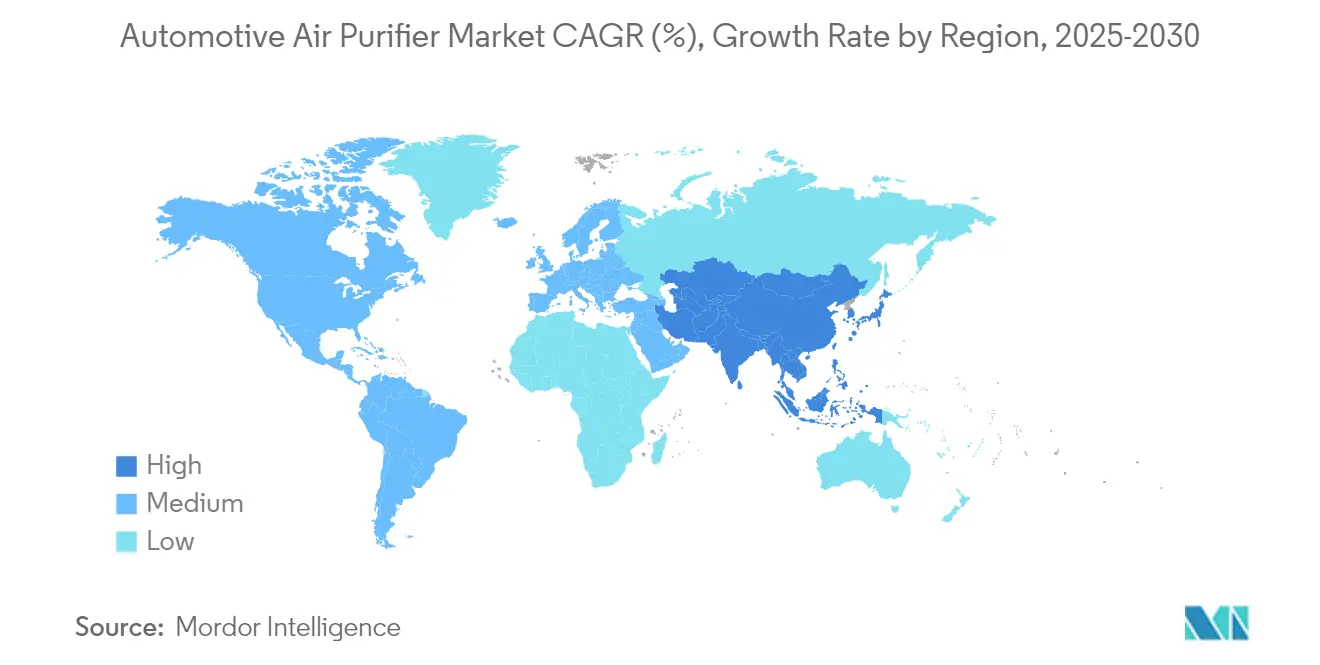
Asia-Pacific heads the regional league table with a 39.04% revenue share in 2025 and will compound at 10.87% CAGR through 2031. China accounts for more than half of regional demand thanks to mandatory in-cabin aldehyde limits for new-energy vehicles and consumer readiness to pay USD 100–200 premiums for filtration upgrades. Japanese and South Korean OEMs contribute patented nano-e and plasma-cluster technologies, giving domestic markets early access and reinforcing export competitiveness.
Europe follows, driven by Euro 7 deadlines that oblige both passenger and commercial vehicles to meet unified interior-air benchmarks by late 2026 . German automakers have already committed to dual-stage HEPA-carbon layouts across 80% of new launches in the 2025 model year. Southern European countries, where fleet ages average more than 11 years, offer sizable retrofit potential once awareness climbs through public health campaigns.
North America posts a moderate uptake. United States federal regulations focus on tailpipe emissions, yet Californian legislators plan a 2027 rulemaking agenda for cabin air-quality disclosure stickers, which could mirror tire-pressure-monitoring mandates in their market-catalyst effect. Elsewhere, the Middle East, Africa, and South America remain nascent, but rapid urbanization of Lagos, Cairo, São Paulo, and Riyadh creates high-pollution corridors. Once free-trade zones simplify filter imports, local assemblers are likely to adopt cost-optimized HEPA cartridges originally engineered for Asian mass-market models, fostering long-run convergence.
Regulatory Landscape
Regulation is tightening around vehicle emissions, and in key markets it is increasingly tied to vehicle interior air quality management and cabin filtration performance. In the European Union, Euro 7 was adopted in 2024, and its application has been further clarified through a Commission Implementing Regulation adopted in July 2025 that specifies procedures and test methodologies. A Commission Delegated Regulation adopted in March 2026 updates technical requirements for environmental performance and emissions compliance across vehicle categories, reinforcing the need for robust monitoring and validated performance claims for in-cabin systems.
In China, MIIT implemented QC/T 998-2023 in July 2024 to update the cabin air filter standard that replaces the prior 2015 version, raising the compliance baseline for filter suppliers selling into OEM and service markets. Globally, harmonization efforts continue through bodies and standards used by OEM engineering teams, including UNECE WP.29 workstreams on vehicle interior air quality (VIAQ) and ISO methods used for VOC and pollutant measurement in vehicle cabins. These standards shape test documentation, validation workflows, and procurement requirements even where no single mandatory global protocol exists.
Value Chain Analysis
The value chain starts with upstream material suppliers for nonwovens, including melt-blown and nanofiber media, activated carbon, additives and coatings with antimicrobial claims, UV-LED and sensor components, and plastics for housings and duct interfaces. Tier suppliers then convert media into filter elements and purification modules, including HEPA, carbon, hybrid, and UV-LED add-ons, and validate performance using established methods such as ISO/TS 11155-1 and DIN 71460-1 for cabin particulate filtration testing. They also align product claims to relevant lab frameworks, for example ISO 18184 and ISO 20743 when antiviral or antibacterial performance is marketed.
OEMs and tier-ones integrate these modules into HVAC architectures for factory-fit systems, while independent brands package portable or retrofit formats for retail and installer channels. Downstream, distribution splits between OEM sourcing (platform programs and long-term supply) and aftermarket replacement (cataloging, fitment accuracy, and service intervals), supported by industry bodies such as the Auto Care Association Filter Manufacturers Community that coordinates technical and catalog practices. Recent commercial linkages show how branding and technology partnerships are used to accelerate pull-through in replacement cycles, for example Premium Guard Inc. announcing a licensing partnership with Procter & Gamble in December 2025 to launch Febreze Cabin Air Filters using PUREFLOW technology for retail rollout in early 2026. OEM-facing systems are also incorporating specialized active filtration technologies, such as CabinAir solutions used in Advanced Air Cleaner systems for Volvo Cars and Polestar, which pushes suppliers to document repeatable performance and durability under automotive duty cycles.
Competitive Landscape
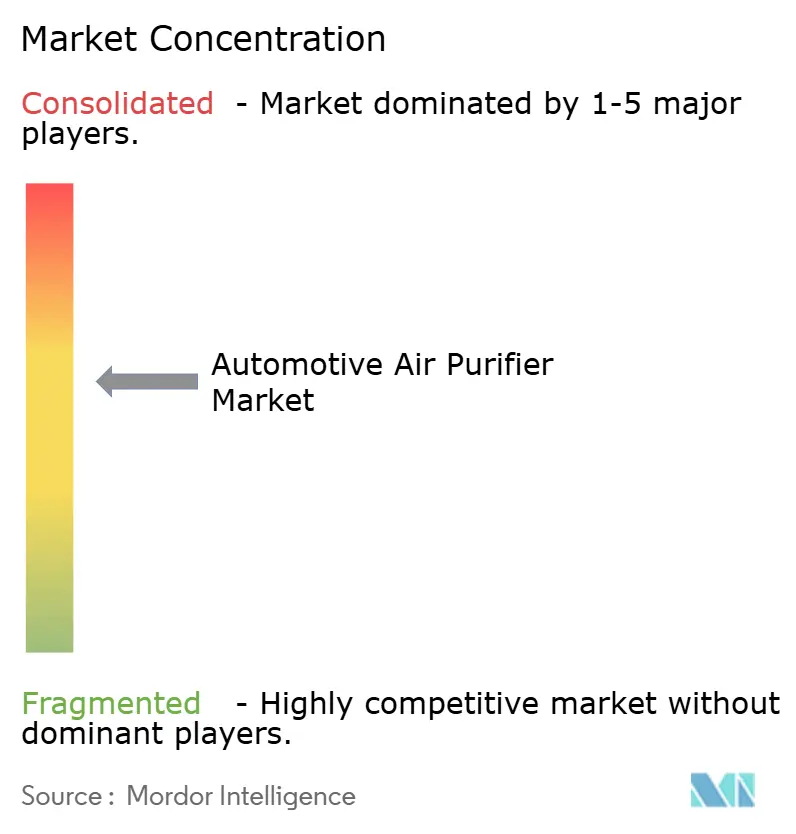
The automotive air purifier market shows moderate fragmentation. The top five suppliers- Panasonic, 3M, MANN+HUMMEL, Denso, and Bosch, collectively hold dominant share of OEM revenue, leveraging wide product catalogs and global manufacturing footprints. Panasonic’s nanoe X ion-radical generator, now standard on six Lexus nameplates, locks in multi-year cartridge pull-through because only authorized filters maintain design performance. 3M exploits its filtration material heritage to co-develop thin-profile microfibers that fit tight EV dashboards, while MANN+HUMMEL cross-sells new nanofiber blanks to both heavy-duty trucks and passenger vehicles.
Disruptive entrants chase niche performance attributes. UV-LED diode specialists partner with tier-ones to create ultra-compact reactor chambers capable of 99.9% viral deactivation in under five minutes. Sensor start-ups supply AI modules that fuse particulate, gas, and odor measurements, triggering variable fan speeds that cut energy consumption by up to 20%. Tesla’s patent for ride-hailing auto-sanitization shows how software platforms can orchestrate deep-clean cycles between passengers, pointing to a recurring-service business model beyond traditional filter sales.
Strategic activity underscores rising stakes. In August 2024, MANN+HUMMEL unveiled a nanofiber cabin filter that extends service life by 30% and claimed first-to-market status for sub-200 micron thickness. Denso invested in a Chinese melt-blown plant to localize HEPA media, insulating itself from commodity price swings. Bosch launched a cloud-based filter-change predictor integrated with its telematics control unit, securing recurring revenue via subscription alerts sent to vehicle owners.
Automotive Air Purifier Industry Leaders
-
Honeywell International Inc.
-
Panasonic Corporation
-
Denso Corporation
-
3M
-
MANN+HUMMEL
- *Disclaimer: Major Players sorted in no particular order
Market Opportunities and Future Outlook
A near-term whitespace area sits at the intersection of regulation-driven validation and consumer-facing health claims. Suppliers that can industrialize multi-stage filtration while keeping pressure drop and noise within OEM targets have room to gain share in both factory-fit and replacement cycles. Euro 7 adoption and the follow-on EU implementing and delegated acts (2025 and 2026) are pushing procurement teams toward clearer test procedures and on-board monitoring concepts, which increases demand for integrated modules that combine filtration media with sensing, diagnostics, and service-life prediction rather than stand-alone filter elements.
Technology and channel expansion is also becoming more visible in aftermarket premiumization and active sanitization R&D. In January 2026, DENSO Aftermarket launched the ClearAir+ premium cabin air filter line in Europe with a five-layer design including activated carbon and antiviral or antibacterial positioning, pointing to higher-spec replacement demand beyond basic pollen filters. On the OEM innovation side, Hyundai Motor and Kia unveiled Plasma Care UVC in June 2026, a Far-UVC (200 to 230 nm) in-vehicle sanitization concept aimed at reducing microorganisms and odors. That development expands the design space for hybrid systems that pair HEPA and carbon filtration with UV-based stages, while using established lab-test frameworks such as ISO 18184 and ISO 20743 for performance communication.
Recent Industry Developments
- June 2026: Hyundai Motor and Kia unveiled Plasma Care UVC, an in-vehicle sanitization concept using Far-UVC light (200 to 230 nm) to reduce microorganisms and odors. The announcement highlights active purification architectures that complement particulate and gas filtration rather than relying only on filter media. It also raises engineering focus on validating sanitization performance while managing safety and in-cabin integration constraints.
- January 2026: DENSO Aftermarket launched the ClearAir+ premium cabin air filter line for Europe, featuring a five-layer construction that includes activated carbon and targets allergens, bacteria, and viruses. The launch reinforces aftermarket premiumization, with replacement filters positioned as health and hygiene upgrades instead of routine maintenance items. It also supports higher value per unit for suppliers that can scale multi-layer media consistently across vehicle applications.
- June 2024: MANN+HUMMEL expanded availability of its FreciousPlus cabin air filter featuring nanofiber technology to the automotive aftermarket, initially covering specific BMW 5 Series and 7 Series models. Wider aftermarket access to nanofiber media brings OEM-grade filtration concepts into replacement cycles and strengthens pull-through demand for higher-efficiency filters. The move also increases competitive pressure on conventional cabin filter offerings that do not address fine particle capture to the same level.
Research Methodology Framework and Report Scope
Market Definition and Coverage
For this study, the market covers air purification units and systems used inside vehicle cabins to reduce dust, odors, smoke, allergens, and harmful gases, sold through OEM fitment and aftermarket channels across passenger cars and commercial vehicles.
Scope exclusions: We exclude non-automotive room purifiers and general cabin HVAC parts that do not perform a dedicated air purification function.
Segmentation Overview
- By Vehicle Type
- Passenger Cars
- Light Commercial Vehicles
- Medium and Heavy Commercial Vehicles
- By Technology
- HEPA
- Activated Carbon
- Ionic Filter
- Photo-Catalytic
- Plasma Cluster
- Hybrid/Multistage
- UV-LED Purification
- By Installation Type
- HVAC-Integrated Factory-Fit
- Stand-Alone Plug-in
- Roof-Mounted Cartridge
- Cup-Holder/Portable
- By Sales Channel
- OEM
- Aftermarket
- By Vehicle Propulsion
- Internal Combustion Engine Vehicles
- Hybrid and Plug-in Hybrid Vehicles
- Battery Electric Vehicles
- By Geography
- North America
- United States
- Canada
- Rest of North America
- South America
- Brazil
- Argentina
- Rest of South America
- Europe
- Germany
- United Kingdom
- France
- Italy
- Spain
- Russia
- Rest of Europe
- Asia-Pacific
- China
- Japan
- India
- South Korea
- Australia and New Zealand
- Rest of Asia-Pacific
- Middle East and Africa
- Saudi Arabia
- United Arab Emirates
- Turkey
- South Africa
- Rest of Middle East and Africa
- North America
Data Sources, Market Sizing, and Validation
Desk Research
Desk work starts with mapping the product boundary and demand signals that can be checked independently. We rely on public sources such as the International Organization of Motor Vehicle Manufacturers (OICA) for vehicle production context, U.S. EPA and California Air Resources Board materials for in-vehicle air quality and emissions related direction, and European Commission updates that explain upcoming standards that can push cabin filtration upgrades. For Asia, policy and standards notes from agencies in China and India are reviewed to understand the timing of stricter emission and air quality requirements.
To connect demand to sales, we also review company annual reports, investor presentations, and product documentation that describes purifier technologies like HEPA, activated carbon, and ionization. Import and export trade statistics and customs classifications are used as a sense check where product mapping is feasible, and patent databases help confirm what technology themes are actively being developed for in-cabin use. Where available, paid subscriptions are used only to speed up company financial checks and to cross-check trade shipment level movements. These desk research sources are illustrative, and many other public documents were also used for validation and clarification during the work.
Primary Interviews and Surveys
Primary inputs were collected through expert interviews and structured surveys with OEM facing teams, aftermarket channel participants, and component suppliers that work on in-cabin air treatment. Since adoption patterns differ by region and vehicle type, we used inputs from Americas, EMEA, and APAC to pressure test pricing, feature mix, and the OEM versus aftermarket split before finalizing the model.
Distribution of primary research fieldwork respondents
| Company type | Respondent position | Region |
|---|---|---|
| Top tier: 39% | CXOs: 13% | APAC: 45% |
| Mid tier: 45% | Functional/Unit leaders: 38% | EMEA: 30% |
| Smaller Players: 16% | Managers: 49% | Americas: 25% |
Market-Sizing & Forecasting
Sizing begins with a top-down demand pool build that links vehicle parc and production by region with likely fitment and replacement behavior for cabin air purification. The model then applies adoption rates for OEM installation and aftermarket purchases, followed by average selling price bands that reflect technology choices such as HEPA, activated carbon, and ionic filters.
To keep totals realistic, the outputs are corroborated with selective bottom-up approximations, including sampled ASP times volume checks from channel discussions and supplier revenue split indications. These are then used to adjust outlier assumptions. Key inputs we track include passenger car versus commercial vehicle mix, OEM versus aftermarket share, penetration of multi-stage purification setups, replacement cycle expectations for consumables where relevant, and regional policy timing that can change feature content inside cabins.
Forecasts are built using scenario analysis supported by a light multivariate regression layer, where vehicle production outlook, urban air quality concerns, and technology premiumization act as core drivers. When gaps appear in country-level pricing or penetration, proxies are used from similar vehicle segments and re-checked with interview feedback before being rolled into the regional totals.
Data Validation & Update Cycle
Validation is done through multiple passes so that unusual jumps are explained before numbers are published. We compare the modeled totals with independent indicators like vehicle production trends, pricing movement seen in the aftermarket, and the expected pace of OEM feature additions, and then we look for breakpoints by region and sales channel.
If the model creates a sharp variance against these signals, assumptions are revisited and, when needed, respondents are re-contacted to confirm what changed and why. An internal review step is completed before sign-off, and reports are refreshed annually, with interim updates added when material events occur such as regulation changes or sudden pricing shifts. Before delivery, a final check is run so the client receives the most current view.
Mordor Intelligence's Automotive Air Purifier Market Estimate Compared With Other Published Estimates
Published market numbers for automotive air purifiers often vary because the scope lines are drawn differently and the pricing logic is not always consistent across channels. Differences also show up when one estimate uses production based demand signals, while another leans more on shipment narratives without fully checking fitment rates and replacement behavior.
By tracking OEM fitment assumptions, channel level ASP bands, and annual refresh checks, Mordor Intelligence keeps the total tied to HEPA, activated carbon, and ionic filter purifier revenue sold through OEM and aftermarket routes, instead of mixing in adjacent cabin HVAC hardware or unrelated consumer air purifiers.
Benchmark comparison
| Source | Market Size | Gaps in Research Methodology |
|---|---|---|
| Mordor Intelligence | USD 2.33 B (2026) | |
| Industry Publisher A | USD 2.59 B (2026) | Uses a narrower forecast window and tends to apply a flatter ASP curve, which can lift the current-year value when premium technology share is assumed higher than what channel checks support. |
| Press Release B | USD 2.20 B (2025) | Often reports an earlier base year and a broad product definition that may not clearly separate purifier revenue from general cabin filtration components, and currency timing can also shift the reported USD value. |
The table shows that the spread is mostly explained by base-year choice, what is counted as an in-cabin purifier, and how OEM versus aftermarket pricing is treated. When scope and the price-volume logic are kept consistent, the resulting market size is easier to trace back to clear inputs and to repeat during updates.
Key Questions Answered in the Report
What is the current size of the automotive air purifier market?
The market stands at USD 2.33 billion in 2026 and is forecast to reach USD 3.78 billion by 2031, reflecting a 10.11% CAGR over 2026-2031.
Which region shows the strongest growth for automotive cabin purifiers?
Asia-Pacific leads, holding 39.04% of 2025 revenue and projected to grow at an 10.87% CAGR through 2031 due to megacity pollution concerns and high EV production.
Why are UV-LED systems gaining attention over traditional HEPA filters?
UV-LED modules inactivate pathogens without consumable filter changes and are projected to expand at a 11.94% CAGR, the fastest among all technologies.
How do Euro 7 and China VI-B rules specifically influence automaker purchasing decisions for cabin-air purifiers?
Euro 7 (effective November 2026) and China VI-B (active since July 2023) set binding interior-air contaminant limits, making high-efficiency filtration a compliance item rather than an optional feature, which in turn guarantees baseline demand for purifier modules on every new vehicle sold in those regions.