
Auto Dimming Mirror Market Size and Share
Market Overview
| Study Period | 2019 - 2031 |
|---|---|
| Market Size (2026) | USD 2.19 Billion |
| Market Size (2031) | USD 2.78 Billion |
| Growth Rate (2026 - 2031) | 4.89 % |
| Fastest Growing Market | Asia Pacific |
| Largest Market | Asia Pacific |
| Market Concentration | Medium |
Major Players
*Disclaimer: Major Players sorted in no particular order Image © Mordor Intelligence. Reuse requires attribution under CC BY 4.0. |
|
Auto Dimming Mirror Market Analysis by Mordor Intelligence
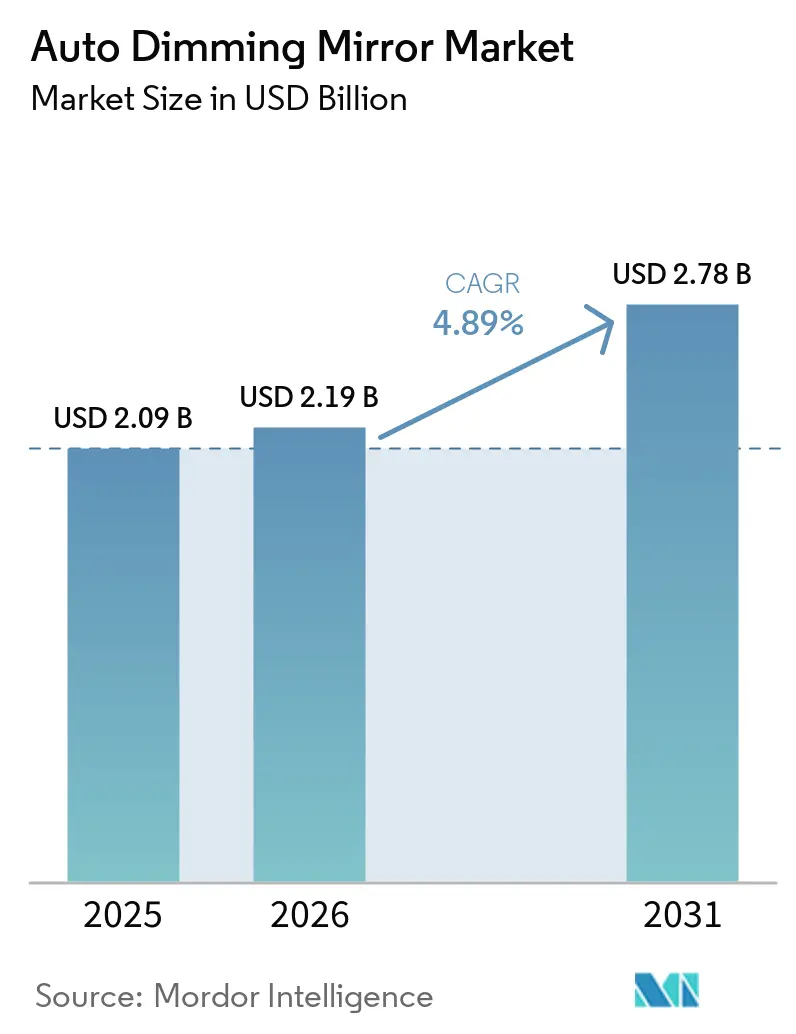
The auto dimming mirror market size was valued at USD 2.09 billion in 2025 and is expected to grow from USD 2.19 billion in 2026 to reach USD 2.78 billion by 2031 at 4.89% CAGR over 2026-2031. The market is moving beyond a feature limited to high-end vehicles as manufacturers add glare control to more mid-range vehicle programs and broader option packages. Demand also reflects the broader adoption of connected-vehicle functions, driver monitoring, and electronic safety features within mirror assemblies. Electric vehicle development supports interest in smaller exterior mirror designs and digital viewing systems where these solutions meet vehicle approval requirements. Competition is increasingly based on software, camera integration, manufacturing reliability, engineering support, and the ability to serve vehicle programs across regions.
Key Report Takeaways
- By product type, electrochromic mirrors held 68.98% of the Auto Dimming Mirror market share in 2025, while adaptive mirrors are forecasted to record the highest CAGR of 5.95% through 2031.
- By functionality, connected auto-dimming mirrors accounted for 64.48% of category revenue in 2025 and are forecasted to post a CAGR of 5.12% during 2026-2031.
- By technology, automatic dimming accounted for 71.95% of category revenue in 2025 and is forecasted to record the highest CAGR of 6.79% through 2031.
- By application, inside rear-view mirrors held 62.56% of category revenue in 2025, while outside rear-view mirrors are forecasted to record the highest CAGR of 7.54% through 2031.
- By vehicle type, passenger vehicles accounted for 74.15% of category revenue in 2025 and are forecasted to record the highest CAGR of 6.19% through 2031.
- By propulsion type, internal combustion engine vehicles held 77.84% of the category's revenue share in 2025, while battery electric vehicles are forecast to record the highest CAGR of 8.34% through 2031.
- By distribution channel, OEM sales held 82.87% of the share of category revenue in 2025, while the aftermarket is forecasted to record the highest CAGR of 7.21% through 2031.
- By geography, Asia-Pacific dominated the auto dimming mirror market, with a 40.51% share in 2025, and is expected to continue with the fastest growth of 5.38% CAGR during the forecast period (2026-2031).
Note: Market size and forecast figures in this report are generated using Mordor Intelligence’s proprietary estimation framework, updated with the latest available data and insights as of January 2026.
Market Trends and Insights
Drivers Impact Analysis of Auto Dimming Mirror Market*
| Driver | (~) % Impact on CAGR Forecast | Geographic Relevance | Impact Timeline |
|---|---|---|---|
| OEM Fitment Race in Mid-Segment Cars | +1.2% | Asia-Pacific (China, India), North America | Medium term (2–4 years) |
| Rising Vehicle Production and EV Boom | +1.1% | Asia-Pacific core, spill-over to MEA | Medium term (2–4 years) |
| ADAS Feature Integration | +0.9% | North America & Europe, spill-over to APAC | Long term (≥ 4 years) |
| Stricter Glare-Safety Regulations | +0.7% | Global (UNECE markets), China, India | Short term (≤ 2 years) |
| Regulatory Green Light for Digital Mirror Systems | +0.4% | Europe, Japan, South Korea | Medium term (2–4 years) |
| Aerodynamic Drag Reduction in EVs | +0.3% | Europe, North America, China | Long term (≥ 4 years) |
| Source: Mordor Intelligence | |||
OEM Fitment Race in Mid-Segment Cars
Auto-dimming mirrors are entering vehicle lines that previously used conventional mirrors, especially in mid-segment passenger vehicles. China, India, and other Asia-Pacific production centers remain important as vehicle output and feature content rise. The auto-dimming mirror market benefits when automakers offer the function as a factory option, though suppliers must meet local validation, cost, delivery, and quality requirements. Factory-installed systems are changing supplier selection. Automakers require mirror assemblies to align with vehicle electrical architecture, wiring, software, safety needs, and service plans. This favors suppliers that can support full production cycles and manage engineering changes. However, cost-sensitive programs may retain manual mirrors in some trims, keeping affordability central to market growth.
Rising Vehicle Production in APAC and EV Boom
Electric vehicle manufacturers closely evaluate exterior components because aerodynamic drag affects energy use, driving range, and vehicle efficiency. Side mirror shape and placement support interest in compact designs and camera-based alternatives. This strengthens the engineering case for rethinking exterior mirror architecture in long-range electric vehicles and related platforms. Mirror producers may need new materials, sensors, heating elements, software, and camera integration, though not every electric vehicle will adopt camera-only systems or remove conventional exterior mirrors. The auto dimming mirror market will benefit where advanced mirror assemblies retain auto-dimming capability, but it will face pressure when camera-monitor systems replace exterior electrochromic modules.
Integration with ADAS/Connected-Car Features
Mirror assemblies are taking on a larger role as vehicles add cameras, displays, sensors, and driver monitoring functions. These features can give drivers the needed information without a separate display. Magna reported a driver and occupant monitoring program award from a European vehicle manufacturer during 2026, showing continued interest in behind-the-glass camera systems[1]"MAGNA AWARDED DRIVER AND OCCUPANT MONITORING SYSTEM PROGRAM WITH EUROPEAN OEM," Magna International, magna.com. Higher electronic content, including display mirrors, is helping suppliers differentiate beyond dimming while adding requirements for software integration, data handling, thermal performance, validation, and long-term support. Connected mirrors can raise assembly value but add procurement checks around network reliability and cybersecurity. Non-connected products remain relevant for fleets, commercial vehicles, and replacement demand where simpler designs are preferred.
Stricter Glare-Safety Regulations
Glare reduction remains the core purpose of auto-dimming mirrors and continues to support demand. Vehicle manufacturers use these systems to improve rearward visibility in low-light conditions, while regulations and vehicle assessment programs increase attention to glare control and related safety functions. Rules permitting camera-monitor systems also enable digital alternatives to physical exterior mirrors, creating demand for new designs and reshaping conventional exterior electrochromic supply chains. Digital mirror approval changes manufacturers' product decisions. These systems support styling, aerodynamics, and driver visibility but require cameras, screens, software, heating, cleaning, and poor-weather visibility measures.
Restraints Impact Analysis of Auto Dimming Mirror Market*
| Restraint | (~) % Impact on CAGR Forecast | Geographic Relevance | Impact Timeline |
|---|---|---|---|
| High BOM Cost | −0.9% | Global, most acute in APAC entry-level cars | Short term (≤ 2 years) |
| Growing Camera-only Mirror Replacement | −0.8% | EU heavy trucks, global spillover | Long term (≥ 4 years) |
| Price Sensitivity in Entry-Level Vehicles | −0.6% | APAC and South America | Medium term (2-4 years) |
| Electrochromic Glass Supply Bottlenecks | −0.4% | Global fabs, APAC hubs | Short term (≤ 2 years) |
| Source: Mordor Intelligence | |||
High BOM Cost vs. Traditional Mirrors
Auto-dimming mirrors cost more than traditional mirrors because they require electrochromic glass, sensors, electronics, and vehicle-specific integration. Automakers find this cost harder to absorb in entry-level vehicles, where component budgets remain tight. As a result, they may restrict the feature to higher trims when it does not fit the target vehicle price. Cost pressure can also push suppliers to favor proven designs over advanced systems. These factors can slow broader adoption, especially in price-sensitive vehicle markets.
Growing Adoption of Camera-Only Mirror Replacements
Camera-monitor systems can replace exterior mirrors in vehicle programs where regulations allow their use and buyers accept digital rearward views. This trend directly challenges suppliers that depend on sales of conventional exterior electrochromic mirrors. These systems support aerodynamic designs and integrate rearward visibility with digital displays, but they require cameras, screens, software, heating, and reliable performance in poor weather. Conventional mirrors remain appealing because drivers know them, service teams can repair them more easily, and vehicle markets widely accept them.
*Our forecasts treat driver/restraint impacts as directional, not additive. The impact forecasts reflect baseline growth, mix effects, and variable interactions.
Auto Dimming Mirror Market Segment Analysis
By Product Type:
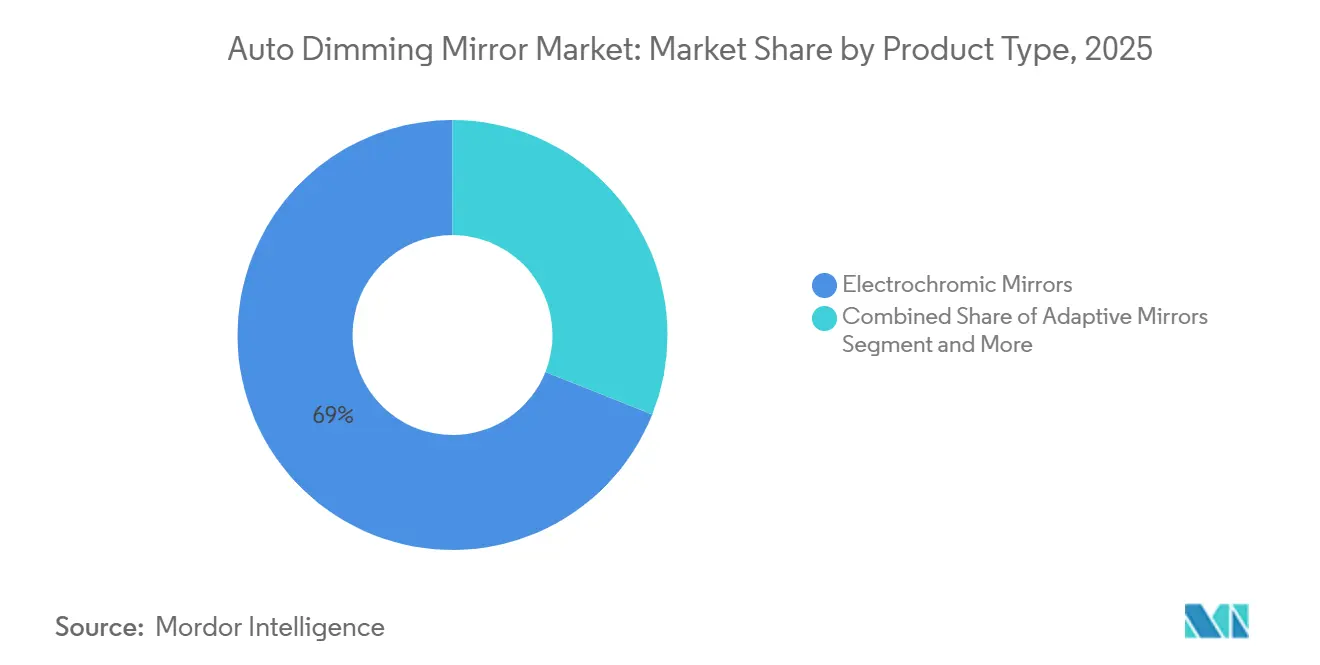
Electrochromic Mirrors Remain the Main Technology BaseElectrochromic mirrors held 68.98% share in 2025, while adaptive mirrors are expected to grow at a 5.95% CAGR through 2031. Electrochromic products remain central because they provide a proven way to reduce reflected glare during routine nighttime driving. Their established use on factory-installed vehicle programs supports continued demand and gives automakers a familiar component choice. Manufacturers understand the validation requirements for these products and can integrate them with existing mirror designs and vehicle controls. This familiarity supports their position across passenger vehicles, selected commercial applications, and multiple vehicle price categories.
Adaptive mirrors are gaining attention because they can combine dimming with additional sensing, control, or connected functions in a single assembly. These products may adjust more precisely to changing light conditions than basic designs and support a wider set of vehicle features. They can also fit with broader vehicle plans for camera integration and software-based functions that are becoming more common. Product developers need to ensure that the added capability does not make the mirror difficult to manufacture, diagnose, or service. Cost remains an important consideration when adaptive systems are offered on mid-range vehicles with tighter component budgets.


By Functionality:
Connected Systems Support Higher-Content Vehicle ProgramsConnected auto-dimming mirrors accounted for 64.48% of category revenue in 2025, and are forecasted to grow at a 5.12% CAGR. Their role has expanded as vehicle manufacturers bring more functions into electronically managed vehicle architectures and centralized control systems. Connectivity can support display features, camera functions, and data exchange within a vehicle system when the design requires it. It can also help a manufacturer offer different mirror functions across vehicle trims without changing the fundamental mirror location. The installed base of connected vehicles gives these mirrors a clear role in newer passenger vehicle programs that use digital interfaces. Their use remains tied to the availability of supporting electrical, software, and cybersecurity architecture within each vehicle platform.
Non-connected mirrors continue to serve customers who prefer a simpler product with fewer electronic dependencies. Fleets, commercial operators, and replacement buyers may place more value on durability, predictable operation, and straightforward maintenance. These mirrors can provide glare reduction without the additional requirements of network integration or software updates. This makes them suitable where connected-vehicle infrastructure is less developed, unavailable, or unnecessary for the buyer. Suppliers can maintain both product lines because their customers have different operating needs, service models, and purchasing priorities.
By Technology:
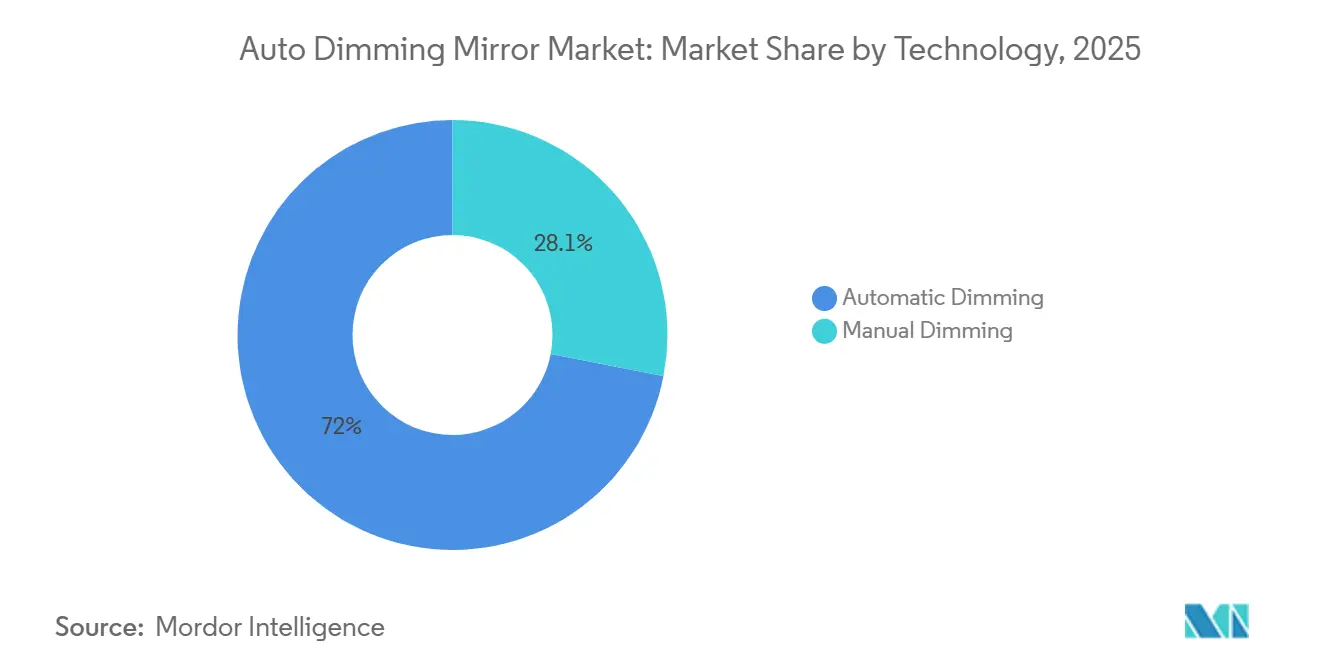
Automatic Dimming Leads the Technology MixAutomatic dimming accounted for 71.95% of category revenue in 2025 and is forecasted to grow at a 6.79% CAGR through 2031. The technology responds to changes in rearward light without requiring a driver to change the mirror setting during a journey. This direct benefit makes it suitable for vehicles that emphasize nighttime comfort, visibility, and reduced driver distraction. Manufacturers can use automatic systems across several trim levels when the cost is acceptable and the vehicle architecture supports them. The technology also has a clear fit with electronic mirror assemblies that already contain sensors, controls, cameras, or display functions.
Manual dimming systems remain relevant where vehicle cost is the main purchasing factor and feature content must be controlled. They offer a familiar mechanical solution and require fewer electronic components, sensors, and integration steps than automatic alternatives. This can make them useful on entry-level commercial vehicles and lower-priced passenger models sold in price-sensitive regions. However, manual operation provides less convenience when driving conditions change frequently, or rearward glare appears unexpectedly. Vehicle manufacturers may gradually reduce their use as automatic systems become easier to integrate and more widely accepted.
By Application:
Interior Mirrors Retain Their Central RoleInside rear-view mirrors held 62.56% of the share of category revenue in 2025, while outside rear-view mirrors are forecasted to grow at a 7.54% CAGR through 2031. Interior mirrors remain important because they fall within the driver’s normal line of sight and provide a clear use case for reducing glare. They can also house displays, cameras, garage-control functions, and driver-monitoring equipment without altering the vehicle’s exterior design. This allows suppliers to add functions while keeping the mirror in a familiar position for drivers and vehicle service teams. The result is a stable role for interior products across a wide range of passenger vehicle programs and feature packages.
Outside mirrors are attracting more development work because they affect vehicle visibility, styling, aerodynamic performance, and exterior electronic design. Manufacturers are considering auto-dimming, camera support, and digital viewing functions for exterior systems across different vehicle types. These changes can raise the technical requirements for housings, wiring, heating, sealing, image quality, and resistance to weather. Exterior mirror development also depends on regulations and customer comfort with digital displays that replace a conventional reflected view. Suppliers that can meet these requirements may gain access to more advanced vehicle programs and long-term development work.
By Vehicle Type:
Passenger Vehicles Provide the Broadest Demand BasePassenger vehicles held 74.15% of the share of category revenue in 2025 and are forecasted to grow at a 6.19% CAGR through 2031. Their leading position reflects the large number of vehicle models where drivers value comfort, convenience, and glare reduction. Mid-range models are particularly important because feature adoption in this group can create substantial unit demand across several vehicle lines. Passenger vehicle manufacturers also use mirror functions to support broader safety and convenience packages that help differentiate trims. This makes the category important for both basic electrochromic mirrors and higher-content display products with added electronics.
Light commercial vehicles can also provide demand where fleet operators prioritize driver visibility, safer nighttime operation, and reliable component performance. Their purchasing decisions often consider durability, maintenance needs, replacement availability, and total operating cost over a vehicle’s working life. Medium and heavy commercial vehicles can have different mirror layouts and qualification requirements from passenger cars and light trucks. These differences may limit the direct transfer of a passenger vehicle design to a commercial application without further engineering. Suppliers need to adjust housings, electronic interfaces, mounting points, and service plans for each vehicle class.
By Propulsion Type:
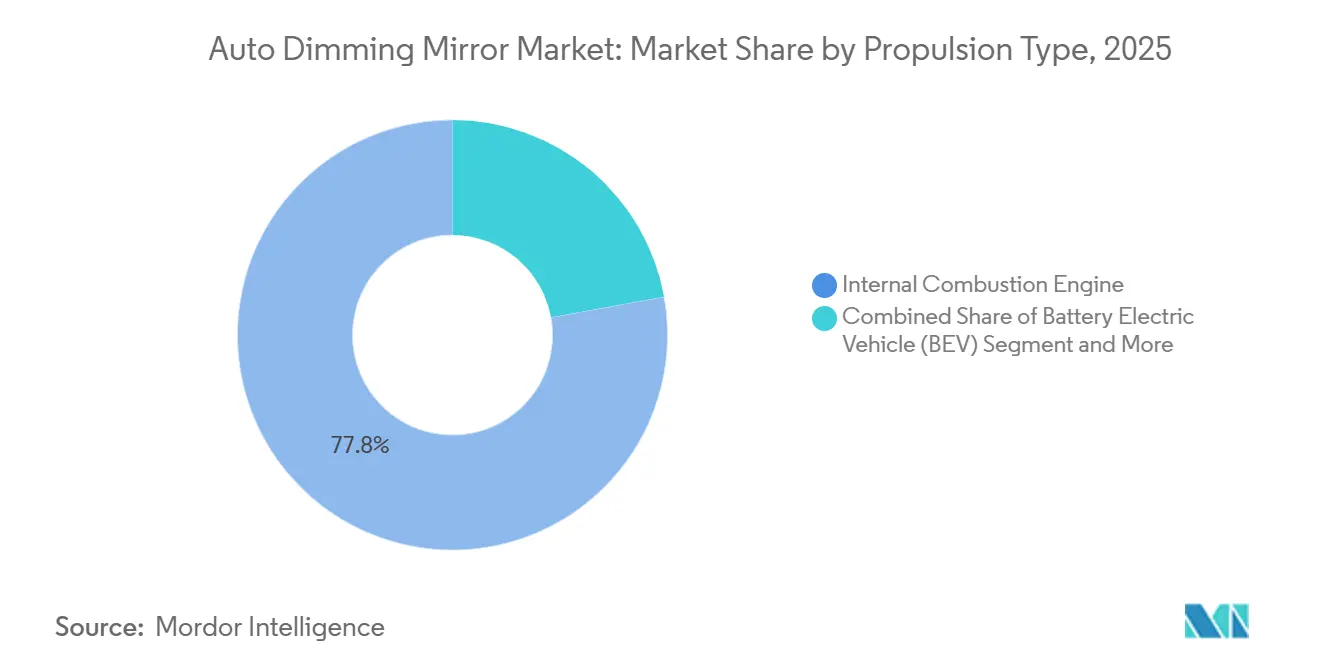
Electric Vehicles Create the Fastest-Growing OpportunityInternal combustion engine vehicles held 77.84% of the share of category revenue in 2025, while battery electric vehicles are forecast to grow at an 8.34% CAGR through 2031. Internal combustion vehicles remain important because they account for a large installed and production base across major vehicle regions. They also support the continued demand for standard interior auto-dimming mirrors and selected exterior products within established model ranges. Manufacturers can add mirror features to refresh a model without redesigning the full vehicle architecture or changing the powertrain. This gives established powertrain platforms a continued role in mirror demand even as electric vehicle production expands.
Battery electric vehicles can favor advanced mirror systems because vehicle designers consider energy use and aerodynamic performance closely. They also often use digital interfaces that can support displays, cameras, warning functions, and other electronically controlled features. Some manufacturers may use advanced mirrors to position an electric vehicle as a higher-content product within its model range. Hybrid and plug-in hybrid vehicles can share feature packages with electric and combustion variants when they use common platforms. Fuel-cell vehicles are likely to follow similar design directions where they use advanced electronic architectures and shared vehicle components.
By Distribution Channel:
OEM Programs Remain the Primary Route to MarketOEM sales held 82.87% of the share of category revenue in 2025, while the aftermarket is forecast to grow at a 7.21% CAGR through 2031. Factory installation remains dominant because mirror systems must match a vehicle’s electrical interfaces, sensors, physical design, and program specifications. Automakers also need components that meet their program-specific validation standards for quality, performance, environmental exposure, and durability. This favors suppliers that can work with vehicle manufacturers from early design work through series production and service support. OEM business can provide long production runs but also requires careful quality control, delivery planning, and engineering coordination.
The aftermarket provides suppliers with a separate channel to customers who want to upgrade or replace a mirror after vehicle purchase. This channel can appeal to specialty retailers, enthusiasts, fleets, and owners of older vehicles that did not receive factory fitment. Products must be simple enough to install and must work reliably without the same level of factory integration and vehicle-specific calibration. The opportunity is stronger for products with clear comfort, visibility, or styling benefits that customers can understand before purchase. It may also allow suppliers to test branded products outside their established OEM relationships and traditional vehicle programs.
Geography Analysis
APAC Auto Dimming Mirror Market
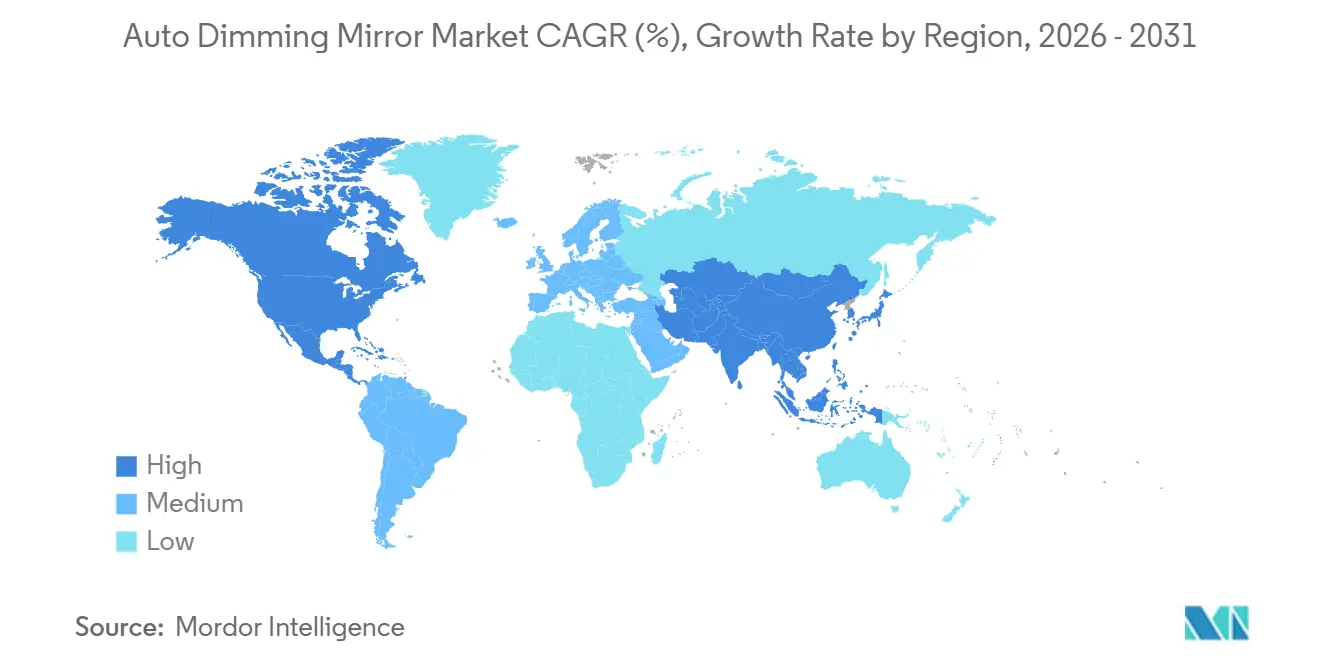
Asia-Pacific accounted for 40.51% of category revenue in 2025 and is forecasted to grow at a 5.38% CAGR through 2031. The region combines major vehicle production centers with growing demand for features that improve nighttime driving and add visible value to passenger vehicles. China and Japan remain important for vehicle technology, supplier capability, and the development of electronic mirror functions for domestic and export programs. India offers another route to growth as manufacturers expand vehicle production and introduce more features to mid-range models that are becoming more competitive. Regional suppliers must satisfy local qualification requirements and compete with established global companies on cost, reliability, and engineering support.
North America Auto Dimming Mirror Market
The auto dimming mirror market in North America is significant for higher-content mirrors used in passenger vehicles and premium feature packages. Vehicle manufacturers in the region continue to show interest in display mirrors, camera integration, and connected functions that can be incorporated into established vehicle platforms. The aftermarket also provides a route for upgrades and specialty products where buyers seek added comfort, rearward visibility, or a more distinctive vehicle interior. Mexico matters as a vehicle assembly location for models supplied across the region and as part of broader supplier production networks. Canada adds demand through its connection to North American vehicle production, distribution, service activity, and cross-border supply relationships.
EMEA and South America Auto Dimming Mirror Market
Europe is developing at a slower pace because suppliers face both regulatory changes and pressure to adopt digital exterior viewing systems. The closure of FLABEG Automotive Germany in 2025 altered the European supply situation for electrochromic mirror products[2]European Foundation for the Improvement of Living and Working Conditions, “Flabeg Automotive | Bankruptcy | Factsheet 202438,” Eurofound, eurofound.europa.eu.. European manufacturers are also considering camera-monitor systems for premium and electric vehicle programs that require a more integrated electronic design. South America and the Middle East and Africa remain smaller opportunities, but fleet safety needs and localized vehicle production can support selective demand. These regions require products that balance glare reduction with affordability, availability of replacement parts, and practical service support.

Competitive Landscape
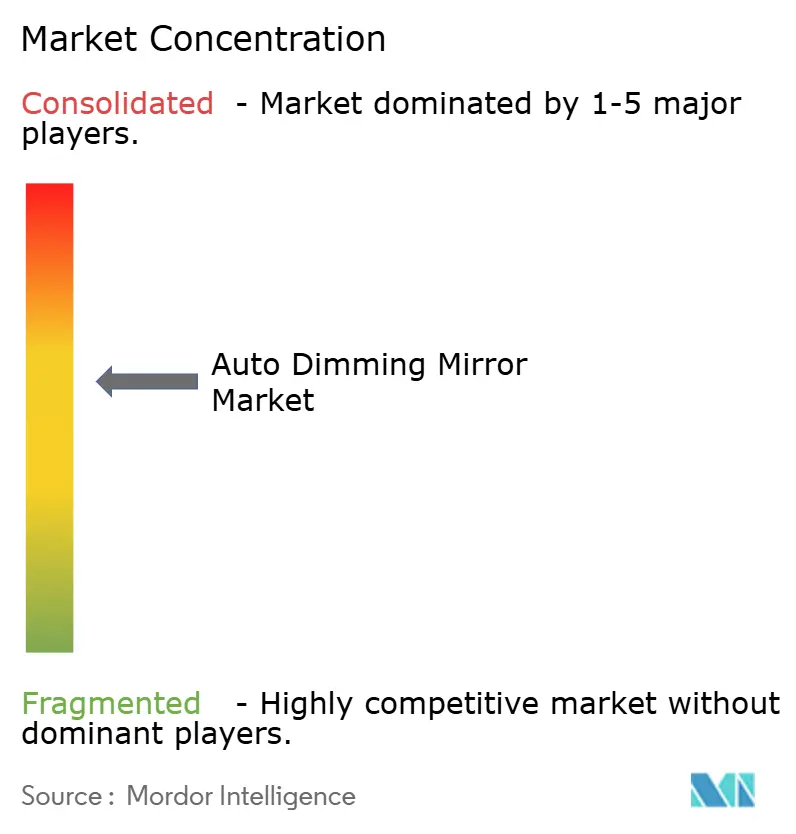
The auto dimming mirror market has a moderate concentration because the leading suppliers hold established positions, but no single supplier is described as having an unassailable position. Gentex, Magna, Samvardhana Motherson Reflectec, Ficosa, and Murakami are among the companies active in the category. Their competition includes manufacturing scale, product quality, customer relationships, electronic integration, and the ability to meet program schedules across several regions. Established suppliers benefit from existing relationships with vehicle manufacturers and experience with electrochromic technology, validation requirements, and high-volume production. Newer entrants can still compete by offering camera, display, or software capabilities that complement mirror hardware and address emerging vehicle needs.
Gentex is expanding its focus on products with added electronic content, including display and driver-assistance-related functions. The company also introduced the GNTX-R carbon-fiber automatic-dimming mirror for specialty retail availability, extending its approach into the aftermarket. Magna has continued to develop driver and occupant monitoring systems that can be integrated behind the mirror glass. These moves show that suppliers in the Auto Dimming Mirror Market are seeking product positions that go beyond a basic dimming mirror and address broader vehicle system requirements. They also indicate that manufacturers value systems that can support several vehicle functions in one location while preserving visibility and a familiar driver interface. The competitive advantage may shift toward firms that can combine optical performance, electronics, software support, and reliable automotive production.
Samvardhana Motherson Reflectec and Ficosa are positioned around mirror systems and adjacent digital technologies that can support changing vehicle designs. Murakami remains relevant through its established automotive mirror experience and technical development work for vehicle manufacturers. Companies must decide whether to strengthen conventional electrochromic capacity, develop camera-monitor systems, or serve both product paths as customer needs change. The European supply gap has created an opening for suppliers that can meet local automaker needs with dependable production, engineering support, and established quality procedures. However, new capacity alone will not guarantee success because vehicle manufacturers require long-term reliability, delivery assurance, and the ability to support model changes.
Auto Dimming Mirror Industry Leaders
-
Gentex Corporation
-
Magna International Inc.
-
Samvardhana Motherson Reflectec
-
Ficosa International S.A.
-
Murakami Corporation
- *Disclaimer: Major Players sorted in no particular order
Auto Dimming Mirror Market Companies Covered in this Report
- Gentex Corporation
- Magna International Inc.
- Samvardhana Motherson Reflectec
- Ficosa International S.A.
- Murakami Corporation
- Tokai Rika Co., Ltd.
- SL Corporation
- Global Media Industry Group Co., Ltd. (GERMID)
- Hyundai Mobis Co., Ltd.
- Metagal Industria E-commercio Ltd.
- Hella GmbH & Co. KGaA
- Fuyao Glass Industry Group Co., Ltd.
- Ambilight Inc.
- Continental AG
- Robert Bosch GmbH

Recent Industry Developments in Auto Dimming Mirror Market
- July 2026: Gentex Corp announced a Morocco production site by 2028 for Europe’s vehicle market, with government-backed local production of electrochromic mirrors and advanced electronic modules.
- June 2026: Ruihua Optoelectronics topped out its Gaochun, Nanjing, production base on June 12 for AI-driven liquid crystal dimming glass, targeting 700,000 sets annually from Q4 2026.
- March 2026: Gentex Corporation revealed plans to introduce a transparent, dimmable sun visor in 2027 to reduce blinding glare from oncoming headlights.


Global Auto Dimming Mirror Market Report Scope
The Auto Dimming Mirror Market is segmented by product type, functionality, technology, application, vehicle type, propulsion type, distribution channel, and geography.
By Product Type, the market is segmented into Electrochromic Mirrors, Adaptive Mirrors, and Manual Dimming Mirrors. By Functionality, the market is segmented into Connected Auto-Dimming Mirrors and Non-Connected Auto-Dimming Mirrors. By Technology, the market is segmented into Automatic Dimming and Manual Dimming. By Application, the market is segmented into Inside Rear-View Mirror and Outside Rear-View Mirror. By Vehicle Type, the market is segmented into Passenger Vehicles, Light Commercial Vehicles, and Medium and Heavy Commercial Vehicles. By Propulsion Type, the market is segmented into Internal Combustion Engine, Battery Electric Vehicle (BEV), Hybrid Electric Vehicle (HEV), Plug-In Hybrid Electric Vehicle (PHEV), and Fuel Cell Electric Vehicle (FCEV). By Distribution Channel, the market is segmented into OEM and Aftermarket. By Geography, the market is segmented into North America (United States, Canada, and Rest of North America), South America (Brazil, Argentina, and Rest of South America), Europe (United Kingdom, Germany, Spain, Italy, France, Russia, and Rest of Europe), Asia-Pacific (India, China, Japan, South Korea, and Rest of Asia-Pacific), and Middle East and Africa (United Arab Emirates, Saudi Arabia, Turkey, Egypt, South Africa, and Rest of Middle East and Africa).
Market forecasts are provided in terms of Value (USD) and Volume (Units).
| Electrochromic Mirrors |
| Adaptive Mirrors |
| Manual Dimming Mirrors |
| Connected Auto-Dimming Mirrors |
| Non-Connected Auto-Dimming Mirrors |
| Automatic Dimming |
| Manual Dimming |
| Inside Rear-View Mirror |
| Outside Rear-View Mirror |
| Passenger Vehicles |
| Light Commercial Vehicles |
| Medium and Heavy Commercial Vehicles |
| Internal Combustion Engine |
| Battery Electric Vehicle (BEV) |
| Hybrid Electric Vehicle (HEV) |
| Plug-In Hybrid Electric Vehicle (PHEV) |
| Fuel Cell Electric Vehicle (FCEV) |
| OEM |
| Aftermarket |
| North America | United States |
| Canada | |
| Rest of North America | |
| South America | Brazil |
| Argentina | |
| Rest of South America | |
| Europe | United Kingdom |
| Germany | |
| Spain | |
| Italy | |
| France | |
| Russia | |
| Rest of Europe | |
| Asia-Pacific | India |
| China | |
| Japan | |
| South Korea | |
| Rest of Asia-Pacific | |
| Middle East and Africa | United Arab Emirates |
| Saudi Arabia | |
| Turkey | |
| Egypt | |
| South Africa | |
| Rest of Middle East and Africa |
| By Product Type | Electrochromic Mirrors | |
| Adaptive Mirrors | ||
| Manual Dimming Mirrors | ||
| By Functionality | Connected Auto-Dimming Mirrors | |
| Non-Connected Auto-Dimming Mirrors | ||
| By Technology | Automatic Dimming | |
| Manual Dimming | ||
| By Application | Inside Rear-View Mirror | |
| Outside Rear-View Mirror | ||
| By Vehicle Type | Passenger Vehicles | |
| Light Commercial Vehicles | ||
| Medium and Heavy Commercial Vehicles | ||
| By Propulsion Type | Internal Combustion Engine | |
| Battery Electric Vehicle (BEV) | ||
| Hybrid Electric Vehicle (HEV) | ||
| Plug-In Hybrid Electric Vehicle (PHEV) | ||
| Fuel Cell Electric Vehicle (FCEV) | ||
| By Distribution Channel | OEM | |
| Aftermarket | ||
| By Geography | North America | United States |
| Canada | ||
| Rest of North America | ||
| South America | Brazil | |
| Argentina | ||
| Rest of South America | ||
| Europe | United Kingdom | |
| Germany | ||
| Spain | ||
| Italy | ||
| France | ||
| Russia | ||
| Rest of Europe | ||
| Asia-Pacific | India | |
| China | ||
| Japan | ||
| South Korea | ||
| Rest of Asia-Pacific | ||
| Middle East and Africa | United Arab Emirates | |
| Saudi Arabia | ||
| Turkey | ||
| Egypt | ||
| South Africa | ||
| Rest of Middle East and Africa | ||


Key Questions Answered in the Report
What is driving demand for auto-dimming mirrors?
Factory fitment on more mid-range vehicles, connected vehicle functions, and the need to reduce glare support demand for auto-dimming mirrors. These factors encourage vehicle manufacturers to treat the mirror as part of a wider safety and convenience package for daily driving across different vehicle price levels.
Which product type leads the auto-dimming mirror category?
Electrochromic mirrors led product-type revenue with 68.98% share in 2025. Their established factory use and proven glare-reduction function support their position across many passenger and commercial vehicle programs around the world.
Which vehicle type creates the largest demand for auto-dimming mirrors?
Passenger vehicles represented the largest vehicle-type segment with 74.15% share in 2025. The broad range of passenger vehicle models allows manufacturers to extend mirror features across several trims, body styles, regions, and customer preferences.
Why are battery electric vehicles important for mirror suppliers?
Battery electric vehicles are the fastest-growing propulsion segment at an 8.34% CAGR through 2031 and can support advanced mirror designs. Their development places greater attention on vehicle efficiency, digital interfaces, feature differentiation, and integrated electronic systems within new model programs.
Page last updated on:


 Your data is secure and never sold or shared.


