
Market Overview
| Study Period | 2020 - 2031 |
|---|---|
| Forecast Data Period | 2026 - 2031 |
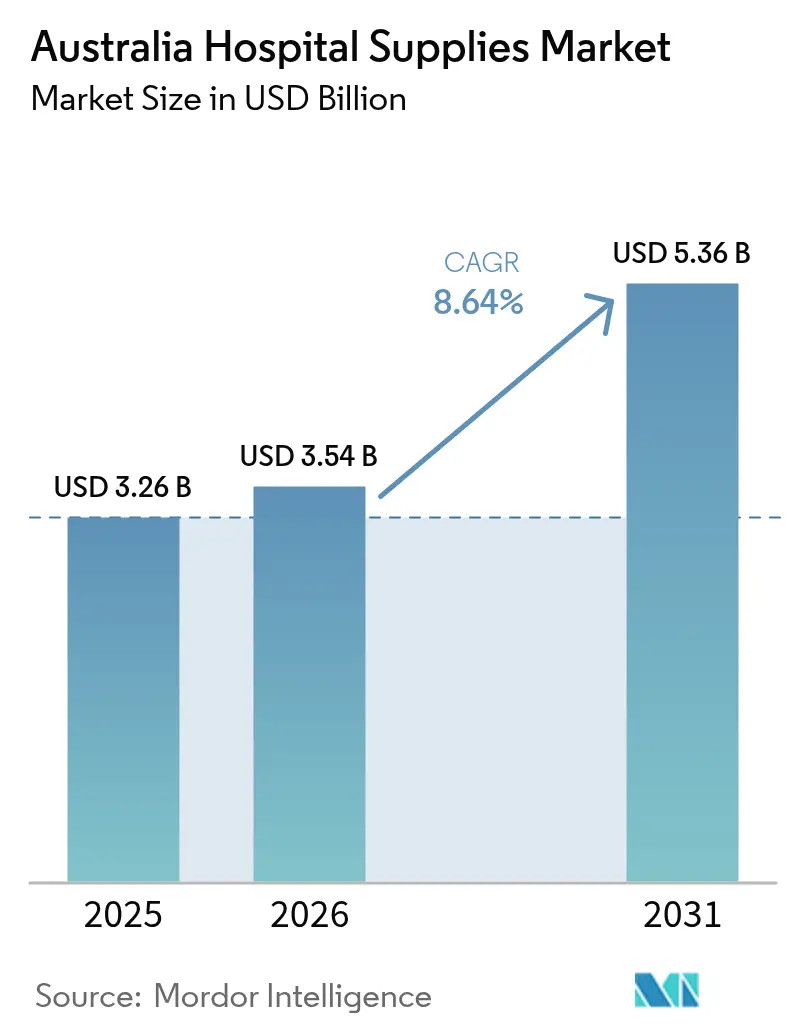
| Base Year Market Size (2025) | USD 3.26 Billion |
| Market Size (2026) | USD 3.54 Billion |
| Market Size (2031) | USD 5.36 Billion |
| Growth Rate (2026 - 2031) | 8.64 % |
| Market Concentration | Medium |
Major Players *Disclaimer: Major Players sorted in no particular order Image © Mordor Intelligence. Reuse requires attribution under CC BY 4.0. | |
Australia Hospital Supplies Market Analysis by Mordor Intelligence
The Australia Hospital Supplies Market size was valued at USD 3.26 billion in 2025 and estimated to grow from USD 3.54 billion in 2026 to reach USD 5.36 billion by 2031, at a CAGR of 8.64% during the forecast period (2026-2031).
Rapid population ageing, surging chronic-disease admissions, and the nationwide pivot toward minimally invasive and day-surgery models are lifting baseline demand across disposables, diagnostic kits, and high-throughput sterilisation devices. Tighter infection-control rules, exemplified by the Therapeutic Goods Administration’s new Unique Device Identification framework, are steering procurement toward traceable, single-use and re-processable products that can demonstrate verifiable quality. Rising state and federal capital outlays for hospital infrastructure are fuelling orders for operating-room equipment and smart monitoring systems, while regional workforce shortages encourage bulk purchases of mobility aids that support faster patient turnover. From a competitive standpoint, global brands with in-house R&D and local servicing capabilities now emphasise value-based contracts that link product performance to measurable reductions in patient complications
Key Report Takeaways
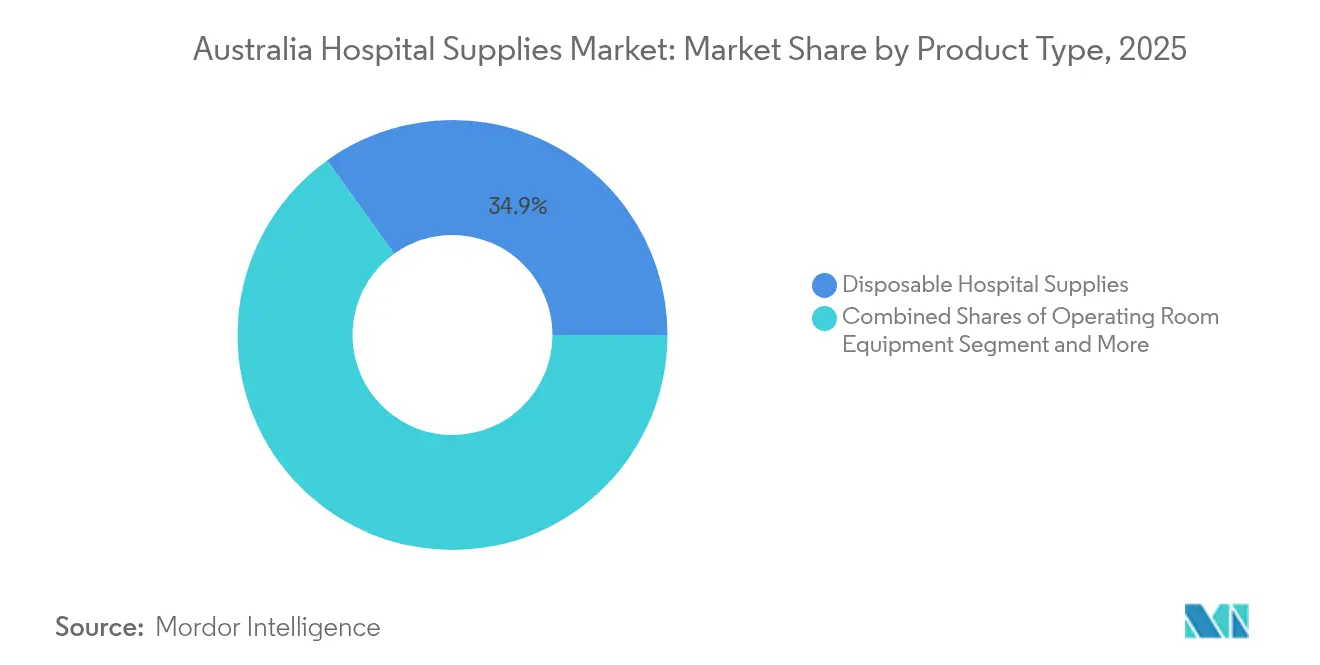
- By product type, disposables led with 34.92% of Australia's hospital supplies market share in 2025; sterilisation & disinfectant equipment is set to rise at a 9.34% CAGR through 2031, outpacing all other categories.
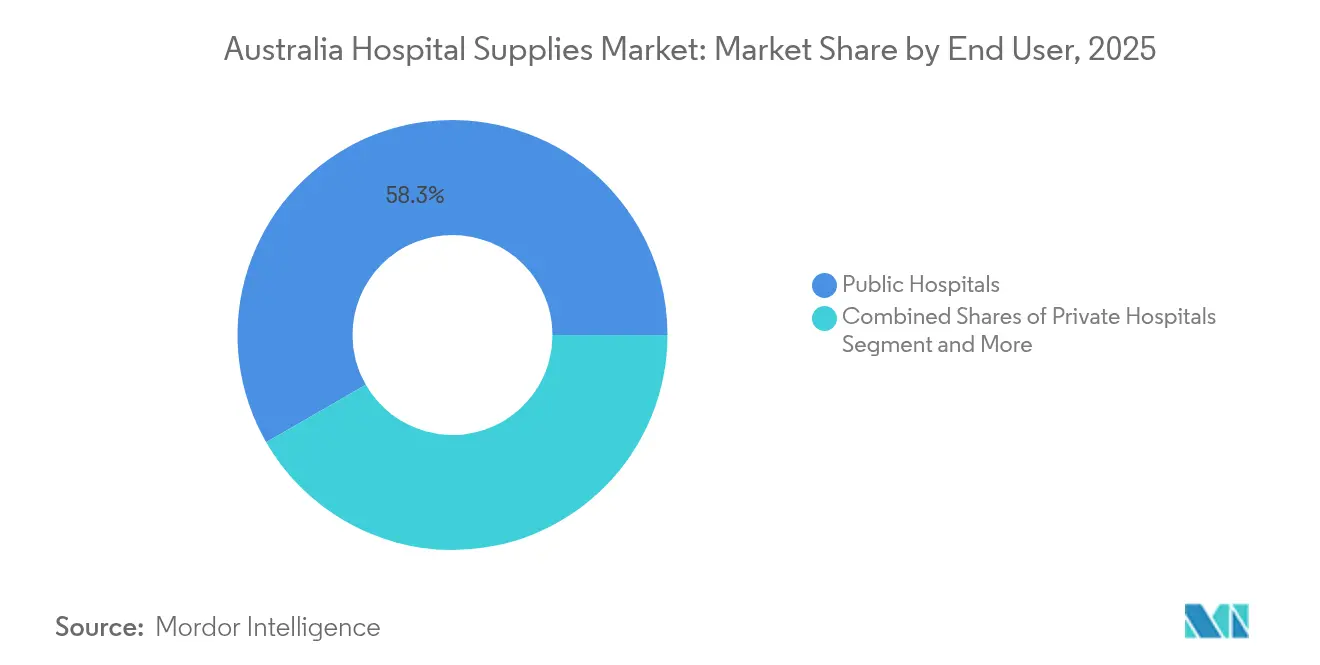
- By end user, public hospitals held 58.31% of Australia's hospital supplies market share in 2025, while private hospitals and day-surgery centres recorded the highest projected CAGR at 9.92% to 2031.
Note: Market size and forecast figures in this report are generated using Mordor Intelligence’s proprietary estimation framework, updated with the latest available data and insights as of 2026.
Australia Hospital Supplies Market Trends and Insights
Drivers Impact Analysis*
| Drivers Impact Analysis | (~) % Impact on CAGR Forecast | Geographic Relevance | Impact Timeline |
|---|---|---|---|
| Ageing population & chronic-disease admissions elevating baseline supply demand | +2.10% | National; metro focus | Long term (≥ 4 years) |
| Escalating federal & state healthcare capital expenditure on hospital infrastructure | +1.80% | NSW, Victoria | Medium term (2-4 years) |
| Surge in surgical procedure volumes—particularly minimally-invasive & day-surgeries | +1.50% | Major urban hubs | Medium term (2-4 years) |
| Rising multi-drug-resistant infections driving demand for advanced sterilisation solutions | +1.00% | High-density acute-care centres | Long term (≥ 4 years) |
| Shift to digital patient-monitoring increasing demand for connected examination devices | +1.20% | National | Medium term (2-4 years) |
| Regulatory Compliance Driving Growth | +1.40% | National | Short term (≤ 2 years) |
| Source: Mordor Intelligence | |||
Ageing Population & Rising Chronic-Disease Admissions Elevating Baseline Supply Demand
Emergency-department presentations among Australians aged 65 years and above are forecast to jump 574% by 2050 compared with 2010 levels, sharply increasing utilisation of diagnostic consumables and patient-monitoring kits.[1] Dementia patients are already exhibiting higher rates of hospital-acquired complications, driving sales of specialised pressure-injury dressings, fall-prevention mats, and innovative mobility aids. Unplanned hospitalisations for home-care recipients aged 65+ touch 39.8%, underscoring persistent reliance on acute settings even as community programmes scale. The Australia hospital supplies market, therefore, sees sustained orders for infection-control disposables and advanced wound-care portfolios that lower complication risk. Procurement policies now routinely bundle fall sensors, low-air-loss mattresses, and rapid sepsis-screening strips as integrated safety packages that appeal to overstretched clinical teams.
Escalating Federal & State Healthcare Capital Expenditure on Hospital Infrastructure
The 2024-25 Commonwealth Budget earmarked AUD 20.2 billion (USD 13.2 billion) for hospital expansion and equipment modernisation across priority states.[2] Coupled with co-funding from New South Wales and Victoria, the programme channels fresh demand into surgical robotics, 4K endoscopy towers, and modular CSSD (Central Sterile Services Department) suites. Capital grants stipulate demonstrable lifecycle cost savings, motivating suppliers to offer energy-efficient autoclaves and IoT-enabled asset-tracking tags that align with green-hospital mandates. The Australian hospital supplies market thereby benefits from multi-year framework agreements that lock in baseline volumes and pave the way for incremental upgrades.
Surge in Surgical Procedure Volumes—Particularly Minimally-Invasive & Day-Surgeries
Ambulatory surgery now accounts for more than 90% of cataract procedures and 75% of hernia repairs in Australia, mirroring OECD peers.[3] Shorter inpatient stays pivot inventory toward pre-packed disposable kits, single-use laparoscopic ports, and compact sterilisation trays that fit day-theatre cycles. Philips reports that its LumiGuide system trims procedure times by 37% and eliminates X-ray exposure, spurring hospitals to invest in light-based navigation consumables and disposable sensor arrays. With robotic platforms averaging USD 4.4 million per installation, group purchasing organisations increasingly negotiate bundled consumable contracts to offset capital costs, deepening supplier lock-in across the Australian hospital supplies market.
Rising Multi-Drug-Resistant Infections Driving Demand for Advanced Sterilisation Solutions
Outbreak-linked reports of carbapenem-resistant organisms in tertiary ICUs lead infection-control committees to mandate low-temperature plasma sterilisers, trace-element disinfectant indicators and antimicrobial instrument trays. Vendors pairing smart autoclaves with cloud analytics offer predictive maintenance and audit-ready cycle logs that assist hospitals in meeting AS/NZS 4187 compliance and lowering re-processing failures.
Restraints Impact Analysis*
| Restraint | (~) % Impact on CAGR Forecast | Geographic Relevance | Impact Timeline |
|---|---|---|---|
| Emergence of home care services | -1.20% | National; higher impact in metropolitan areas | Medium term (2-4 years) |
| Stringent Australian regulatory framework for small & mid-size enterprises (SMEs) | -0.90% | National | Short term (≤ 2 years) |
| Sustainability regulations phasing down single-use plastics | -0.70% | National; stronger effect in states with active waste-levy schemes | Medium term (2-4 years) |
| Increasing purchasing power of group procurement organisations compressing margins | -0.60% | National; most pronounced in NSW and Victoria public-hospital clusters | Short term (≤ 2 years) |
| Source: Mordor Intelligence | |||
Emergence of Home-Care Services
Admissions to government-funded home-care programmes climbed 32% between FY 2017-18 and FY 2023-24, reaching 102,000 new placements.[4] The shift siphons low-acuity cases from wards, tempering growth in basic linen packs and non-critical disposables. Yet demand for portable infusion pumps, tele-vital-sign monitors, and negative-pressure wound-therapy dressings climbs as clinicians support patients remotely. Suppliers are redesigning packaging to consumer-friendly formats and forging last-mile logistics partnerships, ensuring the Australian hospital supplies market continues to capture value even as care migrates to homes.
Stringent Australian Regulatory Framework for Small & Mid-Size Enterprises (SMEs)
Compliance with the new Medical Device Vigilance Program obliges manufacturers to maintain post-market incident databases and field-safety corrective action plans. For SMEs with limited quality-management infrastructure, costs rise, narrowing product portfolios, and delaying Australian launches. Hospitals respond by consolidating supplier panels in favour of firms with proven audit readiness. While safety gains are evident, the Australia hospital supplies market faces near-term product-variety constraints until smaller players adapt or pursue partnership strategies.
*Our forecasts treat driver/restraint impacts as directional, not additive. The impact forecasts reflect baseline growth, mix effects, and variable interactions.
Segment Analysis
By Product Type: Disposables Remain Core While Sterilisation Equipment Accelerates
Disposable items, ranging from surgical gloves to isolation gowns, generated the most significant slice of the Australian hospital supplies market size at 34.92% in 2025. High turnover in emergency rooms and rising multi-resistant organisms alert to bulk orders for sterile drapes, sharps containers, and single-use procedure packs. National guidelines that obligation single-patient-use for numerous invasive accessories continue to elevate unit volumes. Suppliers differentiate through hypoallergenic materials and biodegradable polymers that align with hospital sustainability pledges and waste-levy caps. Private procurement groups now insist on end-to-end carbon disclosure, rewarding firms able to quantify lower incineration emissions.
Sterilisation & disinfectant equipment is the fastest-growing line, advancing at a 9.34% CAGR, well ahead of other categories in the Australian hospital supplies market. CSSDs are replacing legacy steam sterilisers with low-temperature hydrogen-peroxide plasma units that safeguard delicate optics and battery-integrated arthroscopy hand-pieces. Smart autoclaves log cycle parameters to cloud dashboards, enabling predictive maintenance and UDI-linked load traceability. Regional facilities—particularly in Queensland’s coastal belt—invest in compact tabletop sterilisers that support outreach clinics. Multinational vendors bundle consumable indicator strips and RFID load tags to lock in recurring revenue, inflating overall Australia hospital supplies market size for sterilisation inputs.
Patient examination devices, including digital stethoscopes and tablet-integrated otoscopes, capture a growing share as point-of-care documentation rises. Mobility aids & transportation equipment benefit from the National Disability Insurance Scheme’s support for functional-impairment aids, expanding beyond walkers to powered transfer-hoists that reduce manual-handling injuries. The “other types” cluster features smart hospital beds with integrated sensors and antimicrobial privacy curtains, signalling escalating sophistication in infection-control infrastructure throughout the Australia hospital supplies industry.

By End User: Public Hospitals Dominate While Private Facilities Gain Momentum
Public hospitals controlled 58.31% of total demand in 2025, due to owning roughly two-thirds of the nation’s bed stock and 90% of emergency presentations. Procurement authorities increasingly pursue collective-tender models, awarding multiyear contracts that cover disposables, diagnostic reagents, and CSSD consumables. State supply agencies embed social-procurement clauses, prompting suppliers to source raw materials domestically where feasible. Cost containment imperatives deepen interest in closed-loop inventory systems that trace SKU consumption at the procedural level, feeding data into activity-based funding calculations.
Private hospitals and day-surgery centres are the fastest-growing customer bloc, set to post a 9.92% CAGR through 2031. Despite pandemic-era profit compression, admissions returned to 4% growth in FY 2024, propelled by elective-surgery wait-list transfers and insurer incentives. Facilities highlight shorter waiting times and hotel-style amenities, spurring investment in premium disposables such as latex-free gown lines and colour-coded trocar kits. Agile procurement privileges suppliers able to guarantee next-day replenishment and loan sets for complex orthopaedics, helping them carve a strategic niche within the Australia hospital supplies market. Specialist clinics & rehabilitation centres widen usage of robotics-assisted physiotherapy aids, drawing on an ageing cohort seeking post-acute functional recovery programmes.
Geography Analysis
New South Wales (NSW) and Victoria house the most significant clusters of tertiary and quaternary hospitals, together accounting for a significant share of the overall Australian hospital supplies market demand in 2024. Integrated-care pilots in Western Sydney and Melbourne’s north emphasise cross-setting supply visibility, encouraging suppliers to provide interoperable tracking software alongside disposables. High urban density concentrates outbreaks of multi-drug-resistant organisms, fostering above-average purchase rates for single-use laryngoscopes and bactericidal surface wipes.
Regional and remote jurisdictions face logistical challenges that drive higher per-capita procurement of inventory with long shelf lives. Northern Territory and parts of Western Australia stockpile heat-stable intravenous solutions and solar-powered vaccine refrigerators, mitigating long lead times caused by seasonal road closures. Government freight subsidies under the Remote Area Health Corps programme ensure parity of supply, reinforcing demand predictability in these zones of the Australia hospital supplies market. Telehealth expansion, combining satellite broadband and clinician-guided home-diagnostic kits, further diversifies supply patterns, moving certain SKUs directly to patients rather than regional hospitals.
Queensland records the fastest growth, aided by accelerated population gains along the Sunshine Coast and large capital programmes such as the AUD 1.8 billion (USD 1.2 billion) expansion of Sunshine Coast University Hospital. Surge capacity planning prioritises modular theatre builds equipped with quick-connect gas outlets and portable CSSD pods. Western Australia invests in high-acuity emergency departments to service mining districts, boosting acquisition of rapid blood-gas analysers and rugged patient-transport stretchers. Across all states, the Medical Science Co-Investment Plan and supply-chain diversification policies cultivate domestic manufacturing for sterile packs and complex electrosurgical tips, tempering exposure to freight volatility and enhancing the long-term resilience of the Australia hospital supplies market.
Regulatory Landscape
Hospital supplies sold into Australia fall under the Therapeutic Goods Act 1989 and the Therapeutic Goods (Medical Devices) Regulations 2002, administered by the Therapeutic Goods Administration (TGA). Devices must meet the Essential Principles for safety and performance, and (with limited exemptions) be included in the Australian Register of Therapeutic Goods (ARTG) before legal supply. This creates a compliance-led pathway for disposables, sterilisation systems, and patient examination devices used in hospitals.
Traceability adds a specific compliance milestone for manufacturers and sponsors. Unique Device Identification (UDI) requirements mandate compliance for devices supplied from 1 July 2026, supported by TGA guidance on UDI timeframes and processes. Post-market oversight continues as well, with the TGA able to take compliance action, including ARTG cancellations, where safety or performance is not maintained. Alongside federal regulation, state procurement governance (for example, NSW Health policy directives and WA Country Health Service medical equipment procurement policy) also ties market access to value-for-money and framework-aligned purchasing, so eligibility depends on both ARTG status and state tender requirements.
Competitive Landscape
Competitive Landscape
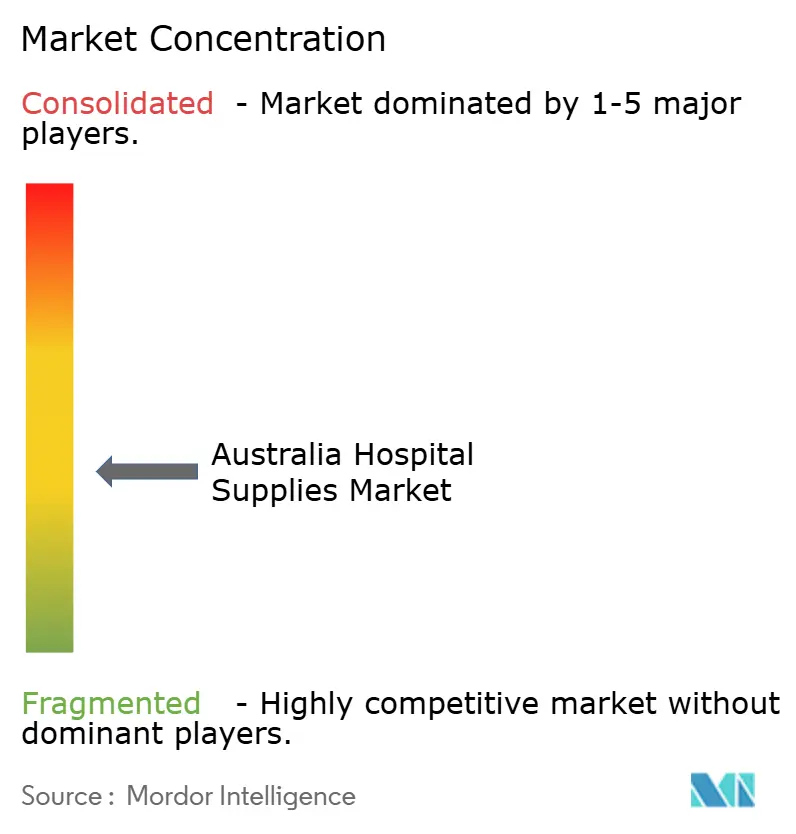
Competition is moderate, with the top five vendors controlling an estimated major share of Australia's hospital supplies market revenue. Global conglomerates such as Johnson & Johnson, Medtronic, and Philips leverage multi-country regulatory dossiers and scale efficiencies, yet maintain local technical support centres to comply with TGA serviceability requirements. Local manufacturers specialise in niche sterilisation accessories and custom procedure packs, often partnering with hospital-based clinicians to co-design new product iterations that meet Australian Standard AS/NZS 4187 compliance cycles.
Strategic alliances between suppliers and health-service networks foster shared-savings models under which vendors provide capital equipment at reduced upfront cost in return for long-term consumables commitments. Johnson & Johnson’s 2025 acquisition of Shockwave Medical brings intravascular lithotripsy devices into its cardiovascular bundle, expanding opportunities for hospital-wide platform contracts that consolidate purchasing lines. Philips uses data from pilot deployments of LumiGuide to negotiate outcome-based agreements that link payment levels to measured reductions in radiation exposure and procedure time, differentiating within the technology-intensive segments of the Australia hospital supplies market.
White-space growth areas include biodegradable instrument packaging, closed-loop sterilisation indicators that integrate with electronic medical records, and smart beds capable of automated micro-turning to prevent pressure injuries. Vendors that invest in locally relevant R&D such as humidity-resistant wraps tailored for tropical northern regions gain preferential access to state procurement panels across all tiers of the Australia hospital supplies industry.
Australia Hospital Supplies Industry Leaders
-
B. Braun Melsungen AG
-
Becton, Dickinson and Company
-
Cardinal Health Inc.
-
ResMed Inc.
-
3M
- *Disclaimer: Major Players sorted in no particular order
Market Opportunities and Future Outlook
The UDI transition creates a near-term opening for suppliers that can deliver hospital-ready traceability, including UDI-compliant labeling, data management, and integration into sterile processing and inventory workflows. With mandated UDI compliance from 1 July 2026 and updated TGA guidance in March 2026 for high-risk devices, hospitals and procurement agencies have a clearer basis to prioritize traceable, audit-ready portfolios. Vendors that bundle UDI-enabled consumables (labels, RFID/2D scanning compatibility) with sterilisation cycle logging and asset tracking can fit this tightening procurement focus.
Hospital infrastructure programs provide a parallel demand anchor for operating-room equipment, monitoring devices, and high-throughput sterile services tied to new builds and redevelopments. In 2026, New South Wales progressed major projects including construction commencement on the AUD 2 billion Bankstown Hospital, additional investment for the Liverpool Health and Academic Precinct, unveiled designs for the AUD 630 million Fairfield Hospital Redevelopment, and major medical equipment deliveries for Nepean Hospital Stage 2, while the Australian Capital Territory committed AUD 1.5 billion to the North Canberra Hospital Redevelopment. These programs expand tender volumes for procedure packs, theatre consumables, sterilisation and disinfection equipment, and connected examination devices, and they tend to favor suppliers with local service coverage and the operational discipline to support multi-year panel contracts within state-based procurement systems.
Recent Industry Developments
- May 2026: BD introduced the Elyra Thulium Fiber Laser (TFL) system for urology and kidney stone management in Australia. The rollout expands the company's operating-room and procedural device footprint and can pull through recurring demand for associated hospital consumables used in endoscopic and urology workflows.
- May 2025: Cardinal Health opened a Sustainable Technologies medical device remanufacturing facility in Beresfield, Newcastle, its first such site outside the United States. The facility strengthens local capability for reprocessing eligible devices, supporting hospital cost and waste-reduction goals while adding a domestic supply-chain node for regulated device turnaround.
- July 2024: The South Australian Government advanced the AUD 117 million expansion of Modbury Hospital, including a new cancer center and additional mental health beds. The project increases near-term procurement requirements for ward and theatre supplies, and it supports multi-category purchasing across disposables, mobility and transport equipment, and sterilisation infrastructure as capacity is added.
Research Methodology Framework and Report Scope
Market Definition and Coverage
This market is defined as the value of hospital supplies sold for use inside Australian public and private hospitals and day surgery centers, covering routine examination items, operating room tools, mobility aids, sterilization and disinfection systems, and single use consumables.
Scope exclusions: We exclude pharmaceuticals, heavy imaging capital equipment, home care only consumables, and standalone aftermarket service contracts.
Segmentation Overview
- By Product Type
- Patient Examination Devices
- Operating Room Equipment
- Mobility Aids and Transportation Equipment
- Sterilisation and Disinfectant Equipment
- Disposable Hospital Supplies
- Other Types
- By End User
- Public Hospitals
- Private Hospitals and Day-Surgery Centres
- Specialist Clinics and Rehabilitation Centres
Data Sources, Market Sizing, and Validation
Desk Research
Desk research starts by mapping the demand context for hospital activity and procurement in Australia, then linking it to the supply side that can be observed in public datasets. We typically review sources such as the Australian Institute of Health and Welfare for hospital activity signals, the Australian Bureau of Statistics for population and price indices, and the Department of Health and Aged Care for system settings that affect procurement cycles.
To anchor the traded component of supplies and check directionality, we review import and export statistics from the Australian Border Force and UN Comtrade, followed by published procurement notices and tender award summaries where available. We also use company annual reports, investor presentations, and reputable press releases to understand category mixes, product launches, and pricing narratives. In a few cases, paid subscriptions for company financials and news intelligence, shipment level trade visibility, and patent lookups are used to cross check what is harder to see in public sources. These desk research sources are illustrative only, and many other public and paid references were also used for data collection, validation, and clarification.
Primary Interviews and Surveys
Primary work focuses on confirming what hospitals are actually buying and how demand shifts across consumables and durable supplies during budget cycles. We speak with hospital procurement and clinical operations contacts, distributors, and product managers, and use their input to validate utilization rates, replacement cycles, and realistic price movements.
Because this is an Australia only market, respondents are selected to represent different care settings (large metro hospitals, regional facilities, and day surgery centers) so the assumptions can be corrected before finalizing the model.
Distribution of primary research fieldwork respondents
| Company type | Respondent position |
|---|---|
| Top tier: 26% | CXOs: 15% |
| Mid tier: 55% | Functional/Unit leaders: 25% |
| Smaller Players: 19% | Managers: 60% |
Market-Sizing & Forecasting
For sizing, we state the market as yearly sales into hospitals and day surgery centers, then reconstruct the value pool using a top-down approach anchored on hospital activity indicators and procurement intensity assumptions. Inputs that matter in this market include inpatient and day surgery volumes, bed capacity and occupancy trends, operating room throughput, sterilization loads, and category level usage norms for single use items that scale with procedures.
Those totals are corroborated with selective bottom-up approximations, where sampled supplier and distributor revenue mixes are combined with average selling price bands and estimated volumes to sanity check the top line. When bottom-up visibility is incomplete, gaps are handled by using category proxies tied to procedure counts and by applying conservative share ranges discussed in interviews, then adjusting only when multiple signals align.
Forecasts are built using scenario analysis, where procedure growth, public versus private activity shifts, and price inflation are varied within realistic bounds. The final trajectory is selected based on what primary respondents view as most likely for procurement budgets and replacement cycles.
Data Validation & Update Cycle
Validation is done through triangulation across the model output and independent signals, like hospital activity trends, trade movements for supply heavy categories, and reported pricing commentary from the supply chain. Outliers are flagged, checked back to the underlying assumption, and reviewed by another analyst so simple errors do not carry through.
If a variance is large or a key assumption changes, follow up calls are triggered to recheck the input, and then the market math is rerun to confirm the impact. Reports are refreshed annually, and interim updates are made when material events occur, such as policy shifts, major procurement changes, or sharp currency moves. Right before delivery, a final pass is completed so clients receive the most current view available.
Mordor Intelligence's Australia Hospital Supplies Market Size Compared Against Other Published Estimates
It is common to see different market size numbers for hospital supplies because the boundary between supplies, equipment, and broader medical devices is not drawn the same way by every publisher. Year choice also matters, since some estimates use a different base year or convert currencies using different timing, which can move the USD total even if local demand is similar.
In this market, the biggest gap drivers usually come from what is counted as hospital-only demand, and whether large capital items and home-care categories are blended into the total. By tracking hospital-only purchasing signals and refreshing the scope checks each update, Mordor Intelligence keeps the estimate focused on supplies used inside hospitals and day surgery centers, rather than expanding into pharmaceuticals or heavy imaging equipment.
Benchmark comparison
| Source | Market Size | Gaps in Research Methodology |
|---|---|---|
| Mordor Intelligence | USD 3.26 B (2025) | |
| Global Consultancy A | USD 5.00 B (2024) | Uses an earlier base year and appears to apply a broader definition of hospital supplies, which can pull in adjacent medical device and facility categories that are not strictly hospital-only consumption. |
| Industry Publisher B | USD 9.00 B (2031) | Reports a forecast-year total with limited visibility on category boundaries, which can overstate the market if capital equipment or non-hospital channels are included and if price growth is assumed uniformly across products. |
The spread across the table is mainly explained by scope and year alignment, not just growth expectations. When the market boundary is held to hospital and day surgery center usage, and inputs are tied back to procedure and utilization signals, the outcome becomes easier to trace and repeat across updates.
Key Questions Answered in the Report
What is the current size of the Australia hospital supplies market?
The market is valued at USD 3.54 billion in 2026 and is forecast to reach USD 5.36 billion by 2031, growing at an 8.64% CAGR.
Which product category commands the largest market share?
Disposables lead at 34.92% Australia hospital supplies market share, reflecting persistent infection-control priorities.
Why is sterilisation equipment growing so rapidly?
Stricter infection-control guidelines and the need for re-processing delicate minimally invasive instruments are propelling a 9.34% CAGR in this segment.
Which end-user segment is expanding fastest?
Private hospitals and day-surgery centres, supported by shorter waiting times and specialised care, are projected to grow at 9.92% annually through 2031.