
Market Overview
| Study Period | 2020 - 2031 |
|---|---|
| Forecast Data Period | 2026 - 2031 |
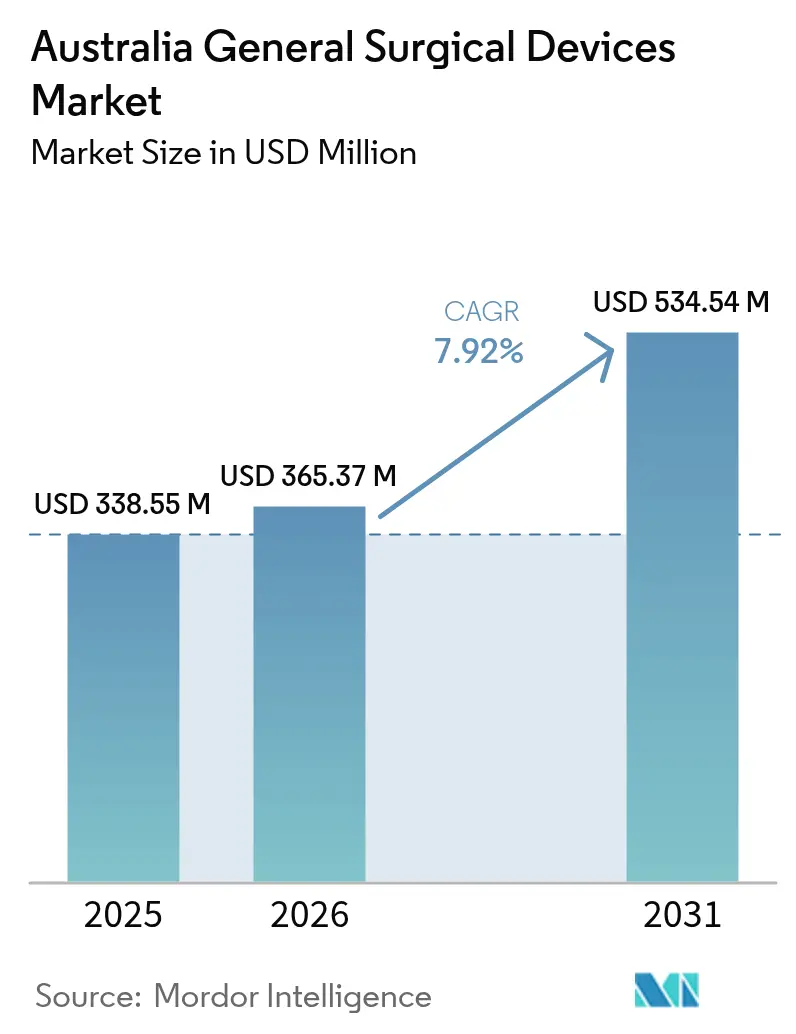
| Base Year Market Size (2025) | USD 338.55 Million |
| Market Size (2026) | USD 365.37 Million |
| Market Size (2031) | USD 534.54 Million |
| Growth Rate (2026 - 2031) | 7.92 % |
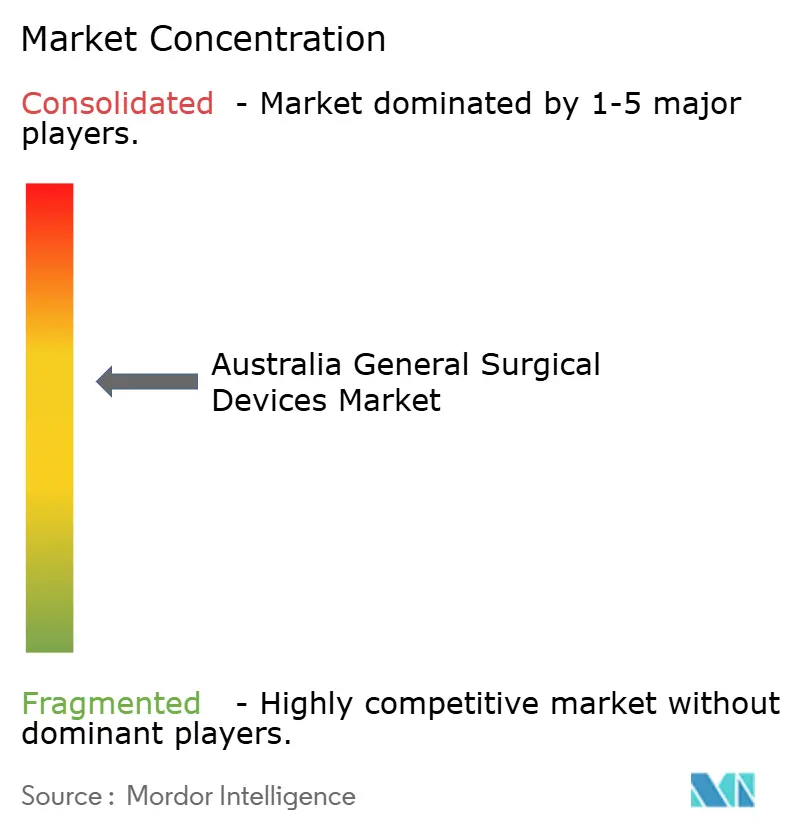
| Market Concentration | Medium |
Major Players *Disclaimer: Major Players sorted in no particular order Image © Mordor Intelligence. Reuse requires attribution under CC BY 4.0. | |
Australia General Surgical Devices Market Analysis by Mordor Intelligence
Australia General Surgical Devices Market size in 2026 is estimated at USD 365.37 million, growing from 2025 value of USD 338.55 million with 2031 projections showing USD 534.54 million, growing at 7.92% CAGR over 2026-2031. Steady procedure growth arises from a population aged 65 and over that will expand by 60% by 2030, amplifying demand for orthopedic, cardiovascular and oncologic interventions. Hospitals are investing in minimally invasive and robotic solutions to shorten recovery times, lower complications and optimise workforce utilisation, while ambulatory surgical centres (ASCs) scale rapidly to ease elective-surgery backlogs. Import-driven supply chains, which cover the majority of devices, expose providers to currency swings and geopolitical risk, yet also keep global innovation pipelines open. Regulatory reforms by the Therapeutic Goods Administration (TGA) add compliance intensity but harmonise local rules with peer markets, encouraging faster adoption of devices already cleared in the United States or Europe.
Key Report Takeaways
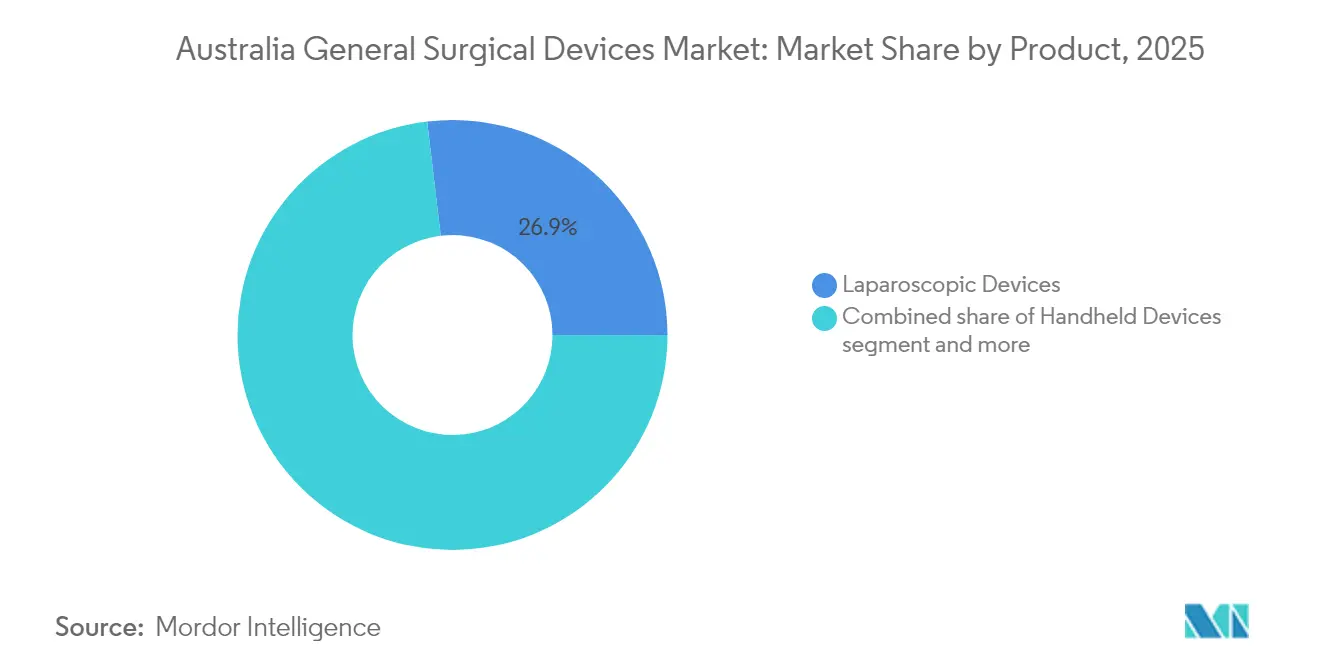
- By product: Laparoscopic devices led with 26.88% of Australia general surgical devices market share in 2025, while robotic and computer-assisted systems record the highest projected CAGR at 9.28% through 2031.
- By procedure approach: Minimally invasive surgery accounted for a dominant 69.76% share of the Australia general surgical devices market size in 2025; the segment is advancing at a 9.31% CAGR to 2031.
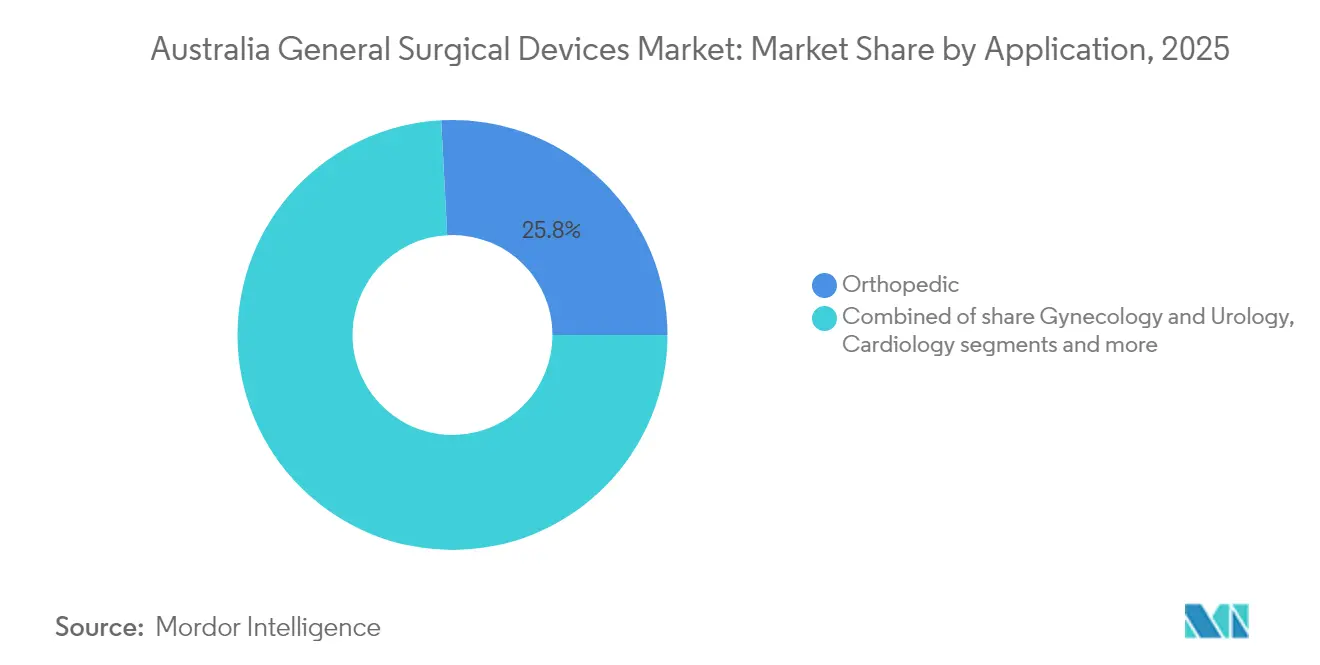
- By application: Orthopedic procedures captured 25.84% of Australia general surgical devices market share in 2025, whereas gynecology and urology applications are projected to expand at 9.95% CAGR between 2026-2031.
- By end user: Hospitals held 71.98% of the Australia general surgical devices market size in 2025 and remain the volume anchor; ASCs show the fastest growth at 10.18% CAGR to 2031.
Note: Market size and forecast figures in this report are generated using Mordor Intelligence’s proprietary estimation framework, updated with the latest available data and insights as of 2026.
Australia General Surgical Devices Market Trends and Insights
Drivers Impact Analysis*
| Driver | (~) % Impact on CAGR Forecast | Geographic Relevance | Impact Timeline |
|---|---|---|---|
| Rising demand for minimally-invasive procedures | +2.1% | National, with concentration in major metropolitan areas | Medium term (2-4 years) |
| Growing incidence of trauma & accident cases | +1.3% | National, with higher impact in regional trauma centers | Short term (≤ 2 years) |
| Rapid adoption of advanced energy & stapling platforms | +1.8% | Metropolitan hospitals and specialized surgical centers | Medium term (2-4 years) |
| Aging population fuelling surgical volumes | +2.4% | National, with pronounced impact in outer metropolitan areas | Long term (≥ 4 years) |
| Expansion of same-day surgery centres | +1.7% | Metropolitan and regional centers | Medium term (2-4 years) |
| Shift toward single-use sterile instruments post-COVID | +1.2% | National healthcare facilities | Short term (≤ 2 years) |
| Source: Mordor Intelligence | |||
Rising Demand for Minimally Invasive Procedures
Over the past decade, laparoscopic volumes have risen sharply, mirroring New Zealand data where appendicectomy laparoscopy moved from 83% to 95% of cases. Australian surgeons highlight faster patient recovery and lower complication rates as key benefits, and hospital administrators see reduced bed-days and lower cost per case. Demand translates into sustained orders for trocars, flexible scopes and energy platforms compatible with small-incision techniques. AI-driven image guidance, now under pilot evaluation, promises further gains in intraoperative accuracy. These factors collectively lift utilisation rates of products that enable 1-cm or smaller access ports, consolidating minimally invasive leadership in the Australia general surgical devices market.
Growing Incidence of Trauma & Accident Cases
Outdoor recreation and dispersed road networks contribute to trauma complexity, making specialised surgical airway and haemostasis tools indispensable. Emergency surgical procedures, particularly front-of-neck access interventions, are critical for trauma centers but are infrequent, creating training and equipment challenges.[1] An Alfred Hospital registry found emergency cricothyroidotomy at 0.22% of intubations, underscoring the need for rare but readiness-critical instruments. Direct costs of major trauma average AUD 78,000 per episode, justifying investment in devices that shorten operative time and curb complications. Regional centres favour portable kits with versatile clamps and suction as they must treat time-sensitive injuries without tertiary-hospital infrastructure. Government initiatives to verify trauma systems nationwide are spurring procurement upgrades, amplifying opportunity for suppliers of core general surgery sets.
Rapid Adoption of Advanced Energy & Stapling Platforms
Hospitals increasingly specify ultrasonic and bipolar devices that seal vessels while cutting tissue in a single step. Ethicon’s HARMONIC and ENSEAL families report USD 101 savings per case by shaving minutes off theatre time and reducing length of stay. Electrosurgical innovations, such as the Anovo system, deliver thermal precision comparable to legacy handpieces with reduced lateral thermal spread. Stapler platforms evolving toward robotic compatibility ride the same efficiency wave, supported by 9.2% projected regional CAGR in advanced stapling solutions. Occupational health regulations around surgical smoke extraction also push theatres to adopt integrated energy consoles that pair cutting performance with air filtration.
Aging Population Fuelling Surgical Volumes
Australians aged 65 and above will approach 22% of the national total by 2026, and this cohort consumes six times more health expenditure than younger groups. Joint-replacement backlogs, accentuated during the pandemic, now require 16% annual growth in case throughput to return to pre-COVID trajectories. Older patients with multimorbidity demand instruments accommodating fragile tissue and osteoporotic bone, such as low-profile retractor systems and cementless implant tools. Hospitals respond by allocating more lists to orthopedic and oncologic specialties, fuelling double-digit procurement growth. Device makers that tailor ergonomic handles and torque-controlled drivers to senior anatomy gain competitive advantage in the Australia general surgical devices market.
Restraints Impact Analysis*
| Restraint | (~) % Impact on CAGR Forecast | Geographic Relevance | Impact Timeline |
|---|---|---|---|
| Stringent TGA regulatory approvals | -1.4% | National regulatory compliance requirements | Medium term (2-4 years) |
| Limited reimbursement for several device categories | -0.9% | National, with variations across public and private sectors | Long term (≥ 4 years) |
| High capital cost of advanced surgical systems | -1.1% | Metropolitan hospitals and specialized surgical centers | Medium term (2-4 years) |
| Import-dependence driven supply-chain risks | -0.8% | National, with higher impact on regional healthcare facilities | Short term (≤ 2 years) |
| Source: Mordor Intelligence | |||
Stringent TGA Regulatory Approvals
The TGA’s audit expansion subjects higher-risk devices to detailed dossier reviews, adding six-month delays and compliance costs that can exceed AUD 100,000 per submission. Recent withdrawals of spinal cord stimulators highlight intensified post-market surveillance, prompting manufacturers to set aside greater contingency budgets. Smaller innovators struggle to fund clinical data generation and may prioritise other Asia-Pacific countries with lighter regulation. While mutual recognition of European CE marks eases some burden, requirements for local representative offices and ongoing performance reports still lengthen commercialisation timelines.
Limited Reimbursement for Several Device Categories
Medicare and private health schedules do not yet reimburse items such as facial prostheses or advanced orthotic constructs, leaving an estimated AUD 13 million annual funding gap for 2,000 patients needing cranio-maxillofacial implants. Absence from the Prostheses List forces hospitals to source via capital budgets, slowing adoption of novel tools that lack immediate tariff codes. Variability among insurers adds administrative burden for device firms that must negotiate item-level benefits. Advocacy groups press for list reforms, but near-term prospects remain cautious, tempering revenue projections for premium-priced implants and robotic accessories in the Australia general surgical devices market.
*Our forecasts treat driver/restraint impacts as directional, not additive. The impact forecasts reflect baseline growth, mix effects, and variable interactions.
Segment Analysis
By Product: Robotics Drive Innovation Wave
Laparoscopic instruments retained USD 91.02 million revenue and 26.88% Australia general surgical devices market share in 2025, underlining their role as the core toolkit for abdominal, thoracic and pelvic procedures. Robotic and computer-assisted systems, though smaller in base, are forecast to expand at a 9.28% CAGR as hospitals integrate multi-port and single-port platforms certified by the TGA. The Hugo system’s inaugural inguinal hernia repair signalled Australia’s transition toward modular robotics that reduce docking time and broaden anatomical reach. Electrosurgical generators capture volume via bundled contracts with hand instruments, and wound-closure devices evolve through barbed sutures and bio-absorbable clips aimed at lowering infection risks.
Handheld devices stay relevant because nearly every procedure begins with scalpels or scissors that surgeons know intimately. Port access systems continue to upgrade sealing technology to preserve pneumoperitoneum during instrument exchange. In “other devices,” Australian centres trial AI-enabled force-sensing graspers that warn of tissue stress, reflecting a shift toward data-rich operating theatres. St Vincent’s Hospital’s adoption of the Symani robot for microsurgery underscores domestic appetite for precision platforms even in sub-specialties such as lymphatic repair. Combined, these product trends confirm a steady pivot to smarter, energy-efficient and ergonomic tools within the Australia general surgical devices market.

By Procedure Approach: Minimally Invasive Dominance
Minimally invasive surgery generated USD 236.19 million, representing 69.76% of Australia general surgical devices market size in 2025, and is expected to grow at 9.31% CAGR through 2031. Conversion-to-open rates continue to fall as surgeons gain proficiency with articulating staplers, articulated scopes and 3-D visualisation towers. Hospitals justify investments by pointing to 1.5-day median reductions in length of stay and lower wound-site infection rates. Endoscopic retrograde procedures, once the domain of gastroenterologists, now often involve general surgeons, expanding the installed base of flexible endoscopes.
Open surgery retains importance for trauma, oncologic debulking and adhesiolysis where adhesions complicate minimal access. Yet its overall share is likely to slip below 20% by 2031 as robotic arms replicate wrist-like motion inside the body and single-incision ports mature. Training bodies mandate proficiency standards that phase residents through laparoscopic to robotic curricula, ensuring a pipeline of skilled users. The trend entrenches minimally invasive orientation as the default pathway in the Australia general surgical devices market.
By Application: Orthopedics Lead, Gynecology Surges
Orthopedics contributed USD 87.49 million and 25.84% Australia general surgical devices market share in 2025, fuelled by knee and hip arthroplasty demand among the aging yet active population. Robotic-arm-assisted resurfacing and patient-specific 3-D printed jigs illustrate how engineering advances align with surgeon goals of alignment accuracy and rapid mobilisation. Implant suppliers partner with instrument makers to deliver integrated trays that cut set-up time.
Gynecology and urology, projected to grow by 9.95% CAGR, benefit from higher diagnosis rates of endometriosis and prostate hyperplasia. Single-port laparoscopy for hysterectomy reduces scarring and recovery intervals, raising instrument turnover in reproductive health centres. Smith+Nephew’s foot-and-ankle launch shows crossover innovations where suture-bridge constructs move from sports medicine into pelvic floor repair. Neurology and cardiovascular segments add incremental volume through hybrid‐OR adoption, strengthening diversified application demand in the Australia general surgical devices market.
By End User: Hospitals Dominant, ASCs Accelerating
Hospitals held 71.98% of Australia general surgical devices market size in 2025, reflecting their role as referral hubs with intensive care and imaging back-up. Teaching hospitals lead early-adopter behaviour by trialling “digital twin” simulations that pre-plan resections, locking in long-term vendor relationships. Capital-purchase cycles typically run five years, aligning with TGA shelf-life certifications and allowing predictable tender calendars.
ASCs expand at a projected 10.18% CAGR as payers incentivise same-day discharge for procedures such as cholecystectomy and ACL repair. Nexus Hospitals reports that day and short-stay models underpin private health sustainability by trimming bundled costs. These centres specify compact, multi-functional instrumentation to manage tight sterilisation timelines. Specialty clinics, though smaller, require bespoke sets for bariatric or colorectal niches, adding steady secondary demand. Workforce shortages emphasise the importance of intuitive devices that cut training time, reinforcing technology uptake across all end-user tiers in the Australia general surgical devices market.
Geography Analysis
Metropolitan hubs such as Sydney, Melbourne, Brisbane and Perth account for majority of procedure volumes, thanks to dense populations and tertiary facilities equipped for complex surgery. New South Wales alone houses more than 60 registered hospitals with robotic systems, drawing referral flows from neighbouring states.
Regional centres in Queensland, South Australia and Tasmania face logistic challenges yet gain traction through modular theatres and remote mentoring. Pilot 5G-enabled telesurgery demonstrated safe gastrectomy between Adelaide and a rural site 150 km away, proving feasibility for complex care decentralisation. Such connectivity accelerates transfer of robotics know-how, boosting Australia general surgical devices market penetration beyond capital cities.
Remote Indigenous communities depend on fly-in surgical teams that carry lightweight electrosurgical units and portable suction, creating niche demand for battery-powered devices. Supply-chain resilience remains critical because the majority of instruments are imported; distributors have set up state-based warehouses to hold three-month safety stock against maritime delays. State procurement frameworks vary in tender periods and localisation quotas, so vendors often partner with accredited Aboriginal enterprises to fulfil social procurement targets. Overall, geographic diversification supports steady national uptake and cushions macroeconomic shocks for the Australia general surgical devices market.
Regulatory Landscape
Australia regulates general surgical devices through the Therapeutic Goods Administration (TGA) under the Therapeutic Goods Act 1989 and the Therapeutic Goods (Medical Devices) Regulations 2002. Eligible products must be included in the Australian Register of Therapeutic Goods (ARTG) and meet the Essential Principles for safety and performance. Compliance intensity has increased for higher-risk categories as mandatory Unique Device Identification (UDI) requirements for Class IIb and Class III medical devices commence from 1 July 2026, tightening expectations around labeling, traceability, and sponsor quality systems.
On the funding side, private hospital reimbursement for many implanted and procedure-related items is governed by the Prescribed List of Medical Devices and Human Tissue Products administered by the Department of Health, Disability and Ageing. The Private Health Insurance (Medical Devices and Human Tissue Products) Rules (No. 1) 2026 took effect on 1 March 2026, and the Prescribed List was updated with a version effective 28 April 2026, making ongoing list monitoring a practical requirement for suppliers. TGA guidance also clarifies operational compliance areas relevant to surgical device workflows, including expectations for supplying surgical loan kits, where kit-level exemptions do not remove ARTG and UDI obligations for individual components where applicable.
Competitive Landscape
The Australia general surgical devices market features moderate concentration, with multinationals such as Medtronic, Johnson & Johnson, Stryker and Olympus holding strong footprints via long-standing distributor alliances and direct sales teams. Johnson & Johnson’s USD 1.3 billion global spend on surgical instruments in 2024 funds pipeline expansion into advanced energy and AI-guided stapling. Medtronic leverages its Hugo platform approvals to cross-sell trocars and electrosurgical tools, strengthening account stickiness in private hospitals.
Australian innovators add competitive spark. Convergence Medical attracted AUD 5 million to commercialise its VO1 arthroscopic robot aimed at sports medicine suites. Trewavis Surgical emphasises “Australian-made” branding on bone wires and diathermy pencils, appealing to buyers seeking alternative supply sources during shipping disruptions. Nanosonics and Device Technologies support infection-control portfolios that bundle probes and instrument reprocessing systems, exploiting hospitals’ zero-tolerance stance on cross-contamination.
Strategic moves focus on education, data and sustainability. Stryker’s Melbourne innovation centre provides virtual reality training for Mako robotic joint replacement, while Olympus partners with universities to run endoscopy fellowships. Several vendors pledge carbon-neutral operations by 2030, investing in recyclable packaging and re-manufacturing loops for metal hand instruments. Together, these tactics underline an ecosystem where service depth and environmental credentials carry as much weight as device performance in the Australia general surgical devices market.
Australia General Surgical Devices Industry Leaders
-
Boston Scientific Corporation
-
Johnson & Johnson (Ethicon & DePuy Synthes)
-
Medtronic plc
-
B. Braun SE
-
Stryker Corporation
- *Disclaimer: Major Players sorted in no particular order
Market Opportunities and Future Outlook
Elective-surgery capacity expansion is creating near-term whitespace for suppliers that can standardize minimally invasive and high-throughput instrument stacks across multiple sites. A prominent example is the NSW Government initiative to run a High Volume Planned Surgery Centre at Northern Beaches Hospital from 1 July 2026, framed to deliver up to 5,000 additional annual surgeries across specialties including general surgery, orthopaedics, and gynaecology. That scale lifts demand for efficient laparoscopic sets, energy platforms, stapling, and reprocessing-compatible single-use or hybrid instruments. In Western Australia, major infrastructure programs such as the Bentley Health Service Surgicentre (six theatres and two procedure rooms) and the Joondalup Health Campus expansion completed in May 2026 (adding 60 medical and surgical beds) reinforce procurement pipelines tied to new theatres, additional lists, and faster turnover targets.
Regulatory change is also shaping opportunity areas, particularly in traceability, labeling, and hospital supply-chain integration as UDI requirements commence for higher-risk devices from 1 July 2026. This shift supports demand for UDI-ready packaging formats, scanner-friendly labeling, and distributor and hospital system interoperability, especially for loan kit components and frequently rotated instrument trays. Regional upgrades such as the Forbes Hospital operating theatre project (including virtual care technology updates noted in 2026) broaden demand beyond capital-city hubs, favoring vendors that pair core general surgery sets with training, service support, and workflow tools suited to smaller facilities managing sterilization constraints and limited specialist staff.
Recent Industry Developments
- June 2026: Pro Medicus entered a binding agreement to invest up to A$20 million in Echo IQ. The deal supports commercialization of AI-enabled cardiovascular diagnostics, reinforcing the data and software layer that hospitals increasingly connect to perioperative decision-making and complex surgical pathways.
- May 2026: DePuy Synthes (Johnson & Johnson) announced an exclusive distribution agreement with CGBIO for NOVOSIS that includes Australia. The agreement expands DePuy Synthes offerings in bone regeneration adjacent to spine, trauma, and CMF procedures, strengthening its position with surgeons and hospitals seeking differentiated graft substitute options.
- May 2025: The Australian government committed USD 3.05 million to introduce a surgical robot at Launceston General Hospital in Tasmania. The funding adds to the installed base of robotic capability outside major metropolitan hubs and supports broader demand for compatible general surgery instruments, accessories, and associated service contracts.
Research Methodology Framework and Report Scope
Market Definition and Coverage
This market covers the value of general surgical devices sold for use in Australia across common surgical settings. It includes tools and systems used to perform open and minimally invasive procedures, counted at the manufacturer level in USD.
Scope exclusions: Veterinary use, dental-only kits, and purely diagnostic endoscopes are not counted in this market sizing.
Segmentation Overview
- By Product
- Handheld Devices
- Laparoscopic Devices
- Electrosurgical Devices
- Wound-Closure Devices
- Trocars and Access Systems
- Robotic and Computer-Assisted Systems
- Other Devices
- By Procedure Approach
- Open Surgery
- Minimally Invasive Surgery
- By Application
- Gynecology and Urology
- Cardiology
- Orthopedic
- Neurology
- Other Applications
- By End User
- Hospitals
- Ambulatory Surgical Centres
- Specialty Clinics
Data Sources, Market Sizing, and Validation
Desk Research
Desk work was used to set the fact base for Australia and to avoid building the model on assumptions that cannot be checked. We typically start with public health system signals, such as Australian Institute of Health and Welfare procedure statistics, Australian Bureau of Statistics population and age structure, and the Australian Government Department of Health and Aged Care updates on elective surgery access and hospital activity.
To tie demand to the device pull, clinical and regulatory context is reviewed using sources such as Therapeutic Goods Administration registers and safety notices, peer reviewed surgical journals, and association guidance on procedure practices. Company annual reports, investor decks, and reputable press were also used to understand pricing direction and product mix shifts, and a paid subscription for company financials and news plus a patent database were used to sanity check innovation cycles and supplier exposure. These sources are examples and are not exhaustive, since many other public documents and datasets were also referred to for data collection, validation, and research clarification.
Primary Interviews and Surveys
Primary work was used to confirm what the desk data could not show clearly, mainly the share of minimally invasive procedures, typical replacement cycles, and how purchasing decisions shift between hospitals and day surgery sites. We spoke with a mix of manufacturers, importers and distributors, procurement and theater staff, and clinical users across Australia so that pricing, utilization, and product scope choices could be checked from more than one angle.
Distribution of primary research fieldwork respondents
| Company type | Respondent position |
|---|---|
| Top tier: 35% | CXOs: 17% |
| Mid tier: 45% | Functional/Unit leaders: 24% |
| Smaller Players: 20% | Managers: 59% |
Market-Sizing & Forecasting
Sizing starts with a top-down build where procedure volumes and hospital activity signals are used to reconstruct the demand pool for surgical devices in Australia, and then spending intensity is applied by major device group. To keep the total grounded, we corroborate it with selective bottom-up approximations, such as sampled average selling prices multiplied by expected unit usage for staples, sutures, trocars, and energy devices, followed by channel checks with local supply participants.
Key inputs that shaped the model included elective surgery throughput and backlog clearance pace, the mix of open versus minimally invasive procedures, public versus private hospital activity, replacement and maintenance cycles for capital systems, and observed price movement for high use consumables. Where bottom-up views were thin for smaller categories, gaps were handled using conservative adoption ranges validated in interviews, and then adjusted to stay consistent with the overall demand pool.
For forecasting, scenario analysis was used, supported by trend lines in procedure growth, aging population exposure, and expected mix shift toward minimally invasive approaches, with assumptions reviewed with market participants so the forward path stayed realistic.
Data Validation & Update Cycle
Validation is done through triangulation across independent signals, so model outputs are checked against procedure trends, import reliance indicators, and supplier commentary on demand direction. Outliers are investigated before sign-off, and if a number moves mainly due to one assumption, that assumption is revisited and, when needed, respondents are re-contacted to confirm the real world behavior behind it.
Each report is refreshed annually, and interim updates are made when material events change demand or pricing direction. Before delivery, we run a final pass to confirm that the latest public releases and market signals are reflected in the estimates and narrative.
Mordor Intelligence's Australia General Surgical Devices Market Size Compared With Other Published Estimates
Published market sizes for general surgical devices in Australia can differ because sources often use different product boundaries, different value points in the supply chain, and different timing for currency and price updates. These differences can look small in wording, but they change whether the total reflects what is actually bought and used in operating rooms.
Procedure throughput trends, hospital activity indicators, and scope checks that remove purely diagnostic endoscopy are the evidence points that connect Mordor Intelligence's estimate to the intended surgical device spend and reduce the risk of adjacent categories being counted. Gaps are also created by how some estimates treat capital systems versus consumables, whether GST and distributor mark-ups are included, and whether the latest elective surgery normalization is incorporated into the base year.
Benchmark comparison
| Source | Market Size | Gaps in Research Methodology |
|---|---|---|
| Mordor Intelligence | USD 338.55 M (2025) | |
| Regional Consultancy A | USD 410.00 M (2024) | Uses a broader surgery devices basket that appears to fold in adjacent operating room supplies and counts at a later value point that can include distributor mark-ups and local taxes, which lifts the total. |
| Industry Data Publisher B | USD 290.00 M (2025) | Leans heavily on procedure volumes and narrower device mapping, which can undercount capital equipment refresh and higher value minimally invasive and robotic systems, especially when adoption is inferred instead of validated. |
The spread in the table mainly comes from scope boundaries and what is included in the price basis, followed by how quickly assumptions are refreshed when utilization patterns change. By keeping the model linked to observable procedure and hospital signals, and then cross-checking with practical price and mix inputs from interviews, the final number stays traceable and can be repeated year to year.
Key Questions Answered in the Report
What is the current size and growth outlook of the Australia general surgical devices market?
The market stands at USD 365.37 million in 2026 and is on track to reach USD 534.54 million by 2031, delivering an 7.92% CAGR.
Which product segment is expanding the fastest?
Robotic and computer-assisted systems show the highest momentum, with a projected 9.28% CAGR through 2031.
Why are ambulatory surgical centres important to device suppliers?
ASCs are the fastest-growing end-user group, advancing at a 10.18% CAGR, so they drive demand for compact, versatile instruments that support same-day discharge.
What major driver is shaping hospital purchasing decisions?
Minimally invasive procedures dominate with 69.76% market share in 2025 and a 9.31% CAGR, prompting hospitals to prioritise laparoscopic, robotic and advanced energy platforms.
How do TGA regulations affect market entry for new devices?
High-risk products undergo detailed audits that can add around six months to approval timelines and cost near AUD 100,000 in compliance work, requiring careful planning by manufacturers.
How concentrated is the competitive landscape?
The top five suppliers control a little over 60% of national revenue, giving the sector a concentration score of 6 and leaving space for emerging local innovators.