
Australia Fire Truck Market Size and Share
Market Overview
| Study Period | 2019 - 2031 |
|---|---|
| Forecast Data Period | 2026 - 2031 |
| Base Year Market Size (2025) | USD 0.17 Billion |
| Market Size (2026) | USD 0.18 Billion |
| Market Size (2031) | USD 0.22 Billion |
| Growth Rate (2026 - 2031) | 4.55 % |
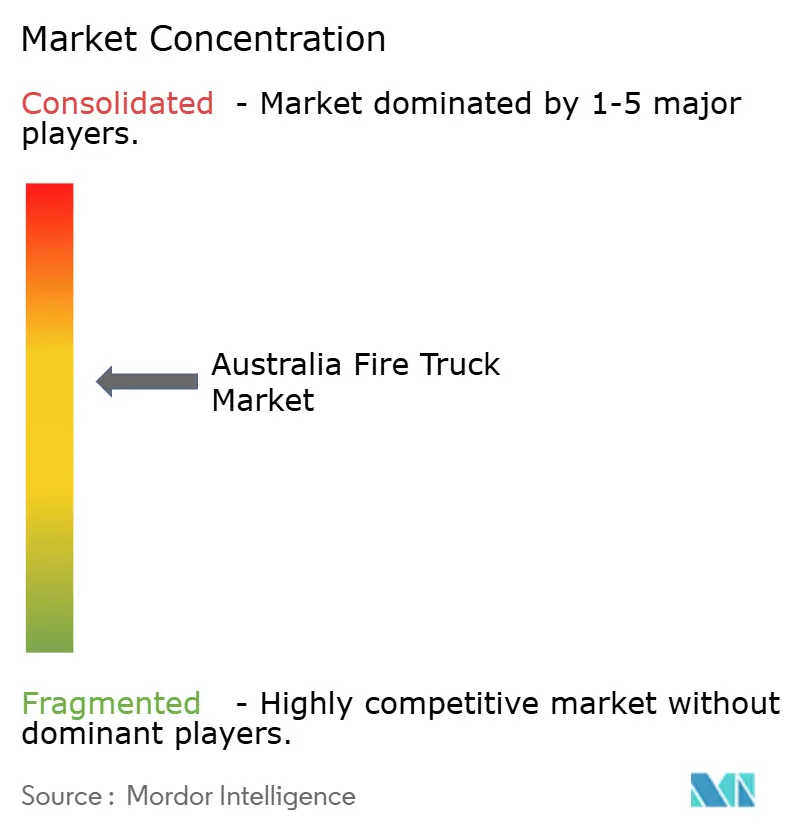
| Market Concentration | Medium |
Major Players *Disclaimer: Major Players sorted in no particular order Image © Mordor Intelligence. Reuse requires attribution under CC BY 4.0. | |
Australia Fire Truck Market Analysis by Mordor Intelligence
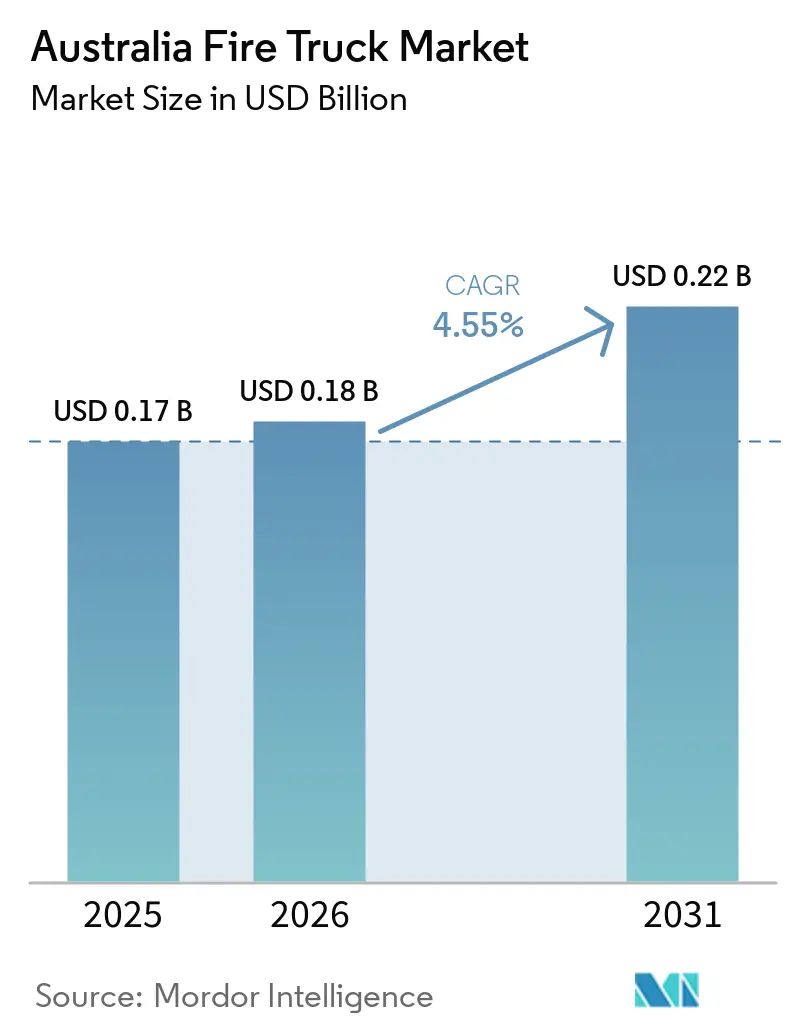
The Australian fire truck market was valued at USD 0.17 billion in 2025 and estimated to grow from USD 0.18 billion in 2026 to reach USD 0.22 billion by 2031, at a CAGR of 4.55% during the forecast period (2026-2031). Rising replacement cycles in New South Wales, Queensland, and Western Australia, federal co-funding under the Disaster Ready Fund, and mandatory Euro 6 (ADR 80/04) engine standards from November 2025 are re-shaping long-term procurement calendars. Tankers still dominate fleets because of bushfire geography, yet metropolitan services are accelerating pumper upgrades that meet new emissions rules while improving crew ergonomics. Battery-electric pilots in the Australian Capital Territory, Victoria, and Queensland are testing zero-emission viability for urban duty cycles. Growing airport capacity projects, especially Western Sydney International Airport opening in December 2026, are expanding high-value aircraft rescue and fire-fighting (ARFF) tenders.
Key Report Takeaways
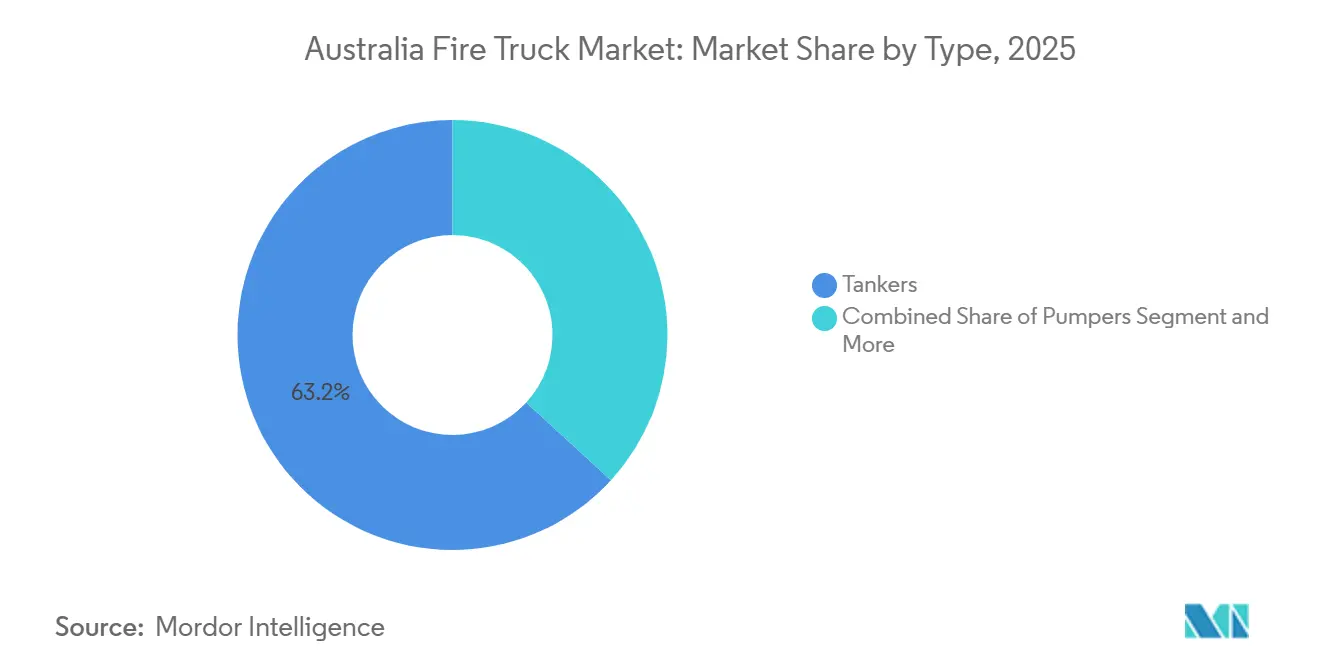
- By type, tankers led with 63.15% of the Australian fire truck market share in 2025, while pumpers are forecast to expand at an 11.24% CAGR through 2031.
- By application, residential and commercial accounted for 72.33% share of the Australian fire truck market size in 2025, while airport use is projected to grow at a 9.13% CAGR to 2031.
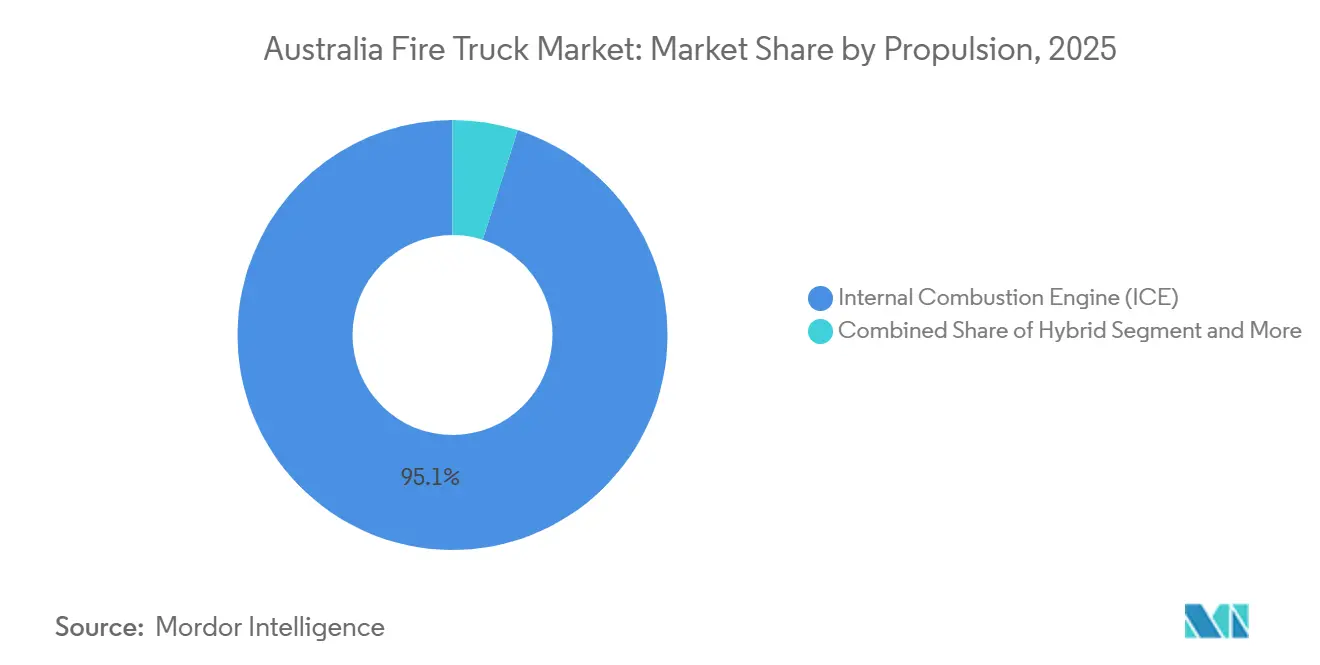
- By propulsion, the internal combustion engine accounted for 95.14% share in 2025, while battery electric is advancing at a 22.15% CAGR over 2026-2031.
- By end-user, municipal fire departments commanded 69.25% share in 2025, while airport authorities will record the fastest CAGR at 9.51% to 2031.
Note: Market size and forecast figures in this report are generated using Mordor Intelligence’s proprietary estimation framework, updated with the latest available data and insights as of January 2026.
Australia Fire Truck Market Trends and Insights
Drivers Impact Analysis*
| Driver | (~) % Impact on CAGR Forecast | Geographic Relevance | Impact Timeline |
|---|---|---|---|
| Replacement of Aging Tanker Fleets | +1.2% | NSW, QLD, WA primary | Medium term (2-4 years) |
| Disaster Fund Accelerating Fleet Modernization | +0.9% | National | Medium term (2-4 years) |
| Wildfire-Driven Demand for 4×4 Appliances | +0.8% | NSW, QLD, VIC, SA, WA | Medium term (2-4 years) |
| Euro 6 / ADR Compliance from 2025 | +0.7% | National | Short term (≤ 2 years) |
| Electrification Pilots Gaining Traction | +0.6% | ACT, QLD, VIC | Long term (≥ 4 years) |
| Rising Airport-Capacity Projects | +0.5% | SYD, MEL, BNE, PER | Short term (≤ 2 years) |
| Source: Mordor Intelligence | |||
Surging Replacement of Aging Tanker Fleets in NSW, QLD and WA
NSW Rural Fire Service (RFS) delivered 290 units during 2025, including six ultra-large Tatra tankers that target remote bushfire terrain. Queensland allocated substantial funding for a large number of vehicles in its Rural Fire Service and signed an AUD 80 million (~USD 52 million) agreement with Fraser Engineering for 80 Type 2 trucks. Western Australia invested AUD 3.5 million (~USD 2.27 million) in November 2025 for seven new appliances optimized for broad-acre fireground coverage. These new acquisitions replace vehicles introduced during the bushfire response surge of the 2000s. Many of these older vehicles have now exceeded a considerable period of service, reaching a point where maintenance costs consume a significant portion of local budgets. This transition from reactive post-disaster purchases to proactive rolling renewals not only streamlines capital expenditures but also minimizes downtime for volunteer brigades.
Federal Disaster Ready Fund Accelerating State-Level Fleet Modernization
The Disaster Ready Fund earmarks up to AUD 1 billion (~USD 1 billion) through 2028 and released AUD 200 million (~USD 129 million) in November 2025, enabling states to match federal grants and lock volume discounts with chassis suppliers [1]. In 2025, South Australia allocated funds to procure heavy urban pumpers and quick response vehicles. Tasmania, in the same year, invested in mobile units, providing a boost to local builder Watson Engineering. By 2026, Victoria's rolling plan successfully delivered light tankers and heavy tankers. Such predictable co-investments not only stabilize tender volatility but also motivate domestic bodybuilders to scale up their capacities.
Wildfire-Driven Demand for 4×4 Modular Bushfire Appliances
In the 2024-25 season, wildfires devastated vast areas, endangering millions of residents across New South Wales, Queensland, and Victoria, all living in high-risk zones. Agencies are now leaning towards modular 4×4 platforms equipped with deluge systems and radiant heat shields. Frontline Fire & Rescue’s Terra Firma Titan offers significant water capacity and pumping efficiency, all while ensuring crew safety with protective blankets. Victoria deployed 29 ultra-heavy tankers in 2024 at AUD 12.8 million (~USD 9.15 million) total to mitigate water scarcity on remote lines. New South Wales introduced ultra-large units, adept at navigating steep terrains. This move highlights a split in fleet strategies: urban brigades gravitating towards standardized Euro 6 pumpers, while their rural counterparts opt for 4×4 tankers.
Mandatory Euro-6 / ADR Compliance for New Heavy Vehicles From 2025
Euro 6 standards under ADR 80/04 became compulsory for all new heavy vehicles over 3.5 t GVM from November 2025 [2]. Fire agencies can no longer extend non-compliant fleets, compressing replacement timelines and boosting demand for Euro 6-ready Scania P-series and Volvo FM crew cabs. Victoria ordered 25 Scania-based pumpers in June 2024, and the ACT accepted Volvo FM crew cabs earlier, reflecting early mover procurement to lock production slots. Compliance has also raised engineering costs for small bodybuilders, accelerating consolidation toward firms with certified designs and local testing capability.
Restraints Impact Analysis*
| Restraint | (~) % Impact on CAGR Forecast | Geographic Relevance | Impact Timeline |
|---|---|---|---|
| Municipal Budget Caps and Tender Delays | -0.8% | VIC, NSW, QLD high | Medium term (2-4 years) |
| Battery Concerns after ACT Outage | -0.5% | ACT, QLD, VIC | Medium term (2-4 years) |
| Skills Shortage for Electric/Hybrid Maintenance | -0.4% | National | Long term (≥ 4 years) |
| Stringent RVSA Type-Approval Costs | -0.3% | National | Short term (≤ 2 years) |
| Source: Mordor Intelligence | |||
Municipal Budget Caps and Long Public-Tender Lead Times
Victoria’s Country Fire Authority logged an AUD A51.8 million (~USD 33 million) deficit in 2024-25 and a cumulative AUD 145 million (~USD 94 million) shortfall across four of five years, forcing critical-only replacements and delaying several overdue tankers [3]. NSW councils primarily fund truck maintenance, leaving a smaller share for the state, which extends the replacement cycles. In March 2026, Queensland faced numerous complaints regarding lengthy lead times and contested specifications. The public tender process can take significant time for evaluation and council approval. Meanwhile, chassis OEM slots are booked well in advance, causing agencies to face prolonged waits. This deferred capital approach has led to increased downtimes, evident from Fire Rescue Victoria's report of frequent faults in their aging fleet over a specific period.
Skills Shortage for Maintaining Advanced Electric/Hybrid Drivetrains
Between 2018 and 2022, only a limited number of technicians acquired battery and hybrid skills, falling short of the numbers needed to support the statewide fleet. Due to a shortage of AS 5732-qualified trainers and equipment in regional areas, appliances must be transported to workshops in the capital city, leading to increased downtime. A battery outage in July 2025 on the ACT hybrid-electric truck, which necessitated factory intervention, underscored the risks associated with service capacity. Workshops that operate independently are reluctant to invest, as the return on investment for chargers extends over an extended period. Without advancements in mobile diagnostics, remote updates, and a steady influx of trained technicians, the trend of electrification is likely to remain confined to major cities.
*Our forecasts treat driver/restraint impacts as directional, not additive. The impact forecasts reflect baseline growth, mix effects, and variable interactions.
Segment Analysis
By Type: Tankers, Anchor Bushfire Defense, while Pumpers Scale in Cities
Tankers accounted for 63.15% of the Australian fire truck market share in 2025, a reflection of terrain where onboard water reserves outweigh hydrant access. The Australian fire truck market size for tankers will stay resilient as volunteer brigades replace 15-year-old fleets, illustrated by Victoria’s order for 29 ultra-heavy units. Pumpers, though smaller in number, post the highest segment CAGR at 11.24% due to the Euro 6 transition and urban densification. Queensland’s deal for 80 Type 2 units demonstrates metropolitan appetite for compliant, high-performance pumpers.
Pumpers gain further momentum from standard cab-chassis solutions that cut training hours and spare-part diversity. Rescue and aerial platforms remain niche yet strategic, with Bronto Skylift delivering four 70 m S70XR units in February 2026 for high-rise coverage. ARFF vehicles, although low in volume, command the highest unit economics; the Royal Australian Air Force’s 19 Panther 6×6 trucks validate global OEM leadership. The bifurcation points toward diversified supplier ecosystems serving separate duty profiles.

By Application: Urban Response Dominates, Airports Accelerate
Residential and commercial incidents absorbed 72.33% of spending in 2025 as municipal brigades protect dense populations. The Australian fire truck market size for those applications expands steadily with city growth and Euro 6 compliance drives. Airport projects, however, post a 9.13% CAGR from 2026 as Western Sydney International, Melbourne’s third runway, and Brisbane’s expansion ratchet ICAO Category demands. Unit costs for Panthers or Striker Volterra hybrids amplify revenue despite low volumes.
Industrial mining sites continue ordering mine-spec tankers with rollover protection, while wildland and forestry overlap urban boundaries as climate change fuels megafires. Victoria’s deployment of ultra-heavy tankers into peri-urban zones blurs segment lines. Airports nonetheless remain the premium niche in the Australian fire truck market, drawing interest from Rosenbauer, Oshkosh, and NAFFCO’s new alliances.
By Propulsion: Diesel Holds Majority, Battery Electric Gains Ground
Internal combustion engines covered 95.14% of deliveries in 2025, yet battery electric vehicles recorded a 22.15% CAGR to 2031. In trials conducted across ACT, Victoria, and Queensland, Scania's BEV CP31, designed specifically for 4×2 metropolitan pumpers, demonstrated silent operations and significantly reduced on-scene fumes. However, hybrid adoption in Australia's fire truck sector remains limited, with penetration rates staying low. This low adoption is primarily attributed to the high costs associated with dual drivetrains, which make hybrids less economically viable.
Furthermore, fuel-cell technology continues to be in the conceptual stage, largely due to the lack of adequate hydrogen infrastructure, which poses a significant barrier to its implementation. On the other hand, regulatory pressures stemming from ADR 80/04 are accelerating the phase-out of pre-Euro 6 diesel vehicles. This regulatory shift is creating opportunities for zero-emission alternatives, particularly in capital cities where depot charging infrastructure is more readily available, supporting the transition to cleaner technologies.
By End-User: Municipal Departments Steer Volume, Airports Offer Margin
Municipal brigades possessed 69.25% of the 2025 demand and continue as the pivot for domestic bodybuilders that deliver tanker and pumper workhorses. Municipal fiscal health plays a pivotal role in dictating yearly volumes for the Australian fire truck market, which remains heavily reliant on council funding and state grants. The financial stability of municipalities directly impacts the procurement and deployment of fire trucks across the country.
Although airport authorities are limited in number, they exhibit the highest CAGR at 9.51%, primarily due to new runway projects that necessitate Category upgrades. These upgrades often require the addition of advanced fleets, such as 6×6 or 8×8 ARFF units, to meet stringent safety and operational standards. In the defense sector, specialist fleets are maintained through long-term contracts with key players like Rosenbauer and NAFFCO, ensuring consistent supply and operational readiness. Additionally, private contract services play a crucial role in safeguarding remote resource operations, providing tailored fire truck solutions to meet the unique challenges of these areas.
Geography Analysis
In 2025, New South Wales took the lead, ordering new trucks and receiving significant deliveries. Among these were ultra-large tankers, specially designed for rugged terrains. Queensland followed suit, allocating resources for a substantial number of vehicles, which included a major contract with Fraser Engineering. Meanwhile, Victoria, with a rolling plan, updated its fleet by early 2026, adding light tankers and 4×4 units. However, the state grapples with ongoing CFA deficits, leading to a continued reliance on legacy assets.
Western Australia and South Australia, while operating on tighter budgets, emphasize modular builds tailored for expansive catchments. In late 2025, WA invested in several appliances, followed by additional units in early 2026. South Australia, on the other hand, allocated resources for heavy pumpers and quick response vehicles, ensuring they meet Euro 6 standards. Tasmania, leveraging federal funds, partnered with a local engineering firm to procure mobile units, emphasizing local value addition.
Despite its smaller fleet, the ACT is at the forefront of electrification initiatives and hosts a dedicated ARFF base at Western Sydney International. The Northern Territory, while currently experiencing limited turnover, is poised to comply with Euro 6 standards in the future. Across the board, states are benefiting from the Disaster Ready Fund's co-investment, which not only ensures predictable capital but also mitigates procurement spikes post-disaster, thereby stabilizing supplier order books.
Competitive Landscape
Global OEMs, including Rosenbauer, REV Group, and Morita, lead the way in ARFF and aerial niches. Meanwhile, Fraser Engineering, Frontline Fire & Rescue, and SEM Fire & Rescue dominate tanker and pumper builds, forming alliances with major players like Scania, Volvo, and Isuzu. Fraser's order for 80 Type 2 pumpers in Queensland underscores the benefits of local assembly, slashing lead times by two years. SEM's contract for 25 Scania units in Victoria highlights the cost-saving advantages of brand standardization in training.
Rosenbauer's delivery of 19 Panthers to the RAAF solidifies its foothold in the lucrative airport segment. However, NAFFCO's partnerships with Scania and MAN for 2025-26 hint at emerging competition. Leveraging Euro 6 cab-chassis and local assembly in Wacol, Volvo Group Australia and Scania Australia are poised to outpace smaller, uncertified vendors. The increasing focus on Euro 6 compliance and local manufacturing capabilities is reshaping the competitive landscape, favoring larger, certified players.
Rising compliance costs and testing demands, particularly with RVSA and Euro 6, are driving consolidation in the industry, pushing smaller firms to either partner up or bow out. Additionally, there is untapped potential in areas like battery electric pumpers, modular 4×4 tankers, and PFAS-free foams, where early adopters could set the standards. Companies that invest in these emerging technologies and align with evolving regulations are likely to gain a competitive edge in the market.
Australia Fire Truck Industry Leaders
-
Rosenbauer International AG
-
Pierce Manufacturing, Inc.
-
Volvo Group Australia
-
REV Group
-
Magirus
- *Disclaimer: Major Players sorted in no particular order
Recent Industry Developments
- December 2025: The Gerringong Rural Fire Brigade began field trials of ultra-large Tatra trucks, marking the first deployment of these next-generation vehicles in New South Wales.
- November 2025: Western Sydney International Airport received the first of four plug-in hybrid Striker Volterra 6×6 trucks that will enable a sub-three-minute response once the dedicated fire station opens.
- September 2025: Volvo Group Australia and Fraser Engineering signed the largest single order in Queensland history for 80 new pumpers to bolster both regional and metropolitan response.
Australia Fire Truck Market Report Scope
The scope includes segmentation by type (pumpers, tankers, rescue trucks, aerial/platform trucks, multi-tasking modular trucks, wildland fire trucks, and airport crash tender), application (residential and commercial, industrial and manufacturing, airports, military, wildland and forestry), propulsion (internal combustion engine, hybrid, battery electric, and fuel-cell electric), and end-user (municipal fire departments, industrial facility brigades, airport authorities, defense and military, contract and private fire services). Market size and growth forecasts are presented by value in USD and by volume in units.
| Pumpers |
| Tankers |
| Rescue Trucks |
| Aerial / Platform Trucks |
| Multi-tasking Modular Trucks |
| Wildland Fire Trucks |
| Airport Crash Tender (ARFF) |
| Residential and Commercial |
| Industrial and Manufacturing |
| Airports |
| Military |
| Wildland and Forestry |
| Internal Combustion Engine (ICE) |
| Hybrid |
| Battery Electric |
| Fuel-Cell Electric |
| Municipal Fire Departments |
| Industrial Facility Brigades |
| Airport Authorities |
| Defense and Military |
| Contract and Private Fire Services |
| By Type | Pumpers |
| Tankers | |
| Rescue Trucks | |
| Aerial / Platform Trucks | |
| Multi-tasking Modular Trucks | |
| Wildland Fire Trucks | |
| Airport Crash Tender (ARFF) | |
| By Application | Residential and Commercial |
| Industrial and Manufacturing | |
| Airports | |
| Military | |
| Wildland and Forestry | |
| By Propulsion | Internal Combustion Engine (ICE) |
| Hybrid | |
| Battery Electric | |
| Fuel-Cell Electric | |
| By End-User | Municipal Fire Departments |
| Industrial Facility Brigades | |
| Airport Authorities | |
| Defense and Military | |
| Contract and Private Fire Services |
Key Questions Answered in the Report
Fire truck fleet life cycle in Australia?
Agencies target 15-year frontline service, after which heavy refurbishment or replacement is scheduled under rolling plans supported by the Disaster Ready Fund.
Outlook for battery electric pumpers?
Zero-emission pumpers will likely serve metro stations first, representing up to 15% of new urban purchases by 2031 as trials in ACT, Victoria, and Queensland mature.
Which states drive highest tanker demand?
New South Wales, Queensland, and Victoria dominate tanker orders owing to high bushfire exposure and large volunteer networks.
Main barrier to electrifying rural fleets?
Limited regional technician skills and sparse high-capacity charging infrastructure restrict the deployment of battery electric units outside capital cities.