
Australia Data Center Physical Security Market Size and Share
| Study Period | 2020 - 2031 |
| Forecast Data Period | 2026 - 2031 |
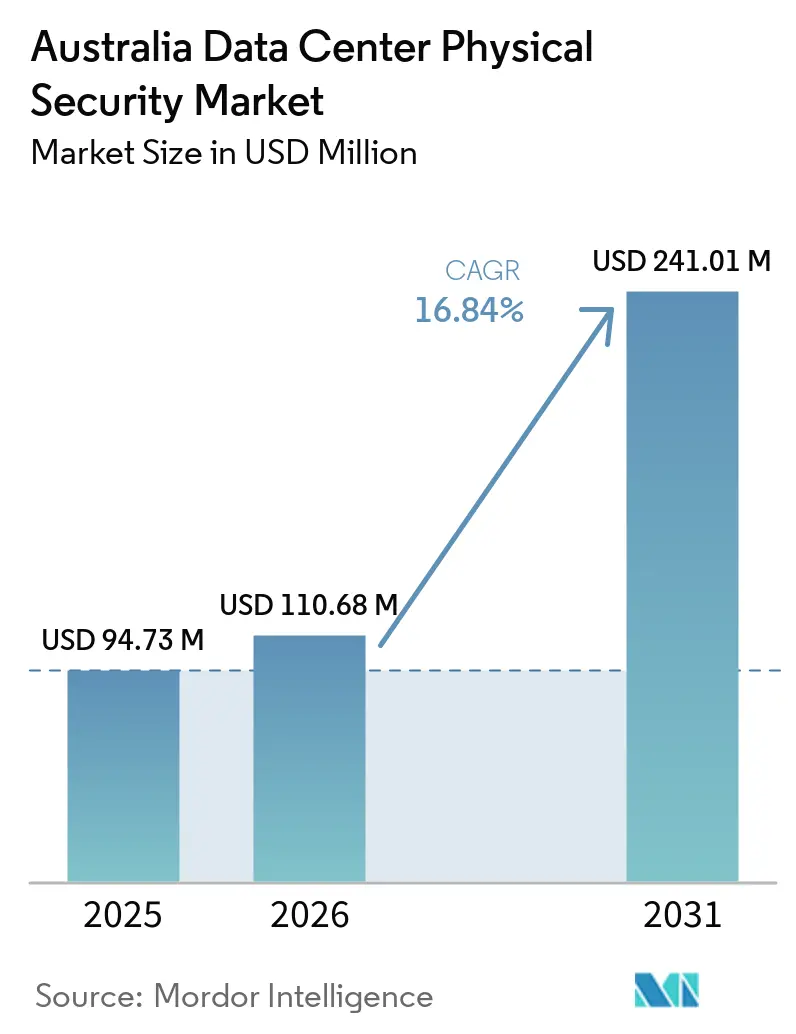
| Base Year Market Size (2025) | USD 94.73 Million |
| Market Size (2026) | USD 110.68 Million |
| Market Size (2031) | USD 241.01 Million |
| CAGR (2026 - 2031) | 16.84% |
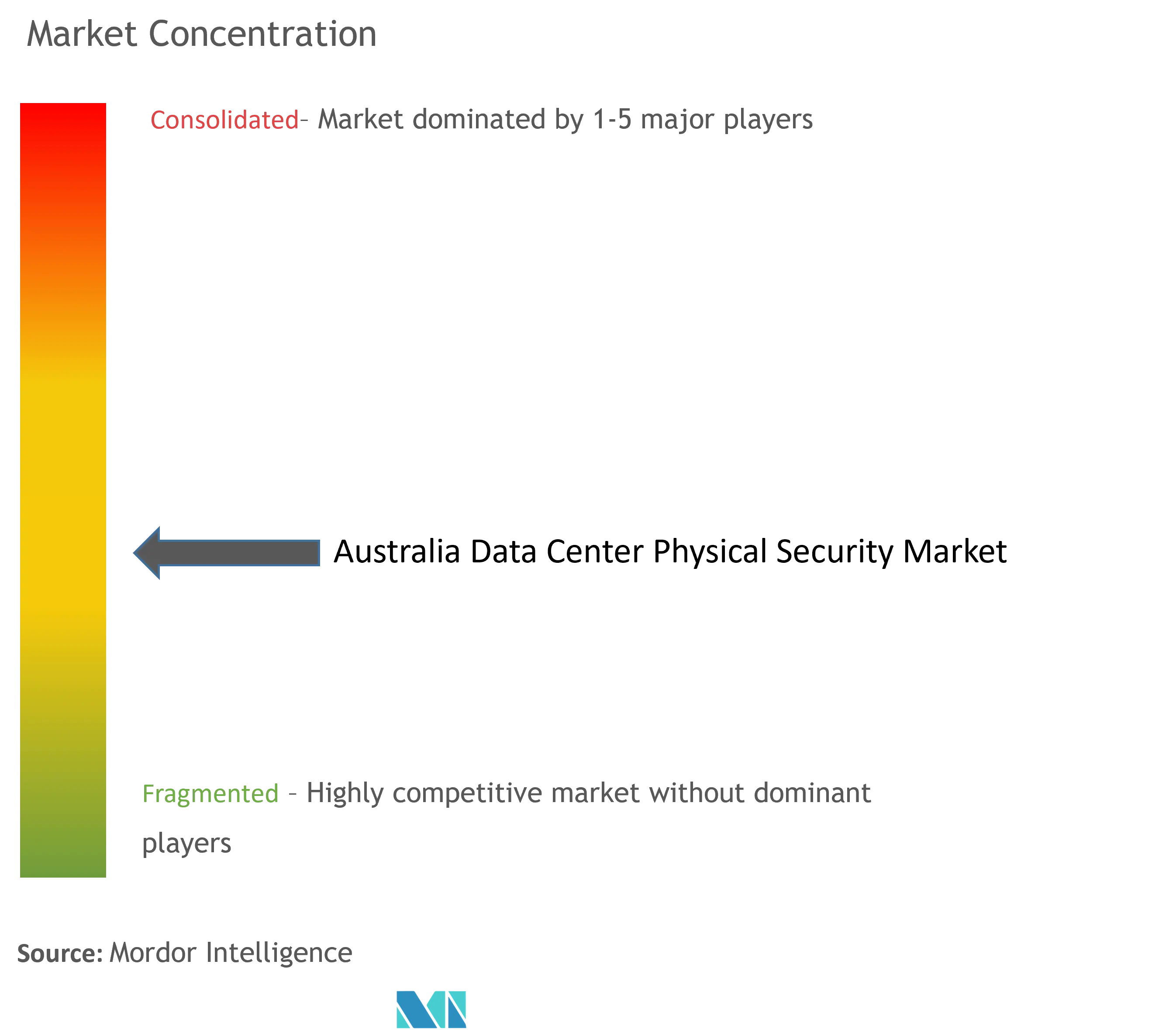
| Market Concentration | Medium |
Major Players *Disclaimer: Major Players sorted in no particular order |
Australia Data Center Physical Security Market Analysis by Mordor Intelligence
The Australia Data Center Physical Security Market size is expected to grow from USD 94.73 million in 2025 to USD 110.68 million in 2026 and is forecast to reach USD 241.01 million by 2031 at 16.84% CAGR over 2026-2031.
The Australia data center physical security market is supported by increasing investment in digital infrastructure, rising demand for artificial intelligence (AI) and cloud computing, and growing requirements to protect critical data storage and processing facilities.
- In June 2025, Amazon Web Services (AWS) is expected to announce an investment of AUD 20 billion (approximately USD 13 billion) in Australian data center infrastructure over five years, including expansions in Sydney and Melbourne. This investment is expected to drive demand for physical security solutions, including video surveillance, access control, perimeter monitoring, and integrated security management systems, across new and expanded facilities.
Regulatory requirements also shape the market. Australia's Security of Critical Infrastructure Act 2018 covers the data storage and processing sector and establishes obligations for entities responsible for designated critical infrastructure assets. In April 2025, amendments to the critical infrastructure framework are expected to clarify certain obligations related to data storage systems and strengthen provisions for managing critical infrastructure risks. These requirements reinforce the importance of risk management, facility protection, and appropriate security controls for eligible data center assets.
Investment momentum is expected to continue into 2026. In March 2026, the Australian Government is expected to outline national expectations for data center and AI infrastructure developers, emphasizing coordinated development, community benefits, and alignment with national priorities. Separately, the Australian Bureau of Statistics is expected to report that investment in data center equipment contributes to higher capital expenditure, while investment in data center buildings continues to grow. These developments are expected to support the broader expansion of Australia's data center infrastructure and create opportunities for physical security equipment, system integration, maintenance, and monitoring services. However, these announcements are not expected to separately quantify security-specific spending.
Australia Data Center Physical Security Market Trends and Insights
The Video Surveillance Segment has a Significant Share in the Market
- Sensitive and important data is stored in data centers, so security is a top priority. Data center operators use video surveillance systems to ensure security standards and regulations are met. This allows you to monitor access, detect unauthorized access, and maintain compliance.
- Video surveillance helps prevent malicious or erroneous data center operations and provides evidence to identify those responsible in the event of an incident.
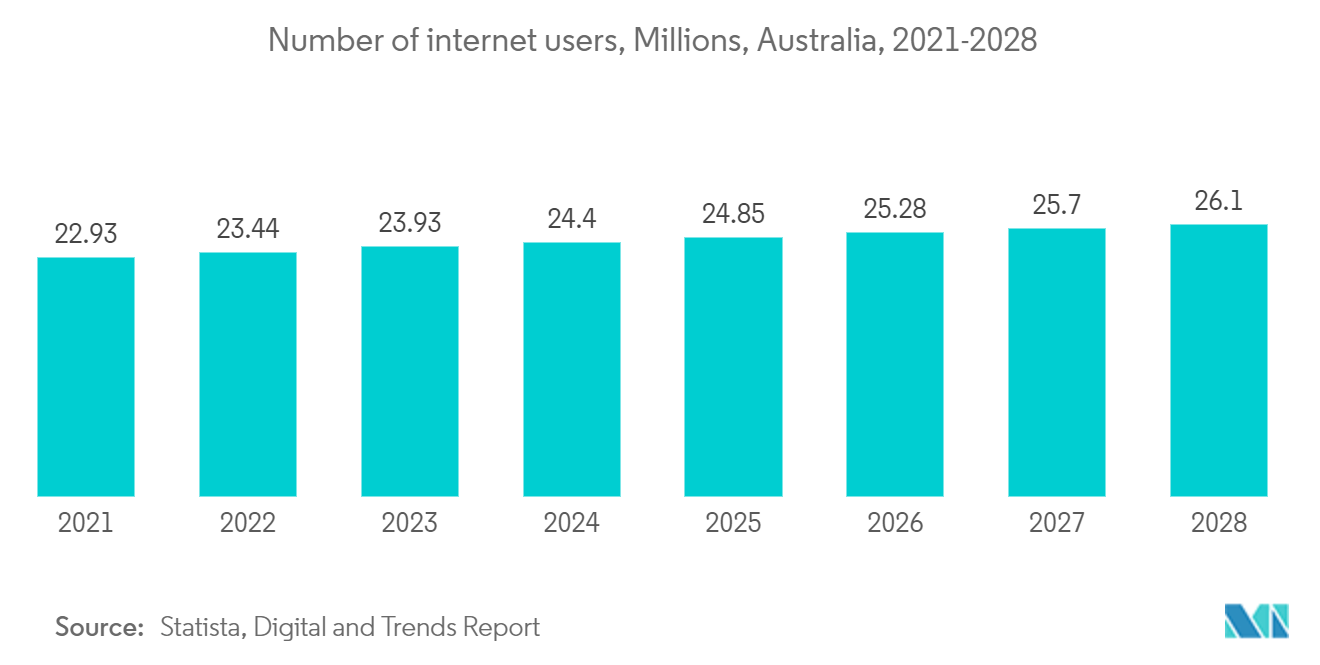
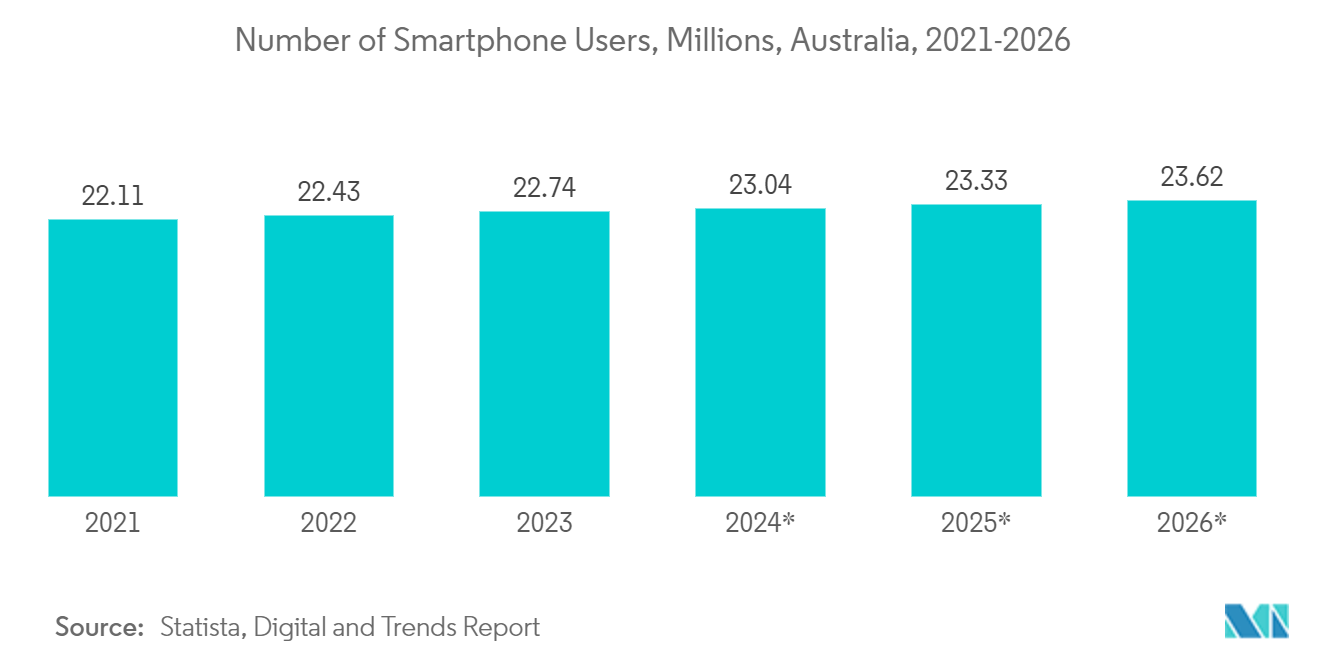
- Australia's mobile penetration rate is 130%. On average, each smartphone device has 104 apps installed. In 2019, the Australian mobile commerce market was worth USD 12.1 billion. This market is expected to increase exponentially in size to over USD 20 billion by 2023. The Australian market`s preference for smartphones necessitates the expansion of data centers' capabilities in order to handle the increase in data. Smartphones generate a lot of data, which necessitates real-time processing and analysis. Data centers must manage the sheer amount of data, thereby increasing the demand for video surveillance that can help prevent malicious or erroneous operations within the data center and provide evidence to identify responsible parties when an incident occurs.
- The increase in bandwidth and data demand is expected to be driven by video streaming in high-definition formats such as 4K and 8K. However, while the increased adoption of streaming games and virtual reality may contribute to this demand, compression technologies that reduce data requirements are expected to partially offset the increase in bandwidth demand. This increases the size of data centers and the need for video surveillance. This helps prevent malicious or erroneous operations within the data center and provides evidence to identify those responsible in the event of an incident.
- Spending on AI systems in Australia is expected to increase to USD 3.6 billion by 2025, with a CAGR of 24.4% between 2020 and 2025. Across industries in Australia, the banking sector is expected to lead the way in AI spending as organizations implement new systems to prevent fraud and improve threat detection and prevention.
The IT and Telecommunication Segment has a Major Share in the Market
- The increasing adoption of advanced technologies, such as artificial intelligence, cloud computing, big data, and the Internet of Things, primarily drives ICT spending in Australian data analytics. The widespread use of AI, automation, and big data in various consumer industries is likely to have a significant impact on the Australian ICT market during the forecast period.
- The need for public cloud services in Australia continued to grow in 2019, with 42% of businesses in the country reporting the use of cloud computing compared to 31% in 2015-16. Market vendors are rolling out enhanced product offerings curated for IT industry end users, which is also driving growth in this segment.
- Currently, Australia has deployed 5G in major cities and is in the process of auctioning off the spectrum to provide more services. This will increase the need for towers. In April 2021, the government allocated a high band 5G spectrum (in the 26 GHz band), which will enable extremely fast, high-capacity services. In the second half of 2021, the government allocated a low band 5G spectrum (in the 850/900 MHz band), which will be crucial for ensuring broader geographic coverage of 5G services. This will enable new applications for 5G in the enterprise market that take advantage of 5G’s unique properties like ultra-low latency, high capacity, and advanced functions like network slicing.
- Moreover, the Australian government's continued focus on the digital transformation of private and public services will positively drive market growth. Therefore, mobility, cloud computing, data and analytics, and digital storage will see high adoption rates over the next few years. All these factors will create growth opportunities and support the growth of the ICT market in this country. This indicates more consumption of data and thereby an increase in data centers in the country hence, increasing the need for data center security in the country.
- The data center construction projects mostly continued as construction is classified as essential under the current Australian regime. It is a vital sector to keep the country's economy running, thereby increasing the need for data center security in the country.
Competitive Landscape
The market is semi consolidated due to players like Axis Communications AB, ABB Ltd, and Bosch Sicherheitssysteme GmbH, which play a vital role in upscaling the capabilities of enterprises. Market orientation leads to a highly competitive environment. The biggest retail and wholesale data center market companies have further tried to make their system secure and safe from thefts. There has been a wave of consolidation in the secondary markets as smaller players seek to scale to compete and big players scale their products in the market. For instance,
- February 2024: In the latest release of the Axis operating system, AXIS OS, Axis Communications AB announced that more than 200 network devices, including cameras, intercoms, and 11.8 audio speakers, are supported by the IEEE MAC 802.1sec security standard. Demonstrating the company's continued commitment to device and data security, Axis has become the first manufacturer of physical safety products supporting MACsec Media Access Control Security.
- August 2023: Securitas signed an expanded 5-year agreement to provide data center security for Microsoft in 31 countries, solidifying a strong relationship. The global agreement includes risk management, comprehensive security technology as a system integrator, specialized safety and security resources, guarding services, and digital interfaces. Securitas ensures that the data center's physical security program remains innovative, robust, and effective. This demonstrates stability as a collaborator, assisting in navigating the challenges of Microsoft's expanding business.
Australia Data Center Physical Security Industry Leaders
-
Axis Communications AB
-
ABB Ltd
-
Bosch Sicherheitssysteme GmbH
-
Honeywell International Inc.
-
Johnson Controls.
- *Disclaimer: Major Players sorted in no particular order
Recent Industry Developments
- March 2026: Schneider Electric is scheduled to partner with Gallagher Security to integrate enterprise-grade physical security solutions, including access control, perimeter security, and intrusion detection, with building and energy management technologies. The partnership will address demand for integrated security and building management solutions across the Pacific region.
- June 2026: Microsoft and the Australian Government are scheduled to announce a memorandum of understanding to strengthen the resilience of digital and critical infrastructure. The collaboration will build on Microsoft’s announced AUD 25 billion investment in Australia’s AI and cloud infrastructure.
- May 2026: CDC Data Centers is expected to secure a 555 MW data center contract with a US customer, increasing its total contracted capacity to more than 1 GW. The expansion of large-scale data center infrastructure is expected to create demand for access control, video surveillance, and integrated physical security systems.
- December 2025: OpenAI and NEXTDC are expected to sign a memorandum of understanding to develop an AUD 7 billion next-generation data center at NEXTDC’s S7 site in Sydney. The proposed campus will support high-density AI workloads and secure data processing, creating a potential opportunity for advanced physical security infrastructure.
Australia Data Center Physical Security Market Report Scope
The data center physical security market refers to the industry focused on providing products and services to safeguard the physical infrastructure and assets of data centers. This includes measures to protect data centers from unauthorized access to premises, hardware theft, vandalism, sabotage, terrorist acts, and other physical threats. Key components of data center physical security may include video surveillance and monitoring, access control systems, physical barriers, biometric authentication, and environmental controls designed to ensure the safety and integrity of the data center environment.
The Australian data center physical security market is segmented by solution type, service type, and end user. By type, the market is segmented into video surveillance and access control solutions. By service type, the market is segmented into consulting services and professional services. By end user, the market is segmented into IT and telecommunication, BFSI, government, media and entertainment, and other end users. The market sizes and forecasts are provided in terms of value (USD) for all the above segments.
| Video Surveillance |
| Access Control Solutions |
| Others (Mantraps, Fences, and Monitoring Solutions) |
| Consulting Services |
| Professional Services |
| Others (System Integration Services) |
| IT and Telecommunication |
| BFSI |
| Government |
| Media and Entertainment |
| Other End Users |
| By Solution Type | Video Surveillance |
| Access Control Solutions | |
| Others (Mantraps, Fences, and Monitoring Solutions) | |
| By Service Type | Consulting Services |
| Professional Services | |
| Others (System Integration Services) | |
| End User | IT and Telecommunication |
| BFSI | |
| Government | |
| Media and Entertainment | |
| Other End Users |
Key Questions Answered in the Report
How big is the Australia Data Center Physical Security Market?
The Australia Data Center Physical Security Market size is expected to reach USD 110.68 million in 2026 and grow at a CAGR of 16.84% to reach USD 241.01 million by 2031.
What is the current Australia Data Center Physical Security Market size?
In 2026, the Australia Data Center Physical Security Market size is expected to reach USD 110.68 million.
Who are the key players in Australia Data Center Physical Security Market?
Axis Communications AB, ABB Ltd, Bosch Sicherheitssysteme GmbH, Honeywell International Inc. and Johnson Controls. are the major companies operating in the Australia Data Center Physical Security Market.
What years does this Australia Data Center Physical Security Market cover, and what was the market size in 2025?
In 2025, the Australia Data Center Physical Security Market size was estimated at USD 94.73 million. The report covers the Australia Data Center Physical Security Market historical market size for years: 2020, 2021, 2022, 2023 and 2024. The report also forecasts the Australia Data Center Physical Security Market size for years: 2025, 2026, 2027, 2028, 2029, 2030 and 2031.
Australia Data Center Physical Security Market Report
Statistics for the 2026 Australia Data Center Physical Security market share, size and revenue growth rate, created by Mordor Intelligence™ Industry Reports. Australia Data Center Physical Security analysis includes a market forecast outlook for 2026 to 2031 and historical overview. Get a sample of this industry analysis as a free report PDF download.
- Brazil Data Center Physical Security Market
- Hong Kong Data Center Physical Security Market
- Mexico Data Center Physical Security Market
- Europe Data Center Physical Security Market
- Saudi Arabia Data Center Physical Security Market
- Canada Data Center Physical Security Market
- Global Data Center Physical Security Market
- Netherlands Data Center Physical Security Market
- South America Data Center Physical Security Market
- Sweden Data Center Physical Security Market
- Data Center Security Market Security across all regions, split by security type, offering and facility type.
- Data Center Cooling Market Cooling worldwide, split by cooling technology, cooling component and facility type.
- Artificial Intelligence (AI) Data Center Market AI facilities across all regions, split by facility type, component and tier.
- Data Center Logical Security Market Network security across all regions, split by solution, service and end user.