
Market Overview
| Study Period | 2020 - 2031 |
|---|---|
| Forecast Data Period | 2026 - 2031 |
| Base Year Market Size (2025) | USD 43.17 Billion |
| Market Size (2026) | USD 45.61 Billion |
| Market Size (2031) | USD 60.01 Billion |
| Growth Rate (2026 - 2031) | 5.64 % |
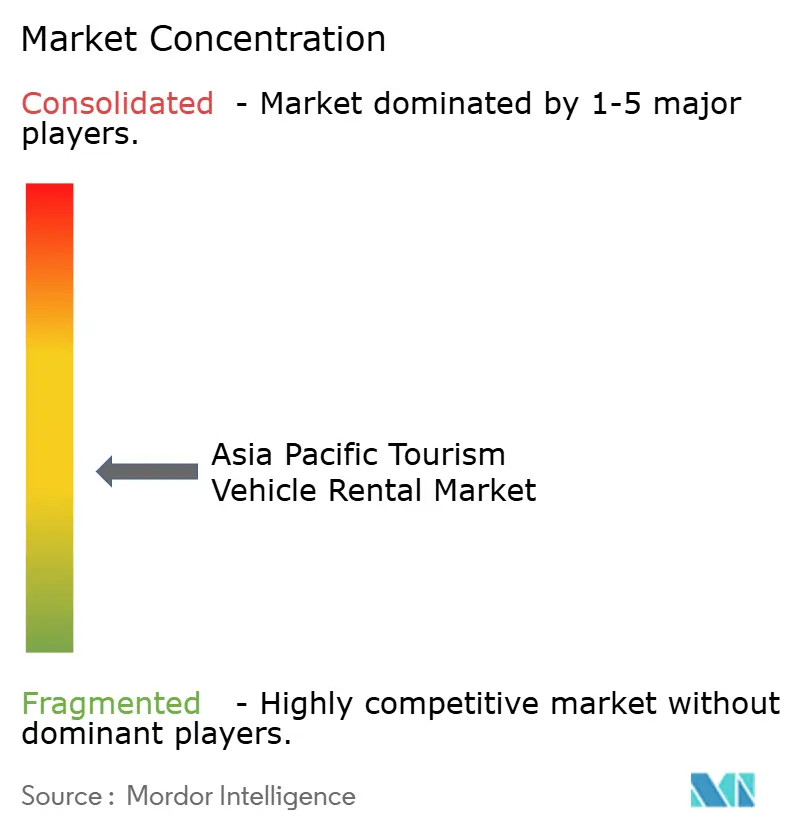
| Market Concentration | Medium |
Major Players *Disclaimer: Major Players sorted in no particular order Image © Mordor Intelligence. Reuse requires attribution under CC BY 4.0. | |
Asia Pacific Tourism Vehicle Rental Market Analysis by Mordor Intelligence
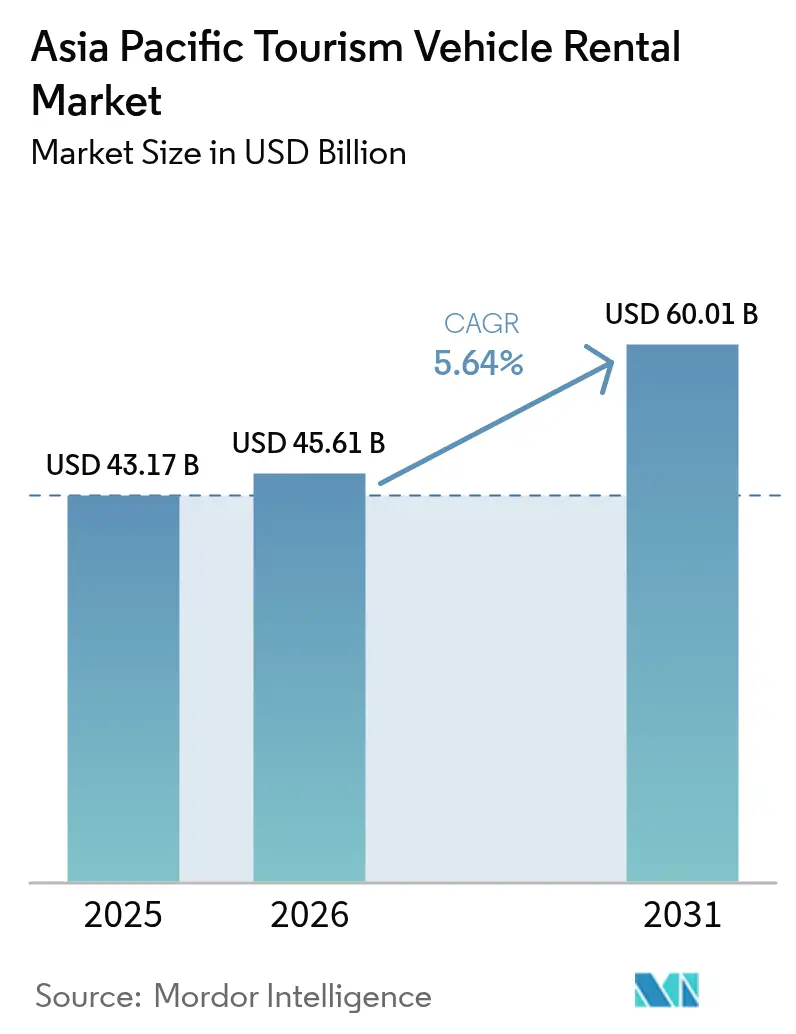
The Asia Pacific Tourism Vehicle Rental Market size market is expected to grow from USD 43.17 billion in 2025 to USD 45.61 billion in 2026 and is forecast to reach USD 60.01 billion by 2031 at 5.64% CAGR over 2026-2031. Surging cross-border travel, and the rapid return of Chinese outbound journeys are restoring vehicle demand to two-thirds of pre-pandemic levels. Recovery momentum is reinforced by super-app penetration, an expanding middle class that favors premium road trips, and policy measures such as Japan’s Tourism Nation Promotion Basic Plan that channel spending into local mobility services.
Key Report Takeaways
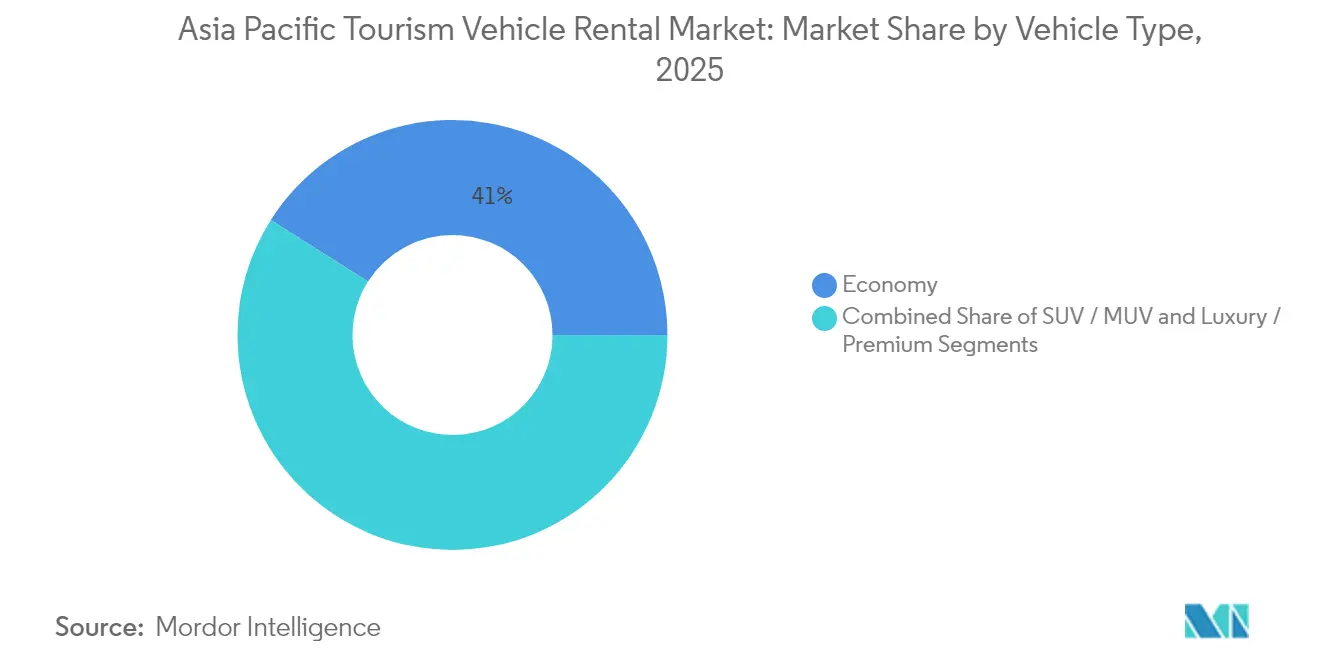
- By vehicle type, economy models led with 41.02% of the Asia Pacific tourism vehicle rental market share in 2025, while SUV/MUV categories are tracking the quickest expansion at a 5.98% CAGR to 2031.
- By booking mode, online channels captured 63.62% of revenue in 2025; mobile-first adoption is propelling this segment at a 5.73% CAGR through 2031.
- By end user, self-drive formats commanded 70.74% of demand in 2025, whereas agency-chauffeured services grow slower but retain relevance among high-end travelers, it also grows at a robust CAGR of 5.29% through 2031.
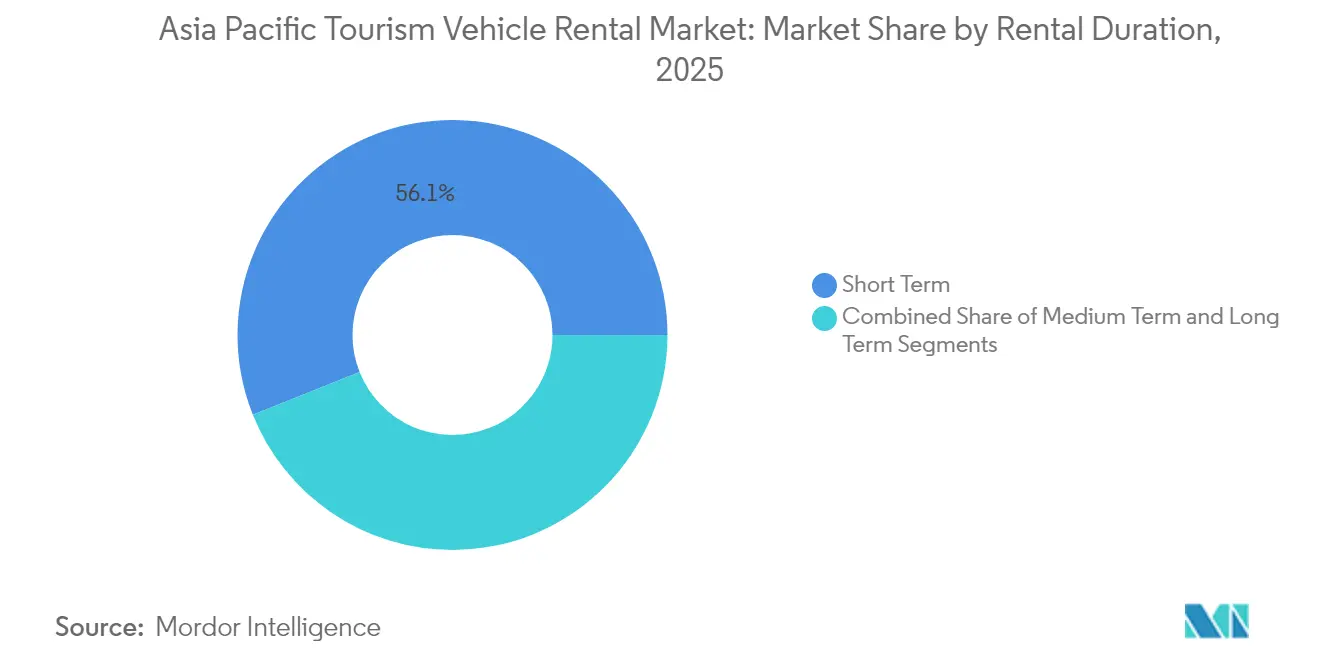
- By rental duration, short-term contracts (Less than or equal to 7 days) accounted for 56.05% of the Asia Pacific tourism vehicle rental market size in 2025; long-term rentals are accelerating at 5.43% CAGR as digital-nomad visas gain traction.
- By service channel, off-airport outlets held 57.88% share of the Asia Pacific tourism vehicle rental market in 2025 and are advancing at a 5.78% CAGR as pickup points migrate to city hubs and resort clusters.
- By country, China controlled 42.85% of regional revenue in 2025, while India delivers the fastest growth at 5.61% CAGR, supported by surging domestic leisure demand.
Note: Market size and forecast figures in this report are generated using Mordor Intelligence’s proprietary estimation framework, updated with the latest available data and insights as of 2026.
Market Trends and Insights
Drivers Impact Analysis of Asia Pacific Tourism Vehicle Rental Market*
| Driver | (~) % Impact on CAGR Forecast | Geographic Relevance | Impact Timeline |
|---|---|---|---|
| Rebound of Inbound and Domestic Tourism | +1.8% | China, Japan, Thailand | Medium term (2-4 years) |
| Mobile OTA and Super-App Penetration | +1.2% | ASEAN core, spill-over to China and India | Short term (≤ 2 years) |
| Rising Middle-Class Road-Trip | +0.9% | China, India, Southeast Asia emerging markets | Long term (≥ 4 years) |
| Mobility-Pass Bundles Via Super-Apps | +0.6% | Urban centers in Indonesia, Singapore, Thailand | Short term (≤ 2 years) |
| ASEAN Digital Licence Interoperability | +0.4% | ASEAN member states, cross-border corridors | Medium term (2-4 years) |
| Carbon-Credit Incentives | +0.3% | China, Japan, South Korea with EV mandates | Long term (≥ 4 years) |
| Source: Mordor Intelligence | |||
Rebound of inbound & domestic tourism
International arrivals are bouncing back sharply: Japan hosted more than 35 million visitors in 2024 and targets 60 million by 2030 under its Tourism Nation Promotion Basic Plan, anchoring fresh demand for regional car rentals.[1] Domestic excursions in China already exceed pre-COVID peaks, and the country intends to eclipse the United States as the world’s largest travel market by 2030. The widening appetite for “slow travel” and off-grid itineraries is driving self-drive and one-way rental uptake, particularly on secondary airport routes and heritage trails. As passengers look beyond standard group tours, the Asia Pacific tourism vehicle rental market benefits from diverse booking durations, including micro-vacations and multiday itineraries. This recovery is also sparking demand for larger vehicle classes that allow multigenerational families to travel together, fueling SUV/MUV penetration across the Asia Pacific tourism vehicle rental market.
Mobile OTA & super-app penetration
Mobile gross bookings in Northeast Asia are set to reach a new high in 2025, outpacing 2019 levels and consolidating online dominance.[2] Super-apps such as Grab, Gojek, and Didi are embedding rental modules inside ride-hailing menus, eliminating app-switching friction and turning spontaneous trips into structured rentals. For traditional operators, the pivot from offline counters to digital funnels means repricing commission structures and integrating API-based inventory feeds in real time. In Thailand and Indonesia, super-app mobility passes that bundle rides, rentals, and last-mile delivery services are driving higher frequency among urban millennials. Consequently, the Asia Pacific tourism vehicle rental market is re-architecting distribution toward “anywhere pick-up” models, reshaping legacy return policies and backend fleet-management logic.
Rising middle-class road-trip culture
Growing disposable incomes and social-media promotion of panoramic drives are catalyzing a new generation of road enthusiasts in China and India. Weekend escapes to hill regions or coastal highways increasingly replace organized excursions, pushing SUV and crossover rentals into premium price bands. The trend dovetails with policy-backed highway expansion—India alone targets 100 km of new highways per day—lowering travel fatigue and improving route safety.[3] Rental firms are responding by adding infotainment-rich models, rear-seat entertainment packages, and multilingual navigation content to address diverse passenger cohorts. As a result, ticket sizes rise and ancillary revenue streams such as roof-rack add-ons, child seats, and Wi-Fi hotspots gain traction within the Asia Pacific tourism vehicle rental market.
ASEAN digital licence interoperability
A proposed common ASEAN driver-licence framework will allow visitors to rent across borders without redundant verification, smoothing Thailand-Malaysia-Singapore corridors. For operators, fewer documentary hurdles lower counter times and improve fleet rotation efficiency across adjoining depots. Leisure travelers benefit from multi-country itineraries—incentivizing longer bookings—and businesses gain cross-border flexibility for project deployments. The system is forecast to go live on priority tourist routes by 2027, improving utilization of dormant fleet inventories during shoulder seasons and bolstering the Asia Pacific tourism vehicle rental market.
Restraints Impact Analysis of Asia Pacific Tourism Vehicle Rental Market*
| Restraint | (~) % Impact on CAGR Forecast | Geographic Relevance | Impact Timeline |
|---|---|---|---|
| Volatile Fuel Prices | -1.1% | Highest impact in fuel-import dependent markets like India | Short term (≤ 2 years) |
| Ride-Hailing and MaaS Substitution | -0.8% | Urban centers across China, Southeast Asia, India | Medium term (2-4 years) |
| Urban ICE-Free Zones | -0.6% | Tier-1 cities in China, Japan, South Korea | Medium term (2-4 years) |
| Semiconductor-Linked Fleet Shortages | -0.5% | Acute impact in vehicle import-dependent markets | Short term (≤ 2 years) |
| Source: Mordor Intelligence | |||
Volatile fuel prices
Fluctuating pump prices compress rental margins and stoke consumer price sensitivity, especially among leisure travelers who pre-pay bundles. Operators in markets importing refined products—such as the Philippines and South Korea—face currency depreciation that compounds procurement costs. Dynamic fuel surcharges can preserve yields but often erode price transparency on OTA listings, deterring bargain hunters. While EV uptake offers a strategic hedge, charging infrastructure gaps and higher acquisition costs limit immediate relief. The Asia Pacific tourism vehicle rental market therefore maintains cautious fleet renewal cycles, prioritizing fuel-efficient engine variants and hybrid powertrains where subsidies apply.
Ride-hailing & MaaS substitution
On-demand taxi fare elasticity and integrated public-transit passes nibble at short-duration rental demand in compact city cores. Super-apps now promote bundled airport transfers and hourly ride packages, directly overlapping with 1-day rental use cases. Academic studies tracking Uber’s expansion show muted displacement in long-haul tourism, yet notable cannibalization for intra-city leisure hops. Consequently, rental players refocus marketing on scenic trails, self-drive safaris, and rural circuits where ride-hailing coverage remains thin. Loyalty enhancements—free mileage tiers, late return grace periods, and digital-nomad subscription passes—are evolving to defend share inside the Asia Pacific tourism vehicle rental market.
*Our forecasts treat driver/restraint impacts as directional, not additive. The impact forecasts reflect baseline growth, mix effects, and variable interactions.
Asia Pacific Tourism Vehicle Rental Market Segment Analysis
By Vehicle Type:
Premium Segments Drive Value MigrationIn 2025 the economy class still supplied 41.02% of Asia Pacific tourism vehicle rental market share, but future mixes skew toward crossovers and seven-seat MPVs. SUV/MUV demand is rewriting fleet economics in the Asia Pacific tourism vehicle rental market. The segment’s 5.98% CAGR to 2031 outpaces the core economy class as middle-income families prioritize cabin comfort, luggage volume, and perceived safety. Japanese inbound arrivals frequently request hybrid SUVs to match long countryside drives, while Chinese millennials opt for MUVs on road trips to Hainan Island. At the high end, luxury marques like Lexus RX and BMW X5 lure corporate travelers in Australia who can offset fees via business expense claims.
Rental companies enjoy a dual benefit: higher average daily rates and lower per-kilometer depreciation due to stronger residual values of premium vehicles. Many operators therefore partner with automakers for fleet buy-back guarantees, protecting residuals against oversupply. Electric SUVs from BYD and MG are entering pilot fleets in Singapore and Shenzhen, signaling an EV twist in premiumization. With component shortages easing, firms are front-loading orders for 2026 models to hedge future supply risk.

By Booking Mode:
Digital Channels Reshape DistributionOnline portals account for 63.62% of Asia Pacific tourism vehicle rental market share in 2025, converting discovery to booking within a few taps and capturing mobile-native travelers across South Korea and Taiwan, the online segment grows at a CAGR of 5.73% through 2031. Super-app integration means the Asia Pacific tourism vehicle rental market now surfaces inside ride-hailing dashboards, turning casual scrolling into rental intent. Offline counters, however, retain importance in regions such as Laos and Cambodia where tourists prefer assistance with local insurance options and language translation.
Comparison widgets that bundle fuel policies, collision-damage waivers, and loyalty perks are narrowing perceived price gaps between big brands and independents. As a corollary, franchise operators embrace channel-management software to synchronize rate parity and cancel penalties across GDS feeds, preventing revenue leakage.
By End User:
Self-Drive Dominance Reflects Independence TrendsSelf-drive formats command 70.74% Asia Pacific tourism vehicle rental market share in 2025, sustained by domestic tourists who know local traffic codes and relish schedule freedom. City-dwellers escaping to rural heritage sites often split driving duties among friends, reducing chauffeur need. For cross-border ASEAN corridors, interoperable e-toll systems and multilingual navigation simplify paperwork, further cementing self-drive appeal.
Chauffeur-driven rentals hold niche relevance, while growing at a robust CAGR of 5.29% through 2031. Luxury shopping sprees in Bangkok, embassy delegations in New Delhi, and first-time visitors wary of left-hand traffic in Australia. Operators diversify into dual offerings: self-drive by day, chauffeur by night, toggled via app. Loyalty tiers gifting free add-on drivers or in-car translation devices persuade repeat business travelers to maintain brand allegiance despite ride-hailing temptation, preserving profitability inside the Asia Pacific tourism vehicle rental industry’s service matrix.
By Rental Duration:
Long-Term Growth Signals Structural ShiftsShort-term contracts retain 56.05%, the highest share of Asia Pacific tourism vehicle rental market in 2025 due to weekend jaunts and week-long family vacations, yet their growth decelerates as consumers test hybrid travel combining leisure and remote assignments. Long-term (More than 30-day) agreements, clock the fastest 5.43% CAGR through 2031 amid remote work-enabled “workation” stays. Digital-nomad visas in Thailand and Malaysia, coupled with coworking resort packages, stimulate monthly rentals that incorporate multiple extensions without fresh paperwork.
Leasing-style products with bundled maintenance, insurance, and Wi-Fi entice long-stay customers who hesitate to buy a car abroad. Operators exploit the lower churn rate by reallocating underutilized city-fleet sedans to long-stay coastal hubs during monsoon off-season. Fleet planners now incorporate advanced telematics for preventive maintenance, ensuring vehicles endure prolonged use cycles without disruptive downtime.
By Service Channel:
Off-Airport Expansion Reflects Urban IntegrationOff-airport depots - city hotels, railway stations, shopping malls hold 57.88% share of Asia Pacific tourism vehicle rental market in 2025 and outpace on-airport growth at 5.78% CAGR. Urban pickup points solve last-mile friction for domestic travelers arriving by high-speed rail, especially across China’s 45,000 km HSR network. In Thailand, Enterprise’s 2024 launch of 10 new off-airport counters in Phuket and Chiang Mai attests to the value of tourist-hub proximity. These outlets consistently post higher ancillary-product attachment rates, such as GPS rentals, due to casual footfall from adjacent attractions.
On-airport sites, conversely, maintain premium pricing and priority booking advantages for intercontinental arrivals with time-sensitive itineraries. Airport authorities are tightening concession frameworks, pressuring operators toward electric fleets and contactless kiosks. The coexistence of both channels ensures network density, bolstering resilience to traffic seasonality in the Asia Pacific tourism vehicle rental market. Looking ahead, peer-to-peer car-share partnerships inside parking garages may blur the line between traditional off-airport counters and community fleets.
Geography Analysis
China Tourism Vehicle Rental Market
China anchors the Asia Pacific tourism vehicle rental market with 42.85% revenue in 2025 and continues to refine tech-driven fleet management, including pilot autonomous rental pods for scenic zones in Hainan. Domestic road-trip culture is swelling as Tier-2 cities advertise self-drive coastal circuits, and EV-only tourist islands such as Wuzhizhou stimulate demand for electric SUV rentals. Zuzuche’s overseas recovery to more than half of pre-COVID levels underscores Chinese appetite for outbound rentals, especially in Japan and Australia.
India Tourism Vehicle Rental Market
India, expanding at 5.61% CAGR, is propelled by expressway construction and smartphone ticketing ecosystems that reduce booking friction. Despite Zoomcar’s Q1 2024 revenue dip, user sessions rose more than 10% after introducing gamified loyalty points, hinting at monetization upside once financing costs stabilize. Federal recognition of digital-nomad visas could elongate average rental durations and catalyze fleet upgrades from hatchbacks to compact SUVs.
APAC Tourism Vehicle Rental Market
Mature destinations includes Japan, Australia, New Zealand, and South Korea, deliver steady high-yield bookings supported by inbound traffic rebounds and corporate travel. Japan’s short-term rental segment jumped almost two fifth in 2023, driven by remote-work visas and extended stays in Kyoto and Okinawa. Southeast Asia benefits from ASEAN tourism integration, as Indonesia, Singapore, and Thailand register a massive year-on-year rise in arrivals, lifting demand across budget and premium tiers. Together these dynamics pluralize revenue channels, reinforcing resilience within the Asia Pacific tourism vehicle rental market.
Regulatory Landscape
Asia-Pacific tourism vehicle rental operators navigate a patchwork of transport licensing and consumer protection rules that shape market entry and day-to-day operating models. In Japan, paid car-rental operations require permission under the Road Transportation Act (Article 80), overseen by the Ministry of Land, Infrastructure, Transport and Tourism (MLIT), including fleet maintenance management obligations for larger fleets. Hong Kong regulates hire-car activity through permit categories under the Road Traffic (Public Service Vehicles) Regulations (Cap. 374D), and the Transport Department maintains an online database of operators with valid Private Service (Limousine) Hire Car Permits (as of 31 May 2026), increasing permit transparency for corporate and tourist demand.
Safety and service compliance requirements also add overhead across several markets. Western Australia requires Tourism Passenger Transport providers to maintain a Safety Management System (in force since 2 July 2019) and hold Passenger Transport Vehicle authorisation, tightening operational controls for chauffeur and tour-oriented rentals. In Australia, the Australian Consumer Law (under the Competition and Consumer Act 2010) sets consumer guarantees and disclosure expectations for rental vehicles, while privacy obligations under the Privacy Act 1988 affect app-based booking and telematics use, particularly where online channels dominate bookings across the region.
Value Chain Analysis
The value chain runs from OEMs and fleet financiers through rental operators, digital distributors, and pickup infrastructure at airports and city hubs. Fleet sourcing increasingly blends bulk purchasing and manufacturer partnerships with residual value support, while telematics and maintenance services are embedded to improve utilization and reduce downtime across dispersed depots. Distribution is led by online channels and super-apps, which pushes operators to connect inventory and pricing to OTA-style interfaces and mobility platforms, alongside traditional airport concession counters and off-airport hotel, rail, and city-center locations.
Recent partnership moves show how global brands extend coverage through local franchise and booking integrations. Hertz began operating in Singapore from November 2025 through a franchise partnership with Ace Drive Pte Ltd (Reach Group), using a local operator to manage execution while scaling brand presence. In April 2026, Enterprise Mobility announced a franchise partnership with Eurokars Leasing to introduce Enterprise Rent-A-Car, National Car Rental, and Alamo in Singapore (with services slated to start in October 2026), while Europcar Mobility Group entered an exclusive partnership with MIC Co., Ltd. (Niconico Rent-A-Car) to improve global booking access for international travelers at Japan airport locations. These arrangements underline the role of franchise operators, airport networks, and digital booking connectivity as the primary gateways to cross-border tourism demand.
Competitive Landscape
Global majors includes Hertz, Avis Budget Group, Enterprise Mobility, leverage scale to negotiate bulk OEM purchasing and deploy AI-powered demand forecasting. Avis operated about more than 690,500 vehicles and handled around 39 million rentals in 2023, generating more than USD 10 billion revenue, a sizable share emerging from its Asia-Pacific unit. Technology remains a differentiator: Enterprise’s Thai franchise tapped cloud-based telematics in 2024 and trimmed unplanned maintenance while boosting utilization.
Regional specialists—CAR Inc., eHi Car Services, and Indian peer Zoomcar—defend market niches via localized booking funnels, vernacular call centers, and flexible subscription passes. CAR Inc. pivots toward premium electric SUVs targeting affluent tourists venturing to China’s western provinces, while eHi amplifies corporate leasing to hedge inbound volatility. Start-ups integrating blockchain-backed carbon-credit tracking bolster green credentials and secure municipal permits for city-center curbside pickup.
Cross-industry entrants intensify rivalry. Grab and Gojek bundle rentals inside super-app ecosystems, driving on-demand conversions but also cannibalizing short-haul rentals. Chinese EV manufacturers such as BYD and NIO test “battery-as-a-service” partnerships with fleet operators, lowering up-front costs and aiding EV uptake. In response, traditional firms experiment with revenue-share alliances—Hertz cooperates with Uber for EV ride delivery across Australia—creating hybrid mobility models that expand value pools within the Asia Pacific tourism vehicle rental industry.
Asia Pacific Tourism Vehicle Rental Industry Leaders
-
eHi Car Service Limited
-
Zoomcar India Pvt. Ltd.
-
Hertz Corporation
-
Beijing China Auto Rental (CAR Inc.)
-
Avis Budget Group
- *Disclaimer: Major Players sorted in no particular order
Asia Pacific Tourism Vehicle Rental Market Companies Covered in this Report
- Beijing China Auto Rental (CAR Inc.)
- eHi Car Services
- Hertz Corporation
- Avis Budget Group
- Sixt SE
- Zoomcar
- Carzonrent
- Drivezy
- Shouqi Car Rental
- Top One Car Rental
- Enterprise Mobility
- Europcar Mobility Group
- Zuzuche
- Didi Chuxing (Hello Car)
- Ola Drive
- Uber Rent
- Klook Mobility
- Gojek GoCar
- GrabRentals
- Thai Rent-a-Car
Read Analysis of Asia Pacific Tourism Vehicle Rental Companies
Market Opportunities and Future Outlook
Digital distribution and bundled mobility products remain a key whitespace area, given that online channels accounted for 63.62% of 2025 revenue and super-apps are increasingly the entry point for travel planning and ground transport. Operators that link real-time inventory to super-app ecosystems can package rentals with airport transfers, multi-day passes, and add-ons, aligning with the market shift toward off-airport city pickups (57.88% share in 2025) and self-drive usage (70.74% share in 2025). Branded networks in hub markets also create opportunities for incremental supply and service standardization, illustrated by Eurokars Group partnering with Enterprise Mobility in April 2026 to bring Enterprise, National, and Alamo brands into Singapore with operations beginning in October 2026.
Electrification-linked rental propositions also represent a practical opportunity set, where programs narrow the EV affordability gap and can draw both tourism demand and platform-led usage. In Indonesia, Grab announced a plan (July 2026) to triple its electric vehicle fleet by end-2027 via a partnership with Wuling, placing models into GrabRentals for driver-partners and expanding EV rental supply tied to a high-frequency usage base. In the Philippines, VinFast expanded its Rentapasada rent-to-hire program in July 2026, bundling vehicle access with charging and maintenance support, which offers a workable model for long-duration rentals and subscription-style products in markets where travelers, digital nomads, and platform users want predictable all-in operating costs. Alongside these initiatives, execution levers for rental operators include charging access at airports and resort clusters and data-driven fleet management to optimize utilization across peak and shoulder seasons.
Recent Industry Developments in Asia Pacific Tourism Vehicle Rental Market
- May 2026: Zoomcar announced completion of key milestones in its financial restructuring. The initiative targeted debt reduction and balance-sheet repair, supporting fleet access and platform investment priorities for an asset-light, app-led rental model. Improved financial flexibility also helps sustain supply consistency during peak tourism periods where availability and pricing responsiveness drive conversion.
- April 2026: Enterprise Mobility announced a franchise partnership with Eurokars Leasing to introduce Enterprise Rent-A-Car, National Car Rental, and Alamo in Singapore with services slated to start in October 2026. The deal strengthens cross-border coverage in a high-connectivity hub and expands brand presence in SEA markets through local execution partners, improving fleet sourcing and customer access across airport and city locations.
- October 2024: Enterprise Mobility opened 10 Enterprise, National, and Alamo locations in Thailand via Thai Rent a Car. The expansion increased network density across key tourist nodes such as Bangkok and Phuket, improving pickup convenience and capacity during demand surges. A larger local footprint also supports cross-selling of ancillary products and broader fleet segmentation for leisure travelers.
Asia Pacific Tourism Vehicle Rental Market Report Scope and Research Methodology
Market Definition and Coverage
This market covers paid rentals of passenger cars and multi-purpose vehicles used mainly for leisure travel across Asia-Pacific, where the service is taken for short periods and paid on a rental basis (including self-drive and chauffeur options).
Scope exclusions: daily commuting use, commercial freight rental, and long-term corporate leasing arrangements are not counted in this market.
Segments Covered in This Report
- By Vehicle Type
- Economy
- SUV / MUV
- Luxury / Premium
- By Booking Mode
- Online
- Offline
- By End User
- Self-drive (Leisure & Business)
- Chauffeur / Rental-agency driven
- By Rental Duration
- Short-term (Less than or equal to 7 days)
- Medium-term (8 to 30 days)
- Long-term (More than 30 days)
- By Service Channel
- On-airport
- Off-airport
- By Country
- China
- India
- Japan
- Australia & New Zealand
- South Korea
- Indonesia
- Singapore
- Thailand
- Rest of Asia Pacific
Data Sources, Market Sizing, and Validation
Desk Research
Desk work starts by building a fact base around travel volumes and rental-demand triggers, then mapping what portion realistically converts into vehicle rental transactions. Public inputs such as national tourism board releases, immigration and arrivals statistics, airport and civil aviation traffic releases, and central bank or national statistics office price series help set the demand context.
To reduce blind spots, we also review operator disclosures such as annual reports and investor presentations, along with association websites and reputed business press, to track fleet additions, booking shifts, and policy changes that affect tourist mobility. For APAC-specific checks, trade and customs summaries are used where vehicle imports influence fleet refresh cycles, and a paid subscription for company financials and news is used only to normalize revenue lines and flag major events. The sources cited here are illustrative, and we also used other public references for cross-checking, validation, and clarifying open questions.
Primary Interviews and Surveys
Primary interviews and structured surveys were used to test assumptions on tourist rental behavior, average rental length, seasonal peaks, and pricing mechanics across key APAC travel corridors. The discussions covered rental operators, travel intermediaries, airport-focused service providers, and industry experts, so desk findings could be corrected where local operating realities differ by country and city.
Distribution of primary research fieldwork respondents
| Company type | Respondent position |
|---|---|
| Top tier: 32% | CXOs: 12% |
| Mid tier: 48% | Functional/Unit leaders: 31% |
| Smaller Players: 20% | Managers: 57% |
Market-Sizing & Forecasting
The core model uses a top-down approach where arrivals, domestic tourism activity, and travel channel mix are translated into a rental demand pool, then valued using typical rental duration and average daily rate patterns. To keep totals realistic, the output is cross-checked with selective bottom-up approximations like sampled operator revenue ranges, airport counter penetration checks, and price-per-day by vehicle class from observable listings.
Key inputs that shape sizing include international and domestic traveler volumes, airport passenger throughput, average rental days per trip, self-drive versus chauffeur preference in major tourist markets, and rate movement by season (especially holiday peaks). When direct data is not available for a smaller destination, we fill gaps using proxy indicators such as nearby market tourism intensity, hotel occupancy direction, and urban mobility constraints, and then re-test those proxies with interview feedback.
For forecasting, scenario analysis is used around travel recovery pace, currency movement, and rate inflation, and the final path is aligned with what primary respondents expect for fleet availability and pricing discipline. A light ARIMA-style time series check is also applied on the historical value curve, so the year-on-year pattern remains consistent with observed seasonality and known disruption years.
Data Validation & Update Cycle
Validation is handled through several practical checks, and we do not accept a single source at face value when it shifts the market noticeably. Model outputs are compared with independent signals such as tourism arrivals, airport traffic direction, and publicly visible rate movement, and then outliers are reviewed to confirm whether they reflect a real change or a data issue.
Before sign-off, assumptions are rechecked through internal review steps, and follow-up calls are triggered when interview feedback conflicts with the desk narrative or when a country total moves beyond an expected band. Reports are refreshed annually, and interim updates are made when a material event occurs, such as a travel policy reset or a sharp pricing swing. Right before delivery, we do a fresh scan of major indicators so clients receive the most current view available.
Mordor Intelligence's Asia Pacific Tourism Vehicle Rental Market Size Measured Against Other Published Estimates
Different published numbers for Asia-Pacific tourism vehicle rental can vary even when the title looks the same, because the boundary between tourism rental, general car rental, and leasing is not consistently applied.
The table shows a noticeable gap between sources, and in Mordor Intelligence's model the value is tied to short-term leisure-oriented rentals (hourly to monthly) for passenger cars and multi-purpose vehicles, and it excludes long-term corporate leases and non-tourism uses that can inflate totals. In other publications, the same label sometimes includes broader car rental demand or applies faster rate growth without matching it back to realistic trip length and utilization checks.
Benchmark comparison
| Source | Market Size | Gaps in Research Methodology |
|---|---|---|
| Mordor Intelligence | USD 43.17 B (2025) | |
| Industry Publisher A | USD 1.71 B (2025) | The estimate appears to use a narrower revenue pool and does not clearly show how country totals are built up, and some intermediate year values are not transparently presented, which can understate the full APAC tourism rental footprint. |
| Regional Research Desk B | USD 42.13 B (2024) | The study uses a different base year and a steeper growth path, and it does not specify exclusions like long-term leasing or non-tourism demand, which can shift comparability when the category boundary is not explicitly enforced. |
Taken together, the comparison mainly reflects scope choices and how travel demand is converted into paid rental value, rather than simple math differences. By anchoring assumptions to observable travel indicators and rechecking pricing and trip length through interviews, we keep the final number traceable to clear drivers and repeatable steps.
Key Questions Answered in the Report
What is the current size of the Asia Pacific tourism vehicle rental market?
The Asia Pacific tourism vehicle rental market size is USD 45.61 billion in 2026 and is projected to grow to USD 60.01 billion by 2031.
Which country holds the largest share of the Asia Pacific tourism vehicle rental market?
China leads with 42.85% market share in 2025, powered by its vast domestic tourism base and a quick rebound in international arrivals.
Why are SUV/MUV rentals growing faster than economy cars?
Middle-class travelers increasingly value comfort and safety on family road trips, pushing SUV/MUV demand to a 5.98% CAGR through 2031.
How is digital booking influencing the Asia Pacific tourism vehicle rental industry?
Online and super-app channels already account for 63.62% of bookings in 2025 and are set to increase further as mobile OTA penetration deepens across ASEAN and Northeast Asia.
What role do long-term rentals play in market growth?
Long-term (More than 30-day) rentals are the fastest-expanding duration segment at 5.43% CAGR, driven by digital-nomad visas and extended remote-work stays in destinations such as Thailand and Malaysia.
How are rental companies addressing fuel-price volatility?
Operators deploy dynamic surcharges, introduce fuel-efficient or electric fleets, and adopt telematics-based route optimization to mitigate margin pressure amid fluctuating fuel costs.