
Market Overview
| Study Period | 2020 - 2031 |
|---|---|
| Forecast Data Period | 2026 - 2031 |
| Base Year Market Size (2025) | USD 18.70 Billion |
| Market Size (2026) | USD 20.54 Billion |
| Market Size (2031) | USD 32.79 Billion |
| Growth Rate (2026 - 2031) | 9.82 % |
| Market Concentration | Medium |
Major Players *Disclaimer: Major Players sorted in no particular order Image © Mordor Intelligence. Reuse requires attribution under CC BY 4.0. | |
APAC Telematics Market Analysis by Mordor Intelligence
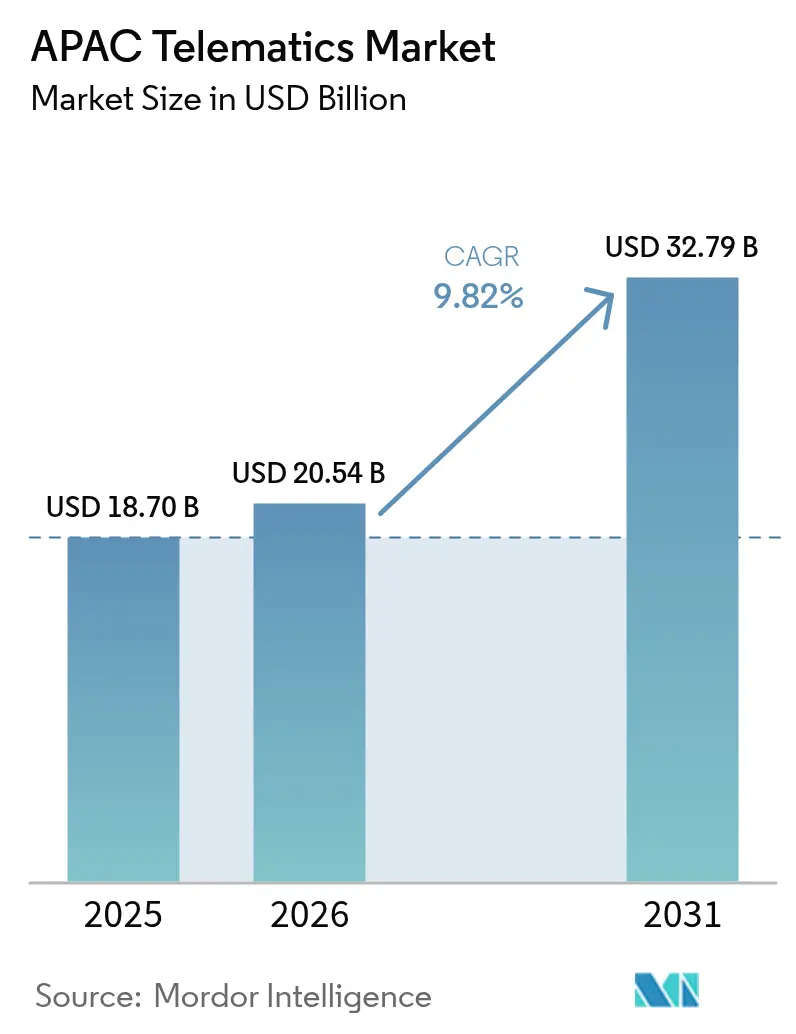
The APAC Telematics Market size was valued at USD 18.70 billion in 2025 and estimated to grow from USD 20.54 billion in 2026 to reach USD 32.79 billion by 2031, at a CAGR of 9.82% during the forecast period (2026-2031). The robust trajectory stems from national digital-mobility programs that push connected-vehicle penetration across commercial fleets, regulatory mandates such as India’s AIS-140, and sustained e-commerce parcel growth that requires real-time fleet visibility. China’s leadership in factory-installed connectivity modules, an accelerating shift toward usage-based insurance, and ongoing smart-city pilots further reinforce demand for sophisticated data platforms. OEMs and fintechs are bundling telematics with leasing products to ease upfront hardware costs, while semiconductor supply-chain resilience initiatives help vendors buffer against the periodic shortages that constrained deliveries in 2024.
Key Report Takeaways
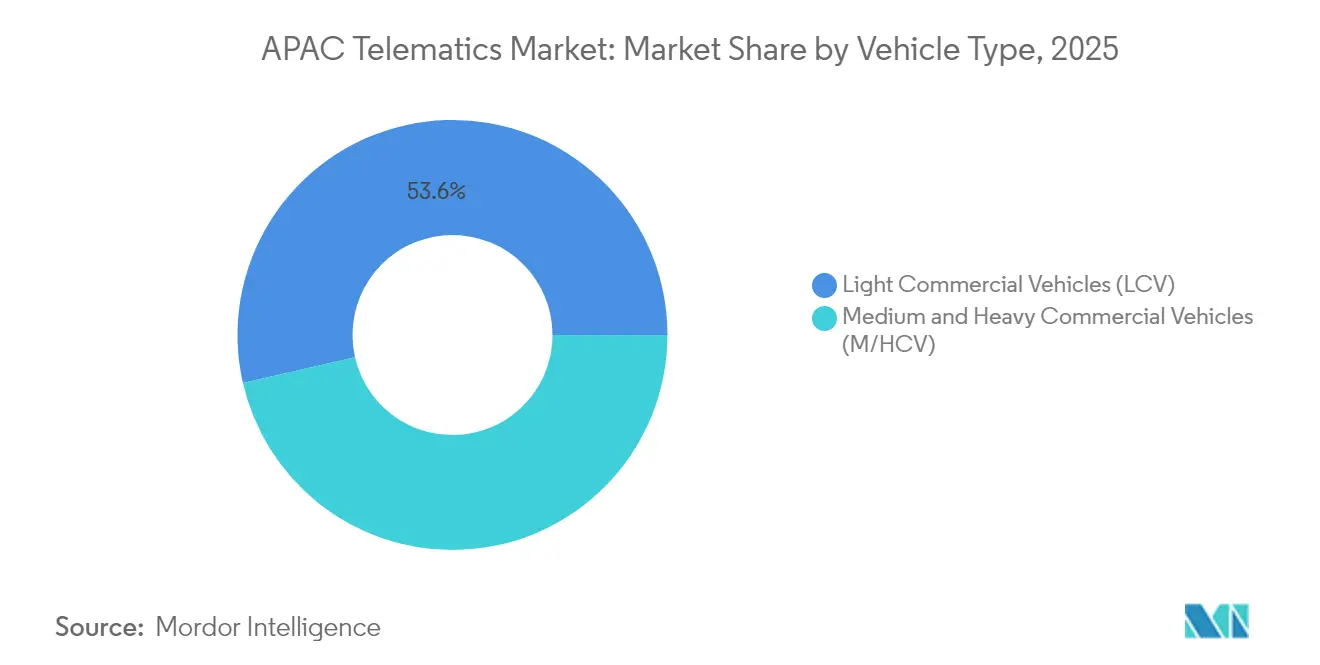
- By vehicle type, Light Commercial Vehicles led with 53.58% of APAC telematics market share in 2025, while Medium and Heavy Commercial Vehicles are projected to compound at 10.41% CAGR through 2031.
- By channel, OEM-embedded solutions held 41.89% revenue share in 2025; After-market OBD-II dongles are forecast to accelerate at a 10.02% CAGR to 2031.
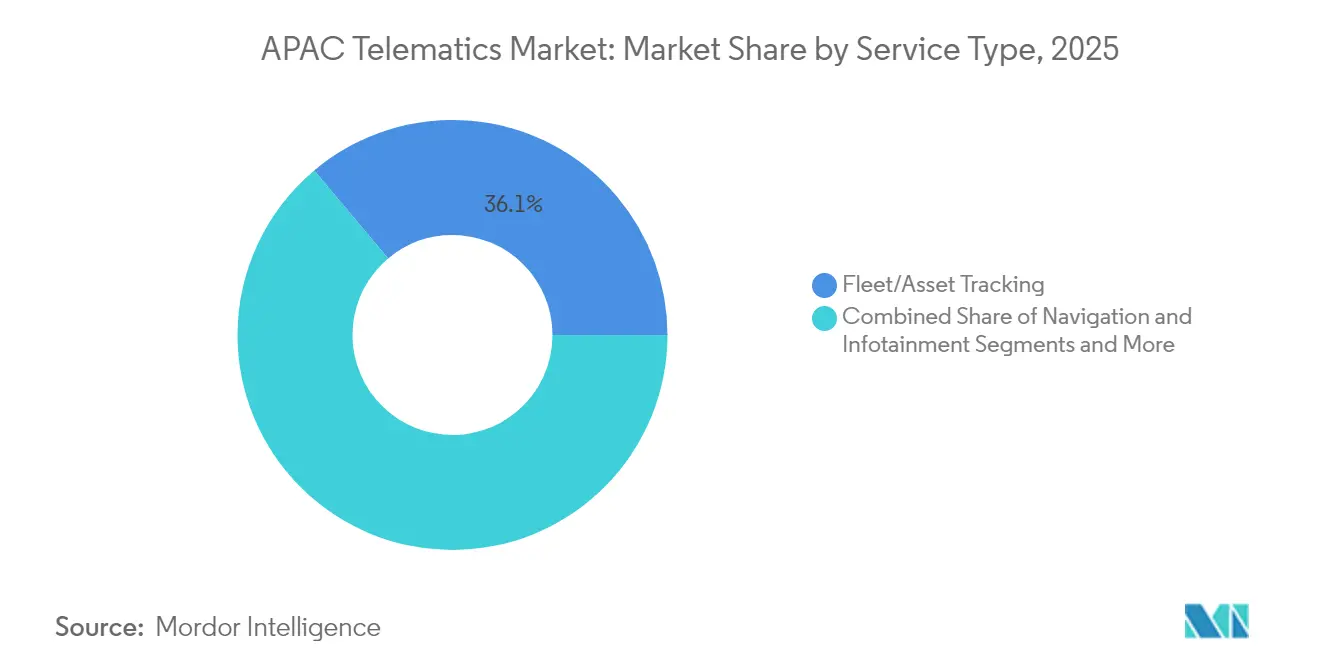
- By service type, Fleet and Asset Tracking accounted for a 36.12% slice of the APAC telematics market size in 2025, and Insurance Telematics is set to surge at 11.02% CAGR during the same period.
- By communication technology, GNSS/GPS retained 48.11% share of the APAC telematics market size in 2025, but DSRC/C-V2X is on track for a 12.08% CAGR through 2031.
- By geography, China captured 37.62% of the APAC telematics market share in 2025 and is advancing at a 9.96% CAGR through 2031.
Note: Market size and forecast figures in this report are generated using Mordor Intelligence’s proprietary estimation framework, updated with the latest available data and insights as of 2026.
APAC Telematics Market Trends and Insights
Drivers Impact Analysis*
| Driver | (~) % Impact on CAGR Forecast | Geographic Relevance | Impact Timeline |
|---|---|---|---|
| Proliferation of OEM-installed connectivity modules | +2.1% | China, Japan, South Korea, ASEAN | Medium term (2-4 years) |
| Regulatory mandates on AIS-140 and eCall | +1.8% | India, Japan, South Korea, ASEAN | Short term (≤ 2 years) |
| Rising demand for usage-based insurance (UBI) | +1.4% | India, China, Australia | Medium term (2-4 years) |
| Growth of e-commerce last-mile fleets | +2.3% | China, India, Southeast Asia | Short term (≤ 2 years) |
| Smart-city ITS pilots driving data partnerships | +1.2% | Singapore, Seoul, Beijing, Tokyo | Long term (≥ 4 years) |
| OEM-fintech leasing models bundling telematics | +0.8% | China, India, Thailand | Medium term (2-4 years) |
| Source: Mordor Intelligence | |||
Proliferation of OEM-installed connectivity modules
Factory-fitted telematics units are increasingly standard across new commercial vehicles as attach rates rise toward 94% by 2028. Chinese manufacturers collaborate with domestic mobile-network operators to integrate embedded SIMs, while Japanese OEMs layer Android Automotive OS to deliver cloud-native services. The shift simplifies regulatory compliance, enables over-the-air software updates, and supports predictive maintenance that cuts unplanned downtime. Aftermarket vendors face pricing pressure as fleets favor deeper vehicle-bus integration that only embedded hardware can provide.
Regulatory mandates on AIS-140 and eCall
India’s transport ministry requires GPS tracking and panic buttons under AIS-140 for all commercial vehicles, and from April 2026, will extend emergency braking and drowsiness warnings to larger passenger vehicles. Japan and South Korea have rolled out eCall, driving uniform emergency-response capabilities. This convergence allows platform vendors to scale compliance solutions region-wide, though varying technical formats still demand modular software architectures.
Rising demand for usage-based insurance (UBI)
Insurers are shifting from demographics to data-driven premium calculations. Telematics programs now incorporate harsh-braking scores, night-driving ratios, and AI-assisted crash reconstruction. Leading carriers in India and Australia report lower loss ratios and stronger customer retention when mileage-linked policies replace flat premiums. Privacy laws, however, differ sharply across APAC, prompting insurers to invest in consent-management modules and localized data storage [1].
Growth of e-commerce last-mile fleets
Parcel volumes continue to climb amid the proliferation of rapid-delivery promises. Dark-store and micro-fulfillment models amplify the need for dynamic routing and battery-health tracking as urban delivery fleets electrify. Vendors integrate driver productivity dashboards and geo-fencing alerts to curb idle time, while AI route optimizers cut fuel or energy consumption. For many operators, telematics has become core infrastructure rather than optional expenditure.
Restraints Impact Analysis*
| Restraint | (~) % Impact on CAGR Forecast | Geographic Relevance | Impact Timeline |
|---|---|---|---|
| Cyber-security and data-privacy concerns | -1.6% | Japan, South Korea, Australia | Short term (≤ 2 years) |
| High upfront hardware/communication cost | -1.2% | India, Southeast Asia | Medium term (2-4 years) |
| Fragmented interoperability standards | -0.9% | APAC cross-border fleets | Long term (≥ 4 years) |
| Semiconductor supply-chain volatility post-2025 | -1.4% | Global manufacturing hubs | Short term (≤ 2 years) |
| Source: Mordor Intelligence | |||
Cyber-security and data-privacy concerns
Fleet operators worry about remote hacking and unauthorized access to location or CAN bus data. Several APAC governments enforce strict rules on data localization and impose penalties for breaches, raising compliance budgets. Hardware vendors now integrate root-of-trust chips and collaborate with telecom carriers to deploy end-to-end encryption. Managed security operations center services are also emerging to monitor anomalies and coordinate rapid patching [2].
Semiconductor supply-chain volatility post-2025
Automotive-grade MCU and DRAM availability tightened after renewed AI demand absorbed advanced-node capacity. Memory price spikes lifted telematics-unit costs, forcing vendors to renegotiate supply agreements and increase safety stocks. Greater packaging reliance on Taiwanese and Korean foundries exposes fleets to geopolitical risk, prompting dual-sourcing strategies and cross-licensing of design files to secondary fabs [3].
*Our forecasts treat driver/restraint impacts as directional, not additive. The impact forecasts reflect baseline growth, mix effects, and variable interactions.
Segment Analysis
By Vehicle Type: Commercial Fleets Drive Adoption
Medium and Heavy Commercial Vehicles account for the fastest expansion at 10.41% CAGR to 2031, whereas Light Commercial Vehicles held 53.58% of the APAC telematics market share in 2025. The higher average revenue per installed unit on long-haul trucks comes from advanced fuel analytics, brake-wear prediction, and compliance modules that reduce costly roadside inspections. Conversely, LCV operators prioritize low-cost GPS tracking to safeguard parcels and streamline urban drops. Regulatory momentum, such as India’s incoming ADAS rules for buses and trucks, further lifts M/HCV penetration. Platform consolidation, evident in Platform Science’s 2025 acquisition of Trimble’s fleet unit, signals that integrated offerings spanning ELD compliance and battery-health dashboards will dominate future growth.
M/HCV electrification projects necessitate concurrent telematics deployment to extend driving range and optimize charging windows. LCV fleet managers, pressed by e-commerce service-level agreements, adopt camera-based driver-behavior analytics to cut accident rates. Although the overall installed-base majority remains within LCVs, revenue share tilts toward M/HCVs because of feature-rich solutions bundled with subscription analytics platforms. The segment interplay, therefore, shapes differentiated go-to-market strategies for hardware OEMs and platform providers.

By Channel: Aftermarket Innovation Challenges OEM Dominance
OEM-embedded units retained 41.89% revenue share in 2025, yet Aftermarket OBD-II dongles are on pace for 10.02% CAGR. Cost-conscious fleets value the ease of self-installation and the ability to switch vendors without forfeiting warranties. In contrast, embedded modules offer deeper vehicle-bus integration that supports over-the-air firmware downloads and factory-grade diagnostics. OEMs increasingly open APIs to third-party software platforms, narrowing the historical gap in flexibility and encouraging hybrid deployment models.
Certified aftermarket devices remain pivotal for retrofitting older assets and meeting AIS-140 in India. Hard-wired black boxes serve fleets demanding tamper-proof records or satellite fallback. Cloud-native telematics vendors bridge the channel divide by delivering a unified dashboard that ingests both embedded and aftermarket data streams. As 5G modems become standard from 2026 onward, vendors expect hardware refresh cycles to accelerate, allowing capex-light subscription bundles to spur adoption among small operators.
By Service Type: Insurance Innovation Drives Growth
Fleet and Asset Tracking contributed 36.12% of the APAC telematics market size in 2025, while Insurance Telematics tops growth with an 11.02% CAGR. Insurer appetite for granular risk scoring enlarges the serviceable addressable market: pay-how-you-drive policies in Australia now factor aggressive acceleration counts and phone-distraction metrics. Vendors add AI crash reconstruction, enabling rapid claims automation that cuts settlement times. Meanwhile, Navigation and Infotainment services benefit from closed-loop feedback between cloud mapping engines and OEM in-dash displays, enhancing driver experience without increasing hardware SKU complexity.
Remote Diagnostics adoption rises as vehicle electronics proliferate; predictive maintenance algorithms tap sensor fusion data to forecast component life. Safety and Security services evolve into compliance necessities, with eCall mandates spreading beyond passenger cars to minibuses in Japan and Korea. The converging suite of services transforms telematics from a location-tracking utility into a holistic mobility intelligence platform that commands recurring subscription revenue.
By Communication Technology: Next-Generation Connectivity Emerges
GNSS/GPS still underpins 48.11% of installed units, yet DSRC/C-V2X is forecast for a brisk 12.08% CAGR, reflecting regional plans for cooperative traffic ecosystems. China scales C-V2X roadside units along major logistics corridors, while Japan integrates ITS-G5 to support automated lane-merge pilots. 5G mid-band coverage accelerates real-time video offload and edge AI analytics for driver-facing ADAS. Satellite-based links serve remote mining and trans-Pacific shipping fleets where terrestrial networks remain patchy, ensuring persistent coverage across APAC’s vast geography.
Component price declines and rising throughput speeds make multi-mode modems economical, encouraging device makers to bundle cellular, GNSS, and C-V2X in a single board. Fleet operators thereby future-proof hardware investments, and governments gain a standards-ready installed base to meet long-term V2X safety objectives.
Geography Analysis
China commanded 37.62% of the APAC telematics market share in 2025 and is on a 9.96% CAGR path through 2031. Government subsidies for intelligent-transport components and mandatory installation on new commercial vehicles shorten payback for fleets. Domestic semiconductor fabrication capacity lowers bill-of-materials costs, ensuring hardware affordability at scale. Data-localization statutes, however, oblige foreign cloud providers to co-locate servers, increasing market-entry complexity but safeguarding local data sovereignty.
Japan and South Korea feature high-penetration environments characterized by premium service mixes such as eCall integration, C-V2X field trials, and AI-enabled predictive maintenance. Mature telecom infrastructure and stringent safety regulations yield advanced service adoption, though incremental growth rates remain modest compared with emerging peers. Nonetheless, vendors leverage these markets as test beds for sophisticated analytics before rolling offers into other APAC countries. India shows outsized growth potential as AIS-140 migrates from mandate to enforcement, ensuring nearly every commercial vehicle above 3.5 tons installs GPS, panic buttons, and driver-behaviour analytics. Fintech leasing bundles lower capex hurdles for small fleet owners, while e-commerce expansion creates density that justifies routing optimization investments. Southeast Asia comprises heterogeneous opportunities: Singapore pilots smart-mobility sandboxes; Indonesia’s archipelago spurs satellite-backed solutions; Thailand and Vietnam focus on cross-border lane compliance for regional trade. Australia and New Zealand adopt telematics primarily for mining, agriculture, and extended line-haul operations, anchoring demand in ruggedized hardware with satellite redundancy.
Regulatory Landscape
Regulation in APAC telematics remains country-specific, but it is extending from basic vehicle location tracking toward safety, cybersecurity, and V2X readiness. India continues to anchor commercial-vehicle compliance around AIS-140 for VLTD and panic buttons, supported by type-approval and device lists maintained by ARAI (updated list as of 29 January 2026), with enforcement tied to fitness and vehicle registration workflows. Separately, the Telecom Regulatory Authority of India (TRAI) issued a V2X regulatory framework consultation in April 2026, pointing to policy direction for secure V2I/V2X service authorization and technical requirements beyond GPS-only tracking.
Other major APAC markets combine national standards with vehicle production and safety compliance systems, which increases interoperability fragmentation for platform and device vendors. China aligns connected-vehicle data and telematics requirements with GB standards alongside production access oversight by MIIT and SAMR, while Japan and South Korea incorporate UN Regulation R155/R156-aligned cybersecurity and software update obligations through their transport and communications frameworks. Australia operates a mature compliance architecture via Transport Certification Australia (TCA) and the National Telematics Framework, referencing ISO 15638 to support high-assurance telematics applications, and Malaysia announced in June 2026 a phased commercial-vehicle telematics implementation from 2026 to 2028, defining a pathway for vendor participation in pilots and government-linked databases.
Value Chain Analysis
The APAC telematics value chain covers device and module suppliers (GNSS, cellular/5G, multi-mode modems, sensors, and edge compute), system integrators and OEMs embedding telematics control units, connectivity providers (mobile network operators and IoT connectivity platforms), and software layers that deliver fleet dashboards, compliance reporting, and insurance scoring. Distribution splits across factory-installed OEM channels and aftermarket installers for hard-wired devices and OBD-II dongles, with certification and type-approval (including AIS-140 in India) shaping procurement for regulated fleets. Data hosting and analytics complete the chain, and localization requirements in markets such as China push vendors toward in-country cloud instances and partner ecosystems.
Recent activity suggests tighter convergence between telecom operators, hardware providers, and logistics users around higher-assurance, lower-latency tracking and verification. In April 2026, U Mobile and Qualcomm completed a 5G IoT cargo tracking proof of concept with City-Link Express, using positioning and IoT connectivity to speed shipment location verification, showing how the connectivity layer is moving upstream into solution design. Asset-level intelligence is also expanding beyond vehicles into containers and multimodal logistics, as Nexxiot and Namsung Shipping completed a smart dry container pilot across multiple intra-Asia corridors. Associations and security bodies are increasingly part of go-to-market motions, including Geotab joining TAPA APAC in April 2026 to support cargo security and resilience requirements that drive adoption of telematics data services.
Competitive Landscape
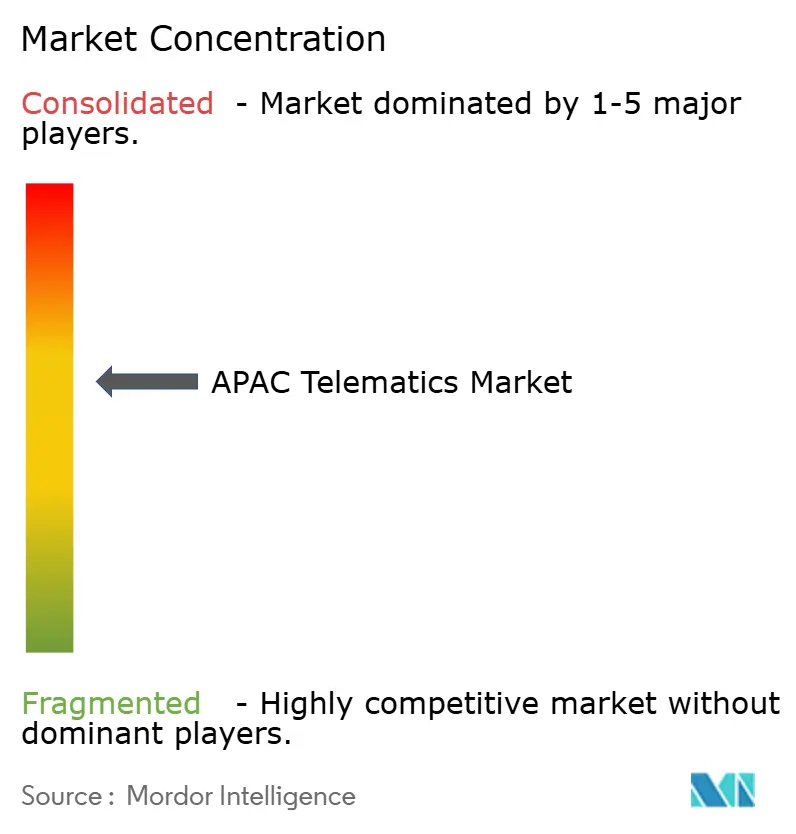
The APAC telematics industry displays moderate concentration. Global suppliers such as Bosch, Continental, and Harman leverage OEM design wins to embed telematics control units at the factory, providing integrated dashboards that sync with infotainment stacks. Regional specialists, MiTAC Digital in Taiwan or SinoTrack in China, compete on price and localized support. Software-centric entrants, including Tech Mahindra, deploy cloud-agnostic platforms that aggregate diverse hardware feeds into unified analytics suites, fostering vendor-agnostic ecosystems.
Strategic moves illustrate a tilt toward platform scale: Platform Science’s 2025 acquisition of Trimble’s transportation unit expanded its software reach into APAC, while Ctrack’s 2024 purchase of Inseego’s telematics arm broadened device portfolios for ASEAN markets. Partnerships flourish between module makers and insurers to co-create UBI products, and between fintechs and OEMs for subscription-based leasing. Vendors race to integrate edge AI and 5G to differentiate on low-latency decision support that can boost driver safety scores or powertrain efficiency. Moderate barriers to entry persist in certification, data-sovereignty compliance, and capital requisites for large-scale hardware rollouts.
APAC Telematics Industry Leaders
-
LG Electronics Inc.
-
MiX Telematics India Private Limited (Powerfleet)
-
Tata Consultancy Services Limited (TCS)
-
Trimble Inc.
-
Tech Mahindra Limited
- *Disclaimer: Major Players sorted in no particular order
Market Opportunities and Future Outlook
Regulatory and standards work across APAC is creating whitespace for compliance-ready platforms that can be configured by country, rather than rebuilt from scratch for each market. India’s AIS-140 enforcement mechanisms and ARAI-listed device ecosystem keep demand focused on certified VLTD, while TRAI’s April 2026 V2X consultation opens an adjacent opportunity for vendors that can combine telematics, security, and V2I service enablement into modular stacks that fleets and OEMs can deploy without changing core hardware. Malaysia’s Ministry of Transport launched a phased telematics implementation for commercial vehicles starting in 2026, with an initial voluntary or advocacy stage before later central database integration, creating near-term openings for pilots, onboarding tools, and government-grade data exchange integrations.
Connectivity and provisioning shifts are also expanding the addressable market for cross-border fleet and asset tracking, especially for operators managing devices across multiple mobile networks. In July 2026, Thales, Singtel, Optus, AIS, and Globe Telecom enabled a multi-operator enterprise IoT eSIM network based on GSMA SGP.32, strengthening the case for telematics platforms that can orchestrate connectivity profiles and device management across APAC. Industry consolidation continues to reshape routes to market in Southeast Asia as well, including Directed Technologies acquiring Thailand-based GPS2GO in June 2026, which can support distribution reach and local service coverage for fleet-management deployments.
Recent Industry Developments
- July 2026: Thales, Singtel, Optus, AIS, and Globe Telecom enabled a multi-operator enterprise IoT eSIM network in Asia Pacific based on GSMA SGP.32. This expanded remote provisioning and lifecycle management options for connected devices deployed across multiple national carrier footprints. For telematics vendors, it supports more scalable cross-border deployments and reduces operational friction from managing SIM inventories and roaming constraints.
- February 2026: LG Electronics unveiled a next-generation smart telematics solution at MWC Barcelona 2026, featuring an integrated telematics control unit and antenna module. The integration approach targets smaller form factors and streamlined vehicle installation while supporting higher-performance connectivity. This strengthens OEM-embedded telematics propositions as attach rates rise across new vehicle programs in APAC.
- April 2024: Powerfleet and MiX Telematics closed their business combination, creating a larger unified AIoT SaaS provider spanning fleet and asset visibility. The combined scale supports broader product bundling across tracking, video intelligence, and analytics services. Consolidation of this kind can also influence partner ecosystems and pricing as fleets seek fewer platforms to manage heterogeneous assets.
Research Methodology Framework and Report Scope
Market Definition and Coverage
For this report, the market means revenue earned from telematics hardware, software, and connected services used to track, monitor, diagnose, and manage vehicles and fleets across Asia Pacific.
Scope exclusions: We exclude unrelated in-vehicle infotainment that is not linked to telematics data capture and remote connectivity.
Segmentation Overview
- By Vehicle Type
- Light Commercial Vehicles (LCV)
- Medium and Heavy Commercial Vehicles (M/HCV)
- By Channel
- OEM-embedded
- Aftermarket Hard-wired
- Aftermarket OBD-II Dongle
- By Service Type
- Fleet/Asset Tracking
- Navigation and Infotainment
- Remote Diagnostics
- Safety and Security (eCall, SVR)
- Insurance Telematics (UBI/PAYD)
- By Communication Technology
- GNSS/GPS
- Cellular (2G/3G/4G/5G)
- Satellite-based
- DSRC/C-V2X
- By Country
- China
- Japan
- South Korea
- India
- Australia and New Zealand
- South-East Asia (Indonesia, Thailand, Malaysia, Singapore, Vietnam, Philippines)
Data Sources, Market Sizing, and Validation
Desk Research
Desk work started by mapping what is counted as telematics revenue and where it shows up in public records across Asia Pacific. We referenced official statistics and regulatory documents that influence adoption and device fitment, alongside cross-country vehicle activity signals. Helpful public sources included national transport ministries and regulators, such as AIS-140 related notifications in India, ITU connectivity statistics, UN Comtrade trade data for relevant electronics, and World Bank macro indicators.
To keep the model practical, we also reviewed company annual reports, earnings decks, and product brochures to understand typical pricing structures and contract lengths for fleet and OEM programs. Patent databases were used selectively to sense technology direction (GNSS, cellular, V2X), and an import/export shipment-level database was used where it helped validate device flow trends at a high level. The desk sources listed are illustrative only, and many other sources were also used for data collection, validation, and clarification.
Primary Interviews and Surveys
Primary work was used to test the desk assumptions on adoption, pricing, and what buyers actually pay for in each country, since published numbers can be inconsistent. We spoke with a mix of OEM-linked stakeholders, fleet operators, system integrators, insurers, and channel partners across key APAC markets, and then the findings were fed back into the model to adjust penetration and ASP paths.
Distribution of primary research fieldwork respondents
| Company type | Respondent position |
|---|---|
| Top tier: 36% | CXOs: 13% |
| Mid tier: 43% | Functional/Unit leaders: 39% |
| Smaller Players: 21% | Managers: 48% |
Market-Sizing & Forecasting
Sizing began with a top-down build that reconstructs the addressable vehicle and fleet demand pool by country, then applies connected-vehicle and fleet-telematics penetration to reach an installed base that can generate revenue. For each major use case, revenues were derived using simple unit economics (active subscriptions, attach rates, and average annual revenue per vehicle), and then rolled up to the regional total.
To keep totals grounded, we also ran selective bottom-up checks using sampled price points and volumes from channel checks, plus supplier and integrator revenue disclosures where they were clear enough to be comparable. Key inputs used in the model included commercial fleet counts and utilization patterns, OEM embedded fitment trends, aftermarket device mix (hard-wired versus OBD-II dongles), cellular connectivity coverage, and service mix shifts between tracking, safety, and insurance programs. Forecasts were produced using scenario analysis, where penetration and ASP trajectories were stress-tested under faster regulation-led adoption versus slower replacement cycles, and then aligned to what interviewees described as realistic rollout timing.
Data Validation & Update Cycle
Model outputs were cross-checked against independent signals such as connected-vehicle shipments, country-level vehicle parc trends, and published telecom and mobility indicators, and then any large variances were investigated before finalizing. When an outlier appeared, for example a sudden jump in implied revenue per vehicle, we rechecked conversion rates, time alignment, and whether one-time hardware was being mixed with recurring services.
Results go through multiple analyst review steps, and clarification calls are triggered when assumptions do not match what market participants report in practice. The report is refreshed annually, with interim updates when material events occur, and a fresh pass is completed before delivery so clients receive the most current view.
Mordor Intelligence's Asia Pacific Telematics Market Estimate Compared With Other Published Estimates
Published market sizes for telematics in Asia Pacific can differ even when the topic sounds the same, since the counted revenue streams and country coverage often change from one study to another. The benchmark table shows a noticeable spread, which is usually explained by whether the estimate mixes adjacent connected-car software, bundles broader mobility services, or uses aggressive penetration curves.
The table points to a scope split around what gets counted as telematics revenue, and in Mordor Intelligence's model only the defined telematics hardware, platforms, and connected services tied to vehicle monitoring and data transmission are included, instead of wider connected infotainment ecosystems. Differences also come from how OEM embedded versus aftermarket device mix is treated, how subscription churn is assumed, and whether currency conversion is done using an average-year rate or a point-in-time rate, which can move APAC totals.
Benchmark comparison
| Source | Market Size | Gaps in Research Methodology |
|---|---|---|
| Mordor Intelligence | USD 18.70 B (2025) | |
| Trade Journal A | USD 22.56 B (2025) | This figure appears to lean toward a broader vehicle-telematics definition, which can fold in connected-car value pools beyond core telematics services, and it also uses a longer forecast window that can push higher base assumptions. |
| Industry Blog B | USD 106.40 B (2025) | The estimate likely combines a wider automotive connectivity stack, including connected vehicle technologies and bundled digital services, which inflates the total versus a telematics-only revenue boundary, and it may assume faster monetization per vehicle. |
Looking across the three values, the main takeaway is that the size changes most when adjacent connected-vehicle categories get included and when aggressive monetization per vehicle is assumed. Our approach stays traceable because the total is built from country demand pools, adoption rates, and revenue per active vehicle, and then validated through interviews and simple cross-checks that can be repeated.
Key Questions Answered in the Report
How large is the APAC telematics market in 2026 and what growth rate is expected?
The market stands at USD 20.54 billion in 2026 and is projected to grow at a 9.82% CAGR to reach USD 32.79 billion by 2031.
Which vehicle category shows the fastest telematics adoption across APAC?
Medium and Heavy Commercial Vehicles exhibit the fastest rise, expanding at 10.41% CAGR through 2031 on account of higher ROI from fuel analytics and compliance modules.
What service type is growing quickest within the region?
Insurance Telematics leads growth with an 11.02% CAGR as insurers deploy usage-based policies and AI-driven claims automation.
Why is China the largest market for telematics in APAC?
China combines policy incentives, local semiconductor supply, and booming e-commerce fleets, capturing 37.62% share in 2025 while advancing at a 9.96% CAGR.
How are regulatory mandates influencing adoption in India?
India’s AIS-140 and upcoming ADAS requirements make telematics compulsory on most commercial vehicles, driving significant fleet retrofits and new-vehicle installations.
What connectivity technology is rising fastest?
DSRC/C-V2X registers the highest growth at 12.08% CAGR as governments deploy roadside units to enable cooperative safety and smart-city applications.